 by Tom Gurney
Tom Gurney BSc (Hons) is an art history expert with over 20 years experience
Published on August 21, 2026 / Updated on October 23, 2026
Email: tomgurney1@gmail.com / Phone: +44 7429 011000
About Water Serpents I
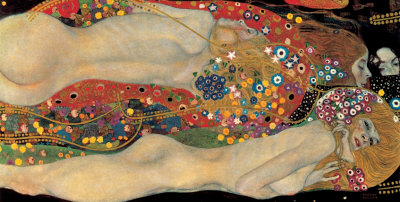
Two women drift through a vertical underwater world. Their nude bodies bend into one another, their eyes close and their hair joins the current around them. Gold, silver and cooler metal tones spread across parchment. Sea plants, patterned skins and strange creatures fill almost every interval. At the lower right, a fish turns one rigid eye towards the viewer.
The Belvedere calls this small work Freundinnen (Wasserschlangen I)—Girlfriends (Water Serpents I)—and also records the alternate Freundinnen I. The Gustav Klimt Database uses Water Snakes I (Parchment). “Serpents” and “snakes” translate the same German word, while “Girlfriends” brings the embracing pair forward. All these names refer to one object.[1][2]
Its material identity is unusually rich. Klimt worked in watercolor, gouache and pencil with gold, silver, platinum and brass on parchment. The result measures only 50 by 20 centimetres. This is neither a large oil painting nor a mosaic-like wall decoration; its precious effects operate within the scale of an intimate sheet.[1]
Klimt began the object in 1904 and made minor additions in 1907. Two monochrome photographs preserve intermediate states. The revision history, unusual support and female embrace make Water Serpents I a concentrated test of how body, desire and marine ornament can become almost inseparable.
At a Glance
- ArtistGustav Klimt
- Public titleWater Serpents I
- Belvedere titleFreundinnen (Wasserschlangen I), translated as Girlfriends (Water Serpents I)[1]
- Alternate institutional titlesFreundinnen I; Water Snakes I (Parchment)[1][2]
- Date1904, with minor additions in 1907[1]
- MediumWatercolor, gouache, pencil, gold, silver, platinum and brass on parchment[1]
- Dimensions50 × 20 centimetres[1]
- SignatureGUSTAV / KLIMT at lower right[1]
- CollectionBelvedere, Vienna
- Inventory number5077[1]
- Principal figuresTwo nude female water beings in an intimate embrace
- Related drawingA 1903 blue-crayon study of two embracing female nudes at the Leopold Museum[3]
- First public presentationGustav Klimt exhibition, Galerie Miethke, Vienna, July 1907[2]
- Current displayThe Belvedere record lists the work as not currently displayed as of 9 August 2026[1]
One Object, Several English Names
The title needs untangling before the image can be discussed clearly. Wasserschlangen means water snakes or water serpents. Both English versions circulate. The Belvedere places the word inside a larger title, Freundinnen (Wasserschlangen I), and gives Freundinnen I as an alternative.[1]
“Girlfriends” is a literal translation of Freundinnen, although English can make the word sound more casual or less erotic than the image. “Water Serpents” preserves the fantastic species and the surrounding marine world. The combined holder title keeps both the relation and the masquerade visible.
The number distinguishes the parchment from Water Serpents II, a separate, much larger horizontal painting. It does not identify an early state of the second work. Nor does “Parchment”, used by the Klimt Database, turn the object into a preparatory drawing.[2]
The clearest public practice is therefore to use Water Serpents I while explaining the Belvedere's Girlfriends title at the outset. The different names change emphasis; they do not create different Klimts.
A Miniature-Like Vertical World
At 50 centimetres high and 20 centimetres wide, the work is close to the proportions of an illuminated page. The bodies occupy much of that narrow field, but their outlines never settle into the clarity of isolated figure studies.[1]
Verticality replaces ordinary horizon. The pair seems to float upward, sink or hover; the image provides no fixed direction of movement. Long hair, plant forms and decorative bands extend the bodies into the surrounding current.
The small scale changes the viewer's relation to nudity. This is not a life-size public confrontation. To inspect faces, hands, metallic marks and the fish, one must look closely. Intimacy is produced by the subject and by the physical demand of the object.
Yet small does not mean slight. Gold, silver, platinum and brass give the sheet an optical intensity that can exceed its dimensions. The surface can brighten or cool as light changes, so the world seems active without opening into depth.
The extreme proportions matter as much as the overall size. The height is two and a half times the width, leaving little space for the women to separate. A horizontal composition could have placed them beside one another; this vertical strip folds their heads, shoulders and flowing hair into a single rising column. The narrowness is therefore not merely an elegant border. It makes closeness structural.
The form also encourages two speeds of viewing. From a little distance, pale bodies and metallic ornament cohere as one elongated sign. Closer inspection breaks that unity into faces, hands, strands, scales and individual marine details. Klimt uses a physically modest object to move between emblem and intimate scrutiny.
His signature occupies the lower-right area as GUSTAV / KLIMT, arranged over two lines.[1] It belongs to the composed surface rather than serving as evidence for one moment in the three-year revision history. Near the outward-looking fish, it also helps hold the densely active lower zone against the long upward pull of the figures.
The Embracing Pair
Two nude female beings occupy the centre. One curls around or alongside the other; their heads meet, eyes close and bodies touch. Klimt allows hair and ornament to complicate where one silhouette ends and the second begins.[1][2]
The embrace is not a incidental decorative crossing. It organises the painting. Faces turn inward, shutting out an ordinary social exchange, while the bodies create a shared vertical unit among the sea plants.
Closed eyes can suggest pleasure, sleep, dream or withdrawal. None proves the figures' exact mental state. What is visible is their mutual orientation. They attend to one another rather than to the viewer.
That concentration gives the scene its erotic charge. Klimt does not need a mythological male intruder or a narrative of pursuit. Female contact itself becomes the pictorial event.
Representing Female Same-Sex Intimacy
The Gustav Klimt Database describes the associated study group as concentrating primarily on lesbian couples, and it identifies the final pair's intimate embrace as central to the work.[2] The language is valuable because it refuses to neutralise the physical relation as merely decorative friendship.
It must also be used with precision. The painting represents erotic intimacy between women; it does not supply the models' names, biographies or own descriptions of their sexuality. A posed figure and a mythic water being are not documentary records of personal identity.
Around 1900, nymphs, mermaids and other imagined beings could provide cultural distance for subjects that might have been harder to present as modern everyday life. Here the underwater fiction removes domestic setting, clothing and social role. Desire appears to exist outside the rules of the city above.
That refuge is not complete privacy. The work was made for viewing, and the fish looks outward. Klimt creates a sealed relation while making it available to an audience—a tension that should remain part of any account of its eroticism.
Neither the fantastic setting nor the historical language around the studies cancels the evidence of the image. The pair's bodily contact is not incidental to a general scene of nymphs: it is the composition's centre. At the same time, modern labels cannot recover how every viewer in 1906 or 1907 understood that contact. “Lesbian couples” is an institutional description of represented intimacy and the study corpus, not a licence to invent a private social history.
That distinction allows a fuller reading. One need not reduce the figures to anonymous ornament in order to avoid overclaiming biography. The painting can be recognised as an unusually sustained image of desire between women while the sitters, circumstances of posing and personal identities remain unknown.
Water Beings Without a Fixed Myth
The Belvedere says Klimt referred to the figures as Wasserschlangen or Nixen. The second term can be translated as nixies, water nymphs or mermaid-like beings. They belong to a fantastic underwater realm rather than to one securely named classical story.[1]
This indeterminacy allows bodies and environment to merge. A named goddess might require attributes and an episode. Klimt's water beings need only float, embrace and share the current with fish and plants.
Their lack of fixed mythology should not be mistaken for lack of subject. The title, aquatic forms and female pair establish enough. The scene explores embodied intimacy under conditions where gravity and ordinary human identity have loosened.
Nor must “serpent” mean that the women are literally snakes. Elongation and winding movement relate them to serpentine form, while marine patterns extend the association. Human faces, torsos and arms remain visible within the transformation.
A Sea Floor Made from Ornament
Golden seaweed rises around the pair, and stylised sea animals occupy the narrow field. Plant-like bands, scale or skin patterns and isolated bright forms replace a measured underwater landscape.[1][2]
The sea floor is suggested rather than mapped. There is no reliable horizon, consistent perspective or single source of illumination. Decorative signs communicate water by rhythm: curves bend, hair streams and bodies appear suspended.
This surface organisation lets the figures remain both flesh and pattern. Pale bodies stand apart from metallic surroundings, but their contours repeatedly join the movement around them. The embrace is held together by ornament as much as by anatomy.
Symbolist atmosphere matters here. The Belvedere describes the marine world as a representation of a mystical realm.[1] “Mystical” should not become a licence to decode every mark. The work's estrangement is visible even when no universal meaning is assigned to a scale, spiral or leaf.
The Fish That Looks Out
A shimmering fish appears in the lower-right zone, its fixed eye directed towards us. It is smaller than the women but psychologically disruptive because it performs the outward look that they withhold.[1]
The fish helps secure the underwater setting. It also interrupts the dream of complete enclosure. The pair may be absorbed in one another, but the painted world contains a witness.
Calling the creature voyeur, guardian or threat would go beyond the evidence. Its expression is a result of fish anatomy and Klimt's stylisation, not a documented human emotion. Still, placement makes its gaze difficult to ignore once found.
The eye creates a triangular viewing relation. The women look inward; the fish looks outward; the spectator looks at all three. Klimt turns a minor marine creature into the point where private intimacy and public inspection meet.
Parchment as Support
Parchment is animal skin prepared as a writing or painting surface. Klimt's use of it immediately distinguishes Water Serpents I from his oil canvases. Its fine surface and page-like scale suit the detailed mixture of drawing, translucent colour and metal.[1][2]
A 1906 article in Die Zeit singled out the material, describing the female pair as delicate and the parchment as giving Klimt's intentions a gauzy effect. The same account noticed snake skins, stylised sea animals and gold-and-silver ornament.[2]
This historical description records an early encounter with the work. It is not a modern condition report. “Gauzy” describes visual impression, not the literal transparency, strength or present conservation state of the support.
Parchment also adds a tactile paradox. The depicted world seems liquid, while its support comes from skin. Water, body and material are joined through association even before the painted figures are interpreted.
Watercolor, Gouache and Pencil
The non-metal components perform different jobs. Pencil can establish contours and fine internal decisions. Watercolor creates transparent or lightly veiled colour. Gouache supplies more opaque passages and stronger surface density.[1]
Klimt did not conceal drawing beneath a uniform coat of oil. Linear and painted effects remain close together. This suits a composition in which hair, plant and body must stay distinct at some moments and flow into one another at others.
The medium list also guards against calling the work simply a drawing because it is on parchment. It is a mixed-media painting in the Belvedere's collection, with substantial colour and metal as well as pencil.
Conversely, “painting” should not make us imagine the depth and heavy surface of a large canvas. The object's character depends on the interaction of page, line, wash, opaque body colour and applied metallic elements.
Gold, Silver, Platinum and Brass
The Belvedere's current record names four metallic materials: gold, silver, platinum and brass.[1] Their coexistence makes the surface more varied than a generic “golden painting”.
Gold can create warm light and hieratic richness. Silver and platinum introduce cooler reflection, while brass adds another yellow-toned metal with a different material character. Exact visual allocation should follow direct technical observation rather than assumption from reproduction.
The Klimt Database also discusses silver, gold bronze, body colour and applications in gold when describing the historical making.[2] The holder's present medium list remains the public baseline; the database language helps explain why earlier accounts may use different technical terms.
No mosaic glass, mother-of-pearl, enamel or ceramic is recorded for this parchment. Its jewel-like effect comes from materials actually attached to this object, not from importing the inventory of Klimt's architectural commissions.
The four metals should not be treated as synonyms. Their record indicates a deliberately differentiated surface in which warmth, coolness and reflectivity could shift against matte pencil, watercolor and gouache. That opposition is central to the underwater illusion: the scene does not depend on painted recession alone, because real changes in surface response enliven the surrounding field.
Reproduction inevitably flattens some of that behaviour. A photographed yellow passage cannot by itself tell a viewer whether gold, brass or painted colour produces it, just as a grey archival photograph cannot identify a metal by tone. The institutional medium record therefore carries information that even a sharp image cannot supply.
An Early Drawing from 1903
The Leopold Museum holds Two Female Nudes Embracing. Study for Water Snakes I, dated 1903. Klimt drew it in blue crayon on brown paper at 43.5 by 32.5 centimetres. The sheet carries inventory number 1342.[3]
One woman kneels or bends into the other, and the pair's closed eyes, touching faces and intertwined bodies already approach the emotional centre of the parchment. Yet the drawing is broader in proportion and does not contain the final marine environment.
Its blue line is unusual within the study group. The crayon gives the bodies a cool fluid unity before Klimt has surrounded them with gold, plants and creatures.[3]
The sheet is close evidence of genesis, not a cartoon for mechanical transfer. Scale, support, format and surrounding field all change between drawing and final object.
Ver Sacrum and the Start of the Motif
The 1903 study was reproduced in issue 22 of the Secession's journal Ver Sacrum. That dated appearance helps establish that Klimt was exploring the embracing pair by 1903, before the Belvedere's 1904 painting baseline.[3]
The reproduction is a publication image, not the same physical sheet. It carried the motif into print while the original drawing retained blue crayon, brown paper, dimensions and later provenance of its own.
The Leopold Museum places the sheet among approximately twenty known preliminary studies for Water Serpents I.[3] “Approximately” matters. Surviving and catalogued drawings are a scholarly corpus, not a diary in which Klimt numbered every attempt.
The group indicates sustained investigation. It does not mean that twenty sheets are equally direct or that the painting was composed by assembling fixed body parts from them.
From 1904 to the 1907 Surface
The Belvedere dates the work 1904 and adds the precise qualification “minor additions 1907”. The Klimt Database likewise starts in 1904 and says Klimt continued modifying the work until 1907.[1][2]
These statements describe one object over time. They do not identify a lost 1904 parchment and a separate 1907 replacement. The current surface contains the endpoint of revision.
Two black-and-white photographs preserve intermediate states.[2] Their existence is especially useful because some changes have been covered or incorporated into the final design. Photographs can compare placement and tone even when earlier paint is no longer visible.
They cannot reliably recover the colour or reflectivity of gold, silver, platinum and brass. Nor do two images provide a complete chronology of every addition. The evidence shows continued work; it does not let us watch the whole process.
This makes the word “minor” important but limited. It is the Belvedere's catalogue description of the 1907 additions, not a claim that the work had become visually inert after 1904. Klimt could preserve the main pair while continuing to adjust the field that determines how those bodies meet water and ornament.
The photographs are most secure when used comparatively. They may show that a form was present, absent or differently placed at a documented moment. They are weaker witnesses for hue, metallic identity, transparency and the sequence of changes between exposures. The final parchment and the two intermediate views together establish a history of revision without converting that history into a frame-by-frame record.
A 1906 Description Before the Public Debut
The Die Zeit article “New Works by Gustav Klimt” appeared in 1906, before the documented July 1907 first public presentation. It praised the embracing golden-haired couple and the union of parchment delicacy with rich decorative ground.[2]
This sequence suggests that the work could be discussed within an informed studio or critical circle while Klimt still revised it. Publication is not the same as a public exhibition opening.
The account is valuable for the language available to an early viewer. It noticed bodies, material and ornament together rather than treating the image as either pure erotic scene or pure decorative experiment.
It also complicates the idea that reception began when the gallery doors opened in July 1907. A work could circulate through studio access, conversation and publication before its first documented public display. The 1906 text is therefore part of the object's public history, but not evidence for an earlier exhibition.
Its admiration should not become unanimous reception. One article tells us what one published voice found remarkable. It cannot establish that every contemporary saw the women, sexuality or precious materials in the same way.
Galerie Miethke in 1907
The reworked parchment first appeared publicly in Klimt's solo exhibition at Galerie Miethke in July 1907. This date follows the holder's minor-additions year and gives the current object a clear exhibition threshold.[2]
Later in 1907, the work appeared through Galerie Arnold and Paul Cassirer in Germany. The Klimt Database identifies it as the reworked version already seen at Miethke.[4]
That movement matters because the work's smallness made it transportable without making it insignificant. Vienna supplied the solo-exhibition debut; the later German venues extended its visibility beyond the city. The sequence also confirms that the revised parchment had entered exhibition life before Wittgenstein acquired it the following year.
The exhibition sequence helped carry a small Viennese parchment into a wider market and critical network. Its materials and intimate scale would have distinguished it from the Faculty Paintings and larger oils that could share those displays.
Nothing in this history moves the first presentation back to 1904. That year belongs to the making baseline and to the separate public history of Water Serpents II.
Not Water Serpents II
The second painting shares aquatic women and a related development period, but it is not another state of this parchment. Water Serpents II is a horizontal work measuring 80 by 145 centimetres, while Water Serpents I is a 50-by-20-centimetre vertical mixed-media sheet.[2]
The Klimt Database says the smaller object might have been made in preparation for the larger one.[2] “Might” preserves an open scholarly relation. Similar subject and chronology make influence plausible, but the finished parchment has its own signature, exhibition history, buyer and museum identity.
The larger work appeared unfinished at the Secession in 1904 and underwent its own revisions. Those events must not be reassigned to Water Serpents I, whose first public presentation was in 1907.[2]
The comparison ultimately strengthens the small work's independence. Klimt did not merely shrink a canvas. He used vertical parchment, precious metals and a concentrated embrace to construct a different kind of underwater enclosure.
A Wider Underwater Motif
Klimt had explored female bodies in watery or dreamlike settings before 1904. The Klimt Database places Moving Water, Water Nymphs (Silverfish), Goldfish, Will-o'-the-Wisp and Daphne within the broader family that led towards the two Water Serpents works.[2]
This lineage establishes sustained interest without making every object interchangeable. Figures may float, swim, transform or occupy uncertain depths, but title, material and bodily relation change.
In Water Serpents I, the two-person embrace is unusually concentrated. The work needs no stream of humanity or narrative procession. A small vertical world is enough.
The family context should therefore remain brief. It explains why aquatic bodies were not an isolated invention in 1904; it does not replace close looking at the parchment.
Karl Wittgenstein and the Belvedere
The Belvedere's provenance begins with Galerie Miethke. Karl Wittgenstein acquired the work in 1908, the year the Klimt Group organised the Kunstschau. The Klimt Database also records his purchase in that exhibition context.[1][4]
Wittgenstein was a major industrialist and patron, but this object history should not be turned into a general account of his family or all Klimt collecting. What matters here is that the parchment entered a documented Viennese private collection shortly after its public debut.
In 1956, the Austrian Gallery acquired it through the Vienna art dealer L. T. Neumann. It now belongs to the Belvedere as inventory 5077.[1]
The dealer's place in that sentence should be retained. “Through L. T. Neumann” describes the documented channel of acquisition, not an assumption that the museum bought directly from Wittgenstein in 1956. The record supports the named stages without filling every interval with an invented transaction.
The chain is concise: Miethke, Wittgenstein, the art trade and the national collection. No unrelated provenance from the privately owned Water Serpents II belongs in it.
Current Display Status
The Belvedere's live record states that Water Serpents I is currently not displayed as of 9 August 2026.[1] This is an access condition, not a change in ownership.
Works on parchment can move between display, storage, conservation and loan. The current record does not explain the reason, and none should be invented.
“Not displayed” also does not mean lost, destroyed or unavailable to scholarship. The object remains catalogued in the Belvedere collection with downloadable open-content imagery and exact institutional metadata.[1]
Any visitor planning around the painting should recheck the museum's current information. A dated status is more accurate than a permanent gallery promise.
How to Look at Water Serpents I
Start with its width. Twenty centimetres gives two bodies and an underwater world very little lateral room. Notice how Klimt makes vertical drift replace horizontal extension.
Then find the faces and trace where hair becomes current. Resist forcing a clean contour around each woman. Their intimacy depends partly on the way separate bodies enter one shared decorative movement.
Compare warm and cool metallic passages without assuming each material from colour alone. Gold, silver, platinum and brass are documented, but reproductions may alter their visual differences.[1]
Finally, look for the fish at lower right. Its outward eye changes the work from a completely sealed dream into an image conscious of being watched.
An Ornamental Refuge
The underwater fiction suspends ordinary rules. There is no clothing, furniture, social label or urban setting. Two women can remain absorbed in one another while the surrounding world turns into water, hair and precious pattern.
This freedom is not simply an escape from meaning. The Belvedere title calls them girlfriends; the alternative calls them serpents. Human relation and mythic disguise remain active together.
Klimt's materials intensify that double state. Parchment brings bodily association, watercolor and pencil preserve delicacy, and metals transform the environment into a shifting screen. The figures are sensuous because they remain visible as bodies, and dreamlike because the surface keeps dissolving them.
The work's achievement lies in making represented same-sex intimacy central without reducing it to a biographical case or a moral lesson. Desire becomes the organising current of a small, self-contained world.
Frequently Asked Questions
References
Accessed August 2026.
- Belvedere, Vienna, “Freundinnen (Wasserschlangen I),” current title and alternate title, 1904 date with 1907 additions, exact mixed medium, parchment support, dimensions, signature, inventory, description, provenance and dated display status. View source.
- Gustav Klimt Database, “The Klimt Affair Surrounding the Faculty Paintings,” Water Snakes I (Parchment): underwater motif context, female embrace and sexuality, mixed-media discussion, 1906 reception, intermediate-state photographs, revision history, July 1907 debut and distinction from Water Snakes II. View source.
- Leopold Museum, Vienna, “Two Female Nudes Embracing. Study for Water Snakes I,” 1903 date, blue-crayon-on-brown-paper medium, dimensions, inventory, Ver Sacrum reproduction, approximately twenty-study context and graded relationship to the final work. View source.
- Gustav Klimt Database, “Gustav Klimt at His Zenith,” 1907 German exhibition context and Karl Wittgenstein's 1908 purchase of Water Snakes I (Parchment). View source.
Discussion
Water Serpents I rewards close attention to source context, object identity and careful reproduction boundaries.