



 by Tom Gurney
Tom Gurney BSc (Hons) is an art history expert with over 20 years experience
Published on August 21, 2026 / Updated on October 23, 2026
Email: tomgurney1@gmail.com / Phone: +44 7429 011000
About Portrait of Adele Bloch-Bauer I
Gustav Klimt's Portrait of Adele Bloch-Bauer I seems at first to turn a woman into gold. Adele's face and folded hands emerge from a field so densely worked with metal, eyes, spirals, triangles and initials that her body is almost impossible to locate. The chair cannot be separated securely from her dress. The dress cannot be separated securely from the ground. She may be seated or standing. Only the concentrated realism of her flushed cheeks, dark hair, red mouth and interlocked fingers prevents the portrait from becoming pure ornament.
That tension is the painting's central achievement. Klimt does not simply place a likeness inside a luxurious setting. He uses gold and pattern to stage a contest between individual presence and decorative splendour. Adele remains unmistakably a person, but she also becomes an image shaped by wealth, patronage, gender, Jewish bourgeois Vienna and the modern ambition to reunite painting with the applied arts.
The portrait took four years to complete. Klimt began it in 1903, made more than one hundred studies and finished the square canvas in 1907. His visit to the Byzantine mosaics of Ravenna during that period supplied one important stimulus, but the work is not an imitation of an empress mosaic. It combines ancient and modern, sacred and fashionable, painted flesh and real metal. Even its frame, designed by Josef Hoffmann, belongs to the total visual conception.
Its later history makes the question of possession impossible to ignore. Ferdinand Bloch-Bauer owned the painting. Nazi authorities seized his property after the Anschluss in 1938, and the portrait entered the Austrian Gallery during the war. A decades-long dispute eventually led to a United States Supreme Court decision about jurisdiction and, separately, an Austrian arbitration ruling in 2006 that required the return of five Klimt paintings to Ferdinand's heirs. The portrait was then acquired by Neue Galerie New York.
That history must be told accurately, but it should not replace the woman in the painting. Adele Bloch-Bauer was not merely “the Woman in Gold,” an anonymous face attached to a famous restitution case. She was a named patron, salon host and participant in the cultural life of Vienna. Klimt's portrait holds her between individuality and symbol; responsible looking begins by allowing both to remain visible.
At a Glance
- ArtistGustav Klimt
- TitlePortrait of Adele Bloch-Bauer I
- Date1907; begun in 1903
- MediumOil, gold and silver on canvas
- Dimensions140 × 140 cm
- LocationNeue Galerie New York
- SitterAdele Bloch-Bauer, aged twenty-six when the portrait was completed
- CommissionOrdered by her husband, Ferdinand Bloch-Bauer; initially intended as an anniversary gift for Adele's parents
- FrameDesigned by Josef Hoffmann
- Preparatory workMore than one hundred drawings survive
- Historical distinctionAdele was the only person Klimt portrayed twice in full-length paintings
Annotated Details from Portrait of Adele Bloch-Bauer I
This annotated view keeps the sitter visible inside the ornament, rather than letting the gold surface swallow the portrait whole.
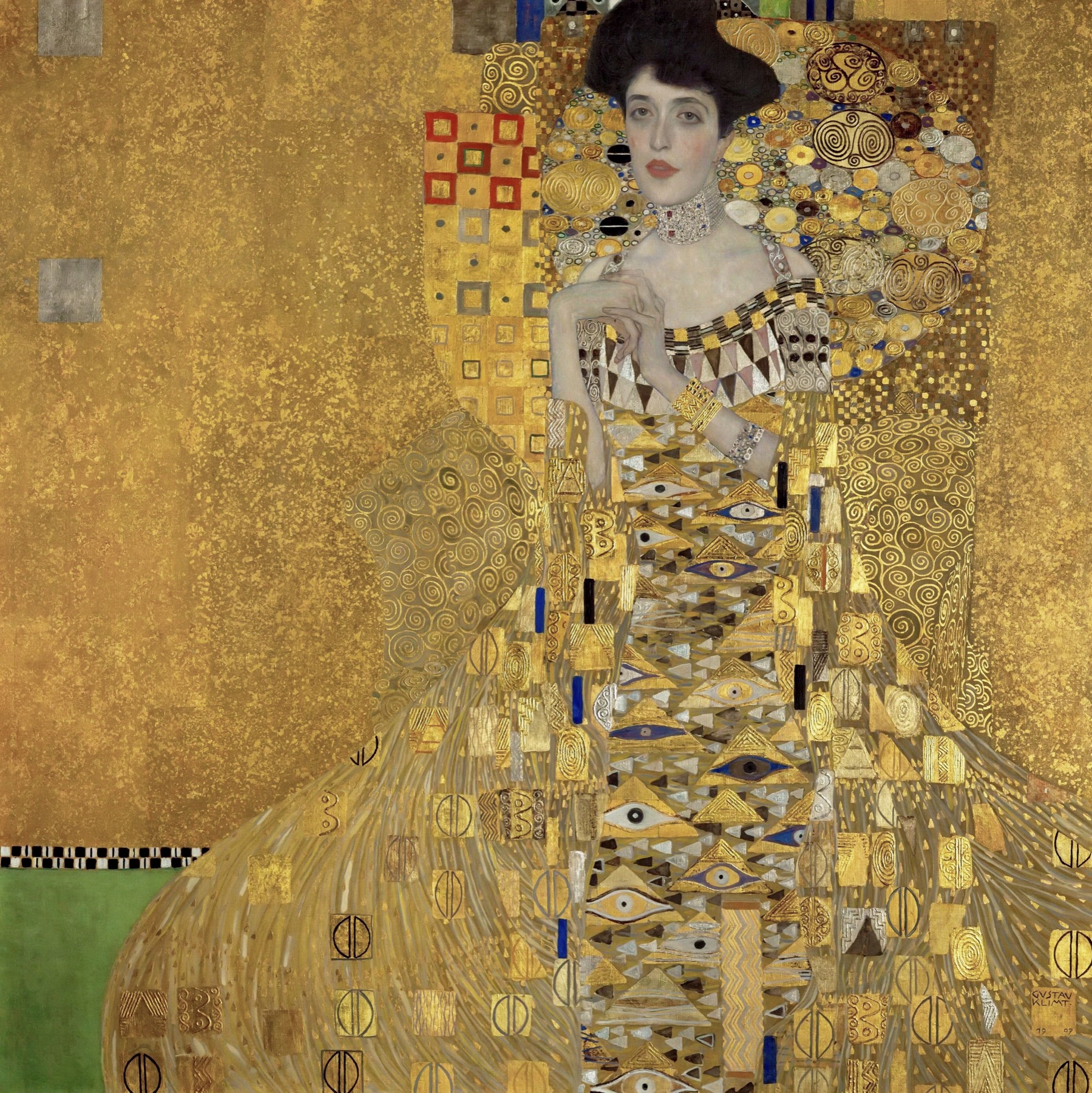
Details from PORTRAIT OF ADELE BLOCH-BAUER I
These close views use the high-resolution public-domain source while keeping annotation markers in CSS rather than in the image file.
Face
Adele's face remains the most human, least abstracted zone of the painting.
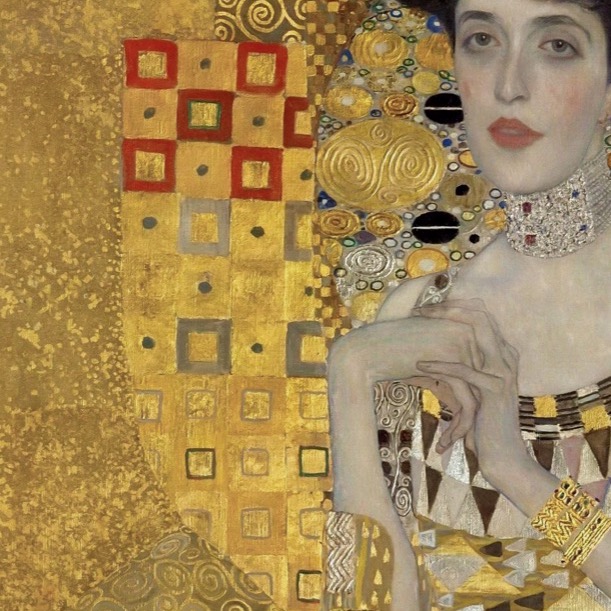
Hands
The interlaced hands interrupt the surface with a tense, recognisable bodily detail.
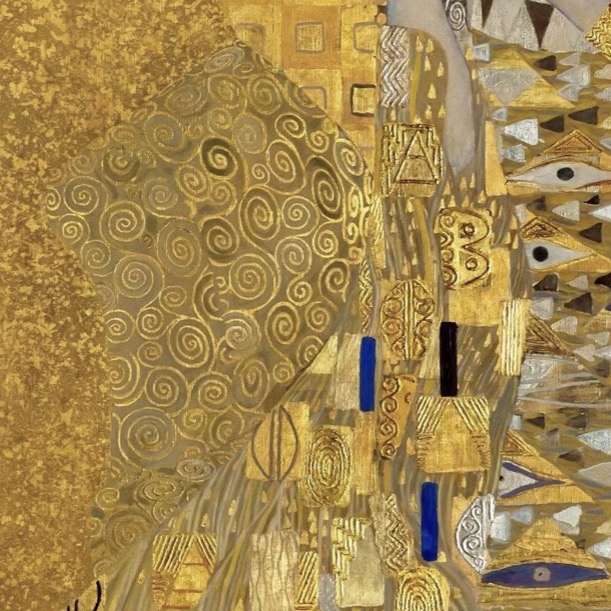
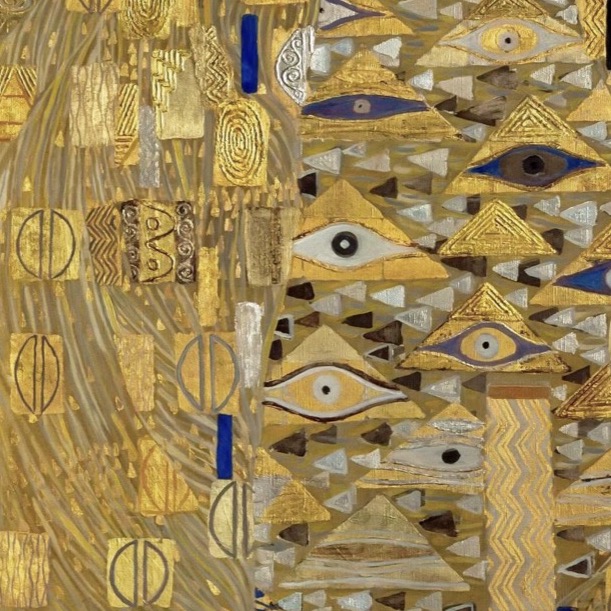
Eye motifs
The repeated eyes belong to the ornamental system, not to a single decoded symbol.
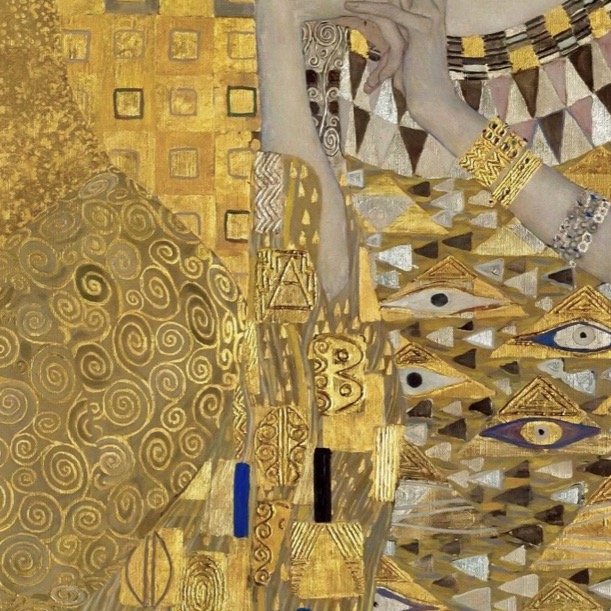
Gold ground
Gold converts portrait space into a patterned field while still leaving a sitter at its centre.
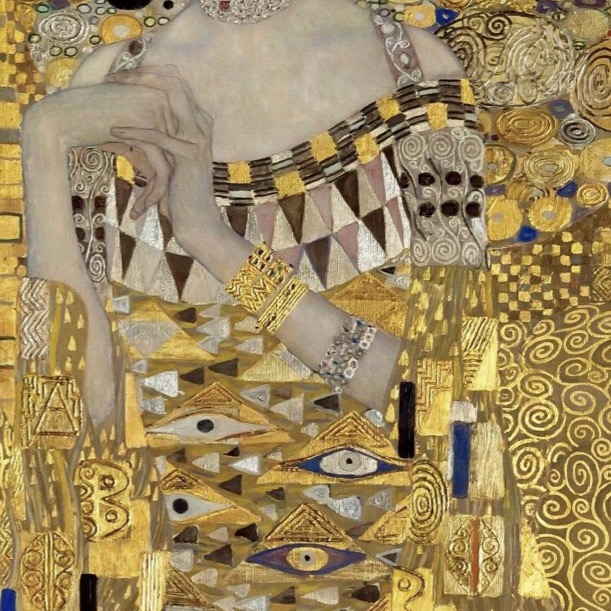
Dress field
The dress is both garment and surface: its edges dissolve into the surrounding pattern.
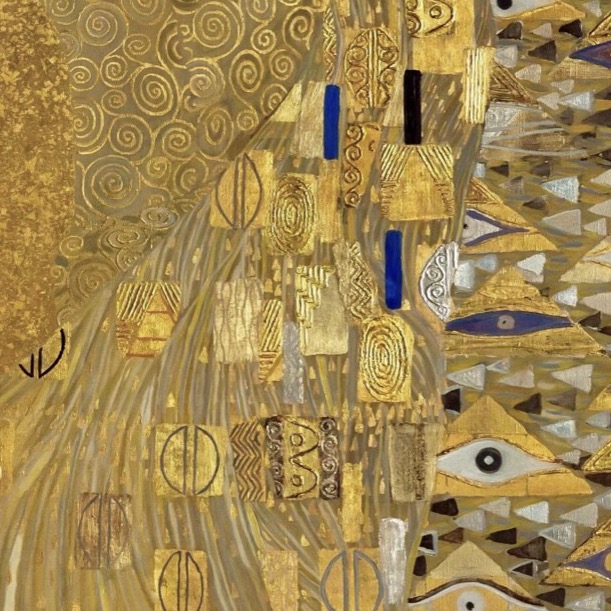
Neck and collar
The neck and collar create a fragile transition between portrait likeness and ornament.
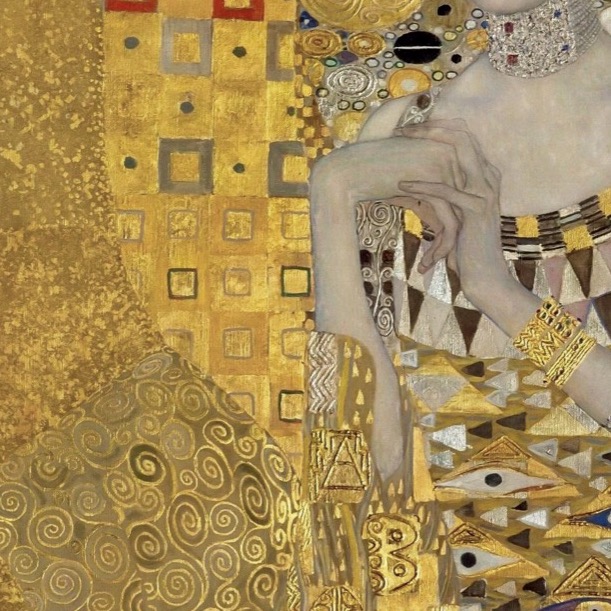
Seated structure
The implied chair and lower shape keep the figure seated even as the surface flattens.
Meeting Adele Through Gold
Adele occupies the upper centre of the square. Her pale face tilts slightly, framed by dark hair and a broad golden halo. A black line around the eyes, arched brows and a vivid mouth give her expression unusual intensity. She looks outward, but not with the social ease of a conventional society portrait. Her gaze is direct yet inward, poised between command and fatigue.
Her hands are gathered high against her body. One bends sharply over the other, and the fingers overlap in a knot of pale forms. The gesture was partly practical: Adele was self-conscious about a disfigured finger and used the pose to conceal it.[1] Klimt turns that concealment into the portrait's second focal point. The hands appear vulnerable, restless and highly controlled at once.
Below them, bodily certainty collapses. Adele wears an elaborate dress, but its outline is hard to follow. A triangular bodice filled with eye-like motifs widens into a field of rectangular, spiral and almond-shaped forms. Some patterns belong to textile, some to the chair, and some to the surrounding surface. Klimt makes it difficult to decide where the woman ends.
The ambiguity of her posture is deliberate. A sinuous spiral suggests the arm of a chair, yet the vertical extension of her body can make her seem upright. The lower portion has neither a clearly modelled lap nor visible legs. Rather than treating that uncertainty as a defect, Klimt uses it to suspend Adele between portrait and icon. Her face and hands prove corporeal presence; the rest becomes ceremonial image.
The square format reinforces the effect. At 140 centimetres in both directions, the portrait refuses the usual vertical emphasis of a standing full-length likeness. Adele is not shown moving through a room or inhabiting a deep interior. She is embedded in a self-contained field. The geometry makes the picture feel less like a window and more like a designed object.
The Face and Hands as Islands of Life
Klimt's realism is selective. He could model a complete body convincingly, but here he concentrates naturalistic attention on the areas most closely associated with identity, consciousness and social contact. Adele's face is softly shaded. Her skin carries warmth and small variations of tone. The lips are not an abstract red shape; they have weight and moisture. The shadows around her eyes suggest a living person rather than an ideal mask.
The hands are more angular and agitated. Their unusual arrangement prevents the graceful ease common in commissioned portraits. Adele's fingers seem to hold one another in place. The gesture can be read as elegant, defensive, nervous or self-possessed, but it is never neutral. The concealment of a physical difference becomes a visible sign of psychological complexity.
Face and hands also interrupt the metal. They are not gilded, and their relatively matte surfaces respond differently to light. As surrounding gold brightens or darkens with the viewer's movement, the flesh remains comparatively stable. Klimt makes the living parts of Adele both small and resistant.
This selective naturalism raises a question at the heart of portraiture: how much of a person must be visibly described for a likeness to survive? Klimt removes conventional bodily information—pose, weight, legibility of clothing—yet Adele's presence remains powerful. In fact, the pressure of ornament may intensify it. Her face has to assert itself against a field that threatens to convert everything into pattern.
The portrait therefore stages identity as concentration rather than completeness. Adele is not equally present in every part of the image. She gathers in the face, gaze, mouth and fingers. The rest of the canvas displays the social and aesthetic systems around her: wealth, fashion, decoration, patronage and the artist's own formal language.
A Dress That Becomes a World
The gown appears to spread across the lower centre, but it does not behave like ordinary fabric. Eye-shaped forms repeat within triangular compartments. Rectangles, whorls and small coloured accents float across gold. The initials “A” and “B” appear in low relief, fastening Adele's name into the decorative field.[1]
These motifs invite interpretation, but they do not form a fully decipherable private code. The eyes have been connected with ancient Egyptian forms and with Klimt's broader interest in archaic visual languages. Triangles and ovals can appear gendered or erotic. The initials clearly identify Adele Bloch-Bauer, yet even they become pattern rather than plain inscription. Klimt uses signs at the threshold between meaning and ornament.
The dress also collapses distinctions among painting, textile and jewellery. It seems woven and encrusted rather than merely brushed onto canvas. Gold and silver catch actual light. Raised details create slight relief. Coloured shapes resemble gems or enamel. Adele's diamond choker, a gift from Ferdinand, joins real represented jewellery to a surface that behaves like an enormous jewel.[1]
Klimt's decorative training is crucial here. He had been educated at the Vienna School of Arts and Crafts and began his career within a collaborative decorative enterprise. By 1907 he was no longer making conventional architectural ornament, but he had not abandoned the belief that materials, pattern and setting could carry serious meaning. The portrait brings those skills into a modern painting without treating them as secondary embellishment.
Jewellery forms the hinge between Adele's body and this larger decorative system. Her diamond choker was a wedding gift from Ferdinand, so it belonged to her social life before it became a painted motif.[1] In the portrait it sits at the base of the neck like a bright structural band. It marks the transition from modelled flesh to the ornament that overtakes the torso.
The choker is identifiable as represented property, while the surrounding gold is Klimt's artistic material. Their proximity blurs the difference between something Adele wore and the precious surface in which he placed her. She appears adorned by an object, then absorbed into an image that behaves as adornment on a monumental scale.
This relation gives luxury more than one function. Jewellery records marriage, wealth and fashionable presentation. The painted and gilded field converts those social facts into visual structure. Klimt does not inventory Adele's possessions or describe a room full of goods. He selects one conspicuous necklace and lets the rest of the canvas expand its logic of brilliance, repetition and value.
The effect is ceremonious but also constricting. The band closes tightly around the neck, and the dress leaves little open space around the body. Splendour frames Adele and holds her in place. As elsewhere in the portrait, the same device that magnifies her presence can appear to limit her freedom.
The relationship between ornament and body is not entirely celebratory. Adele's dress magnifies her social brilliance, but it also engulfs her. Her individual form becomes inseparable from the wealth through which it is represented. Klimt makes luxury both the means of her visibility and the force against which her face must struggle.
Gold, Silver and the Lessons of Ravenna
Klimt began work on the portrait in 1903. In December of that year he visited Ravenna, where the sixth-century mosaics of San Vitale made a powerful impression. The processional images of Emperor Justinian, Empress Theodora and their attendants present frontal figures against glittering gold, joining political authority, precious material and sacred space. Klimt described their splendour enthusiastically.[1]
The connection with Adele's portrait is compelling, but it should be made precisely. Klimt did not copy the Theodora mosaic. Adele's pose, expression, fashionable jewellery and modern psychological presence are different. What Ravenna offered was a model for how a human figure could be held in a metallic field—how gold could abolish ordinary space while heightening status.
Other sources mattered too. Medieval panels, Japanese lacquer, East Asian design, Egyptian motifs and contemporary Viennese applied arts all belonged to the visual environment in which Klimt worked. His gold has no single origin. It is a meeting place for historical forms and modern material experiment.[8]
Real metal changes the relation between painted illusion and object. Gold pigment can imitate the colour of gold, but leaf and metallic application respond directly to the room's light. The surface may flare, flatten or darken as the viewer moves. It refuses the idea that a painting should merely represent light falling within an imagined world. The actual object produces light effects of its own.[8]
Silver introduces further variation. Its cooler reflectivity prevents the canvas from becoming one undifferentiated yellow mass. Dark paint, black pattern and small areas of colour make the luminous zones more forceful. The face appears warmer because it is surrounded by metal; the metal appears less inert because living skin interrupts it.
Gold also carries social meaning. It suggests expense, rarity and ceremony. In a portrait commissioned by a wealthy industrialist and collector, those associations cannot be separated from patronage. Yet Klimt's use is not simply ostentatious. He converts wealth into a formal problem. Can precious material describe status without reducing the sitter to property? The portrait does not settle the question; it gives the question visual form.
Four Years and More Than One Hundred Drawings
Ferdinand Bloch-Bauer commissioned the portrait in 1903. It was initially intended as an anniversary gift for Adele's parents, but Klimt's slow, exploratory process outlasted that occasion.[1] The delay matters because the final image can seem instantaneous, as if Adele had appeared fully formed from gold. In reality, Klimt worked through an exceptional number of studies.
More than one hundred preparatory drawings survive. They examine the angle of Adele's head, the position of her shoulders, the folded hands and the relation between seated body and clothing.[2] Many concentrate on contour rather than decoration. Before the metal and motifs could absorb the figure, Klimt had to understand how her body would hold the composition.
The drawings also reveal that concealment is a product of knowledge. Klimt did not avoid anatomy because he could not describe it. He studied the pose closely, then chose which information the painting would suppress. The indistinct lower body is therefore an active transformation, not a shortcut.
The long development coincided with changes in Klimt's career. After the public conflict over the Faculty Paintings for the University of Vienna, he increasingly relied on private commissions and independent exhibition works. A portrait for the Bloch-Bauers offered material freedom and a receptive setting for experimentation. It could be both an intimate family object and a declaration of modern painting.[4]
The completion date of 1907 places the portrait just before Klimt's commanding display at the 1908 Kunstschau. There, it appeared alongside works that developed related questions of gold, pattern and bodily presence. The four-year labour had produced not merely a likeness but a central statement of his Golden Period.
Josef Hoffmann and the Frame
Josef Hoffmann designed the portrait's frame. This collaboration is easy to overlook because frames are often treated as neutral borders, but Hoffmann was a leading architect and designer and a founder of the Wiener Werkstätte. His involvement places the painting within a culture that sought continuity among architecture, furniture, objects and pictures.[3]
The frame does more than protect the canvas. Its form mediates between the dense golden field and the surrounding room. Rather than allowing the picture to end abruptly, it extends the logic of crafted surface. In this sense, the portrait was conceived as an object with architectural presence.
The connection is particularly apt for a work that already behaves like furniture, textile and jewellery. The spiral of Adele's chair resembles designed ornament. The lower border can look like inlay. The repeated units have the rhythm of a decorative panel. Hoffmann's contribution recognises that Klimt has made something more materially integrated than a portable image in an arbitrary moulding.
This does not mean the portrait loses autonomy. Its visual tensions remain specific to painting: the clash between modelled flesh and flat metal, the uncertainty of represented space, the concentrated gaze. The frame strengthens those tensions by making the whole ensemble feel intentional.
Adele Bloch-Bauer: Sitter, Patron and Host
Adele was born in Vienna in 1881 into the Bauer family, part of the city's Jewish banking elite. She married the industrialist Ferdinand Bloch in 1899; both spouses later used the joined surname Bloch-Bauer. She was eighteen at marriage and twenty-six when Klimt completed the first portrait.[2]
Her life unfolded within the restrictions placed on women in imperial Vienna. Formal university access was severely limited, but the salon offered another space for intellectual and political exchange. Adele hosted artists, writers and political figures, bringing cultural and public life into the domestic interior.[2]
It is tempting to describe her entirely through the painting's sensuality or through later family tragedy. Both approaches narrow her. The portrait shows fashionable jewellery and status, but her direct gaze and tense hands resist the passivity of display. Contemporary accounts and the history of her salon point to a person engaged with ideas and public affairs, not merely the beautiful wife of a collector.
The Bloch-Bauers assembled a major art collection. It included Viennese Biedermeier painting, modern sculpture, porcelain and several works by Klimt. The Klimt paintings were displayed in Adele's private apartment in the couple's Vienna home, where they formed part of a designed domestic environment rather than a museum sequence.[1]
Patronage was a form of participation in modern culture. Ferdinand supplied the commission and owned the resulting painting; Adele supplied the person and social identity the portrait made visible. Their collection gave Klimt's experimental art a setting and helped establish its prestige.
Adele occupies a unique place among Klimt's sitters because he painted her twice in full-length portraits. The second, completed in 1912, replaces the overwhelming gold of the first with a more chromatic, floral environment. The contrast shows both Klimt's stylistic movement and the danger of treating the 1907 image as a transparent record of Adele. Each portrait is an artistic construction made at a different moment.
Two Portraits, Two Versions of Presence
The second portrait makes the strangeness of the first easier to see. In Portrait of Adele Bloch-Bauer II of 1912, Adele stands within an intensely coloured environment. Floral passages, patterned zones and a dark hat create decorative richness, but the gold no longer absorbs the whole body. Her vertical posture is clearer, and the relation between figure and setting follows a different rhythm.[4]
The five-year interval was significant for Klimt. His heaviest concentration on metallic surface had begun to give way to a palette influenced by modern French painting, folk art and Asian objects. Pattern remained fundamental, but colour could now create the instability that metal had previously supplied.
Comparing the portraits prevents “Klimt's Adele” from becoming one fixed identity. The 1907 work presents a pale face and folded hands held within ceremonial gold. The 1912 work gives a more visibly standing, fashionably dressed woman surrounded by restless colour. Neither is more simply true. Each selects and transforms different aspects of the sitter.
The comparison also exposes the power of costume and setting in portraiture. Adele's recognisable face persists, but the visual world around it changes the personality viewers imagine. Gold encourages words such as iconic, remote and precious. Saturated colour can suggest cosmopolitan energy and modern fashion. Those impressions arise from Klimt's construction as much as from evidence about Adele's character.
Only Adele received this kind of full-length return in Klimt's painted portrait practice.[1] That distinction suggests the strength of the Bloch-Bauer relationship as patrons, but it does not prove a hidden romance. Repeat commission, sustained collecting and artistic trust are sufficient historical explanations.
The later fate of the two portraits further complicates their pairing. Both were seized from Ferdinand's collection and both were returned to his heirs in 2006, but their paths diverged afterwards. The first entered Neue Galerie; the second later moved through private ownership. Their separation reminds us that a collection can be reconstructed in history without being physically restored as a permanent whole.
For the 1907 portrait, the second work functions as a control against overconfident interpretation. If the same person can become so different under another set of colours, patterns and compositional choices, then the gold should not be mistaken for Adele's essence. It is Klimt's artistic argument about how she might be made present at one particular moment.
Portraiture and Jewish Vienna
The great private portraits of Klimt's mature career were closely connected with affluent patrons, many of them from Jewish families central to Vienna's commercial and cultural life. These commissions existed within a society that offered economic prominence and cultural influence while sustaining deep antisemitism. The apparent security of the portrait world was therefore historically fragile.
In 1907, Portrait of Adele Bloch-Bauer I could assert new bourgeois splendour. The icon-like gold transfers a kind of magnificence once associated with sacred or aristocratic representation to a modern Jewish woman. The Klimt Database notes that contemporary observers called it a “mosaic picture,” recognising its unusual fusion of portrait painting and decorative art.[3]
The image can be read as social arrival, but it should not be reduced to a display of assimilation or wealth. Adele is not presented in a conventional palace interior imitating hereditary aristocracy. Klimt gives her a deliberately modern, even disorienting form. Her status is expressed through artistic innovation.
That innovation also exposes the ambivalence of the commissioned portrait. A sitter pays to be represented, yet the artist controls the visual language. Here, Klimt preserves Adele's recognisable features while almost dissolving the body on which social portraiture normally depends. He both magnifies her and withholds her.
Later history makes the Jewish identity of the patrons indispensable to the painting's meaning. The Nazi state did not encounter the portrait as a neutral masterpiece. It encountered property belonging to a persecuted Jewish family. Any account that celebrates Viennese modernism while omitting the destruction of the world that supported it would leave the painting's history artificially complete.
Early Exhibition and Reception
The completed portrait was first exhibited in Mannheim in 1907 and then shown at the Vienna Kunstschau in 1908.[2] Public display shifted it temporarily from private commission to modern-art statement. Viewers could compare its gold, square format and radical surface with Klimt's allegories and other portraits.
Responses were mixed. One dismissive phrase, “Mehr Blech als Bloch”—more metal than Bloch—mocked the dominance of the metallic surface.[2] The joke is useful evidence because it identifies exactly what was new and troubling: Adele seemed to disappear behind material display. What could later be admired as synthesis initially looked to some viewers like an excess that overwhelmed portraiture.
The criticism also reveals how easy it is to treat decoration as lesser art. Klimt refused that hierarchy. The metal is not applied to an otherwise complete portrait. It determines composition, space and the sitter's mode of presence. To call it surplus is to miss the work's organising principle.
Other viewers recognised its ceremonial power and technical audacity. The picture became one of the defining works through which Klimt's Golden Period was understood. Yet it retained the intimacy of private ownership, hanging among the Bloch-Bauers' possessions rather than entering a public collection during Adele's life.
Adele's Testament and Ferdinand's Ownership
Adele died in 1925, aged forty-three. Her 1923 testament included a request that Ferdinand leave two portraits and four Klimt landscapes to the Austrian State Gallery after his death. That wording later became central to the dispute over the paintings.[5][6]
The distinction between a request and a bequest is essential. Adele asked her husband to act in the future; she did not directly transfer ownership to the museum. Ferdinand had commissioned and owned the paintings. The 2006 Austrian arbitration ultimately treated Adele's language as a legally non-binding wish rather than an enforceable disposition of the works.[6]
Ferdinand appears to have respected Adele's cultural intention before 1938. He lent works and remained connected with Austrian institutions. But the conditions under which her request had been made were destroyed by Nazi persecution. After the Anschluss, Ferdinand fled Austria. The regime seized and dispersed his property.
The later claim that the museum simply received Adele's intended gift obscured this rupture. Whatever she hoped might happen after Ferdinand's natural death, she had not directed that a persecuting state seize his property during his lifetime. Accurate provenance therefore requires more than reading one sentence from a will. It requires asking who owned the objects, how control changed and under what political coercion.
Nazi Seizure and the Loss of a Name
Following Nazi Germany's annexation of Austria in March 1938, Ferdinand Bloch-Bauer's assets were taken under the machinery of persecution. His collection was administered and dispersed. Portrait of Adele Bloch-Bauer I reached the Austrian Gallery in 1941 and received the inventory number 3830.[2]
The painting was increasingly known by titles such as Woman in Gold or Lady in Gold. That shorthand draws attention to the surface but removes the sitter's surname and the Jewish family identity embedded in the commission. Neue Galerie has described the renaming as a concealment of Adele's identity.[1] Even where catalogue practices varied, the effect is clear: a named Viennese woman became an anonymous golden type.
This erasure parallels the visual risk already present in the painting. Klimt surrounds Adele with ornament but preserves her face and initials. The later title kept the ornament and weakened the name. Restoring the full title is therefore not pedantry. It returns personhood and patronage to the work's public history.
The portrait's beauty can make the violence of seizure seem external to the object. In fact, provenance changed how the painting functioned. A private family possession became a state museum treasure. Its display supported a national story while the owners who had sustained Klimt's art were exiled, dispossessed or murdered across Europe.
The Long Road to Restitution
After the Second World War, Ferdinand's heirs sought the return of property. Austrian authorities maintained that Adele's testament justified the gallery's possession of the Klimt paintings. The heirs challenged that position, and records later brought renewed scrutiny to the non-binding character of her request and to the postwar handling of Ferdinand's collection.[5]
Austria's 1998 Art Restitution Act created a new mechanism for examining objects in federal collections. The Bloch-Bauer claim nonetheless remained contested. Maria Altmann, Ferdinand's niece and an heir, pursued proceedings in the United States against the Republic of Austria and the Austrian Gallery.
In Republic of Austria v. Altmann, decided on 7 June 2004, the United States Supreme Court held that the Foreign Sovereign Immunities Act did not bar the suit in the way Austria argued. The judgment concerned whether the case could proceed against a foreign state in a U.S. court. It did not decide who owned the paintings and did not itself order restitution.[5]
This point is often blurred because the jurisdictional decision was a dramatic legal breakthrough. But the ownership outcome came through a different process. The parties agreed to Austrian arbitration. On 16 January 2006, the panel concluded that five Klimt paintings—including both Adele portraits and three landscapes—met the conditions for return to Maria Altmann and other heirs of Ferdinand Bloch-Bauer under Austrian law. The Austrian government announced that it would comply.[6][7]
The distinction protects the historical record from a satisfying but inaccurate courtroom shorthand. There was no 2005 U.S. judgment awarding Portrait of Adele Bloch-Bauer I to the family. There was a 2004 Supreme Court ruling on sovereign immunity, followed by a 2006 Austrian arbitration award on restitution.
The five paintings left the Belvedere and were shown together at Neue Galerie in 2006. Later that year, Neue Galerie acquired the first Adele portrait with the participation of Ronald S. Lauder, the heirs and supporting funds.[1][4][9] The transfer gave the painting a new institutional setting and reunited its public title with Adele's name.
What Restitution Changes in the Way We See
Restitution does not alter the paint, metal or dimensions, but it changes the ethical conditions of looking. A museum visitor is no longer invited to treat the portrait's passage into a state collection as a neutral chain of ownership. The gaps, coercion and competing claims become part of the object's meaning.
The history also complicates the gold. In 1907 it could signify splendour, artistic experiment and the cultural confidence of a patron. After 1938 the same surface belonged to an object whose material value made it a target for seizure and institutional retention. Gold is not guilty, but its associations shift under history.
Adele's face takes on another force as well. The portrait visually risks dissolving her into decoration, yet her identity survived in family memory, documentation and legal claims. The recovery of the name “Adele Bloch-Bauer” resists the anonymous “Woman in Gold.” What the composition stages aesthetically—person against pattern—the provenance stages historically—person and family against appropriation.
It would nevertheless be reductive to read every motif as prophecy. Klimt did not paint the portrait as a Holocaust memorial, and Adele died thirteen years before the Anschluss. The task is to hold temporal layers together without collapsing them. The work is a 1907 portrait, a record of modern Viennese patronage, an object seized under Nazism, a subject of postwar institutional dispute and a restituted painting. No single layer cancels the others.
The Problem of “Woman in Gold”
“Woman in Gold” is memorable because it describes what the eye first sees. It is also inadequate. It converts a particular woman into a type and makes the precious material seem like the whole subject. Used as a popular nickname, it can help identify the painting. Used as a replacement title, it repeats the loss of historical specificity.
The full title names genre and sitter: this is a portrait of Adele Bloch-Bauer. The Roman numeral distinguishes it from the second portrait. Those elements return the work to a relationship among artist, named subject and commissioning household.
Names matter especially when dispossession has disrupted ownership and memory. Ferdinand's surname establishes the collection history. Adele's establishes the sitter. Their joined family name locates the work in Jewish Vienna. The painting's restitution did not merely move a valuable object; it required public institutions to reconsider whose story its title and display had told.
The nickname can still be critically useful. It reveals the power of Klimt's transformation: many viewers remember the gold before they remember Adele. The responsible response is not to ban the phrase but to move through it—from dazzling surface to person, commission and history.
How to Read the Portrait Without Solving It
The portrait invites symbolic decoding. Eyes, triangles, spirals, initials and the halo seem to promise hidden meanings. Some associations are historically grounded, especially the relation to Byzantine mosaic and to decorative traditions. Others remain speculative. A work can be symbolically rich without functioning as a cipher.
Close looking offers a better path than assigning one definition to every form. Repetition can create rhythm. Eye shapes can make the dress appear watchful. Spirals can imply movement around a motionless sitter. Initials can name Adele while blending into the object that represents her. These effects are real even when no documentary key survives.
The same restraint should apply to biography. Claims of a sexual affair between Klimt and Adele have circulated widely, but no concrete evidence establishes one.[2] The intensity of the portrait does not prove intimacy beyond the demands of sustained artistic attention. More than one hundred studies are evidence of labour, not of romance.
Uncertainty is not a failure here. Adele's posture, expression and relation to the gold remain compelling because they cannot be translated into one sentence. She is displayed and concealed, solid and disembodied, socially powerful and visually absorbed. Klimt gives portraiture the structure of an unresolved encounter.
Why Portrait of Adele Bloch-Bauer I Matters
The portrait matters first because of what it does with a human likeness. Klimt compresses bodily identity into face and hands, then surrounds those living zones with a surface that belongs equally to painting, mosaic, textile and precious object. The result pushes portraiture towards abstraction without losing the person.
It matters because it embodies a particular culture of patronage. Adele and Ferdinand Bloch-Bauer belonged to the modern Jewish bourgeois world that helped make Viennese art possible. The commission is evidence not simply of wealth but of an appetite for radical form. Klimt's innovation was supported inside a domestic collecting culture before it became museum history.
It matters because its provenance exposes the danger of separating masterpieces from owners. Nazi seizure, postwar retention and eventual restitution are not supplementary anecdotes. They reveal how cultural value can be used to nationalise an object while marginalising the people from whom it came.
And it matters because those histories remain visible in the composition's central tension. Adele's face survives the gold. Her name survives the anonymous nickname. The painting has repeatedly risked becoming only an icon, a treasure or a legal symbol. Its enduring power comes from the individual who continues to look out through all three.
Artist Up Close: Klimt, Portraiture and the Golden Period
By 1903, when Ferdinand commissioned the portrait, Gustav Klimt had moved through a decisive professional crisis. He had trained as an architectural decorator and achieved early establishment success, but the hostile reception of his Faculty Paintings for the University of Vienna exposed the widening gap between his mature art and official expectations.
Private patronage offered another path. Portrait commissions could supply income and social connection while allowing greater material and formal freedom. Klimt did not make them conventional in order to reassure clients. He increasingly used costume, setting and pattern to test how far a likeness could move towards decorative autonomy.
The first Adele portrait stands at the centre of this experiment. Its long gestation links the early 1900s, when gold became increasingly important in works such as Judith I, with the extraordinary concentration of metallic pictures around 1907–1909. The work's completion preceded The Kiss and the 1908 Kunstschau, where Klimt appeared at the height of his public authority.[3]
His portrait practice depended on drawing. The surviving studies show repeated attention to bodily position and gesture. This labour counters the misconception that ornament allowed him to evade observation. Klimt often knew the body precisely before covering or transforming it.
He also treated sitters differently across time. The second Adele portrait of 1912 abandons the first work's nearly total gold for intense colour and floral pattern. The change belongs to Klimt's broader movement beyond the Golden Period. It reminds us that his famous metallic style was neither permanent nor automatic.
Klimt rarely supplied explanations that would settle the psychology of his sitters. The portrait's power therefore resides in constructed ambiguity rather than biographical confession. He gives Adele an unforgettable public form while protecting something inaccessible within her gaze.
Frequently Asked Questions
References
- Neue Galerie New York, “Portrait of Adele Bloch-Bauer I (1907)” / “The Woman in Gold.” View source.
- Google Arts & Culture and Neue Galerie New York, “Adele Bloch-Bauer I.” View source.
- Gustav Klimt Database, “Gustav Klimt at His Zenith, 1907–1909.” View source.
- Neue Galerie New York, “Klimt and Adele Bloch-Bauer: The Woman in Gold,” exhibition archive. View source.
- United States Supreme Court, Republic of Austria v. Altmann, 541 U.S. 677 (2004), United States Reports via GovInfo. View source.
- Austrian Federal Ministry, “Klimt-Bilder: Österreichisches Schiedsgericht entscheidet für Restitution,” 17 January 2006. View source.
- Belvedere, “Provenance Research,” restitution register and institutional account. View source.
- Belvedere, “Why Did Gustav Klimt Use Gold?” View source.
- Neue Galerie New York, “Gustav Klimt: Five Paintings from the Collection of Ferdinand and Adele Bloch-Bauer,” 2006 exhibition archive. View source.
Discussion
Portrait of Adele Bloch-Bauer I rewards close attention to source context, object identity and careful reproduction boundaries.


