 by Tom Gurney
Tom Gurney BSc (Hons) is an art history expert with over 20 years experience
Published on August 21, 2026 / Updated on October 23, 2026
Email: tomgurney1@gmail.com / Phone: +44 7429 011000
About Paintings H–S: Portraits, Monuments and Corrected Titles
This middle section of the Gustav Klimt directory covers works filed from H through S. It is especially useful for portraits: named subjects appear by the personal name readers are most likely to search, while unidentified women remain under titles such as Lady at the Fireplace or Portrait of a Lady. The displayed title always preserves the fuller object identity.
The directory also includes several records that need a category warning. The Hydra is an investigation of a misleading alias, not an additional Klimt object. St Wolfgang Church concerns a posthumous print whose caption misidentified another painting. The Faculty Paintings and Friends II are destroyed, Malcesine is missing, Portrait of a Young Woman is a drawing, and Stoclet or Beethoven entries may concern a commission or monument detail. None becomes an oil merely by appearing beneath the familiar “Paintings” heading.
Titles beginning with The are ordered by the important noun: The Hostile Powers is under H, The Kiss under K and The Park under P. For the preceding alphabet, use Paintings A–G; for the remaining range, continue to Paintings T–Z. The Paintings overview supplies chronology rather than another alphabetical list.
Finding the Right Kind of Entry
Each linked heading names one accepted destination. An alternate title immediately after it may be a translation, married name or documented historical wording. Where a familiar phrase is actually wrong, the annotation says so. A short pointer section later in the page catches common searches without granting them second full entries.
Status language is evidence, not decoration. “Private” means a responsible public source places the work outside a named public collection; it does not disclose the owner or guarantee access. “Destroyed” requires evidence of physical loss. “Missing” leaves open a different possibility: the work may have survived beyond the last secure record. “Unfinished” describes a visible state of an extant object.
The annotations identify the decision each dedicated page helps a reader make. They do not attempt to fit dimensions, full provenance, technique, interpretation and reception into miniature essays. Where a claim depends upon technical examination or restitution research, the linked account returns to the relevant museum, archive, legal decision or exact sale record.
Portrait Names, Numbers and Generic Titles
Named sitters are indexed by the identity a reader can verify. Hermine Gallia, Johanna Staude, Mäda Primavesi, Margaret Stonborough-Wittgenstein, Ria Munk, Serena Lederer and Sonja Knips therefore remain easy to scan even when an institution phrases the title as “Portrait of.” A married name or nickname is retained where it protects the historical record: Elisabeth Lederer later became Baroness Bachofen-Echt, and Maria Munk was called Ria.
This approach does not treat a name as proof of every model relationship. A preparatory drawing may identify a person represented on that sheet without proving the sitter of a different oil. Costume, resemblance and family memory can generate proposals, but a proposal remains visibly graded. The anonymous women in the four Lady entries and Portrait of a Young Woman are not assigned names merely to make the alphabet tidier.
Roman numerals and repeated titles usually distinguish objects, not phases. Hope I and Hope II are separate paintings. Ria Munk III belongs to a three-commission sequence, yet only the third is the surviving unfinished oil indexed here. Schloss Kammer IV is one canvas within a numbered architectural group. A revision found inside one support, by contrast, stays part of that single object—as with the two painted portrait states in Portrait of a Lady.
Generic English names demand one more check. Lady with Cape and Hat before a Red Background is a small oil, while similarly worded catalogue records identify drawings. The Large Poplar II is singular despite the inherited plural form. Still Pond, Landscape of a Garden and Poppy Field send readers back to corrected entries in A–G. The alphabet follows secured objects rather than whichever translation happens to be shortest.
H
- Portrait of Hermine Gallia — The National Gallery's 1904 oil was photographed in an incomplete state during its 1903 display. The fuller page follows the reform dress, boa, interior setting and changing study catalogue, then tracks the Gallia family's flight with the painting and its eventual museum acquisition without inventing seizure or sale terms.[4][9]
- Hope I — This 1903/04 oil confronts a nude pregnant figure with dark threatening presences. Its page separates the first landscape form from the revised patterned state, distinguishes withdrawal in 1903 from later private and public presentations, and grades model, anatomy, Typhoeus and Beardsley connections rather than converting them into settled biography.[3][10]
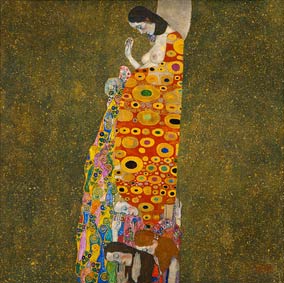
- Hope II — MoMA's pregnant-figure painting began under the title Vision and changed after its unfinished 1909 showing. Open the page for the exact oil, gold and platinum medium, the lowered head, skull and lower women, the 1911 photographic state and later revisions—without importing a diagnosis or dead-child narrative.[5][11]
- The Hostile Powers — A complete reading of the Beethoven Frieze's short-wall ensemble, not a detachable painting. The page maps Typhoeus, the Gorgons, Sickness, Madness, Death, Lust, Unchastity and Intemperance, keeping lower and upper figures, material distribution and the transition to the next wall in their programme positions.[3][12]
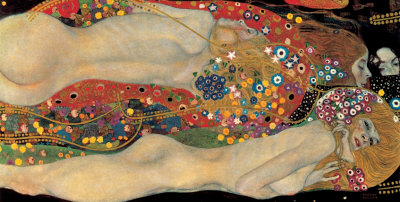
- The Hydra — A corrective record rather than a separate artwork. It traces an unstable online name attached to Water Serpents I, returns the object to Belvedere inventory 3828 and demonstrates that the Beethoven programme names Typhoeus and Gorgons but no Hydra. The page avoids duplicating either artwork's visual essay.[12][13]
J
- Portrait of Johanna Staude — A 1917/18 Belvedere oil organised by face, feather boa, orange field and Martha Alber's blouse design. Its page retains the museum's unfinished classification beside recent technical caution, identifies the secure drawing relation, rejects an unverified mouth anecdote and distinguishes deposit, loan, contract and final payment.[7][14]
- Josef Lewinsky as Carlos in Clavigo — Belvedere inventory 494 portrays the actor in his theatrical role, not a man named Carlos. The dedicated account separates the oil from photographs, a bronze and reproductive photogravure, then explains costume, lighting and the Society for Reproductive Art context behind this unusual 1895 portrait.[1][14]
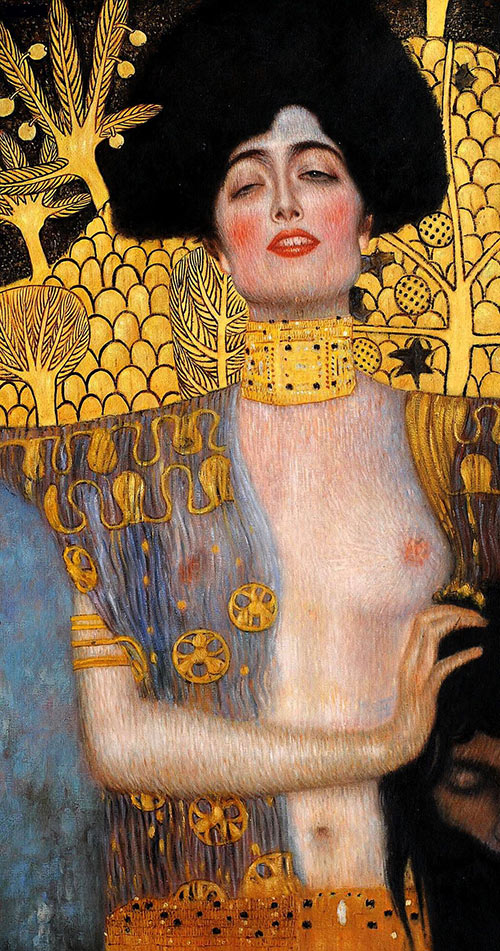
- Judith I — Belvedere's 1901 biblical heroine, distinct from Judith II. Her page uses the original frame inscription to secure Judith and Holofernes, separates gold leaf on the canvas from Georg Klimt's brass frame and balances eroticised reception with the heroine's violent strategy and civic deliverance.[3][14]
- Jurisprudence — The destroyed Faculty Painting developed from an early Themis-centred design into the 1907 final canvas. Its page keeps the condemned figure and lower Erinyes separate from upper Truth, Justice and Law, grades octopus and source interpretations, and distinguishes drawings, photographed states and modern colour hypotheses from the lost original.[3][8]
K
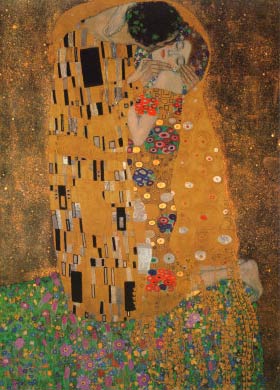
- The Kiss (Lovers) — Belvedere inventory 6678 joins an embracing pair to a carefully documented mixed medium. The page examines bodily position, patterned garments, flowered ground, acquisition and reception while withholding named-model certainty. Lovers is a valid title layer; Stoclet's Fulfilment remains a related but different design and executed mosaic.[5][14]
L
- Lady at the Fireplace — A small horizontal Belvedere interior from 1897/98, probably the work catalogued as Dämmerung. Its account analyses the anonymous figure within dim light and distinguishes that probable identity from the separate lost Im Zwielicht, preserving uncertainty instead of joining two catalogue records.[2]
- Lady with Cape and Hat before a Red Background — A tiny vertical oil of 1897/98 held by the Klimt Foundation. The page makes scale, red field, hat, cape and selective surface central, leaves the sitter unnamed and excludes both Albertina's similarly titled drawing and a later Adele Bloch-Bauer study.[1]
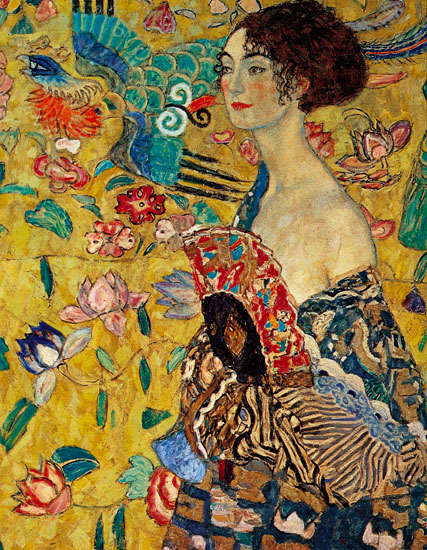
- Lady with a Fan — Klimt's 1917–18 private oil is described by different authorities as nearly complete or unfinished. Its page reconciles that language, keeps the sitter unknown, distinguishes Chinese clothing and motifs from Japanese print comparisons and dates the 2023 sale without turning a buyer or price into a present-location claim.[7][15]
- Lady with Hat and Feather Boa — Former Belvedere inventory 4415, with no secure sitter despite Hilde Roth and Josefine Grete Holfeld proposals. The page uses a 1933 tear as identity evidence, then separates Nazi persecution, the November 1939 emergency sale, the unresolved later chain, lawful museum exchange and completed 2001 restitution.[16]
- The Large Poplar II (Gathering Storm) — The current Leopold title is singular; Tall Poplar Trees II is a superseded English label. Its page distinguishes the 1902/03 canvas from the first poplar painting, considers qualified Seehof documentation and follows the Flöge, Dorotheum and Leopold histories to its dated museum display.[3][17]
- Love — Wien Museum inventory 25005 is the surviving 1895 oil model made for Gerlach's Allegories portfolio, not plate 46 itself. The dedicated page relates the central couple to child and old-man presences, explains the publication function and preserves exact study limits without turning flowers or age into universal symbols.[1][18]
M
- Portrait of Mäda Primavesi — The Met's 1912–13 child portrait centres a wide stance, flowered dress and divided floral-animal setting. Its account identifies Mäda rather than her mother, grades memories of sittings and studies, separates a shared advance for two portraits and follows Jenny Steiner's seizure, restitution and 1964 museum gift.[6][19]
- Malcesine on Lake Garda — A missing signed oil of 1913 known through photographs and prints. Its page reconstructs only what the transmitted image supports, grades travel and viewpoint proposals, traces Zuckerkandl-to-Lederer ownership and explains why unverified transfer to Immendorf does not justify calling the canvas destroyed.[6][8]
- Portrait of Margaret Stonborough-Wittgenstein — A signed Munich portrait dated 1905 but apparently completed after the photographed unfinished Berlin state. The page treats roughly thirty studies as an evolving group, corrects a contemporary nationality error, rejects a weak rejection story and follows sitter agency, wartime recovery and museum acquisition.[4][20]
- Medicine — The destroyed Faculty Painting is approached through versions, photographs, drawings and one historic colour witness for Hygieia. Its page owns the river of life and death, the faculty dispute, more than two hundred associated drawings and attributed Lethe interpretations while labelling recent colour reconstructions as hypotheses.[3][8][21]
- Mountain Slope at Unterach — A signed 1916 private landscape dominated by a wooded incline above narrow village and lake bands. The page grades multiple-viewpoint and optical-device scholarship as method proposals rather than object proof, follows the Böhler–Forbes–Lauder chain and reports the November 2025 sale without naming an unreported owner.[7][22]
- Music (Die Musik) — Munich inventory 8195 is a surviving 1895 oil-and-gold-bronze design. Its page explains the kithara player, mask and Apollonian-Dionysian imagery, then separates this object from the destroyed Dumba overdoor, Schubert at the Piano and other music works before following the direct Munich purchase.[1][23]
N
- Nuda Veritas — The monumental 1899 Theatermuseum oil is not Wien Museum's 1898 drawing or its Ver Sacrum reproduction. The page gives the frontal nude, mirror, flowers, adder and pedestal their object-specific setting, and keeps the painting's Schiller inscription distinct from the Schefer text attached to the graphic version.[2][24]
O
- On Lake Attersee — Leopold inventory 4148, a signed oil of 1900, turns lake water into almost the whole square. Its page locates the first Attersee summer only as needed, grades the Litzlberg fragment and viewpoint, follows the 1901 reception and state purchase, and preserves later provenance and accession discrepancies.[2][25]
- Orchard with Roses (Obstgarten mit Rosen) — The 1912 private oil previously reached through Fruit Garden with Roses. Its dedicated treatment follows the left-hand path, rose clusters and cropped fruit tree, gives the Feldmühlgasse–Nähr comparison strong but qualified weight and records exhibitions while leaving the ownership chain and present access incomplete.[6]
P
- Pallas Athene — Wien Museum's 1898 oil includes its designed title frame. The page separates painted metallic effects from Georg Klimt's brass relief, assigns helmet, spear, aegis, gorgoneion and small Nike-like figure carefully, grades ancient-vase and Stuck comparisons and distinguishes the second Secession exhibition from a poster and ex-libris.[2][26]
- The Park — MoMA object 10.1957, titled The Park and historically Schlosspark or Park von Schloss Kammer. Its page studies the enclosing canopy, right-side trunk, hedge and lake opening, uses the 1910 Venice label for chronology and explains the museum's acquisition, deaccession and repurchase.[5][27]
- Pear Tree (Birnbaum) — Harvard object 299849/BR66.4 is an oil-and-casein canvas begun in 1903 and reworked through 1918. The page reads multiple trunks, horizontal garden bands and unequal paint density while refusing an invented state sequence, then follows Klimt's gift to Emilie Flöge and the Kallir–Harvard chain.[3][28]
- Portrait of a Lady — The Ricci Oddi oil contains two painted portrait states on one canvas, not two surviving works. Its account explains technical discovery of the circa-1910 underlying image, keeps both sitters anonymous, then follows the 1997 theft, 2019 wall-recess recovery and authentication without inventing the painting's path or a motive.[7][29]
- Portrait of Ria Munk III — Maria, called Ria, is the subject of this third posthumous commission. The surviving 1917–18 oil-and-charcoal portrait remains unfinished. Its page distinguishes the deathbed first portrait and proposed second version, treats later studies without impossible live sittings and preserves the Gurlitt custody gap, restitution and private status.[7][30]
- Portrait of a Young Woman — Bridgeman asset BAL4496 secures an 1896–97 drawing in private hands but does not publish exact medium, support, size, signature, sitter or provenance. The page therefore builds from visible turn, line and tone, using adjacent-period practice comparatively and excluding later generic-title portraits.[1][31]
R
- Rose Bushes under Trees — Also Roses under the Trees, a circa-1904/05 oil of three rose bushes before apple-tree crowns. Its page follows Nora Stiasny's coerced 1938 sale, the mistaken 2001 return of Apple Tree II, the 2017 identity correction and completed French restitution in March 2022.[4][32]
S
- Schloss Kammer on the Attersee IV — This private 1910 oil is version IV, not Belvedere's version III, Water Castle or the avenue. Its page centres the clocked yellow façade and reflection, grades the Seehof viewpoint, preserves the 1911 Miethke sale and documentary photographs and leaves the later ownership chain open.[6]
- Portrait of Serena Lederer — The Met's 1899 portrait places its standing sitter against a pale field. The page treats the current fifteen-sheet Albertina group dynamically, keeps reception voices separate and follows impoundment, survival, the withdrawn 1948 sale, return and 1980 acquisition without inflating the evidence into an Immendorf narrative.[2][33]
- The Sirens (Silberfische / Nixen, Sirenen) — Albertina object GE408DL is one oil with competing circa-1899 and later catalogue dates, not several aquatic paintings. Its page leaves the sitter unidentified, grades a connection with Portrait R. R. and reports the 2025 heirs' claim, Bank Austria denial and 1918–42 provenance gap as unresolved.[2][34]
- Portrait of Sonja Knips — Belvedere's square portrait makes the pink dress, lilies, red book and active chair-edge pose its centre. The page reconciles two published measurements and different study-catalogue scopes, grades the probable sketchbook and gift evidence and follows the Secession, London, patronage and direct 1950 sale records.[2][35]
- Stoclet Frieze — The commission-level account of Klimt's dining-room cycle. It separates Vienna's working drawings from the mosaics executed and installed in Brussels, maps the wall programme and workshop roles, and provides the right context for focused entries on Expectation, Fulfilment and the Tree of Life.[5][6][36]
- St Wolfgang Church — Not a third Klimt church oil. The governing object is Leopold inventory 33328, a 1931 print reproducing Church in Unterach under the mistaken caption Kirche am Wolfgangsee. Its page explains the geographic error, source-original boundary and unresolved plate numbering without proposing a lost Wolfgangsee painting.[37]
Names That Point to One Full Entry
The following are search aids rather than additional annotations:
- Fruit Garden or Fruit Garden with Roses → open Orchard with Roses.
- Landscape of a Garden → open Blooming Meadow in A–G.
- Lovers → open The Kiss.
- Maria Munk → open Portrait of Ria Munk III.
- Poppy Field → open Flowering Poppies in A–G.
- Roses under the Trees → open Rose Bushes under Trees.
- Still Pond → open A Morning by the Pond in A–G.
- Tall Poplar Trees II → open The Large Poplar II.
Choose by Evidence State
Named museum object
Museum records provide the strongest anchor for title, category and inventory, but the pages still separate collection from current display. Hermine Gallia, both Hope paintings, Johanna Staude, Judith I, The Kiss, On Lake Attersee, The Park, Pear Tree, Serena Lederer and Sonja Knips all have public holders. A dated gallery location should be rechecked before travel.
Private work
Lady with a Fan, Mountain Slope at Unterach, Orchard with Roses and Schloss Kammer IV are approached through specialist, exhibition, loan or sale documentation. Those records can establish an object and a transaction without disclosing current beneficial ownership. An old city credit, lender name or successful bid is not continuing proof of location.
Destroyed, missing or uncertain location
Jurisprudence and Medicine are destroyed originals known through photographs, reproductions and related studies. Malcesine is missing because its arrival at Immendorf is not secured. Their records support different conclusions and should not share one “lost” shorthand. A reproduced image never becomes the physical original.
Drawing, design or corrective reproduction
Portrait of a Young Woman is a drawing with deliberately limited catalogue metadata. St Wolfgang Church is a posthumous paper print after Church in Unterach. The Stoclet and Beethoven pages move between surviving designs, executed monuments and exact details. Category labels prevent navigation convenience from rewriting medium or authorship.
Restitution-sensitive object
Restitution histories distinguish coercion, custody, postwar return, later correction and present status. Rose Bushes under Trees and Lady with Hat and Feather Boa have completed returns. Portrait of Ria Munk III was restored to heirs after the Gurlitt/Lentos history. The relevant page follows the exact object's chain instead of borrowing the fate of a nearby family work.
Reading Provenance and Access Language
An ownership chain can contain both secure anchors and genuine blanks. A museum inventory, estate list, dated photograph, dealer record or auction catalogue may establish possession at one moment. It does not automatically explain how the work arrived there. The Schloss Kammer IV and Portrait of Ria Munk III pages keep such intervals open because naming the gap is more accurate than filling it with an assumed transaction.
Persecution history also requires object-level verbs. Confiscation, an emergency sale, coerced presentation, impoundment and voluntary postwar transfer are not synonyms. Lady with Hat and Feather Boa has evidence for a November 1939 emergency sale and later restitution. Rose Bushes under Trees has a separate Stiasny chain and a French legal removal from the national collection. Serena Lederer's portrait survived a history that cannot be transferred to destroyed Lederer canvases.
“Restituted” describes a completed return, not the end of all later movement. Heirs may retain, lend or sell a recovered work. Conversely, a decision not to restitute does not necessarily resolve every earlier owner or transaction. The index flags the distinguishing event; the object page supplies the legal and archival sequence without making a moral judgement from missing paperwork alone.
Access belongs to a date. A museum may own an object that is off view; a private lender may withdraw a work; a painting sold at auction may later reappear in another exhibition. The safest distinction is among holder, most recent documented custody and confirmed physical display. None should be inferred from the other two.
Follow a Commission or Work Family
Beethoven Frieze
Use The Hostile Powers for the entire short-wall arrangement. Use The Hydra only to correct a false name: it proves neither a new frieze figure nor a separate painting. The full Beethoven Frieze overview in A–G remains the destination for the three-wall programme, installation and monument history.
University Faculty Paintings
Medicine and Jurisprudence provide object-level accounts of two destroyed canvases. The University Ceiling Paintings overview in T–Z explains the commission, Philosophy, institutional conflict and shared destruction. These pages divide scale rather than repeat the same history.
Ria Munk portraits
Portrait of Ria Munk III is the surviving unfinished third commission. The first, a deathbed portrait, and the proposed second version associated with The Dancer remain different objects and evidence problems. “Maria Munk” is a name pointer, not permission to merge the sequence.
The sequence also illustrates why studies need dates and functions. Ria died in 1911, so a sheet associated with the 1917 composition cannot document a live sitting that year. It may explore how Klimt constructed the posthumous likeness, clothing or pose. The drawings do not establish an unknown substitute model or a photographic-transfer mechanism unless a source does so independently.
Stoclet and Kammer
The Stoclet overview belongs here; Expectation and Fulfilment are in A–G, while Tree of Life appears in T–Z. Around Kammer, The Park and Schloss Kammer IV remain distinct from Avenue in A–G and Water Castle in T–Z. Shared location does not transfer versions, materials or provenance.
Related Gustav Klimt Guides
- Gustav Klimt provides the broadest orientation.
- Biography holds the life chronology.
- Paintings follows changes across the painted work.
- Drawings explains graphic practice and study attribution.
- Prints separates original graphic work from reproduction.
- Landscapes connects sites and landscape development.
- Quotes authenticates documentary statements and rejects apocrypha.
Frequently Asked Questions
References
- Gustav Klimt Database, “Symbolism in Klimt's Oeuvre: 1895–1897,” artworks, portrait and allegorical chronology. View source. Accessed 10 August 2026.
- Gustav Klimt Database, “Cradle of Modernism: 1898–1900,” portraits, landscapes and Secession chronology. View source. Accessed 10 August 2026.
- Gustav Klimt Database, “The Golden Knight and Femmes Fatales: 1901–1903,” Hope, Faculty and Beethoven research. View source. Accessed 10 August 2026.
- Gustav Klimt Database, “The Klimt Affair Surrounding the Faculty Paintings: 1904–1906,” portraits and landscape chronology. View source. Accessed 10 August 2026.
- Gustav Klimt Database, “Gustav Klimt at His Zenith: 1907–1909,” paintings, Stoclet designs and exhibition history. View source. Accessed 10 August 2026.
- Gustav Klimt Database, “Expressive Blaze of Colors: 1910–1913,” portraits, landscapes and Stoclet completion. View source. Accessed 10 August 2026.
- Gustav Klimt Database, “The Final Years: 1914–1918,” late portraits, landscapes, missing works and unfinished states. View source. Accessed 10 August 2026.
- Gustav Klimt Database, “Posthumous Fame and Legend: 1919–1945,” estate history, Nazi-era custody and Immendorf evidence. View source. Accessed 10 August 2026.
- The National Gallery, London, “Portrait of Hermine Gallia,” exact object, sitter, state, provenance and acquisition record. View source. Accessed 10 August 2026.
- National Gallery of Canada, “Hope I,” object identity, medium, provenance and interpretation. View source. Accessed 10 August 2026.
- Museum of Modern Art, “Hope, II,” object, exact medium, provenance and display record. View source. Accessed 10 August 2026.
- Vienna Secession, “Beethoven Frieze,” official programme, monument history and display account. View source. Accessed 10 August 2026.
- Belvedere, “Freundinnen (Wasserschlangen I),” inventory 3828, governing object identity and medium. View source. Accessed 10 August 2026.
- Belvedere, “The Klimt Collection of the Belvedere,” collection identities and object-status overview. View source. Accessed 10 August 2026.
- Sotheby's, “Dame mit Fächer (Lady with a Fan),” exact object, provenance and 27 June 2023 sale record. View source. Accessed 10 August 2026.
- Austrian Art Restitution Advisory Board, “Sammlung Lasus–Danilowatz,” decision of 28 November 2000. View source. Accessed 10 August 2026.
- Leopold Museum, “The Large Poplar II (Gathering Storm),” inventory 2008, title, provenance and display record. View source. Accessed 10 August 2026.
- Wien Museum, “Liebe,” inventory 25005, exact oil-model and portfolio record. View source. Accessed 10 August 2026.
- The Metropolitan Museum of Art, “Mäda Primavesi,” object, sitter and provenance record. View source. Accessed 10 August 2026.
- Bayerische Staatsgemäldesammlungen, “Margaret Stonborough-Wittgenstein,” object and collection record. View source. Accessed 10 August 2026.
- Medical University of Vienna, “The Medicine by Gustav Klimt,” composition, ownership, destruction and reconstruction record. View source. Accessed 10 August 2026.
- Sotheby's, “Waldabhang bei Unterach am Attersee,” exact object, provenance and 18 November 2025 sale record. View source. Accessed 10 August 2026.
- Bayerische Staatsgemäldesammlungen, “Die Musik,” inventory 8195, exact medium, iconography and acquisition record. View source. Accessed 10 August 2026.
- Theatermuseum, Vienna, “Nuda Veritas,” exact 1899 painting and provenance record. View source. Accessed 10 August 2026.
- Leopold Museum, “On Lake Attersee,” inventory 4148, object, provenance and display record. View source. Accessed 10 August 2026.
- Wien Museum, “Pallas Athene,” exact painting, frame and display record. View source. Accessed 10 August 2026.
- Museum of Modern Art, “The Park,” object 10.1957, title, provenance and display record. View source. Accessed 10 August 2026.
- Harvard Art Museums, “Pear Tree,” object 299849/BR66.4, medium, reworking, provenance and display record. View source. Accessed 10 August 2026.
- Galleria d'Arte Moderna Ricci Oddi, “Il Ritratto di signora di Gustav Klimt,” object, technical discovery, theft and recovery record. View source. Accessed 10 August 2026.
- Christie's, “Frauenbildnis (Portrait of Ria Munk III),” object, medium, provenance and restitution record. View source. Accessed 10 August 2026.
- Bridgeman Images, “Portrait of a Young Woman, 1896–97,” asset BAL4496, category and private-collection record. View source. Accessed 10 August 2026.
- French Ministry of Culture, “Restitution of Gustav Klimt's Rose Bushes under Trees,” 23 March 2022. View source. Accessed 10 August 2026.
- The Metropolitan Museum of Art, “Serena Pulitzer Lederer,” object, reception and provenance record. View source. Accessed 10 August 2026.
- Albertina, “Silberfische (Nixen, Sirenen),” object GE408DL, title, date and permanent-loan record. View source. Accessed 10 August 2026.
- Belvedere, “Sonja Knips,” object, measurement, studies, provenance and display record. View source. Accessed 10 August 2026.
- MAK — Museum of Applied Arts, “9 Working Drawings for the Mosaic Frieze in Stoclet House,” design, material and sequence record. View source. Accessed 10 August 2026.
- Leopold Museum, “Church on Lake Wolfgang, Page 28,” object 33328, 1931 print and caption record. View source. Accessed 10 August 2026.
Discussion
Gustav Klimt Paintings H–S: Portraits, Monuments and Corrected Titles rewards close attention to source context, object identity and careful reproduction boundaries.