 by Tom Gurney
Tom Gurney BSc (Hons) is an art history expert with over 20 years experience
Published on August 21, 2026 / Updated on October 23, 2026
Email: tomgurney1@gmail.com / Phone: +44 7429 011000
About Landscape of a Garden: Blumenwiese
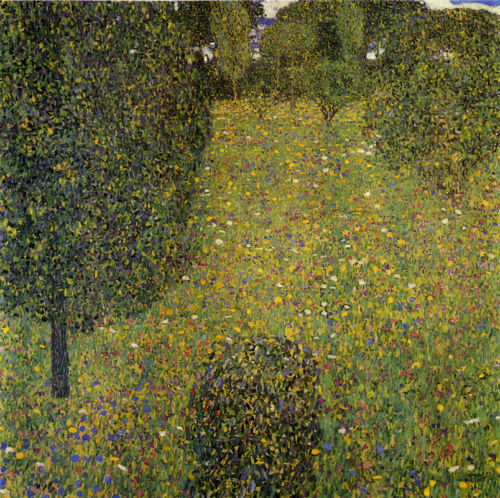
The Gustav Klimt painting often encountered in English as Landscape of a Garden is the signed canvas now catalogued as Blumenwiese (Blooming Meadow). Earlier museum and exhibition records called it Gartenlandschaft (Blühende Wiese) or Garden Landscape (Blooming Meadow). These names identify one square oil painting, not a lost garden scene or a sequence of versions.[1][4]
Sotheby's currently dates the work to circa 1908. Older scholarship placed it between about 1904 and 1906, and the Museum of Modern Art exhibited it as a circa-1906 Garden Landscape (Blooming Meadow) in 1986. The present dating is a reasoned catalogue revision based on landscape chronology, likely Attersee context and comparison with nearby works; it is not a newly discovered date written on the canvas or proof of a repainting campaign.[1][4]
Most of the 110-centimetre square is filled by a flowering meadow. A subtle route begins at lower left and becomes difficult to follow among scattered touches of colour. Darker tree masses hold a high horizon, while a narrow blue interval and white clouds prevent the scene from closing completely. The painting remains a recognisable landscape even as its vegetation approaches an autonomous field of marks.[1]
At a Glance
- ArtistGustav Klimt
- Current titleBlumenwiese (Blooming Meadow)
- Historical titlesGartenlandschaft, Gartenlandschaft (Blühende Wiese) and Garden Landscape (Blooming Meadow)
- DateCirca 1908 under the current Sotheby's record; older catalogues used circa 1904–06
- SignatureGustav Klimt, lower right
- Format110 × 110 centimetres
- MaterialsOil paint on canvas
- Probable early exhibitionsVenice Biennale and Galerie Miethke, both 1910
- Secure early ownerBroncia Koller-Pinell and Hugo Koller by 1928
- Later ownerLeonard A. Lauder, acquired from Serge Sabarsky Gallery in December 1985
- Recent saleSotheby's New York, 18 November 2025, reported result $86 million
- Current statusPrivate; buyer, present location and public display unverified as of 10 August 2026[1][2]
From Garden Landscape to Blumenwiese
The painting's title history is multilingual and unusually fluid. Records have used Gartenlandschaft, Gartenlandschaft (Blühende Wiese), Blumenwiese, Blumige Wiese, Prato fiorito, Meadow in Flower and Garden Landscape (Blooming Meadow).[1]
The variations do not imply different physical objects. Each combines two ideas in changing proportions: a garden or landscape setting and a flowering meadow. Sotheby's current Blumenwiese gives priority to the flower field that occupies most of the image.
“Landscape of a Garden” remains an understandable English doorway, but it is too generic to secure identity by itself. Klimt painted several gardens, orchards and flower fields. The governing evidence is the signed, 110 × 110 centimetre oil whose exhibition and ownership history reaches the Koller family, Serge Sabarsky, Leonard Lauder and the 2025 sale.[1]
That exact object also prevents confusion with the separate 1916 Gartenlandschaft mit Bergkuppe (Pfarrgarten), translated as Garden Landscape with Rounded Mountaintop (Parsonage Garden). The late Kunsthaus Zug painting has a visible hill, an unfinished classification and a different ownership history.[5]
The Signed Private Canvas
The physical anchor is a 110 × 110 centimetre oil on canvas signed Gustav Klimt at lower right.[1] Equal height and width place it within Klimt's established square landscape practice, but the measurement does not join it materially to another 110-centimetre painting or prove a coordinated series.
Unlike a museum object, Blumenwiese has no current public collection inventory. Its identity is carried by signature, dimensions, image, historic titles, exhibitions and provenance. A generic English caption alone would be insufficient; the agreement of those object-level records secures the canvas discussed here.
Auction photography permits sustained attention to the visible composition. It does not disclose every physical fact. The retained public record supplies no responsible basis for asserting an original frame, stretcher history, restoration campaign, pristine condition or current appearance under neutral conservation lighting.
The medium should likewise remain exact. This is oil on canvas. Golden-looking yellows are paint effects, not evidence of gold leaf, and no casein, metal, glass or textile is listed. Materials belonging to Klimt portraits or other landscapes cannot be inferred from visual resemblance.
Why the Current Date Is Circa 1908
Earlier authors assigned Blooming Meadow to circa 1904–05, 1905–06 or circa 1906. The MoMA catalogue's circa-1906 date became especially familiar through modern exhibition history.[1][4]
Sotheby's 2025 scholarship moves the canvas to circa 1908. The argument places it after Klimt changed his Attersee lodging from the Litzlberg area to Villa Oleander near Kammer and relates its handling to the concentrated garden paintings of the later decade. Possible motifs near Villa Oleander or Villa Paulick become more plausible under this chronology.[1]
The reasoning is art-historical rather than technical. The retained object record does not cite a dated inscription, X-ray discovery, pigment test or documentary letter naming this painting in 1908. “Circa” therefore remains essential.
Older dates still matter because they show how scholars have situated the work. They should not be presented as mistakes attached to separate canvases or as proof that Klimt worked on the painting continuously for four years. One signed object has moved within the catalogue as evidence and comparison have been reassessed.
A Meadow That Occupies the Square
The flowered ground rises through most of the composition. There is no broad foreground ledge, central tree trunk or architectural façade to divide it into stable zones. Instead, small strokes and dabs accumulate unevenly across a green field.[1]
Violet, yellow, white and darker green incidents vary in density. They are not uniform dots placed according to a simple formula. Some passages cluster; others leave more breathing space. Direction, scale and colour shift sufficiently to keep the meadow from becoming a repeated decorative unit.
The marks also work at more than one viewing distance. Close inspection separates short strokes, soft patches and sharper touches; stepping back allows them to cohere as uneven flowering growth. That change is central to the painting's visual life. The surface does not merely disguise an otherwise conventional meadow, and the meadow does not disappear when the paint becomes conspicuous.
There is no regular grid beneath the visible distribution. Dense concentrations can slow the eye, while open green intervals give neighbouring colours more force. The resulting rhythm seems organic without claiming to reproduce each plant stem by stem.
Sotheby's identifies wildflowers common to the Attersee region, including bellflowers, buttercups, clover, cornflowers, daisies and dandelions.[1] These names are a specialist reading of the painted ecology, not a scientifically complete inventory. The picture does not establish that every plant bloomed simultaneously at one surveyed spot.
The high horizon intensifies the meadow's dominance. A conventional landscape may balance ground with an extensive sky; here the sky is reduced to a slim upper interval. The field consequently feels tilted towards the viewer without ceasing to be ground.
The Nearly Absorbed Path
Sotheby's traces a subtle path from the lower-left corner towards the darker trees. It passes an ambiguous leafy or shadowed form before becoming difficult to distinguish from surrounding vegetation.[1]
The path is important precisely because it is not emphatic. It offers a way into the scene, then loses clarity among colour touches. The viewer alternates between following a route through space and scanning marks distributed over the canvas.
Nothing in the visible record turns this passage into a mapped garden walk, a named driveway or evidence of Klimt's own footsteps. No exact standing point or property boundary has been established. The path is best understood as a visible spatial suggestion within the brushwork.
Its near-disappearance separates Blooming Meadow from a garden composition organised around a clear opening. Movement is possible but not guaranteed. The painting asks how little directional information a landscape needs before it begins to feel like a self-sufficient surface.
Trees, Possible Fruit and a Narrow Sky
Darker green forms gather along the upper part of the meadow. They read as trees or dense shrubs and establish a middle distance without yielding individually mapped trunks. Yellow touches within them may, according to Sotheby's, indicate fruit that has not yet ripened.[1]
“May” is the governing word. The touches cannot secure apple or pear species, a harvest date, an owner of the orchard or a precise number of trees. Their visual role is clearer: they enliven the dark band and connect it chromatically with the flower field below.
Above the foliage, a narrow strip of blue and thick white cloud shapes retain atmosphere. Their restricted area makes them more consequential. Without that opening, vegetation might seal the square entirely. With it, the painting preserves weather, distance and an upper boundary.
The sky should not acquire technical findings from other Klimt landscapes. No object-specific analysis here identifies pigments, ground, binder or a sequence of cloud applications. Auction photography supports careful description, not conservation reconstruction.
Near Abstraction without Losing Place
At close range, the meadow can seem to dissolve into independent marks. At greater distance, their aggregate restores flowers, ground and the transition to trees. The painting keeps these modes in suspension rather than forcing a choice between representation and abstraction.
Calling the work “near-abstract” can describe that instability. Calling it an abstract painting would erase the path, vegetation, horizon and weather that continue to orient the viewer. Nor should the canvas be treated as a predetermined step towards a later movement.
The date matters to this balance. Under the older circa-1906 convention, the work appeared close to Klimt's increasingly decorative garden pictures. The circa-1908 position makes it a particularly free response after Cottage Garden with Sunflowers and Flowering Poppies, without turning any of those paintings into a study for another.[1]
Comparisons should stop at the problem they illuminate. The signed Belvedere Flowering Poppies owns its fruit-tree rows, conservation evidence, Kunstschau history and restitution chain. The private 1912 Orchard with Roses owns its more visible left-hand path and probable studio-garden context. None of their technical or ownership evidence belongs to Blumenwiese.
Possible Attersee Locations
The circa-1908 dating encourages a search around Villa Oleander, where Klimt stayed from that summer, and around nearby Villa Paulick. Sotheby's discusses these locations while acknowledging that the precise source of the meadow is unknown.[1]
Different elevated positions could help explain the field's steep rise and restricted sky. They remain proposals, not reconstructed easel coordinates. No working photograph, property plan, telescope placement or preparatory drawing fixes the view.
Klimt's letters document his practice of taking Japanese-art books into the landscape, and Sotheby's relates the painting's high viewpoint and compressed depth to that interest.[1] This provides a responsible general context. It does not identify one ukiyo-e print copied in the meadow or prove that a specific book was open beside the canvas.
The painting therefore belongs to a known Attersee working environment without becoming a topographical diagram. Its radical organisation may begin with observation while withholding the information needed to walk back to one exact patch of ground.
What Is Not Known about Its Making
No conservation dossier retained here establishes an underdrawing, transfer method, ground preparation, binding medium or hidden first composition. The circa-1908 argument comes from chronology and comparison, not from infrared reflectography or X-radiography.[1]
Visible passages can appear thin in one area and more loaded in another, but photography alone cannot support a complete order of application. It would be unsafe to say which flower was painted first, whether Klimt revised the path, or whether the narrow sky was planned from the outset.
No exact preparatory drawing or working photograph is assigned in the governing record. That absence describes current documentation rather than proving that Klimt never sketched or tested the motif. General knowledge of his square finder or optical aids cannot become object-specific evidence.
These limits protect the distinct evidence of other canvases. The graphite underdrawing and oil-resin findings published for Flowering Poppies, the X-radiographic changes in Cottage Garden with Sunflowers and the casein recorded in Pear Tree remain attached to those objects alone.
Monet, Seurat and Van Gogh as Comparisons
Sotheby's discusses Claude Monet, Georges Seurat and Vincent van Gogh when situating Blooming Meadow within the international modern landscape.[1] Each comparison clarifies a different possibility: cropping and immersion, divided touch, or an intensified relation between mark and vegetation.
These are contextual affinities rather than proved quotations. Klimt did not adopt a mechanically consistent Pointillist system, and the painting's marks vary too much to be reduced to one borrowed formula. Nor does similarity to a flower field by Van Gogh establish direct copying.
The comparisons are most useful when they return attention to the canvas. Klimt combines a steep field, unevenly distributed colour, dark foliage and minimal sky in a configuration that remains his own. A roll call of European modernists would obscure rather than explain that structure.
Probable Exhibitions in 1910
Sotheby's associates the painting probably with Prato fiorito, catalogue number 20 at the 1910 Venice Biennale. It also probably identifies it with Blumenwiese, number 3 in a Galerie Miethke exhibition later that year.[1]
Both matches are persuasive, especially because their titles describe a flowering field. They remain probable rather than secure. An exhibition title can coincide with a known painting without preserving enough measurements, ownership or imagery to close the identification completely.
The distinction prevents two overstatements. Venice should not automatically be called the painting's certain debut, and the Miethke listing should not be used to invent a sale or first owner. Probable presence is valuable evidence even when the transaction record remains incomplete.
Secure Exhibitions from 1928 Onward
The canvas was securely displayed in the 1928 Vienna Klimt memorial exhibition as Blumige Wiese. It was then loaned to the Austrian Gallery in 1933–34 under the shorter title Landschaft.[1]
Modern exhibitions record continuing changes in date and title. MoMA included it in Vienna 1900 in 1986 as Garden Landscape (Blooming Meadow), circa 1906.[4] It later appeared in major Klimt exhibitions in Zurich in 1992, Ottawa in 2001 and the Belvedere/Clark presentation of 2002–03.[1]
These venues document historical access, not current location. They also show why older title and date conventions remain widespread even after the 2025 catalogue revision.
Selecting the exhibitions by evidentiary role is more useful than listing every loan. The probable 1910 appearances address early identity; 1928 and 1933–34 anchor ownership-era display; later museum presentations document modern scholarship.
Broncia Koller-Pinell and the Koller Family
Broncia Koller-Pinell and her husband Hugo Koller owned the painting by 1928. The dated exhibition loan establishes their possession, although Sotheby's does not supply the work's complete history before that point.[1]
Koller-Pinell was herself a significant modern Austrian painter. That fact makes the work's presence in the household culturally meaningful, but it does not prove why or from whom the couple acquired it. No price, date of purchase or direct transaction with Klimt is established in the retained record.
Nor does her ownership prove a stylistic exchange responsible for the canvas. The work can be understood within a collecting household led partly by an artist without converting provenance into evidence that Koller-Pinell selected the motif, advised Klimt or altered the painting.
By 1949, the painting had descended to Rupert Koller and Silvia Koller. Family descent is secure at that stage; the exact legal instruments and dates between the documented anchors need not be invented.[1]
The 1928 and 1933–34 exhibition records add a useful distinction. A family could retain ownership while allowing the picture to enter a memorial show or museum loan. Public appearance does not by itself mark a sale, donation or transfer of title.
This Koller history distinguishes Blumenwiese from Klimt landscapes with Nazi-era seizure and restitution records. The published chain used here does not identify the canvas as confiscated, forcibly sold or restituted.
From Schebesta to Serge Sabarsky
Sotheby's provenance next names the heirs of Kunsthandlung Franz Schebesta, followed by a private collection in Vienna and Serge Sabarsky Gallery, New York. Sabarsky had the painting by 1983.[1]
Several transitions remain undated or only broadly situated. It would be misleading to fill them with invented consignment terms, prices or continuous custody. A published sequence can be useful while remaining incomplete.
Leonard A. Lauder acquired the painting from Sabarsky Gallery in December 1985.[1] The transaction begins a clearly dated forty-year association with a major private collection. It does not require a survey of Lauder's other art or an assumption that the canvas was continuously on public view.
The provenance therefore has a different evidentiary shape from Farmhouse with Birches and the lost Garden Path with Hens. It contains private and dealer gaps, but the retained sources do not attach a persecution claim or restitution case to this object.
The $86 Million Sale in November 2025
Sotheby's offered Blumenwiese in the Leonard A. Lauder Collection Evening Auction in New York on 18 November 2025. The auction house reported a result of $86 million.[1][2][3]
That figure belongs to a dated transaction. It does not measure permanent artistic worth, establish the painting's place in a universal ranking or disclose its condition beyond what the sale record responsibly states. Slightly different rounded totals in secondary reports should not replace the auction house's own figure.
The public record retained here does not identify the buyer. It also does not confirm a present city, storage site or planned museum loan. A high-profile sale can make an image widely visible while leaving physical access private.
The sale also did not rename or redate the picture by financial force. Sotheby's supplied the current catalogue argument before the bidding, and the result records what happened at one auction. Ownership changed; the signed canvas remained the same object traced through earlier titles and exhibitions.
As of 10 August 2026, no current public display was verified. The 1986 MoMA exhibition, 2001 Ottawa loan, 2002–03 Belvedere/Clark presentation and 2025 pre-sale viewing are past events rather than a current itinerary.
Why Blumenwiese Matters
The painting does not abolish landscape; it makes landscape difficult to stabilise. The path nearly disappears, the meadow rises steeply, tree forms hover between mass and foliage, and only a narrow sky keeps the field from closing.
Its title and date history sharpen that achievement. Garden Landscape foregrounds place, while Blooming Meadow foregrounds surface and growth. The older circa-1906 date and present circa-1908 position similarly alter the neighbouring works through which viewers understand it, without changing the identity of the signed canvas.
The current evidence also rewards graded certainty. Two 1910 appearances are probable; the 1928 exhibition and Koller ownership are secure. The route through later dealers has open intervals; Lauder's acquisition and the 2025 sale are exact. The buyer and current location remain unknown.
Holding those levels apart allows the painting to remain visually adventurous without becoming historically vague. Its flower field may approach abstraction, but its object history depends on precision.
Frequently Asked Questions
References
- Sotheby's, “Blumenwiese (Blooming Meadow),” lot 11, Leonard A. Lauder Collection Evening Auction, New York, 18 November 2025; current title and circa-1908 date, signature, medium, measurements, title/date scholarship, visual and site analysis, probable and secure exhibitions, provenance and auction record. View source. Accessed August 2026.
- Sotheby's, “Historic Night at Sotheby's Continues as White-Glove Leonard A. Lauder Collection Totals $527.5 Million,” 18 November 2025; $86 million result and sale date. View source. Accessed August 2026.
- Sotheby's, “New York Sales — November 2025 Evening Auctions”; object-focused sale summary and reported price. View source. Accessed August 2026.
- Museum of Modern Art, Vienna 1900: Art, Architecture & Design, exhibition catalogue, 1986; historical Garden Landscape (Blooming Meadow) title and circa-1906 dating layer. View source. Accessed August 2026.
- Gustav Klimt Database, “The Final Years: 1914–1918”; identity control for the separate 1916 Garden Landscape with Rounded Mountaintop (Parsonage Garden). View source. Accessed August 2026.
Discussion
Landscape of a Garden: Blumenwiese rewards close attention to source context, object identity and careful reproduction boundaries.