



 by Tom Gurney
Tom Gurney BSc (Hons) is an art history expert with over 20 years experience
Published on August 21, 2026 / Updated on October 23, 2026
Email: tomgurney1@gmail.com / Phone: +44 7429 011000
About The Kiss
Few paintings are more instantly recognisable than Gustav Klimt's The Kiss. That familiarity can be deceptive. Reproductions encourage the eye to register a golden rectangle, a kneeling woman and a man bending towards her, then move on as if the picture's meaning were already settled. The original is less compliant. Its metallic surface changes as the viewer moves. Its figures appear at once sheltered and precarious. The embrace seems tender, yet the woman's body folds beneath the man's weight and her feet approach the edge of the flowered ground. Even the title promises something the painting withholds: his lips touch her cheek, not her mouth.
Klimt made the picture at the height and near the end of his so-called Golden Period. It is not simply a painting with gold added to it. Gold, silver, platinum, brass, resinous colour, graphite drawing and ordinary paint are organised into different zones, each with its own physical character. Human skin remains vulnerable and comparatively unadorned. Pattern claims the clothed bodies. Metal turns the surrounding field into something between atmosphere, wall, icon and precious object. The result is both intimate and monumental: a private gesture enlarged to the scale of a public image.
The work also has a more complicated beginning than its serene appearance suggests. It was exhibited unfinished under the title Lovers in 1908, purchased for the Austrian state collection while the exhibition was still running, substantially revised afterwards and delivered in completed form in 1909. Its transformation from Lovers to The Kiss occurred alongside changes to the figures, clothing and flowered ground. Looking closely therefore means following not only a couple's embrace but a work in motion—drawn, gilded, displayed, acquired, retitled and altered before becoming the apparently inevitable masterpiece now in the Belvedere.
At a Glance
- ArtistGustav Klimt
- TitleThe Kiss (Lovers); German: Der Kuss (Liebespaar)
- Datec. 1907–1909
- MediumOil-resin colours, gold, silver, platinum and brass on primed canvas
- Dimensions180 × 180 cm
- LocationBelvedere, Vienna; normally displayed at the Upper Belvedere
- SignatureGVSTAV / KLIMT
- First exhibitionVienna Kunstschau, 1908, under the title Lovers
- AcquisitionApproved for the Modern Gallery in July 1908, before the painting was finished
- Essential detailThe man's mouth touches the woman's cheek. The title describes a kiss, but the couple's lips do not meet.
Annotated Details from The Kiss
Use the numbered points to test the painting's familiar golden surface against the details that make the embrace unstable, material and theatrical.
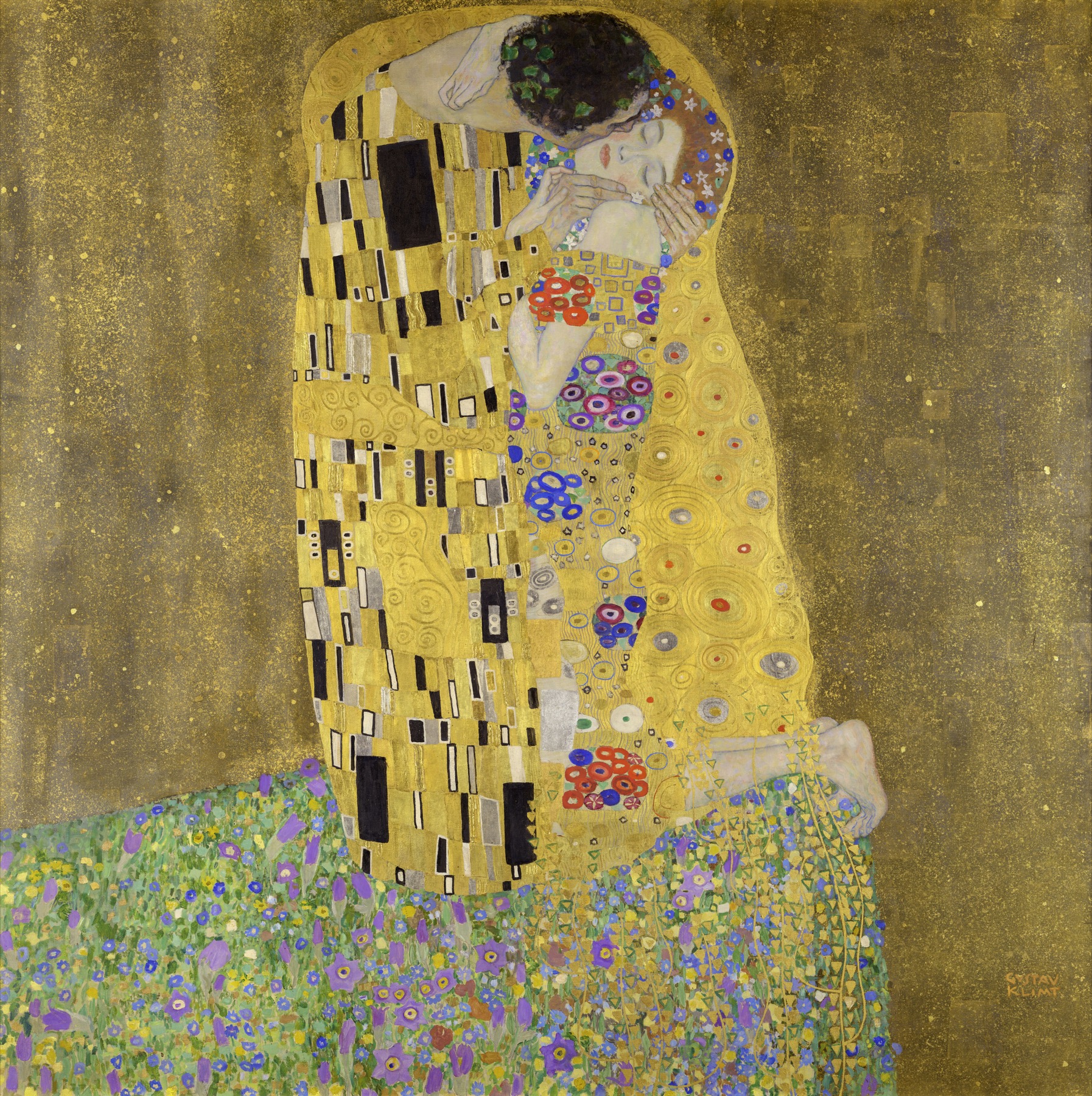
Details from THE KISS
These close views use the high-resolution public-domain source while keeping annotation markers in CSS rather than in the image file.
Gold field
The metallic surround is not passive background: it presses the figures into a precious, icon-like space.
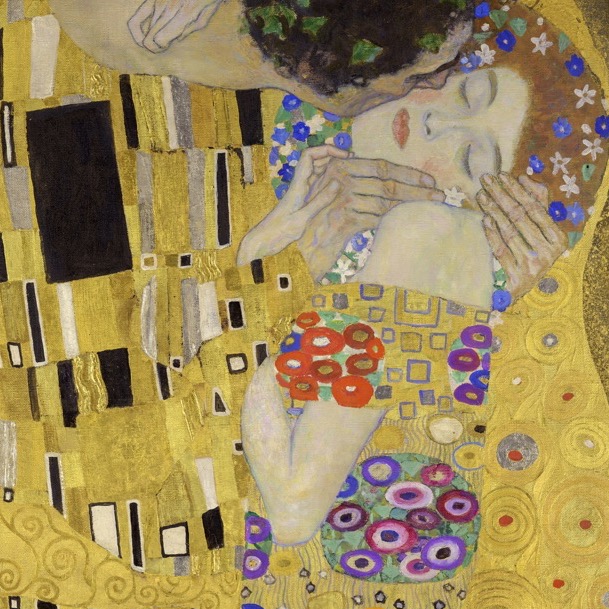
Heads and contact
The man's kiss lands on the cheek, while the woman's turned face keeps the scene more ambiguous than the common title suggests.
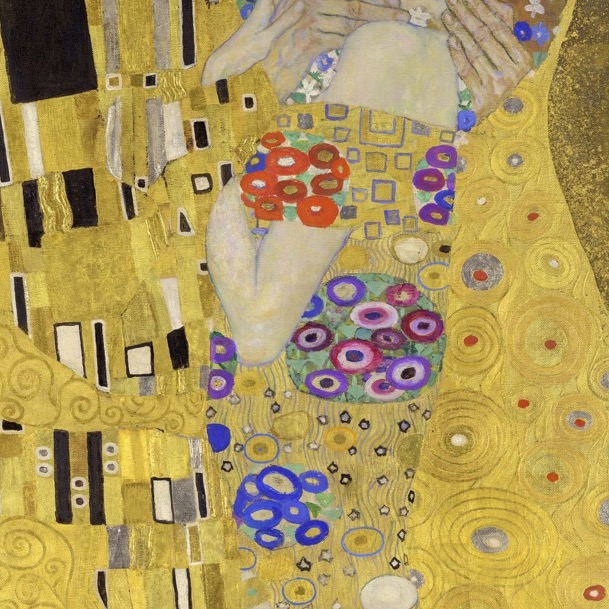
Contrasting garments
Rectangles and circles separate the two clothed bodies before the gold field pulls them back together.
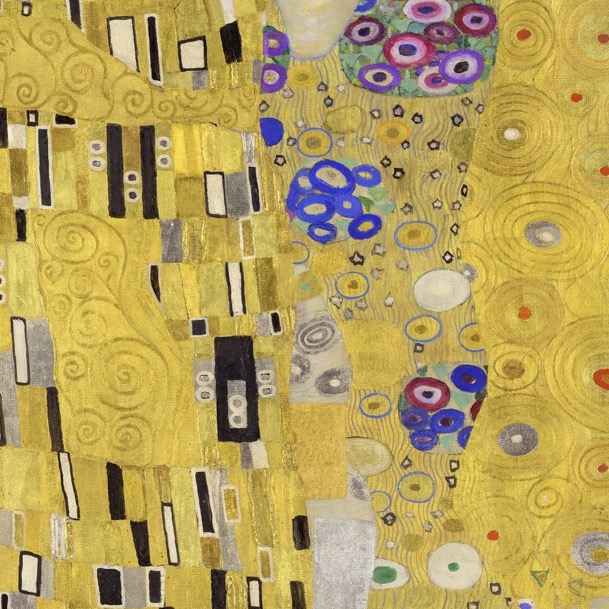
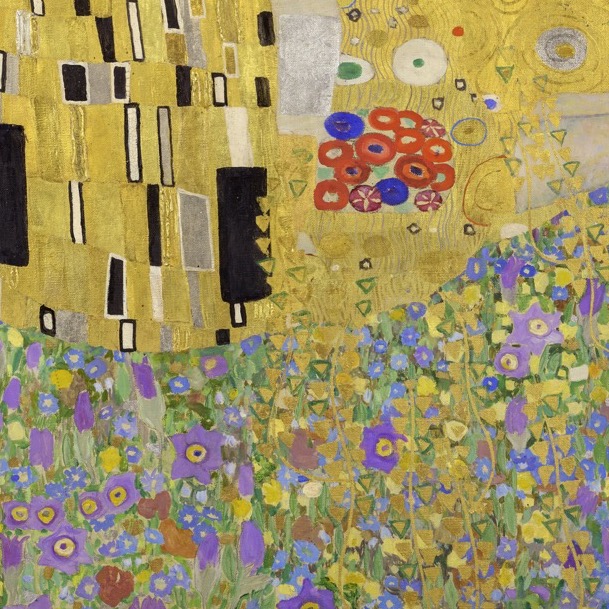
Flowered brink
The couple kneels on a decorated edge rather than a stable landscape, giving tenderness a note of risk.
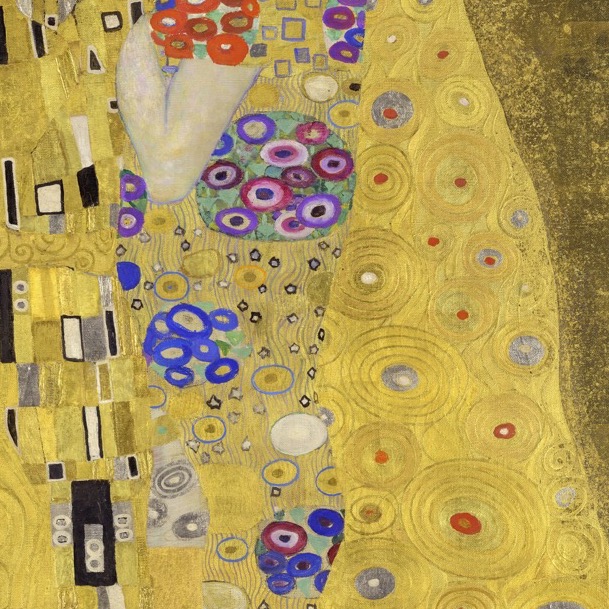
Hands
Hands carry much of the drama: holding, receiving and resisting are all compressed into small gestures.
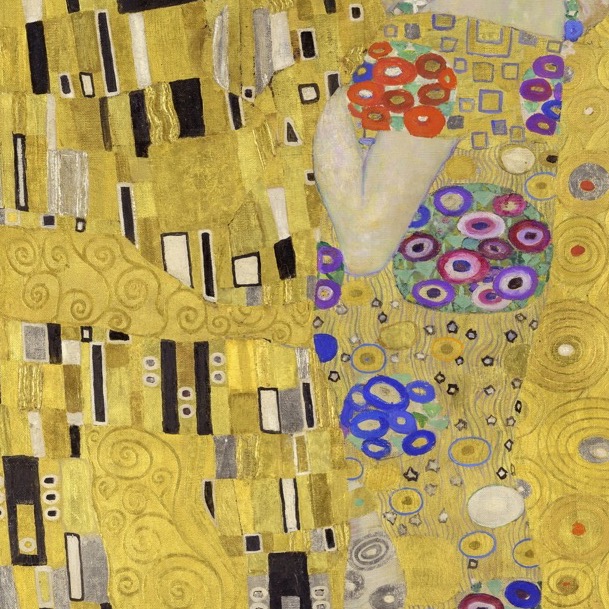
Bare skin
The comparatively plain skin keeps the bodies vulnerable inside the lavish surface.
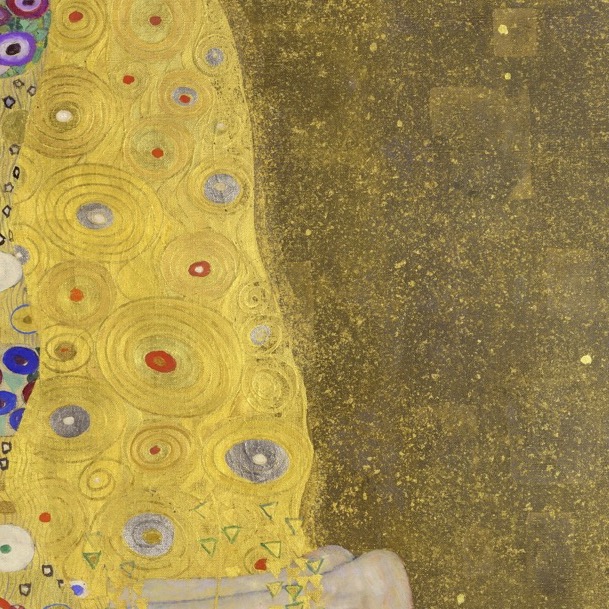
Picture edge
The vertical format tightens the couple against the borders, making the embrace feel staged and enclosed.
What Is Happening in the Painting?
A man bends over a kneeling woman and encloses her within a broad, patterned cloak. His left hand cups the side of her face. His right hand turns her head gently but decisively towards him. Her eyes are closed. One arm reaches around his neck; the other rises between them, her fingers touching his hand. He kisses the upper part of her cheek, close to her temple.
That description sounds straightforward, but Klimt makes the bodily arrangement deliberately hard to resolve. The man's lower body disappears inside his garment. The woman's dress merges with the cloak and the surrounding gold. Her knees appear to rest on a flowered ledge, yet the direction of her torso and the extension of her legs make the pose feel unstable. There is no furniture, room or horizon by which to measure their position. They might be outdoors on a meadow, suspended in a golden void, or contained within an ornamental space that has no ordinary depth.
The picture is a square, and its central mass is almost rectangular. The couple's joined silhouettes occupy much of the surface, leaving only a relatively narrow field of stippled metal around them. The man's head breaks the upper contour. Below, the flowered ground interrupts the otherwise abstract field and supplies a fragile footing. Its outer edge curves downward at the right, close to the woman's bare toes. Behind that edge there is no visible earth—only more gold. What could have been an idyllic bed of flowers therefore also resembles the brink of a cliff.
Klimt balances this unease with extraordinary visual cohesion. The man's bowed head follows the curve of the woman's face. Their hands create a chain of touch around her head and shoulder. The dark crown of leaves in his hair answers the flowers in hers. His cloak and her dress remain distinguishable, but their patterned surfaces lock together inside a larger golden shape. The picture never decides entirely whether two people are joining or one richly decorated image is absorbing them both.
A Kiss That Does Not Meet the Lips
The most famous action in the picture is also one of its most frequently misdescribed details. The man does not kiss the woman on the mouth. Her face turns outward and downward; his mouth presses against her cheek. The small physical gap between their lips matters because it prevents the composition from becoming a perfectly reciprocal seal.
Her closed eyes and lifted arm can suggest pleasure, repose or trust. Her fingers curve around his neck, and her hand meets his. Nothing in the painting requires a reading of resistance. Yet neither does her posture provide unambiguous equality. He is upright and bends from above. His hands guide her face. Her body is kneeling, exposed at the shoulder and gathered close to the ledge. The embrace can appear protective from one angle and enclosing from another.
That instability helps explain why the painting can support very different responses without becoming vague. It presents physical tenderness with enough asymmetry to keep interpretation active. The cheek kiss is affectionate, but it is not the mutual lip-to-lip union a casual memory of the painting often supplies. Klimt makes fulfilment visible as an approach, a pressure and a surrounding field rather than as an unequivocal conclusion.
The historical titles intensify the ambiguity. At the 1908 Kunstschau the work was called Lovers. By autumn 1909 it appeared in a museum catalogue as The Kiss. The first title names a relationship; the second names an action. Neither tells us who the figures are, what has just happened, or what will happen next. The change nevertheless encouraged the later concentration on a single gesture, even though the gesture itself remains slightly displaced from the expectation created by the word “kiss.”[1]
Two Bodies, Two Pattern Languages
Klimt differentiates the figures most clearly through ornament. The man's cloak is structured by vertical blocks, elongated rectangles and darker compartments. Black, white, grey and metallic tones give the pattern a weight and directional force that follow his upright body. Some forms resemble bars or mosaic tesserae; others appear to float on top of the gold.
The woman's dress is more fluid. Circular and oval motifs, concentric forms, coloured blossoms and curling lines spread across its surface. Her garment widens over the flowered ground and becomes difficult to separate from it. The distinction between geometric male pattern and rounded female pattern is conspicuous, and it belongs to a larger tendency in Klimt's art to code bodies and identities through ornament.
It would be too simple, however, to treat the patterns as a fixed dictionary in which every rectangle means “male” and every circle means “female.” The motifs cross and answer one another. Small circular forms enter the man's zone, while the woman's garment includes firmer vertical elements. Both figures are joined by the same gold. Their pattern languages distinguish them, but the surrounding metallic unity also threatens to erase that distinction.
The faces, hands and feet are painted differently from the clothes. Flesh is modelled with soft changes of colour and retains the irregularity of living bodies. The man's neck, the woman's reddened cheek, the shadows beneath her eyes and the delicate pressure of fingers all belong to a more naturalistic mode. Klimt places this vulnerable flesh beside hard, reflective metal and highly controlled pattern. The contrast makes touch feel more immediate: skin encounters skin inside a world that otherwise resists ordinary bodily depth.
The woman's face is especially important. It is the clearest area in the composition, turned towards the viewer yet withdrawn behind closed eyes. Her features do not dissolve as completely as her body. The face preserves personhood inside an image that converts nearly everything else into surface. Because her expression cannot be reduced to a single emotion, it becomes the painting's quietest and most persistent uncertainty.
The Flowered Edge
At the couple's feet, Klimt paints a compact meadow filled with small flowers. White daisies, bright dots, leafy marks and scattered blooms form a dense strip beneath the metallic robes. The ground introduces colour, texture and the suggestion of nature into an otherwise indeterminate setting. It also provides the strongest evidence that gravity still operates.
The meadow is not a broad landscape. It has no visible continuation into distance, and it ends abruptly. The woman's toes curl near its descending edge; thin golden extensions below her dress emphasise the downward pull. The man appears more securely planted, although his feet are hidden. Their enclosure can therefore be seen as a refuge at the limit of habitable space.
This threshold is one reason the painting feels more dramatic in person than in many reproductions. Cropped or flattened images often turn the flowers into a decorative border. At full scale the relation between the 180-centimetre square and the couple's footing becomes bodily. The viewer confronts a near life-size mass whose lowest forms seem to hover above an undefined drop. Love appears not in a stable garden but at a boundary.
The flowers also connect the human figures to the surrounding ornament. Blossoms are scattered in the woman's hair and across her dress. Coloured circular forms descend from garment to meadow until the distinction between textile motif and living plant becomes uncertain. Klimt does not simply set a patterned couple in nature. He allows clothing, body and ground to exchange visual properties.
Gold as Material, Light and Distance
Calling The Kiss a “gold painting” is accurate but incomplete. Its metallic field is not one uniform layer, and the gold is not merely a colour imitated in paint. Technical examination by the Belvedere has identified gold, silver, platinum, brass and other materials used in different combinations. The work changes with illumination because these substances reflect light differently from painted pigment.[1]
Klimt began on a lightly primed canvas with a graphite underdrawing, then fixed that drawing with a thin, transparent glaze. Broad areas received metal leaf and metallic preparations. A dark brown oil-resin glaze helped establish the surrounding tone. Small flakes of gold, platinum and brass were scattered across portions of the surface. The Belvedere's technical account compares this sprinkling of metal with effects found in Japanese maki-e lacquer, where metallic powder or flakes form luminous decoration.[1]
Different zones were built in different ways. Much of the man's cloak was gilded and then enriched with raised ornament, metal and paint. The woman's garment combined brass and gold with coloured motifs through another layered procedure. The meadow, hair and flesh were not simply laid over one continuous metallic foundation. Ordinary pigments, including vermilion and cobalt, remained essential to the living and floral parts of the work.[1]
These distinctions are not technical trivia. They shape the meaning of the picture. The gold can feel infinite because it refuses the conventional depth of a painted background. It can also feel dense and manufactured because raised elements and overlapping layers reveal the labour of making. Light seems both to come from the room and to belong to the painting. As the viewer shifts position, one metal brightens while another recedes. The embrace is surrounded by an atmosphere that is physically present yet pictorially impossible.
Gold had many possible historical associations for Klimt and his audience. Byzantine mosaics, medieval sacred backgrounds, Japanese lacquer and other East Asian arts all offered models for images in which precious surface does more than imitate the visible world. Klimt had seen the sixth-century mosaics of Ravenna, and his mature works repeatedly test what happens when the materials of decoration, craft and luxury enter ambitious painting. The Belvedere describes his metal use as a challenge to purely mimetic art: gold does not pretend to be sunlight on an object; it is a light-bearing object in itself.[3]
In The Kiss, this history need not make the lovers saints or transform the painting into a religious icon. The analogy is visual, not doctrinal. The gold removes the figures from ordinary time and place while lending their gesture the gravity of a ritual image. At the same time, the patterned robes recall textiles, jewellery, mosaics and designed interiors. Klimt joins sacred splendour to the modern ambition to dissolve boundaries between painting and the applied arts.
Drawing the Embrace
The apparent completeness of the final design conceals a long process of searching. Klimt produced studies of standing and kneeling lovers, examining how two figures could become one contour without losing the pressure of individual bodies. A drawing known as Standing Pair of Lovers, Seen from the Side, made around 1907–1908, already brings together several elements that would matter in the painting: a couple on a raised ground, a rose-like plant, enveloping robes and a strong contrast between patterned clothing and exposed heads.[2]
The surviving sheets do not function as a simple storyboard. Klimt repeatedly changed the inclination of heads, the positions of arms and the relationship between standing and kneeling. Drawing allowed him to locate the emotional event in gesture before translating bodies into metallic pattern. The works on paper are often spare, with lines concentrating on neck, shoulder, hands and the fall of cloth. Ornament could be added later; the bodily hinge had to be found first.
The Wien Museum preserves design studies connected with The Kiss and the Stoclet Palace project. Seen together, they show that the embracing couple was not an isolated invention. Klimt varied the motif across drawings, paintings and decorative commissions, using it to investigate union, enclosure and the boundary between figure and surface.[4]
One important comparison is Fulfilment, the embracing couple in the mosaic frieze designed for the dining room of the Stoclet Palace in Brussels. Its bodies also merge within rich ornament, but the architectural setting and mosaic execution give the embrace a different rhythm. The relation does not make one work a rehearsal for the other in any simple sense. It shows Klimt developing a family of solutions to the same formal question: how can an embrace become a complete decorative unit while retaining human tenderness?
The motif also has precedents beyond Klimt's own work. Edvard Munch's The Kiss, known in versions from the 1890s, fuses two faces into a shadowed, nearly indivisible mass. Klimt's light, materials and bodily arrangement are markedly different, but the comparison clarifies a shared modern problem. A kiss could be represented not merely as romantic anecdote but as a disturbance of separate identity.
The Golden Period at Its Zenith
The name “Golden Period” is a later convenience, not a programme Klimt announced with fixed dates. It usually describes the years in which he gave metallic materials and ornament a commanding role in paintings such as Judith I, the first portrait of Adele Bloch-Bauer and Hope II. The Kiss, developed from about 1907 to 1909, stands near the period's culmination and its endpoint.[1][2]
By then Klimt had moved far from the illusionistic history painting on which his early professional success was built. The controversy surrounding his ceiling paintings for the University of Vienna had made public commissions increasingly fraught. Private portraits, landscapes, allegories and exhibition pieces gave him greater control. At the same time, his association with the Vienna Secession and the wider culture of Viennese design encouraged him to treat a painting as part of a world in which architecture, furniture, textiles and graphic art might share formal principles.
The Kiss condenses these developments without becoming a manifesto. Its square format recalls the designed regularity of a panel or wall field. Its relief-like ornament brings the handmade object to the front. Its modelling of flesh preserves Klimt's academic mastery while setting that mastery against deliberate flatness. The painting does not choose between fine art and decoration; it makes their collision its subject.
The work's date also matters because Klimt did not continue using gold at this intensity indefinitely. After 1909, colour often took on greater independence in his portraits and landscapes, while pattern remained crucial in different forms. The Kiss therefore looks both like a triumphant synthesis and a threshold. It gathers the visual vocabulary of the Golden Period at the moment Klimt was beginning to move beyond it.
The 1908 Kunstschau
The painting first appeared publicly at the Vienna Kunstschau of 1908, a vast exhibition organised outside the Secession's regular programme. The show ran from 1 June to 15 November and brought architecture, painting, sculpture and applied arts into a purpose-built environment. Klimt was its central artistic presence, showing sixteen paintings and eighteen drawings across three rooms.[1][2]
Lovers, as the painting was then titled, received an exceptionally prominent position opposite the entrance to one of Klimt's rooms. It faced The Three Ages of Woman, creating a visual conversation between erotic union and the female life cycle. This installation belonged to a designed sequence rather than a neutral row of pictures. Viewers met Klimt's figures within an environment intended to assert the modern unity of arts.[1]
The painting was not finished when the exhibition opened. A photograph by Moriz Nähr records the earlier state, particularly the unresolved lower-left portion. The incomplete condition is striking because the work was already coherent enough to command the room and attract official attention. It also means the first public saw a materially different Kiss from the one now familiar.[1]
On 10 July 1908, while the Kunstschau was still open, the acquisition committee of the Modern Gallery decided to purchase the picture. The price was 25,000 crowns, the highest the institution had paid for a work by a living artist. The decision carried symbolic weight. Klimt's difficult relationship with official culture had included bitter disputes, yet the state collection now secured an unfinished modern work at a record price.[1]
The sale was not a commission. Klimt had not made the painting to satisfy a government brief. The institution chose a work already underway and publicly exhibited. This distinction helps preserve the painting's artistic independence while also showing how quickly its importance was recognised.
A State Purchase After Public Conflict
The acquisition carried a significance that price alone cannot explain. Klimt's relationship with Austrian official culture had been badly strained by the Faculty Paintings commissioned for the University of Vienna. Critics, professors and politicians attacked those allegories; Klimt eventually returned the commission payments and recovered the works. He did not become an artist obediently reconciled with state expectations.
Against that background, the purchase of Lovers marked a change in institutional recognition without pretending the earlier conflict had disappeared. The Modern Gallery acquired a work conceived independently, displayed in an artist-led exhibition and still visibly unfinished. The museum did not validate Klimt by persuading him to return to an official programme. It responded to the authority he had established outside one.
The timing also reveals an unusually confident act of collecting. Museums often wait until reputations and objects have settled. In July 1908, the title was not yet the one that would become famous, the composition had not reached its final state, and the completed canvas had not been delivered. The committee purchased a developing work and accepted that Klimt would continue to control its form.[1][5]
That arrangement complicates the familiar opposition between radical artist and conservative institution. The same public culture that had rejected aspects of Klimt's art could also preserve one of his boldest experiments. Institutional history is rarely consistent. Different commissions, committees and moments produce different outcomes.
The record price of 25,000 crowns made the choice visible. It announced that a modern Austrian artist could command the gallery's strongest financial commitment while still alive. Yet the work's later fame should not make the decision seem risk-free. The museum bought an unresolved painting from a controversial figure because its significance was already persuasive.
The purchase also secured the canvas within Vienna. Its later identity as an emblem of the city depends on this early entry into the state collection. International exhibitions helped establish Klimt's reputation, but the painting's long residence at the Belvedere created repeated local encounters across generations.
A Masterpiece Revised After Its Triumph
Acquisition did not freeze the composition. After the Kunstschau, Klimt continued to alter it. Technical imaging and comparison with the exhibition photograph reveal changes to the clothing, flowers, limbs and contours. The man's cloak acquired revised ornament. The woman's form was strengthened and her lower legs lengthened. Flowers were added or adjusted in the meadow. Her left forearm, initially more covered, became clearer. Beneath the final image, investigators have even found evidence that the man was first drawn with a beard.[1]
These revisions complicate the idea of effortless perfection. Klimt's golden surfaces can look so resolved that they seem conceived all at once, but the work contains second thoughts. Pattern was not applied after the “real” painting was complete; it was part of the continuing act of composition. Changing a rectangle, contour or floral cluster could alter the balance of bodies just as decisively as changing a hand.
The unfinished state also raises an intriguing question about public response. The work achieved institutional success before Klimt had made his final decisions. Its later status cannot be explained solely by those revisions, yet the adjustments sharpened many features now central to interpretation: the woman's extension towards the ledge, the distinction between garments, and the integration of the flowered ground.
Klimt completed the picture in June 1909 and delivered it the following month. By autumn, the museum catalogue used The Kiss. The change in title and the final phase of painting were not necessarily a coordinated campaign, but together they mark the passage from an exhibited work in progress to the museum object known today.[1]
Was the Couple Gustav Klimt and Emilie Flöge?
The proposed identification of the lovers as Gustav Klimt and Emilie Flöge is attractive, frequently repeated and unproved. Flöge was a pioneering Viennese fashion designer and Klimt's closest lifelong companion. Their correspondence, shared summers and family connections establish profound intimacy, but the exact nature of their relationship remains uncertain. Klimt also resisted straightforward self-portraiture and rarely supplied explanations that would settle the identities in his allegorical works.
Some evidence keeps the suggestion alive. A 1908 brooch designed around an embrace has been connected with the initials of Klimt and Flöge. Preliminary work for The Kiss included a bearded man, which could loosely evoke Klimt's appearance. The picture also emerged during years when the embracing pair recurred in his work and private visual culture.[1][2]
None of this amounts to identification. The final man is not a portrait in the conventional sense, and the woman's features do not securely establish Flöge. Klimt could draw on personal feeling without illustrating a particular episode or fixing the figures as named individuals. The safest conclusion is not that biography is irrelevant, but that it operates as one possible source among several.
This uncertainty serves the painting's larger effect. Unnamed figures can become archetypal more readily than documented sitters. Yet turning them into a generic symbol should not erase their physical specificity—the angle of her body, his pressure from above, the distinct patterns that organise each person. The painting is universal partly because it refuses to say exactly whose experience it contains.
Love, Myth and Allegory
The work has often been read as an allegory of love. Its isolation of the couple, precious materials and absence of a specific narrative support that view. The golden surround removes the embrace from a dated room or recognisable landscape. The pair seem to occupy a symbolic condition rather than a moment in everyday life.
Scholars have also compared the figures with mythic and literary lovers: Cupid and Psyche, Dionysus and Ariadne, or Paolo and Francesca. Such parallels can illuminate the cultural memory around an embracing couple, but the painting includes no attribute that securely selects one story. Klimt's achievement lies partly in creating the intensity of myth without committing the scene to a mythological plot.[1]
The edge of the meadow encourages another allegorical approach. Love may offer shelter at the brink of nothingness; desire may suspend awareness of danger; the golden field may describe fulfilment or the loss of an external world. These interpretations remain proposals rather than translations of a code. The canvas supplies formal pressures—enclosure, instability, touch, disappearance—from which meanings grow.
Klimt's unwillingness to explain his works should make the viewer cautious, not silent. Interpretation is strongest when it begins with observable relations. The man's greater height and the woman's kneeling pose are visible. Whether they signify protection, surrender, domination, ecstasy or some unstable combination depends on how the whole composition is weighed.
Gender, Power and Consent
Modern feminist readings have productively challenged the assumption that The Kiss is an uncomplicated image of mutual romance. The man's body controls the upper composition. His face is largely hidden, while his hands direct the woman's head. She is lower, more exposed and closer to the edge. The division between angular and rounded ornament may reinforce culturally gendered oppositions between firmness and softness, action and receptivity.[1]
These observations do not force a single verdict. The woman's left arm encircles him; her hand engages his; her face can appear peaceful. The painting does not depict explicit struggle. But the absence of struggle is not the same as perfect symmetry, and the viewer should not allow the golden beauty to settle every question in advance.
The most compelling account holds tenderness and power together. Klimt presents a gesture in which care can shade into possession and surrender can include agency. The woman's face remains visible precisely where the man's does not. Although he surrounds her bodily, her expression dominates the emotional reading. She is not merely an ornamental accessory; her inwardness is the picture's human centre.
The work's popularity has often simplified this tension. It is easy to reproduce the couple as a sign for romance while cropping away the ledge or ignoring the cheek kiss. Returning to the full composition restores its difficult balance. The image endures not because it answers every question about love, but because it gives love an attractive form that remains open to doubt.
How the Painting Creates Intimacy Without a Room
Traditional scenes of lovers often use a setting to define privacy: a bedroom, garden, doorway or secluded landscape. Klimt removes almost all such narrative information. There is no time of day, architecture, weather or accessory. Even the meadow is too narrow to become a believable place.
This removal turns space into emotion. The gold presses forward rather than receding, so the couple seem close to the surface and to the viewer. At the same time, their absorption closes them off. We see the woman's face but do not receive her gaze. The man turns away from us. Their intimacy is publicly exposed and psychologically inaccessible.
The square format contributes to this sealed quality. Unlike a tall portrait or a wide narrative, the canvas does not strongly direct the eye towards an exterior continuation. Its dimensions create a self-contained field. The couple fill it like a monumental emblem, while the uneven lower edge keeps that emblem from becoming static.
Klimt's patterned surfaces also alter the normal relationship between figure and ground. The figures do not stand in front of the background so much as emerge from and return to it. Their clothing becomes a bridge. The embrace therefore occurs not only between two people but between modelling and flatness, body and ornament, image and object.
Looking From Across the Room and Up Close
The Kiss rewards two almost opposite kinds of looking. From a distance, the couple forms one immense sign. The man's cloak supplies a dark-edged column; the woman's dress flares beneath it; the two heads close the shape at the top. Individual metallic marks merge into a golden atmosphere. The subject can be grasped almost instantly, which helps explain the painting's extraordinary recognisability.
At close range, that unity breaks apart. The broad field resolves into flakes, glazes, leaf and uneven reflections. Raised pattern interrupts smooth areas. Small differences between platinum, silver, brass and gold become active as the viewer changes position. The figures' supposedly seamless robes reveal joins, revisions and distinct methods of application. What seemed like a single radiance becomes a record of many decisions.
The faces and hands undergo the reverse transformation. At a distance they appear as small naturalistic islands surrounded by ornament. Close inspection reveals how little modelling Klimt needs to make a finger press, a cheek warm or an eyelid close. These quiet tonal changes are not overwhelmed by the metal; the metal makes them seem more fragile. The physical fact of skin gains intensity because so much of the painting refuses the softness of skin.
The movement between near and far also changes the narrative. From across a gallery, the image reads as union. Close to it, one becomes more conscious of separated gestures: his thumb at her jaw, her fingers at his hand, the gap between their mouths, the awkward turn of her neck and the extension of her toes. The emblem resolves into a sequence of contacts. Klimt's design is powerful because neither scale cancels the other.
This dual address distinguishes the canvas from a small private picture. At 180 centimetres square, it can command an architectural space and hold its own within a designed exhibition room. Yet its decisive events are minute. A viewer is drawn towards the cheek kiss and the fingertips, then pushed back by the need to recover the entire square. Intimacy is not achieved through smallness; it is staged inside monumentality.
The surrounding gold participates in this shifting relation. From afar it can appear empty, an infinite field free of worldly information. Nearer, it is densely worked and materially specific. It is “nothing” in the narrative sense but emphatically something as an object. That paradox prevents the background from functioning as mere atmosphere. The field removes the lovers from ordinary space while continually reminding the viewer of the canvas in front of them.
The painting's best-known reproductions necessarily fix one illumination and one distance. They can transmit the design, colour relations and pose, but not the sequence by which different metals flare and dim. The original therefore does not simply offer a larger version of the familiar image. It adds time: the time of walking, adjusting, approaching and retreating. Klimt makes the viewer's movement part of the work's changing visibility.
From Vienna to an International Icon
After entering the Modern Gallery, The Kiss was shown internationally in Rome in 1911 and Dresden in 1912. It spent most of its later life in the Austrian collection, surviving political upheaval and wartime evacuation. It has been associated with the Upper Belvedere display since 1954 and has rarely travelled in recent decades; the Belvedere records its last major external loan as Rome in 1997.[1]
Its institutional stability helped make it a cultural emblem of Vienna around 1900. The painting offers a compact image of qualities now associated with that moment: gold, ornament, eroticism, psychological ambiguity and the breakdown of boundaries between high art and design. Yet its fame also exceeds its historical setting. Viewers who know little about the Secession or Habsburg Vienna can respond immediately to the held face, closed eyes and surrounding light.
That accessibility has a cost. Repetition can drain the work of strangeness. Gold becomes “luxury,” the figures become “romance,” and the title becomes a complete explanation. The original restores resistance through scale and changing reflectivity. Metal can appear dull, brilliant or dark depending on the angle. Raised ornament makes the surface uneven. The empty gold is full of material events.
The picture's afterlife is therefore best understood as a continual negotiation between recognition and rediscovery. Its outline is easy to remember; its actual construction is not. Every serious encounter must move past the emblem and back towards the object.
Why The Kiss Matters
The Kiss matters because it makes contradiction coherent without resolving it. The work is both painting and precious object, both intimate scene and public monument, both naturalistic and abstract. Its gold can suggest timelessness while its materials insist on physical manufacture. Its embrace can feel consensual and tender while remaining unequal in posture and pressure. Its figures can invite biographical identification while resisting names.
The painting also demonstrates how decisively Klimt could think through ornament. Pattern is not background embellishment. It constructs the bodies, differentiates them, binds them and threatens to dissolve them. The visual drama depends as much on rectangles, circles and metallic layers as on facial expression.
Finally, the work embodies an unusual relation between process and fame. It was celebrated and purchased before completion. Klimt then revised the very details through which later generations would understand it. Its title changed as its final form emerged. The masterpiece was not discovered whole; it became itself under public view.
To look again is to notice that the famous kiss misses the lips, that the meadow ends, that the man once had a beard beneath the visible surface, and that the gold is many metals rather than one. Those facts do not diminish the romance. They give it depth.
Artist Up Close: Gustav Klimt in 1907–1909
Gustav Klimt was in his mid-forties when he made The Kiss. He had already travelled from respected academic decorator to the most contested and celebrated modern artist in Vienna. Born in 1862 to a family connected with gold engraving, he trained at the Vienna School of Arts and Crafts and began his career producing decorative schemes with his brother Ernst and Franz Matsch.
By the late 1890s, Klimt had become a founding leader of the Vienna Secession. The group challenged conservative exhibition culture and promoted international modern art. Its ideal of bringing painting, architecture and applied design into closer relation remained important even after Klimt and his associates withdrew from the Secession in 1905.
The years around The Kiss were intensely productive. Klimt developed the first portrait of Adele Bloch-Bauer, Hope II, the Stoclet Palace designs and numerous drawings concerned with bodies joined by ornament. At the 1908 Kunstschau he presented himself not through a single genre but through portraits, allegories, landscapes and works on paper. Four paintings sold, confirming the strength of his private and institutional audience.[2]
Klimt's public persona was less explanatory than his fame might suggest. He left relatively few statements that dictate how individual paintings should be interpreted. Drawings, photographs, correspondence and exhibition records provide evidence, but not a key that unlocks every symbol. His art asks for close looking precisely because biography and intention never fully close the image.
In The Kiss, the tension between his early decorative training and his mature painting reaches an extraordinary synthesis. Gold engraving belonged to his family background; applied art belonged to his education; figure drawing belonged to his daily practice. The canvas unites these strands without subordinating one to another. It is not a naturalistic love scene covered in decoration. It is a new kind of image whose emotion exists through decoration.
Frequently Asked Questions
References
- Belvedere, “The Kiss (Lovers),” collection record, curatorial essay, provenance and technical examination. View source.
- Gustav Klimt Database, “Gustav Klimt at His Zenith, 1907–1909.” View source.
- Belvedere, “Why Did Gustav Klimt Use Gold?” View source.
- Wien Museum, “Gustav Klimt: The Wien Museum Collection,” press and collection dossier. View source.
- Belvedere, “History and Architecture,” including the history of the Modern Gallery and Belvedere collection. View source.
Discussion
The Kiss rewards close attention to source context, object identity and careful reproduction boundaries.


