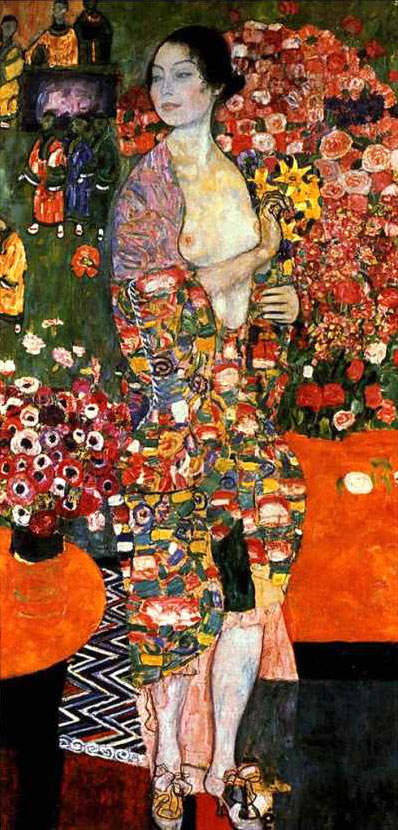
 by Tom Gurney
Tom Gurney BSc (Hons) is an art history expert with over 20 years experience
Published on August 21, 2026 / Updated on October 23, 2026
Email: tomgurney1@gmail.com / Phone: +44 7429 011000
About Paintings T–Z: Works, Series and Commission Relationships
The final section of this alphabetical directory contains nine full entries, from Tannenwald I to Woman in a Kimono. The shorter list is deceptive. These works sit inside Klimt's most easily confused families: two numbered fir forests, the Stoclet programme, the destroyed University commission, several Kammer views, a group of aquatic female subjects and two exact drawings that must not be reclassified as paintings.
The page therefore gives equal weight to relationships and objects. Each full entry identifies one accepted destination and the question it answers. Separate family maps explain where neighbouring pages belong without turning them into extra T–Z entries. Alternate names appear later as brief pointers only.
Initial articles do not affect filing: The Three Ages of Woman, The Tree of Life and The Virgin are under T or V. For earlier letters, use Paintings A–G or Paintings H–S. The Paintings overview is the better starting point for chronology and broad stylistic development.
What the Labels Tell You
A numeral usually identifies a work within a series. Tannenwald I and Tannenwald II are different paintings, as are the four numbered Schloss Kammer views. It does not follow that every change of title marks a new object: Pine Forest and Fir Forest are English translation layers around Tannenwald I, while Water Castle and Schloss Kammer am Attersee I identify one canvas.
Category is equally important. Tragedy is a finished drawing prepared as a publication model. Woman in a Kimono is an independent graphite sheet. The University page is a commission overview, and Tree of Life focuses on a motif carried from working drawings into mosaic. Alphabetical inclusion makes these records findable; it does not alter their materials or physical form.
Status answers a separate question. A surviving museum object, private painting, destroyed commission and reproduction of a lost work require different kinds of evidence. This range directs readers to current holders where there are holders, and to drawings, photographs or archival sources when the painted originals have been destroyed.
T
- Tannenwald I — Kunsthaus Zug and the Kamm Collection identify this as inventory K.G 1, a 1901 oil with a separate frame measurement. Tannenwald, Pine Forest and Fir Forest are language choices for one canvas. Its page distinguishes the paired Tannenwald II, attaches contemporary church-column and twilight language first to the exhibited pair, grades the Khnopff comparison and preserves the incomplete pre-Kamm ownership record. The close-ranked trunks, dark forest floor and limited opening supply the visual question; no exact grove, preparatory study or current continuous display is invented.[1][2]
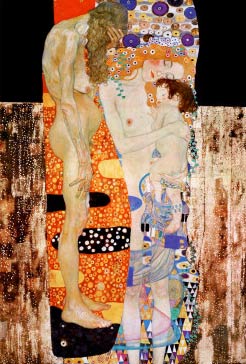
- The Three Ages of Woman (Le tre età) — GNAMC inventory 951 is the 1905 square oil joining an infant, mother and elderly woman. The dedicated page centres unequal contact, maternal enclosure and the exposed ageing body, while treating vanitas, model and transfer-reversal proposals as interpretations. It keeps the public medium conservative, separates secure Italian acquisition from uncertain Rome display and dates the painting's temporary loan rather than implying a permanent move. The figures are stages, not established portraits or a literal family, and maternity is not presented as the necessary path of every adult woman.[3]
- Tragedy — Wien Museum inventory 25007, Strobl 340, is a finished 1897 drawing on paper in pencil, black and white chalk and gold paint. Its page keeps the handmade original distinct from Gerlach plate 66 and the March 1898 Ver Sacrum reproduction. The woman, mask, collar, dragon, antique episode and linear border are considered at their different source strengths, with the related Strobl 341 sheet remaining a study rather than another version. The account also places the original at the first Secession and Klimt's later collective exhibition before explaining its museum acquisition and works-on-paper access limits.[4]
- The Tree of Life — Stoclet Frieze — This motif page follows the spreading, curling tree across Klimt's surviving full-scale working designs and the mosaic executed for the Stoclet dining room. It explains birds, flowers, instructions and transfer between walls without claiming one universal symbolic key. Paper, pencil, paint and written material directions belong to the designs; stone, enamel, glass and metal describe workshop execution in Brussels. For patronage, architecture, contributors and the complete wall sequence, the separate Stoclet overview remains the governing destination and prevents motif analysis from becoming commission duplication.[5][6]
U
- University of Vienna Ceiling Paintings — The commission overview brings Philosophy, Medicine and Jurisprudence together without pretending their original canvases survive. It owns the Klimt–Matsch division, institutional conflict, withdrawal and repayment, separate ownership paths, Nazi-era custody and Immendorf destruction. Because Philosophy has no separate page, the overview also gives it object-level treatment through composition, approximately seventy associated drawings, 1900 reception and carefully qualified source comparisons. Original oils, surviving drawings, monochrome photographs, printed reproductions, the 2005 ceiling installation and 2021 colour hypotheses remain explicitly different evidence forms.[7][8]
V
- The Virgin — National Gallery Prague inventory O 4152 is the 1913 oil whose current institutional description repeatedly counts seven women. The page begins with the rotating cluster, dreamlike relation and selective definition before grading erotic or life-stage readings. It keeps object-specific pigment findings within this canvas, treats the 1911/12 studies dynamically and follows the Rudolfinum presentation, negotiated 20,000-crown acquisition and dated museum access. The translated English title remains one title layer; the figures are not assigned a fixed genealogy or converted into seven named portraits.[9][10]
W
- Water Castle (Schloss Kammer am Attersee I) — National Gallery Prague inventory O 4103 is version I, dated 1908–09, with a rectangular 110 × 100-centimetre support rather than a square. Its page balances architecture and vegetation against the broad reflected field, then confines XRF, Raman, support, ground, underpaint, drawn-line and pigment evidence to this object. It also explains the 1910 Rudolfinum presentation and direct 500-crown acquisition. The documented inscription is retained without inventing its placement, and painted colour is never casually promoted to gold or another metal medium.[10][11]
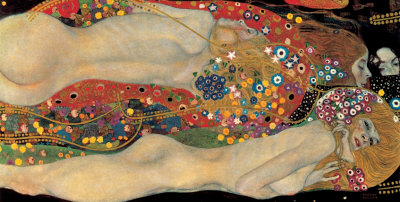
- Water Serpents I — Belvedere Girlfriends — Belvedere inventory 3828 is the 1904 mixed-medium parchment work, with minor additions dated to 1907. Its page treats female same-sex intimacy as represented subject without assigning names or private biography, grades the 1903 drawing and broader study group, and uses two monochrome photographs only for intermediate-state evidence. It follows the Miethke, Wittgenstein and 1956 Belvedere history while dating non-display status rather than promising verified current access. Water Serpents II, Friends II, The Sirens and the Hydra alias remain separate records.[12]
- Woman in a Kimono — MFA Boston accession 2006.1930, Strobl 2608, is an independent circa-1917 graphite drawing on Asian-style paper. The sitter remains anonymous, and no commission, source print or preparatory target is invented. Its page differentiates this exact sheet from Strobl 2610, a separate recto-verso kimono drawing and studies assigned to Ria Munk or The Dancer, while keeping later reproduction products outside the original-object record. Documented gift and past presentation evidence does not become a claim of continuous public display for this light-sensitive work.[13][14]
Series and Family Map
Tannenwald and the forest paintings
Tannenwald I is the Kamm canvas catalogued as K.G 1. The numeral distinguishes a paired second fir-forest painting; it is not a first state followed by repainting on the same support. The dedicated page discusses reception of the pair before relating those words cautiously to version I. No new Tannenwald II page is created here.
The name also differs from three A–G forest entries. Dresden's Beech Forest I retains a beech title despite a probable birch or aspen subject. Birch Forest is the restituted Bloch-Bauer canvas later associated with the Paul Allen collection. Forest of Beech Trees is documentary Buchenwald II, with uncertain survival and whereabouts. Farmhouse with Birches includes architecture and belongs to another landscape problem. Similar vertical trunks do not merge their titles, sites or provenance.
Tree of Life inside the Stoclet commission
The Stoclet Frieze overview in H–S explains the dining-room commission, patrons, wall arrangement and movement from Vienna designs to Brussels mosaic. Expectation and Fulfilment in A–G isolate the two figure groups. Tree of Life completes that navigation by concentrating on the expanding central motif and the instructions embedded in its working drawings.
These pages describe related scales, not four copies of one essay. A question about the tree's curling branches and birds belongs with the motif page. A question about how the mosaic workshops interpreted Klimt's instructions may require the complete commission. Comparison with The Kiss belongs only where the figure-design evidence supports it; the oil cannot become a Stoclet panel by association.
University commission, Philosophy, Medicine and Jurisprudence
The University overview is the sole destination that explains the entire ceiling scheme and Klimt's relationship to Franz Matsch's contributions. It distinguishes Matsch's accepted central picture, spandrels and surviving Theology from Klimt's three controversial paintings. It also holds the shared chronology of commission, faculty opposition, withdrawal and wartime loss.
Philosophy remains inside that overview because there is no accepted standalone page. Its river of humanity, cosmic head, Sphinx-like figure, approximately seventy associated drawings and 1900 reception receive substantive treatment there rather than a title pointer masquerading as an object essay. Medicine and Jurisprudence, by contrast, have their own H–S destinations for Hygieia, the life-and-death stream, the condemned figure, Erinyes and upper legal triad.
The evidence categories cannot be blended. Monochrome photographs help reconstruct structure; a 1931 Hygieia collotype offers one historic colour witness; the 2021 recolourisations are researched hypotheses. None restores the destroyed canvases or proves unverified colours across the whole commission.[7][8]
Water Castle among the Kammer views
Water Castle is Schloss Kammer version I. Version IV appears in H–S as Schloss Kammer on the Attersee IV, centred on a clocked yellow façade and a different private history. The Park, also H–S, turns canopy and hedge into a compressed field with a lake aperture. A–G's Avenue approaches the castle along a linden axis.
Only version I carries the National Gallery Prague technical record cited here. Its non-invasive XRF and Raman results, architectural drawing lines and paint-layer findings must not be assigned to Avenue, The Park or version IV. A shared building and lake do not create a common support, state sequence or conservation history.[10][11]
Water Serpents, Friends, Sirens and Hydra
Water Serpents I leads the aquatic-female group because Belvedere secures its object identity. The title Girlfriends is safe only when paired with Water Serpents I; used alone, it can collide with the destroyed Friends II. That late oil, corrected from the false name The Beaches, places a standing nude and clothed woman against birds and flowers rather than in an aquatic parchment setting.
The Sirens in H–S is Albertina's Silberfische (Nixen, Sirenen), a separate oil with its own dating and unresolved provenance dispute. Water Serpents II is another painting but has no full destination in this accepted directory. The Hydra page is narrower still: it records an unstable online alias attached to Water Serpents I and establishes that the Beethoven Frieze programme contains Typhoeus and Gorgons, not a Hydra.
Recurring women, water and intimacy justify comparison, not object merger. Medium, support, pose, date, owner and survival history decide which page answers the question.
Not Every Entry Is an Oil Painting
Tragedy as a finished publication design
The Wien Museum sheet is a completed work on paper, not an unfinished oil study. It served as the hand-made model from which Gerlach's printed plate was produced and was also reproduced in Ver Sacrum. Original drawing, printed plate and magazine impression share imagery but remain physically and authorially distinct publication objects.[4]
Woman in a Kimono as an independent drawing
MFA accession 2006.1930 has its own title, medium, support, inscriptions and provenance. A kimono-like garment or comparable pose does not make it preparatory for Ria Munk III, The Dancer or another late portrait. Those relations belong only to exact sheets catalogued as such. Commercial prints after the MFA image are reproductions, not alternative sizes of the drawing.[13][14]
Tree of Life and the University overview
The Tree page navigates between physical working drawings and an executed mosaic motif. The University page covers three destroyed Klimt paintings through documentation and reconstruction evidence. They appear in this directory because they are dedicated work or commission records; neither is a newly catalogued portable canvas.
Evidence Boundaries across Related Pages
Begin with the secured object, then compare
The fastest way through a crowded family is to identify holder, inventory, date and category before considering resemblance. National Gallery Prague O 4103 leads to Water Castle; Belvedere 3828 leads to Water Serpents I; MFA 2006.1930 leads to the kimono drawing. Once that anchor is fixed, another work can illuminate format or motif without lending its title or evidence to the first.
This order prevents attractive but false shortcuts. A reflected lake does not make every Kammer painting a state of Water Castle. Two closely placed women do not make Friends II an aquatic work. A kimono-like garment does not attach an anonymous sheet to Ria Munk. Formal comparison is strongest after identity control, not instead of it.
Keep technical findings with the examined support
The Prague bulletin studies The Virgin and Water Castle as two named canvases. Its observations can be discussed for each object because both were actually examined, but even then their pigment and construction results are not interchangeable. The fact that one publication covers two works does not imply one recipe or working sequence.[10]
The same restriction reaches beyond this alphabet. Infrared and layered-paint evidence from Avenue to Schloss Kammer belongs to that Belvedere canvas. It cannot complete missing information for Water Castle, The Park or Schloss Kammer IV. Conservation results answer questions about a physical support; geographic or stylistic proximity cannot move them to another one.
For destroyed Faculty paintings, the evidentiary problem is sharper. No new scan can be made of Philosophy, Medicine or Jurisprudence. Associated drawings, historic photographs, printed reproductions and one colour detail each answer limited questions. Digital colour reconstruction may visualise a researched proposal, but it does not behave like laboratory analysis of an extant original.
Separate current identity from present access
A holder record may remain authoritative while physical display changes. Paintings can travel, galleries can rotate their rooms and drawings may rest for conservation. The Three Ages page therefore dates its temporary loan; Water Serpents I dates its non-display status; Woman in a Kimono treats earlier exhibition evidence as past rather than permanent.
Private or destroyed objects require other language. The Stoclet mosaics remain in a private building even though MAK preserves the working drawings. The Faculty canvases no longer exist even though reproductions may be installed or displayed. An accessible image is evidence about an object, not proof that the object itself can be visited.
Use titles as evidence with different strengths
A present institutional title usually leads, but historical wording can preserve how a work travelled through exhibitions and scholarship. Le tre età and The Three Ages of Woman are language forms for one Italian museum canvas. Aufsteigendes Gewitter helps identify The Large Poplar II elsewhere. By contrast, “Hydra” and the Wolfgangsee church caption are corrective problems because they wrongly assign identity.
Numbering is strongest when tied to a catalogue or series record. The I in Tannenwald and Water Castle prevents collision with other canvases; it does not announce an unfinished first attempt. The III in Ria Munk identifies commission sequence. Readers should never infer a II or IV page solely because one numeral appears here.
Overview or Detail: Which Page Answers Which Question?
Choose an overview when the question requires the whole institutional or architectural setting. University of Vienna Ceiling Paintings is the right page for commissioning terms, faculty objections, Klimt's withdrawal and the relationship among all three subjects. Stoclet Frieze is the right page for the dining room, patrons, walls and mosaic workshop.
Choose a detail page when the question concerns one internal problem. Tree of Life owns the tree's design and bounded interpretation. Medicine and Jurisprudence own their separate compositions and study groups. Expectation and Fulfilment own figure-specific development. This division gives each page a purpose while keeping a reader one link away from the larger setting.
Choose an exact-object page when category or physical evidence matters. Tragedy distinguishes a drawing from its publications. Woman in a Kimono distinguishes one MFA sheet from nearby drawings. Water Castle and The Virgin confine technical findings to named Prague canvases. The index provides the map; the dedicated page carries the evidence in full.
Alternate-Name Pointers
These lines aid discovery without adding full entries:
- Tall Poplar Trees II → use the corrected singular museum record in H–S.
- Water Serpents I → use the full Girlfriends / Water Serpents I record, never bare “Girlfriends.”
- The Hydra → open the corrective alias explanation in H–S; it is not another artwork.
- Philosophy → open the University Ceiling Paintings overview.
- Hostile Forces → open The Hostile Powers in H–S where that institutional translation is encountered.
Choose the Best Starting Point
- For forest numbering and translation, begin with Tannenwald I, then use the A–G forest distinctions.
- For Stoclet, choose the commission overview first unless your question concerns the tree or a single figure group.
- For the Faculty Paintings, use the University overview for shared history and Philosophy; use Medicine or Jurisprudence for their object-specific imagery.
- For Kammer architecture, identify the version before considering viewpoint, reflection or technical evidence.
- For women and water, start from the holder title and medium rather than a generic “girlfriends” label.
- For drawings, check the exact accession or catalogue number before inferring a preparatory relationship.
Related Gustav Klimt Guides
- Gustav Klimt introduces the artist and major works.
- Biography owns the life sequence and documented relationships.
- Paintings traces the painted corpus across time.
- Drawings explains graphic functions and catalogue attribution.
- Prints separates original printmaking from reproductive images.
- Landscapes follows place, format and landscape practice.
- Quotes authenticates documentary statements and quarantines false sayings.
Frequently Asked Questions
References
- Kunsthaus Zug, “Tannenwald I,” collection record. View source. Accessed 10 August 2026.
- Gustav Klimt Database, “The Golden Knight and Femmes Fatales: 1901–1903,” forest group and paired exhibition evidence. View source. Accessed 10 August 2026.
- Galleria Nazionale d'Arte Moderna e Contemporanea, “Le tre età,” inventory 951, object and collection record. View source. Accessed 10 August 2026.
- Wien Museum, “Tragödie,” inventory 25007, Strobl 340, exact drawing and publication-model record. View source. Accessed 10 August 2026.
- MAK — Museum of Applied Arts, “9 Working Drawings for the Mosaic Frieze in Stoclet House,” design, sequence and material record. View source. Accessed 10 August 2026.
- UNESCO World Heritage Centre, “Stoclet House,” architecture, contributors, integrity and World Heritage record. View source. Accessed 10 August 2026.
- University of Vienna, “Gustav Klimt's Faculty Paintings in the Festival Hall,” commission, controversy, ownership, destruction and later installation. View source. Accessed 10 August 2026.
- Albertina, “University of Vienna,” commission, division of labour, withdrawal, ownership and destruction. View source. Accessed 10 August 2026.
- National Gallery Prague, “The Virgin,” inventory O 4152, object and collection record. View source. Accessed 10 August 2026.
- National Gallery Prague, “Material Research on Gustav Klimt's Paintings The Virgin and Water Castle,” Bulletin XXVIII/2018. View source. Accessed 10 August 2026.
- National Gallery Prague, “Water Castle,” inventory O 4103, object and collection record. View source. Accessed 10 August 2026.
- Belvedere, “Freundinnen (Wasserschlangen I),” inventory 3828, title, medium, state and provenance record. View source. Accessed 10 August 2026.
- Museum of Fine Arts, Boston, with Google Arts & Culture, “Woman in Kimono, Left Shoulder Bare,” exact drawing record linked to accession 2006.1930. View source. Accessed 10 August 2026.
- Christie's, “Dame im Kimono,” separate Strobl 2610 sheet and Ria Munk III study classification. View source. Accessed 10 August 2026.
Discussion
Gustav Klimt Paintings T–Z: Works, Series and Commission Relationships rewards close attention to source context, object identity and careful reproduction boundaries.