 by Tom Gurney
Tom Gurney BSc (Hons) is an art history expert with over 20 years experience
Published on August 21, 2026 / Updated on October 23, 2026
Email: tomgurney1@gmail.com / Phone: +44 7429 011000
About Gustav Klimt Quotes
Gustav Klimt quotations are most revealing when they stop behaving like slogans. His surviving words belong to particular documents: an undated typescript, a letter written during jury duty in Prague, a joke on a postcard, a report from Paris and urgent messages about unfinished work. Date, recipient and physical source change what each sentence can mean.
The seven records examined here are all tied to a digitised primary item or to a named institutional transcription. They do not form a diary, manifesto or authorised collection of aphorisms. Together they reveal something more human: an artist who resisted public self-explanation, looked hungrily and impatiently, worried over deadlines, revised his own claims and wrote affectionately to Emilie Flöge.
Many sayings attributed to Klimt online lack that documentary foundation. Repetition cannot turn an unlocated sentence into a primary source. The most dependable practice is to ask four questions: What kind of document contains the words? When was it made? Who received it? Can the wording be checked in the original language or a responsible transcription?
At a Glance: Seven Verified Records
| Date | Document | Recipient | What it securely shows |
|---|---|---|---|
| Undated | One-leaf typescript on a nonexistent self-portrait | None stated | Klimt's resistance to personal self-description and his direction towards the pictures |
| November 1895 | Letter from Prague | Emilie Flöge | City impressions, demanding jury work and affectionate attachment |
| 6 July 1908 | Postcard from Vienna | Emilie Flöge at the Attersee | A private joke about the public purchase of her portrait |
| 22 October 1909 | Letter from Paris | Emilie Flöge | Museum fatigue and concise reactions to Cézanne, Manet and the Musée Guimet |
| 10 July 1917 | Letter | Erwin Böhler | Underestimated labour, missed expectations and a revised completion date |
| 13 August 1917 | Postcard from Vienna | Emilie Flöge in Tyrol | A provisional claim that Baby might soon be finished and the artist's mixed response |
| 30 December 1917 | Letter from Winkelsdorf | Emilie Flöge in Vienna | A deeply felt New Year wish in Klimt's last known surviving message |
This selection is deliberately small. The Gustav Klimt Database describes an autograph section containing around 1,000 letters, postcards, telegrams, files, documents and notes, including records by, to and about the artist. That total is not a count of Klimt quotations and not every item was written by him.[3][4]
Why the Recipient Changes the Meaning
Five of the six correspondence records selected here were sent to Emilie Flöge. That concentration does not make them entries in a private notebook. Klimt chose language for a person who shared years of family, travel and artistic context with him. References could be brief because the recipient already understood names, places and unfinished business.
The Flöge correspondence is also one-sided in survival. The Klimt Database states that Emilie's replies have not survived.[6] Readers encounter Klimt's joke, fatigue and affection without the words to which some of those messages may have responded. A sequence of his postcards cannot be made into a complete dialogue by imagining her side.
The Erwin Böhler letter has a different pressure. Klimt is explaining delay to the person expecting a picture and discussing when the work might be available. Its shame and revised timetable belong to a client-facing negotiation, even if the frustration was genuine.[8] Reading it as though it were an intimate confession to Emilie would flatten the social purpose of the document.
The typescript differs again. It has no named recipient and appears designed to answer public curiosity about a self-portrait that does not exist.[1] Its compact declarations are more shaped than the postcards, yet its precise occasion and date remain unknown. “Public-facing” is therefore a reasonable description of tone, not proof of where or when it was published.
Recipient also governs what silence means. Klimt does not explain Cézanne at length to Emilie; that may reflect haste, shared assumptions or the letter's practical form rather than lack of interest. He does not name Baby in the 13 August wording used by the database, instead referring to the child's picture.[7][8] Institutional reconstruction connects these shorthand references to larger histories, but the original economy should stay visible.
Authenticating words is thus only the first task. A genuine sentence can still be misread if its audience disappears. The same phrase may function as teasing, apology, status report or self-positioning depending on who was expected to read it.
How Can a Klimt Quote Be Authenticated?
The strongest case begins with a physical or digitised document. A library record can identify author, format, date status and stable identifier. An autograph catalogue can connect a transcription to a recipient and day. A museum or research institution can provide an English translation while making clear that Klimt wrote in German.
These levels should not be collapsed. An image of a typescript is closer to the primary object than a modern quotation page. An institutional transcription is stronger than a sentence copied without a source. A recollection by someone who knew Klimt may be important testimony, but it is still remembered speech rather than his surviving written hand.
Punctuation and omission matter too. Ellipses can make separate clauses appear continuous, while a polished translation can sound more formal than the German. A trustworthy presentation preserves the document's date and audience, labels a new translation and quotes only enough wording to support the discussion.
The Gustav Klimt Database was built to connect paintings, photographs and autographs, and its index includes correspondence from, to and about Klimt. It supplies extensive transcriptions and cross-references through a research section available after free registration.[4] This structure helps prevent a letter by someone else from becoming Klimt's voice merely because his name appears in it.
The Undated Self-Commentary Is One Document
The most famous group of Klimt statements comes from a single sheet. The Wienbibliothek im Rathaus catalogues it as Kommentar zu einem nicht existierenden Selbstporträt—Commentary on a Nonexistent Self-Portrait. The item has no recorded place or year. It consists of one quarto leaf of typescript, begins Malen und Zeichnen and has the stable URN urn:nbn:at:AT-WBR-113407.[1]
This material identity corrects several common misunderstandings. The text is not a dated interview, a diary entry or four independent declarations. Its opening assertion, Malen und zeichnen kann ich—“I can paint and draw,” in a direct translation—belongs to the same argument as Von mir gibt es kein Selbstportrait, “There is no self-portrait of me.”[1]
Klimt then shifts from the absent self-portrait to daily labour and the pictures themselves. He describes himself as a painter working from morning to evening and tells anyone interested in him as an artist to examine the works. The Neue Galerie renders the final direction as an invitation to “look carefully at my pictures” and seek there what he is and wants.[2]
Read continuously, the typescript is less a celebration of mystery than a refusal of the expected form of self-advertisement. Klimt does not say that biography is meaningless. He says that he does not find himself especially interesting as a person and relocates artistic attention to making and looking.
That distinction matters. If the final clause is detached and printed beneath a painting, it can sound like a universal command. Within the document, it follows a specific premise: he has not made the conventional self-portrait through which the public might inspect him.
The statement also does not settle every catalogue question about self-representation. A youthful figure in a larger decorative setting may be discussed as an image of Klimt without becoming the easel self-portrait he says does not exist. The typescript reports his position; it is not a mechanical inventory rule.
Because the original is German and undated, English versions should retain both facts. “I can paint and draw” is a direct project translation of one brief clause. The Neue Galerie's wording is an institutional English version. Neither should be retroactively assigned to a particular year or presented as words spoken in English.
Prague, November 1895: Affection and Professional Fatigue
In November 1895 Klimt travelled to Prague as a jury member in a competition organised by the Society for the Promotion of German Science, Art and Literature in Bohemia. The Klimt Database identifies his privately owned letter from that stay as the earliest known surviving correspondence from him to Emilie Flöge discussed in its record.[5]
He called Prague “truly beautiful” but also described strenuous jury duties. The juxtaposition is useful: appreciation of place and complaint about work occupy the same practical letter. The source is not a prepared travel essay.
Klimt closed affectionately, calling Emilie his darling and looking forward to seeing her again.[5] That direct warmth establishes a strong personal bond by 1895. It does not, by itself, define every dimension of their lifelong relationship or settle later debates about romance and sexuality.
The institution supplies only November for this exact letter. Adding a day would create false precision. “Earliest known” also describes the surviving and currently catalogued record, not necessarily the first message Klimt ever sent her.
6 July 1908: A Joke about Emilie's Portrait
By July 1908 Emilie Flöge's full-length portrait was displayed at the Vienna Kunstschau. A Lower Austrian public body acquired the painting that year; it eventually entered the Wien Museum. Klimt relayed the moment to Emilie, already at the Attersee, in a postcard of 6 July.[6]
His joke says that she was going to be “sold off,” or rather “cashed.”[6] The shift between verbs turns a financial event involving a painted likeness into teasing private language about the sitter herself.
Context prevents the sentence from becoming crueler or grander than the evidence supports. It concerns a specific portrait acquisition and a recipient who knew the work intimately. It is not a general theory that sitters were commodities, nor proof that Klimt alone controlled the sale.
The postcard also demonstrates how tone can disappear in a quote list. Without date, recipient and painting, the line looks like a blunt remark about a woman. Restored to its exchange, it records shared humour around public recognition and money.
22 October 1909: Looking until Exhaustion in Paris
Klimt's Paris correspondence presents a voice very different from the formal calm often assigned to his paintings. During an intensive museum programme, he told Emilie that he was close to losing his mind from walking through collections, yet they kept going.[7]
The letter dates from 22 October 1909. The Klimt Database reconstructs visits to the Louvre, Musée des Arts décoratifs, Musée du Luxembourg, Musée Guimet and a private gallery showing French modern art. Klimt's reactions are exceptionally compressed: Cézanne and Manet are “very beautiful”; the Guimet is “very interesting.”[7]
Those few words establish contact and enthusiasm, not a complete aesthetic system. They do not rank every artist Klimt saw or prove that a specific Japanese object entered a specific painting. A travel letter written amid a punishing schedule is not an exhibition review.
The emotional rhythm is nevertheless informative. Fatigue does not end attention. He complains about the physical marathon and continues looking. The terse judgments suggest a person recording impressions quickly for someone familiar with his habits rather than composing a defence of his own style.
Translation again changes texture. The English institutional version produces a smooth sentence about “pacing up and down.” The original German record should control any close linguistic claim; the English is best treated as the database's published rendering.
10 July 1917: A Deadline Moves
A letter to industrialist Erwin Böhler shows Klimt explaining unfinished work to a client. On 10 July 1917 he admitted, “I underestimated the work,” after saying that he had intended to finish the picture by 15 July. Much was already painted, but September had become the new expectation.[8]
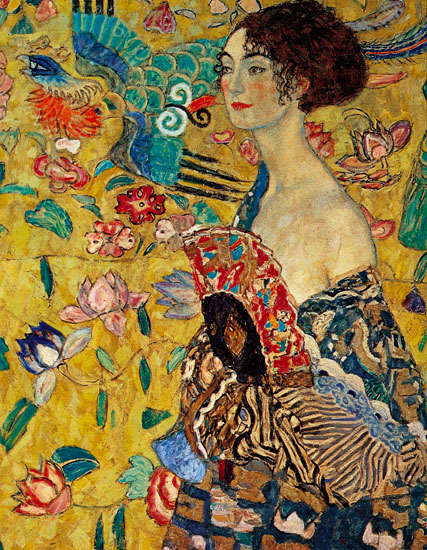
The Klimt Database places this exchange within its account of Lady with a Fan. The surviving wording refers to “the picture,” so the object connection should retain that institutional context rather than becoming an unqualified title inside Klimt's mouth.[8]
What the letter establishes securely is process under pressure. Klimt had estimated a completion date, discovered that the work demanded more and revised the promise. The language is apologetic and practical, not a timeless statement about artistic perfection.
It also complicates the idea of effortless late style. A painting that can look spontaneous or luxuriantly assured involved uncertainty about how much remained. The letter cannot reveal every revision or certify the exact state of the canvas in July, but it places labour, money and expectation beside the visual result.
13 August 1917: Baby Is “Half Finished”
Another message from the same summer shows why even an artist's own status report cannot always determine a final catalogue date. On 13 August Klimt told Emilie that “the child's picture” was half finished. He hoped it would be completed that day—adding “if it is true”—and reported “extremely mixed feelings.”[8]
The Klimt Database identifies the picture as Baby. It also compares documentary photographs and concludes that Klimt made further changes after the Stockholm exhibition in September. The work is consequently dated 1917–18 in that account.[8]
The postcard is not wrong; it records one morning's expectation. Its self-correction already reveals doubt. “Completed today” would have described Klimt's hoped-for threshold, not a technical finding that no later stroke could be added.
This is an important lesson for reading correspondence. Primary evidence can be immediate and still provisional. A catalogue constructed from surviving surface, photographs, exhibitions and multiple messages may reasonably use a broader date than one optimistic postcard implies.
The phrase about mixed feelings should remain equally open. It proves ambivalence about the picture at that moment. It does not diagnose depression, identify a model or disclose the painting's private symbolic key.
30 December 1917: The Last Known Message
At the end of 1917 Klimt was staying with the Primavesi family at Winkelsdorf. On 30 December he wrote to Emilie in Vienna, wishing her the happiest possible New Year—one that “the two of us” needed urgently.[6]
The Klimt Database identifies this as his last known letter to her and, in its Czechia account, his last known message. Within days he suffered a stroke; he died on 6 February 1918.[5][6]
“Last known” is the accurate phrase. It describes the latest surviving record located by present scholarship. It does not claim these were his last spoken words, that no later note was ever written or that the New Year sentence was intended as a farewell.
Its power comes partly from hindsight, but the document must retain its original form: a seasonal wish between two people who had exchanged messages across decades. The wording supports intimacy and shared strain. It does not settle the legal or sexual definition of their bond.
What These Documents Reveal—and What They Do Not
Across the seven records, Klimt's written voice is economical. The self-commentary moves quickly from person to practice. The letters and postcards compress travel, work, money and feeling into language meant for people who already knew the circumstances.
Humour is situational. Emilie's portrait is “cashed” because an acquisition is happening. Exhaustion in Paris arises from a specific itinerary. Deadline shame belongs to a client exchange. Detached from those situations, the phrases become more absolute and less accurate.
Self-correction is equally characteristic. Klimt revises “sold off” with another verb, continues visiting collections despite exasperation, shifts a July completion to September and interrupts the hope of finishing Baby with “if it is true.” The documents preserve thought in motion rather than polished doctrine.
They also resist being used as codes for pictures. A deadline letter illuminates labour but does not decode every bird or flower. An affectionate closing demonstrates attachment but does not reveal the identity of every female model. The self-commentary asks viewers to look; it does not promise that a painting is a disguised confession.
Why Translations Differ
Klimt wrote these records in German. English punctuation, tone and even title terminology can vary between institutions and translators. Selbstportrait, for example, is commonly rendered “self-portrait,” while Bild can mean picture or painting depending on context.
A responsible English page therefore names its translation source. The brief German clauses from the Wienbibliothek typescript are translated directly here and labelled as such. The correspondence wording follows the English transcriptions published by the Gustav Klimt Database. Where an institution uses an ellipsis, the omitted text is not silently reconstructed.
Translation should preserve uncertainty rather than polish it away. The hesitant qualification in the Baby postcard matters. So does the typescript's undated status. A smoother sentence is not better if it turns a provisional message into a maxim.
The Problem with Apocryphal Klimt Sayings
Several highly shareable sayings circulate under Klimt's name without an exact autograph, typescript or responsible critical citation. Claims that all art is erotic, that truth resembles fire, that art traces a line around thought or that one should follow one's course while people talk were not admitted to this verified selection.
That exclusion does not prove no related wording exists anywhere. It records the present source result: no exact primary document or dependable edition was located for those formulations. Attribution should remain withheld unless such evidence appears.
The undated self-commentary presents a subtler problem. Its wording is genuine, but websites often break connected clauses into separate “quotes” and omit the document title. Authentic words can still be transmitted misleadingly when their relationship to one another disappears.
Popularity is not provenance. A phrase repeated on posters, merchandise and quote aggregators may have thousands of copies but no traceable original. One stable library record outweighs that numerical abundance.
Where to Read Klimt's Words
The Wienbibliothek provides a digital catalogue page, downloadable file, IIIF record and permanent URN for the self-commentary.[1] Its object description makes the lack of date explicit rather than guessing.
The Gustav Klimt Database offers public thematic essays that quote selected letters and postcards in context. Its deeper research index requires a one-time free registration and links correspondence by, to and about Klimt.[3][4]
These resources remain works in progress. The database says archives and estates continue to be searched, especially for lesser-known material. “Known” and “surviving” are therefore essential words: documentary history can expand when a letter is found, reattributed or published.
The best reason to consult the records is not to accumulate more one-liners. It is to see how Klimt's voice changes with audience and purpose—from a public-facing typescript to affectionate postcards, travel reports and requests for patience.
Frequently Asked Questions
References
Accessed August 2026.
- Wienbibliothek im Rathaus, Digital Collections, “Kommentar zu einem nicht existierenden Selbstporträt”: Gustav Klimt authorship, undated and unlocated status, one-leaf typescript format, Malen und Zeichnen incipit, digital file and URN urn:nbn:at:AT-WBR-113407. View source.
- Neue Galerie New York, “Gustav Klimt”: institutional English rendering and identification of the self-commentary as an undated statement, with its diary/self-description context. View source.
- Gustav Klimt Database, “More than 1,000 autographs relating to Gustav Klimt” (1 June 2023): current corpus scale and distinction among letters, postcards, telegrams, files, documents and notes by Klimt and third parties. View source.
- Gustav Klimt Database, “About”: research basis, critical review, autograph-index scope, transcriptions, cross-references and free-registration access conditions. View source.
- Gustav Klimt Database, “Czechia”: November 1895 Prague letter, month-level date, jury context, earliest-known-surviving status, affectionate closing and identification of the Winkelsdorf New Year message as Klimt's last known message. View source.
- Gustav Klimt Database, “The Flöge Family”: 6 July 1908 postcard and portrait-acquisition joke; 30 December 1917 letter, exact recipient, Winkelsdorf setting, New Year wording and last-letter status. View source.
- Gustav Klimt Database, “France”: 22 October 1909 letter to Emilie Flöge, Paris itinerary, collection fatigue and brief reactions to Cézanne, Manet and the Musée Guimet. View source.
- Gustav Klimt Database, “The Final Years”: 10 July 1917 Erwin Böhler letter in the Lady with a Fan context; 13 August 1917 Baby postcard; photographs, later changes and qualified completion evidence. View source.
Discussion
Gustav Klimt Quotes rewards close attention to source context, object identity and careful reproduction boundaries.