 by Tom Gurney
Tom Gurney BSc (Hons) is an art history expert with over 20 years experience
Published on August 21, 2026 / Updated on October 23, 2026
Email: tomgurney1@gmail.com / Phone: +44 7429 011000
About Paintings A–G: An Annotated Guide to the Works
This alphabetical guide leads to Gustav Klimt works and work-related records filed from A to G. It is designed for choosing the right page, especially when two paintings have similar names, a familiar English title has been corrected, or the original no longer survives. Each entry explains the question its fuller account answers rather than trying to compress that account into a few lines.
“Paintings” is the familiar name of the directory, not a claim that every item has the same medium. Most entries are oil paintings, but this range also includes a finished chalk drawing, two Stoclet Frieze designs, a monument and records for destroyed works known through documentation. The category and survival status given beside a title are therefore part of its identity.
Titles beginning with A or The are filed by their significant word: The Dancer appears under D, The Fable under F and The Giant Typhoeus under G. Named portraits are filed by sitter, so the two Adele Bloch-Bauer portraits follow Adam and Eve. Anonymous portraits keep their object titles.
For later letters, continue to Paintings H–S or Paintings T–Z. Readers seeking a chronological account of Klimt's changing pictorial practice can begin with the Paintings overview instead.
How to Read the Entries
The bold linked title is the preferred identity for the destination. A German title, translated form or familiar older label follows only when it genuinely helps recognition. Such wording can record translation, a historical catalogue name or a corrected attribution; it does not necessarily mean that Klimt made several objects. The two numbered apple trees, by contrast, really are separate canvases, so each receives its own entry.
The date and category identify the evidence under discussion. “Unfinished oil” means a surviving painting whose working state remains visible. “Destroyed oil” means that an original canvas once existed but is no longer extant; a period photograph may preserve its arrangement without supplying its material surface. “Drawing” identifies an independent work on paper rather than a painting demoted to preparatory status.
The final sentence of each annotation tells you why to open that page. Some destinations answer a visual question, such as how the avenue makes depth and pattern coexist. Others resolve an evidence problem: which Adele portrait is meant, whether an image is an original or reproduction, why a museum title conflicts with depicted tree species, or what can responsibly be said about a provenance gap.
Dates are concise here because catalogues sometimes use overlapping conventions. A span such as 1916–18 may cover documented work until Klimt's death, while another institution may prefer 1917/18 for the same canvas. The dedicated page explains consequential differences. This guide never treats a catalogue-date variation as a newly discovered version.
A
- A Morning by the Pond — Historical title: Still Pond. This signed 1899 oil is now connected with Eglsee near Golling, not Schloss Kammer Park. Its page explains how water becomes reflected sky, why it belongs among Klimt's earliest square landscapes and how a superseded location entered its record.[3][4]
- Adam and Eve — An unfinished oil of 1916–18. The fuller account reads unequal completion as working evidence without pretending to know Klimt's intended final state. It also distinguishes what the biblical title invites viewers to expect from what is actually visible on the canvas.[9][11]
- Portrait of Adele Bloch-Bauer I — Klimt's 1907 portrait in the Neue Galerie, widely nicknamed the “Woman in Gold.” Open this page for its sitter and commission, documented metal-rich medium, dense distinction between face and ornament, Nazi-era history and restitution rather than a general account of Klimt's Golden Period.[7][12][13]
- Portrait of Adele Bloch-Bauer II — A separate 1912–13 oil, not a later state of the gold portrait. Its account follows revisions detected within this canvas, the emphatically coloured standing figure, its independent exhibition life and the persecution and restitution history shared with—but not reducible to—the first portrait.[8][13][14]
- Portrait of Amalie Zuckerkandl — This late portrait remained visibly unfinished at Klimt's death. Its page separates secure working evidence from conjectural completion and preserves a major provenance uncertainty: the later recommendation against restitution did not supply the missing pre-war ownership passage or turn an incomplete chain into a settled one.[9][11]
- Apple Tree I — A signed, approximately 1912 Bloch-Bauer landscape built around a low crown, narrow trunk and distributed red fruit. The dedicated page distinguishes it from the smaller 1916 sequel, then follows confiscation, restitution with the other Bloch-Bauer paintings and its later private history without claiming a current display.[8][13]
- Apple Tree II (Green Apple Tree) — This distinct 1916 private canvas has a taller trunk, permeable crown and open blue intervals. Its history requires particular care: an erroneous return to the Stiasny heirs was corrected in 2017, followed by a 2023 settlement that did not reveal a present owner or complete the earlier chain.[9][14]
- Avenue to Schloss Kammer — Also known as Avenue in Schloss Kammer Park. Belvedere inventory 2892 turns a linden approach into both deep recession and a patterned wall. Its page owns the conservation evidence for underdrawing, layered preparation, translucent paint and selected impasto; those findings do not transfer to other Kammer canvases.[8][15]
B
- Beech Forest I (Buchenwald I) — The Dresden painting retains its institutional title even though curatorial examination finds that the trunks probably represent birch or aspen. This page is the place to understand that productive title-versus-species tension, the metre-square forest screen and the exact exhibition and acquisition record.[5][16]
- Beethoven Frieze — The complete 1902 monument, created for the Vienna Secession's Beethoven exhibition. Its overview follows the three-wall programme, experimental materials, removal, survival, restoration and present installation. Separate entries for Expectation, Fulfilment and Typhoeus answer narrower figure or design questions; none substitutes for the whole frieze.[5][17]
- Birch Forest — Historically catalogued as Birkenwald (Buchenwald), this signed Bloch-Bauer canvas is not Dresden's Beech Forest I. Its page concentrates on the more varied woodland floor and vertical rhythm, then follows Nazi seizure, 2006 restitution and the painting's later Paul Allen and auction history without identifying a current owner.[5][13]
- Blooming Meadow (Blumenwiese) — The private landscape formerly circulated under the generic label Landscape of a Garden. Current specialist evidence uses Blumenwiese and a circa-1908 date. Its page explains the field's compressed floral surface, the remaining exhibition uncertainties and the provenance that culminated in the November 2025 sale.[7][18]
- Bust of a Lady — More exactly Damenbrustbild von vorne, Strobl 3318: a finished 1897/98 drawing in brown, black, red and blue chalk, heightened with white. The page identifies this precise sheet, asks whether it was autonomous rather than preparatory, and excludes later drawings carrying deceptively similar English titles.[3][19]
C
- Church in Cassone — A signed 1913 private oil made during Klimt's Lake Garda stay. Cypress trees divide compacted architecture from the surrounding colour field. Its account grades competing viewpoint proposals, separates the original from a 1918 heliogravure and traces the theft and private restitution agreement without inventing the missing chain.[8]
- Church in Unterach — The surviving 1915/16 oil now identified as Horten K-855. Open this page for the square church view, evidence of direct wet-into-wet work without underdrawing, the 1917 Stockholm presentation and a published first-owner conflict. It also briefly explains the later false Wolfgangsee caption.[9][20]
- Cottage Garden with Sunflowers — Belvedere inventory 3685, dated 1906, fills the square with two dominant sunflower plants and a nearly horizonless flower field. Object-specific X-radiography reveals covered heads, while support evidence records later stretching; neither finding belongs to Klimt's other garden paintings.[6][27]
D
- The Dancer — An unfinished 1916–17 oil in which exposed charcoal remains visible below the painted upper figure and interior. The page holds two identity levels apart: Johanna Jusl is associated with the visible dancer and a study, whereas reuse of a proposed Ria Munk II portrait remains an unverified hypothesis.[9]
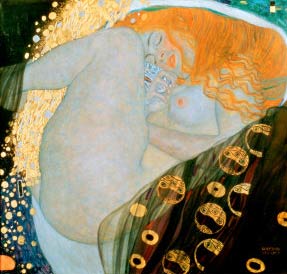
- Danaë — Klimt's 1907–08 private mythological oil encloses the sleeping figure within a compressed curve as Zeus descends in golden colour. The dedicated discussion begins with pose and textile enclosure, then addresses erotic readings and unequal divine access without treating closed eyes as proof of consent or gold colour as metal.[7]
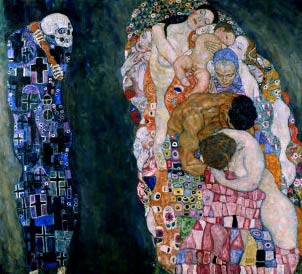
- Death and Life — The Leopold Museum canvas changed substantially between its first exhibited form and the final state. Its page uses photographs, reproductions and surviving frame traces to keep those stages distinct, examines Death opposite the island of bodies and reports the unresolved Rome-prize attribution alongside the painting's public history.[8][9][22]
E
- Portrait of Elisabeth Lederer — Later Baroness Elisabeth Bachofen-Echt, she appears in a 1914–16 full-length portrait. Its page differentiates Chinese, late-Qing and Korean source proposals, explains infrared evidence for two removed figures and follows persecution, a survival fiction, restitution and later private ownership without turning family claims into sitter biology.[9]
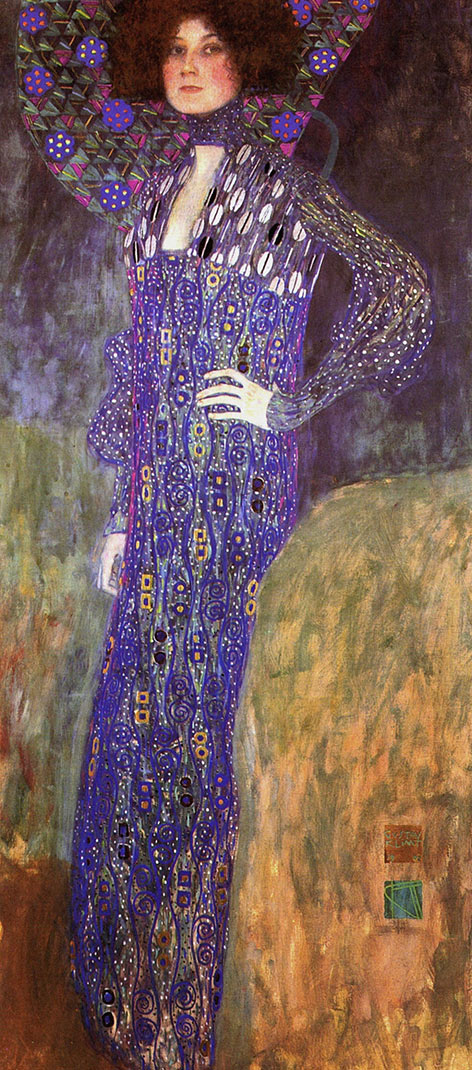
- Portrait of Emilie Flöge — The signed 1902/03 Wien Museum canvas joins an exposed face and hands to an expansive patterned dress. Its account distinguishes first display, continuing reworking and later acquisition; treats the represented garment cautiously; and restores Flöge's professional agency as a fashion director without converting the portrait into a relationship biography.[5]
- Expectation — Stoclet Frieze — A figure-and-design study centred on the dancer with a turned head and sharply articulated gesture. This page separates MAK's surviving paper working design from the mosaic executed in Brussels, then grades Egyptian, dance and modern-art comparisons instead of presenting any one source as a proven template.[7][21]
F
- The Fable — The signed 1883 Wien Museum oil was a painted model for Gerlach's portfolio, not the printed plate itself. Its page explains the scroll-bearing personification and Aesopic animal pairings, the design's applied-art purpose and its 1885 presentation while keeping the original object distinct from later reproductions.[1][2]
- Farm Garden with Crucifix — A destroyed 1912 Lederer oil in which a wayside crucifix rises within an ascending garden. Its account weighs a real-site proposal against a constructed landscape, then follows expropriation and wartime custody. Photographs document the work; they are not the missing canvas, and the circumstances at Immendorf remain qualified.[8][10][22]
- Farmhouse in Upper Austria — Belvedere inventory 1370 presents a pale, frontal farmhouse behind trunks and meadow. The page grades competing Buchberg and Echtlhäusel site identifications, confines infrared and macroscopic evidence to this object, explains the later woodpile addition and corrects a misleading story about the museum acquisition.[8][28]
- Farmhouse with Birches — A compact signed landscape of 1900 in which young trunks stand before the house. Its fuller record preserves conflicting accounts of early ownership and follows Hermine Lasus's persecution-era sale, the unexplained Ucicky passage, restitution and the 2004 sale without treating every gap as proof of one mechanism.[3][10]
- Flower Garden (Bauerngarten / Blumengarten) — This signed 1907 private oil forms a dense field from many flowering plants. The page distinguishes it from Flowering Poppies and later orchard pictures, considers its 1908 Kunstschau reception and follows documented Prague and market stages while leaving the present owner, city and display unclaimed.[7]
- Flowering Poppies (Blühender Mohn) — Historically translated as Poppy Field, Belvedere inventory 5166 is a signed 1907 oil. Its page explains high horizon and receding blossom scale, then uses conservation evidence for graphite, ground and varied paint handling before tracing the Kunstschau sale, restitution history and later federal acquisition.[7][23]
- Forest of Beech Trees (Buchenwald II / Buche) — A distinct 1903 work, not Dresden's Buchenwald I or the Bloch-Bauer Birch Forest. The canvas is known through exhibition, sale and Gallia-interior documentation; its inherited image match remains probable, while dimensions, signature, post-Gallia ownership, survival and current whereabouts remain unresolved.[5]
- Forester's House in Weißenbach I — Historically Landhaus or Country House on Attersee, this 1914 signed oil is now Belvedere permanent loan Lg 1889. Its page centres the lodge beyond a flower meadow and follows Jenny Steiner's persecution, restitution and later private-loan history without naming an undisclosed owner.[9][25]
- Portrait of Friederike Maria Beer — A 1916 portrait now in Tel Aviv. Its dedicated page disentangles the represented Marina dress from the fur jacket and assigns their designers carefully; it also treats the sitter as a collector and gallery worker, grades the study group, and preserves gaps in the later provenance.[9]
- Friends II (Die Freundinnen II) — The image incorrectly circulated as The Beaches belongs to this destroyed 1916/17 figure painting. Its page examines the anonymous nude and clothed pair, their represented intimacy, the buyer-request evidence and related drawings, then distinguishes photographs and prints from the Lederer oil lost at Immendorf.[9][22]
- Portrait of Fritza Riedler — Belvedere's 1906 oil places its seated subject within a striking geometric chair and wall arrangement. Open the page for the sitter correction, graded Hoffmann and Velázquez comparisons, representative studies, early exhibitions and the documented pre-Anschluss museum purchase rather than a generic survey of Klimt's society portraits.[6][29]
- Fruit Trees (Obstbäume am Attersee) — A private 1901 oil whose clustered orchard intermittently opens onto Lake Attersee. Its page focuses on the tension between screen and aperture, documents the 1902 Secession showing and preserves the fragmentary Knips and later wartime record instead of inventing a signature, exact grove or finished provenance chain.[5]
- Fulfilment — Stoclet Frieze — This entry leads to the embracing couple and the design process that carried it from paper to mosaic. The page grades related lovers' drawings, explains reversal and workshop translation, and uses The Kiss only as a bounded comparison rather than collapsing two objects into one composition.[8][21]
G
- Garden Path with Hens — A destroyed 1916 Lederer landscape known through documentary images. The page follows the path, birds and enclosing vegetation while maintaining a strict original-versus-reproduction boundary. It also traces Nazi expropriation and probable Immendorf destruction without inventing technical findings, a present canvas or a restitutable surviving object.[9][10][22]
- Portrait of Gertrud Loew (Gertha Felsőványi) — The 1902 oil's governing title preserves both birth and married-name layers. Its page explains the narrow pale composition, the absence of known preparatory studies, the unresolved Ucicky acquisition, a voluntary Washington Principles settlement and distinct 2015 and 2026 sales while withholding any current owner or location.[5][26]
- The Giant Typhoeus — A close examination of the monster within the Beethoven Frieze rather than a separate portable painting. The page identifies its anatomy and mother-of-pearl eyes, grades gorilla, octopus and mythological source proposals, and states the present archive status of an independent monster study without claiming that none ever existed.[5][17]
- Goldfish — Kunstmuseum Solothurn inventory C 80.22, associated with Klimt's intended title To My Critics. The page follows one tall canvas through delayed delivery and revision, keeps Faculty-Painting context proportionate, identifies the exact related study evidence and records the Galerie Arnot–Dübi-Müller provenance and museum display.[5][24]
Often Searched under Another Name
These are pointers to the entries above or to another alphabetical range, not additional artworks:
- The Beaches → open the destroyed Friends II painting.
- Country House on Attersee → open the Weißenbach lodge entry.
- Fruit Garden or Fruit Garden with Roses → open the Orchard with Roses entry in H–S.
- Landscape of a Garden → open the corrected Blooming Meadow entry.
- Poppy Field → open the Flowering Poppies entry.
- Still Pond → open the A Morning by the Pond entry.
Choose a Work by the Question You Have
Which entries explain unfinished, missing or destroyed works?
Begin with Adam and Eve, Portrait of Amalie Zuckerkandl or The Dancer for visible working states. Farm Garden with Crucifix, Friends II and Garden Path with Hens explain what can and cannot be recovered from documentary images after destruction. Forest of Beech Trees presents a different problem: the record establishes a work, but present survival and whereabouts remain uncertain.
These categories should not be blended. An unfinished canvas is materially present and can sometimes be examined for charcoal, ground or unequal paint development. A destroyed canvas can be studied through records but cannot undergo new technical examination. A work whose location is unknown should not be called destroyed unless the evidence establishes loss. That distinction affects every later question about condition, ownership and access.
Which portraits need the most identity guidance?
The two Adele Bloch-Bauer portraits are independent canvases. Elisabeth Lederer's married title, Gertrud Loew's later name and Friederike Beer's holder-title history require name control rather than sitter speculation. Bust of a Lady is anonymous and is a drawing; The Dancer has a supported identification for the visible subject but only a hypothesis concerning possible reuse.
Portrait names also lead to different kinds of inquiry. Adele I and Adele II invite separate discussions of material, setting and restitution. Amalie Zuckerkandl and The Dancer make the working process unusually visible. The Gertrud Loew and Elisabeth Lederer pages show why persecution history must follow the documented object chain without being projected backwards as symbolism already present in the sitter's expression.
How do I separate similar gardens, orchards and forests?
Use title, date, holder and visual structure together. Apple Tree I and Apple Tree II are different canvases, not successive states. Beech Forest I, Birch Forest and Forest of Beech Trees have separate histories. Flower Garden, Flowering Poppies and Cottage Garden with Sunflowers each carry object-specific evidence that must not migrate merely because all are dense floral squares.
Look first for a governing noun and numeral, then for the institution or status. Beech Forest I is the Dresden museum canvas; Forest of Beech Trees is the documentary Buchenwald II; Birch Forest is the restituted private work. In the gardens, Flowering Poppies has Belvedere conservation evidence, Cottage Garden with Sunflowers has a different X-radiographic record, and Flower Garden remains private. Similar scale or vegetation does not license technical borrowing.
Which entries belong to a larger monument or commission?
The Beethoven Frieze entry covers the full three-wall monument. The Giant Typhoeus narrows attention to one monster within its programme. Expectation and Fulfilment are Stoclet figure-and-design pages: they connect Vienna working drawings with mosaics executed for the Brussels dining room. These focused entries are useful when a whole-commission account would hide a specific design or material problem.
Opening the focused page does not turn the figure into a separate portable painting. It tells you which evidence applies at that scale. The monument or commission overview remains the better destination for patronage, wall order, installation history and the relation among all components.
What the Status and Category Wording Protects
Surviving museum work
A museum name or inventory anchor secures the identity, but it does not promise that the work is hanging today. Loans, conservation and gallery rotations change. When a dedicated page gives a display location, it is dated; the holder's current visitor information remains the final check.
Private work
“Private collection” reports the strongest published status, not a hidden owner's identity. An auction can establish the object offered, a sale result and the last documented transaction without proving the successful bidder's continuing beneficial ownership, city or willingness to lend. This is why entries such as Blooming Meadow and Apple Tree II do not make present-display claims.
Destroyed or missing original
The surviving image of a lost work may come from a photograph, heliogravure, portfolio plate or later digital copy. It can support title correction and broad visual analysis. It cannot reveal current surface, varnish, pigment composition or condition, and it cannot be booked for viewing as though the original remained in storage.
Corrected or layered title
Some changes refine identity rather than rename an artwork capriciously. A Morning by the Pond replaces a misleading Kammer association; Blooming Meadow corrects an over-generic landscape label; Friends II reconnects a falsely beach-like name with a destroyed figure painting. Historical translations remain useful search aids when clearly subordinated to the governing title.
Drawing or design within the directory
Exact category matters more than the directory heading. Bust of a Lady is a finished chalk drawing. Expectation and Fulfilment lead to working designs and their relationship to executed mosaic. Their inclusion helps readers find dedicated Klimt records while their labels prevent medium inflation.
Related Gustav Klimt Guides
- The Gustav Klimt homepage is the broad starting point.
- Biography owns the life chronology and relationships.
- Paintings explains development across the painted corpus.
- Drawings covers graphic practice, study groups and attribution.
- Prints distinguishes original graphic work from reproductive publication.
- Landscapes follows sites, summer practice and pictorial change.
- Quotes authenticates a small documentary record and rejects unsupported sayings.
Frequently Asked Questions
References
- Gustav Klimt Database, “Theater Painter in the Crown Lands and Vienna: 1883–1888,” early commissions, Gerlach designs and exhibition chronology. View source. Accessed 10 August 2026.
- Wien Museum, “Fabel,” inventory 25001, exact oil-model identity and portfolio distinction. View source. Accessed 10 August 2026.
- Gustav Klimt Database, “Cradle of Modernism: 1898–1900,” artworks and landscape chronology. View source. Accessed 10 August 2026.
- Leopold Museum, “A Morning by the Pond,” inventory 2007, object title, date, site and collection record. View source. Accessed 10 August 2026.
- Gustav Klimt Database, “The Golden Knight and Femmes Fatales: 1901–1903,” artworks, exhibitions and commission chronology. View source. Accessed 10 August 2026.
- Gustav Klimt Database, “The Klimt Affair Surrounding the Faculty Paintings: 1904–1906,” artworks, portraits and landscape chronology. View source. Accessed 10 August 2026.
- Gustav Klimt Database, “Gustav Klimt at His Zenith: 1907–1909,” artworks, exhibitions and commission chronology. View source. Accessed 10 August 2026.
- Gustav Klimt Database, “Expressive Blaze of Colors: 1910–1913,” artworks, revisions and Stoclet chronology. View source. Accessed 10 August 2026.
- Gustav Klimt Database, “The Final Years: 1914–1918,” late paintings, destroyed works and unfinished states. View source. Accessed 10 August 2026.
- Gustav Klimt Database, “Posthumous Fame and Legend: 1919–1945,” estate, Nazi-era custody and Immendorf evidence. View source. Accessed 10 August 2026.
- Belvedere, “The Klimt Collection of the Belvedere,” collection identities and object-status overview. View source. Accessed 10 August 2026.
- Neue Galerie New York, “Portrait of Adele Bloch-Bauer I,” object, sitter, medium and restitution scholarship. View source. Accessed 10 August 2026.
- Austrian Federal Ministry / APA-OTS, “Klimt Paintings: Austrian Arbitration Court Decides in Favour of Restitution,” 17 January 2006. View source. Accessed 10 August 2026.
- Austrian Commission for Provenance Research, “Collections of August and Serena Lederer / Nora Stiasny: Apple Tree Report,” 12 July 2017. View source. Accessed 10 August 2026.
- Belvedere, “Avenue to Schloss Kammer,” inventory 2892, object, conservation, provenance and exhibition record. View source. Accessed 10 August 2026.
- Staatliche Kunstsammlungen Dresden, “Buchenwald I,” object 246365, title, species discussion and acquisition record. View source. Accessed 10 August 2026.
- Vienna Secession, “Beethoven Frieze,” official programme, material history and installation account. View source. Accessed 10 August 2026.
- Sotheby's, “Blumenwiese (Blooming Meadow),” lot 11, Leonard A. Lauder Collection Evening Auction, 18 November 2025. View source. Accessed 10 August 2026.
- Im Kinsky, “Damenbrustbild von vorne,” lot 0426, exact drawing, Strobl identity and provenance. View source. Accessed 10 August 2026.
- Heidi Horten Collection, “Provenance Research: Gustav Klimt, Church in Unterach am Attersee,” exact object and provenance record. View source. Accessed 10 August 2026.
- MAK — Museum of Applied Arts, “9 Working Drawings for the Mosaic Frieze in the Dining Hall of Stoclet House,” object sequence and design/execution distinction. View source. Accessed 10 August 2026.
- Klimt Villa with MAK and Austrian National Library materials, “Klimt Lost,” reproductions, Nazi expropriation, wartime display and Immendorf evidence. View source. Accessed 10 August 2026.
- Belvedere, “Flowering Poppies,” inventory 5166, object, conservation, provenance and display record. View source. Accessed 10 August 2026.
- Kunstmuseum Solothurn, “Goldfische,” inventory C 80.22, object, provenance and display record. View source. Accessed 10 August 2026.
- Belvedere, “Forsthaus in Weißenbach I (Landhaus am Attersee),” loan Lg 1889, object and provenance record. View source. Accessed 10 August 2026.
- Sotheby's, “Bildnis Gertrud Loew (Gertha Felsőványi),” object, provenance and 2026 sale record. View source. Accessed 10 August 2026.
- Belvedere, “Cottage Garden with Sunflowers,” inventory 3685, object, conservation, provenance and display record. View source. Accessed 10 August 2026.
- Belvedere, “Upper Austrian Farmhouse,” inventory 1370, object, technical, provenance and acquisition record. View source. Accessed 10 August 2026.
- Belvedere, “Fritza Riedler,” object, sitter, provenance and acquisition record. View source. Accessed 10 August 2026.
Discussion
Gustav Klimt Paintings A–G: An Annotated Guide to the Works rewards close attention to source context, object identity and careful reproduction boundaries.