 by Tom Gurney
Tom Gurney BSc (Hons) is an art history expert with over 20 years experience
Published on August 21, 2026 / Updated on October 23, 2026
Email: tomgurney1@gmail.com / Phone: +44 7429 011000
About Cottage Garden with Sunflowers
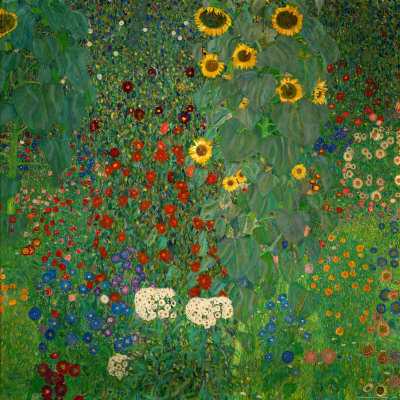
Gustav Klimt's Cottage Garden with Sunflowers (Bauerngarten mit Sonnenblumen) is a 1906 oil painting on canvas in the Austrian Gallery Belvedere. The square measures 110 × 110 centimetres, bears the two-line signature GUSTAV / KLIMT at lower left and is catalogued as inventory 3685. The Belvedere listed it at the Upper Belvedere when its record was checked on 10 August 2026.[1]
Almost nothing in the composition behaves like a conventional distant landscape. There is no visible horizon, broad sky, lake or road. Flowers cover the square from edge to edge. Two sunflower plants rise above a mass of smaller blooms without acquiring an empty setting around them. Klimt turns a piece of cultivated ground into a close field of colour, but current conservation evidence also shows that this seeming abundance was revised, layered and materially considered.
At a Glance
- ArtistGustav Klimt
- English titleCottage Garden with Sunflowers
- German titleBauerngarten mit Sonnenblumen
- Date1906
- MediumOil on canvas
- Dimensions110 × 110 centimetres
- InventoryAustrian Gallery Belvedere 3685
- SignatureGUSTAV / KLIMT, lower left
- Likely locationFlower garden near Anton Mayr's farm by the Bräuhof at Litzlberg, Lake Attersee
- First documented contemporary description25 December 1906
- Major lifetime exhibitionKunstschau Wien, 1908
- Current accessUpper Belvedere as of 10 August 2026; verify before travelling
Why the Date Is Now 1906
The painting's date has moved within Klimt scholarship. The 1967 catalogue by Fritz Novotny and Johannes Dobai used circa 1905/06. Later catalogues by Alfred Weidinger and Tobias Natter assigned it to 1908. The Belvedere's current record uses 1906 because of a newspaper article discovered by Markus Fellinger in 2022.[1]
Published in the Vienna newspaper Die Zeit on 25 December 1906, the anonymous article described recent works apparently seen in Klimt's studio. One was a cottage garden whose sunflowers and other ordinary blooms had been brought together in a highly stylised, carpet-like arrangement. The description is specific enough for the Belvedere and Klimt Database to identify inventory 3685. The canvas must therefore have been begun no later than the summer of 1906.[1][2]
This correction concerns one painting. The 1905/06 and 1908 labels do not designate successive states, copies or companion canvases. They show how catalogue dates change when a contemporary document supplies a firmer terminus. The 1908 date was understandable because the work appeared prominently at that year's Kunstschau, but an exhibition date cannot override a detailed description published two years earlier.
The revised chronology also strengthens the geographical case. Klimt was staying in Litzlberg during the summers through 1907, close to the Bräuhof. A flower garden belonging to the nearby farm of Anton Mayr has been proposed as the motif.[1] The association is persuasive, but it remains a location judgment rather than a surveyed reconstruction.
A Garden Brought Very Close
At one hundred and ten centimetres on each side, the canvas is large enough to give the flower field bodily presence. Yet it offers almost none of the usual devices for measuring distance. There is no strip of sky at the top, no diminishing path and no architecture against which plants can be scaled. The gaze meets vegetation immediately.
This proximity shifts the painting towards the territory of a flower piece while preserving the logic of a garden. Stems still rise from a shared ground; heads occupy different levels; leaves overlap neighbouring plants. The square is not a vase arrangement, but it has been selected so tightly that the setting beyond the flowers disappears.
The absence of a horizon does not make the surface uniform. Larger heads and leaves occupy more visual weight, while smaller flowers form a distributed ground. Some stems can be followed; others vanish behind leaves or colour touches. Overlap creates a shallow, compressed depth that never develops into a long view.
Klimt's square format intensifies the enclosure. A horizontal canvas might have suggested a bed extending laterally; a tall one could have isolated the sunflowers as upright specimens. The equal dimensions allow growth to spread in all directions. Cropping at every edge implies continuation, yet the internal balance makes the selected field feel complete.
Two Sunflower Plants, Not One Emblem
The Belvedere identifies two prominent sunflower plants, each carrying several heads of different sizes. They rise above a denser population of smaller red, blue and white flowers.[1] Their scale gives the eye a first point of orientation without turning the composition into a portrait of a single plant.
One head may present a broad face, another turn or incline, and still others appear at different stages or angles. Leaves break the stems into intervals. The two plants therefore act less like matched pillars than like related vertical structures with their own rhythms. They interrupt the all-over pattern while remaining part of it.
The holder's description also names dahlias, marigolds, asters and flame flowers among the garden's contents.[1] These identifications help restore difference within the visual profusion. They should not become an exhaustive botanical inventory. A painted flower can be stylised, partly hidden or altered, and no exact count or cultivar list is required to understand the composition.
The sunflower plants create a useful hierarchy. Broad leaves and large heads gather attention; small blooms scatter it again. The eye moves between recognisable specimens and a more general field of colour. This alternating focus prevents the “carpet” analogy from implying that every element has the same scale or importance.
The Carpet Comparison
The newly recovered 1906 review did more than help date the work. It compared the stylised garden to an ideal carpet made from ordinary flowers. During the 1908 Kunstschau, critic Günther Freiberg likewise described Klimt's flower pictures as resembling brightly patterned carpets from which a section had been cut and framed.[1]
Both comparisons respond to visible features: suppressed depth, an edge-to-edge field, repeated colour and the absence of a dominant sky or horizon. They also show that the painting's radical closeness was legible to contemporary viewers. “Carpet” was not invented by later criticism to make Klimt appear more abstract.
It remains an analogy, not a production history. The canvas was not copied from a named textile, and its medium is not fabric, embroidery or mosaic. The plants retain enough irregularity, overlap and differing scale to resist a mechanical repeat. The comparison is most useful when it explains how the garden occupies the picture plane, not when it converts natural growth into a fixed ornamental code.
Nor does surface emphasis eliminate observation. The two main sunflower structures, varied leaves and differentiated blooms suggest sustained looking. Stylisation and specificity coexist. Klimt could select a real cultivated patch and make its arrangement serve the square without reducing every plant to a botanical portrait.
A Flower Landscape in Austrian Context
Klimt did not invent the idea of treating flowers as a serious landscape subject. Belvedere research places his work beside a strong Austrian tradition around 1900, including paintings by Tina Blau, Marie Egner and Olga Wisinger-Florian. Egner and Wisinger-Florian developed compositions in which large foreground plants could lead rapidly into an extensive field beyond.[1]
Cottage Garden with Sunflowers takes a different spatial course. It does not use near flowers as a threshold to a distant meadow. It removes the distant zone almost altogether. Plants encountered at close range become the whole pictorial environment, and the upper edge supplies no horizon against which their scale can settle.
That contrast helps identify Klimt's innovation without pretending that flowers had been an artistically minor subject before him. His contribution lies in the degree of compression, the square selection and the refusal of a background. The garden is still a cultivated place, but the distinctions between foreground, middle distance and far view have been brought almost to collapse.
The painting can consequently be both landscape and flower picture. Its plants occupy a patch of ground rather than a vase, yet their proximity invites the sustained scrutiny normally associated with still life. This hybrid position is more exact than treating the scene as either pure decoration or a conventional outdoor vista.
Litzlberg without a False Viewpoint
The 1906 date places the painting within Klimt's Litzlberg period. Belvedere research associates the motif with the flower garden near Anton Mayr's farm beside the Bräuhof.[1] The Klimt Database likewise locates his richly flowering meadow subjects in the vicinity of his lodging.[2]
That context is sufficient to establish a likely setting. It does not identify an exact bed, compass direction, viewing distance or modern patch of ground. Gardens change from season to season; individual plants are moved; buildings and boundaries alter. No working photograph, planting plan or preparatory map fixes the selected square.
Klimt's correspondence documents his use of a square cardboard finder when choosing landscape motifs. The Belvedere connects that practice to the canvas.[1] A finder offers a convincing way to think about the severe crop: it isolates a portion of the visible world before the painter commits it to the square. It does not prove the precise size of the opening, the distance from the flowers or a mechanical transfer from sight to canvas.
Landscape composition drawings are exceptionally rare in Klimt's surviving work. A 1917 sketchbook contains small studies of individual flowers, but those sheets postdate this painting by more than a decade and do not establish its total arrangement.[1] They cannot be treated as cartoons for inventory 3685 or used to move its date forward.
A Light Ground Applied by Hand
Belvedere conservation research provides unusually exact information about how this canvas was prepared. Beneath the flowers is a light ground applied with visible brushwork. Drying garlands—subtle curved effects formed as the prepared canvas dried—and evidence at the edges show that the ground was not an industrially uniform coating. It was applied by the artist.[1]
This finding matters because the ground remains optically active. It is not merely a hidden barrier between canvas and colour. In several areas it contributes brightness and participates in the image, particularly among the pale foreground flowers.
The current stretching is secondary, meaning the canvas has been re-stretched since its first mounting. Original nail holes nevertheless survive along the edges.[1] These are separate facts. Re-stretching does not mean that the image was repainted, resized or transferred to a second canvas, and surviving early nail holes do not identify the original frame.
The edges preserve making history that cannot be inferred from the front alone. They help distinguish the artist's hand-applied preparation from later changes to the support's tension. Neither condition should be converted into a dramatic damage narrative: the Belvedere records a present support state and surviving evidence of the original mounting.
From Thin Paint to Relief
Klimt began the colourful arrangement with thin, fluid oil-resin paint over the pale preparation. In later layers the same oil-resin paint became increasingly pastose, leaving a more pronounced brush trace. Some areas have substantial thickness because he revised them until they met his pictorial requirements.[1]
This progression complicates the idea of effortless natural abundance. Thin passages establish broad relations economically. Thicker applications give selected leaves, heads or accents greater physical presence. The surface can look spontaneous because gestures remain visible, yet the accumulated layers preserve reconsideration.
“Oil-resin” identifies the binding character found in the paint; it does not replace the public medium of oil on canvas. Nor does thickness justify assigning an exact sequence to every visible mark. Conservation can establish broad differences between liquid and pastose handling without reconstructing the hour, day or order in which each flower was completed.
The result is an uneven physical field corresponding to an uneven visual one. Prominent sunflower elements gain relief while thinner areas allow the light preparation to participate. Flatness in composition therefore coexists with variation in actual surface depth.
The Sunflower Heads beneath the Leaves
X-radiography reveals some sunflower heads that Klimt laid into an earlier arrangement but ultimately covered with sunflower leaves.[1] The finding is important because it shows that even the largest plant structures were not fixed from the outset.
The X-ray does not reveal a complete alternative painting. It records local forms that became hidden under later work. We cannot use it to draw an authoritative first-state diagram, count every abandoned head or establish the entire chronology of revision. The covered flowers belong to one continuously developed canvas.
What can be said is more interesting than a speculative reconstruction. Klimt reconsidered the balance between round heads and expanding foliage. By replacing some floral discs with leaves, he changed both the distribution of focal points and the continuity of green across the field. The final surface is not a transparent record of the first plan.
This evidence also clarifies the distinction between change and damage. Hidden heads were intentionally covered during painting; they are not losses caused by abrasion or later restoration. The surviving image is the resolved public state, while X-radiography provides a limited view of decisions beneath it.
No infrared graphite or charcoal findings are published for this object. Those belong to Belvedere's separate Upper Austrian Farmhouse. Inventory 3685 must not acquire its sibling's underdrawing evidence, woodpile revision or macroscopic paint claims.
White Flowers Made with the Ground
Macroscopic examination shows that pale foreground flowers rely partly on exposed light ground. Klimt added a few red and violet touches and bounded their forms with fluid green brushstrokes.[1] What might appear in reproduction as blankness is therefore active pictorial construction.
The technique allows brightness without filling every petal with opaque white paint. The support's preparation becomes the flower's light, while small colour accents give differentiation. Thin green contours prevent the pale areas from dissolving entirely into the surrounding field.
These passages demonstrate why close technical evidence can refine formal interpretation. The carpet-like field is not equally covered. Some flowers emerge from paint accumulation; others depend on restraint and exposed preparation. Material variation keeps the surface alive even where spatial recession has been compressed.
The finding should not be broadened into a rule for all Klimt flower paintings. It belongs to inventory 3685. Nor should exposed ground be called unfinished simply because less pigment is present. Here it has a clear representational function within a completed, signed and exhibited work.
Cottage Garden, Bauerngarten and Sunflower
The generic German word Bauerngarten created a historical identity problem. Klimt also painted a separate private canvas titled Bauerngarten in 1907, using a comparably close field of flowers. The 1908 Kunstschau catalogue shortened inventory 3685's title to Bauerngarten, leaving later scholars to ask which painting had actually been shown.[1]
A Moriz Nähr photograph of the Klimt room resolves the problem. At the right edge, partly cut off, appears a painting identifiable as Cottage Garden with Sunflowers, notably through the pale flowers in its lower zone. The photograph secures inventory 3685 in the 1908 exhibition. The similarly brief Bauerngärtchen listed at the 1909 Internationale Kunstschau can consequently be assigned to the other garden painting.[1]
This is a case in which an installation photograph does more than illustrate an exhibition. It reconciles an abbreviated catalogue title with a particular object. The photograph is not a preparatory image or another state of the canvas; it is documentary evidence of where the finished painting hung.
The separate Sunflower must also remain distinct. That 1907/08 Belvedere painting centres one tall plant above a carefully tiered base and uses oil and gold leaf on canvas.[3] Inventory 3685 contains two multi-headed sunflower plants within a broader garden and is recorded simply as oil on canvas. No gold leaf or other metal may be inferred from its yellow or gold-coloured passages.
From the Kunstschau to the Memorial Exhibitions
The 1908 Kunstschau gave the canvas a major public setting two years after the newspaper description. The catalogue's abbreviated title made the later photographic identification necessary, but the installation image also shows how the dense square operated among Klimt's exhibited works. It was a finished public painting, not an experiment left in the studio.[1]
The subsequent exhibition trail helps connect changing titles to changing ownership records. In Mannheim in 1913 and Prague in 1914 it appeared as Sonnenblumen—Sunflowers—and was listed as available for sale. The shortened plural did not transform it into the singular Belvedere Sunflower. The dates, two-plant composition and later provenance retain the identity of inventory 3685.[1]
In 1928 Hermine Wittgenstein lent the canvas to the Klimt memorial exhibition at the Vienna Secession. Her lending receipt is especially useful because it supplies an ownership anchor after the unresolved Karl-to-Hermine passage. The painting travelled again in 1937 for exhibitions of Austrian art in Paris and Bern, where the catalogue record continued to associate it with the Wittgenstein collection.[1]
These appearances should not be mistaken for a complete itinerary. They are selected points at which the painting becomes publicly visible and its title or owner can be documented. The gaps between them remain gaps; an exhibition list cannot by itself reconstruct storage, family agreements or every movement of the canvas.
From Karl to Hermine Wittgenstein
The second instalment of Galerie Miethke's Klimt portfolio, published in 1910, named industrialist and collector Karl Wittgenstein as owner. The current record does not establish his exact purchase date or terms. After his death in January 1913, the painting appeared at Mannheim in 1913 and Prague in 1914 as a work offered for sale.[1]
Those sale listings do not prove that Klimt had taken the canvas back or that a buyer was found. By 1928, Karl's eldest daughter Hermine Wittgenstein is documented as lender to the Klimt memorial exhibition at the Vienna Secession. She also lent the painting to Austrian art exhibitions in Paris and Bern in 1937.[1]
Older catalogue entries sometimes named “Henriette Wittgenstein,” but the documented owner was Hermine. Even so, no surviving transfer record explains precisely when or how the painting moved from Karl's estate to her. “Inherited” may seem likely, but the object history currently supports a change in recorded ownership, not the missing legal instrument.
This distinction keeps the chain honest. Karl's ownership by 1910 and Hermine's later lending are secure anchors. The interval between them is not an invitation to invent an estate division, family purchase or return to the artist.
Galerie Sanct Lucas and the 1939 Gap
In October 1939 the Austrian Gallery bought Cottage Garden with Sunflowers from the Vienna Galerie Sanct Lucas for 5,000 Reichsmarks. The Belvedere archive retains a receipt dated 28 October. What it does not retain is documentation showing when or under what conditions Hermine Wittgenstein transferred the painting to the gallery, perhaps for sale on commission.[1]
The gap is material. A transaction in Vienna in 1939 demands careful provenance language, but the absence of transfer documents cannot itself prove a forced sale, confiscation, fair-market disposal or freely negotiated consignment. Each of those conclusions would require evidence beyond the current record.
The acquisition should therefore be stated in two stages: Galerie Sanct Lucas was the Austrian Gallery's immediate seller, and the preceding passage from Hermine Wittgenstein is unresolved. This formulation neither conceals the historical circumstances nor fills them with a mechanism that has not been established.
The painting entered the museum collection through that 1939 purchase and has remained a Belvedere object. Its provenance does not merge with the expropriated Lederer history of Farm Garden with Crucifix, and no restitution outcome should be imported from another Klimt work.
What the Different Kinds of Evidence Establish
Inventory 3685 survives with several unusually complementary records. The December 1906 review secures an early date and preserves a contemporary reaction to the composition. The Moriz Nähr photograph resolves which flower garden hung at the 1908 Kunstschau. Exhibition catalogues and lending documents anchor later title and ownership changes. X-radiography, macroscopic examination and the canvas edges disclose aspects of manufacture unavailable to ordinary viewing.[1]
These records answer different questions. The newspaper does not prove the current support condition. The installation photograph cannot reveal hidden sunflower heads. An X-ray cannot identify the legal terms of a 1939 transfer. A provenance receipt does not show which flower was painted first. Keeping those evidentiary roles separate makes the account stronger rather than more cautious for its own sake.
Together they reveal a painting that was both immediately striking and repeatedly considered. Contemporary writers noticed an almost textile-like field; current examination shows how thin paint, relief and exposed preparation produced its variety. Public photographs distinguish it from a sibling, while radiography distinguishes the final arrangement from local forms underneath. The canvas has one identity, but it can be approached through several non-interchangeable records.
Present Display and What to Look For
As of 10 August 2026, the Belvedere listed inventory 3685 at the Upper Belvedere.[1] Museum displays and loans can change, so visitors should confirm its location before travelling.
Seen in person, the work rewards shifts of distance. From farther away, the square can read as a dense floral fabric punctuated by sunflower structures. Closer viewing reveals unequal thickness, visible brushwork, thin contours and pale areas in which the ground itself helps form blossoms. The technical findings explain why these readings coexist.
The painting is radical not because Klimt abandoned the garden for pure ornament, but because he made selection, observation and material revision work together. He removed the horizon, brought plants to the front, adjusted major heads beneath later leaves and allowed preparation to remain visible. The result is both an encountered garden and a deliberately constructed surface.
Frequently Asked Questions
References
- Austrian Gallery Belvedere, “Cottage Garden with Sunflowers,” inventory 3685; current identity, 1906 date, medium, dimensions, signature, likely Litzlberg site, dating research, floral description, carpet reception, study limits, conservation findings, Kunstschau identification, provenance and Upper Belvedere location. View source. Accessed August 2026.
- Gustav Klimt Database, “The Klimt Affair Surrounding the Faculty Paintings,” “Colorful Floral Mosaics”; 1906 identity, Litzlberg context, December 1906 description and position among Klimt's close-view flower landscapes. View source. Accessed August 2026.
- Austrian Gallery Belvedere, “Sunflower,” inventory 10500; separate 1907/08 object identity, oil-and-gold-leaf medium, dimensions, signature and composition. View source. Accessed August 2026.
Discussion
Cottage Garden with Sunflowers rewards close attention to source context, object identity and careful reproduction boundaries.