 by Tom Gurney
Tom Gurney BSc (Hons) is an art history expert with over 20 years experience
Published on August 21, 2026 / Updated on October 23, 2026
Email: tomgurney1@gmail.com / Phone: +44 7429 011000
About Apple Tree II
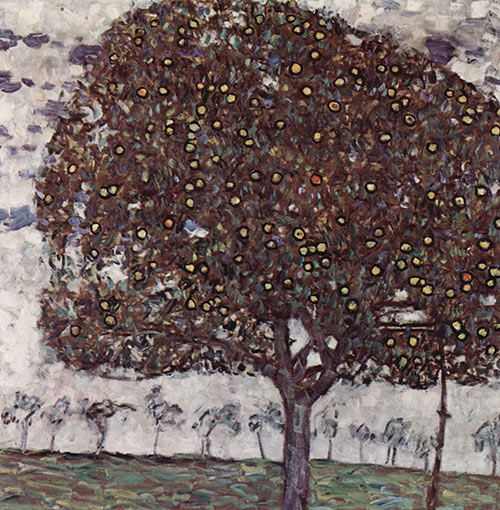
Gustav Klimt's Apple Tree II, also known as Green Apple Tree, is a distinct landscape painted in 1916. It is an oil on canvas measuring 80 × 80 centimetres, formerly held by the Österreichische Galerie Belvedere as inventory 5447 and now recorded in a private collection.[1][2] Its tall trunk supports a broad crown through which blue sky remains visible. Rounded fruit, restless foliage and loosely painted trees behind it give the image an openness very different from the compact enclosure of Apple Tree I.
The painting is also the centre of an extraordinary provenance correction. Austria returned it to Nora Stiasny's heirs in November 2001 after identifying it as a work she had lost under Nazi persecution. Research completed in 2017 concluded that this particular canvas had almost certainly been confused with another Klimt landscape. Yet that correction did not produce a complete alternative ownership history. A connection with the Lederer family and Elisabeth Bachofen-Echt is highly probable, while the means by which the painting reached the filmmaker Gustav Ucicky remains unknown.[2]
Those two histories should be kept in balance. Apple Tree II is not only a restitution case, and its expressive paint cannot be used to illustrate the uncertainty of the documents. It is a finished late landscape whose atmosphere depends on the exchange between solid tree and open sky.
At a Glance
- ArtistGustav Klimt
- Governing titleApple Tree II (Green Apple Tree)
- German titlesApfelbaum II and Der Apfelbaum II
- Date1916
- MediumOil on canvas
- Dimensions80 × 80 centimetres
- Former museum numberÖsterreichische Galerie Belvedere inventory 5447
- Present statusPrivate collection; no verified public display as of August 2026
- Defining featuresA tall trunk, broad permeable crown, blue sky openings, muted fruit and sketchier background trees
- Provenance cautionProbable Lederer/Bachofen-Echt origin; unknown acquisition by Gustav Ucicky; mistakenly returned to Stiasny's heirs in 2001; financial settlement reached in 2023
One Canvas, Several Names
The Roman numeral is part of the painting's modern identity, not evidence of a second state. Apple Tree II was not painted over Apple Tree I, nor has technical imaging revealed the first painting beneath it. The two are separate canvases made approximately four years apart and at different scales. The later picture is exactly square and considerably smaller.[1][2]
Green Apple Tree is an alternative English title for the same 1916 object. It does not mean that every visible fruit must be classified as green or unripe. The former Belvedere painting also appeared as Garten—Garden—in the 1962 Klimt memorial exhibition in Graz.[7] That historical catalogue wording did not create another work.
Other descriptions in archival documents are more difficult. A 1926 exhibition catalogue listed an Apfelbaum, Oelskizze (gerahmt), or framed apple-tree oil sketch. Later records mention a small apple tree, a landscape with an apple tree and other imprecise variants. Such phrases can help reconstruct ownership only when measurements, dates, photographs or linked records support the match. A title alone is hazardous: the 2017 official investigation counted six Klimt paintings whose titles contain “apple tree” and five more dominated by apple or otherwise indistinct fruit trees.[2]
That crowded catalogue field is not a minor scholarly inconvenience. It explains how a description could appear persuasive while pointing to the wrong canvas. The safest starting point remains the physical identity: the 1916 oil, 80 centimetres square, formerly numbered 5447.
No authoritative source retained here supplies a secure signature transcription. The absence of a published field does not prove that the painting is unsigned, but it prevents confident claims about lettering, position or condition.
How the Tree Occupies the Square
The trunk begins close to the lower edge and rises with unusual directness. It is slender in relation to the expanse above, yet it acts as the composition's vertical support. Rather than splitting the image symmetrically, it bends and branches into an irregular system. The eye follows that ascent, then disperses through leaves, fruit and fragments of atmosphere.
The crown fills most of the square without sealing it. Its apparent monumentality comes from breadth, height and proximity: the tree is close enough for its upper growth to press toward the frame. But the canopy is not a single flat disc. Gaps separate clusters; branches and twigs appear briefly, vanish, then re-emerge; cooler and warmer marks interrupt one another. The tree feels abundant while remaining permeable.
This combination matters. A densely filled square can make a landscape seem like a decorative screen. Here, Klimt repeatedly punctures that screen. Foliage advances, blue recedes, and the viewer shifts between reading a surface of coloured strokes and looking through a living crown. The specialist account describes the tree as monumental and potentially Symbolist while also emphasising the atmospheric, almost Impressionist effect of the brightening sky.[1] Those descriptions are compatible: the tree can command the image without becoming opaque.
Blue Openings and Atmospheric Depth
Blue enters mainly through the upper crown. It appears in irregular apertures rather than as one continuous band above a horizon. Some openings are small and enclosed by foliage; others expand toward the top edge. Their scattered distribution keeps the eye circulating instead of allowing it to settle on a conventional division between earth and sky.
These patches also prevent the upper half from becoming uniformly heavy. The crown retains mass, but light and air pass through it. Blue sometimes reads as distant atmosphere and sometimes as a coloured interval embedded in the painted surface. The distinction depends on viewing distance. Close inspection isolates marks; farther away, they connect as glimpses beyond branches.
No surviving evidence fixes an exact viewpoint or proves the use of an optical device for this canvas. The painting may transform a place observed during Klimt's final Attersee summer, but neither a working photograph nor a securely associated study establishes a precise site. The visual argument does not require one. What matters is the chosen relation between near tree, incomplete background and sky.
Fruit Without a Colour Code
Apples appear throughout the crown as rounded interruptions. Some are pale or muted; others carry warmer notes. They are less insistently red than the fruit in Apple Tree I, so they do not dominate the image through repeated scarlet accents. Instead they participate in the canopy's broader rhythm.
The alternate title Green Apple Tree can tempt an overly literal interpretation. Yet a title is not a pigment chart. Changing light, reproduction and the surrounding leaves affect how individual forms appear, and no responsible account needs an exact tally. The more useful observation is relational: fruit forms slow the mobile brushwork by offering moments of fullness, then release the eye back into foliage.
Apples also carry extensive cultural associations, from harvest and abundance to knowledge, temptation and mortality. The Klimt Database calls the motif symbolically charged, but no retained statement by Klimt assigns this painting a fixed programme.[1] Its date during the First World War does not turn muted colour into proof of grief, pessimism or political allegory. Visible atmosphere should not be converted into private diagnosis.
The Lower Field and the Trees Behind
The base of the canvas is narrow but active. The main trunk emerges from growth described with abbreviated marks rather than from a carefully mapped strip of earth. That compressed foundation strengthens the tree's upward movement: there is little foreground to cross before the trunk begins.
Behind the principal tree, smaller forms suggest a row or group of more distant trees. Their trunks and crowns are notably sketchier. They do not possess the main tree's sustained weight or degree of integration. This difference creates recession while also revealing a hierarchy of attention. Klimt worked the commanding central crown into a coherent whole and allowed the background growth to remain more visibly abbreviated.[2][4]
The distinction is crucial because archival descriptions sometimes called an apple-tree work an oil sketch. Tobias Natter's expert assessment, discussed by the Austrian restitution authorities, treated Apple Tree II itself as a worked-through painting. Its background may have a sketch-like character; that does not classify the complete canvas as preparatory.[2][4] Open handling is a pictorial choice, not evidence of incomplete status.
Dynamic Brushwork in a Finished Painting
The Klimt Database characterises the brushwork as open and dynamic and relates its energy to Vincent van Gogh.[1] The comparison is most useful at the level of visible movement. Short strokes change direction; branches, leaves and sky press against one another; coloured marks keep the crown from settling into still ornament. Klimt does not imitate a single Van Gogh formula. He uses an animated surface to make the tree's growth feel continuous.
The palette is described as muted relative to other late works, not colourless.[1] Blue still illuminates the canopy, and differences among greens, pale fruit and darker structural marks remain active. “Muted” therefore names a relationship of intensity. It cannot by itself determine weather, mood or wartime meaning.
Nor does looseness eliminate decision. The square is carefully held by the trunk's rise, the crown's outward pressure, the repeated sky holes and the subordinate background. Every part need not receive equal finish for the whole to read as complete. The painting's vitality comes partly from this inequality: density at the centre, abbreviation behind, atmosphere threaded through both.
No surviving preparatory sheet has been securely attached to the canvas in the official research. Natter allowed that studies might once have existed, but none was preserved or located.[2] That is an archive-status conclusion, not proof that Klimt began directly on canvas without drawing.
A Late Alternative to Apple Tree I
The earlier numbered canvas offers a concise way to see what changed. Apple Tree I, dated 1912 or circa 1912, measures 109 × 110 centimetres. Its low compact crown is crowded with conspicuous red fruit above a narrow flowered strip. Apple Tree II measures 80 centimetres square, sends its trunk higher and admits substantially more blue between foliage.[1]
The difference is not a simple progression from finished to sketchy. Both are complete oil paintings. The later work makes the boundary of the tree less absolute: crown and atmosphere interpenetrate, while smaller trees behind remain visibly open. Its fruit is less commanding and its marks more mobile. The comparison clarifies two solutions to the orchard motif without making the canvases a commissioned pair or a single evolving object.
Pear Tree belongs to another problem again. Its mixed medium and prolonged reworking should not be projected onto Apple Tree II, whose retained record identifies oil on canvas and no photographed revision sequence.
Three Very Different Exhibition Records
The painting's exhibition history is unusually dependent on degrees of identification. The 1926 Neue Galerie entry is the earliest likely appearance in the reconstructed chain, but its wording is not exact enough to make the match certain. Serena Lederer lent a framed Apfelbaum, Oelskizze to the gallery's twenty-third exhibition.[2] The owner, subject and approximate place in the chronology all support a relationship with the present canvas. The description “oil sketch,” however, conflicts with the expert assessment of the 1916 painting as worked through. Without a surviving catalogue photograph or measurements tying the entry to former inventory 5447, “probably shown in 1926” is stronger than “definitely exhibited.”
The 1962 appearance is firmer. The Klimt Database records the canvas in the Graz memorial exhibition under the title Garten.[7] That generic title belongs to the history of cataloguing this particular work; it should not be used to merge the painting with Klimt's other gardens. By then the Austrian Gallery had received Ucicky's death-contingent gift, so title, institutional custody and exhibition chronology meet around an identifiable object.
The proposed Leopold Museum loan in 2018 occupies a third category. The museum's advance material supplied a precise image and the title Apfelbaum II, named the date and oil medium, and credited Fondation Louis Vuitton.[6] The canvas was therefore physically identified and prepared for presentation. Yet it was removed before the exhibition opened, making it evidence of a planned loan rather than a completed public showing.[8]
These distinctions are more than catalogue etiquette. “Probably present,” “securely exhibited” and “withdrawn before opening” describe different historical facts. Flattening them into one uninterrupted exhibition list would conceal exactly the kind of uncertainty that shaped the painting's provenance. It would also create a false impression of regular public access. The surviving record instead shows brief, uneven moments of visibility separated by long periods in private or museum custody.
Why the Provenance Became So Difficult
For much of the twentieth century, published provenance connected Apple Tree II with August and Serena Lederer before Gustav Ucicky. Research around 1999 and 2000 challenged that account. A Nazi-era file described an apple-tree painting associated with Nora Stiasny, and details were matched to the former Belvedere canvas. Austria's Art Restitution Advisory Board recommended its return to Stiasny's legal successors on 10 October 2000.[2][3]
That decision addressed a genuine history of persecution. Nora Stiasny was Jewish, and her Klimt landscape was lost under National Socialism. The later correction concerns which painting that was; it does not rehabilitate the circumstances of her loss. Object identity and historical injustice must not be set against each other.
Doubts were present even during the original process. The Austrian authorities revisited whether the canvas belonged with Stiasny or with the Lederer family before delivery. Nevertheless, on 27 November 2001, Apple Tree II was handed to the representative of Stiasny's heirs.[2][3] The painting subsequently passed into private ownership.
The Probable Lederer and Bachofen-Echt Connection
The revised investigation began with evidence that the Lederer collection contained two apple-tree paintings. A July 1921 notarial record supplies the earliest archival support for that pair. One was the photographically documented Golden Apple Tree, probably destroyed at Immendorf in 1945. The other is a possible predecessor in the ownership history of Apple Tree II.[2]
Serena Lederer lent a framed work catalogued as Apfelbaum, Oelskizze to the Neue Galerie's twenty-third exhibition in 1926. The official report considers it likely that an apple-tree painting subsequently passed to her daughter Elisabeth Bachofen-Echt. An apartment record dated 13 July 1938 refers to an apple tree among Bachofen-Echt's possessions.[2]
These clues form a strong pattern, but they do not amount to certain identification. The catalogue's “oil sketch” wording sits awkwardly beside the worked-through 1916 canvas. The report judged a match highly probable because otherwise another, presently unknown apple-tree version would be required. It did not claim that measurements, a photograph or an inventory number completed the proof.[2][4]
The correct formulation therefore has two parts. Apple Tree II probably came from the Lederer collection or Elisabeth Bachofen-Echt's ownership. No discovered visual or written document definitively confirms that assignment. Probability is not certainty, even when it is the most persuasive account available.
The Unresolved Transfer to Gustav Ucicky
Gustav Ucicky possessed the painting before his death. In 1961, the Austrian Gallery received it under his death-contingent gift, and it entered the Belvedere as inventory 5447.[2] What happened before that transfer to the museum is the central gap.
The official investigation found no document establishing when Ucicky obtained the canvas, who transferred it or on what terms. A transaction from Elisabeth Bachofen-Echt, her former husband Wolfgang Bachofen-Echt or her brother Erich Lederer was considered possible, but no seller can be named from the surviving evidence. A wartime acquisition cannot be proved; neither can a postwar purchase or inheritance.[2][4]
The report also found no documented restitution claim concerning this precise painting from Bachofen-Echt's relatives. That absence does not prove the ownership change was voluntary or lawful. It means the mechanism remains unknown. Describing the canvas as certainly Nazi-looted would exceed the record, while describing the chain as clean would make the opposite error.
Correcting the 2001 Identification
Renewed questions in 2015 led to expert and provenance investigations. Their 2017 conclusion separated two landscapes that title-based research had confused. Apple Tree II could no longer be treated as Nora Stiasny's former property. Instead, Rose Bushes under Trees—historically connected with the longer title Roses under the Bending Apple Tree—was identified with high probability as the work from the Zuckerkandl and Stiasny history.[2]
Only that minimum comparison is necessary here. Rose Bushes under Trees is a different canvas with its own ownership and restitution record. Its role in the present account is diagnostic: a title containing “apple tree” helped one object disappear inside another's documentation.
The 2017 correction did not automatically transfer ownership of Apple Tree II to the Austrian state or Lederer heirs. It revised the historical attribution. Nor did it turn the Stiasny family's 2001 receipt into deliberate wrongdoing. Austria had made the recommendation and delivered the painting under the evidence then accepted.
The Withdrawn 2018 Loan
The Leopold Museum prepared to include Apple Tree II in its 2018 centenary exhibition. Its press-image list records the painting as a 1916 oil and identifies Fondation Louis Vuitton, Paris, as the intended lender.[6] The canvas reached the pre-opening presentation but was withdrawn before the exhibition opened after the unresolved provenance dispute drew renewed attention. The museum stated that it would not show a work subject to an unsettled dispute.[8]
This episode supports a dated lender credit and an intended Vienna display. It does not prove that Fondation Louis Vuitton remained the legal owner in August 2026, and it should not be listed as a completed exhibition appearance. The painting was removed before visitors saw the show.
The 2023 Settlement
In February 2023, the Republic of Austria announced a settlement with Nora Stiasny's heirs arising from the mistaken return. The heirs agreed to pay US$11.3 million, reported as approximately €10.6 million, in compensation to the Republic.[5] The payment resolved the direct financial dispute over the 2001 delivery.
It did not amount to a repurchase of the canvas. The official announcement says the Republic and the heirs had tried to contact the current owners about a possible buyback, but those owners did not wish to enter discussions.[5] Austria therefore did not recover the painting, and the settlement supplied neither a current owner name nor the missing Ucicky acquisition history.
The work continues to be classified as privately owned.[1][7] No verified public display, owner or city was located as of August 2026. The 2018 Fondation Louis Vuitton credit remains a historical lending record, not a current travel instruction.
Why Apple Tree II Matters
Apple Tree II demonstrates how Klimt could make a tree monumental without closing it against the world. The trunk rises firmly, yet sky penetrates the crown; fruit supplies weight, yet never halts the restless surface; sketchier background growth opens depth behind the principal form. The result is neither a botanical record nor an oil sketch, but a finished late landscape built from unequal densities of attention.
Its provenance teaches a different kind of looking. Titles, family recollections and archival descriptions can be indispensable, but none substitutes for exact object identification. The 2001 return tried to repair a real persecution history and attached the wrong canvas to it. The 2017 correction restored a more credible distinction while leaving another history incomplete. Responsible interpretation must preserve both achievements and gaps.
Frequently Asked Questions
References
- Gustav Klimt Database, “The Final Years: 1914–1918,” Apple Tree II (Green Apple Tree), date, private status and object-specific visual interpretation. View source. Accessed August 2026.
- Austrian Commission for Provenance Research, “Collections of August and Serena Lederer / Nora Stiasny: Report of the Art Restitution Advisory Board,” 12 July 2017; identity research, probable Lederer/Bachofen-Echt provenance, Ucicky gap and corrected Stiasny conclusion. View source. Accessed August 2026.
- Austrian Art Restitution Advisory Board, “Nora Stiasny,” recommendation of 10 October 2000; historical grounds for returning former Belvedere inventory 5447. View source. Accessed August 2026.
- Austrian Art Restitution Advisory Board, “Information on Apple Tree II,” 16 March 2018; worked-through-painting assessment and limits of the pre-Ucicky ownership evidence. View source. Accessed August 2026.
- Austrian Federal Ministry for Arts, Culture, the Civil Service and Sport, “Republic of Austria and Stiasny Heirs Reach Settlement on Apple Tree II,” 10 February 2023; US$11.3 million settlement and unsuccessful owner contact concerning a possible repurchase. View source. Accessed August 2026.
- Leopold Museum, “Gustav Klimt: Artist of the Century,” 2018 press-image list; Apple Tree II, 1916, oil on canvas, and intended Fondation Louis Vuitton lender credit. View source. Accessed August 2026.
- Gustav Klimt Database, “Klimt Today,” private classification, restitution overview and the historical Garden exhibition title. View source. Accessed August 2026.
- The Art Newspaper, “Austria Returns Wrong Klimt to Wrong Family,” 13 November 2018; report of the pre-opening withdrawal and the Leopold Museum's public statement. View source. Accessed August 2026.
Discussion
Apple Tree II rewards close attention to source context, object identity and careful reproduction boundaries.