 by Tom Gurney
Tom Gurney BSc (Hons) is an art history expert with over 20 years experience
Published on August 21, 2026 / Updated on October 23, 2026
Email: tomgurney1@gmail.com / Phone: +44 7429 011000
About Apple Tree I
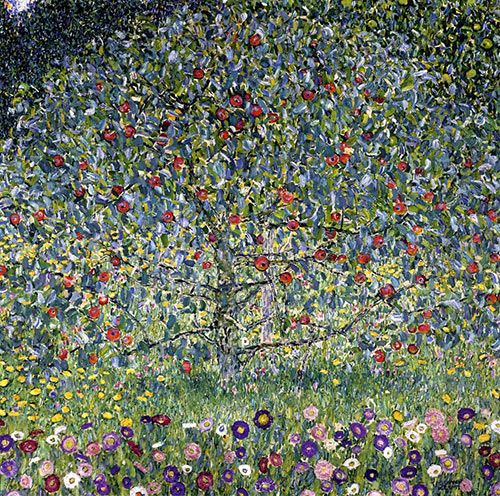
Gustav Klimt's Apple Tree I presents a tree so abundant that it nearly becomes the whole landscape. A short central trunk rises into a broad, low crown. Red apples are distributed across masses of green and blue-green foliage, while a narrow strip of flowers presses along the lower edge. Only a small opening in the upper background admits a glimpse of blue sky. The canvas is almost square, but the tree does not sit inside it like a specimen with space around it. Branches, leaves and fruit seem to expand until the frame itself contains their growth.
This is the signed canvas formerly owned by Adele and Ferdinand Bloch-Bauer. Christie's records it as an oil painting of 1912 measuring 109 × 110 centimetres, with Gustav Klimt signed at lower right.[1] The Gustav Klimt Database uses the slightly more cautious date circa 1912 and the identifying subtitle Small Apple Tree.[2] Both records concern one painting, first exhibited in Dresden in 1912 and now in a private collection.
The picture rewards close looking because abundance never becomes indiscriminate. Red fruit, coloured blossoms, darker branches and tiny openings through the crown each remain visible within the profusion. Klimt makes density his subject, then gives the eye enough distinctions to move through it.
At a Glance
- ArtistGustav Klimt
- TitleApple Tree I
- German titleApfelbaum I
- Specialist subtitleSmall Apple Tree
- Date1912; also catalogued as circa 1912
- MediumOil on canvas
- Dimensions109 × 110 centimetres
- SignatureGustav Klimt, lower right
- First documented ownersAdele and Ferdinand Bloch-Bauer, Vienna
- Current collectionPrivate collection
- Current accessNo verified public display when checked in August 2026
Which Painting Is Apple Tree I?
The title identifies the near-square canvas offered by Christie's in New York on 8 November 2006. Its red-fruited central tree, intensely flowered foreground, measurements, lower-right signature and Bloch-Bauer provenance distinguish it securely.[1] The work is also called Apfelbaum I and, in the Klimt Database, Apple Tree I (Small Apple Tree).[2]
“Small” describes the tree or inherited catalogue title, not the physical importance of the painting. At 109 × 110 centimetres, the canvas is only slightly wider than it is high and should not be rounded to an exact square.
The Roman numeral matters because Klimt painted a separate Apple Tree II in 1916. That later work is smaller, measuring 80 × 80 centimetres, and opens its crown more visibly to the sky.[3] The numerals do not denote photographed states of one canvas. They distinguish two objects with different dates, compositions and ownership histories.
A third work, The Golden Apple Tree, was painted in 1903 and was probably destroyed in the Immendorf fire of 1945.[3] It is not an earlier state of this painting, and Apple Tree I contains no recorded gold leaf or metallic medium. Its reds, yellows and luminous greens are oil paint.
A Crown That Nearly Seals the Canvas
The apple tree begins low. Its trunk rises from the flowered ground near the centre, then divides into branches that support a wide, rounded crown. Because the crown occupies most of the canvas, the familiar hierarchy of foreground, middle distance and sky is compressed. The eye encounters the tree before it encounters a landscape around the tree.
The crown is not a single green mass. Darker areas give it weight, while blue-green and yellow-green touches separate clusters of foliage. Narrow branches appear and disappear between leaves. Some areas read as continuous growth; others break into small marks that declare the action of painting. The tree remains recognisable without being bounded by a smooth outer contour.
Its low breadth is important. A tall isolated tree could direct attention upward, but this one expands sideways and forward. Leaves approach the top and side edges. The visual pressure makes the tree seem larger than its trunk alone would suggest. Growth is represented not by showing the full height of a specimen against open sky, but by allowing the crown to occupy almost every available part of the field.
Background vegetation reinforces that effect. Darker growth continues behind the main crown, so its outer leaves do not always meet a contrasting sky. Figure and setting overlap. Klimt nevertheless preserves the tree's identity through the central trunk, the distribution of fruit and subtle shifts between nearer and more distant marks.
Red Fruit Across Green
The apples provide the painting's clearest recurring accents. Their red forms appear throughout the crown rather than gathering in one corner. Some are strongly modelled and conspicuous; others are smaller interruptions within the foliage. The Klimt Database describes the fruit as ripe and ready for harvest, emphasising how their colour and form stand out amid looser handling.[2]
Red against green produces immediate contrast, but Klimt avoids a regular decorative grid. Intervals vary. A fruit can sit beside a dark branch, among lighter leaves or near another red accent. The eye jumps from apple to apple, building its own path across the tree. This scattered movement prevents the centre from becoming static even though the trunk anchors the composition firmly.
The painting does not support an exact fruit count. Reproduction, surface condition and the similarity between small red flowers and distant fruit would make such precision misleading. Nor does the object record identify a cultivar. “Apples,” “ripe red fruit” and their visible distribution are sufficient. Botanical certainty would add less than sustained attention to how the red marks organise the crown.
Colour also connects the apples to the foreground. Reds and pinks reappear among the flowers below, so the tree and meadow do not operate as separate zones. The stronger fruit forms above answer smaller floral accents beneath them. Abundance moves vertically through the painting, from ground to branches.
The Narrow Flowered Ground
Only a shallow band of earth and meadow remains visible below the tree. It is crowded with small flowers in red, pink, white, yellow and violet tones. Greens run between them, while the trunk establishes the one firm link from ground into crown. The strip is narrow, yet its intensity prevents it from functioning as a neutral base.
The coloured marks accumulate across the lower edge and make the ground rise visually toward the surface. Depth persists through overlap, but perspective is not established through long converging lines or an open horizon.
This treatment makes the lower band both ground and border. It roots the tree, then decorates the threshold through which the viewer enters the painting. The flowers are not an inventory of separately labelled species. Current specialist commentary identifies blossoms and their intensity without providing the evidence for a complete botanical list.[2] The safest language stays with the visible field rather than assigning every coloured touch a name.
The Small Opening of Sky
Near the upper edge, a limited patch of blue appears beyond the foliage. Its smallness is as consequential as its colour. The opening confirms that the tree stands outdoors and that there is space behind the crown, but it does not release the image into a broad atmosphere.
Most landscape skies establish weather and distance. Here the glimpse serves more like an interval in a dense structure. Blue also appears among green leaves, making the boundary between atmospheric opening and coloured foliage optically active. A viewer may need time to decide where the crown ends.
The opening should not be made to prove a particular hour, temperature or exact day. Christie's describes the painting as a summer image, and its 1912 exhibition date is secure, but a blue patch alone cannot reconstruct weather.[1] It can support a more modest conclusion: Klimt retained just enough sky to keep the crown spatial, then suppressed it so that fruit and foliage dominated.
Loose Paint and Exact Distinctions
The Klimt Database characterises Apple Tree I as more impasto and loose while noting the strong modelling of individual fruit and the intensity of foreground blossoms.[2] That combination explains much of the painting's vitality. Freedom and specificity occur together. The marks do not become uniformly blurred, and the carefully perceived apple forms do not make every leaf mechanically exact.
At close range, many passages resolve into dashes, touches and patches of colour. At a distance, they cooperate as crown, meadow and background growth. The effect can recall Pointillism or Neo-Impressionism, but the cited accounts do not show Klimt applying a fixed scientific system of complementary colour. Christie's instead stresses his adaptation of divided or relatively pure colour to his own visual purposes.[1]
No retained object-specific technical report identifies pigments, brush types, ground layers or a complete order of application. “Impasto” describes raised or thick paint visible in the surface and noted by specialist scholarship; it does not authorise a reconstruction of every stroke. There is also no securely associated preparatory drawing in the retained records. The finished image can be analysed closely without inventing laboratory evidence.
Was the Tree Painted at Litzlberg?
A retrospective recollection gives the painting an intriguing but uncertain outdoor context. Irene Hölzer-Weineck remembered encountering Klimt near Litzlberg, working at an easel before an apple tree despite drizzle and cold. She recalled the surprising simplicity of the motif and its close observation. Christie's proposes that, because Klimt painted relatively few apple-tree canvases, the work witnessed may have been Apple Tree I.[1]
The conditional language is essential. The memory was recorded later, and the witness did not supply an inventory number, measurements or another feature that proves the identification. The episode demonstrates that Klimt could paint an apple-tree motif outdoors in poor weather. It does not establish that every passage of this exact canvas was completed during that encounter.
The recollection has also been connected with Klimt's known use of opera glasses to inspect distant subjects.[1] That general practice cannot be converted into object proof. The tree stands relatively near within the composition, and no surviving working photograph, optical calculation or statement identifies the device used for this painting. It is more responsible to separate three levels: a documented broader practice, a retrospective apple-tree sighting and a possible identification with the present work.
The precise tree and plot have not been secured. “Possibly Litzlberg” is stronger than an invented standing point.
Why the Date Is 1912—or Circa 1912
Christie's catalogued the painting as made in 1912.[1] The Gustav Klimt Database uses circa 1912, acknowledging that the precise completion date is not inscribed or fully documented.[2] Both conventions place the canvas in the same late phase, and the public baseline can be stated as 1912 with the catalogue qualification nearby.
Its appearance in the Große Kunstausstellung in Dresden in 1912 provides a firm boundary: the exhibited painting existed by then. The Klimt Database identifies Dresden as its first broad public presentation.[2] Christie's lists it as catalogue number 1832 and traces subsequent appearances in Prague in 1914 and Zurich in 1918.[1]
This chronology corrects an easy error. Klimt had already painted The Golden Apple Tree and Pear Tree in 1903, but subject similarity does not move Apple Tree I into that earlier group. Its richer red-green contrasts, more open handling and relation to Klimt's colour developments around 1912 support the later placement.[1][2]
Klimt sometimes retained paintings and adjusted them before public release, but no photographed state sequence survives for Apple Tree I.
Neo-Impressionism and Van Gogh
The broken surface has encouraged comparisons with Neo-Impressionism. Small coloured marks cooperate optically without dissolving the tree's structure. Klimt had encountered modern French painting and international artists through travel and exhibitions, yet Christie's cautions through its analysis that his use of divided colour was personal rather than doctrinaire.[1]
Vincent van Gogh is another recurring comparison. The auction essay relates the surface's energy and the movement created by its dashes to Van Gogh's animated handling.[1] The Klimt Database likewise places the picture within the expressive colour developments of 1910–13.[2] This connection is useful when it remains visible: dark branches, circulating touches and intense red-green opposition make growth feel active.
It is less useful as a claim of copying. No cited letter identifies a specific Van Gogh canvas as Klimt's source for Apple Tree I. Nor does formal similarity prove that every mark came from a single influence. The painting combines a centrally stabilised tree, close observation, distributed colour and nearly all-over density in a way that belongs to this exact motif.
Does the Apple Tree Have a Symbolic Meaning?
An apple tree carries a large cultural inheritance. Western viewers may think of Eden and the Tree of Knowledge; classical traditions add golden apples, beauty, conflict and immortality. Klimt also created explicitly allegorical works, so it is reasonable to ask whether this orchard subject participates in symbolic thought.
The evidence does not provide a single intended answer. Christie's discusses possible associations but ultimately treats the painting's sensory celebration of nature as more secure than a fixed religious programme.[1] No cited statement by Klimt calls the canvas Eden, fertility, mortality or a confession about his private life.
The strongest interpretation therefore begins with what the painting actually organises: a living crown heavy with fruit, a richly flowered ground and very little empty space. Fullness may invite thoughts of abundance or seasonal maturity, but these remain responses to form. They should not be upgraded into a universal code.
This restraint also protects the work from biography imposed after the fact. Family deaths, relationships and the First World War cannot be read directly from a red apple or muted green. Apple Tree I can feel generous, concentrated or celebratory without requiring a secret personal key.
Adele and Ferdinand Bloch-Bauer
Adele and Ferdinand Bloch-Bauer acquired Apple Tree I from Klimt.[1] The exact purchase date and terms are not supplied by the auction record, so the transaction should not be turned into an undocumented commission. What is secure is that the landscape formed part of one of the most important collections of Klimt's work.
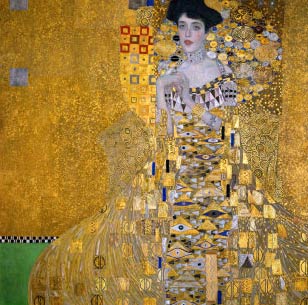
The Bloch-Bauer holdings joined portraits and landscapes without making them interchangeable. Apple Tree I stood alongside both portraits of Adele, Birch Forest and Houses in Unterach on the Attersee.[4] That history helps explain why the five paintings later travelled and were displayed together, but this landscape has its own object life. Adele's image is not hidden in its tree, and the picture is not an appendix to either portrait.
Ferdinand remained the relevant owner after Adele's death. Later disputes around Adele's will, Austria and the portraits have a larger legal history than this page needs. For Apple Tree I, the essential sequence is direct Bloch-Bauer ownership, coercive state seizure, museum possession, restitution and private sale.
Seizure and Museum Acquisition
After Nazi Germany annexed Austria, the Viennese Magistrate seized the painting in May 1938.[1] This was not an ordinary change of ownership. Ferdinand Bloch-Bauer, who was Jewish, had fled, and the regime dismantled his property and collection under persecution.
Dr Erich Führer became the state-appointed administrator for Ferdinand's property. The Österreichische Galerie acquired Apple Tree I through him in October 1941.[1] Naming that role matters: “acquired by the museum” on its own would conceal the coercive machinery that placed the painting in state hands.
The work remained in the Austrian Gallery for decades. It appeared in the Vienna Klimt exhibition of 1943 and in later international exhibitions, including Amsterdam in 1956, Berne in 1957 and Cologne in 1962.[1] Public visibility during museum possession did not resolve the underlying ownership problem.
The chain is unusually secure compared with the unresolved history of Apple Tree II. There is no need to borrow uncertainty from that later canvas. Dates, administrator and museum transaction are documented specifically for Apple Tree I.
Restitution and the Five-Painting Displays
Austria restituted Apple Tree I to the Bloch-Bauer heirs in March 2006.[1] The return formed part of the same outcome that released four other Klimt paintings. The Klimt Database identifies the five as the two Adele portraits, Apple Tree I, Houses in Unterach and Birch Forest.[4]
Before the four privately sold works dispersed, all five were presented together in 2006. Christie's records the exhibition Gustav Klimt: Five Paintings from the Collection of Ferdinand and Adele Bloch-Bauer at the Los Angeles County Museum of Art and Neue Galerie New York.[1] These displays made the collection's reconstruction temporarily visible while keeping each painting's distinct identity.
The exhibition context should not turn this page into another account of Portrait of Adele Bloch-Bauer I. Its value here is object-specific: viewers could see the apple-tree landscape as part of the collection from which it had been taken, shortly after physical restitution and before its next transfer.
The Anonymous 2006 Sale and Present Status
Christie's offered Apple Tree I in New York on 8 November 2006. Its post-sale record identifies the buyer as anonymous.[5] The event securely marks the painting's passage from the restituted heirs into private ownership. It does not disclose the individual's name or establish where the canvas is kept today.
The painting later returned to Vienna as a loan for the Leopold Museum's 2012 Klimt presentation. The museum's press material credited it only to a private collection.[6] That is a dated exhibition credit, not a permanent-location statement. A collection can move, lend, sell or store a painting elsewhere.
Current specialist records continue to classify Apple Tree I as privately held.[2][4] No verified public display or current owner was located when checked in August 2026. Reproduction licences, old collection credits and the anonymous auction record do not fill that gap. Anyone hoping to see the original should look for a newly announced loan rather than treating a historic exhibition credit as current access.
Apple Tree I and Apple Tree II
The two numbered canvases make a revealing but limited comparison. Apple Tree I is almost 110 centimetres square, with a compact low crown, emphatic red fruit, dense background growth and a highly coloured flower strip. Apple Tree II, painted in 1916, is 80 centimetres square. Its crown admits more blue sky, its palette is relatively muted and its brushwork appears more open.[3]
These differences show development without producing a simple story from “bright” to “dark.” The later painting is not evidence that Klimt became depressed, and the earlier one is not proof of uncomplicated happiness. Each answers a different visual problem: I compresses fullness; II allows atmosphere to pass through a monumental tree body.
Their provenance histories are equally separate. The Bloch-Bauer chain of Apple Tree I is documented from acquisition through seizure, restitution and anonymous sale. The disputed Lederer, Ucicky and mistaken Stiasny history belongs to Apple Tree II. Similar titles are precisely why the records must not be combined.
Why Apple Tree I Matters
Klimt turns an ordinary cultivated tree into an experience of sustained attention. The central trunk gives the composition stability, but nearly everything around it multiplies: branches divide, leaves gather, apples recur and flowers crowd the ground. The result is full without becoming formless.
The painting also resists an easy division between observation and design. Closely perceived fruit and blossoms build a deliberate colour structure across an almost square field. Depth survives, yet the small marks continually return attention to the surface.
Its history adds another form of specificity. This is not merely “a Klimt apple tree.” It is the signed 1912 canvas collected by Adele and Ferdinand Bloch-Bauer, seized in 1938, acquired by the Austrian Gallery under persecution, restituted in 2006 and then sold anonymously. Exact identity allows visual experience and historical responsibility to remain attached to the same object.
Frequently Asked Questions
References
- Christie's, “Gustav Klimt (1862–1918), Apple Tree I,” lot 53, Impressionist and Modern Art Evening Sale, New York, 8 November 2006; object data, provenance, exhibitions and lot essay. View source. Accessed August 2026.
- Gustav Klimt Database, “Expressive Blaze of Colors: 1910–1913,” Apple Tree I (Small Apple Tree), date, current status, Dresden exhibition and visual analysis. View source. Accessed August 2026.
- Gustav Klimt Database, “The Final Years: 1914–1918,” Apple Tree II, The Golden Apple Tree and comparative late-landscape evidence. View source. Accessed August 2026.
- Gustav Klimt Database, “Klimt Today,” Bloch-Bauer restitution, five-painting group and current private classification. View source. Accessed August 2026.
- Christie's, “Impressionist and Modern Art Evening Sale, 8 November 2006,” post-sale results identifying the Apple Tree I buyer as anonymous. View source. Accessed August 2026.
- Leopold Museum, “Klimt Up Close and Personal,” exhibition press material; Apple Tree I, circa 1912, oil on canvas, 109 × 110 centimetres, then credited to a private collection. View source. Accessed August 2026.
Discussion
Apple Tree I rewards close attention to source context, object identity and careful reproduction boundaries.