 by Tom Gurney
Tom Gurney BSc (Hons) is an art history expert with over 20 years experience
Published on August 21, 2026 / Updated on October 23, 2026
Email: tomgurney1@gmail.com / Phone: +44 7429 011000
About The Large Poplar II (Gathering Storm)
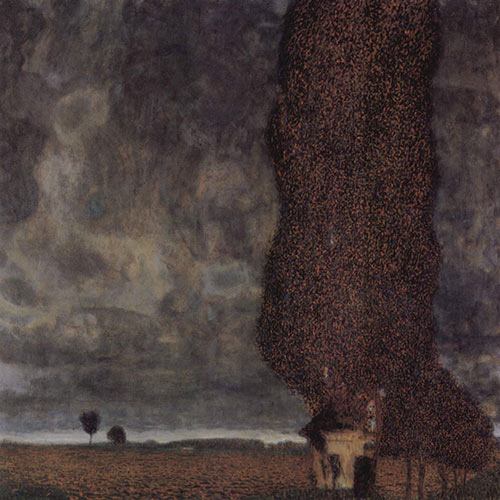
The painting sometimes loosely called Tall Poplar Trees II is Leopold Museum inventory 2008, Die große Pappel II (Aufsteigendes Gewitter). The holder's title is singular: its protagonist is one monumental poplar. The Large Poplar II (Gathering Storm) is the clearest English rendering, while Approaching Thunderstorm and the German variant Aufziehendes Gewitter describe the same canvas.[1][2]
Klimt painted the work in 1902/03. It is an oil on canvas measuring 100.8 × 100.8 centimetres. A low horizon compresses a chapel, meadow and adjoining line of trees into the lower part of the square. Above them, the great poplar rises on the right into an immense changing sky. The contrast between the narrow inhabited landscape and the broad storm field gives this work its particular tension.[1][2][3]
The Roman numeral identifies a second, separate painting—not a revised state of The Large Poplar I. The later canvas was exhibited as Aufsteigendes Gewitter, number 6, in Klimt's 1903 Secession collective exhibition. It passed through the Flöge family, a private owner in Seewalchen and a 1974 Dorotheum auction before entering the Leopold collection. As checked on 10 August 2026, the original was displayed on OG4 of the Leopold Museum.[1][4][6]
At a Glance
- ArtistGustav Klimt
- Current German titleDie große Pappel II (Aufsteigendes Gewitter)
- Preferred English titleThe Large Poplar II (Gathering Storm)
- Other translation layerThe Large Poplar II (Approaching Thunderstorm)
- Date1902/03
- MaterialsOil on canvas
- Dimensions100.8 × 100.8 centimetres
- SignatureNo exact wording or placement supplied by the governing public record
- MuseumLeopold Museum, Vienna
- Inventory2008
- Probable motifLarge poplar near the Seehof Chapel at Litzlberg on the Attersee
- First documented exhibitionVienna Secession, November–December 1903, number 6
- Documentary photographMoritz Nähr photograph associated with the motif, Leopold Museum inventory 5746
- Current accessDisplayed on OG4 when checked 10 August 2026; gallery rotations can change[1][2][4][5]
One Large Poplar, Not Several Equal Trees
The plural English phrase “Tall Poplar Trees II” makes the motif sound misleadingly plural. Smaller trees do accompany the composition, but the holder identifies one dominant große Pappel: a large poplar.[1]
It rises near the right side, much thicker and taller than the adjacent row. Its crown extends into the storm field, and its trunk connects the compressed land below with the atmospheric expanse above. The singular title captures this hierarchy more accurately than a phrase that distributes importance across several trees.
The correction does not require pretending that the poplar stands alone. The smaller verticals establish comparison. Their modest scale makes the main trunk appear still larger, while their row extends the low horizon laterally. Klimt builds monumentality relationally: the great tree dominates because it is measured against chapel, meadow and neighbours.
Nor does “large” supply a botanical measurement. The canvas records a pictorial relation, not a survey of the tree's height or girth. No present-day specimen should be identified as Klimt's exact model without stronger evidence.
The 1902/03 Canvas
The Leopold Museum dates the painting 1902/03 and records oil on canvas, 100.8 centimetres square.[1] An older publication gives one side as 100.7 centimetres, a negligible measurement variation rather than evidence of another object.[5]
The date spans two years because the surviving scholarship does not compress the making into one calendar. The work's appearance at the Secession late in 1903 supplies a firm exhibition anchor, but it does not reveal when every passage was painted.
No exact signature wording or placement is supplied in the current public holder record. That silence should remain a withheld claim. It does not prove that the canvas is unsigned, and it does not permit a transcription copied from another Klimt landscape.
The material description is equally direct: oil on canvas. The coloured foliage and changing greys belong to paint. They do not establish metal leaf, casein or a hidden technical recipe. No object-specific pigment analysis is needed to understand the picture's basic structure.
A Low Horizon beneath a Vast Sky
Klimt places the horizon unusually low. The meadow, chapel and tree row occupy a relatively shallow band, leaving much of the square to weather.[1][2][3]
This division produces an immediate imbalance of scale. Human architecture is present, but it is small. The chapel helps establish distance and supplies a compact vertical accent; the great poplar then exceeds it many times over. Above both, cloud masses expand across an area larger than the visible earth.
The horizon is not perfectly empty or uninterrupted. Trees punctuate it, and the main poplar carries the lower zone upward. The composition therefore avoids becoming two unrelated stripes. A single living form crosses the division and binds ground to sky.
The square format intensifies that relation. A long horizontal canvas might have allowed the eye to travel along the field. Here the equal sides keep attention near the vertical encounter between tree and atmosphere. Width still matters, particularly in the spread of clouds, but height determines the work's principal drama.
The Poplar as a Vertical Axis
The trunk enters from the meadow and climbs through several kinds of surrounding colour. Near the land it belongs to the row of vegetation. Higher up, its foliage is set against the cloud field. At the top, its tapering form approaches the canvas edge.[1][2]
Its placement on the right prevents simple bilateral symmetry. The open sky to the left has room to gather weight, while the tree acts as a counterforce. Rather than centring the trunk like an emblem, Klimt lets it brace one side of the composition.
The poplar's narrow, upward form can look candle-like. Current Klimt scholarship uses that resemblance when comparing the canvas with the vertical cypresses of Vincent van Gogh's late landscapes.[3] The analogy clarifies shape and pictorial role; it does not prove that Klimt copied a particular Van Gogh painting or assigned the tree the same meaning.
The tree also need not become a self-portrait, supernatural guardian or symbol of death. Its visual force is already explained by scale, position, contrast and the weather surrounding it.
Chapel, Tree Row and Meadow
The Leopold Museum locates the motif near the Seehof Chapel in Litzlberg.[2][5] The small building sits close to the horizon, where its geometric form interrupts vegetation without becoming the principal subject.
Architecture gives the scene a measure of inhabited scale. The chapel's low roofline and compact walls make the poplar's height legible. Yet the painting does not require a theological programme. A church in a landscape can function as a place marker and formal counterweight without turning every cloud into religious symbolism.
An adjoining row of smaller trees strengthens the horizontal band. Their repetition leads the eye across the field, while the main poplar breaks away vertically. This interaction between row and individual keeps the picture from becoming either a pure sky study or an isolated tree portrait.
The foreground is a flowered meadow built from brown, red and green touches.[1][2] It anchors the lower edge and brings varied colour into a zone that could otherwise read as a flat strip. The holder's description supports “flower meadow,” but not a complete species inventory, exact season or agricultural history.
A Sky in Transition
The title Aufsteigendes Gewitter describes a storm rising or gathering. Another institutional layer, Aufziehendes Gewitter, conveys an approaching storm.[1][2] Both direct attention to weather in motion rather than to a fixed, neutral cloudscape.
Dark masses occupy much of the square, but the sky is not one dead grey. Holder and specialist accounts note colours working within the cloud layers.[2][3] Subtle variation allows some passages to advance and others to recede, producing volume and instability.
The exact meteorological moment cannot be recovered. The clouds may resemble cumulonimbus formations, yet the painting supplies no timestamp, wind reading or documented storm diary. “Gathering” is an art-historical and titular description, not a scientific forecast.
Weather changes the relation between the tree and its surroundings. Against lighter cloud, the crown can appear dense; against darker areas, parts of its foliage merge into the atmosphere. The poplar both resists and participates in the storm field.
That tension is enough. The canvas does not automatically record Klimt's anxiety, foretell political catastrophe or turn the weather into a universal image of death. Mood arises from visible scale and chromatic pressure before it becomes metaphor.
How the Eye Moves through the Square
The foreground initially offers the most numerous small events: reddish, green and brown meadow touches distributed across a narrow strip. From there, the chapel and lower trees make a chain near the horizon. The large poplar interrupts that lateral movement and redirects attention upward.[1][2]
Following the trunk does not end the act of looking. Its foliage opens and closes against differently weighted clouds, so the eye moves back into the sky and then returns to the land to recover scale. This circuit—across, upward, outward and down—helps the square feel active without relying on a road or a deep panoramic vista.
The tree's rightward position also changes the apparent balance of empty and occupied areas. The left side contains more uninterrupted weather, yet the dense vertical mass on the right can counter that breadth. Klimt balances unlike quantities: the extensive cloud field against the concentrated tree.
Reproduction often makes the low horizon seem like a simple base beneath a tree-and-sky emblem. At the painting's metre-wide scale, the chapel, row and meadow remain substantial enough to resist that simplification. Their compressed detail supplies the measure by which the poplar and storm become monumental.
This way of looking does not depend on reading the weather as an omen. It follows the painting's constructed differences in direction, density and scale.
Foliage, Coloured Marks and Pointillist Resemblance
The poplar's foliage is assembled from numerous coloured touches. Current accounts describe the surface as Pointillist-looking, while preserving Ludwig Hevesi's vivid comparison to “trout-like dots.”[2][3][5]
The phrase captures the speckled, mobile impression of the crown, but it remains an attributed critical image. It is not a technical finding, and it does not demonstrate strict adherence to Neo-Impressionist colour theory.
Klimt varies the work of small marks across the canvas. In the meadow they scatter colour horizontally; in the crown they articulate a rising, tapering mass; in the sky broader changes establish weather. Similar units therefore serve different spatial purposes.
The resulting surface remains legible at two distances. From farther away, poplar, chapel, field and storm hold together. At closer range, coloured incidents loosen those forms without dissolving them. This oscillation connects the landscape's atmospheric subject to Klimt's interest in a strongly worked pictorial field.
The Large Poplar I and II
The Large Poplar I is a separate 1900 canvas measuring about 80 centimetres, listed by Neue Galerie New York with an Estée Lauder collection credit.[7] It is associated with the same general motif, but numeral II does not mean that Klimt painted over the first work or enlarged it.[3][5]
The second canvas changes the relation among tree, land and sky. Its poplar is more imposing within a larger square, the horizon is low, and the approaching storm claims a major share of the field. Comparison reveals a return to a motif under altered atmospheric and formal conditions.
The works need not be forced into a simple before-and-after lesson in which the first is merely preparatory. Each is an independent oil painting. The first provides context for Klimt's sustained attention to the poplar near Litzlberg; the second owns the storm title, 1902/03 date, 1903 exhibition and Leopold history.
Seehof, Litzlberg and the Nähr Photograph
The current holder connects the motif with the area around the Seehof Chapel at Litzlberg on the Attersee.[2][5] That site identification is more precise than a generic “Austrian landscape,” but it does not locate Klimt's easel to an exact coordinate.
A photograph by Moritz Nähr, associated with the work or motif and held as Leopold Museum inventory 5746, provides valuable documentary context.[5] It helps connect the painted landscape with the Seehof environment and the poplar subject.
The photograph is not a transfer study. No retained evidence shows Klimt tracing it, projecting it or using it to establish every contour. It also cannot serve as an exact colour witness for the canvas or prove that a present tree is the one painted.
Its role is narrower: it preserves historical visual information around a motif that Klimt treated in more than one painting. Read alongside the canvas and holder research, it strengthens place and comparison without dictating a mechanical method.
Aufsteigendes Gewitter at the 1903 Secession
The catalogue for Klimt's collective exhibition at the Vienna Secession lists Aufsteigendes Gewitter as number 6.[4] This title securely ties the storm identity to the displayed painting.
The exhibition opened in November 1903 and presented a concentrated view of Klimt's work. Contemporary criticism noticed the landscape's darkness and atmosphere.[1][3][5] Those responses belong to this object and should not be confused with Hevesi's earlier discussion of the paired conifer paintings.
The historical title also clarifies that weather was not added only by later interpretation. Viewers in 1903 encountered a named gathering storm. What remains open is how literally or symbolically each critic understood it.
Darkness and the Work's Early Reception
Leopold and specialist accounts note that contemporary viewers responded to the painting's dark atmosphere.[1][3][5] That reception is consistent with the large cloud field and the title's active storm, but it should remain attached to the exhibited canvas rather than becoming a verdict on Klimt's landscapes as a whole.
“Dark” can describe more than a low level of illumination. It may register tonal weight, the pressure of clouds over a narrow land band or the emotional tension created when the poplar enters unsettled weather. The canvas still contains varied colour in meadow, crown and sky; sombre atmosphere does not reduce it to monochrome.
The title gave 1903 viewers a directional cue. The storm was rising, not simply present as a decorative backdrop. Critics could therefore read the landscape as an event unfolding before them. Yet the catalogue did not prescribe a political, religious or biographical meaning for that event.
Keeping the response at this level preserves historical value without allowing a general Symbolist vocabulary to overtake the object. The painting's mood belongs first to its low horizon, towering tree and expansive weather.
No exhibition record turns the canvas into an oil sketch or a subordinate study. It was catalogued as an independent work, and its subsequent ownership history follows that finished painting.
Therese and Gertrude Flöge
The Leopold Museum records Therese Flöge, née Paulick, as owner until 1949. A reverse inscription supports her connection with the work.[1][6] The record does not establish when or on what terms Klimt transferred the canvas to her.
Gertrude Flöge owned it from 1949 until 1971.[1][6] These stages are important object history, but they should not be expanded into a complete account of the Flöge family or made to prove a private symbolic message in the tree.
The published chain supplies names and date spans, not a gift narrative. Without a direct document, there is no responsible basis for inventing an original presentation date, purchase price or emotional dedication.
Seewalchen, Dorotheum and the Leopold Collection
From 1971 to 1974, the painting is recorded in unknown private ownership in Seewalchen.[1][6] “Unknown” here identifies a bounded provenance stage, not evidence of theft, forced sale or concealed export.
The canvas appeared at Dorotheum in Vienna on 28 May 1974, sale 604, lot 330.[1][6] The published museum chain does not supply an auction result that should be repeated as fact, so the event functions as a dated custody and market anchor.
Dr Rudolf Leopold and George McQuire owned the work from 1974 to 1976. Rudolf Leopold then held it alone until 1994, when it entered the Leopold Museum-Private Foundation.[1][6] Keeping those stages separate avoids collapsing joint ownership, private collection and foundation status into one vague “Leopold” period.
A federal provenance dossier records research into the canvas and its inscriptions.[6] The current published chain does not identify a Nazi-persecution loss or restitution outcome. Twentieth-century dates alone cannot supply such a history.
Seeing the Painting Today
The Leopold Museum online collection identifies the canvas as inventory 2008 and marked it displayed on OG4 when checked on 10 August 2026.[1]
That is a dated access fact rather than a permanent promise. Museums rotate galleries, lend works and revise installations. Anyone planning a visit should recheck the live object record.
Physical access matters particularly for this painting. Reproduction can convey the dominating poplar and low horizon, but the 100.8-centimetre square allows the coloured foliage, narrow land band and broad storm sky to work at a bodily scale. The original lets the viewer move between the whole atmospheric structure and the small marks that sustain it.
Why The Large Poplar II Matters
Klimt gives most of a square landscape to weather while allowing one tree to hold earth and sky together. The chapel and meadow establish scale; the neighbouring row creates a horizontal measure; the large poplar rises through that system and makes the storm feel both distant and immediate.
The painting also rewards exact naming. A plural English label obscures the hierarchy of the single dominant tree. The numeral can falsely suggest a state rather than a separate canvas. The storm has more than one defensible translation, but all point back to Leopold Museum inventory 2008.
Its ownership history is unusually legible from the Flöge family through the 1974 auction and Leopold collection, yet it still contains limits. The first transfer from Klimt is undocumented, the Seewalchen owner is unnamed, and no persecution mechanism should be invented.
Together, formal and documentary evidence give the painting its individuality: one great poplar, one low inhabited horizon, one unstable sky and one traceable object whose present display can be checked.
Frequently Asked Questions
References
- Leopold Museum Online Collection, “Die große Pappel II (Aufsteigendes Gewitter),” object 2149, inventory 2008; current title, date, medium, dimensions, visible account, exhibition, provenance and dated display. View object record. Accessed 10 August 2026.
- Leopold Museum, “Die große Pappel II (Aufziehendes Gewitter),” collection highlight; title layer, Seehof Chapel setting, visual structure, flower meadow, foliage and weather. View highlight. Accessed 10 August 2026.
- Gustav Klimt Database, “The Golden Knight and Femmes Fatales: 1901–1903”; chronology, relation to The Large Poplar I, low horizon, coloured storm layers, critical reception and attributed Van Gogh comparison. View source. Accessed 10 August 2026.
- Vereinigung Bildender Künstler Österreichs Secession, Kollektiv-Ausstellung Gustav Klimt: XVIII. Ausstellung, Vienna, November–December 1903, catalogue entry 6, Aufsteigendes Gewitter. View catalogue. Accessed 10 August 2026.
- Leopold Museum / Klimt Centre, “Die große Pappel II,” object folder; Moritz Nähr photograph, Seehof context, first/second poplar comparison and historical weather discussion. View PDF. Accessed 10 August 2026.
- Austrian Federal Ministry for Arts and Culture, “Dossier Leopold Museum, LM 2008”; provenance stages, reverse inscription, Dorotheum appearance and Leopold/McQuire chain. View dossier. Accessed 10 August 2026.
- Neue Galerie New York, “The Large Poplar I,” museum-authored Google Arts & Culture object record; separate 1900 canvas and published Estée Lauder collection credit. View object record. Accessed 23 October 2026.
Discussion
The Large Poplar II (Gathering Storm) rewards close attention to source context, object identity and careful reproduction boundaries.