 by Tom Gurney
Tom Gurney BSc (Hons) is an art history expert with over 20 years experience
Published on August 21, 2026 / Updated on October 23, 2026
Email: tomgurney1@gmail.com / Phone: +44 7429 011000
About On Lake Attersee
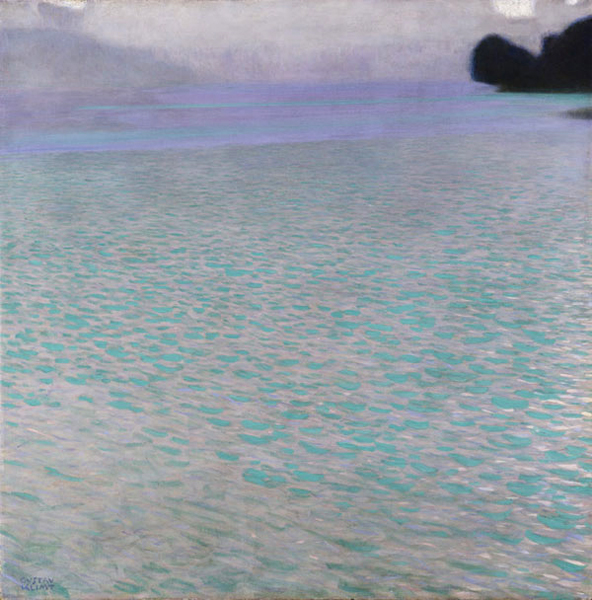
Almost the whole of Gustav Klimt's On Lake Attersee is water. The lake rises from the lower edge of the canvas to the top, where only a small wedge of land and foliage enters at the right. There is no accommodating bank from which to survey the view, no wide sky and no chain of mountains to secure the horizon. Short touches of grey, green, blue and turquoise spread across a square field, close enough in value to hold together yet varied enough to make the surface tremble.[1]
That radical economy is easy to mistake for simplicity. Klimt has not merely painted an empty stretch of lake. He has made minute changes of direction, colour and density carry nearly all the work that foreground, distance and incident perform in a conventional landscape. The tiny fragment of Litzlberg Island prevents the image from losing its geographical identity, but it does not dominate the view. Water remains both the subject represented and the structure through which the painting is organised.
Made in 1900 during Klimt's first documented summer at the Attersee, the canvas stands near the beginning of his sustained engagement with the lake region. It is also an important early demonstration of how observation and designed surface could reinforce one another in his landscapes. The Leopold Museum describes the work as approaching the boundaries of abstraction.[5] Yet it never stops being a painting of a particular body of water. Its achievement lies in keeping recognition and near all-over pattern in active balance.
At a Glance
- ArtistGustav Klimt
- Leopold Museum titleOn Lake Attersee
- German titleAm Attersee
- Date1900
- Object categoryPainting
- MediumOil on canvas
- Dimensions80.2 × 80.2 × 2.1 centimetres
- SignatureGUSTAV KLIMT, lower left
- Leopold Museum inventory number4148
- Online object number4328
- Geographical motifLake Attersee, with a fragment of Litzlberg Island at upper right
- First public presentation10th Vienna Secession exhibition, 15 March–12 May 1901
- Current accessRecorded on display on OG4 at the Leopold Museum when checked on 10 August 2026[1]
Which Painting Is On Lake Attersee?
The governing object is Leopold Museum inventory 4148, a signed oil painting dated 1900 and measuring 80.2 centimetres square, with a canvas depth of 2.1 centimetres. The museum's English record calls it On Lake Attersee; the German title is Am Attersee. The Klimt Database sometimes translates that wording as On the Attersee. These are title variants for the same canvas, not evidence of multiple versions.[1][2]
Its identity needs to be separated from Island in the Attersee, painted in 1902. In the later picture Klimt returned to Litzlberg Island but gave the land a larger and more central role. He also changed the organisation of the water. The two paintings belong to a developing lake series, but they are distinct objects with different dates and compositions.[4]
Nor should the title be allowed to absorb Klimt's later views of Kammer, Unterach, Litzlberg and other Attersee sites. Those works gradually tested buildings, gardens, shorelines and distant slopes in different relationships to the square. On Lake Attersee poses a more concentrated problem: what happens when water is allowed to occupy almost everything?
The recorded medium is simply oil on canvas. The grey-green light can appear silvery, and institutional scholarship has referred to a reflecting surface, but there is no published object record here for silver, gold leaf, metallic powder or foil.[1][2] “Silver” describes an optical effect. It is not a material ingredient.
A Square Filled with Water
The painting offers remarkably few of the cues by which viewers ordinarily measure a landscape. There is no foreground path or bank. No boat supplies a familiar scale. No figure stands against the lake, and no architecture creates a dependable interval between near and far. Even the horizon is reduced to a fragment at the upper-right edge.
What remains is not blankness but an immense accumulation of small differences. Short strokes cluster, loosen and change direction. Some read as ripples; others behave less like individual marks for separate waves than like units within a continuous painted fabric. Cooler blues and turquoises meet muted greens and greys. Darker accents gather briefly before dispersing into the general field.[1][2]
Because the support is square, the viewer cannot follow the familiar horizontal sweep of a panoramic lake view. Width and height balance each other. Water consequently reads less as a strip extending towards a horizon than as a field pressed parallel to the canvas. The square does not eliminate depth, but it makes depth compete with surface.
That tension changes as one looks. From a distance, the many touches combine into a broad expanse of gently moving water. At closer range, their separateness becomes prominent and the lake seems to break into marks. Step back and a natural phenomenon gathers again. Move forward and Klimt's decisions—where to shorten a stroke, darken a patch or interrupt a rhythm—become the principal event.
The absence of people intensifies this encounter. Nothing within the painting tells the viewer how large the visible expanse should feel. Scale has to be inferred from the narrow shore fragment and from what one knows a lake to be. The result can feel both vast and unusually close: a body of water extending beyond sight, and a painted skin brought directly before the eyes.
The Litzlberg Fragment
At the upper right, a small area of shore and treetops identifies the view with Litzlberg Island. Its position is crucial. Had Klimt removed it, the painting might have become almost placeless. Had he enlarged it, the island could have become the principal motif. Instead, the fragment acts as a restrained geographic clue and a measure of the composition's severe cropping.[1]
The land does not establish a broad conventional horizon. It enters obliquely at the edge, as if most of the expected landscape lay outside the selected field. Buildings are not clearly described, and the painting does not invite a tour of the island. The fragment's chief visual task is relational: it makes the surrounding water seem more extensive while preventing that water from becoming wholly detached from place.
Its asymmetry also matters. A small concentration of firmer shapes and darker tones occupies one corner, while the rest of the square remains open to repeated movement. The island therefore gives the eye somewhere to arrive, but not somewhere to rest permanently. Attention returns to the distributed activity below and beside it.
It is tempting to reconstruct an exact standing point from this clue. The surviving documentation does not support that certainty. The painting belongs to Klimt's first Attersee season and depicts Litzlberg, but it does not preserve a labelled viewpoint, measured line of sight or photograph that fixes precisely where the artist stood. The crop is evidence of selection, not a map coordinate.[1][3]
Seeing the Lake without a Panorama
Landscape painting had often made lakes legible through depth: a near shore leads to open water, then to distant land and sky. Klimt withholds most of that sequence. His selected portion is so restricted that the scene can initially feel more like a close inspection than an expansive prospect.
The viewer's imagined position is consequently unstable. Are we looking outward across the lake, or almost downward at water immediately below? The tiny island fragment suggests distance, while the lack of a normal horizon and the density of the marks draw the surface close. Klimt does not need to resolve the contradiction. The picture's energy depends upon it.
This is why the work should not be reduced to a decorative pattern. Its repeated strokes are inseparable from the experience of looking at a broad, changing expanse whose scale exceeds any one glance. At the same time, it should not be treated as an unmediated transcription of nature. The compressed crop, balanced square and carefully distributed touch all reveal deliberate construction.
Klimt's documented use of a cardboard viewfinder provides useful context. An autograph source discussed by the Klimt Database records a viewing aid with a square opening, a practical means of isolating a portion of the visible world.[2] Such a device helps explain his attention to selection, but it does not mechanically account for this finished painting. No object-specific photograph shows the opening aligned with On Lake Attersee, and a viewfinder cannot explain how the painted marks were revised or arranged.
Later photographs of Klimt using a telescope have encouraged attempts to reconstruct his lake views through magnified isolation.[6] They demonstrate an interest in optical framing, not proof that this particular canvas was “painted through a telescope.” The instrument, magnification and exact location used in 1900 are not documented for the work. Its pictorial concentration is visible; the precise equipment behind it remains uncertain.
Water Rather than Reflection
The Klimt Database distinguishes On Lake Attersee from nearby pond landscapes in which reflected trees or banks help organise the image. Here the primary problem is the colour and changing quality of water itself.[2] The surface catches light, but it does not behave like a legible mirror containing a second landscape.
That distinction prevents imaginative additions. There are no securely identifiable reflected castle walls, boats, clouds or human figures. Grey and green touches can suggest light shifting across a reflective surface without corresponding point by point to objects outside the frame. The lake is responsive to its environment, but Klimt does not inventory everything it reflects.
The slight undulation described by the Leopold Museum comes from variation rather than dramatic wave action.[1] Marks advance in loosely related bands, overlap and dissolve. A darker passage may seem to recede; a paler one may flash forward. Yet the movements remain modest enough that the square holds together as a single sustained field.
This restraint is a major part of the painting's atmosphere. Nothing announces a storm, a passing vessel or a spectacular sunset. Change occurs within a narrow range. Klimt asks the viewer to notice how much animation can emerge from increments: one grey beside another green, one short horizontal touch checked by a slanted mark, one concentration opening into a quieter interval.
Institutional scholarship describes the handling as almost Pointillist and connects it with Impressionist attention to the mutable appearance of water.[2] Those terms are helpful if they remain comparisons rather than labels of allegiance. Klimt did not build the canvas from a rigid Neo-Impressionist system of separated colour dots, and no evidence makes it a direct quotation from one French painter. His touches vary in shape and merge often enough to retain their own logic.
An Early Square, but Not the First
The near-perfect square became one of the defining features of Klimt's mature landscapes, and On Lake Attersee is a striking early example. It is sometimes tempting to call it his first square landscape. Current Klimt Database research places that development earlier, among the works he made at Golling in 1899.[2]
A Morning by the Pond and Cows in the Stable are identified among those first square nature paintings. The correction is more than a matter of priority. It shows that Klimt was already testing how the format could transform a view before his first documented Attersee summer.
A Morning by the Pond also offers a useful bounded contrast. Its pond, shore and reflected vegetation allow the square to gather different zones of nature into a compressed design. In On Lake Attersee, the open water has become far more dominant. Reflection is less an image of surrounding things than a quality of light distributed across the lake.[2]
The square therefore did not dictate one solution. It could hold animals and architecture, organise a pond with surrounding vegetation or, as here, sustain a field in which the usual hierarchy of landscape elements nearly disappears. Klimt's innovation lies not in discovering a neutral format once, but in learning how differently it could direct attention.
This canvas also corrects the idea that his landscape practice began fully formed at the Attersee. He had painted nature elsewhere in the Salzkammergut before 1900. The lake season gave him new motifs and became the foundation of a long engagement, but the formal questions of cropping and squaring had already begun.[2][3]
The First Attersee Season
The Leopold Museum and the Klimt Database place the work in summer 1900, during Klimt's first documented stay at Lake Attersee. He lodged at the Litzlberg Brewery, and the paintings associated with the season include several landscapes as well as Black Bull.[1][2][3]
That context explains proximity to the motif without turning the painting into an illustrated holiday diary. The daily routines of Klimt and his companions are not visible in the square. The absence of bathers, rowers and social incident is part of the work's concentration. A viewer does not need to reconstruct a breakfast, excursion or conversation in order to understand the water.
The date is nevertheless important because the canvas announces possibilities Klimt would continue to explore around the lake. Later works could bring islands, poplars, orchards, houses, churches or distant slopes into firmer prominence. They could make a location architecturally specific or build it through dense vegetation. On Lake Attersee begins from a more elementary encounter between water, edge and selected land.
The painting should not be used to claim that every later Attersee landscape evolved in a straight line from abstraction towards description, or in the reverse direction. Klimt repeatedly changed the balance between observed motif and constructed surface. This work is unusually reduced, but its reduction is one decision within a varied landscape practice rather than a permanent formula.
From Looking to a Near All-Over Field
The Leopold Museum's suggestion that the painting approaches the boundaries of abstraction describes a genuine experience of the surface.[5] The eye can wander across it without following a central figure or conventional perspective. No single ripple is the subject. Repetition distributes importance widely, and the water can momentarily appear as a self-sufficient arrangement of coloured touches.
Yet the word “abstraction” needs care. Klimt did not erase the world or invent non-objective forms without a referent. The title names the lake; the shore fragment identifies Litzlberg; the changing marks evoke observable water. The painting remains accountable to a place even as its organisation becomes unusually independent of ordinary topographical description.
The most productive way to see the work is therefore not to choose between nature and decoration. The broad lake demanded selection because it could not be contained in full. The square intensifies that selection. Repeated brushwork translates change over time into a fixed surface. The same decisions that make the canvas look designed also communicate how difficult water is to hold still in vision.
Its near all-over structure likewise does not make every section interchangeable. The upper-right land fragment weights one corner. Darker and lighter areas create local rhythms. The lower-left signature interrupts the water with the artist's name.[1] A field can be broadly continuous while still containing directional pressures and points of emphasis.
The painting's radical quality emerges gradually. At first it may look quiet and sparse. Continued attention reveals that Klimt has shifted the burden of meaning away from incident and onto perception itself: how little land is needed to locate a view, how many differences exist within apparently uniform water, and how a flat support can evoke distance without surrendering its surface.
No Figure, No Ready-Made Scale
Klimt's figure paintings often organise looking through faces, gestures and bodies. On Lake Attersee removes that human exchange. The painting contains no securely visible person, boat or animal. This is not evidence that the site was deserted, only that human presence was excluded from the selected image.
Without a figure, scale becomes less immediate. The island fragment suggests the breadth of the lake, but the strokes can also be experienced at the scale of the hand that made them. A mark may stand for a ripple extending across water or remain visibly a few centimetres of pigment on canvas. The work moves between those orders without disguising either.
Silence is an equally tempting projection. A painted surface cannot record the sound of water, wind or activity beyond the frame. What it can do is suppress narrative disturbance. The slight motion of the field suggests continuity rather than climax. The small shore fragment offers location without telling a story about anyone arriving or leaving.
This restraint helps distinguish the canvas from allegory. Water does not need to become a universal symbol of death, desire, purification or unconscious life. Such associations may occur to viewers, but the painting's strongest evidence concerns visual experience: extension, movement, reflection, colour and the limits of framing.
The 1901 Secession Exhibition
On Lake Attersee first appeared publicly at the 10th exhibition of the Vienna Secession, which ran from 15 March to 12 May 1901. Klimt showed it with other new works in a room arranged by Kolo Moser.[4] This was not a private experiment discovered only later; it entered public debate almost immediately after its making.
The critic Ludwig Hevesi recognised the severity of the reduction. In a response cited by the Leopold Museum, he described “a frame full of lake water” made from short grey and green waves.[1] The brief phrase matters because it captures what was startling: the frame seemed filled not with a conventionally staged view of a lake, but with water itself.
Hevesi's language should not be made to stand for every contemporary visitor. It documents one important critic's admiration, not unanimous agreement or a definitive interpretation. Still, it shows that the near-total occupation of the square by water was legible in 1901. The painting's modernity is not merely a later story imposed after abstract art had become familiar.
The exhibition also placed the landscape within Klimt's broader public activity, but that context need not swallow the object. Medicine and the University controversy involved different commissions, institutions and disputes. Here the essential fact is that a water-dominated square was presented alongside Klimt's current work and was sufficiently valued to enter state ownership.[4]
The State Purchase and the Modern Gallery
After the Secession exhibition, the Imperial-Royal Ministry of Culture and Education purchased On Lake Attersee directly from Klimt. The Leopold provenance dates state ownership through the ministry to 1901–03, followed by the Austrian Gallery from 1903 to 1923.[1]
The purchase placed a formally adventurous landscape within an emerging public collection of modern art. Klimt Database research associates the painting with the early holdings of the Modern Gallery, presented at the Lower Belvedere when that institution opened in May 1903.[4] The work's later life in private hands can obscure this first public chapter, but for more than two decades it belonged to the Austrian state collection.
In 1923, the Austrian Gallery transferred the painting to the dealer Gustav Nebehay in an exchange.[1] “Exchange” is the holder's documented description. It should not be converted without evidence into a sale, restitution, scandal or gift. Nebehay retained the work until 1926, when it passed to the Neue Galerie.
This early institutional history is unusually well recorded. It connects the painting's first exhibition, purchase and museum life without requiring speculation about an original private commissioner. Klimt painted the work during his first Attersee season; the state acquired it after its public presentation the following year.
Provenance after the Belvedere
The Leopold Museum publishes a detailed chain after the 1923 exchange. From the Neue Galerie, where the work was recorded from 1926, it entered the ownership of Bernhard Panzer sometime after 1928. Panzer held it until his death in 1934, and his estate retained it from 1934 to 1943.[1]
The next published owner is Maria Dressler, who possessed the canvas before 1964 and kept it until 1992. The wording leaves a significant interval unresolved: the live record does not state exactly how the painting passed from the Panzer estate after 1943 to Dressler before 1964. That gap should remain visible. There is no basis in the cited object history for inventing a wartime seizure, forced sale, inheritance or postwar transaction.
Maria Ittner owned the picture from 1992 to 1995. The detailed provenance then records its entry into the Leopold Museum-Privatstiftung in 1995 and cites a purchase contract dated 31 January of that year.[1]
The same live record also contains a smaller catalogue discrepancy. Its separate inventory-access line says the painting was contributed to the foundation in 1994, whereas the detailed chain and contract support 1995. These dates do not indicate two paintings or a change of physical state. They are differing institutional accession labels within the record for one object. Where a single public date is required, the documented 1995 contract and detailed provenance provide the clearer basis.
This chain is valuable precisely because it combines secure passages with admitted limits. Ministry, Austrian Gallery, Nebehay, Neue Galerie, Panzer, Dressler, Ittner and the Leopold foundation can all be named at the level published by the holder. The undocumented transitions should not be repaired with narrative invention.
On Lake Attersee and Island in the Attersee
Klimt's return to the island in 1902 makes comparison tempting. Island in the Attersee is not a revised state, alternate title or enlarged version of the 1900 canvas. It is a separate painting made two years later.[4]
In the later composition, Litzlberg Island moves farther into the square and becomes more visibly substantial. The water is organised differently, and the balance between motif and field changes. These differences show Klimt returning to a location without simply repeating his first solution.
The 1900 picture is more withholding. Its island remains a peripheral fragment and its water almost overwhelms geographical description. This does not make the later work less modern or the earlier one a preliminary sketch. Each painting sets a different threshold between recognisable place and the independent organisation of the canvas.
Keeping the titles distinct also protects provenance and access information. Leopold Museum inventory 4148 belongs only to On Lake Attersee. Facts attached to Island in the Attersee or later Kammer landscapes cannot be transferred to it because the subjects share a region.
Why the Painting Still Feels Unsettling
The work's quietness can disguise how insistently it resists ordinary landscape habits. A viewer looks for the line that divides water from sky, but almost none is offered. One searches for a near bank, then realises the field begins at the frame. The single land fragment promises orientation while remaining too small to organise the whole.
Klimt turns those absences into positive structure. The square gives equal pressure to vertical and horizontal movement. Short strokes carry differences across a surface that would otherwise risk monotony. The signature confirms the lower edge without supplying a foreground. The island marks an upper limit without becoming a full horizon.[1]
This is why the painting can approach abstraction while remaining intensely observational. Klimt does not abandon the visible world; he chooses a part of it whose repetition makes ordinary representation unstable. Water is recognisable, but no ripple can be held long enough to become an individual object. The painter must build continuity from marks that are both descriptive and autonomous.
The canvas rewards slow attention because its drama is distributed rather than concentrated. There is no climactic incident to discover. Instead, the viewer becomes increasingly sensitive to small changes across the field and to the audacity of retaining so little land. What first looks empty becomes densely active.
Current Location and Display
On Lake Attersee belongs to the Leopold Museum-Privatstiftung in Vienna. When checked on 10 August 2026, the museum's live object record marked it as on display on OG4.[1]
Gallery assignments can change for loans, conservation and reinstallations, so that statement is dated rather than permanent. Visitors travelling specifically to see the painting should consult the museum's current record before arrival.
Its present museum setting also changes the conditions of looking. The water can no longer be encountered within the mixed installation Klimt and Moser prepared for the 1901 Secession. Yet the square still performs the same fundamental reversal: instead of offering a scenic survey, it brings a nearly unbroken field of water up against the viewer.
Frequently Asked Questions
References
- Leopold Museum, “On Lake Attersee,” online collection record, object 4328, inventory 4148. View source. Accessed August 2026.
- Gustav Klimt Database, “Cradle of Modernism: 1898–1900,” object chronology and research chapter. View source. Accessed August 2026.
- Gustav Klimt Database, “Attersee,” place and network record. View source. Accessed August 2026.
- Gustav Klimt Database, “The Golden Knight and Femmes Fatales: 1901–1903,” object chronology and exhibition research chapter. View source. Accessed August 2026.
- Leopold Museum, “Gustav Klimt,” collection overview. View source. Accessed August 2026.
- Leopold Museum, “Gustav Klimt Center in Kammer am Attersee Presented for the Artist's 150th Birthday,” documentation of viewfinder and telescope context. View source. Accessed August 2026.
Discussion
On Lake Attersee rewards close attention to source context, object identity and careful reproduction boundaries.