 by Tom Gurney
Tom Gurney BSc (Hons) is an art history expert with over 20 years experience
Published on August 21, 2026 / Updated on October 23, 2026
Email: tomgurney1@gmail.com / Phone: +44 7429 011000
About Portrait of Johanna Staude
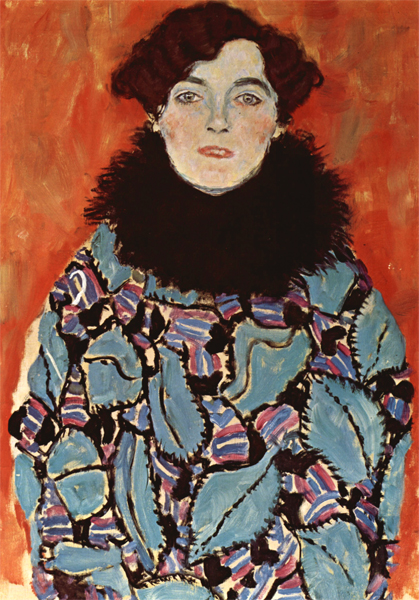
Gustav Klimt's Johanna Staude brings the viewer exceptionally close. A pale face with bright blue eyes rises above a dark feather boa. Short, waved hair cuts a firm silhouette. Below, a turquoise blouse spreads across much of the small canvas, its leaf pattern pressing toward the surface, while an orange-red field burns behind the sitter. The picture contains little space and no narrative action. Its energy comes from colour, gaze and the different degrees to which Klimt resolves each passage.
The portrait was painted in 1917–18, during the last months of Klimt's life, and the Belvedere classifies it as unfinished. That description is important but not simple. Recent research published by the museum cautions that the famous story about an incomplete mouth has no reliable source, and that Klimt often left canvas visible within the open handling of his late work. The painting therefore asks two related questions: what is visibly resolved, tentative or exposed, and how far can any of those conditions disclose the artist's final intention? Its known sitter, exact Wiener Werkstätte fabric and unusual passage from Johanna's possession to the Belvedere make it a particularly rich test case.[1][2][3]
At a Glance
- ArtistGustav Klimt
- Current titleJohanna Staude; commonly called Portrait of Johanna Staude in English
- Date1917–18
- MediumOil on canvas
- Dimensions70 × 50 centimetres
- Institutional stateClassified as unfinished by the Belvedere and Gustav Klimt Database
- SitterJohanna Staude, born Johanna Widlička in Vienna in 1883
- ClothingA blouse made from the Wiener Werkstätte silk pattern Blätter (Leaves), designed by Martha Alber
- Secure studyAlbertina inventory 34667, circa 1917, pencil on paper, 50 × 32.5 centimetres
- OwnershipRetained by Johanna; sold by her to the Belvedere in 1963 under an instalment arrangement completed in 1965
- Current displayIncluded in the Upper Belvedere's permanent Klimt presentation as documented on 9 August 2026[1][2][4][5][6]
One Small Canvas from Klimt's Final Year
Belvedere records Johanna Staude as an oil painting on canvas measuring 70 by 50 centimetres. It is a bust portrait rather than a full-length society image. Johanna's head and upper torso fill most of the support, bringing her eyes close to the viewer and making the patterned blouse a structural element rather than one detail among furnishings.[1][5]
The date 1917–18 places the painting within the final group of portraits Klimt was working on before his stroke in January 1918 and death on 6 February. Several canvases from this period remained at different stages of resolution. The date alone does not prove that every open-looking passage in Johanna's portrait was awaiting more work, but it supplies the historical basis for treating its state with care.[3][6]
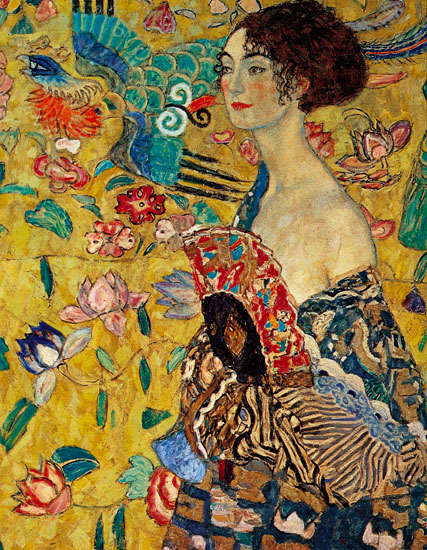
The current title is secure because the sitter is known. Johanna Staude and Portrait of Johanna Staude refer to the same object. The painting must not be confused with The Dancer, whose associated model is Johanna Jusl, or with Lady with a Fan, whose sitter remains unidentified. A shared first name or facial resemblance cannot transfer identity from one canvas to another.
Who Was Johanna Staude?
Johanna was born Johanna Widlička in Vienna on 16 February 1883. Archival research places her within a family strongly connected to the arts: several brothers pursued artistic or musical careers. Around the period of the portrait, official records described her as a language teacher. Later address records and her death certificate called her a painter or academic painter, although no works securely made by her are presently known. She died in Vienna in 1967.[2]
These facts reveal both knowledge and limits. Johanna did not enter art history only when Klimt placed her before a canvas; she moved through a cultural network and used an artistic professional identity. Yet the absence of securely identified works prevents a confident reconstruction of her practice. “Painter” is an archival designation, not permission to invent an oeuvre.
Belvedere describes Johanna as Klimt's friend and probable repeated model. She also reported having posed for Egon Schiele. Recent research stresses that named sitters such as Johanna can help test the assumption that Klimt's late fashionable women were imaginary types. The secure identification applies to this portrait. It does not establish that every proposed lookalike in a Klimt or Schiele drawing is Johanna.[1][2]
A Face Brought Forward
Johanna's head sits high in the rectangle. The pale face is comparatively modelled, with blue eyes, dark brows and small touches around nose and mouth. Her short hair forms waves against the orange field and makes the contour of the skull easy to follow. The hairstyle was strikingly fashionable, but it should not be used as automatic proof of a political identity or a complete theory of the “new woman.”[1]
The gaze is frontal and sustained. Because the canvas contains no hands, props or view into a room, the eyes carry an unusual share of the portrait's address. Their blue is repeated and altered in the blouse below. Colour therefore connects the most individuated feature to the most decorative passage.
It is tempting to translate that gaze into personality: confident, challenging, amused or enigmatic. These words describe effects available to a viewer. They are not records of Johanna's thoughts during the sittings. Klimt produces intensity by reducing distraction and increasing proximity, not by supplying a written psychological key.
The Feather Boa as a Dark Interval
A black or very dark feather boa encircles Johanna's neck and shoulders. It creates a broad irregular band between the light face and bright blouse. Without it, head and garment might merge too quickly through their shared blue accents. The boa gives the composition a pause.[1]
Its texture also changes the kind of looking required. Hair is described through curved locks; skin through relatively smooth modelling; the boa through a soft, broken darkness; the blouse through repeated motifs. These surfaces do not form a seamless naturalistic outfit. Each is handled according to a different visual problem.
The boa has sometimes helped cast Johanna as a performer or a theatrical personality. No secure profession as dancer or actor follows from the accessory. It is fashionable dress, pictorial separator and tactile contrast. Anything more should begin from documentary evidence rather than costume alone.
Orange Against Turquoise
The background is a saturated orange-red expanse with few spatial markers. It neither documents a room nor explains the sitter's surroundings. Belvedere proposes that Klimt chose this colour to intensify the blue of the blouse. The opposition is immediate: warm ground and cool garment drive one another toward greater brilliance.[1]
The field is not uniform in effect. Around the hair, orange establishes a clean silhouette. Beside the face, it makes pale flesh seem cooler. Lower down, it meets the energetic leaf pattern without mediating furniture or shadow. The portrait becomes a compact arrangement of adjacent colour zones.
This differs from the atmospheric pale field around Serena Lederer and from the crowded patterned spaces of several late full-length portraits. Johanna's background is assertive but not descriptive. It brings the sitter forward while withholding location. A room has been replaced by a chromatic pressure.
Martha Alber's Blätter Fabric
The blouse provides the painting's most exact link to Viennese design. Belvedere identifies its silk as the Wiener Werkstätte pattern Blätter, meaning Leaves, designed by Martha Alber. Alber studied at the Vienna School of Arts and Crafts between 1908 and 1913, and the fabric went into production after 1910. Its blue-green ground and repeated dark leaf forms are not a generic invention labelled “Wiener style”; they belong to a documented textile design.[1][2][3]
Klimt does not merely use the material as evidence of fashionable consumption. The motif is enlarged and adjusted to the painted body. Leaves curve across the shoulder and chest, and their repeated dark marks make the torso broad and visually active. Clothing supplies both identity and compositional architecture.
Recent estate research deepens the connection. Members of Johanna's family remembered remnants of the Blätter silk among her belongings. A blouse made from the same material, now in the Belvedere and dated around the same period, provides an illuminating comparison. It is not proven to be the precise garment worn during the sittings. Johanna may have commissioned her blouse or made it herself; the surviving evidence does not settle that point.[1][2]
These distinctions protect three different objects: Martha Alber's textile pattern, a comparable historic blouse and Klimt's painted garment. They overlap materially and visually, but they are not interchangeable. The painting remains oil on canvas. It does not contain attached silk, metallic thread or applied jewellery.
Fabric Translated into Paint
The blouse seems both specific and unstable. Individual leaves can be followed, yet their scale and spacing respond to the portrait rather than functioning as a neutral sample. Near the shoulders, motifs turn with implied form; elsewhere they flatten into a field that resists bodily volume. Klimt is faithful enough for the pattern to be recognised while free enough to make it part of his late painting.[1]
This duality is central to the sitter's presence. The blouse locates Johanna within modern Viennese fashion, but it does not swallow her into ornament. Face, hair and eyes retain another order of description. The dark boa mediates between the two, making the shift from likeness to pattern legible.
No precious metal is needed for the effect. Current institutional records identify oil on canvas. Brightness comes from the collision of orange, turquoise, blue, black and pale flesh. Gold leaf from Klimt's earlier work, platinum from Hope II and the metals of the Stoclet mosaics have no evidentiary place here.[5]
Is the Portrait Unfinished?
Belvedere's present collection material and Klimt Database classify Johanna Staude as unfinished. That remains the responsible public baseline. The blouse and other passages show open handling, and Klimt died while several portraits were still in progress. “Unfinished” is therefore not an arbitrary label added only because the work belongs to 1918.[3][5][6]
Franz Smola's recent Belvedere Research Journal study nevertheless complicates the usual proof. Klimt's late paintings often leave areas of canvas visible between passages of colour. Openness can be a positive feature of the style rather than a transparent sign that the artist intended to fill every gap. Smola also argues that the mouth does not necessarily look incomplete when considered within the dynamic handling of the whole.[2]
These positions do not cancel one another. A museum can retain a historically and catalogually grounded unfinished classification while scholarship questions whether viewers can identify the missing work simply by pointing to the mouth or exposed canvas. The present surface shows how the portrait was left. It does not preserve a list of changes Klimt would have made.
The most accurate conclusion has two levels. The canvas is institutionally classified as unfinished, and Klimt's death fixes its physical state. The degree to which its open passages were provisional, intentional or close to satisfactory in his eyes remains unknowable.
At Least Seventeen Studio Visits
New archival research has reconstructed dates recorded on the back of a photograph connected with the portrait. Smola interprets them as evidence of no fewer than seventeen sittings or studio visits over approximately three months. That is a minimum inferred from dated evidence, not a complete appointment diary.[2]
The finding is valuable because it challenges the idea of a rapidly abandoned sketch. Klimt appears to have worked on the likeness with unusual intensity. Repeated sittings would have allowed him to test head position, clothing and the relation between sitter and surface even if the canvas was not finally declared complete.
Frequency does not answer intention. Seventeen or more visits cannot prove that the last state satisfied Klimt, and the unfinished classification cannot reduce those sessions to failed attempts. What the dates establish is sustained labour around a compact image.
The Secure Albertina Drawing
Albertina holds a study explicitly associated with Portrait of Johanna Staude. Dated circa 1917, it is pencil on paper, measures 50 by 32.5 centimetres and carries inventory number 34667. The sheet identifies Johanna as the person represented and belongs to a documented portrait context.[4]
Its role must remain proportionate. A preparatory drawing can clarify posture, dress and the process of looking at a sitter. It is not a second painted state, a one-to-one transfer cartoon or evidence of the exact colour scheme. Pencil cannot record the orange-turquoise opposition that dominates the canvas.
Recent research also indicates that portrait sittings produced multiple studies on paper. Yet a complete stable count has not been established in the current institutional catalogue. The exact Albertina object is secure; a broad number should not be presented as if every sheet's association and survival were settled.
The Famous Mouth Anecdote
One story has become almost inseparable from the portrait. Johanna supposedly asked Klimt why he had not finished the mouth, and he supposedly replied that if he completed it she would never return to the studio. Belvedere's popular account already introduces the answer cautiously. Smola's archival study goes further: the anecdote is repeatedly attributed to Christian M. Nebehay, but the claimed exchange cannot be found in Nebehay's extensive documentation.[1][2]
The story is appealing because it converts an ambiguous surface into flirtatious dialogue. It names the mouth as the missing passage, supplies Klimt with a motive and turns repeated sittings into personal attachment. Those are precisely the reasons to resist treating it as fact.
The anecdote still belongs to the portrait's afterlife. It shows how viewers use biography to close an open image. Presented as an unverified tradition, it can sharpen the difference between memorable storytelling and documented studio history. Presented as a quotation from life, it creates evidence that current research has not found.
Was It a Commission or a Gift?
Belvedere has long cautioned that Johanna's portrait may not have been a conventional paid commission. The sitter did not belong to the same financial world as Klimt's great society clients, and the painting resembles the fashionable female types he sometimes made without a named commissioner. Smola's research argues that the realistic likeness shows how such images could grow from actual models rather than fictional beauties.[1][2]
The earliest ownership step remains partly hypothetical. Because the painting did not enter the estate administered by Gustav Nebehay, recent research proposes that Klimt's sisters may have given it to Johanna after his death. The argument is plausible, especially if she could not have afforded Klimt's portrait fee, but no surviving gift document makes it certain.[2]
The surviving evidence therefore supports restraint. There is no known client, price or contract to reconstruct. Friendship and repeated sittings are documented more strongly than a commercial transaction. Johanna's possession is secure; the exact legal or personal moment by which she obtained the canvas is not.
A Sitter Within Vienna's Art World
Johanna worked for a time in the household of writer Peter Altenberg. Evidence from her estate and later correspondence also shows close attention to sculptor Anton Hanak; she helped finance work connected with one of his figures and owned pieces by him. Her family included painters and musicians. These connections make it misleading to describe her as an anonymous model discovered only by Klimt.[1][2]
At the same time, the network should not become a set of invented collaborations. Altenberg did not commission the canvas, Hanak did not design it, and no specific Schiele work can be renamed solely because Johanna said she posed for him. Her importance lies in occupying several roles—teacher, model, self-described painter, collector and supporter—without every role being equally documented.
That complexity returns attention to the portrait. The fashionable blouse is not costume imposed on a socially blank figure. It belonged to a woman who selected and kept art, maintained artist relationships and preserved the canvas for decades.
From Johanna's Home to the Belvedere
Johanna retained the portrait long after Klimt's death. Belvedere research records that in 1928 she deposited it with the museum, together with two Klimt drawings, for an unspecified period. A deposit is not a sale or gift. Ownership remained hers.[2]
The picture returned to the Belvedere for the exhibition Gustav Klimt—On His 100th Birthday, held from 15 October to 16 December 1962. The loan placed the canvas in the institution shortly before acquisition, but the exhibition did not itself transfer title.
On 30 January 1963 Johanna sold the painting to the Belvedere for 155,000 Austrian schillings. The contract arranged payment in regular monthly instalments, a structure the museum's director compared to a life annuity. The last payment was made on 27 April 1965, approximately two years before Johanna's death.[2]
The arrangement should not be sentimentalised. It was a documented purchase from the sitter, designed to distribute the agreed price over time. Nor should it be reduced to a credit-line footnote. The person represented in 1917–18 remained the owner who negotiated the portrait's passage into a public collection almost forty-five years later.
Current Display at the Upper Belvedere
Belvedere's 2026 collection overview places Johanna within the sequence of Klimt portraits through which visitors can follow his development from the 1890s to the unfinished works of 1917–18. The museum describes its principal Klimt paintings as part of the permanent presentation at the Upper Belvedere.[6]
As of 9 August 2026, that is the appropriate current-display statement. “Permanent” describes the collection presentation, not an unchangeable promise that one canvas will hang in the same room every day. Anyone travelling specifically for Johanna Staude should confirm the latest museum listing.
How to Look at Johanna Staude
Begin with the face, but do not stop at the eyes. Notice the compact shifts around nose, cheeks and lips, then compare them with the more open marks elsewhere. Ask whether “finished” and “unfinished” adequately describe every local difference.
Next, use the boa as a boundary. Above it, flesh and hair hold the likeness. Below it, Blätter takes command. Follow individual leaves until the motif ceases to model a body and becomes an active surface.
Then test the orange. Cover the background mentally and the blouse loses part of its force. Restore it and turquoise becomes brighter, dark hair sharper and pale skin cooler. The ground does not depict a place, but it is indispensable to the sitter's presence.
Finally, separate three kinds of knowledge. The museum classification, date, material, dimensions and sitter are secure. The inference of at least seventeen studio visits is strong but reconstructed. The witty mouth exchange is memorable and unverified. The portrait becomes more compelling when those levels remain visible.
A Known Woman and an Open Surface
Johanna Staude's portrait is not powerful because it withholds her name. On the contrary, unusually detailed research lets us connect face, fabric, study, sitter and ownership. Its mystery lies elsewhere: in the gap between a well-documented person and a surface whose completion cannot be read with certainty.
Klimt compresses the encounter until colour and material carry nearly everything. Orange drives blue forward. A boa separates flesh from pattern. Martha Alber's leaves make fashion into structure. Johanna's gaze prevents ornament from reducing her to a type.
The painting's later history gives that gaze a second force. Johanna kept the canvas, deposited and lent it, then sold it under terms that sustained her over time. She was not only represented by the object; she directed its survival. The Belvedere's unfinished label remains valuable, but the portrait exceeds a story about what Klimt did not complete. It is also an unusually vivid record of what sitter, artist and painted surface made present.
Frequently Asked Questions
References
Accessed August 2026.
- Belvedere, Vienna, “Klimt's Portrait of Johanna Staude,” Franz Smola institutional feature: sitter, possible nontraditional commission, face, eyes, blouse, Martha Alber's Blätter pattern, orange-ground relation, comparable blouse and qualified mouth anecdote. View source.
- Franz Smola, “Gustav Klimt's Portrait of Johanna Staude (1917–1918),” Belvedere Research Journal 1 (2023): archival biography, sitter/network evidence, fabric and estate findings, reconstructed sittings, noncommission/gift hypotheses, unfinished-state caution, anecdote source failure, 1928 deposit and 1963–65 acquisition. View source.
- Gustav Klimt Database, “The Final Years,” exact-period account: 1917/18 date, unfinished classification, formed face, patterned garment, Martha Alber/Wiener Werkstätte blouse and orange background within Klimt's late portraits. View source.
- Albertina, Vienna, “Study for Portrait of Johanna Staude,” circa-1917 pencil drawing: sitter identification, 50 × 32.5-centimetre dimensions, inventory 34667 and catalogue status. View source.
- Belvedere, Vienna, “Vienna 1900: Birth of Modernism,” current collection publication: Johanna Staude, 1917/18, oil on canvas, unfinished, 70 × 50 centimetres. View source.
- Belvedere, Vienna, “The Belvedere,” February 2026 collection overview: Johanna in the Klimt portrait sequence and permanent Upper Belvedere display context. View source.
Discussion
Portrait of Johanna Staude rewards close attention to source context, object identity and careful reproduction boundaries.