 by Tom Gurney
Tom Gurney BSc (Hons) is an art history expert with over 20 years experience
Published on August 21, 2026 / Updated on October 23, 2026
Email: tomgurney1@gmail.com / Phone: +44 7429 011000
About Josef Lewinsky as Carlos in Clavigo
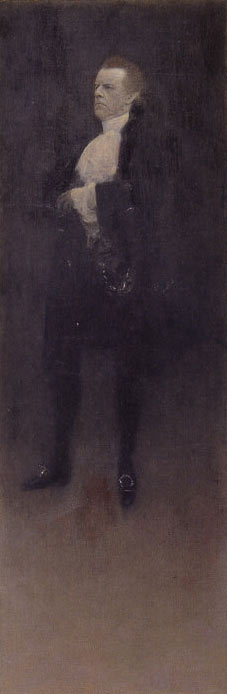
Gustav Klimt's Josef Lewinsky as Carlos in Clavigo is a portrait built from several kinds of performance. A celebrated Burgtheater actor appears in one of his best-known roles. His face and white shirt emerge from a black costume and a darkened stage, while lettering identifies both man and character. Around him, foliage, a smoking tripod, a woman holding a mask and an image of Dionysus turn a commissioned likeness into an allegory of theatre.[1][2]
The painting was also made to travel beyond its canvas. Vienna's Society for Reproductive Art commissioned it in 1894 as the model for an illustration in a history of the Court Theatre. Klimt worked for roughly a year, using direct access to Lewinsky when possible and photographs while the touring actor was away. A bronze statuette cast by Karl Dietrich supplied another kind of three-dimensional evidence. The finished oil was then translated into a photogravure for publication.[3][4][5]
These layers should remain distinct. Lewinsky was not Carlos in private life. A photograph was not the painting, the bronze was not made by Klimt, and the published plate was not the original canvas. Their convergence is precisely what makes the portrait so revealing: it asks how a person becomes a role, how a role becomes an image and how one image changes when it is multiplied.
At a Glance
- ArtistGustav Klimt
- Belvedere titleJosef Lewinsky als Carlos in Clavigo
- Date1895
- Object typePainting
- MediumOil on canvas
- Dimensions60 × 44 centimetres
- Inventory number494
- SignatureLower right, with Klimt's name and the year in Roman numerals
- InscriptionUpper centre, identifying Josef Lewinsky as Carlos in Clavigo
- CommissionerGesellschaft für vervielfältigende Kunst, or Society for Reproductive Art
- PurposeOriginal illustration model for a volume on Vienna's Court Theatre
- Working evidenceSittings, photographs and a bronze statuette cast by Karl Dietrich
- First documented exhibitionThird International Graphic Art Exhibition, Vienna Künstlerhaus, 1895
- Public collection entryModern Gallery, 1902
- Current collectionBelvedere, Vienna
- Current accessRecorded as not on display on 9 August 2026[1][3][4][6]
The Exact Belvedere Painting
The Belvedere catalogues the work as Josef Lewinsky als Carlos in Clavigo, dated 1895. It is an oil painting on canvas measuring 60 by 44 centimetres and carries inventory number 494. The museum classifies it unambiguously as a painting, not as a print, drawing or photograph.[1]
Klimt signed the lower right with his name and the date in the form “MDCCCLXXXXV.” At the upper centre, an inscription reads “JOSEF. LEWINSKY. / ALS CARLOS IN CLAVIGO.” The unusual Roman-numeral construction and the capitalised role identification are recorded features of this object. They are not later website captions or a modern exhibition label.[1]
English titles vary slightly. Portrait of Josef Lewinsky as Carlos in Clavigo, Actor Josef Lewinsky as Carlos and the shorter Josef Lewinsky as Carlos all refer to this same canvas. Old full and cropped reproductions do not indicate two Klimt portraits. The explicit Belvedere title is the secure anchor because it names sitter, character and play together.
Older references have occasionally printed a height of 64 centimetres. The current holder gives 60 by 44 centimetres, so that is the responsible measurement to use. A discrepancy in secondary records does not establish another state, altered canvas or lost companion.
Josef Lewinsky: Actor before Image
Josef Lewinsky was born in Vienna on 20 September 1835. After early training and uncertain engagements, his performance as Franz Moor in Brno in 1858 led Heinrich Laube to invite him to the Vienna Burgtheater. That appearance marked the beginning of an exceptionally long association with the theatre.[3]
The Klimt Database credits Lewinsky with 48 years in the ensemble and approximately 300 roles. He was named Court Actor in 1865 and, in 1872, became a director responsible for tragedy. His repertoire extended from villains and serious character parts to comedy and folk theatre. He also toured as a reciter and wrote on acting and poetry.[3]
This career explains why the commissioning society could treat him as representative of the old Court Theatre. Klimt was not rescuing an obscure performer from anonymity. He was portraying a public figure whose face, voice and interpretations were already familiar to Viennese audiences.
Lewinsky was about sixty when Klimt completed the canvas. Age matters here as professional duration rather than as a theme of decline. The picture presents an established actor through a role that had helped define his reputation. He would continue performing until 1906 and died in February 1907.[3]
Who Is Carlos in Goethe's Clavigo?
The name Carlos can mislead viewers who do not know Goethe's play. Carlos is not its title character. In the 1774 tragedy, Clavigo is an ambitious writer and royal archivist who has broken his promise to Marie Beaumarchais. Carlos is his friend and worldly adviser.[7]
Carlos repeatedly urges Clavigo to protect his career from what he regards as an imprudent marriage. In the fourth act, when Clavigo has renewed his promise to Marie, Carlos presses him again to consider ambition, reputation and worldly consequence. His language combines apparent concern for a friend with ruthless scepticism about fidelity and feeling.[7]
The character is therefore more complicated than a stock villain. Carlos can appear lucid, cynical, protective and destructive at once. Lewinsky's reputation in the role depended on making argument and controlled speech dramatically powerful, rather than on spectacular costume alone.[3][7]
None of this makes the actor identical to Carlos. Klimt portrays Lewinsky performing a part. The distinction allows the face to be both a likeness and a theatrical construction: a known man is visible through the bearing, clothing and mental pressure of someone invented by Goethe.
A Commission for the Society for Reproductive Art
The Gesellschaft für vervielfältigende Kunst was founded in Vienna in 1871 to cultivate and promote reproductive graphic techniques. Its publications circulated paintings and drawings through engraved and printed translations, giving original designs a reach that exhibition alone could not provide.[5]
From 1894 the Society developed Die Theater Wiens, an ambitious history of Viennese stage life. It invited artists to portray celebrated actors for the project. Klimt received the task of choosing an artist associated with the old Burgtheater and selected Lewinsky.[3][5]
A letter of 19 May 1894 preserves the approach. Klimt explained to Lewinsky that the Society was publishing a major work about Vienna's theatres and that he had been assigned to paint an artist of the old Burgtheater. He then asked permission to choose Lewinsky's portrait. The surviving message fixes commissioner, purpose and artist's selection without requiring an invented private commission from the actor.[5]
Other contributors supplied illustrations for the publication, including Hans Temple, Andreas Groll and Adolf Hirémy-Hirschl. A Belvedere online study describes their contributions as historical-style grisailles and contrasts them with Klimt's more modern solution. His canvas did not abandon the commission; it expanded what an illustration model could be.[2]
A Year of Work and Interrupted Presence
The project took about a year. Lewinsky's touring schedule meant that a continuous sequence of studio sittings was impossible. Klimt Database research says the painter used photographs for part of the work while the actor was away.[3]
Its chronological chapter adds a bronze statuette cast by Karl Dietrich. A photograph offered a fixed optical record; a statuette supplied mass and bodily orientation that could be considered from more than one angle. Direct sittings, photographic evidence and sculpture served different purposes within the same portrait process.[4]
No retained source identifies one surviving Carlos photograph as the single template for every passage. The Theatermuseum holds historical photographs of Lewinsky, including a role portrait, but resemblance is not sufficient to turn any convenient image into the definitive source. Klimt could draw on a visual archive without copying one exposure mechanically.[3]
The bronze requires the same care. Dietrich cast it; Klimt used it. Calling it “Klimt's sculpture” would erase the maker and confuse an aid with the final work. Nor does its use make the painting less observed. Portraiture has long combined sittings with drawings, memory and substitute records when access changes.
Here those substitutions have special resonance. An actor was professionally present through repeated transformations of body and voice. Klimt's method likewise built a stable painted image from appearances encountered at different times and through different media.
A Face and White Shirt in Darkness
Lewinsky stands or sits slightly elevated within a dark field, wearing a black stage costume. His pale face and the white of his shirt, collar and cuffs command attention because so much of the surrounding body approaches darkness. The limited light does not describe an ordinary room; it stages visibility.[1][2]
The Belvedere study notes the minute handling of facial and clothing detail. At close range the actor's features and costume have an almost miniaturist precision. From farther away, however, detail contracts into a few luminous anchors: face, shirt, hands and inscription.[2]
This double effect suits the subject. Theatre asks an actor's small gestures to carry across distance. Reproduction asks a painted design to remain legible when reduced to a printed page. Klimt's concentrated lights preserve the likeness while making it survive changes of scale.
The black costume does not simply disappear. Its edge can be sensed against neighbouring areas of dull darkness, keeping the body present without outlining it emphatically. The viewer must look for Lewinsky in much the same way an audience locates an actor as stage light isolates him.
It would be easy to label the expression guilty or calculating because Carlos advises betrayal. The picture does not provide direct access to Lewinsky's private mind. What can be described is a controlled theatrical address: the face is exposed, the body withheld and the role sustained under observation.
Portrait, Stage and Photographic Appearance
The Belvedere's online study compares the central portrait zone to late nineteenth-century studio photography. The slightly elevated actor, dull background, black costume and concentrated light can evoke a carefully arranged photographic sitting.[2]
That comparison is particularly apt because photographs contributed to the working process. Yet the painting does not conceal their use. It makes photographic stillness one layer within a larger construction whose colour, lettering, ornament and mythological imagery exceed an ordinary role photograph.
The result can resemble a collage before collage became a central modernist practice. A relatively naturalistic actor occupies one zone; brighter borders and symbolic images press against it; typography participates in the design. Different modes of representation remain adjacent rather than melting into a unified fictional room.[2]
This adjacency keeps the viewer alert to mediation. Lewinsky is both present and already reproduced. Carlos is both embodied and named. The surrounding apparatus tells us that a portrait likeness is never identical with the person who stood before the artist.
The Tripod, Mask and Apparition
On the right, an ancient tripod or incense burner emits smoke from which a young woman seems to emerge. She carries a theatrical mask. Above appears Dionysus, the god with whom Greek theatre was historically associated. The Belvedere reads the ensemble as an allegory of theatre and links the tripod to the ancient origin claimed for the modern stage.[1][2]
The woman is more apparition than solid companion. Fine handling and smoke give her a different degree of reality from Lewinsky. The mask, in turn, is an image of a face that is not alive at all. Human likeness, performed character and theatrical emblem sit beside one another.
Foliage or organic tendrils occupy the opposite border. They spread across a diffuse surface rather than opening into a landscape. Ornament therefore connects the central likeness to the allegorical margin while preserving a visible difference between them.[2][4]
Klimt Database scholarship compares the result with his 1890 portrait of pianist Joseph Pembaur. In the earlier work, antique references were distributed around the frame without being fully related. Lewinsky joins tripod, smoke, vision and plant forms into a more integrated symbolic system.[4]
That change should not be converted into a universal code. A mask does not always mean deceit, and smoke does not automatically indicate death or dream. Here the commission, role and holder's interpretation make theatrical representation the strongest context.
The Lettering Is Part of the Image
The inscription does more than label the sitter after the fact. Its capital letters occupy the painted design and announce the transformation from Josef Lewinsky into Carlos. Viewers do not have to guess whether they are seeing a private gentleman or an actor in role.[1]
At the same time, the wording preserves two identities. It says Lewinsky “as Carlos,” not simply Carlos. The small preposition carries the difference between person and character that the whole portrait investigates.
Lettering also connects the canvas to its printed destination. A book illustration must function near captions, type and page architecture. Klimt internalises words within the original rather than leaving all identification to a publisher's label.
This interest would become more conspicuous in later works, but it already matters in 1895. Text, image and ornament cooperate without becoming identical. The painted words state facts; the actor supplies likeness; the allegorical border opens interpretation.
From Ringstrasse Naturalism toward Symbolism
The portrait belongs to a turning point in Klimt's career. His reputation had been built through decorative schemes and carefully observed public commissions. During the mid-1890s he increasingly adopted Symbolist methods and tested less conventional relations among figure, ornament and idea.[4]
Lewinsky retains impressive naturalistic control. The sitter must remain recognisable, and costume detail matters. But the canvas no longer treats likeness as sufficient. Darkness interrupts stable space; an apparition shares the surface with the actor; ancient theatre enters through a decorative border; writing becomes pictorial.
This is why the work should not be described as a premature Golden Period painting. It has no object record of gold leaf, silver, platinum or applied ornament. Its modernity lies in representational structure: several realities are made to coexist within oil on canvas.[1][4]
Nor should every later Klimt controversy be read back into it. The Vienna Secession would be founded in 1897, two years after the painting. Lewinsky is evidence of movement before that institutional break, not an illustration of a fully formed programme announced in advance.
The stage subject was especially suitable for transition. Theatre already accepted costume, illusion, symbolic props and the unstable relation between person and role. Klimt could move beyond conventional portrait space without abandoning the commissioner or the sitter's recognisability.
Original Painting and Published Photogravure
The oil was created as an original model for reproduction, but that purpose did not make it a print. Klimt designed and painted the canvas. A specialist reproductive process then translated the image for Das k. k. Hofburgtheater seit seiner Begründung, part of the wider Die Theater Wiens project.[4][5]
Klimt Database's artwork chapter identifies the published image as a photogravure placed with a photograph of Lewinsky. Its Society history also describes a colour reproduction in the theatre volume. These descriptions refer to the publication history; they should not be expanded into a claim that every proof or issue had an identical colour and process.[4][5]
The pairing of photograph and reproduced painting was conceptually rich. One image could present the performer as photographed sitter, the other as Carlos within Klimt's allegorical theatre. Readers could compare documentary likeness with artistic transformation on the printed page.[4]
Reproduction also altered scale and surface. Oil brushwork, canvas texture and subtle darkness had to become an inked plate impression. The original's concentrated lights and strong divisions helped the composition remain legible, but the print could never carry every material property of the canvas.
Klimt was responsible for the original design. The historical record does not make him the printer of the plate. Keeping authorship roles distinct reveals the Society's purpose: reproductive art depended on collaboration between an original artist, publication editors and technical specialists.
The Third International Graphic Art Exhibition
The original painting was shown at the Third International Graphic Art Exhibition, the Society's anniversary exhibition at the Vienna Künstlerhaus, from October to December 1895. The display brought together original models for major reproductive projects as well as graphic work.[4]
Lewinsky's inclusion made the painting's double status visible. Museum visitors could encounter an oil portrait, while the exhibition context emphasised its future or parallel life as a multiplied image. It belonged to painting and to the culture of reproduction without collapsing one into the other.
The event also placed Klimt among artists and techniques concerned with how art circulated. This context helps explain why a portrait intended for a book could receive such a complex symbolic structure. Reproduction was not an afterthought applied to a conventional easel painting; it shaped the work's commission and public purpose from the beginning.
From the Society to the Modern Gallery
The Belvedere records the painting's 1902 inventory entry from the Society for Reproductive Art, described as consideration connected with a subsidy. It entered the Modern Gallery rather than passing to the museum through a later private sale.[1]
The Modern Gallery was conceived as a public collection of important recent art. Klimt Database research identifies Lewinsky among three Klimt paintings acquired between 1900 and 1902, alongside After the Rain and On the Attersee. Parts of the new collection became accessible in rooms of the Lower Belvedere in May 1903.[6]
The sequence matters. Commission and completion came in 1894–95; publication and graphic-exhibition life followed; public collection entry occurred in 1902. These dates describe stages in one object's use, not competing creation dates.
Institutional names later changed as the Modern Gallery developed into the Austrian Gallery Belvedere. Inventory 494 anchors the canvas through those changes. As of 9 August 2026 the live Belvedere record marked it “currently not on display.” The painting remains in the collection, but possession is not the same as gallery access.[1][6]
Why the Portrait Matters
Josef Lewinsky as Carlos in Clavigo offers an unusually exact demonstration of representation in motion. A famous performer lends his appearance to a fictional adviser. Photographs and a bronze help Klimt work across absence. Oil turns that evidence into a staged likeness. Photogravure then carries the painting into a book.
The canvas makes those transformations visible rather than hiding them. Words distinguish actor from role. Black costume and darkness isolate a face under theatrical light. A woman with a mask enters through smoke. Dionysus and the tripod connect the modern Burgtheater to an imagined ancient origin. Ornament prevents the portrait from settling into an ordinary interior.
Its importance is not that it predicts every later Klimt masterpiece. The work stands securely in 1895, before the Vienna Secession and before the material splendour of the Golden Period. Its innovation is already substantial: portrait, allegory, stage image and publication design coexist within a painting only sixty centimetres high.
Lewinsky's identity is neither lost nor simplified in the process. The picture honours his craft by showing that acting is more than disguise. Carlos becomes present through control of body, face, costume and speech; Lewinsky remains the artist who performs him. Klimt's portrait asks viewers to recognise both at once.
Frequently Asked Questions
References
Accessed August 2026.
- Belvedere, “Josef Lewinsky als Carlos in Clavigo”: exact holder title, 1895 date, oil medium, 60 × 44 centimetres, signature and inscription, inventory 494, theatrical imagery, 1902 entry and current non-display. View source.
- Belvedere, “Klimt's Painting of ‘Josef Lewinsky as Carlos in Clavigo’”: commission context, contrast with other publication illustrations, photographic staging, costume, lighting, miniature handling and allegorical border. View source.
- Gustav Klimt Database, “Josef Lewinsky”: actor's dates and career, approximately 300 roles, Carlos's prominence, 1894 commission, year-long work and partial use of photographs. View source.
- Gustav Klimt Database, “Symbolism in Klimt's Oeuvre”: mid-1890s transition, photograph and Karl Dietrich bronze evidence, photogravure, symbolic construction, comparison with Joseph Pembaur and the 1895 graphic exhibition. View source.
- Gustav Klimt Database, “Society for Reproductive Art”: institutional purpose, Die Theater Wiens, Klimt's 19 May 1894 letter and publication of the reproduction. View source.
- Gustav Klimt Database, “Vienna's Modern Gallery”: 1902 acquisition and the painting's place among the Modern Gallery's early Klimt holdings. View source.
- Johann Wolfgang von Goethe, Clavigo, fourth act: primary text establishing Carlos as Clavigo's friend and worldly adviser. View source.
Discussion
Josef Lewinsky as Carlos in Clavigo rewards close attention to source context, object identity and careful reproduction boundaries.