 by Tom Gurney
Tom Gurney BSc (Hons) is an art history expert with over 20 years experience
Published on August 21, 2026 / Updated on October 23, 2026
Email: tomgurney1@gmail.com / Phone: +44 7429 011000
About Lady at the Fireplace
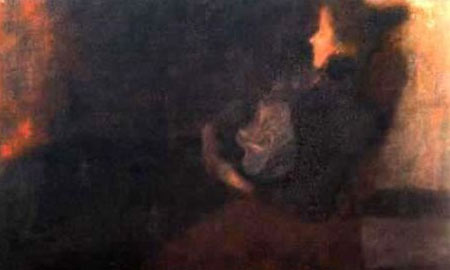
Gustav Klimt's Lady at the Fireplace is a portrait in which certainty falls away at the edges. A fashionably dressed woman sits in profile within a low, horizontal canvas. Her dark clothing approaches the surrounding interior, while the pale interval of her face remains suspended in dim light. The fireplace named in the title is more atmospheric presence than carefully described fixture. Warmth, darkness and open brushwork make the room perceptible without making it fully knowable.[1][3]
The sitter is equally elusive. Her name and the circumstances of the painting's creation have not been established. Even the work's historical title has only recently become clearer: current scholarship considers the Belvedere painting probably identical with Dämmerung—At Dusk—shown as catalogue number 74 at the Vienna Secession's second exhibition in 1898. “Probably” matters. Another twilight portrait, Im Zwielicht, appeared at the first Secession exhibition and is now lost.[2][5]
What remains secure is the object itself: an oil painting on canvas dated 1897/98, measuring 41 by 66 centimetres, signed at upper left and held by the Belvedere under inventory number 5434. Its restraint makes it a key experiment in Klimt's emergence as a modern portrait painter. An anonymous woman is not turned into a riddle to be solved; she becomes the centre of a new relation among figure, atmosphere and paint.[1]
At a Glance
- ArtistGustav Klimt
- Belvedere titleDame am Kamin
- English titleLady at the Fireplace or Lady by the Fireplace
- Related historical titleProbably Dämmerung (At Dusk), catalogue 74 at the second Vienna Secession exhibition
- Date1897/98
- Object typePainting
- MediumOil on canvas
- Dimensions41 × 66 centimetres
- SignatureUpper left, “GUSTAV / KLIMT”
- Inventory number5434
- SitterUnidentified
- Provenance anchorsFriedrich Stadler-Wolffersgrün; Hermann Bauch; purchased by the Belvedere from Editha Bauch in 1961
- Current collectionBelvedere, Vienna
- Current accessThe live museum entry consulted on 9 August 2026 marked the painting as not exhibited[1]
Which Painting Is Lady at the Fireplace?
The exact work is the Belvedere's Dame am Kamin, inventory 5434. The museum dates it 1897/1898, classifies it as a painting, and records oil on canvas, 41 × 66 centimetres. Klimt's two-line signature appears at the upper left.[1]
Those facts distinguish the original from the numerous prints, digital crops and hand-painted reproductions that circulate under the English title. A seller's configurable dimensions describe a product, not Klimt's canvas. Nor does a brightened reproduction establish colours, objects or flames that are barely legible in the painting itself.
The German Dame am Kamin translates directly as a lady at or by the fireplace. Recent Belvedere material also uses the combined title Dämmerung (Dame am Kamin), while the Gustav Klimt Database calls it Lady by the Fireplace (at Dusk). These naming forms point to one museum object, but the link between the familiar title and the 1898 exhibition title still requires qualification.[2][5]
Dämmerung: A Probable Historical Identity
At the second exhibition of the Vienna Secession, held in the association's newly built exhibition house in November 1898, Klimt showed seven works. Catalogue number 74 was called Dämmerung, meaning dusk or twilight. For a long time it was treated in the literature as a landscape because the brief catalogue title did not identify its subject.[2]
Contemporary descriptions have changed that understanding. They indicate that Dämmerung was a small portrait study of a woman at dusk. On that evidence, the Klimt Database concludes that the exhibited painting is probably identical with the Belvedere work previously known as Lady by the Fireplace. The painting's small format, dim light and female figure support the association, but the documentary argument does not amount to absolute proof.[2]
It is therefore responsible to say that Lady at the Fireplace was probably exhibited as Dämmerung in 1898. It would be too strong to claim that a signed original title on the canvas or an unbroken catalogue trail has settled the matter beyond question.
This distinction adds meaning without forcing certainty. Dame am Kamin locates the woman near an interior feature. Dämmerung names a condition of fading light. Together they describe the two inseparable subjects of the picture: a seated figure and the atmosphere through which she is seen.
Not the Lost Im Zwielicht
A second twilight title makes precision essential. At the Vienna Secession's first exhibition in spring 1898, Klimt presented an oil study called Im Zwielicht or By Twilight, catalogue number 201. A contemporary article identifies its motif as a lady in twilight. The work was sold during the exhibition and its present whereabouts are unknown.[2]
Research suggests that the lost painting resembled Lady at the Fireplace and another small oil, Various Faces (Lady in an Armchair). Similarity of scale, atmosphere and female subject helps reconstruct a group of experiments, but it does not turn three paintings into one.
The first exhibition's Im Zwielicht, catalogue 201, remains lost. The second exhibition's Dämmerung, catalogue 74, is the work probably identified with Belvedere inventory 5434. Keeping the exhibition number, date and status beside each title prevents a seductive twilight vocabulary from erasing object identity.[2]
A Portrait Wider Than It Is High
The painting's 41-by-66-centimetre shape is unusual for a portrait. Instead of using an upright rectangle to enclose a standing figure or bust, Klimt chooses a low horizontal field. The woman's seated body extends through that format, and the darkness around her has room to operate.[1][4]
She occupies the right side of the composition and faces to the right in strict profile. Her pose is not presented as a formal frontal audience with the viewer. We encounter her from the side, as if attention has settled elsewhere. The horizontal canvas makes that withheld exchange feel natural: the picture follows the direction of the seated body and gaze rather than forcing the face to turn outward.[2]
An armchair or reclining support can be discerned, yet furniture is not described with the precision of an interior portrait. The dark dress merges with the chair and room. Body, clothing and setting remain distinct enough to hold the figure, but they are not separated by hard outlines.
This is not empty vagueness. Klimt decides where recognition should be easy and where it should slow. Face, collar and selected lights can be found quickly. The rest requires a more patient adjustment to a narrow tonal range. Looking becomes analogous to entering a dim room and waiting for objects to emerge.
What the Fireplace Contributes
The title encourages the viewer to expect flames, a grate and a clearly illuminated face. Klimt provides no such descriptive inventory. The Belvedere observes that the fire's warm glow can only be sensed. The fireplace gives the painting its light condition without becoming a still life of hearth and furnishings.[1]
That restraint protects the picture from a single narrative. The woman need not be staring into visible flames, keeping vigil or warming herself after a named event. A suggestion of fire explains tonal warmth and dusk, but it does not reveal what has happened before or what she is thinking.
The interior is similarly incomplete. Darkness closes behind the sitter instead of opening into measurable architecture. Walls, curtain, furniture and hearth may be perceived in varying reproductions, but the painting's principal structure lies in their subordination. They create enclosure and atmosphere around the profile.
Light is therefore relational. It does not fall evenly across a room and then happen to reveal a person. It gathers around the sitter's face while allowing dress and interior to approach one another. The result is both intimate and impersonal: the viewer is close to a private-looking moment but receives almost no private information.
A Face Held in Dusk
Klimt gives the profile enough definition to establish forehead, nose, lips and chin, yet he avoids the continuous sharp modelling associated with a formal commissioned likeness. The face appears through pale, softly connected passages rather than through a crisply bounded silhouette.[1][3]
Hair, hat or head covering and collar contribute to the contour, but none becomes a catalogue of fashion details. The woman is recognisably elegant and dressed for an urban social world. The Belvedere describes a metropolitan sophistication, while also stressing that the sitter's identity and the circumstances of creation remain unknown.[3]
“Fashionable” is consequently a description of appearance, not a biography. The painting does not prove that she belonged to Klimt's wealthy patron circle, commissioned the canvas, attended the Secession or lived in the depicted interior. No name can safely be supplied from resemblance to another portrait.
The profile also resists emotional certainty. A lowered or distant attention can look dreamlike, reflective or melancholy. The Belvedere relates the painting to a sorrowful image of women often invoked in period literature, but that is a cultural frame for the representation—not a diagnosis of the woman's mind.[3]
Open Brushwork and Selective Clarity
The Gustav Klimt Database describes the painting's handling as open or liberal. Its tonal colouring and atmospheric blur place it among the small oils with which Klimt was reconsidering portraiture around 1897. The brush does not simply conceal detail; it redistributes importance.[2]
Where a more conventional portrait might distinguish fabric, flesh, chair and wall through increasingly exact description, Lady at the Fireplace lets surfaces meet. Dark paint can serve dress and shadow together. Soft transitions can suggest both bodily volume and fading light. The viewer receives fewer separate things and a stronger overall condition.
The Belvedere has contrasted this pastel-like painting with Klimt's more sharply naturalistic portraits of the mid-1890s. The comparison reveals flexibility rather than an abrupt replacement of one style by another. Within a few years he could pursue photographic precision, decorative symbolism and an atmospheric portrait that seemed to hover at the edge of visibility.[3]
No technical study published with the current object record licenses an exact pigment list or a stroke-by-stroke reconstruction. “Open” does not mean careless or unfinished. The canvas is catalogued as a painting, not an abandoned study in an incomplete state. Its looseness is a visible method whose effect can be discussed without pretending to recover Klimt's order of work.[1][2]
Whistler and International Symbolist Portraiture
Klimt's late-1890s portraits developed in conversation with art beyond Vienna. The Klimt Database associates the tonal colouring and blurred handling of Lady at the Fireplace and related profiles with James McNeill Whistler. The Belvedere likewise places it near the mysterious, dimly lit portraits of international Symbolism.[2][3]
Whistler offered an important model for treating a portrait as an arrangement of tones rather than as an exhaustive social document. Fernand Khnopff and other Symbolists showed how atmosphere, distance and selective description could make a represented person seem psychologically charged without telling a conventional story.[2]
These comparisons do not identify one picture that Klimt copied. Nor do they turn the anonymous woman into an allegorical being. Their value lies in clarifying a shared problem: how can a modern portrait preserve the presence of a person while refusing the descriptive certainty expected from academic naturalism?
Klimt's answer here is compact. He retains a recognisable profile and fashionable appearance, then allows tonal unity to weaken the boundaries between sitter and surroundings. The mystery comes from pictorial organisation, not from a hidden symbol that must be decoded.
The Vienna Secession Context
The painting dates from the foundation years of the Vienna Secession. Klimt was the association's first president and used its exhibitions to present an unusually wide range of paintings and drawings. International members and invited artists exposed Vienna to Whistler, Khnopff, Auguste Rodin, Giovanni Segantini and other alternatives to established academic practice.[2]
The second exhibition brought Dämmerung into a display that also included Klimt's Pallas Athene, Moving Water, Portrait of Helene Klimt and Portrait of Sonja Knips. Critics confronted not one stable Klimt style but sharply different approaches to portrait, allegory and landscape.[2]
That setting explains why the probable identification matters. Lady at the Fireplace was not necessarily a private experiment hidden until later museum acquisition. If it was catalogue 74, contemporary visitors saw this understated horizontal portrait beside much larger and more confrontational works.
Its modernity was quiet but consequential. The canvas does not need mythological armour, an inscription or applied gold to depart from convention. It changes portraiture by changing how much visual and biographical information a likeness must provide.
From the Small Oil to Klimt's Modern Portraits
Klimt Database scholarship places Lady at the Fireplace with Portrait of a Lady in Profile to the Right and Various Faces (Lady in an Armchair) as small oils that prepared compositional strategies later expanded in Portrait of Sonja Knips. All turn women toward the right and use tonal atmosphere to complicate their position in pictorial space.[2]
The comparison is formal, not biographical. Sonja Knips was a named sitter in a large square commission with its own patronage history. The fireplace woman remains anonymous in a canvas less than a third as high. What connects them is Klimt's growing confidence in asymmetry, uncertain depth and the expressive value of a field that is not filled with descriptive incident.
Scale changes the social encounter. Sonja Knips can dominate a wall; Lady at the Fireplace asks for nearness. Yet the smaller painting already contains an essential Klimt problem: how to let a woman remain visually commanding when the surrounding space refuses to behave like a stable room.
Ownership and the Belvedere
The early ownership of the painting is incomplete. The Belvedere records it with Friedrich Stadler-Wolffersgrün until 1936, followed by Hermann Bauch in Vienna. In 1961 the museum purchased it from Editha Bauch.[1]
Those entries do not establish who first acquired the work from Klimt, whether the sitter or another patron ever owned it, or how it reached Stadler-Wolffersgrün. They also do not support a claim of Nazi seizure or forced sale. Responsible provenance writing preserves the documented sequence and leaves the preceding gap open.
After entering the Belvedere, the painting appeared in a succession of exhibitions, beginning with the museum's 1962 Klimt centenary display. It has since been repeatedly reconsidered, including in the Alte Nationalgalerie's 2023 exhibition Secessions: Klimt, Stuck, Liebermann.[1][4]
Its museum life has helped restore the work's historical position. A picture once known chiefly by its descriptive fireplace title can now be connected cautiously with the Secession's Dämmerung, bringing exhibition history and visual atmosphere into closer alignment.
Where Is the Painting Now?
Lady at the Fireplace remains in the Belvedere collection under inventory number 5434. The museum's live record stated that it was not currently on display on 9 August 2026.[1]
Museum ownership should not be confused with permanent gallery access. Paintings may be stored, studied, conserved or lent, and displays can change. Anyone planning a visit should consult the Belvedere's current object record rather than rely on an older exhibition photograph or travel guide.
Why Lady at the Fireplace Matters
The painting is easy to underestimate because it is small, dark and attached to no famous sitter. Those qualities are precisely why it matters. Klimt tested whether a portrait could remain compelling after name, room, narrative and hard contour had been reduced.
Its horizontal format gives atmosphere unusual weight. Its profile denies the viewer a conventional social exchange. Its open brushwork allows dress, chair and dusk to converge, while its probable historical title describes the fading condition that makes such convergence possible.
The woman is neither a cipher nor an invitation to fantasy. She is the painting's most specific presence and its greatest limit on what can be known. Klimt makes that limit productive. A portrait need not disclose a life to transform the act of looking.
Frequently Asked Questions
References
Accessed August 2026.
- Belvedere, Collection Online, “Dame am Kamin”: exact title, date, object type, oil-on-canvas medium, 41 × 66 centimetres, signature, inventory 5434, description, provenance, exhibition history and current non-display. View source.
- Gustav Klimt Database, “Cradle of Modernism”: modern-portrait group, Whistler context, first and second Secession exhibitions, lost Im Zwielicht, catalogue 74 Dämmerung and its probable identity with Lady by the Fireplace. View source.
- Belvedere / Franz Smola, “Zoom Into Klimt's ‘Lady at the Fireplace’”: international Symbolist comparison, dim atmosphere, blurred outlines, fashionable anonymous sitter and period mood interpretation. View source.
- Staatliche Museen zu Berlin, Alte Nationalgalerie, Secessions: Klimt, Stuck, Liebermann checklist: independent confirmation of the 1897/98 oil, 41 × 66 centimetres, Belvedere ownership and 2023 loan. View source.
- Belvedere, “Digitales Sammlungsverzeichnis zu Gustav Klimt veröffentlicht”: current institutional naming layer Dämmerung (Dame am Kamin) and launch of the researched digital Klimt catalogue. View source.
Discussion
Lady at the Fireplace rewards close attention to source context, object identity and careful reproduction boundaries.