 by Tom Gurney
Tom Gurney BSc (Hons) is an art history expert with over 20 years experience
Published on August 21, 2026 / Updated on October 23, 2026
Email: tomgurney1@gmail.com / Phone: +44 7429 011000
About Lady with Hat and Feather Boa
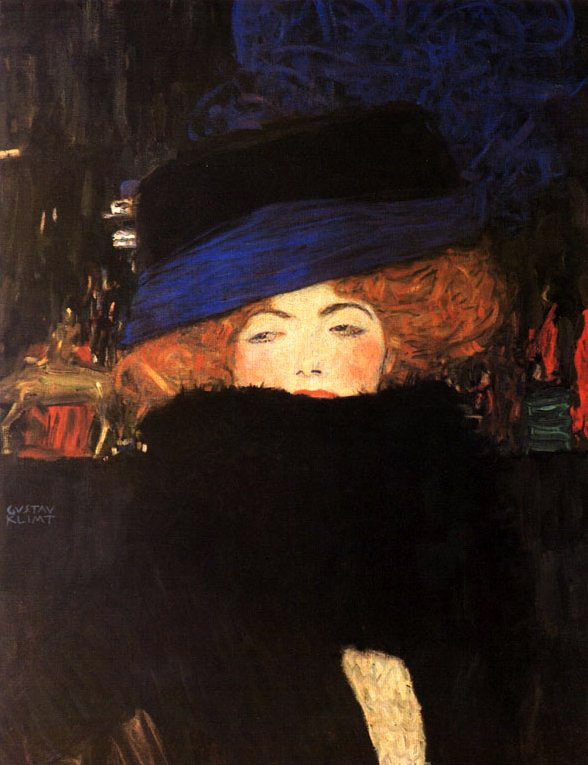
Gustav Klimt's Lady with Hat and Feather Boa turns fashionable concealment into the substance of a portrait. A broad hat enlarges the woman's head and silhouette. A dark feather boa rises across the lower face, interrupting the usual passage from chin to neck and shoulders. Between them, her pale features and sideways, half-lowered eyes occupy a narrow opening. The accessories make her more visible and harder to know at the same time.[4][5]
The sitter has not been identified securely. Hilde Roth and Josefine Grete Holfeld have both been proposed, but current Belvedere scholarship stresses that each attribution depends on unconfirmed tradition. The painting's official restitution file called it a portrait of Grete Holfeld; that historical wording is evidence in the provenance record, not conclusive identification.[1][4]
The physical object is far more traceable than the face. A stepped tear recorded in the Lasus family's diary in 1933 later helped connect their painting with former Belvedere inventory 4415. Nazi persecution forced the family into an emergency sale in November 1939. The subsequent ownership chain remains unresolved until 1950, when the Austrian Gallery acquired the work by exchange. A federal advisory decision in 2000 led to restitution in 2001.[1][2][3]
This combination makes the portrait unusually revealing. Hat and boa obscure biography within the image, while damage, diary, inventory and restitution research establish the history of one canvas with exceptional precision.
At a Glance
- ArtistGustav Klimt
- Official restitution titleDame mit Federboa
- Expanded German titleDame mit Hut und Federboa
- English titleLady with Hat and Feather Boa
- Date1909; the Klimt Database uses “around 1910”
- Object typePainting
- MediumOil on canvas
- Dimensions69 × 55.8 centimetres
- Former museum inventoryAustrian Gallery/Belvedere 4415
- SitterUnidentified; Hilde Roth and Josefine Grete Holfeld have been proposed
- Documented early ownersGeorg Lasus, then Hermine Lasus
- 1939 transactionEmergency sale to Galerie St. Lucas under Nazi persecution
- Museum acquisitionAustrian Gallery, by exchange from Herbert Barth von Wehrenalp in 1950
- RestitutionRecommended 28 November 2000; returned to Hermine Lasus's heirs in 2001
- Current statusPrivate ownership; buyer, location and public access unconfirmed as of 9 August 2026[1][2][3][4]
One Painting, Several Titles and Dates
The Austrian Art Restitution Advisory Board's decision lists Dame mit Federboa, dated 1909, measuring 69 by 55.8 centimetres and bearing Austrian Gallery inventory number 4415. Within its account, the fuller title Dame mit Hut und Federboa also appears. English-language records vary among Lady with Feather Boa, Lady with Hat and Boa and Lady with Hat and Feather Boa.[1]
These titles describe one painting. The shorter official wording omits the hat but does not identify a second version. The former inventory remains a useful historical anchor even though the picture no longer belongs to the Belvedere.
Dating varies slightly. The federal decision and exhibition scholarship use 1909. The current Klimt Database entry cited in the Belvedere Research Journal gives “around 1910.” The 1909 date is the clearest public baseline because the work was shown at the Vienna Kunstschau that summer, while “around 1910” records a broader catalogue convention.[4][6]
Nothing in this variation establishes two canvases, a 1909 study followed by a 1910 final painting or a documented repainting campaign. It is one oil whose chronology is expressed with different degrees of precision.
Oil on Canvas, Not Feathers on a Surface
The original is an oil painting on canvas. An archival Hulton Fine Art caption gives oil on canvas and 1909; the official restitution dossier independently establishes the canvas support through its detailed account of a tear, lining and restoration.[1][8]
The hat and feather boa are represented in paint. No actual feather, textile, gold leaf, metal or collage material is recorded. Product pages for modern prints sometimes describe their own canvas, varnish or framing; none of those manufacturing details belongs to Klimt's object.
Later conservation materials require the same distinction. By the time the Austrian Gallery acquired the portrait in 1950, it had already been lined, retouched and varnished. Those interventions belong to the painting's material history, not to Klimt's original medium.[1]
The 69-by-55.8-centimetre format is a vertical bust rather than a full-length society portrait. It is large enough for hat, face and boa to have bodily force, yet close enough to make the accessories press against the picture's boundaries.
A Face between Hat and Boa
The broad hat occupies a disproportionate amount of the upper field. It extends beyond the scale needed merely to cover the head and turns fashionable silhouette into pictorial architecture. The face seems to emerge from beneath its mass rather than sit neutrally below it.
At the lower edge of the face, the feather boa performs the opposite movement. It rises, folds and absorbs the transition into the torso. Chin, throat and shoulder are partly hidden, so the sitter is presented less as a complete body than as a concentrated facial interval.
Her eyes look sideways through lowered lids. The Leopold Museum describes a similar glance in a possibly related drawing as “lascivious,” but the term should remain a perception of pictorial effect, not evidence of consent, profession or private character.[5]
The mouth, eyes and exposed skin receive attention because the surrounding forms are so dark and enveloping. Yet the portrait does not become simply naturalistic at its centre. Hat brim, shadow, boa and facial modelling meet at soft boundaries, making visibility feel temporary.
This is why the accessories cannot be treated as decoration added to a completed likeness. They determine the amount of the person the image will disclose. The woman's fashionable appearance and the painting's structure are the same problem.
Dark Ground, Light Skin and Compressed Colour
Christie's places the picture within a group of dark-ground figures Klimt showed around 1909. In works from that group, facial features emerge dramatically against comparatively sombre surroundings. Lady with Hat and Feather Boa makes that contrast especially close and direct.[6]
The hat and boa register as dark, weighty shapes, though colour within them prevents the portrait from becoming a black-and-white scheme. The face carries warmer and paler notes; the lips and eyes act as smaller points of concentration. Background, garment and accessories do not separate into sharply measured layers.
Colour should not be translated into a universal code. A dark boa does not prove mourning or danger. A violet or plum impression in the hat does not reveal class, sexuality or theatre. The reliable analysis is relational: deep surrounding tones intensify the exposed face, while muted transitions keep the whole portrait atmospheric.
Nor does the comparatively open surface prove an unfinished state. No retained institutional record classifies the painting as unfinished. Klimt can reserve detail for eyes, mouth and skin while treating hat, boa and ground more broadly. Selective definition is an artistic method, not missing labour.
The absence of decorative gold is equally important. Made near the end of Klimt's Golden Period, the portrait achieves luxury through fashion, surface and colour rather than applied metal. It should not inherit gold leaf merely because other works of the decade used it.
An Unidentified Sitter
The title identifies clothing, not a person. Attempts to recover the sitter have produced two main proposals, neither secure enough to replace “unidentified woman.”[4]
Susanne Partsch proposed the singer and dancer Hilde Roth. Her case relied on resemblance to photographs and a Roth family tradition that Hilde had modelled for Klimt before moving to Kiel. Resemblance and family memory can guide inquiry, but they do not amount to a documented sitting, commission or inscription.[4]
Markus Fellinger later associated the portrait with Josefine Grete Holfeld, a professional model known in Klimt scholarship. The 2000 restitution file had already referred to the work as a portrait of Grete Holfeld. Franz Smola nevertheless notes that this attribution also rests entirely on unconfirmed tradition and is difficult to verify in the absence of a photograph.[1][4]
Smola's conclusion is methodologically important. The woman's face is partly obscured by the boa, and fashionable portraits of this type often supplied no biographical indication. Trying to force a name onto the image can distract from what the painting actually documents: a carefully staged anonymous presence.[4]
The responsible wording is therefore simple. Hilde Roth and Josefine Grete Holfeld have been proposed; neither has been proved. The sitter remains unidentified.
A Possibly Related Drawing
The Leopold Museum holds Sitzende Dame mit Hut im Halbprofil nach links, dated 1907/08. It is a drawing in red and blue crayon on Japanese paper, measuring 54.7 by 34.7 centimetres and carrying inventory number 1320.[5]
The museum connects the sheet cautiously with two later paintings: The Violet Hat and Lady with Hat and Feather Boa. The seated model's profile and hat relate to the first, while the softer facial features and sideways, half-lowered glance appear closer to the second.[5]
“Possibly related” is the correct level. The drawing is not catalogued as a transfer cartoon, exact costume design or proved study for former Belvedere inventory 4415. Its sitter is not automatically the same woman, and its 1907/08 date does not redetermine the oil's date.
The material boundary is firm. Red and blue crayon on Japanese paper belong to the Leopold sheet. Oil on canvas belongs to the painting. A comparative glance can reveal Klimt testing the relation among hat, turned face and oblique gaze without making the two objects stages of a documented sequence.
The Vienna Kunstschau of 1909
The painting appeared at the Vienna Kunstschau in summer 1909. Christie's exhibition history for Klimt's Alte Frau records that Lady with Hat and Feather Boa and Mother with Two Children were shown alongside it.[6]
The three works offered variations on a dark-ground figure. Faces and exposed skin emerged from heavier surrounding tones, while posture and clothing created sharply different kinds of encounter. This context supports the 1909 date and places the fashionable portrait within a deliberate public presentation rather than treating it only as a private studio image.
The Kunstschau brought Austrian work into contact with an international field that included Edvard Munch, Félix Vallotton, Henri Matisse, Ernst Barlach, Vincent van Gogh and Paul Gauguin. That setting does not prove a direct source for Klimt's hat, boa or brushwork. It shows the modern exhibition culture within which viewers first encountered the portrait.[6]
Claims that the canvas was painted in Paris or directly quotes Toulouse-Lautrec go beyond the secure object record. French modern painting can be a useful comparison for close cropping and fashion, but the visible result should not be converted into undocumented travel geography.
Georg and Hermine Lasus
Georg Lasus, a Jewish Viennese entrepreneur, owned several works by Klimt, including Farmhouse with Birches and Lady with Hat and Feather Boa. After Georg's death in 1933, the collection passed to his widow, Hermine Lasus.[1][3]
The official dossier does not say when Georg acquired this portrait, from whom he bought it or whether Klimt knew the family personally. Those parts of the early provenance remain open. What is secure is the family's possession through the 1930s.
In 2000, Georg and Hermine's granddaughter Angelina Danilowatz confirmed to provenance researchers that both paintings remained with the family until their sale in 1939. That testimony aligns ownership memory with diary and physical evidence.[1]
The Lasus history belongs to the painting, but it does not identify the sitter. Ownership by a family is not proof that the woman was a relative or acquaintance. The object can have a precise collector history while retaining an anonymous subject.
The 1933 Tear as Identity Evidence
Josef Danilowatz recorded an accident in his 1933 diary. While Hermine Lasus was dusting in his studio, a painting fell and sustained a large tear. His entry did not need to supply a modern inventory number for the event to become important later.[1]
The Austrian Gallery's restorer Erhard Stöbe documented an approximately fifteen-centimetre, stepped tear to the left of the sitter's face. When the museum acquired the portrait in 1950, the canvas had already been lined, retouched and varnished. The date of the first lining was not known.[1]
The unusual shape and position of the damage helped establish that the museum's painting was the same portrait formerly in the Lasus–Danilowatz collection. Condition became provenance evidence: the canvas carried a physical event that could be matched to family documentation.
That role should not be sentimentalised. The tear happened in 1933, before the family's forced sale, and is not a visual symbol of Nazi persecution. Nor does the dossier establish that it remains exposed today. It is a material identifier whose later treatment is only partly documented.
Nazi Persecution and the November 1939 Emergency Sale
Hermine Lasus, her daughter Maria Danilowatz and Maria's husband Josef were subjected to persecution after the Nazi seizure of power in Austria. Although Josef was classified as non-Jewish, authorities barred him from working as an artist and graphic designer on 24 November 1938 because he was married to a Jewish woman and had made anti-regime caricatures.[1]
The prohibition helped push the family into a precarious financial situation. Josef's diary records negotiations with Galerie St. Lucas on 22 November 1939 and, two days later, the sale of “the two Klimts.” The federal dossier identifies these with near-certainty as Farmhouse with Birches and Lady with Hat and Feather Boa.[1]
That cautious legal wording is worth preserving: the diary's shorthand and surrounding evidence support the identification very strongly, but the source expresses its conclusion as a reconstruction. No sale price or complete contract has been established in the decision.
The Advisory Board concluded that the transaction should be regarded as an emergency sale caused by political persecution and would probably have qualified for restitution under postwar law if proceedings had been initiated in time. The transfer was not an ordinary free-market disposal abstracted from the family's loss of livelihood.[1]
The Unresolved 1939–50 Chain
After the sale to Galerie St. Lucas, the portrait's ownership cannot be reconstructed until Herbert Barth von Wehrenalp. The gap is explicit in the official decision. No dealer, collector or family should be inserted merely because that person appears elsewhere in Klimt provenance.[1]
In 1950 the Austrian Gallery acquired Lady with Feather Boa from Barth von Wehrenalp by exchange. The Advisory Board distinguished two facts: the museum's acquisition was legally valid, but the painting had previously been the object of a voidable persecution-related transaction.[1]
This is more exact than saying simply that the museum “received looted art.” It recognises the lawful form of the 1950 exchange while tracing the unresolved title back through a 1939 emergency sale that the family could have challenged under restitution legislation.
The museum's former inventory number 4415 dates from this period of public ownership. It remains useful for identifying the restituted object, but it no longer implies that the painting is part of the Belvedere collection.
Recommendation, Poster and Restitution
On 28 November 2000, the Austrian Art Restitution Advisory Board unanimously recommended that Lady with Feather Boa and Farmhouse with Birches be returned to Hermine Lasus's heirs. The Belvedere accepted the recommendation.[1][2][7]
At that moment the portrait was serving as the poster image for the exhibition Klimt and the Women. The heirs agreed that it could remain through the exhibition's scheduled close on 7 January. This temporary arrangement separated public display from ownership: the work could continue to represent the exhibition while the return process moved forward.[7]
The Belvedere's restitution index and the Kunsthistorisches Museum's later account record the handover in 2001. Recommendation, museum acceptance, temporary continued display and physical restitution were successive stages, not one instantaneous event.[2][3]
The poster use also shows how the painting's close fashionable face had become a public emblem. A once privately owned portrait, whose sitter remained debated, could stand for Klimt's broader engagement with women. That reception should not be confused with the complete image: posters may crop or brighten a work for graphic impact.
Private Ownership after 2001
Current scholarly material identifies the painting as privately owned. The retained institutional records do not name a buyer, present owner, country, storage location or public display after restitution.[4]
Claims of a particular post-2001 sale price circulate in derivative accounts, but no source-grade auction record has been retained to support them. Price should therefore not be used to rank the portrait or to fill the gap after the heirs recovered it.
As of 9 August 2026, no current physical access was confirmed. It is no longer correct to direct visitors to the Belvedere simply because the museum's former inventory and older reproductions remain widely indexed.
Not The Black Feather Hat
Klimt painted another fashionable woman with a large feathered hat around 1910, now known as The Black Feather Hat. It is a separate work with a different composition, dimensions and provenance.[4]
The distinction is especially important because modern headlines and captions sometimes shorten both titles to a “lady with feather hat.” The shared vocabulary is not evidence of shared ownership, collection identity or restitution history.
Other works called The Violet Hat and several drawings of seated women with hats or boas also remain separate. Fashion created a family resemblance; exact title, date, medium, dimensions and provenance preserve individual identities.
Why Lady with Hat and Feather Boa Matters
The portrait joins two kinds of uncertainty without confusing them. Within the image, fashion hides the sitter's body and part of her face. Within scholarship, two names remain proposals rather than facts. The painting retains a specific human presence while refusing a secure biography.
Its material history moves in the opposite direction. A tear noted in 1933, the Lasus family's diary, the 1939 emergency sale, a museum inventory and a federal decision allow the canvas to be followed through persecution and restitution even where one eleven-year ownership gap remains.
Klimt's visual achievement and the painting's provenance should not compete for attention. Hat, boa, gaze and dark ground explain why the object mattered as art. The Lasus history explains why exact identification later mattered as justice.
Frequently Asked Questions
References
Accessed August 2026.
- Austrian Art Restitution Advisory Board, “Sammlung Lasus–Danilowatz,” decision of 28 November 2000: official title, 1909 date, 69 × 55.8 centimetres, former inventory 4415, family ownership, 1933 tear and restoration evidence, persecution, 1939 emergency sale, unresolved chain, 1950 exchange and recommendation. View source.
- Belvedere, “Provenance Research”: former inventory 4415 and completed 2001 return to Hermine Lasus's heirs. View source.
- Kunsthistorisches Museum Vienna, “Point of View #9: Gustav Klimt, Lady with a Lilac Scarf”: independent institutional summary of Georg Lasus's collection, the forced 1939 sale of the feather-boa portrait and its 2001 restitution. View source.
- Franz Smola, “Gustav Klimt's Portrait of Johanna Staude,” Belvedere Research Journal 1 (2023): current around 1910 catalogue convention, fashion-portrait context, Hilde Roth and Josefine Grete Holfeld proposals and reasons both remain unverified. View source.
- Leopold Museum, Online Collection, “Seated Lady with Hat in Half-Profile from the Left”: separate 1907/08 red-and-blue-crayon drawing, Japanese paper, 54.7 × 34.7 centimetres, inventory 1320 and qualified relation to the feather-boa portrait. View source.
- Christie's, “Gustav Klimt, Alte Frau”: 1909 Vienna Kunstschau co-exhibition and dark-ground figure-group context. View source.
- Basis Wien, “Klimts ‘Dame mit Hut und Boa’ wird zurückgegeben”: exhibition-poster use, Belvedere acceptance and the heirs' agreement to leave the painting through the exhibition's close. View source.
- Getty Images / Hulton Fine Art Collection, “Lady with hat and feather boa”: archival caption confirming oil on canvas and 1909; digital licensing dimensions are excluded from the original-object facts. View source.
Discussion
Lady with Hat and Feather Boa rewards close attention to source context, object identity and careful reproduction boundaries.