 by Tom Gurney
Tom Gurney BSc (Hons) is an art history expert with over 20 years experience
Published on June 19, 2020 / Updated on July 28, 2026
Email: tomgurney1@gmail.com / Phone: +44 7429 011000
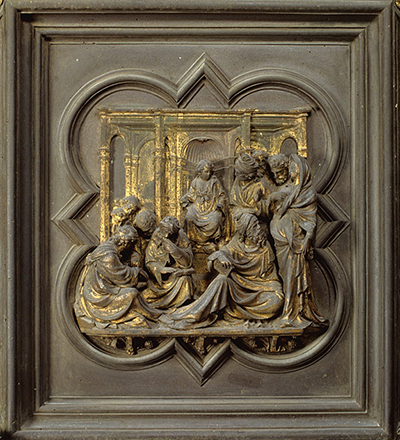
Lorenzo Ghiberti presents the youthful Christ as the still, elevated centre of an adult intellectual assembly. Christ sits beneath a temple-like structure, while the Doctors gather below and beside him with books, turned heads and expressive hands. Architecture stabilizes a crowded debate, and the listeners' varied reactions make authority visible without requiring physical dominance.
Contents
- Position and chronology
- Christ at the centre
- Books and gestures
- Architecture as order
- Reading responsive authority
Position and chronology
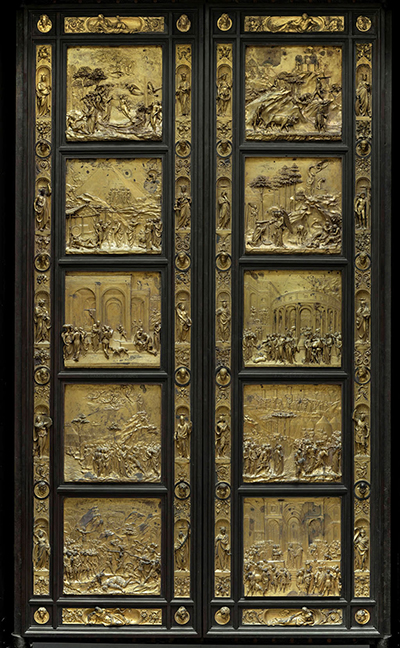
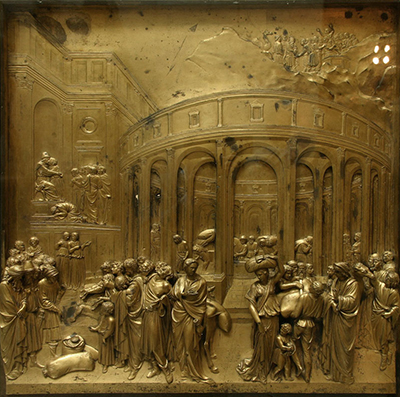
The relief is on the right leaf of the North Door, paired with the Adoration of the Magi. Along with the Annunciation and Nativity on the left leaf, it completes the lowest level of the twenty narrative scenes. The four Evangelists and four Doctors of the Church occupy the two registers beneath.
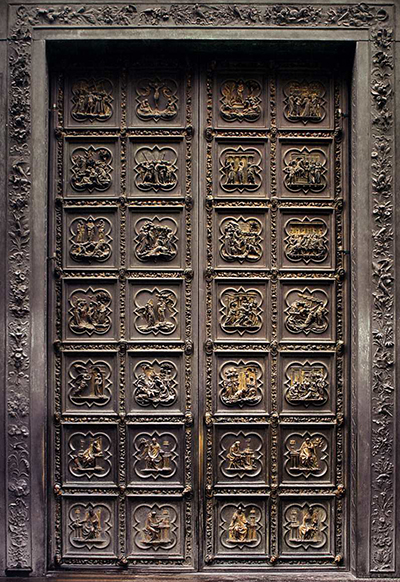
The North Door was produced from 1403 to 1424 and is now in the Museo dell'Opera del Duomo. The Baptistery's exterior door is a copy. Opera del Duomo reports a proposed stylistic phase around 1407–1413/15 for this panel. The grouping comes from Krautheimer's reconstruction and should not be read as an exact documented completion date.[1][2]
Christ at the centre
Luke 2:41–52 describes the twelve-year-old Jesus in the Temple, listening and asking questions while those present are amazed at his understanding. Ghiberti places Christ at the raised centre. The elevation makes him immediately identifiable, yet his smaller youthful body remains surrounded by mature scholars.[3]
His authority therefore depends on position and attention. The other figures turn toward him, and the composition makes their response part of his identity. He is central because the debate converges on him.
Books and gestures
The Doctors hold or consult books, turn their heads and answer with their hands. These variations prevent the group from becoming a repeated ornamental border. One may appear to read, another to question, another to respond. Together, they show thought as a bodily and social activity.
Books establish learned setting, but gesture carries the exchange across the relief. Arms, faces and volumes create short directional links between figures. The viewer reads the debate by following those links toward the centre.
Architecture as order
Columns and an entablature frame the upper zone. Their measured verticals and horizontals impose order on the semicircle of listeners. Selective gilding concentrates attention on architecture, Christ and the ridges of drapery, allowing light to reinforce the hierarchy.
The building should not be treated as a detailed reconstruction of the Jerusalem Temple. Its role is pictorial and ceremonial: it identifies sacred institutional space and gives the gathering a stable centre.
Reading responsive authority
Begin with Christ and then move outward through the faces and hands nearest him. Locate the books, note which figures turn inward, and compare the irregular human semicircle with the regular architecture above. The contrast shows how a lively exchange can remain compositionally controlled.
The panel is also a useful bridge to the lower figures on the door. The seated Evangelists and Doctors similarly join books, furniture and gesture, but they appear as individual sacred authors and teachers. Here those motifs form a narrative crowd. Ghiberti's distinctive solution is to express youthful authority through elevation and collective response rather than through scale or isolation.
Discussion
Ghiberti rewards slow looking: relief, gilding, narrative structure, workshop practice and conservation evidence can all change how a work is read.
Join the Conversation
Have an observation about Christ among the Doctors, a source to add, or a comparison that sharpens the reading? Share it below.