by Tom Gurney
Tom Gurney BSc (Hons) is an art history expert with over 20 years experience
Published on June 19, 2020 / Updated on October 2, 2026
Email: tomgurney1@gmail.com / Phone: +44 7429 011000
A pale road follows the river into the distance. On one side are water, a few boats and people near the bank; on the other, a row of light buildings and a large tree. The picture on this page is a single landscape, not a named series spanning several places and years. It matches the reproduction catalogued as Banks of the Seine, Bougival (Bords de la Seine, Bougival) in a Denver Art Museum sourced file. [1]
That file identifies an oil on canvas dated about 1871, measuring 43 × 55 cm, and gives Denver Art Museum accession 24.2017. The museum object link recorded with the file currently does not resolve, so those particulars remain unconfirmed by an accessible Denver record. What the image itself establishes is a broad riverside composition in which Renoir puts the everyday movement of a road beside the still, open surface of the Seine.
Contents
- The painting at a glance
- A road beside the water
- Boats and a quiet river
- The breadth of the sky
- Bougival and Renoir’s river subjects
- One canvas, several tempting names
- Looking again
Watch: Pierre-Auguste Renoir
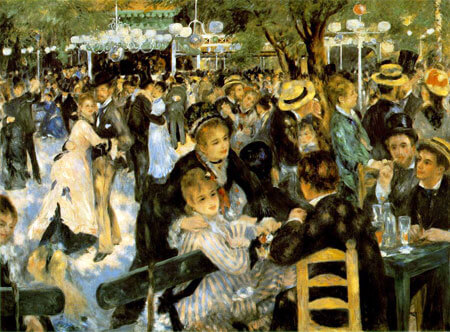
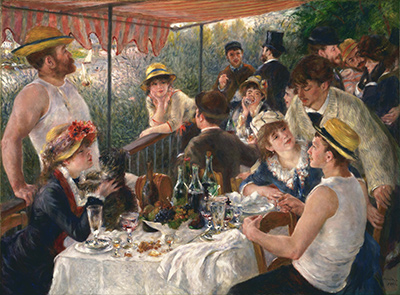
Explore a Montmartre dance, a gathering beside the Seine and the drawings behind Renoir’s paintings.
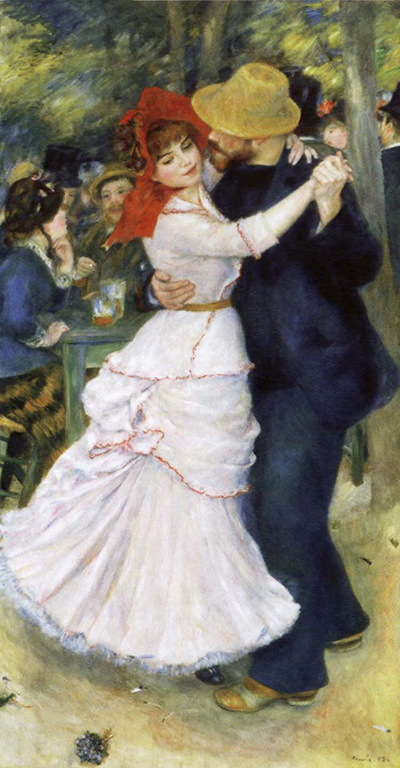
Renoir, Bal du moulin de la Galette
Dr. Beth Harris and Dr. Steven Zucker discuss Renoir’s 1876 Montmartre dance scene, its light and its crowds.
Watch on YouTubeAt a glance
- ArtistPierre-Auguste Renoir (1841–1919)
- Identifying titleBanks of the Seine, Bougival (Bords de la Seine, Bougival)
- Local route titleThe Banks of the Seine
- DateAbout 1871 in the Denver-sourced image record; older reproduction sellers give different estimates
- MediumOil on canvas in that record
- Size43 × 55 cm in that record
- Collection identificationDenver Art Museum, accession 24.2017, pending direct object-page reconfirmation
The local title drops the place name. Keeping “Bougival” in the article matters because Renoir painted many views along the Seine. Similar English labels do not make them interchangeable objects.
A road beside the water
The road begins at the lower right, wide enough to bring the viewer into the scene, and narrows toward the bend in the river. Its pale, sandy colour is a visual route through the painting. Darker patches of earth and shadow stop it from looking like a blank strip. Rather than presenting a dramatic landmark, Renoir asks us to notice how a person might move along an ordinary bank.
Several small figures punctuate the road. They are far enough away that clothing and gesture are only suggested. Their placement provides scale for the embankment and houses, but the painting does not supply names or a narrative for them. A figure nearer the water helps connect the path with the activity on the river. Looking from one person to another makes the bank feel inhabited without turning the work into a crowd scene.
The buildings at right run diagonally toward the distance. Their pale faces pick up some of the road’s light, while the near tree forms a much darker vertical edge. This contrast gives the composition a firm frame. It also allows the further houses to become smaller and less distinct without a hard architectural outline at every point.
Boats and a quiet river
The river occupies the left side of the view. At the shore, dark narrow shapes suggest boats resting or moving slowly beside the bank. Other marks farther back can be read as craft on the water. Renoir gives them just enough form to make the river a used place, not an empty band of colour. The exact activity of each distant figure or boat cannot be determined from the inherited small image.
Water and sky share a restrained range of grey, blue and pale violet. A light seam along the opposite bank separates them. The river does not glitter with the high contrast that appears in some of Renoir’s later boating pictures. Its quieter surface lets the road and town carry more of the picture’s human detail. This balance is one reason the work should be read as a particular landscape rather than as a general example of his leisure scenes.
The far bank is low and blurred. Trees rise above it at intervals, but none commands the scene like the tree on the near right. The distant bridge or crossing suggested near the centre needs a sharper source image before a precise identification can be made. The composition gives a sense of connection along and across the river without documenting every built feature.
The breadth of the sky
Much of the canvas is sky. Soft grey clouds make the upper half active even though it has few firm outlines. Its light moves down into the road and the walls of the houses. The road’s warm earth contrasts with the cooler clouds and green bank, while loose brushwork keeps the sky in motion.
The tree at the right margin breaks the sky’s width. Its crown pushes inward over the buildings, making a dark counterweight to the boats and open water at left. A smaller tree on the distant bank echoes it. Those vertical notes keep the long horizontal view from becoming merely panoramic. Renoir is measuring a river corridor by alternating open stretches and interruptions.
None of this requires treating every loose mark as a fixed object. The impression of passing weather comes from shifts in colour and edge, not from a single cloud whose exact shape can be named. The road similarly has an uneven, worked surface rather than a straight line drawn toward a vanishing point. Close looking reveals how the landscape is assembled from these small adjustments.
Bougival and Renoir’s river subjects
Bougival lies west of Paris on the Seine. The regional landscape atlas [2] groups Bougival with nearby Croissy, Carrières and Port-Marly as places painted by Renoir and other artists of his circle. The area offered river traffic, paths, bridges and leisure grounds within reach of the city. This setting helps explain Renoir’s repeated interest in the river without making every Seine painting a member of a documented series.
The about 1871 date in the image record places this canvas early in Renoir’s exploration of the district. It should not be silently replaced with about 1875, a date appearing on some commercial reproductions. The accessible museum-sourced record is the stronger identifying evidence here, although Denver’s live object entry remains to be recovered for confirmation. The picture’s quiet road and lightly articulated boats are consistent with an early riverside view, but style alone cannot settle a disputed year.
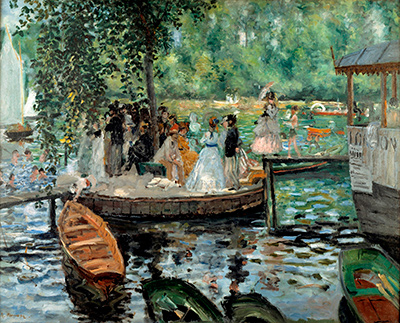
Renoir later made more populous boating and restaurant pictures around the Seine. Our page for La Grenouillère concerns an identified 1869 canvas of a different place and arrangement; The Skiff presents yet another river subject. Such links offer a route through his interests, not evidence that the paintings were conceived as one formal series.
One canvas, several tempting names
The old text attached to this route claimed that “The Banks of the Seine” was a series made from 1874 to 1880, then listed views at Champrosay, Asnières and Argenteuil as its parts. The page’s own image does not establish that construction. The safer identification is the Bougival canvas recorded with the Denver accession. Other riverbank paintings deserve their own object checks, dates and collection histories.
Similar names can even cross artists. The Nelson-Atkins Museum’s Waterworks of the Marly Machine at Bougival [3] is a Camille Pissarro painting dated 1871 and has circulated under a “Banks of the Seine” title. It is not Renoir’s road-and-houses view. The title and year alone would make a poor match; the image and artist record are decisive.
The Denver-linked Commons file records an accession number, medium and dimensions, but it does not provide a full, current provenance history. This article therefore makes no claim about who owned the canvas before its museum entry or whether it is on display today. Those details need the museum’s current catalogue or an equivalent collection record. A documented gap is preferable to importing a history from a different Seine picture.
Looking again
Start at the road and follow it past the nearest building. Pause where the small people meet the riverbank, then look across the boats toward the far side. Finally, let the sky return your eye to the tree at right. Renoir has given us several ways to traverse the scene; none depends on a heroic centre.
The Banks of the Seine works best when its familiar title leads to this particular Bougival view. The path, houses, boats and passing cloud share one stretch of river. Their modest scale is the painting’s subject: daily life held within a broad, changing landscape.
Renoir artworks directory
Questions about The Banks of the Seine
No formal series is established by the cited object evidence. The image on this route matches one canvas identified as Banks of the Seine, Bougival. Renoir made other Seine views, but they should be treated as separate works.
The Denver Art Museum sourced image file assigns it accession 24.2017. The linked museum object page currently does not resolve, so present display and the current catalogue wording need direct confirmation.
The museum-sourced file says about 1871. Some reproduction sellers give about 1875; this article uses the former while recording the need for a current owner catalogue check.
The same file gives 43 × 55 cm for an oil on canvas. Those dimensions belong to the identified Bougival view, not to every Renoir painting titled for the Seine.
No names are established in the cited material. At this scale they serve chiefly to show the size and use of the riverside path.
Discussion
What do you notice when you return to Renoir’s Bougival riverbank?
How does the pale road direct your eye along the Seine?
Reader Insights
How does the pale road direct your eye along the Seine?
The Denver sourced image identifies this oil as about 1871, 43 × 55 cm.
How do the small figures change the scale of the road and river?
Join the Conversation
Share a close observation or a source-backed question about Renoir’s Bougival landscape.
References
- Denver Art Museum sourced image file, Banks of the Seine, Bougival: exact image match, c. 1871 date, oil medium, dimensions and accession 24.2017. Its old Denver object link now returns an error; direct catalogue confirmation remains open View source.
- Yvelines regional landscape atlas, Boucle de Montesson: geographic and Impressionist context for Bougival and neighbouring Seine sites View source.
- Nelson-Atkins Museum of Art, Waterworks of the Marly Machine at Bougival: distinct Pissarro painting used to guard against title confusion View source.
- Lead image credit. Image: Auguste Renoir, Banks of the Seine, Bougival, about 1871. Denver Art Museum image via Wikimedia Commons, CC BY-SA 4.0; resized and converted to JPEG. This web version is shared under the same licence.