by Tom Gurney
Tom Gurney BSc (Hons) is an art history expert with over 20 years experience
Published on June 19, 2020 / Updated on October 2, 2026
Email: tomgurney1@gmail.com / Phone: +44 7429 011000
Renoir’s Bather with Long Hair turns her face to the right while drawing a white cloth across her body. Her other arm reaches toward garments on a rock, and long golden-brown hair falls over her shoulder. The setting suggests water and vegetation without identifying a specific place. The painting matches Baigneuse aux cheveux longs, dated around 1895 by the Musée de l’Orangerie in Paris. Its inventory number is RF 1963 23. The museum’s object record [1] supplies the date, dimensions, description and ownership history.
The Orangerie calls the scene deliberately timeless. Renoir does not supply a building, named river or recognizable shore to place the sitter in a particular moment. Instead, her hair, the moving foliage and the folds of cloth provide the painting’s strongest rhythms. The nude is not a documented portrait of a named individual; the museum describes a bather and her action, not a securely identified model. Musée de l’Orangerie interpretation. [1]
At a glance
- ArtistPierre-Auguste Renoir
- Museum titleBaigneuse aux cheveux longs (Bather with Long Hair)
- Datec. 1895
- Medium and sizeOil on canvas, 82 × 65 cm
- CollectionMusée de l’Orangerie, Paris, RF 1963 23
- Recorded image creditRMN-Grand Palais (Musée de l’Orangerie) for the museum’s current photograph
Watch: Pierre-Auguste Renoir
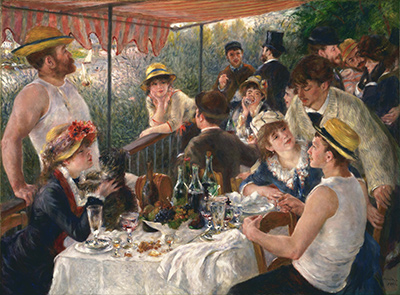
Explore a Montmartre dance, a gathering beside the Seine and the drawings behind Renoir’s paintings.
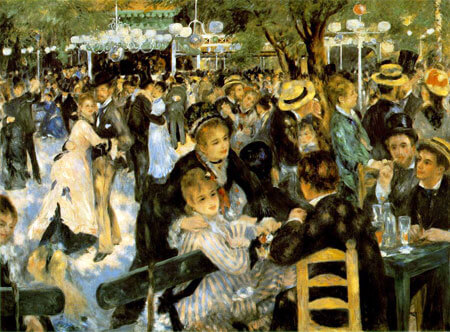
Renoir, Bal du moulin de la Galette
Dr. Beth Harris and Dr. Steven Zucker discuss Renoir’s 1876 Montmartre dance scene, its light and its crowds.
Watch on YouTubeThe measurements refer to the canvas; the Orangerie also gives a larger framed size. Display status can change, so consult the museum’s current object page before a visit. Orangerie object details. [1]
Hair, cloth and the turn of the body
The figure occupies almost the whole height of the canvas. Renoir places her head near the upper centre and lets the hair descend in two long sweeps. One falls behind her shoulder; the other crosses the front of her body and continues beside the hanging cloth. The hair’s reddish gold plays against the cooler grey, lilac and green strokes of the background.
Her left hand bunches the white drapery near her chest. The fabric drops into a deep fold and catches on the bank beneath her, creating an oblique route across the lower half of the painting. The extended right arm reaches toward a pale garment and a pink cloth lying on a large rounded rock. This gesture opens the composition outward at the right edge. It also makes the bather’s movement legible: she is pulling cloth toward herself after emerging from the water, as the Orangerie explains. Orangerie visual description. [1]
Renoir keeps the body softly modelled. Warm pink touches gather on the face, shoulder and hands, while cooler marks shape the shadowed arm and side. There is no hard outline enclosing each part. The figure still has weight and direction: the bent arm holds the drapery, the extended arm balances it, and the torso turns between those actions.
The water at the lower edge is mostly a field of blue-grey marks. Behind the sitter, green and brown areas suggest plants and earth, with few distinct leaves. The Orangerie connects the hair’s flowing movement with the slight motion of the vegetation. That relationship is visible without assigning a precise season or location. The painting creates a sheltered place that seems to shift around the comparatively steady figure. Orangerie interpretation. [1]
Renoir’s figure painting in the 1890s
The Orangerie dates the painting around 1895, well after Renoir’s earlier 1881 Blonde Bather at the Clark. Both works put a single nude beside water, but they organise the body and landscape differently. In the 1881 picture, the seated figure faces the viewer more directly and holds a cloth across her lap, with a rocky coast to her left. Here the bather turns in profile and reaches to the right, and no specific coastline can be identified. Their shared subject should not erase the separate dates, locations or objects. Orangerie entry [1]; Clark catalogue for the earlier painting. [2]
The museum describes the luminous handling of the skin as characteristic of Renoir’s mature period, sometimes called his “pearlescent” period. That term points to the way pale, warm and cool colours vibrate across the figure. It does not mean every part is painted alike. The rock, clothes and vegetation stay looser than the face and body, allowing the figure to emerge from a less defined natural space. Orangerie interpretation. [1]
There is also an artful ambiguity in the subject. The bather seems to be finishing a real action, grasping cloth after leaving water. Yet the absence of a specific setting gives that action a more general, idealized quality. Renoir asks the viewer to look at a body in motion, the hanging fabric and the changing colour around them rather than to identify a particular beach or story. The Orangerie calls this an Eden-like world outside ordinary time. That is a reading of the image, not evidence that it depicts a real place. Orangerie curatorial text. [1]
The related Barnes bather
The Orangerie explicitly compares its painting with a 1895 bather at the Barnes Foundation in Philadelphia. The two are close in pose and gesture, but the museum says the Barnes composition shows more clothing on the bank, while the woman’s hair obscures more of her facial features. Those distinctions make the pictures related versions rather than two reproductions of one canvas. Orangerie comparative note. [1]
The Barnes Foundation’s Renoir scholarly catalogue [3] also reproduces the Orangerie work while discussing its own paintings. That cross-reference is useful, but a source about the Barnes collection should not replace the Orangerie as authority for this specific object’s inventory, provenance and measurements. A similar title or pose is not enough to transfer a museum record between them.
The Orangerie notes that Renoir later explored the same action of drawing drapery toward the body in sculpture. The motif therefore continued to interest him beyond this one canvas. The painting can be understood as part of a recurring investigation of pose and movement, without claiming that any later work is a direct cast or copy of it. Orangerie curatorial text. [1]
From Durand-Ruel to the Orangerie
The museum’s provenance begins with the dealer Paul Durand-Ruel, who bought the canvas from Renoir on 18 November 1896. Oskar Schmitz acquired it in 1911. A later entry associates it with Paul Guillaume, but the Orangerie marks that step as uncertain. It then passed to Domenica Walter and was acquired in 1963 with support from the Société des Amis du Louvre. The museum records its physical arrival at the Orangerie in 1977. Orangerie provenance. [1]
That sequence explains why this painting belongs to the Jean Walter and Paul Guillaume collection at the Orangerie, while retaining a gap in certainty about Paul Guillaume’s personal ownership. A carefully recorded question mark is better than filling the gap with a confident but unsupported date or transfer. The museum’s exhibition list shows how the painting was displayed internationally before and after entering the public collection. Orangerie object history. [1]
The Orangerie’s bibliography traces the painting through the Schmitz years: Marie Dormoy reproduced it in a 1926 article about his Dresden collection; it appears as no. 49 in the 1932 Kunsthaus Zürich exhibition catalogue and as no. 54 in the 1936 Oscar Schmitz Collection catalogue. These dated, illustrated records strengthen the link to Schmitz, while the museum’s question mark over a later Paul Guillaume connection still stands. Orangerie source bibliography. [1]
Looking again
Look first at the point where the left hand gathers the drapery. Let the folds carry your eye down to the water, then follow the extended arm to the garments on the rock. Return through the long hair to the turned face. The composition keeps those routes moving across the canvas while the soft natural setting refuses to settle into a named location. Renoir makes an ordinary gesture feel sustained and expansive.
Renoir artworks directory
Questions about Bather with Long Hair
The Musée de l’Orangerie dates its canvas around 1895. Some older listings use a range such as 1895–96, but the owner’s current date is c. 1895.
It belongs to the Musée de l’Orangerie in Paris, inventory RF 1963 23. Check the museum’s current display information before visiting.
No. The Orangerie identifies a closely related Barnes painting with a similar gesture, but notes differences in the hair, clothing and framing.
The consulted museum record does not name the model. The figure is presented as a bather in an unspecified natural landscape.
Discussion
What do you notice when you return to Renoir’s Bather with Long Hair?
How do the long hair and falling white drapery carry movement through the composition?
Reader Insights
How do the long hair and falling white drapery carry movement through the composition?
The Orangerie identifies this c. 1895 canvas as RF 1963 23 and distinguishes a close Barnes version.
Which visible differences keep the Orangerie and Barnes bathers from being treated as one painting?
Join the Conversation
Share a close observation or a source-backed question about Renoir’s Bather with Long Hair.
References
- Musée de l’Orangerie, Baigneuse aux cheveux longs: primary object record, interpretation, date, measurements, inventory, provenance and comparison with the Barnes painting View source.
- Clark catalogue for the earlier painting View source.
- Barnes Foundation, Renoir in the Barnes Foundation catalogue: scholarly reproduction and discussion of the related bather motif View source.
- French Ministry of Culture, POP/Joconde record 00000089505: independent national collection record for RF 1963-23, with image-credit and use information View source.
- Wikimedia Commons exact-object reproduction: 2069 × 2616 image sourced to a 2001 Renoir book and marked Public Domain Mark; used for the enlarged local page image. The Orangerie credits RMN-Grand Palais for its current photograph View source.