by Tom Gurney
Tom Gurney BSc (Hons) is an art history expert with over 20 years experience
Published on June 19, 2020 / Updated on October 2, 2026
Email: tomgurney1@gmail.com / Phone: +44 7429 011000
A pale road curves beside dark water toward a group of white houses. A large tree rises at the right, its dark trunk carrying yellow leaves into the grey-blue sky. The inherited image matches a Gallerix listing titled Cagnes Landscape [1], which gives 1910. That is useful evidence for the circulated image and title, but it is a secondary listing without an original object catalogue or current collection record. The date is therefore attributed rather than treated as fully verified.
The picture is more animated than a simple view of houses. Small pale figures stand or walk near the road, dark shapes interrupt the water, and warm orange marks spread across bank and foliage. Renoir makes the viewer travel from the near foreground into the settlement. The place name “Cagnes” is plausible within his late landscape practice, but the image alone cannot identify the precise street, shore or viewpoint.
Contents
- The work at a glance
- Following the curve through the village
- Houses beneath the trees
- The tree and the unsettled sky
- Renoir and Cagnes
- A landscape made from colour relationships
- Looking again
Watch: Pierre-Auguste Renoir
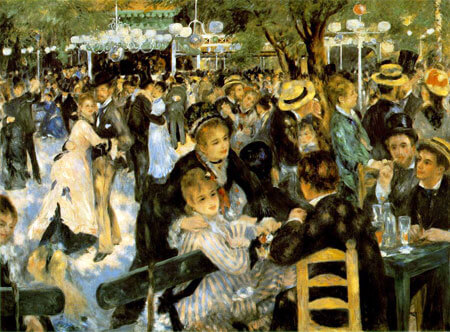
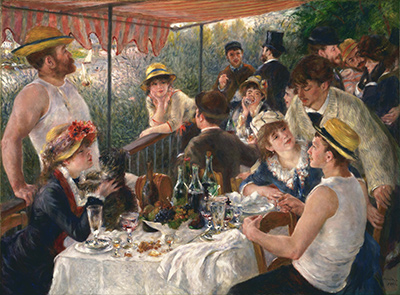
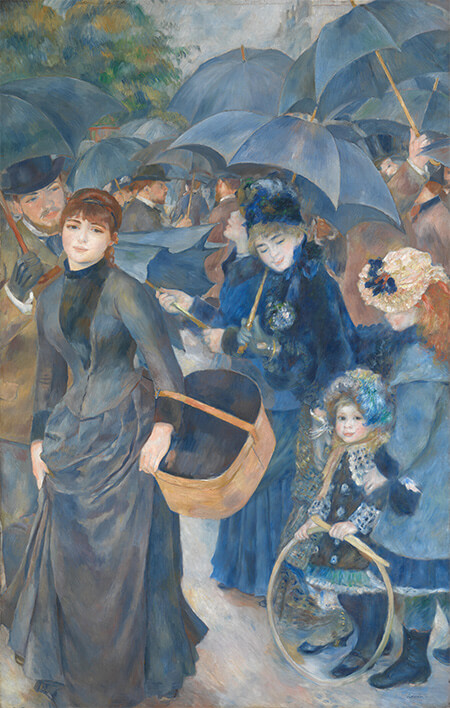
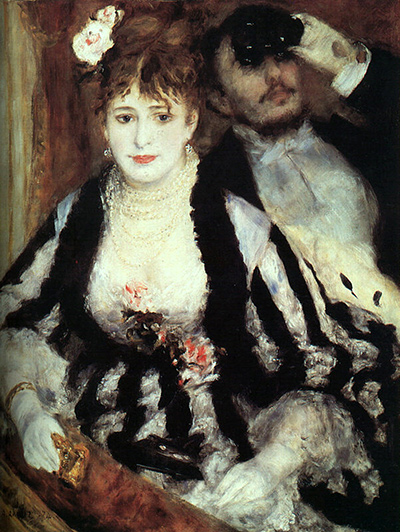
Explore a Montmartre dance, a gathering beside the Seine and the drawings behind Renoir’s paintings.
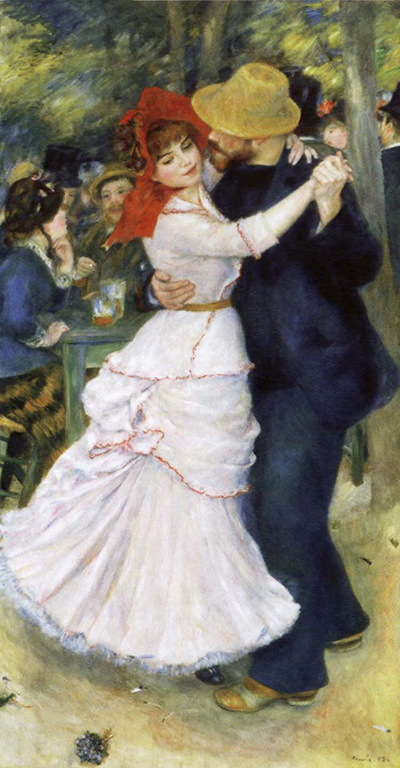
Renoir, Bal du moulin de la Galette
Dr. Beth Harris and Dr. Steven Zucker discuss Renoir’s 1876 Montmartre dance scene, its light and its crowds.
Watch on YouTubeAt a glance
- ArtistPierre-Auguste Renoir (1841–1919)
- Inherited titleCagnes Landscape
- Matching secondary listingGallerix, Cagnes Landscape, dated 1910
- Medium, size and current ownerNot independently verified for this exact canvas
- Image statusInherited 400 × 332 legacy reproduction, retained under the owner’s public-domain declaration
The Gallerix image entry [1] matches the arrangement of water, houses, winding road and large right-hand tree. Its date should be checked against an illustrated collection or catalogue raisonné record. The Barnes Foundation’s scholarly Renoir catalogue [2] documents the artist’s sustained work around Cagnes and a different circa-1910 landscape. It supplies historical context, not this image’s ownership or dimensions.
Following the curve through the village
The lower edge begins in dark water or a wet inlet. Black-green strokes are interrupted by small cream, yellow and orange patches, so the surface appears reflective without becoming a smooth mirror. A pale path starts near the lower right and bends inward, widening as it reaches a few lightly painted figures.
The road is the composition's strongest line. It leads behind a low white building with an orange roof and then toward the cluster of houses across the middle distance. It is not a measured map of a village street. Its bends give the eye a way into a scene made of quick patches of colour.
Small human forms make the view feel inhabited. One pale shape stands near the near bend; another darker figure appears farther along. The reduced local file does not allow secure descriptions of dress, identity or action. Their scale matters more than their biographies: they make the tree and houses appear large, while keeping the road from looking empty.
The left-hand water and right-hand road almost meet at the bottom. That V-shaped opening puts the viewer at the edge of the scene rather than above it. The picture invites a slow passage inward. The viewpoint may have been adjusted for composition, and no source here establishes that Renoir painted this exact arrangement outdoors in one sitting.
Houses beneath the trees
A row of pale buildings runs across the central band. The walls are mostly white or cream, with orange, pink and ochre edges. They are separate enough to suggest a village, but their roofs and windows are abbreviated. Renoir lets foliage interrupt the architecture, especially toward the right where the large tree takes over.
The houses also provide a line of light between dark foreground and clouded sky. Without their pale faces, the middle of the painting might be swallowed by the darker trees. They make the settlement a visual hinge between water and distance.
It is tempting to name a particular building or neighbourhood in Cagnes-sur-Mer. The painting does not supply a recognisable church tower, inscription or street sign. The historical town includes hillside houses and a coastal plain, but this small reproduction cannot settle where the depicted inlet or road lay. The article therefore uses the inherited and matching title while leaving the exact viewpoint open.
Look at the house nearest the centre. Warm roof colour answers the amber leaves above and the rust-coloured reflections below. Renoir repeats a small range of colours across unrelated objects. A wall is not only architecture; it helps connect sky, tree, ground and water.
The tree and the unsettled sky
The large tree anchors the right side. Its trunk is nearly black at the lower edge, and branches reach into the upper half. Yellow and ochre leaves cling to it in patches. A few long dark limbs remain visible against the sky, preventing the crown from becoming a single block of colour.
The tree balances the broad water at left. One side is vertical and dense; the other is low and broken into reflections. Between them, the road and houses become the route of movement. The composition feels crowded but not closed because the sky occupies a generous area above the settlement.
Blue, lavender and grey paint swirls across that sky. Some passages appear clouded, while others are light enough to suggest a break in weather. The small file cannot establish the exact time of day or season. Yellow leaves and muted light might invite an autumn reading, but colour in a painting is also an artistic choice.
The tree's yellow touches recur on smaller trees along the distant band. They form a rhythm from right to left. The eye can move across that rhythm and return through the houses and water, making a circuit rather than stopping at the main trunk.
Renoir and Cagnes
The Barnes Foundation catalogue [2] records that Renoir began spending winters on the Mediterranean coast from 1898 and bought Les Collettes at Cagnes in 1907. From the estate he could look toward the old town and the coast. The catalogue discusses how one of its own circa-1910 canvases arranged a shoreline view as an idealised landscape, rather than a literal snapshot. That context helps explain Renoir's interest in the region without proving the precise site of this picture.
The National Gallery of Art’s Maison de la Poste, Cagnes [3], dated 1906/07, is another documented view of pale houses within foliage. Its composition is different: buildings fill a compact grove, without this route's bending road, dark water and large right-hand tree. The NGA record is a useful comparison for subject and place, but its provenance and dimensions cannot be transferred here.
The Barnes Foundation’s Landscape with Figures, near Cagnes [4] is likewise a distinct circa-1910 oil on canvas. Its documented foreground trees and figures frame a coastal vista. The inherited page’s houses beside a bending road give it a different structure. Even if both were made around the same time, they are not interchangeable object records.
Another image circulated as Cagnes Landscape [5] is catalogued on Wikimedia Commons with Crocker Art Museum metadata, accession 2004.56. Its image shows a dense grove of trees, without this page’s waterside buildings or winding road. That file’s stated 27 × 35 cm size and collection attribution belong to the grove image, not to the composition discussed here. The comparison is a warning about shared titles, not independent proof of this page’s canvas history.
Renoir's late landscapes can invite a broad label such as “Cagnes,” “Cagnes landscape” or “landscape near Cagnes.” These titles recur across separate canvases. The combination of water at lower left, white houses in the middle, curving path and tall right-hand tree is a safer image fingerprint than the place name alone.
A landscape made from colour relationships
The foreground is painted in short, broken marks. Dark strokes hold the water together; orange and cream touches appear to float over it. The road is also broken rather than smoothly outlined. Its light colour makes it legible even as its exact edges dissolve into the bank.
The houses are more solid but no more rigid. White surfaces accept pink and yellow shadows. The warm colours of rooftops and trees move through the whole picture, including reflections that seem almost abstract at the bottom. The sky contributes cool blue and violet, which return in the water and shaded road.
This distribution prevents a simple division between “nature” and “village.” Renoir paints buildings, people and plants with related marks. The small figures are nearly absorbed into the route they travel. The scene's activity is conveyed by brushwork and direction more than by a sharply described event.
At the inherited resolution, the body of water could be a stream, inlet or harbour edge. Several small dark forms look boat-like, but their outlines are too reduced to name confidently. A high-resolution object image may clarify them. Until then, the article uses the broad word “water” and treats any harbour reading as an interpretation of the image.
Looking again
Start at the dark foreground water, cross to the bright path, then follow it toward the houses. From there move up the large tree into the sky and back across the yellow crowns. This path reveals the painting's balance: horizontal settlement and water are held by one strong vertical tree.
The circulated 1910 date fits Renoir's documented Cagnes years, but fit is not proof. An illustrated primary record has not yet confirmed the exact canvas, medium, dimensions, date or present owner. Several Renoir works share nearly the same landscape title, so those details should remain qualified.
Renoir artworks directory
Questions about Cagnes Landscape
A curving road, small figures, white houses, water and a large tree beneath a blue-grey sky.
The matching Gallerix listing gives 1910. An illustrated original-object record is still needed to verify that date for this exact picture.
The current owner or collection has not been independently confirmed.
No. The Barnes Foundation documents a different coastal composition with foreground figures and trees; its catalogue details should not be attached to this route.
Not from the available image and sources. The title names the wider area, while the depicted road, houses and water have not been tied to a precise location.
Discussion
Where does the curving road take your eye?
How do the trees frame the sunlit houses?
Reader Insights
How do the trees frame the sunlit houses?
The matching 1910 listing remains a secondary date until an object record confirms it.
What do the small figures add to the road?
Join the Conversation
Share a close observation or a source-backed question about this Cagnes landscape.
References
- Gallerix, Cagnes Landscape: matching secondary image and circulated 1910 date; no original-object record established View source.
- Barnes Foundation, Renoir in the Barnes Foundation, catalogue 54: Cagnes context and distinct documented landscape View source.
- National Gallery of Art, Maison de la Poste, Cagnes: distinct documented Cagnes houses image View source.
- Barnes Foundation, Landscape with Figures, near Cagnes: distinct collection object View source.
- Wikimedia Commons, Cagnes Landscape file: a visibly different grove composition with Crocker Art Museum metadata; used only to prevent title-based misidentification View source.
Image: inherited 400 × 332 legacy reproduction, visually matched to the cited Gallerix composition and retained under the owner’s public-domain declaration.