


 by Tom Gurney
Tom Gurney BSc (Hons) is an art history expert with over 20 years experience
Published on June 19, 2020 / Updated on May 18, 2026
Email: tomgurney1@gmail.com / Phone: +44 7429 011000
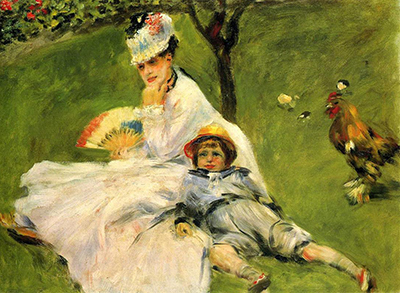
Camille Monet and her Son Jean in the Garden at Argenteuil by Pierre-Auguste Renoir
Camille Monet and her Son Jean in the Garden at Argenteuil is one of Pierre-Auguste Renoir's most revealing paintings from the early years of Impressionism. Painted in 1874, it shows Camille Monet, the wife of Claude Monet, seated in the garden at Argenteuil with her young son Jean nearby.
At first glance, the painting appears to be a relaxed domestic scene: a mother and child in a garden on a summer day. Yet it also records one of the most fascinating moments in Impressionist history, when Renoir, Monet and Édouard Manet were working in close contact at Argenteuil.
The painting is especially valuable because it connects Renoir's interest in figures, family life and outdoor light with Monet's own Argenteuil garden subjects. It also forms a natural companion to Manet's Monet Family in their Garden at Argenteuil and Claude Monet's Springtime (The Reader).
- Artist Pierre-Auguste Renoir
- Title Camille Monet and her Son Jean in the Garden at Argenteuil
- Date 1874
- Medium Oil on canvas
- Movement Impressionism
- Subjects Camille Monet and Jean Monet, Argenteuil, France
- Current Location National Gallery of Art, Washington D.C.
Why This Painting Matters
Camille Monet and her Son Jean in the Garden at Argenteuil matters because it captures the private world of the Monet family through the eyes of one of Claude Monet's closest Impressionist colleagues. Renoir was not simply painting a pleasant family scene; he was recording the atmosphere of the garden, the warmth of friendship and the shared outdoor working methods of the Impressionists.
The painting also shows why Argenteuil was such an important place for early Impressionism. Monet had moved there in late 1871, and the town soon became a gathering point for artists interested in modern life, river views, gardens and changing light. Renoir, Manet and other painters visited Monet there, creating works that now help us understand the social and artistic networks behind the movement.
Unlike Monet's paintings of bridges, boats and the Seine, Renoir's painting focuses on family life. Camille and Jean are placed within a soft, flickering garden environment, where sunlight, foliage and colour are as important as the figures themselves.
Who Are Camille Monet and Jean Monet?
Camille Monet, born Camille Doncieux, was Claude Monet's first wife and one of the most important models in early Impressionism. She appears in several major paintings by Monet, including portraits, figure paintings and garden scenes. Her presence in this Renoir painting helps connect it directly to Monet's personal life at Argenteuil.
Jean Monet was the eldest son of Claude and Camille Monet. In Renoir's painting, he appears as part of the relaxed domestic setting, helping to give the image its intimate and informal quality. Rather than presenting Camille and Jean as formal sitters, Renoir shows them absorbed into the life of the garden.
This makes the painting especially useful for understanding the human side of Impressionism. The movement was not only about landscapes, light and broken brushwork; it was also about modern leisure, family relationships and everyday experience.
The Garden at Argenteuil
Argenteuil was one of the most important locations in the development of Impressionism. During the 1870s, Claude Monet painted the Seine, bridges, regattas, railway structures, gardens and domestic scenes there. Renoir's painting belongs to this same world of outdoor observation and modern suburban life.
The garden setting is central to the painting's effect. The foliage creates a screen of broken colour around Camille and Jean, while the outdoor light softens the figures and blends them into their surroundings. This was exactly the kind of visual problem that interested the Impressionists: how to paint people not as isolated forms, but as part of a changing atmosphere.
The subject also anticipates Monet's later fascination with gardens. The cultivated spaces at Argenteuil helped prepare the way for his later gardens at Vétheuil and, most famously, Giverny.
Renoir, Manet and Monet Working Together
One of the most memorable stories connected with this painting concerns a day in Monet's garden at Argenteuil when Édouard Manet was painting the Monet family. Renoir arrived and, attracted by the scene, began painting the same subject nearby.
The result was a fascinating pair of related works: Renoir's Camille Monet and her Son Jean in the Garden at Argenteuil and Manet's The Monet Family in their Garden at Argenteuil. Both show the Monet family in the same domestic setting, but the mood and handling are noticeably different.
Manet's painting feels more structured and deliberate. Renoir's version is softer, more immediate and more dissolved into light. His brushwork gives the impression of a scene quickly captured, with figures, foliage and shadows merging into a single outdoor sensation.
This comparison is one of the most useful ways to understand the different personalities within Impressionism. Manet remained more attached to structure and clarity, while Renoir pursued a warmer, more fluid treatment of people and light.
Compare Manet's Version of the Scene
Édouard Manet also painted the Monet family in the garden at Argenteuil. Comparing Manet's version with Renoir's reveals two very different approaches to the same Impressionist subject.Analysis of the Painting
Renoir's painting is built around softness, colour and domestic intimacy. Camille Monet is seated in the garden, while Jean appears nearby, helping to create a relaxed family scene rather than a formal portrait. The figures are not separated sharply from the background; instead, they are woven into the foliage and light around them.
The brushwork is central to the painting's effect. Renoir uses loose, broken strokes to suggest leaves, flowers, shadows and fabric. This gives the scene a sense of immediacy, as though the artist is capturing a passing moment rather than constructing a carefully finished academic composition.
Colour is equally important. The greens of the garden, the lighter tones of clothing and the small touches of brighter colour all work together to create a warm outdoor atmosphere. Renoir was especially skilled at making figures feel alive within their surroundings, and this painting shows that quality clearly.
The image is therefore both a family scene and a study of Impressionist light. Camille and Jean provide the subject, but the real visual interest lies in the relationship between people, foliage, sunlight and movement.
Renoir's Impressionist Style
Renoir was one of the central figures in the development of Impressionism, but his interests differed from Monet's in important ways. Monet often concentrated on landscape, water, reflections and atmospheric change. Renoir, by contrast, was especially drawn to people: women, children, families, dancers, social gatherings and scenes of leisure.
In this painting, Renoir combines both interests. The work is clearly about Camille and Jean, but it is also about how figures appear outdoors under filtered sunlight. The garden setting allowed him to soften outlines and use colour to suggest the way light moves across forms.
This human element helped distinguish Renoir within the Impressionist group. His paintings often show modern life as sociable, intimate and sensuous, turning everyday moments into scenes of warmth and visual pleasure.
Camille Monet as an Impressionist Model
Camille Monet was not only Claude Monet's wife; she was also one of the most recognisable women in early Impressionist painting. She appeared in works by Monet, Renoir and Manet, making her a key figure in the visual history of the movement.
In Monet's own paintings, Camille often appears in garden settings or outdoor figure compositions. In Renoir's version, she becomes part of a wider Impressionist network: a shared subject through which different artists could explore light, family life and modern informality.
This makes the painting a valuable bridge between Renoir's art and Monet's world. It is a Renoir painting, but its subject belongs deeply to the Monet cluster of Argenteuil, Camille, Jean and the garden.
See Monet's Own Garden Paintings from Argenteuil
Renoir's portrait of Camille and Jean connects closely with Claude Monet's own domestic scenes from Argenteuil, including Springtime (The Reader), where Camille Monet sits beneath lilac trees in the family garden. Together, these works reveal how gardens, family life and outdoor painting shaped early Impressionism.How This Painting Connects to Monet's Argenteuil Period
Monet's years at Argenteuil were among the most productive of his career. He painted river scenes, railway bridges, regattas, snow scenes, gardens, houses and family subjects. Renoir's painting belongs to this wider visual world, even though it was created by another artist.
The importance of Argenteuil lies in its mixture of nature and modernity. It was close enough to Paris to feel connected to the modern city, yet open enough to provide gardens, river views and suburban leisure. This combination made it ideal for the Impressionists.
Renoir's painting of Camille and Jean helps complete the picture of Argenteuil. Monet's own works show the river, bridges and garden from his perspective, while Renoir shows the family life behind those paintings.
Related Monet and Argenteuil Paintings
This painting fits naturally into a wider group of Impressionist works connected with Monet's garden and family life at Argenteuil. Readers may also enjoy the following pages:
- Springtime (The Reader) by Claude Monet
- The Monet Family in their Garden at Argenteuil by Édouard Manet
- The Artist's House at Argenteuil by Claude Monet
- Camille Monet and a Child in the Artist's Garden by Claude Monet
- Monet in Argenteuil
- Monet's Studio Boat
Why Argenteuil Was Important to Impressionism
Argenteuil became one of the central locations of early Impressionism because it offered artists a wide range of modern subjects. The town had river views, railway bridges, leisure boating, gardens, suburban streets and changing light. It was close to Paris, but visually different enough to offer a new kind of modern landscape.
Monet lived there from 1871 to 1878, and several fellow artists visited him during this period. Renoir and Manet both painted in and around Monet's garden, while Monet continued to develop his own language of light, colour and outdoor observation.
Renoir's painting of Camille and Jean therefore belongs to one of the key artistic environments of the 1870s. It is not just a family scene, but part of the wider story of how Impressionism emerged through friendship, collaboration and shared observation.