by Tom Gurney
Tom Gurney BSc (Hons) is an art history expert with over 20 years experience
Published on June 19, 2020 / Updated on October 2, 2026
Email: tomgurney1@gmail.com / Phone: +44 7429 011000
Alfred Sisley sits in a dark suit, a broad white cravat bright against his waistcoat. One hand rests on the chair arm; the other slips into his trouser pocket. Renoir gives him a direct, steady gaze and a composed place in the picture. This is the 1864 portrait of Sisley in the Emil Bührle Collection, now on long-term loan to the Kunsthaus Zürich. It is a different painting from Renoir’s later, much looser portrait of Alfred Sisley in Chicago. Kunsthaus Zürich object record [1]; Art Institute of Chicago scholarly catalogue. [2]
The distinction matters because both pictures are often labelled simply Alfred Sisley. Their chairs, dates, sizes and owners are different. The Bührle canvas shows a young painter as the son of a prosperous family, before the financial collapse that later changed his circumstances. The Chicago canvas, made about twelve years later, places him astride the back of a bamboo-style chair. The two portraits let us see Renoir changing the conventions of a friend’s likeness over the first decade of his career. Art Institute catalogue, “Renoir and Sisley”. [2]
At a glance
- ArtistPierre-Auguste Renoir
- SitterAlfred Sisley (1839–1899), painter
- Date1864, as catalogued by the Kunsthaus Zürich
- Medium and sizeOil on canvas, 81 × 65 cm
- CollectionEmil Bührle Collection, BU 0086, long-term loan to Kunsthaus Zürich
- Catalogue raisonnéDauberville 525
Watch: Pierre-Auguste Renoir
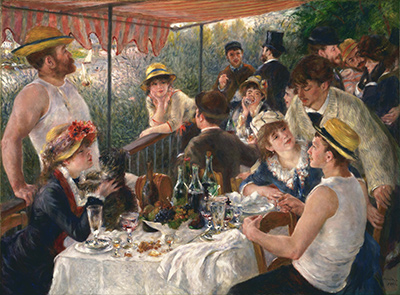
Explore a Montmartre dance, a gathering beside the Seine and the drawings behind Renoir’s paintings.
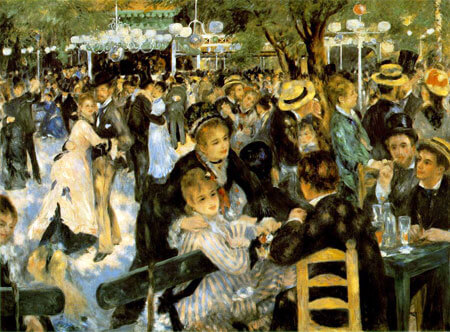
Renoir, Bal du moulin de la Galette
Dr. Beth Harris and Dr. Steven Zucker discuss Renoir’s 1876 Montmartre dance scene, its light and its crowds.
Watch on YouTubeThe Kunsthaus’s online record also lists the work as on display. Gallery positions can change; the museum’s current record is the place to check before a visit. Its inventory code is useful when comparing reproductions and older titles, particularly because another Renoir portrait carries the same sitter’s name. Kunsthaus Zürich collection record. [1]
A formal likeness made among friends
Renoir and Sisley met in Charles Gleyre’s Paris studio in 1862, where Claude Monet was also part of their circle. They were young painters sharing an interest in new approaches to landscape and figure painting. Yet Renoir did not present Sisley as a painter outdoors, at an easel or surrounded by brushes. He made a seated portrait that a well-to-do family could recognise as a serious likeness. The Art Institute of Chicago describes Renoir’s early portraits of Alfred and his father William Sisley as commissions made during the family’s prosperous years. Art Institute of Chicago scholarly catalogue. [2]
The Bührle record gives an unusually personal clue about this picture’s first destination. Its provenance lists Alfred Sisley himself as the owner from 1864 until his death in 1899 and describes the painting as a commission. That does not tell us how often he displayed it or how he felt about the result. It does establish a much more direct connection between sitter and object than a portrait that merely passed through the art market later. Kunsthaus Zürich, provenance. [1]
The sitter’s dress carries much of the picture’s formality. A black coat spreads across the lower half of the canvas; a grey waistcoat gives the torso its shape; white cuffs and a cravat bring light to the centre. Sisley’s hair and beard are carefully arranged. The open jacket and hand in pocket relax the pose a little, but the controlled face and direct gaze keep the encounter measured. Renoir makes his fellow painter look like a particular young man in a social setting, rather than illustrating an abstract idea of the artist as a rebel.
How Renoir builds the figure
The painting is nearly filled by Sisley’s body. His left arm extends toward the lower corner, while the other turns inward to the pocket. Those diagonals lead back to the pale triangle of his cravat and the face above it. A strip of patterned chair upholstery appears at the right edge; most of the support is hidden behind the sitter. The chair acts as evidence of a seated pose without competing with him as an object in its own right.
Renoir places the head against a dark grey-green background. The boundary is clear enough to keep the hair visible, but the right shoulder almost merges with the shadow beside it. Small warmer passages at the left and in the upholstery prevent the setting from feeling completely flat. The picture’s richest shifts of light occur in the face, cravat and hands. These are visible choices in the reproduction; they do not by themselves prove where the sitting took place or what Renoir was thinking as he worked.
The surface deserves a close look. Fine lines of age and paint texture cross the dark background and the lighter face. Around the beard, brown and gold tones soften the edge between skin and jacket. The hands receive less detail than the face: the visible hand rests heavily at the left, and the other is mostly concealed. That unequal attention makes the eyes and facial expression the most sustained part of the encounter. It is tempting to read a private mood in the gaze, but the painting gives no document from Sisley explaining one.
Two portraits, two moments in Renoir’s art
Renoir’s Chicago Alfred Sisley is dated 1876 by the Art Institute and was shown at the 1877 Impressionist exhibition. There Sisley faces the back of a bamboo-style chair and props his head on one hand. Bright, short strokes cross his beard, clothes and setting. In the Bührle painting the pose is more settled, the coat forms a broad dark mass and the face is modelled with smoother transitions. The difference is visible without treating one picture as merely a rehearsal for the other. Each portrait answered a different moment and purpose. Art Institute catalogue and technical report. [2]
The comparison can also guard against a common mistake. Monet’s much later recollection of Renoir painting Sisley astride a chair at Argenteuil belongs to the Chicago portrait, according to the Art Institute’s discussion. It cannot be used as evidence that this 1864 portrait was painted in Monet’s house. The Bührle canvas belongs to the artists’ earlier acquaintance, only two years after their meeting in Gleyre’s studio. Art Institute scholarly catalogue. [2]
Renoir painted William Sisley, Alfred’s father, in the same early period. The Art Institute places these two commissioned likenesses together when describing Renoir’s conventional early portrait practice. William’s portrait appeared at the Salon of 1865, an opportunity for Renoir to demonstrate his skill to an official Paris audience. Alfred’s Bührle portrait should not be assigned that Salon history merely because the pictures are related. They are separate canvases with separate documented records. Art Institute catalogue. [2]
The painting’s route to Zürich
The Kunsthaus provenance begins with Renoir and Alfred Sisley. After Alfred’s death, the canvas passed to his daughter Jeanne Sisley. The record then places it with collector Henry Lapauze by 1912 and at least until 1917. It later belonged to Marie-Paule Pomaret, Lapauze’s widow. The catalogue marks some intervals in that chain as uncertain; the word “by” matters where an exact transfer date is not documented. Kunsthaus Zürich, provenance. [1]
In June 1955 dealer César de Hauke acquired the painting, and Emil Georg Bührle bought it the following month. The Kunsthaus record gives the date of payment as 28 July 1955 and records the price as 330,000 Swiss francs. After Bührle’s death, the painting entered the foundation collection in 1960. It has been on loan to the Kunsthaus Zürich since 2021. The museum says its provenance research for the object is continuing and that new findings will be added to the record. That statement should be read as an open research note, not as proof of a particular claim about any earlier transfer. Kunsthaus Zürich, provenance and research status. [1]
Looking again
Begin with Sisley’s eyes, then follow the white cravat into the grey waistcoat. The quiet dark coat occupies far more space than the face, but its sleeves lead outward to a hand resting on the chair and another disappearing into a pocket. The narrow flash of upholstery tells us how Renoir seated him. For a second look, compare the later Chicago portrait: the younger man’s composed gaze gives way to a pose that feels deliberately informal. The two paintings record different choices Renoir made while picturing the same friend.
Renoir artworks directory
Questions about Renoir’s early portrait of Alfred Sisley
The Kunsthaus Zürich dates it to 1864. Some older and secondary image captions give a later year; the owner’s current object record and the Art Institute’s comparison with the 1876 canvas support using 1864 for this specific painting.
It belongs to the Emil Bührle Collection and is on long-term loan to the Kunsthaus Zürich, inventory BU 0086. Check the museum’s current record for display information.
No. The bamboo-chair portrait is Renoir’s 1876 canvas in the Art Institute of Chicago, accession 1933.453. This earlier portrait has a broad white cravat, dark suit and a mostly hidden upholstered chair.
The Kunsthaus provenance lists Alfred Sisley as owner from its creation in 1864 until his death in 1899, then records its passage to his daughter Jeanne.
Discussion
What do you notice when you return to Renoir’s 1864 portrait of Alfred Sisley?
How do the cravat, dark coat and partly hidden chair organise this early portrait?
Reader Insights
How do the cravat, dark coat and partly hidden chair organise this early portrait?
Kunsthaus Zürich dates its Bührle Collection canvas to 1864 and records Sisley as its first owner.
What changes when you compare this formal pose with Renoir’s 1876 Sisley portrait in Chicago?
Join the Conversation
Share a close observation or a source-backed question about Renoir’s 1864 portrait of Alfred Sisley.
References
- Kunsthaus Zürich, Alfred Sisley (BU 0086): owner title, date, dimensions, catalogue reference, collection status and object-specific provenance View source.
- Art Institute of Chicago, scholarly catalogue for Renoir’s 1876 Alfred Sisley: research on Renoir’s earlier Sisley family portraits and the distinction between the 1864 and 1876 canvases View source.
- Emil Bührle Collection, Alfred Sisley: the owner collection’s object entry confirms the 1864 date, oil medium, 81 × 65 cm size, Dauberville 525, and documented ownership through its 1960 foundation transfer View source.