by Tom Gurney
Tom Gurney BSc (Hons) is an art history expert with over 20 years experience
Published on June 19, 2020 / Updated on October 2, 2026
Email: tomgurney1@gmail.com / Phone: +44 7429 011000
Renoir looks down on the Pont Neuf from above. People walk in both directions, carriages work through the crowd, and the Seine opens beside the bridge. The sky takes almost half the canvas, bathing buildings, paving and figures in a clear light. This is Pont Neuf, Paris, signed and dated 1872, now in the National Gallery of Art, Washington. The painting offers a view of ordinary movement through the city shortly after France’s war and civil conflict of 1870–71. National Gallery of Art object record. [1]
The picture is often recalled through a story told later by Renoir’s younger brother Edmond: he helped the artist by briefly engaging passers-by while Renoir painted from a café room overlooking the bridge. The anecdote makes the scene vivid, but the museum treats the claim of a single day’s execution as conditional. It draws attention to how carefully the permanent buildings and the whole composition are organised. The work gives us an impression of a passing moment, made with more thought than the story alone can show. National Gallery of Art account of Edmond Renoir’s recollection. [1]
At a glance
- ArtistPierre-Auguste Renoir
- Date1872, signed and dated on the canvas
- MediumOil on canvas
- Dimensions75.3 × 93.7 cm
- CollectionNational Gallery of Art, Washington, 1970.17.58; Ailsa Mellon Bruce Collection
- ViewThe Pont Neuf and adjoining riverfront in Paris, seen from an elevated position
Watch: Pierre-Auguste Renoir
Explore a Montmartre dance, a gathering beside the Seine and the drawings behind Renoir’s paintings.
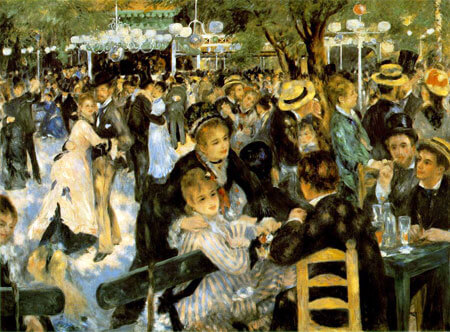
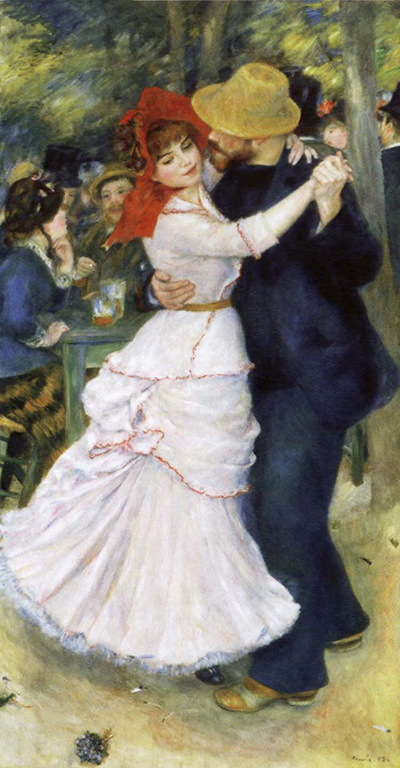
Renoir, Bal du moulin de la Galette
Dr. Beth Harris and Dr. Steven Zucker discuss Renoir’s 1876 Montmartre dance scene, its light and its crowds.
Watch on YouTubeLooking down on the oldest bridge
The roadway and pavements widen towards the bottom of the canvas, drawing the viewer into the scene. A row of dark lamps marks the bridge, while the parapet cuts across the right side. The river is a contrasting band of deep blue. Across it, high buildings and chimneys form a dense horizon below the clouded sky. The National Gallery’s visual description identifies the bridge’s white stone, the lamps, carriages, parasols and tricolour near the water. These details locate the picture in a recognisable Paris without turning it into an architectural survey. National Gallery of Art visual description. [1]
The painting is full of people but has no single protagonist. Some figures approach us; others cross away from us or pause at the river wall. Renoir varies their scale and definition, keeping nearby gestures readable while dissolving more distant pedestrians into small dark marks. The result is a city that feels occupied rather than posed. Even the horse-drawn vehicles are woven through the pedestrians instead of becoming a separate spectacle.
It would be easy to call this a painting of “the modern city” and leave it there. Its effect is more specific. The elevated viewpoint lets us see the bridge as a route: people move between the two banks and between foreground and distance. The river runs at right angles to that movement. Sky, stone and water therefore divide the canvas into broad calm areas, while the human traffic gives those areas changing scale. This is one reason the scene remains legible despite its many figures.
Sunlight as a way of organising the crowd
The National Gallery emphasises Renoir’s treatment of midday light. Strong sunlight lifts the bridge, softens incidental detail and intensifies the blue of the sky and river. White, pale yellow and blue passages connect the paving, clouds and façades. The small figures stand out partly because they interrupt those larger bright surfaces. The work is a landscape and a record of urban life at once. National Gallery of Art painting analysis. [1]
Notice how little of a face Renoir needs to describe. A hat, a dress or a dark coat can identify a person’s place in the crowd. Short touches of colour do the work of clothing and movement; the people seem individually present even when they cannot be named. That economy is different from the close modelling of a formal portrait. It suits a view taken from some distance above a public space.
The foreground is also not evenly sharp. Edges of figures, paving and parapet mingle where the sun is brightest. In the river, cooler, denser blues make the space feel deeper. The artist’s use of colour gives a route for the eye: from the shaded figures at the bottom, along the bridge, across to the water and back to the pale skyline. Renoir creates breadth without making every window or passer-by equally detailed.
Edmond Renoir’s story—and its limits
The National Gallery records Edmond Renoir’s later account that his brother gained permission to use an upper room of a café for a day. According to Edmond, he occasionally delayed walkers on the bridge so the painter could capture their appearance. He also claimed to appear twice, with a walking stick and straw hat. The museum presents this as Edmond’s recollection, not a contemporaneous record of each moment of painting. National Gallery of Art account. [1]
The story helps explain the unusual vantage and the quick-looking figures. It cannot prove that every stroke on the canvas was made in those hours. The National Gallery suggests that the permanent architectural features may have been prepared beforehand. The careful perspective and crowded arrangement support that caution. A useful way to read the painting is to hold both ideas: Renoir may have worked directly from a busy city view, and the final image is a designed composition.
Nor can we identify a particular foreground figure as Edmond merely by looking. The anecdote gives a claim about his presence, and the museum notes two supposed appearances, but the small painted people have no name tags. The narrative should open up the painting, rather than make uncertain identifications sound certain.
Paris after 1870–71
The year on the canvas matters. France had suffered defeat in the Franco-Prussian War, followed by the siege of Paris and the violence around the Paris Commune. The National Gallery reads the 1872 bridge as an image of civic life resuming: a range of people move across a historic crossing in the heart of the city. That is the museum’s contextual interpretation, supported by the date and subject, not a message written into every figure. National Gallery of Art historical reading [1]; National Gallery of Art, France and the 1874 exhibition. [2]
The Pont Neuf is Paris’s oldest surviving bridge despite its name, “New Bridge.” Renoir paints it in use, not as a deserted monument. The tricolour at the river’s edge and the flow of people invite a civic reading, but the scene’s power also comes from the plain fact of many different journeys sharing one passage. A viewer need not recognise every building to understand the bridge as a working part of a recovering city.
This is an early painting in relation to Renoir’s better-known group scenes and portraits of the later 1870s. It already shows his interest in many people held together by colour and light. The setting is a public crossing rather than the social leisure of Dance at Le Moulin de la Galette, yet both pictures ask how individual figures can remain alive within a crowded whole.
Sale and later ownership
The National Gallery’s provenance begins with Renoir’s own Paris sale of 24 March 1875, where the picture was no. 42. The dealer Paul Durand-Ruel bought it and later sold it to Nicolas Auguste Hazard. After Hazard’s 1919 sale and later changes of hands, Ailsa Mellon Bruce purchased the painting in December 1966. Her 1970 bequest brought it to the National Gallery. The museum’s record distinguishes documented owners from details that are less firm within the longer twentieth-century chain. National Gallery of Art provenance. [1]
Later exhibitions have used the canvas to tell different stories: Renoir’s art, Impressionist landscapes and views of Paris. It appeared in the 2007–08 Renoir landscapes exhibition under the shorter title The Pont Neuf. That name and the current Pont Neuf, Paris refer to the same Washington picture, accession 1970.17.58. The museum’s current object page is the best source for display information and its public-domain image. National Gallery of Art exhibition history and media notice. [1]
Looking again
Begin with the bright bridge deck, then follow the lamps towards the far bank. Return through the pedestrians: a dark coat or parasol is enough to make a body visible. Finally step back and notice how much room Renoir has given the sky. The city’s movement occupies only part of the canvas, but the generous light gives that movement its rhythm. The painting makes a shared urban route feel like a moment you could have passed through.
Renoir artworks directory
Questions about Pont Neuf, Paris
The canvas is signed and dated 1872. It shows the Paris bridge and riverfront in the period after the Franco-Prussian War and the Paris Commune.
His brother Edmond later described a day of painting from an upper café room. The National Gallery treats the one-day account conditionally and points to signs of careful preparation in the architecture and arrangement.
Edmond later claimed that he appeared twice. The individual figures are too small and loosely described to establish that identification by visual inspection alone.
It belongs to the National Gallery of Art, Washington, accession 1970.17.58. Check the museum’s page for current display information.
Discussion
What do you notice when you return to Pont Neuf?
How do the bridge, river and sky keep this crowded scene legible?
Reader Insights
How do the bridge, river and sky keep this crowded scene legible?
Edmond Renoir’s later account of the painting day is useful testimony with limits.
Which figures still feel individual even though Renoir gives them few details?
Join the Conversation
Share a close observation or a source-backed question about Renoir’s pont neuf.
References
- National Gallery of Art, Pont Neuf, Paris, 1970.17.58, object description, Edmond Renoir account, dimensions, provenance, exhibition history and public-domain image View source.
- National Gallery of Art, “Birth of Impressionism” exhibition announcement, postwar Paris background View source.
- National Gallery of Art, Paris 1874: The Impressionist Moment, broader period context View source.
- Whole-work image: National Gallery of Art open-access image, public domain per the museum’s object page View source.