by Tom Gurney
Tom Gurney BSc (Hons) is an art history expert with over 20 years experience
Published on June 19, 2020 / Updated on October 2, 2026
Email: tomgurney1@gmail.com / Phone: +44 7429 011000
Flowers spread across nearly every part of this small landscape. Near the upper centre, a woman in dark clothes holds a pale parasol; a second figure bends beside her. There is no open horizon to organise the scene. Pierre-Auguste Renoir makes the thick garden itself the main subject, with the people glimpsed inside it. The local title Summer Landscape describes the season and colour, while the Museo Nacional Thyssen-Bornemisza identifies the exact painting [1] as Woman with a Parasol in a Garden.
The museum dates its oil on canvas to 1875 and measures it at 54.5 × 65 cm. It is in the museum’s Madrid collection, inventory 724 (1974.43). Earlier writers proposed 1873, 1874, or 1875–76; the museum explains why it now favours 1875. The old route’s summer title and inherited image can remain useful, but the owner’s object record should govern the date, dimensions and setting.
Contents
- The painting at a glance
- The figures inside the flowers
- A garden with no horizon
- Light made from separate strokes
- Why the date and place changed
- Other gardens, other stories
- Looking again
Watch: Pierre-Auguste Renoir
Explore a Montmartre dance, a gathering beside the Seine and the drawings behind Renoir’s paintings.
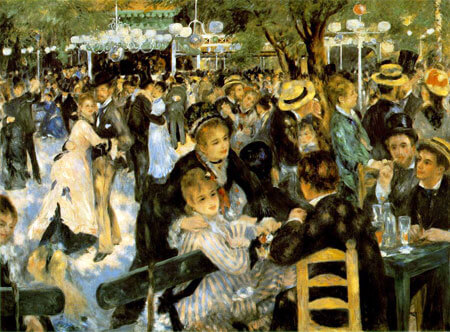
Renoir, Bal du moulin de la Galette
Dr. Beth Harris and Dr. Steven Zucker discuss Renoir’s 1876 Montmartre dance scene, its light and its crowds.
Watch on YouTubeAt a glance
- ArtistPierre-Auguste Renoir (1841–1919)
- Museum titleWoman with a Parasol in a Garden
- Local route titleSummer Landscape
- Date1875, preferred by Museo Nacional Thyssen-Bornemisza
- MediumOil on canvas
- Size54.5 × 65 cm
- CollectionMuseo Nacional Thyssen-Bornemisza, Madrid
- Inventory724 (1974.43)
- DisplayThe museum’s online record currently says not exhibited; check it before a visit
The museum page gives the strongest direct account of this canvas. Its curatorial text places the scene in the garden of Renoir’s Montmartre studio and discusses the evidence behind that placement. This is more precise than treating the image as a generic country meadow or borrowing facts from another Renoir garden picture.
The figures inside the flowers
The woman stands in a dark dress, relatively small within the frame. Her pale parasol rises above her head like a round point of light. Against the darker shrubs, it catches attention immediately; the eye then finds her dress and the person beside her. The second figure bends forward. The museum’s description [1] suggests that he may be picking a flower, but the visible marks do not prove exactly what is in his hand.
Their scale matters. Were the figures removed, this would still be a dense study of plants and colour. Their presence gives the abundance a human measure: a viewer can imagine moving through the garden, then notice how readily the figures almost vanish among stems and blooms. Renoir does not give either person a portrait face or a clearly narrated event.
The parasol is also a compositional hinge. Its bright round form sits near the middle of the dark upper band, while small white flowers scatter downward into the foreground. The eye connects a made object to natural highlights across the grass. Renoir does not isolate the woman from her surroundings; he lets a similar broken handling join dress, foliage and light.
A garden with no horizon
The lower half of the canvas is a broad, crowded field of flowers, grasses and leaves. Red, white, pink and yellow flecks stand out within green. The far edge of the garden is hard to locate. Instead of an empty strip of sky, the upper part is filled with taller bushes and trees. The result is an unusually shallow landscape: the eye can move into it, but not out to a distant view.
The Thyssen-Bornemisza entry [1] specifically points to the missing horizon and the tiny dabs of colour that interweave flowers and shrubs. That is visible even in the inherited small reproduction. Each flower is less an individually described specimen than a mark in a larger field of changing colour. The garden appears lush because the strokes crowd together while retaining separate red, blue and white accents.
A path or open patch near the left creates a little breathing room. Elsewhere the paint fills the frame. The garden’s scale remains uncertain: the figures could be closer or farther than one first thinks because there is little architectural geometry to measure them against. This uncertainty is part of the experience of looking through foliage rather than surveying a mapped property.
Light made from separate strokes
Renoir’s light is spread through the painting rather than concentrated in one beam. It touches the parasol, pale flowers and areas of grass, then seems to break into smaller flashes as it reaches the near foreground. Dark greens and browns behind the figures keep the lighter marks visible. The picture feels sunny, but its effect comes from relationships among colours more than from a defined sun or shadow line.
This is an early Impressionist approach in which rapid, visible touches register a lively surface. It does not require every bloom to be botanically exact. The museum’s curatorial account stresses that the flowers and shrubs are built from small dabs and varied textures. The visible local image supports that reading: the dense foreground seems to vibrate as distinct spots and short strokes compete with one another.
There is a structural decision underneath this apparent freedom. The two figures occupy the upper centre, the parasol is the brightest large shape, and the flowers swell toward the lower right. This distribution keeps the canvas from becoming a uniform pattern. Looking moves between the recognisable people and the almost abstract field of colour around them.
Why the date and place changed
The museum notes that earlier authors placed the picture near Renoir’s work with Monet at Giverny in 1873, or at Charles Le Coeur’s country house in 1874. Its current curatorial account instead follows research linking the work to Renoir’s new studio garden on rue Cortot, Montmartre, rented around 1875 or 1876. An inventory made by the dealer Paul Durand-Ruel on 25 August 1891 listed a painting titled Garden and dated it 1875; the museum regards that year as the most likely one for this canvas.
That argument is stronger than a confident but unexplained single-year label. It still leaves a little historical uncertainty: even the accounts of exactly when Renoir rented the studio differ. The page therefore gives the museum’s preferred 1875 date and explains the evidence, rather than pretending that every chronology has always agreed.
The Montmartre location also changes how the scene is understood. What looks like open countryside is, in the museum’s reading, the garden of a Paris studio. The vegetation makes an enclosed urban plot feel expansive. The absence of buildings does not prove the painter was far from the city; it shows how completely he chose to frame the plants.
The museum suggests that this may be the Garden admired at the Third Impressionist Exhibition in 1877. It presents that exhibition identification as a possibility, not a settled catalogue number. The local page should keep the same distinction between a documented inventory clue and a proposed historical match.
Other gardens, other stories
Renoir made many garden views, and similarities can invite false identification. The National Gallery of Art’s Picking Flowers [2] also has two figures among plants, but it is a separate work. The Thyssen-Bornemisza commentary compares the pictures to discuss the figures’ closeness; it does not say they are two names for one canvas.
The route title Summer Landscape is especially broad. It should not become a source for invented sitter names, an exact hour, or a rural town. The museum’s record gives the work’s recognised title, size, collection and preferred date. The picture itself gives us a white parasol, dark standing figure, bending companion and flower-filled garden. Together those details provide a secure identity without forcing a story about what the pair said or did.
The inherited small reproduction matches the museum composition. It supports identification and discussion of broad forms, though its size cannot support claims about fine surface detail.
Looking again
Try starting with the white parasol, then follow the two figures into the foliage. Let the eye move down across the red and white blooms, and back through the more open left edge. The painting never gives a fixed route through its plants. Its small people and crowded marks make looking feel like wandering.
The title Summer Landscape catches the warmth but misses the striking fact that this may be a garden in Montmartre. Renoir makes a city studio plot feel almost boundless by bringing the plants close, removing the horizon and using small moving touches. The human figures are present, yet the garden remains the painting’s most insistent character.
Renoir artworks directory
Questions about Summer Landscape
The Museo Nacional Thyssen-Bornemisza catalogues it as Woman with a Parasol in a Garden. Summer Landscape is the established descriptive title of this local route.
The museum prefers 1875, citing a Durand-Ruel inventory dated 25 August 1891. Its curatorial text explains why older sources proposed other years.
It belongs to the Museo Nacional Thyssen-Bornemisza in Madrid, inventory 724 (1974.43). Its online record currently marks it not exhibited, so check before travelling to see it.
The museum’s current research places it in the garden of Renoir’s rue Cortot studio in Montmartre, rather than an identified rural field. The tight framing hides the surrounding city.
The museum suggests he may be picking a flower. The image does not show the action clearly enough to make that certain, and neither figure is securely named in the cited record.
Discussion
What do you notice when you return to this Renoir garden?
How does the pale parasol anchor the crowded garden?
Reader Insights
How does the pale parasol anchor the crowded garden?
The Thyssen-Bornemisza Museum dates this exact oil to 1875 and measures it at 54.5 × 65 cm.
Where does the garden open among the densely painted flowers?
Join the Conversation
Share a close observation or a source-backed question about Renoir’s Montmartre garden.
References
- Museo Nacional Thyssen-Bornemisza, Woman with a Parasol in a Garden: exact museum object, 1875 date, oil medium, 54.5 × 65 cm dimensions, inventory 724 (1974.43), curatorial discussion of garden, date and figures, and image terms View source.
- National Gallery of Art, Picking Flowers: a separate Renoir picture mentioned comparatively by the Thyssen-Bornemisza View source.
- Museo Nacional Thyssen-Bornemisza, garden collection feature: confirms the museum’s Montmartre studio interpretation and 1875 date View source.