 by Tom Gurney
Tom Gurney BSc (Hons) is an art history expert with over 20 years experience
Published on June 19, 2020 / Updated on July 5, 2026
Email: tomgurney1@gmail.com / Phone: +44 7429 011000
The Listening Room by Rene Magritte
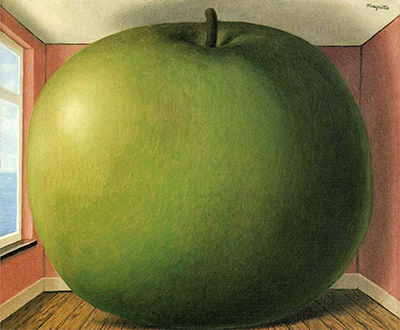
The Listening Room is one of Rene Magritte's most memorable apple paintings. A green apple fills a small room so completely that the viewer has to ask a basic question: is the apple gigantic, or has the room become miniature? [1]
The Menil Collection records the work as The Listening Room (La chambre d'ecoute), painted in 1952. It is an oil on canvas measuring 17 13/16 x 21 3/4 inches, or 45.2 x 55.2 cm, and entered the Menil as the Gift of Fariha Friedrich with accession number 1991-53. [1]
The painting matters because it turns scale into mystery. Magritte does not deform the apple. He does not paint a fantasy fruit. He paints an ordinary apple in an impossible relation to an ordinary room. [4]
At a Glance
- Artist: Rene Magritte [2]
- Title: The Listening Room (La chambre d'ecoute) [1]
- Date: 1952 [1]
- Medium: oil on canvas [1]
- Dimensions: 17 13/16 x 21 3/4 in. (45.2 x 55.2 cm) [1]
- Collection: The Menil Collection, Houston [1]
- Credit: Gift of Fariha Friedrich [1]
- Accession number: 1991-53 [1]
Contents
- Why this painting matters
- Museum perspective
- Historical background
- Visual description
- Looking carefully
- Meaning and interpretation
- Comparison works
Why This Painting Matters
The Listening Room matters because it is a perfect example of Magritte's ability to make the familiar strange. The apple is one of the most ordinary objects in Western still life. The room is plain. The window, floor and walls give the scene a domestic setting. But the relationship between object and room is impossible. [5]
It also belongs to a larger group of Magritte works in which everyday objects become too large for the spaces around them. This is not mere comic enlargement. The altered scale makes the viewer feel how fragile ordinary proportions are. [3]
Museum Perspective
The Menil record gives a precise factual frame: title, date, material, size, credit line and accession number. That matters because The Listening Room exists in more than one version and has appeared in popular culture. The Menil version is the 1952 oil on canvas in Houston. [1]
The Menil also places the painting within exhibition contexts that emphasise silence, listening and Surrealist object displacement. It appeared in Silence in 2012 and in The Secret of the Hanging Egg: Salvador Dali at the Menil in 2015-16. [1]
Museum Moment
The modest size of the Menil canvas changes how the image works. At 45.2 x 55.2 cm, the painting is physically small enough to feel intimate, yet the apple inside it appears too large for its painted room. That reversal gives the work its quiet pressure: a small canvas contains a room that cannot contain its own object. [1]
This is also why reproductions can be misleading. Online, the apple may seem simply monumental. In object terms, the painting is compact, controlled and deliberately compressed. The contrast between the painting's actual scale and the apple's imagined scale is part of the experience. [1]
Historical Background
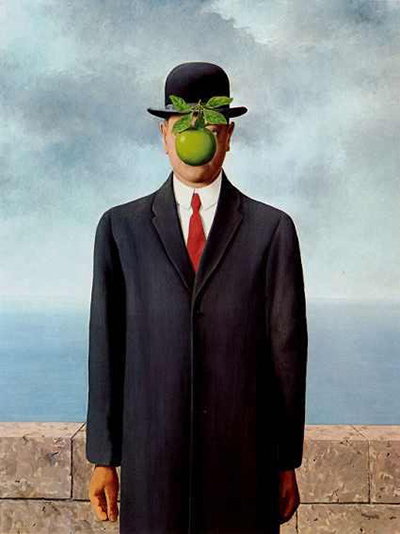
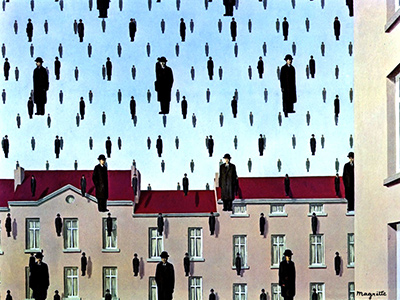
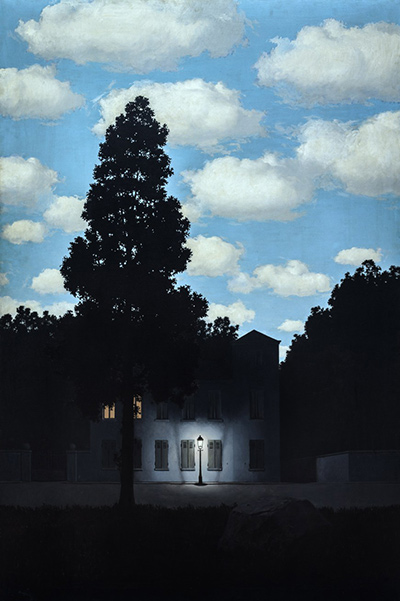
By 1952, Magritte had returned fully to the clear, precise mode that defines his mature Surrealism. His late works often use a single memorable object or contradiction: men falling or hovering in Golconde, daylight above night in The Empire of Light, or a face hidden by an apple in The Son of Man. [3]
The Listening Room belongs to this mature phase. Its structure is simple enough to remember instantly, but the image is not simple in thought. The object is familiar, the room is familiar, and yet their combination breaks the logic of scale. [6]
Visual Description
The painting shows a quiet interior with wooden floorboards, pale walls and a window at the left. A large green apple fills most of the space. It presses close to the ceiling and walls, leaving only a narrow sense of room around it. [1]
The apple is painted as a normal apple, with its green skin, round body and small stem. Its strangeness does not come from distortion. It comes from its size and placement. The apple is too large for the room but too calmly present to feel like an accident. [5]
Looking Carefully
The first thing to notice is the apple's relationship to the ceiling. It nearly touches the top of the room, which prevents the viewer from imagining it as a normal still-life object simply placed on the floor. [1]
Next, look at the window. It opens the room to an outside world, but the apple blocks almost everything else. The room becomes a container, and the apple becomes the event inside it. [6]
Finally, notice the title. A listening room suggests sound, attention or silence. But the painting gives us a visual object, not an audible event. That mismatch is part of the work. The title asks the viewer to attend differently. [4]
Things You Might Miss
- The apple is not necessarily a symbol of temptation or knowledge. The stronger method is displacement: a common object placed in an impossible relation to its surroundings. [5]
- The room is as important as the apple. Without walls, ceiling, window and floor, the apple would simply be large. The interior gives the apple its impossible scale. [6]
- The painting's small physical size is important. A modest canvas contains an object that appears too large for its own room. [1]
Technique and Composition
Magritte's technique is controlled and direct. The apple is painted clearly, and the room is built from simple planes. The viewer is not distracted by painterly drama. The image stays calm enough for the contradiction to become sharper. [5]
The composition is almost a compressed stage. The walls and floor define the box of the room, while the apple becomes a round mass locked inside that box. The contrast between geometric interior and organic fruit gives the painting much of its tension. [6]
Meaning and Interpretation
The safest interpretation begins with scale. Magritte makes an ordinary object impossible by changing its size relative to its environment. The painting asks whether reality is stable if proportion can be changed so easily. [4]
The title adds another level. Listening is an act of attention, and the painting may ask the viewer to listen to silence, or to attend to what the image does not explain. But the title should not be forced into a literal explanation. Magritte titles often deepen mystery rather than solve it. [4]
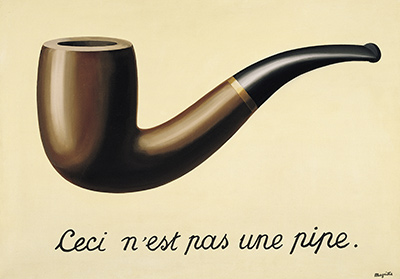
The apple later became one of Magritte's most famous motifs, especially in The Son of Man and This is Not an Apple. The Listening Room shows the motif working through scale rather than concealment or language. [3]
Title Analysis
La chambre d'ecoute can be translated as The Listening Room. It is a strange title because the picture contains no visible listener and no obvious sound. The room might be silent. The apple might be mute. The title makes the viewer aware of absence. [4]
This is typical of Magritte. A title can redirect attention without explaining the image. Here, listening becomes a metaphor for patient looking. The viewer has to wait with the image instead of decoding it too quickly. [5]
Provenance and Collection Context
The Menil Collection identifies the painting as a Gift of Fariha Friedrich and gives accession number 1991-53. The Menil is especially important for Magritte scholarship because John and Dominique de Menil supported the multi-volume catalogue raisonne of Magritte's work. [1] [3]
Houston therefore matters twice: as the home of the painting and as one of the major centres for the scholarly study of Magritte. [3]
The Menil context also matters because the collection has long been central to Magritte scholarship. The catalogue raisonne supported by the Menil is one of the core tools for separating versions, dates and titles in an artist whose best-known motifs often recur in multiple forms. [3]
Exhibition History
The Menil page lists the painting in Silence, held July 27 to October 21, 2012, and The Secret of the Hanging Egg: Salvador Dali at the Menil, held November 5, 2015 to June 19, 2016. [1]
Those exhibitions are useful contexts. One emphasises silence and attention, which suits the painting's title. The other places Magritte's object logic near Dali and Surrealist transformations of ordinary things. [1]
Comparison Works
The closest internal comparison is The Son of Man, where an apple hides a man's face. In The Listening Room, the apple does not hide a face; it overwhelms a room. Both paintings make the apple more than a still-life object. [3]
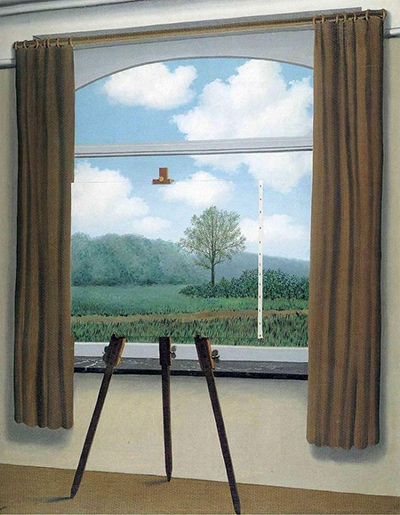
Personal Values is another key comparison because it also fills an interior with ordinary objects at impossible scale. The Human Condition is useful because it turns a room and window into a problem of perception. [6]
The Empire of Light and Golconde show the same mature economy. One impossible relation changes everything: day and night in one landscape, men suspended in the air, or an apple filling a room. [5]
Reception and Influence
The Listening Room has remained memorable because its image is immediate. Viewers do not need to know Magritte's biography to understand that something has gone wrong with scale. [5]
The later 1958 version also entered popular culture through the Beck-Ola album cover, which helped spread the image beyond museum audiences. That afterlife should be treated as reception, not as the original meaning of the 1952 Menil painting. [3]
Timeline
- 1952 - Magritte paints The Listening Room. [1]
- 1991 - The painting enters the Menil Collection as the Gift of Fariha Friedrich. [1]
- 2012 - The painting appears in Silence at the Menil. [1]
- 2015-16 - The painting appears in The Secret of the Hanging Egg: Salvador Dali at the Menil. [1]
FAQs
The 1952 version is in the Menil Collection in Houston. [1]
It shows a large green apple filling a small interior with a window, floor and walls. [1]
The Menil records it as oil on canvas. [1]
The strongest reading is about scale and displacement. The apple becomes strange because it is placed in an impossible relation to the room. [5]
Yes. A later version from 1958 exists, but the Menil version discussed here is the 1952 oil painting. [3]
References
- The Menil Collection, "The Listening Room (La chambre d'ecoute)," accessed July 4, 2026, https://www.menil.org/collection/objects/4787-the-listening-room-la-chambre-d-ecoute.
- Museum of Modern Art, "Rene Magritte," artist record, accessed July 4, 2026, https://www.moma.org/artists/3692-rene-magritte.
- David Sylvester and Sarah Whitfield, eds., Rene Magritte: Catalogue Raisonne, Houston and London: Menil Foundation / Philip Wilson, 1993.
- Harry Torczyner, Magritte: Ideas and Images, New York: Harry N. Abrams, 1977.
- Suzi Gablik, Magritte, London: Thames & Hudson, 1970.
- Patricia Allmer, Rene Magritte: Beyond Painting, Manchester: Manchester University Press, 2009.