


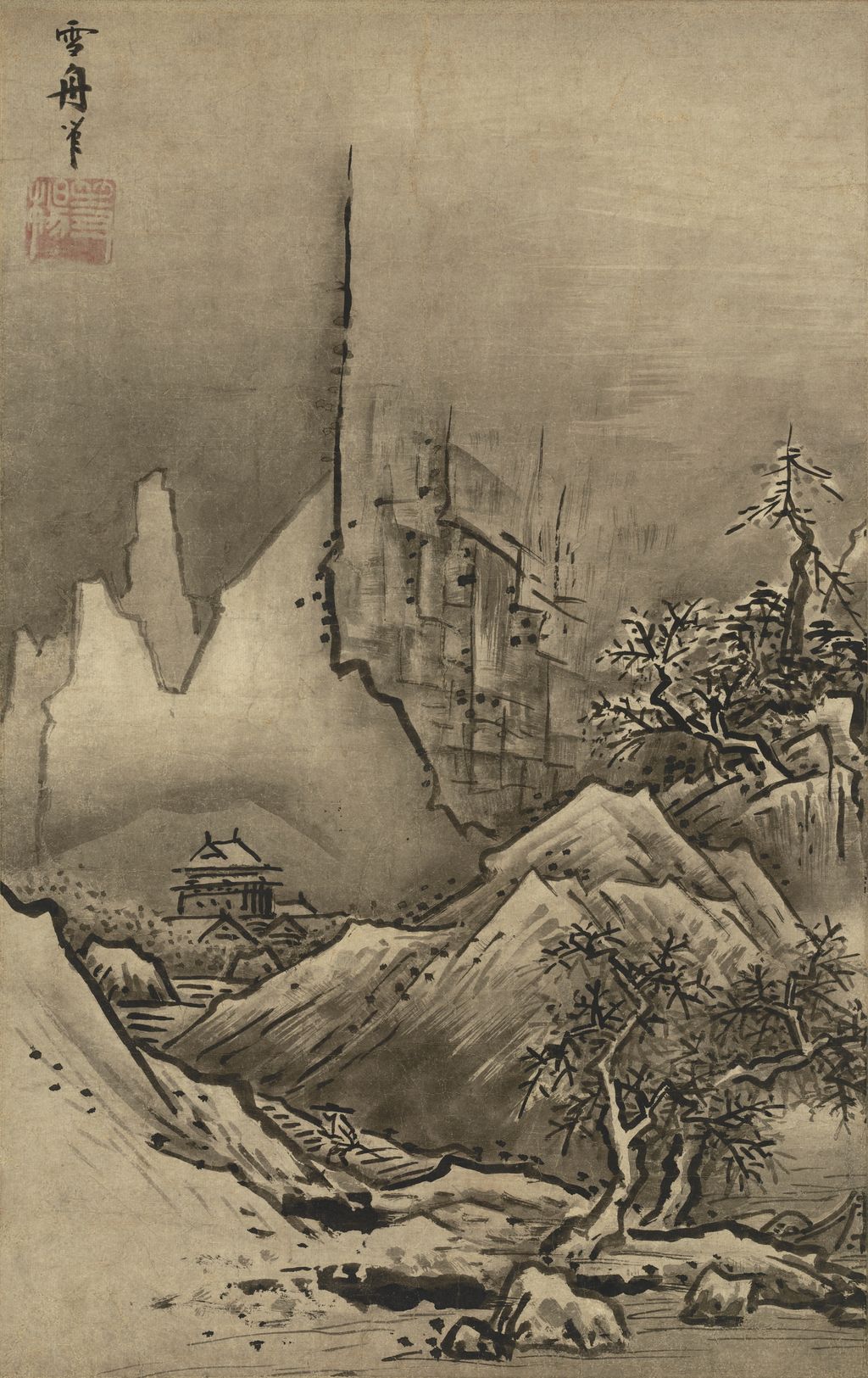
Winter Landscape, one of the National Treasure pair, Tokyo National Museum A-1398. Image from ColBase, resized for web display.
 by Tom Gurney
Tom Gurney BSc (Hons) is an art history expert with over 20 years experience. Updated September 24, 2026.
Introduction
Contents
- Introduction
- A painter-priest in a connected world
- The 1495 scroll: a picture that also speaks
- Autumn and Winter: two designs for distance
- Beyond ink landscape
- Nine views: attribution and reception
- “By,” “attributed to,” “after” and “copy”
- Pupils, successors and the making of a legend
- A route through the works
- Reader insights and discussion
- Books on Sesshū and ink painting
In one pair of narrow hanging scrolls, a path moves through an autumn landscape while a cliff compresses a winter scene. In another painting, an inhabited place seems to assemble from diluted ink and a few assertive strokes; above it, an unusually long inscription turns the artwork into evidence for the painter's own account of learning and teaching. These are not interchangeable examples of a vague “Zen style.” Sesshū Tōyō [4] worked across different forms of landscape, figure and bird-and-flower painting during the Muromachi period, and his later reputation grew through pupils, claims of succession, copies, printed discussions and the admiration of artists who never met him. To understand him, we need to look at individual objects and the kind of evidence each can bear.
The Tokyo National Museum dates the National Treasure Splashed-Ink Landscape [1] to 1495. Sesshū's own inscription, written for his pupil Sōen at the close of training, names artistic forebears and recounts his studies. Another Tokyo National Museum National Treasure, Autumn and Winter Landscapes [3], is a pair of distinct scrolls dated more broadly to the late fifteenth or early sixteenth century. The two accepted work pages will follow these objects closely. This home page asks a wider question: how did a painter-priest active in Kyoto, Yamaguchi and Ming China become the figure later called a “saint of painting,” and how can a reader distinguish a documented work from an attribution or a later response?
Kyoto National Museum's 2024 exhibition, The Legend of Sesshū [4], framed that second question with unusual clarity. It notes six works designated National Treasures, while acknowledging that the larger body of paintings assigned to Sesshū has not always commanded consensus. Its title points to a historical process, not a suggestion that the painter himself was invented. Strong works survive; many artists, collectors and writers also built a legend around them. The separate biography treats dated places, teachers and relationships at greater length. This page provides an object-led route into that history.
At a glance: how to read the evidence
- Artist and periodWhat a source establishes: Museum records identify Sesshū Tōyō as a Muromachi painter and Zen monk, conventionally c. 1420–1506?
Limit to carry forward: The question mark after the death year in Kyoto's exhibition record [4] is meaningful - 1495 evidenceWhat a source establishes: Tokyo National Museum A-282 [1] is a National Treasure with an inscription by Sesshū and poems by six monks
Limit to carry forward: His dedication is first-person testimony; it is not independent confirmation of every episode he relates - Paired landscapesWhat a source establishes: Tokyo National Museum A-1398 [3] contains two National Treasure hanging scrolls, autumn and winter
Limit to carry forward: The pair is not a single panorama or a secure 1495 commission - AttributionWhat a source establishes: ColBase A-12335 [9] says attributed to Sesshū; A-2291 [10] says copy by Kano Tsunenobu
Limit to carry forward: These labels cannot be changed to “by Sesshū” in captions - ReputationWhat a source establishes: Kyoto's 2024 exhibition [4] traces later Unkoku, Hasegawa and Kano engagement
Limit to carry forward: A later claimant to his lineage was not automatically a direct pupil - Childhood taleWhat a source establishes: Kyoto's museum dictionary [5] identifies the mouse painted with tears as fiction appearing in early Edo writing
Limit to carry forward: It belongs in a section on reception, not in a factual childhood chronology
A painter-priest in a connected world
Sesshū's life is often compressed into three locations: Kyoto, Yamaguchi and China. Tokyo National Museum's account of the 1495 scroll [2] explains the sequence in more useful terms. After training at Shōkoku-ji, one of Kyoto's major Zen temples, he moved in his mid-thirties to Yamaguchi. There he worked under the protection of the Ōuchi family, whose domain supported diplomatic and cultural contact across the sea. He travelled to Ming China with a Japanese embassy in 1467. Such movement mattered to painting: it put a Japanese monk-painter in relation to the images, people and institutions through which Chinese styles could be studied, as well as to patrons who could sustain a working career. The biography will identify each relationship with its specific role rather than treating “China” or “Zen” as a single creative cause.
The 1495 inscription lets us listen to Sesshū's own account of artistic descent. In TNM's Japanese explanation [2], he speaks of learning from Zhang Yousheng and Li Zai while in China, and of recognizing the achievement of the Japanese monk-painters Josetsu and Shūbun after returning. These are powerful names because Sesshū chose to set them above a painting given to a student. They reveal a deliberate public statement about who authorized his art. Yet an inscription written near the end of a career is also self-presentation; it cannot, alone, provide the dates, length and nature of every encounter. The distinction makes the source more interesting. The artwork is at once a landscape, a pedagogical gift and a claim about lineage.
This is one reason to resist a familiar shortcut, that every energetic ink stroke is simply the direct expression of spontaneous meditation. The painter had models to study and people to persuade. Techniques could be taught, copied, varied and debated in social settings. The Metropolitan Museum's record for Bokushō Shūshō's Splashed-Ink Landscape [6] describes the later painter's variation on Sesshū's celebrated composition and explains the haboku method as dark ink rapidly applied over wet, light washes. The Met also links that method to Zen contemplative associations. Those associations are useful context, but they do not replace the specific 1495 inscription or prove that a painter's every mark came without planning. A student received the scroll; monks added poems; viewers could read it as well as look at it.
The places associated with Sesshū are not picturesque backdrops to a solitary genius. Shōkoku-ji supplied monastic training and a painting lineage; Yamaguchi offered an Ōuchi patronage base; the China voyage connected him to contemporary painters and broader diplomatic exchange. These roles differ. The later mouse tale is placed at Hōfuku-ji in today's Sōja, Okayama, but the tale itself is not reliable proof of a childhood incident there. Historic photographs, when one is used, will be labelled as views made centuries later, not as witnesses to Sesshū's presence. The page needs the chronology and relationships more than it needs romantic-looking site imagery.
The 1495 scroll: a picture that also speaks
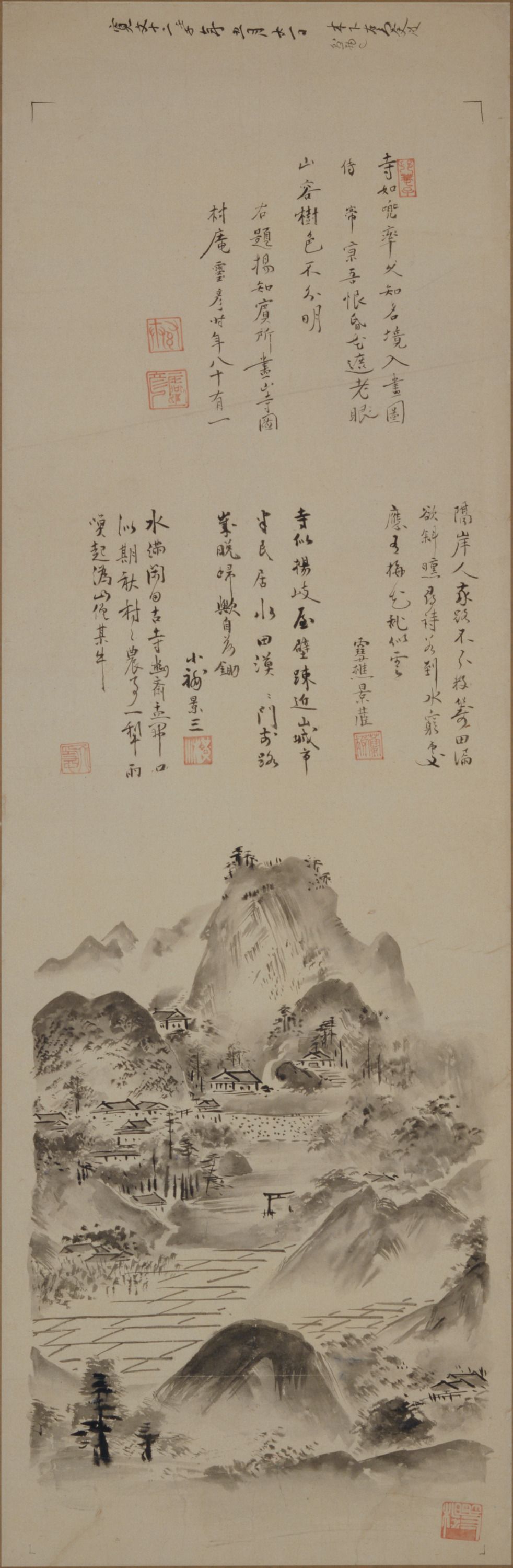
In the exact ColBase record A-282 [1], the image is vertically dominated by calligraphy. Sesshū's own text is the lower inscription above the painted landscape; the six monks' poems sit above it. A web crop containing only the inked scenery is useful for seeing brushwork, but it hides the social life of the object. This page keeps the full scroll view visible so the relationship between dedication, poems and picture is apparent. The current ColBase file is 662 pixels wide; it is a properly reusable object image when credited, but too narrow to make claims from enlarged details of the writing. A high-resolution annotated transcription would need a stronger, licensed source and authoritative Japanese review.
What can be seen at the bottom is remarkably compressed. ColBase's English interpretation [1] describes distant cliffs in faint ink, a darker middle hill, and a nearer hill beside still water. It asks readers to find a building, a flag indicating food and drink, and a boat. These small clues are worth locating because they prevent the entire painting from being treated as pure abstraction. A settlement and movement on water occupy a landscape that first appears almost dissolved in ink. The apparently quick brushwork sets different zones of distance without requiring every rock or building to have a continuous outline.
The scroll was made, according to the inscription, at Sōen's request to mark the end of his training. Six Kyoto monks later contributed poems. That sequence is crucial: the student is not a later collector mentioned by accident, and the poems are not simply a decorative border painted by Sesshū. Different hands and moments made the object we see. The landscape page will separate those layers and explain what each tells us. Yukio Lippit's 2012 scholarly article abstract [14] argues that the splashed-ink mode and inscriptions helped construct artistic transmission as a kind of spiritual lineage. The full article was not accessed for this manuscript, so that claim is attributed to its abstract, not treated as a fully reviewed reading of every paragraph.
The title's English word “splashed” may mislead a reader into imagining uncontrolled paint thrown at paper. The image shows economy rather than shapelessness. Dilute and dark ink were applied in a way that lets paper take an active part in forming hills, mist, shore and sky. The Met's Bokushō comparison [6] demonstrates how another monk-painter could work within a related method and reach a distinct image. Sesshū's authorship of the Tokyo scroll rests on its catalogue and inscription, not on a generic look that every later landscape might imitate. Likewise, a file of the painting alone is not evidence that all similar-looking works by other monks are his.
Autumn and Winter: two designs for distance
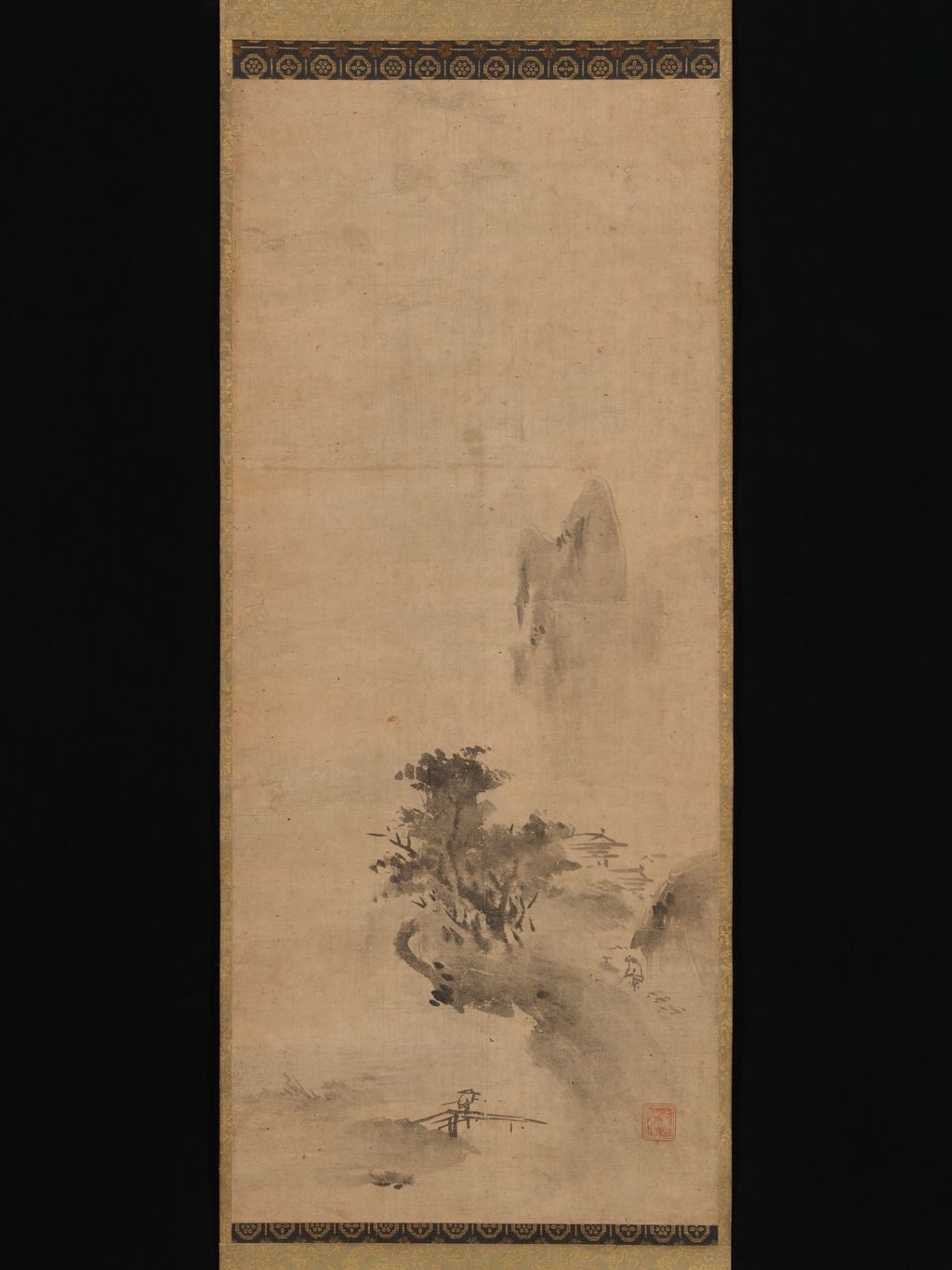
Autumn and Winter Landscapes, Tokyo National Museum A-1398 [3], consists of two hanging scrolls. The museum dates them to the late fifteenth or early sixteenth century, records transmission through Manshu-in in Kyoto, and treats them as a National Treasure. They are small enough in format to invite close inspection, but each builds an expansive journey from bottom to top. ColBase explicitly contrasts the views and notes how the motifs' relative positions give the works a deliberate structure. That specific curatorial account is preferable to claiming that they are merely spontaneous expressions of a wintry mood.
Autumn gives the eye a way in. A path follows water and moves upward toward a tall building in the distance. Forms gather more densely in the lower half, leaving a broad upper sky. The viewer can follow a route between trees, water and architecture, then meet an open area that makes the human scale feel small. Winter stages a different encounter: a sheer cliff becomes the central mass, while buildings appear diminutive. The scroll's steep vertical line and abrupt change of scale make the journey more obstructed. Both are ink landscapes, but the shapes that steer us through them differ. The paired-work page will show each separately, with annotations tied to observed paths, cliff faces and buildings, using the ColBase originals at their actual resolution.
Names of seasons can seem self-explanatory, yet the formal observations must remain tied to the two exact TNM images, not to a stock set of four seasons, a different Sesshū scroll or a later painted copy. The ColBase files contain enough pixels—1,684 by 2,668 and 1,568 by 2,488—to produce a lossless 300-dpi-tagged working master for cropped annotations. Such a tag preserves a production standard; it does not invent missing ink texture. The site's displayed files are resized to 1,024 pixels wide, JPEG quality 80 at 144 dpi. Readers can enlarge a crop and follow the museum's full object link to see the image in its institutional context.
The pair also challenges the idea of a single “Sesshū style.” At the bottom of Splashed-Ink Landscape, form can seem to coalesce from washes and broken marks. In Winter, a cliff imposes a forceful upright geometry; Autumn distributes a route through a more open field. The difference is not a simple early-versus-late chart, because the 1495 work has a precise date and the autumn/winter pair has only a broader museum date. Nor is it proof that one mode is more “Chinese” and another more “Japanese.” Sesshū studied multiple painting models and chose them for different objects and audiences. Close comparison reveals choices; the surviving dates set the limits of a chronology.
A long scroll is a different encounter
The famous Landscape of the Four Seasons in the Mōri Museum [18] adds a scale and viewing action that neither TNM pair supplies. Its own museum describes a scroll roughly sixteen metres long, progressing from spring to winter, and dates the colophon to 1486, when Sesshū gives his age as sixty-seven. A person does not view sixteen metres of a handscroll in one glance. Unrolling one stretch and closing another makes sequence part of the experience. That differs from facing the two upright autumn/winter pictures together, or looking at a single hanging scroll whose poems sit above the image. The Mōri scroll belongs in an introduction to his range even if this programme has not accepted a separate page for it and its image has not yet been cleared for reproduction here.
There is a naming trap. Kyoto National Museum has a different Four Seasons Landscapes handscroll [19], roughly 11.5 metres long, sometimes called the “short landscape scroll” in contrast to the Mōri work. The Kyoto collection essay calls it by Sesshū, but its collection database [20] uses “attributed to Sesshū”; the difference should be acknowledged rather than silently flattened. A Kyoto 2024 exhibition list [21] gives the Mōri long scroll separately as a National Treasure dated 1486. There are also separate four-season hanging-scroll sets and later copies. “Sesshū's Four Seasons” cannot be used as a precise image caption without a museum, accession or collection and format.
The 1486 scroll provides a second firm chronological anchor next to the 1495 dedication, though it does not make the intervening nine years a simple stylistic ascent. The long scroll is a sustained, sequential project; the 1495 landscape is a compact gift to a student with a self-account; the autumn/winter pair is dated within a wider range. Their different scale and social use may explain as much of their appearance as age does. A timeline on the biography page can place them in order while keeping medium, patronage and certainty visible. It should not claim that every passage of brushwork maps neatly to a biographical stage.
Beyond ink landscape
An artist home should not turn Sesshū into the maker of only two famous landscape titles. ColBase A-11962, Shoulao under a Plum Tree [8], catalogues a fifteenth-century work by Sesshū, with colour on a very different figure subject. The figure, plum branches and surrounding dark field give a reader a chance to see how materials and genre change the problem of drawing. The object is separately designated an Important Art Object; that is not the same status as the National Treasures. Its exact title, date and attribution should appear beside its image rather than be swallowed by a gallery headed “ink landscapes.”
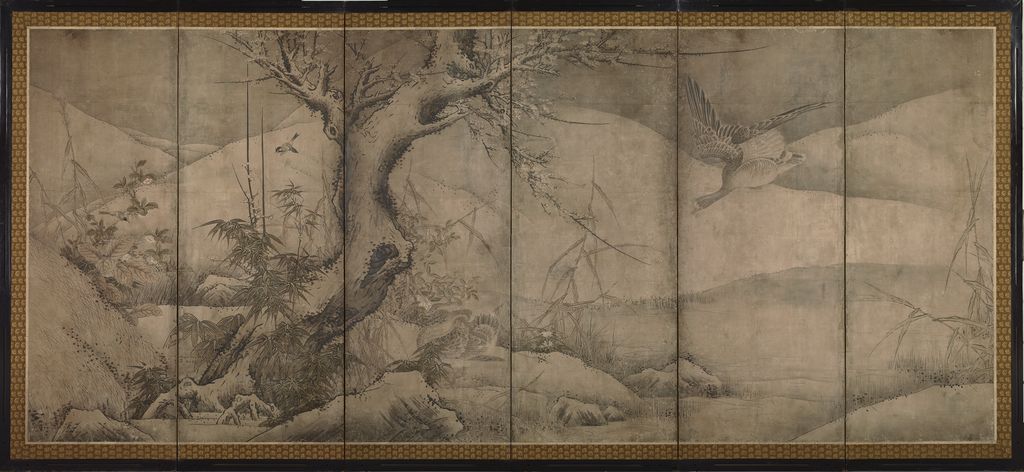
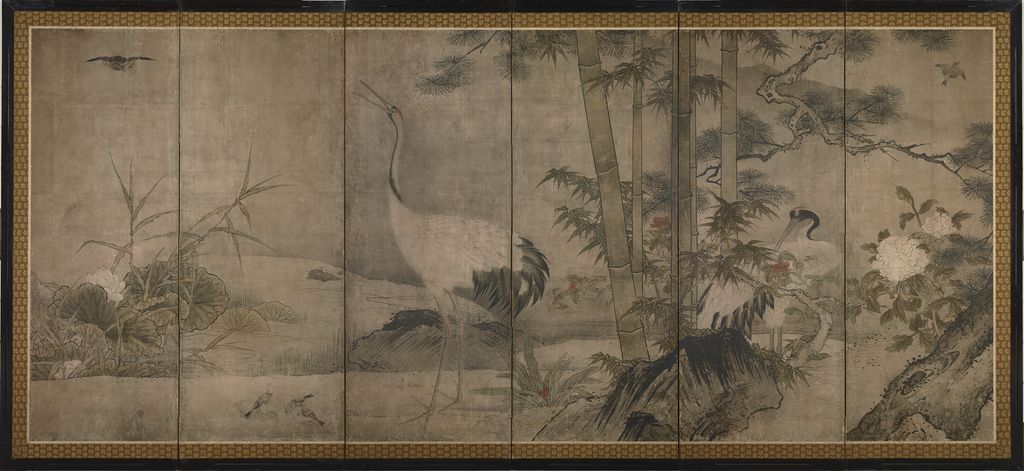
The seasonal bird-and-flower screens A-12335 [9] expand the view again, with large cranes, plants and water spanning a pair of screens. Yet ColBase's current English record says “Attributed to Sesshū Tōyō.” The two panels shown on this page therefore illustrate what a related object, currently associated with him, can add to a discussion of his range without pretending that their attribution is settled. The Kyoto National Museum's 2024 display included a bird-and-flower pair labelled by Sesshū in its own collection; these are not the same accession as Tokyo's A-12335. A caption that retains museum and accession avoids turning two large works into one imaginary painting.
Other works draw readers outward without automatically becoming separate accepted URLs. Kyoto National Museum describes View of Amanohashidate [12] as a highly constructed image of a place rather than a transparent snapshot from one fixed lookout. Its Huike Offering His Arm to Bodhidharma [13] is dated 1496, an imposing figure composition held by Sainen-ji. The latter's date makes it a close chronological neighbour of the 1495 scroll, but the two works have different subjects, formats and purposes. They show why an introduction to Sesshū has to move among landscape, Zen figures and place painting while assigning each claim to its own record. The accepted cluster holds a separate Amanohashidate URL until object identity, image rights and a full page's reader job justify it.
Nine views: attribution and reception
Four images come from works catalogued by Sesshū, two from an attributed pair, and the rest from a copy or later makers.
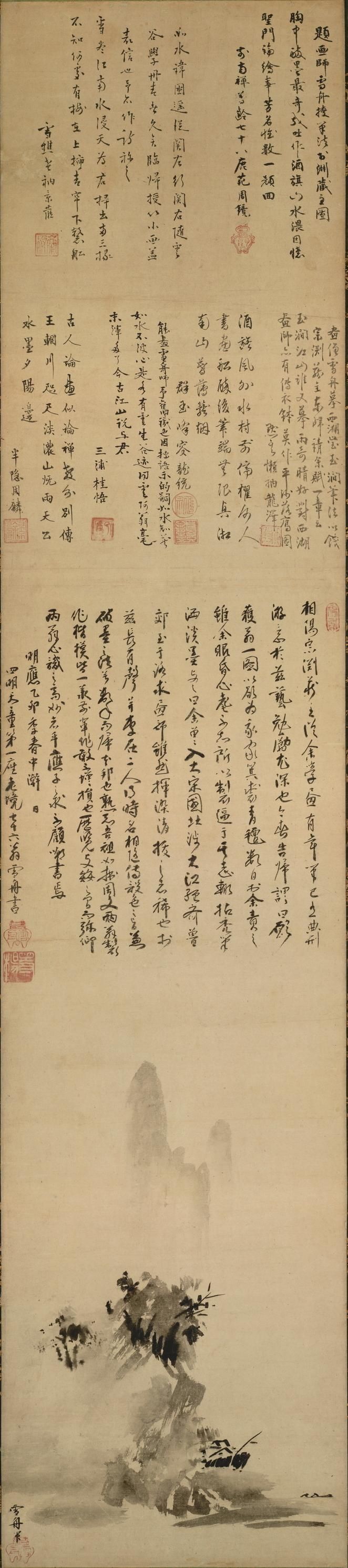
Splashed-Ink Landscape, 1495
Tokyo National Museum A-282 · National Treasure · by Sesshū, with his self-inscription and six monks’ poems.
ColBase · Resized image. Exact object and image record.
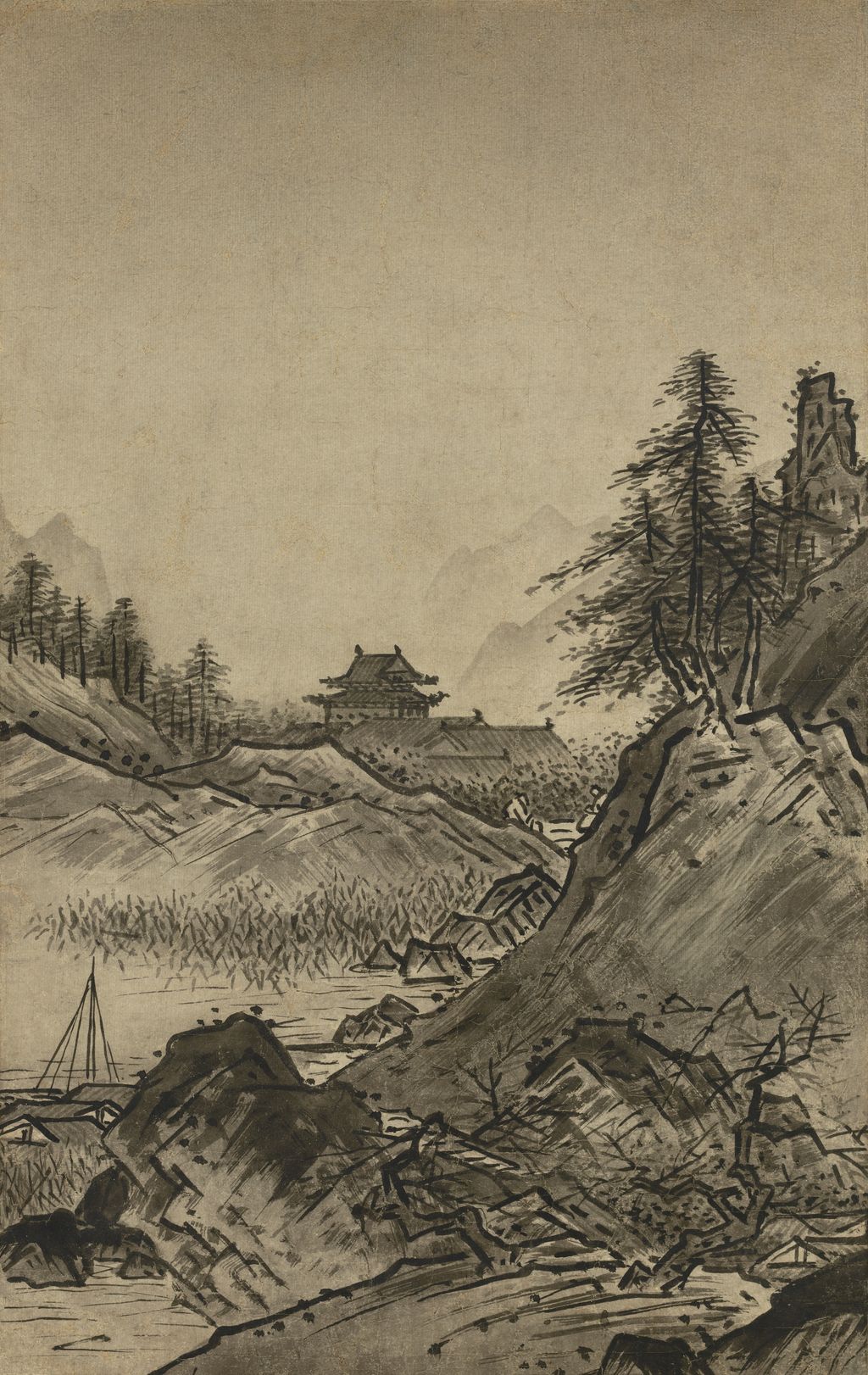
Autumn Landscape
Tokyo National Museum A-1398 · one scroll of the National Treasure pair · by Sesshū.
ColBase · Resized image. Exact object and image record.
Winter Landscape
Tokyo National Museum A-1398 · the other scroll of the pair · by Sesshū.
ColBase · Resized image. Exact object and image record.
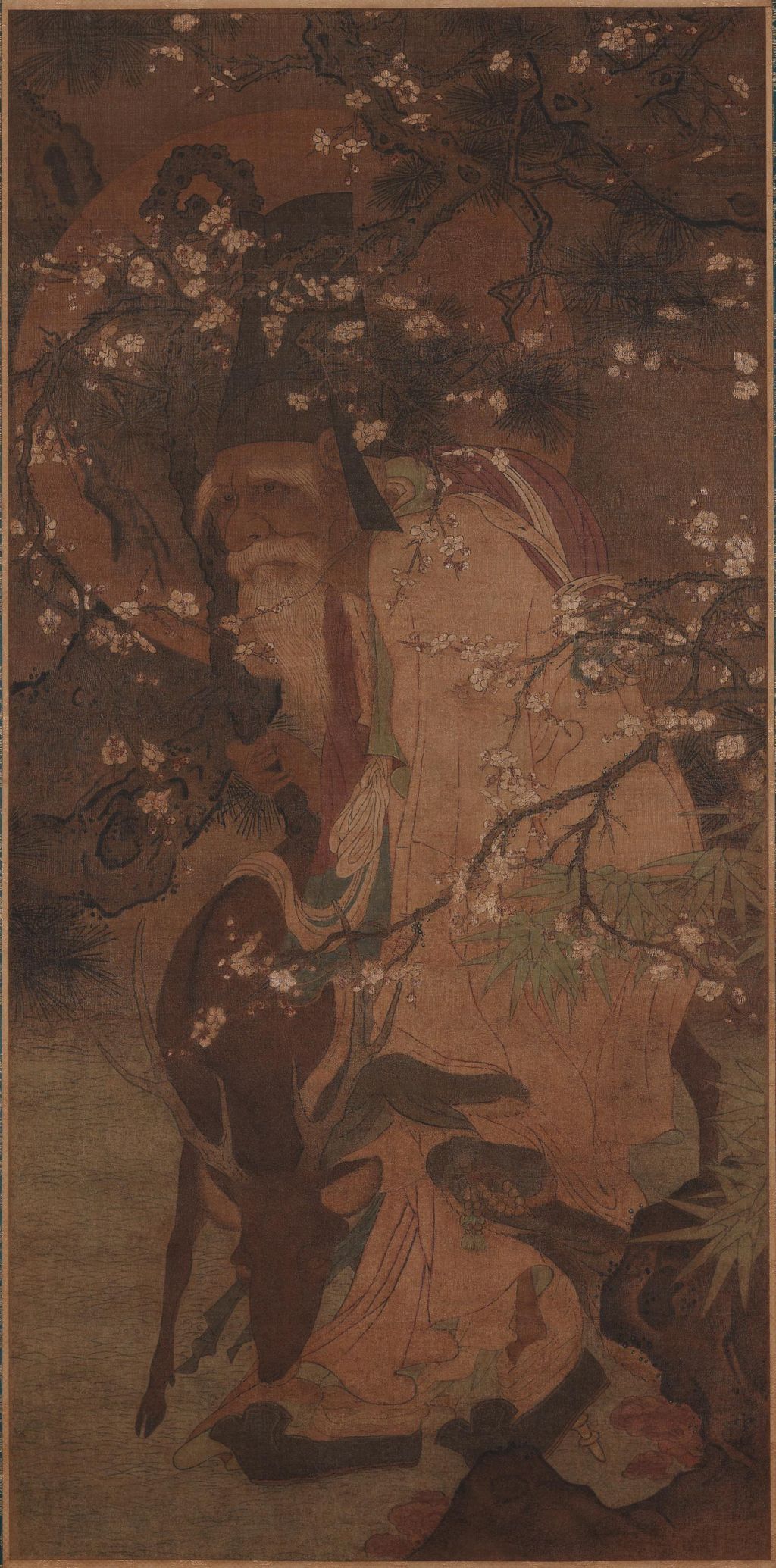
Shoulao under a Plum Tree
Tokyo National Museum A-11962 · coloured figure painting catalogued by Sesshū.
ColBase · Resized image. Exact object and image record.
Birds and Flowers of the Four Seasons, screen 1
Tokyo National Museum A-12335 · attributed to Sesshū; not secure autograph.
ColBase · Resized image. Exact object and image record.
Birds and Flowers of the Four Seasons, screen 2
Tokyo National Museum A-12335 · the other screen, attributed to Sesshū.
ColBase · Resized image. Exact object and image record.
Landscape after Sesshū, Kano Tsunenobu copy
Tokyo National Museum A-2291 · seventeenth-century copy by Kano Tsunenobu.
ColBase · Resized image. Exact object and image record.
Bokushō Shūshō, Splashed-Ink Landscape
Met 2015.300.55 · separate early-sixteenth-century painter’s variation.
Met Open Access · Resized image. Exact object and image record.
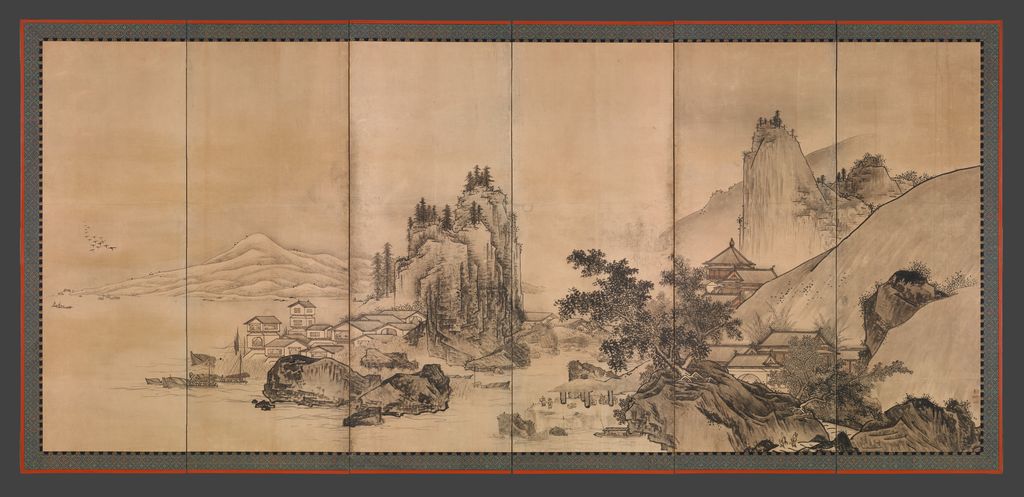
Unkoku Tōgan, Landscape of the Four Seasons
Met 2015.300.73.1, .2 · later painter who claimed Sesshū’s legacy.
Met Open Access · Resized image. Exact object and image record.
“By,” “attributed to,” “after” and “copy”
These short catalogue terms are a central feature of the Sesshū story. “By” on A-282 [1] or A-1398 [3] records the holding museum's authorship. “Attributed to” on A-12335 [9] states a less certain association. A-2291 [10] is not a Sesshū work with an unusually late date: ColBase identifies a seventeenth-century Kano Tsunenobu copy after a Sesshū original. The Met's Bokushō Shūshō [6] is another maker adapting the haboku approach, while Unkoku Tōgan's four-season screens [7] represent a later painter who worked under Sesshū's influence. All can be worth viewing; none should be quietly relabelled as a direct Sesshū painting.
Kyoto's 2024 exhibition [4] argues that the painter's canonical status cannot be understood from today's list of authentic works alone. During the Edo period, some now-disputed “Sesshū paintings” were easier for artists to see or know through copies than works kept privately. A copy could influence a later hand and a critic's idea of Sesshū even when its source was uncertain. The gallery on this page therefore offers an attribution filter rather than a simple grid of “masterpieces.” A reader can inspect documented works first, then switch to attributed works, copies and later responses. The labels tell the story of changing knowledge instead of hiding it.
This filter is also an image-rights safeguard. The seven ColBase files carry an official policy permitting commercial use when the database is credited and linked, with edited images disclosed. The two Met files have object-specific public-domain/Open Access flags. The ledger retains original files, URLs and hashes. We have not pulled a high-resolution e-Museum view of the 1495 scroll merely because the pixels exist: that site's own terms restrict website reproduction. A production page can be visually rich and still respect both the attribution and the file-source boundary.
Pupils, successors and the making of a legend
Sesshū's influence did not move through one unbroken, easily documented studio line. The Kyoto exhibition [4] names Shūgetsu, Sōen and Tōshun among the people he taught. The 1495 dedication gives Sōen a special evidential place: here the teacher-student relation is written on an exact surviving artwork. Later painters Unkoku Tōgan and Hasegawa Tōhaku presented themselves as inheritors of Sesshū but were not his direct students. The Met's Unkoku landscape screens [7] give a distinct, accessioned example of such reception. In the Edo period, Kano Tan'yū looked to Sesshū while shaping a widely influential painting language, and Kano copies and sketches helped spread what people thought a Sesshū picture was.
The mouse painted with tears is part of that history of fame. Kyoto National Museum's essay [5] explains the familiar story: a young monk tied to a pillar supposedly makes a lifelike mouse with tears and his toe, impressing the priest who had punished him. The museum traces the written tale to Kano Einō's early Edo Honchō gashi and calls it fiction. The British Museum's biographical entry [15] also labels it a legend. It deserves a short, clearly marked place on this site because readers may arrive looking for it, and because the tale shaped public familiarity. It does not tell us how the historical child actually learned to draw.
The modern title “saint of painting” has its own history. Six National Treasure designations register extraordinary esteem; the work of later painters, collectors, editors and museums also made Sesshū visible. This is the point of the 2024 Kyoto catalogue, The Legend of Sesshū: Birth of a Master Painter [16], verified as a 264-page publication with 87 works. We recommend it as a substantial museum book, without implying we have read the whole volume. A reader interested in the longer history of ink painting may also use PIE International's Sumi-e: The Iconography of Japan [17] for wider context; its catalogue description names Shūbun and Sesshū. Book recommendations come after the page's numbered reference list, separate from claims that rely on text actually consulted.
What later viewers could actually see
A famous name does not guarantee that the original painting was available to every artist inspired by it. Kyoto's exhibition separates works it considered foundational from works that later viewers knew through claims, sketches and copies. The British Museum's copy after the Mōri long scroll [22] is a particularly concrete case: its entry identifies the 1486 original in the Mōri collection and later copies associated with Unkoku and Kano makers. Those copies had their own circulation and could carry compositions to audiences beyond a private original. The question “What did a later painter actually see?” matters as much as “Which Sesshū painting does this resemble?”
In the Edo period, the Kano house had institutional reach, and Kano Tan'yū's admiration could help turn Sesshū into a lineage claim. Kyoto's exhibition [4] notes that some widely influential “Sesshū paintings” have since lost that attribution. That does not make their historical influence unreal. It means that reputation can be built from a mixture of authentic works, works believed authentic at the time, reproductions and stories. The site can show this process with the explicitly labelled Tsunenobu copy A-2291 [10] and the Met's Unkoku screens [7], while keeping the actual National Treasures beside them as separate objects. This is a more useful art history than treating every derivative image as an inferior footnote or, in the opposite direction, as a concealed Sesshū autograph.
A route through the works
Start with the 1495 Splashed-Ink Landscape. See the whole hanging scroll before looking only at its bottom third. Its inscription makes the picture a record of how Sesshū wished to present a teacher, a student and a chain of models. Then move to Autumn and Winter Landscapes and compare how a path and a cliff lead the eye through two separate scenes. The biography will place the painter's movement from Kyoto to Yamaguchi and China beside that sequence, with confidence levels for each date and relationship. These four pages serve different reader questions and should link to each other without repeating the same compressed life story in every article.
After those works, use the gallery's attribution states as a second route. The coloured Shoulao asks whether a narrow monochrome idea of Sesshū misses part of his practice. The bird-and-flower screens show the visual richness of an attributed pair while keeping the label visible. A Kano copy and two later Met paintings let us watch later hands remember, adapt or reconstruct Sesshū. The result is not a neat ladder from “original” to “inferior imitation.” Each object has its own time and role. The category helps us avoid claiming a copy as proof of what Sesshū's brush directly did.
Several uncertainties remain honest limits rather than flaws to hide. The exact year of death is printed with a question mark by Kyoto; the A-1398 pair has a broad date; the 1495 inscription is first-person evidence for a claimed lineage; the early childhood mouse tale is late fiction; and the surviving corpus includes debated attributions. We can still say a great deal. Exact images and records show how Sesshū varied the weight of brush, the distance within a landscape and the form of an object made for a human relationship. His later reception shows how paintings became models, copies, claims and stories. Looking closely at both histories makes his achievement more concrete than the single word “master.”
Reader insights and discussion
Name the exact object and say whether it is by, attributed to, copied after, or made in response to Sesshū.
Reader Insights
How does the text above the image alter your reading of the landscape?
What do the path and cliff do to the sense of distance?
What can a later copy tell us about how Sesshū was known?
Join the Conversation
Include the museum accession that prompted your observation.
References
- Tokyo National Museum / ColBase, Splashed-Ink Landscape, A-282. Exact National Treasure, 1495, Sesshū inscription, six monks' poems, visual guide and reusable image file.
- Tokyo National Museum, 2007 account of Splashed-Ink Landscape and Sesshū's career. Shōkoku-ji, Yamaguchi, 1467 embassy, named Chinese and Japanese painters in the inscription.
- Tokyo National Museum / ColBase, Autumn and Winter Landscapes, A-1398. Exact paired National Treasure scrolls, date range, Manshu-in transmission, visual reading and two image files.
- Kyoto National Museum, The Legend of Sesshū exhibition, 2024. Six National Treasure works, authenticity and reception, pupils and later successors.
- Kyoto National Museum, museum dictionary on the mouse legend. Kano Einō, early Edo publication and fictional status.
- Metropolitan Museum of Art, Bokushō Shūshō, Splashed-Ink Landscape, 53228. Separate later painter and haboku comparison, Open Access.
- Metropolitan Museum of Art, Unkoku Tōgan, Landscape of the Four Seasons, 53240. Later claimed successor, separate screen pair, Open Access.
- Tokyo National Museum / ColBase, Shoulao under a Plum Tree, A-11962. Separate coloured figure painting catalogued by Sesshū.
- Tokyo National Museum / ColBase, Birds and Flowers of the Four Seasons, A-12335. Pair catalogued attributed to Sesshū, not an autograph claim.
- Tokyo National Museum / ColBase, Kano Tsunenobu copy after Sesshū, A-2291. Seventeenth-century copy, separate authorship.
- National Center for the Promotion of Cultural Properties, ColBase reuse FAQ. Commercial reuse, credit, link and crop disclosure.
- Kyoto National Museum, View of Amanohashidate object essay. Separate place painting and composition.
- Kyoto National Museum, Huike Offering His Arm to Bodhidharma object essay. 1496 figure painting held by Sainen-ji.
- Yukio Lippit, The Art Bulletin 94.1, 2012, article abstract. Article verified; claims here restricted to publisher abstract.
- British Museum, Sesshū biographical record. Mouse story marked legend and later written source.
- Kyoto National Museum, 2024 Legend of Sesshū catalogue listing. Verified publication details, not cited as though read cover to cover.
- PIE International, Sumi-e: The Iconography of Japan publisher record. Verified book recommendation for broader Japanese ink-painting history.
- Mōri Museum, collection account of the 1486 long Landscape of the Four Seasons. Original sixteen-metre scroll and dated colophon.
- Kyoto National Museum, its different Four Seasons Landscapes handscroll. Roughly 11.5 metres, sometimes called the short scroll.
- Kyoto National Museum collection database, same short scroll. Records the attribution as attributed to Sesshū.
- Kyoto National Museum, 2024 exhibition object list. Separately identifies the Mōri long scroll and other four-season works.
- British Museum, copy after Sesshū's Mōri long scroll. Research record for later copying and circulation.
