


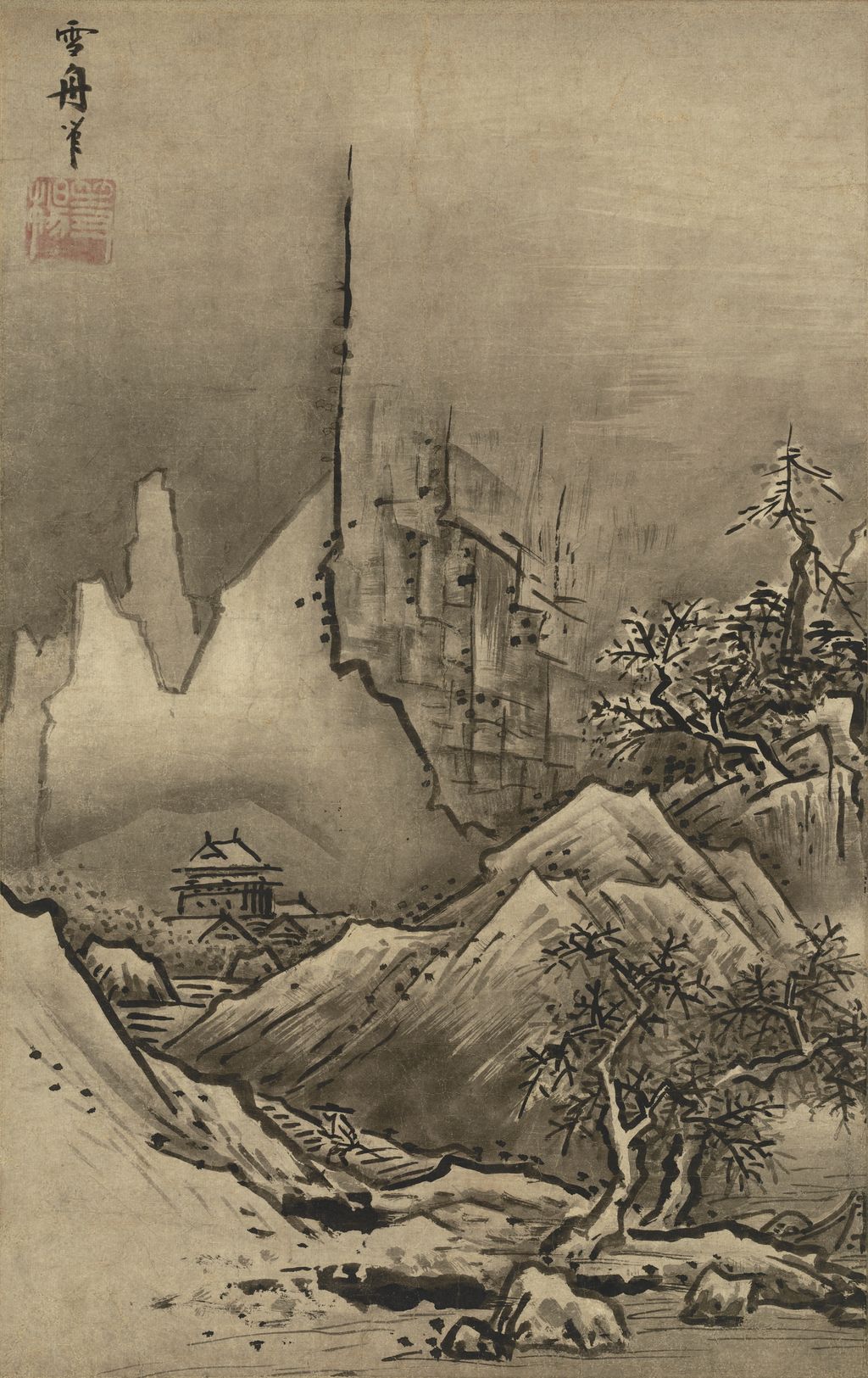
Winter scroll of the National Treasure pair, Tokyo National Museum A-1398. ColBase image, resized for web display.
 by Tom Gurney
Tom Gurney BSc (Hons) is an art history expert with over 20 years experience. Updated September 24, 2026.
Introduction
Contents
- Introduction
- Begin with the pair, not a favourite detail
- The right-hand scene: a route beneath open sky
- The left-hand scene: cliff, pavilion and an obstructed journey
- Brushwork as construction
- Were they once part of four seasons?
- Seasons as interpretations, not automatic labels
- Eight views of two paintings
- What the pair adds to Sesshū's work
- Reader insights and discussion
- Books on Sesshū and ink painting
Two small hanging scrolls invite the eye to travel from a rocky near shore toward buildings and mountains. Yet the routes feel different. In the picture now called Autumn, a river, stepping path and clustered trees draw us to a distant building under a broad open sky. In Winter, a cliff cuts into the centre of the view, so that a tiny building, path and shore have to negotiate its weight. The contrast is the subject of Sesshū Tōyō's Autumn and Winter Landscapes, Tokyo National Museum A-1398. This is a pair of distinct upright paintings, not a single continuous panorama and not the 1486 sixteen-metre Four Seasons handscroll in the Mōri Museum. [1] [2] [3]
The National Treasure designation belongs to the pair. The Agency for Cultural Affairs describes two ink-on-paper hanging scrolls, the painting surface of each 47.7 × 30.2 cm, dated broadly to the late fifteenth or early sixteenth century. The pair was formerly transmitted through Manshu-in in Kyoto. Those basic facts keep the article on a specific object. No inscription here gives the narrow precision of Sesshū's 1495 Splashed-Ink Landscape, so an account of the two scenes must not invent a single commission year or read them as a diary of weather he experienced. [1] [2] [4]
There is also a productive uncertainty in the title. The right-hand scroll is presently called Autumn, but its seasonal signs are less decisive than the winter snow of the left. The museum's explanatory essay on e-Museum says the pair was formerly called Summer and Winter, and records a scholarly proposal to call it Spring and Winter because an old plum tree appears on the right. This page uses the current museum title for clarity while explaining that the season attached to one painting has a history. It does not turn the old name or new proposal into settled fact. The same essay reports competing ideas about what format the two pictures originally served. We can compare their compositions with confidence while remaining cautious about the lost parts, if any, around them. [5]
Two scrolls and their evidence
| Question | Holding-source answer | Limit |
|---|---|---|
| Exact object | Tokyo National Museum A-1398, National Treasure pair of two scrolls | Not the Mōri long handscroll or a later four-season screen. [1] [2] |
| Attribution | Catalogued by Sesshū Tōyō | Keep exact item and museum together; attribution to other objects cannot be inferred from style. [1] |
| Date | Late fifteenth to early sixteenth century | Do not substitute 1486 or 1495 from other works. [2] |
| Material and dimensions | Ink on paper; each image 47.7 × 30.2 cm | Small sheets can imply a wide world without physically spanning one. [2] |
| Provenance | Formerly kept at Manshu-in, Kyoto | The record does not settle their original function. [1] [5] |
| Seasons | Current title Autumn and Winter | Right-hand season has also been called Summer; Spring has been proposed. [5] |
| Source images | Two ColBase files under A-1398 | The page's web views and details are derived from these files, not e-Museum images. [1] [6] |
Compare the two full scrolls
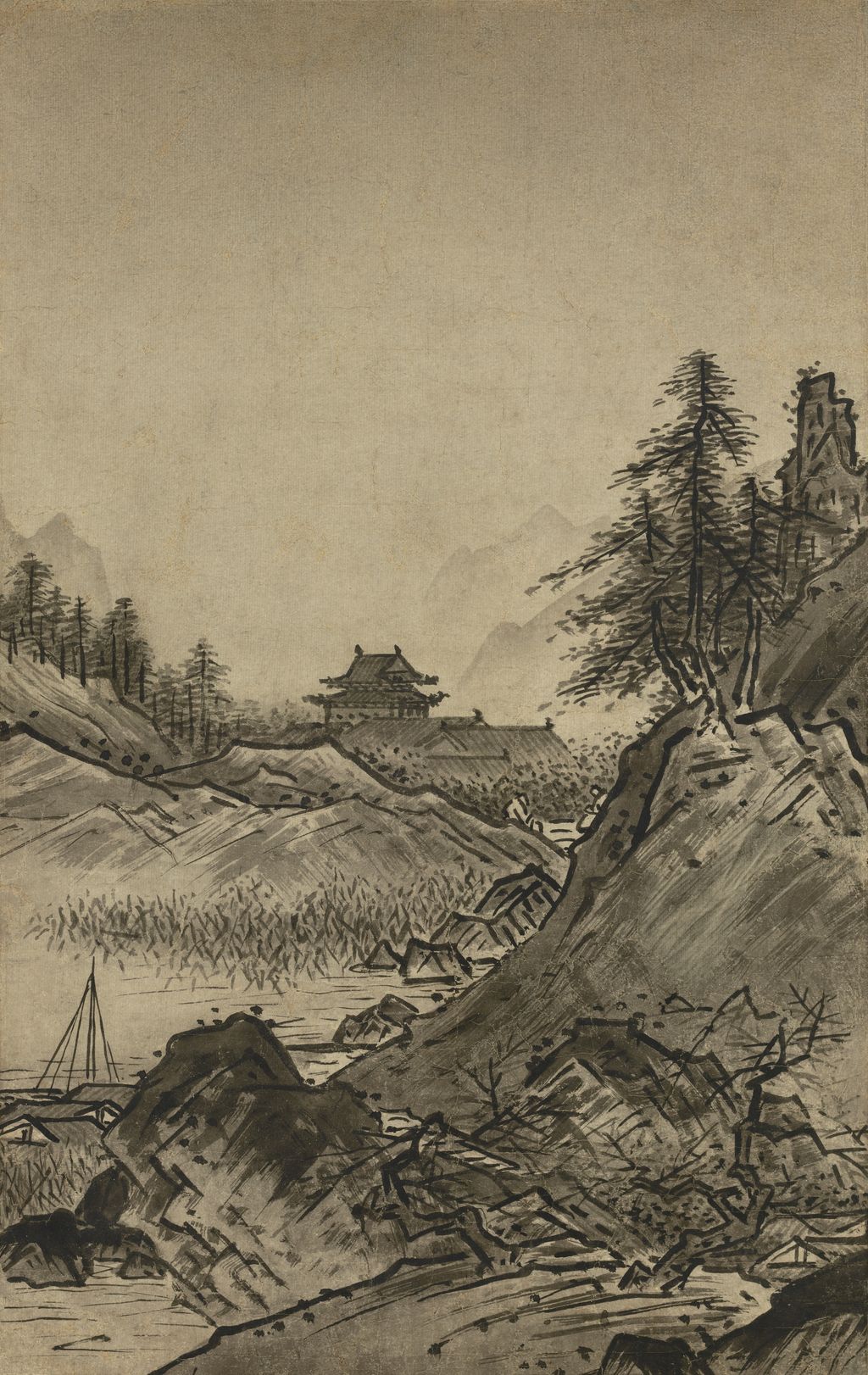
The right scroll’s “Autumn” name has been debated. Labels follow the current museum title; views are resized from ColBase A-1398.
Begin with the pair, not a favourite detail
Tokyo National Museum's 2015 National Treasure gallery described the autumn view on the right and winter on the left when displayed together. That orientation is useful, but online pages often stack images vertically or show one at a time. A digital comparison should label both every time. The two scrolls are similar in size and medium, yet the visual event is not the same. Autumn opens a large, pale upper region over concentrated forms below. Winter places a blunt, sheer mass close to the middle, reducing the scale of the distant pavilion. Seen side by side, the pair can teach composition more directly than a generic label such as “Chinese-style ink landscape.” [2] [7]
The site therefore begins with both complete ColBase-derived views and offers an Autumn/Winter switch for focused observation. The annotated details do not replace the whole scrolls. They point back to positions on the original compositions: the boat and river, the middle path, the distant building in Autumn; the cliff, small pavilion and foreground shoreline in Winter. Cropping is a tool for noticing, but it can hide the very scale relationships the pair is about. Each detail remains linked to an exact object record and can be enlarged through the site's standard image popup. [1] [6]
The Museum dates the pair within a broad span. It is tempting to claim that one scroll records a particular late-life change of style or that the autumn scene came first because its path feels more open. Neither follows from the records. The pictures work as a comparison even without such a narrative. We can describe what a viewer encounters, distinguish that from a hypothesis about production, and ask why similar-sized sheets use space so differently. [1] [2]
The right-hand scene: a route beneath open sky
The Agency for Cultural Affairs describes the right-hand picture as a road running along a river toward a building in the distance. Much of the motif is concentrated in the lower half, leaving the upper area broad and comparatively quiet. At the bottom, land, dark rocks and water meet. A boat on the river is small next to the hard edges of the near bank. The eye begins with that contrast of dark weight and pale space, then moves past vegetation and stepping forms toward a pavilion. The sequence does not need a large format to feel extended. [2] [7]
The path is neither a flat line across the sheet nor a fully mapped trail whose every step can be counted. Ink edges and breaks carry it in stages. Trees create a screen at middle distance; built architecture provides a destination without making a precise view of a named Kyoto or Yamaguchi site. The collation of repeated small marks, roof lines and darker near rocks gives the eye enough landmarks to build a route. Above, pale mountains and extensive paper allow the space to breathe. Calling it “open” refers to how much of the upper sheet remains visually unburdened, not to a literal measured sky over a topographically identified river. [1] [2]
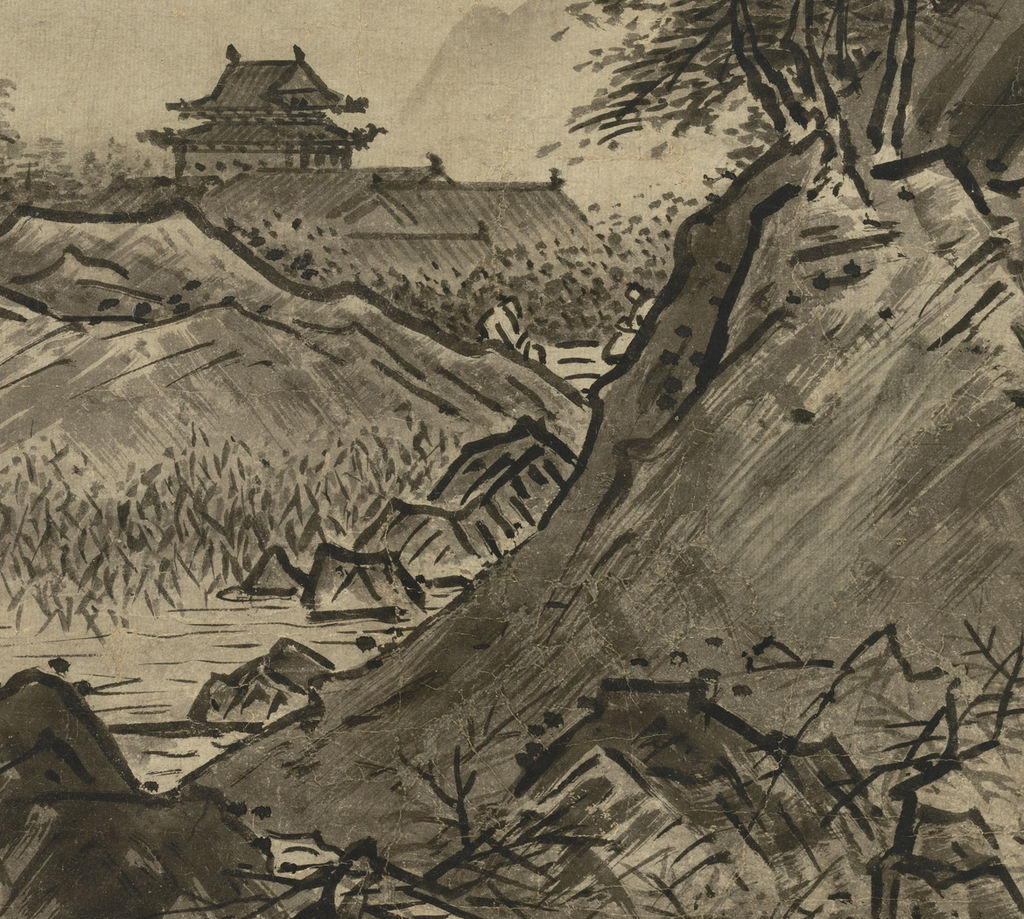
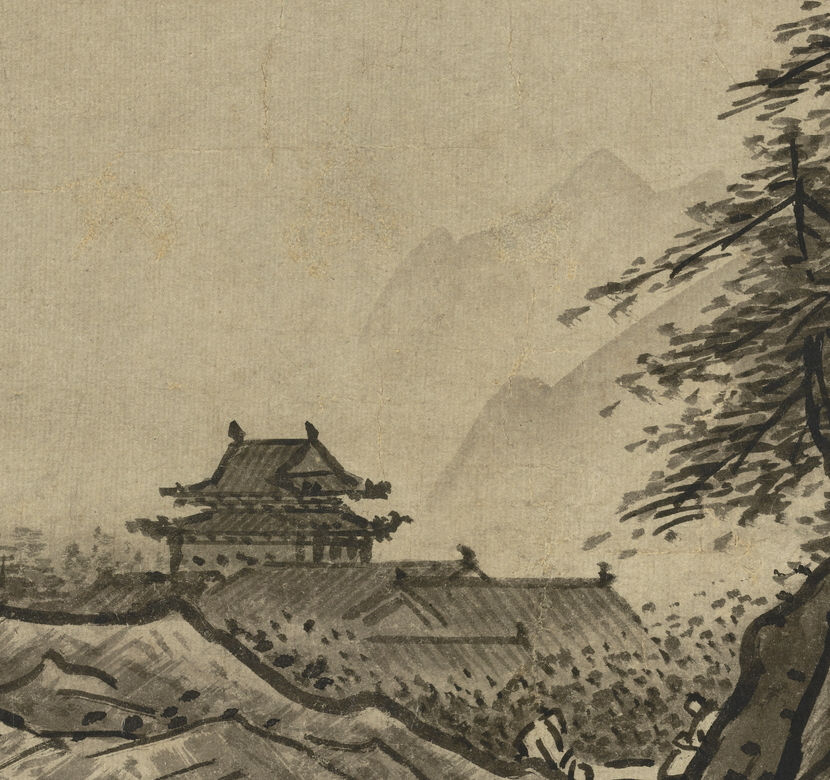
Look especially at the far pavilion. It is not detailed like a portrait of a building, yet its layered roof and placement give the journey a human point of arrival. The cropped detail retains the surrounding pale mountain and trees so that the structure is not presented as an isolated architectural drawing. In the full scroll, its small scale is essential: it is distant because foreground rocks, path and vegetation make the approach feel long. If we enlarge only the roof, we gain line detail but lose the painter's distance-making. The annotated module keeps both a numbered point on the full view and a separate explanation underneath. [1] [2]
The seasonal word Autumn is a modern framing of this observed design, not an unambiguous object embedded in every brushstroke. The upper emptiness may suggest a large autumn sky, as the Agency's interpretation says, but the e-Museum discussion points out that the right sheet lacks a decisive sign of autumn. Older viewers called it Summer; another reading has seen an old plum tree as a spring clue. We can recognize the official current title without forcing each tree or sky passage to prove it. The uncertainty makes the image more interesting: seasonal naming is a claim about an artwork, and claims can change as scholars look again. [2] [5]
The left-hand scene: cliff, pavilion and an obstructed journey
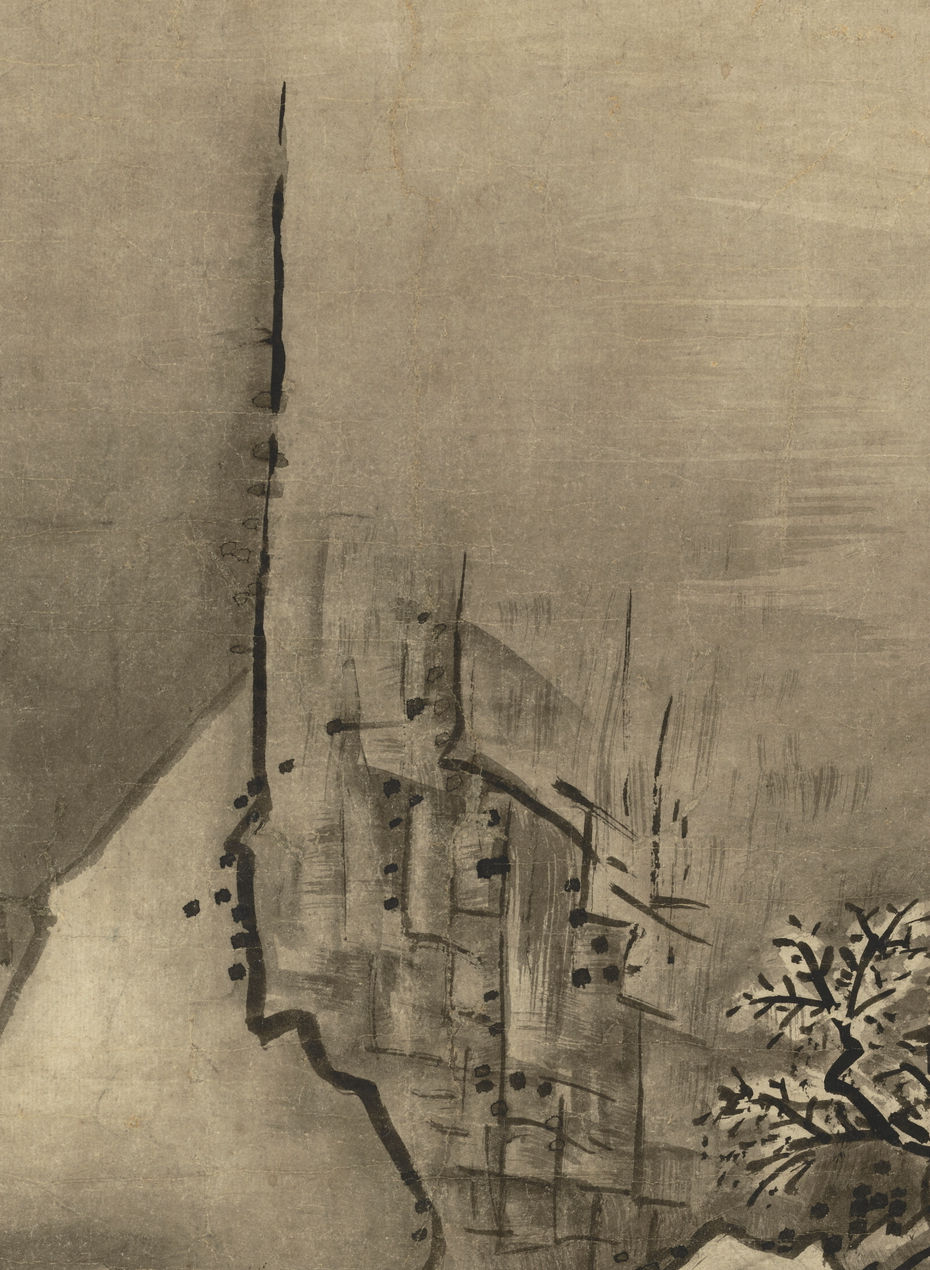
In Winter, the first emphatic feature is the central cliff. A long vertical edge makes the sheet feel steeper than Autumn, while overlapping dark and light planes refuse to resolve into a smooth mountain. The e-Museum textual essay calls attention to the way the cliff is boldly cut into the view and creates a more complex, almost abstract layering of motifs. The Agency describes the small buildings set against that large mass. Those accounts are more specific than calling the picture merely “wintry” or “dramatic.” They let us ask how the painter used scale, edge and position to make a cramped surface suggest a vast place. [2] [5]
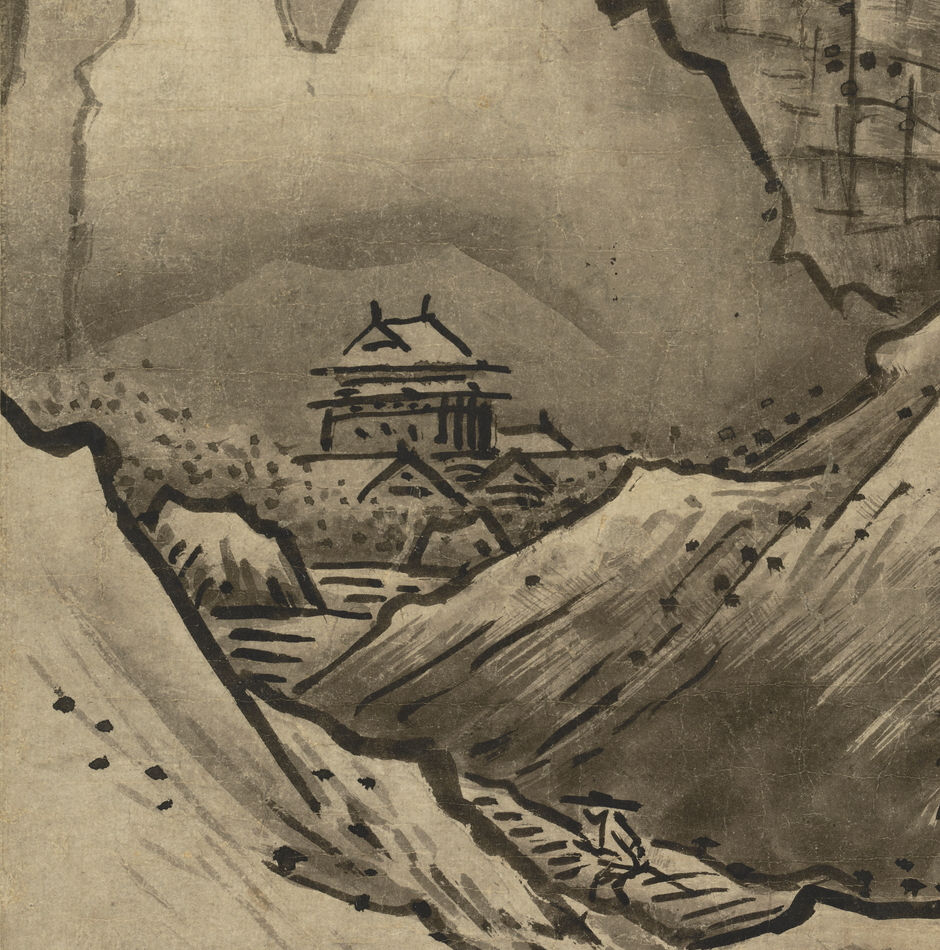
TNM's dedicated gallery text offers a route through the winter scene. It identifies a boat at the lower right, then a path rising leftward and a traveller under the cliff apparently heading toward the distant pavilion. These details are minute in the full web image. Their role is not to turn the painting into an illustrated itinerary with a named destination. They let the viewer test the painter's construction of depth: near water, an ascent, a human figure and a building all compete with the cliff. The cliff's scale makes the pavilion seem farther and the traveller smaller. The path is a way to imagine movement through a picture dominated by an obstacle. [7]
There is a discipline in what our detail images can prove. The published ColBase original is more than 1,500 pixels wide and supports useful crop views, but the lower shoreline crop selected for this page does not clearly isolate the tiny traveller. It is captioned as shoreline, foreground trees and dry brush, not as a close-up portrait of someone the crop fails to show. The main full view and TNM text carry the traveller observation. The cliff and small-building crops are more legible, so they become the strongest annotated points. A visual feature should help readers see what is actually in the file. [1] [7]
The winter title is firmer than Autumn because the left sheet depicts a snowy scene, according to the museum commentary. Yet a snow label should not make us overlook the picture's formal intelligence. Narrow but strong dark strokes draw rocks; soft and light passages suggest snowy distance. Some marks are dry and broken, others wet. TNM stresses these material contrasts, and they are visible at different scales in the source image. Looking from the cliff to the foreground trees, one can see a painter varying pressure, water and ink concentration rather than applying one uniform “winter brush.” [7]
Brushwork as construction
TNM's 2015 exhibition text describes these small paintings as having a firmness and logical organisation unusual in earlier Japanese landscape painting. The Agency for Cultural Affairs likewise calls attention to a rational, constructive arrangement. These are institutional evaluations, not measurable formulas. We can test them through the way motifs line up. In Autumn, the lower path, river, vegetation and pavilion create a chain of nearness and distance. In Winter, the cliff interrupts a similar journey, but path and building keep the possibility of passage alive. Both scenes let the eye move upward from foreground to far distance; they simply give the movement different obstacles and pauses. [2] [7]
The museum connects the pair with the compositional and brush traditions of Xia Gui, a Southern Song court painter, while its other accounts emphasize Sesshū's experience of Japanese monk-painters and Ming modes. A catalogue relationship to Xia Gui does not mean a specific lost Xia Gui picture can be superimposed on A-1398 or that Sesshū was merely copying. What we can see is a Chinese-derived landscape grammar adapted into highly particular arrangements of rocks, architecture, route and open paper. The paintings' strong, sometimes abrasive marks and solid designs have led curators to describe an individual hand within those inherited practices. [5] [7]
The detail crops let the reader study different kinds of mark. Autumn's near rocks are built from repeated angular strokes and dark accents, while the distant building is drawn with relatively precise roof lines against a much softer mountain. Winter's cliff combines a sharp dark edge with washed planes and scattered dots. At the bottom, dry strokes make stony bank and trees. These are observations about the present ColBase files, not a claim to know the exact order in which Sesshū loaded his brush. The 300-dpi working TIFFs retain the original pixels for preparation; their resolution tag is a production convention and does not create detail absent from the museum file. The web images are at most 1,024 pixels wide, quality-80 JPEGs at 144 dpi. [1] [6]
There is a further compositional question in the meeting of building and rock. In Autumn, a fairly legible roof provides an architectural measure against hills whose surfaces are made from broken marks. In Winter, the tiny pavilion is pressed beneath a cliff that seems almost to cut the paper into separate zones. Buildings do not simply decorate the view; they let a viewer judge scale. If the pavilion were omitted from Winter, the cliff could be read as a calligraphic shape with little sense of distance. If the one in Autumn were moved to the foreground, the path would no longer suggest the same journey. That interpretation is a reading of visible placement, supported by the museum's emphasis on small buildings and carefully distributed motifs, rather than a claim about Sesshū's private intentions. [1] [2]
The two images can therefore be compared in terms of intervals: the space between near water and pavilion, between pavilion and mountain, and between marks and open paper. Autumn's upper interval is generous; Winter's upper cliff reduces the feeling of a free sky. The eye is repeatedly asked to infer a route through passages it cannot walk in a continuous line. Small visual discontinuities are part of the depth effect. They allow the viewer to bridge what the brush leaves unresolved. The paintings' precision lies as much in the spacing of these cues as in the force of individual strokes. [1] [7]
Were they once part of four seasons?
The pair's former transmission through Manshu-in is recorded, but its first display setting remains debated. e-Museum's text explains several hypotheses: the two may be surviving members of a four-scroll seasonal set; they may have served as an album or screen-mounting project; or they may have been models for sliding-door paintings associated with an Ōuchi residence. The text does not announce one proven solution. We should not illustrate missing Spring and Summer scrolls as if they are known objects, or convert a possible architectural commission into a fact about a particular building. [5]
The suggestion of a lost four-season set is understandable. Seasonal landscape cycles were an established format, and two named seasons appear to invite two others. But the right-hand season itself is disputed, which complicates a confident reconstruction of a four-part sequence. Moreover, two separate present scrolls are not the same thing as a surviving sixteen-metre handscroll. The Mōri Museum's 1486 Landscape of the Four Seasons is a distinct dated long scroll. Kyoto National Museum has another shorter four-season handscroll with its own attribution questions. These works can provide context for Sesshū's different ways of organising time, but their images and dates cannot be pasted into the gaps of A-1398. [3] [5] [8]
Another question is whether the pair was first seen side by side in precisely its present mounting. The museum record tells us its current form and recorded provenance; the competing original-format hypotheses remind us that mounting history can change how an image is encountered. Our digital switch imitates a focused look at each present scroll, not a reconstruction of a lost Muromachi room. Side-by-side comparison is similarly an analytical tool. Readers should know the difference between today's two hanging scrolls and proposed earlier uses. [1] [5]
The 1936 purchase from Manshu-in, recorded in the e-Museum interpretive text, gives a later firm point in the object's history but does not solve the original commission. A twentieth-century transfer can be documented while the fifteenth-century first mounting remains uncertain. That contrast is useful for any old work: provenance is often a sequence with well-lit and dark stretches. It is also why the caption should say “formerly transmitted through Manshu-in” rather than “painted for Manshu-in” unless another source establishes a commission. The pair may have passed through more settings than the current record reveals. [5]
Seasons as interpretations, not automatic labels
The right-hand sheet's title history offers a useful exercise in art-historical judgment. First list what can be seen without naming a season: river, path, rocks, trees, pavilion, broad pale upper area and perhaps a tree identifiable as plum. Next ask which of those details require a particular month. Winter's snow is relatively direct evidence for winter; an open upper field or an old tree is more flexible. Finally compare the museum's present title with its account of older and proposed names. The purpose is not to pick a new title from a web photograph, but to understand why experts can disagree even about an apparently simple pair of seasonal pictures. [2] [5]
The labels also influence mood. “Autumn” encourages a visitor to see the pale upper half as autumn sky and vegetation as late growth. “Summer” might make the same open space feel warm and hazy. “Spring” would move attention to a possible plum. Each reading selects evidence and leaves other features in the background. On this page the current title remains in headings, captions and links, but a short evidence note beside the comparison prevents the right scroll from being presented as a calendar illustration beyond dispute. [5]
This uncertainty should not unsettle the pair's authorship or National Treasure status. Attribution, date range, provenance and seasonal naming are separate questions. The museum catalogues the paintings by Sesshū; the date is broad; the former Manshu-in ownership is recorded; the season of the right scene remains discussed. Treating these as different columns of evidence is more useful than applying a single vague “uncertain” label to the whole work. [1] [2] [5]
Eight views of two paintings
Six annotated details across two scrolls
Choose a numbered point on either full scroll, read its explanation below, and open the detail in the site’s shared popup. Crops derive from retained ColBase originals.
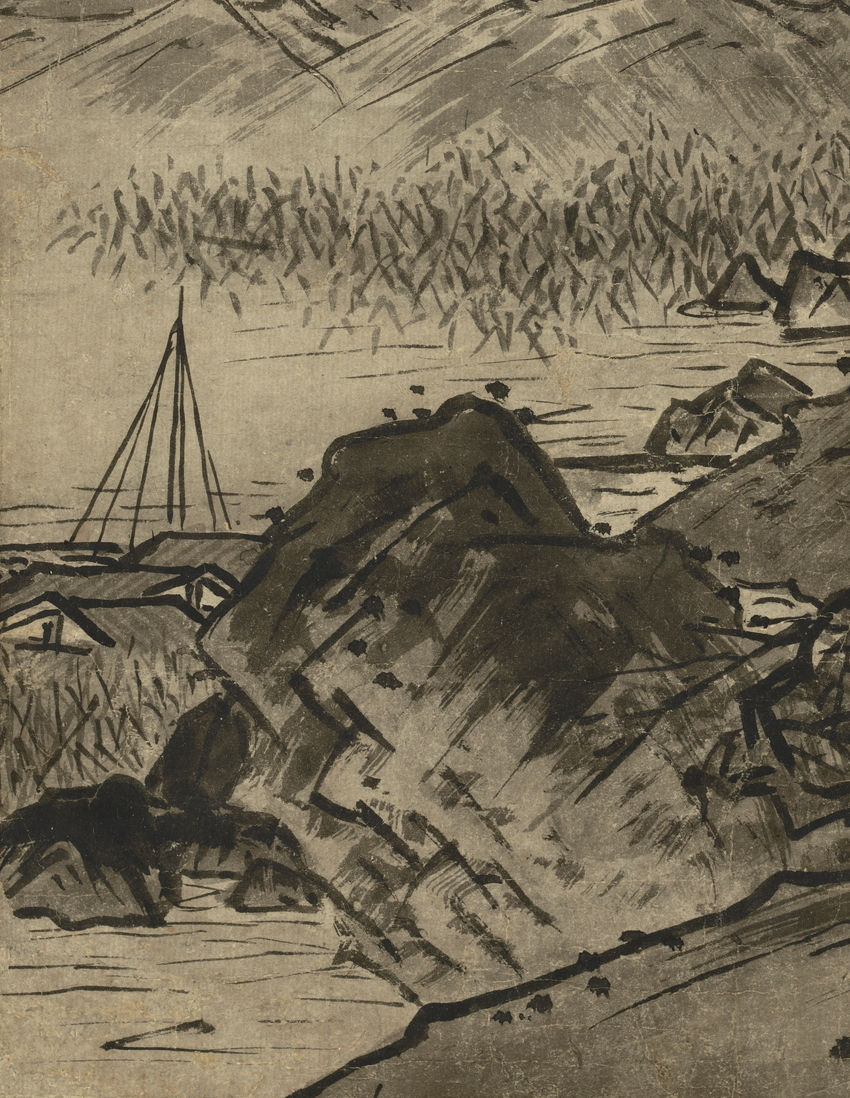
123456Boat and river
The small boat and the pale water establish a lower, nearer zone.
The middle route
Broken edges and vegetation lead the eye toward the distant roof; this is not a measured route map.
Pavilion and open interval
The roof is a destination; pale mountain and paper make it feel remote.
The cut cliff
A vertical dark edge and washed planes build the picture’s central obstruction.
A building beneath the cliff
The pavilion is small against the rock mass, helping the viewer judge scale.
Foreground shore and trees
Dry marks build shore and trees. This crop does not clearly isolate the tiny traveller named in TNM’s text.
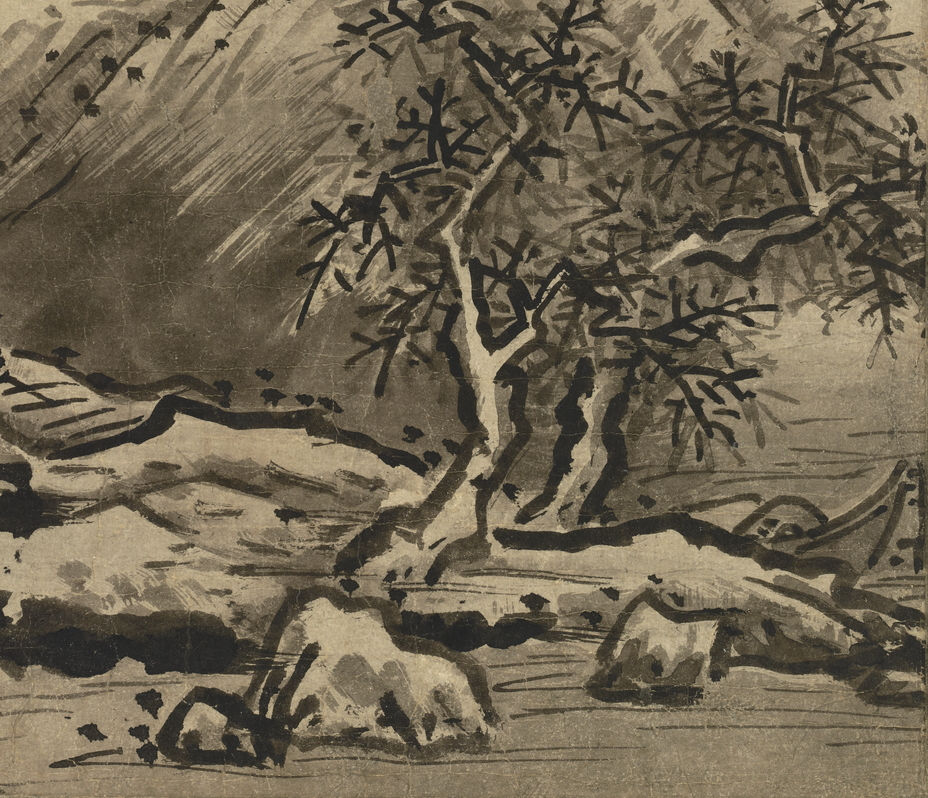
The page's image programme is deliberately finite: two full scroll views and six annotated details, three from each source file. The autumn details centre on the lower river and boat, the middle passage, and the distant pavilion. The winter details examine the cliff, the small pavilion and the lower shore. Each is a crop of a retained ColBase image, documented with its original-pixel rectangle and rights statement. No later copy or unrelated Four Seasons picture is substituted as if it were one of A-1398's two members. [1] [6]
Choose a numbered hotspot on either full view to reach a written explanation, then open the crop in the site's standard enlargement popup. The note under each image says what it points to and what it cannot settle. In Autumn, the small boat confirms water in the lower field, while the pavilion establishes a distant destination. In Winter, the cropped cliff demonstrates mixed ink handling; the tiny pavilion clarifies scale. The lower shore crop draws attention to dry marks without claiming an invisible traveller. This structure keeps annotation tied to an interpretive question rather than treating enlarged fragments as decorative filler. [1] [7]
Because ColBase permits commercial reuse with source credit, link and disclosure of cropping, every derived image points back to A-1398. The original files are retained along with hashes and production records. The e-Museum essay contributes its nuanced discussion of names and original format, but its image-use terms are different and no image from that service is supplied to the page. Visitors should be able to trace both what we say and what we show. [1] [5] [6]
What the pair adds to Sesshū's work
These pictures are neither a miniature version of the Mōri long scroll nor a seasonal variant of the 1495 gift for Sōen. The long scroll asks for a sequential unrolling across many metres; the 1495 picture places a small landscape under an extensive text and poetry; A-1398 asks us to face two compact upright worlds with different distributions of ink and space. Comparing them reveals a painter able to work with several viewing rhythms. A general description of Sesshū as an innovative ink painter is true but less useful than naming the object, its format and the precise visual choice it makes. [3] [4] [8]
Autumn's route passes through land and water to a building under open upper space. Winter's route is constrained by a cliff that makes an already small human world smaller. The present labels help us compare them, even while the right-hand season remains open to discussion. The National Treasure lies not in a single formula for drawing hills, but in the two carefully organised encounters with distance. For the artist's wider history, continue to Sesshū's biography; for a dated landscape in which teaching and inscription are central, see the 1495 Splashed-Ink Landscape. [1] [2] [5]
Reader insights and discussion
Name the exact object and say whether it is by, attributed to, copied after, or made in response to Sesshū.
Reader Insights
How does the text above the image alter your reading of the landscape?
What do the path and cliff do to the sense of distance?
What can a later copy tell us about how Sesshū was known?
Join the Conversation
Include the museum accession that prompted your observation.
References
- ColBase, Tokyo National Museum A-1398, Autumn and Winter Landscapes.
- Agency for Cultural Affairs, Cultural Heritage Online entry for Autumn and Winter Landscapes.
- Mōri Museum, 1486 Landscape of the Four Seasons.
- ColBase, Tokyo National Museum A-282, Splashed-Ink Landscape.
- e-Museum, A-1398 interpretive essay on seasons and possible original format; no image reused.
- National Institutes for Cultural Heritage, ColBase image reuse guidance.
- Tokyo National Museum, 2015 National Treasure Gallery explanation of A-1398.
- Kyoto National Museum, shorter Four Seasons handscroll record.
