


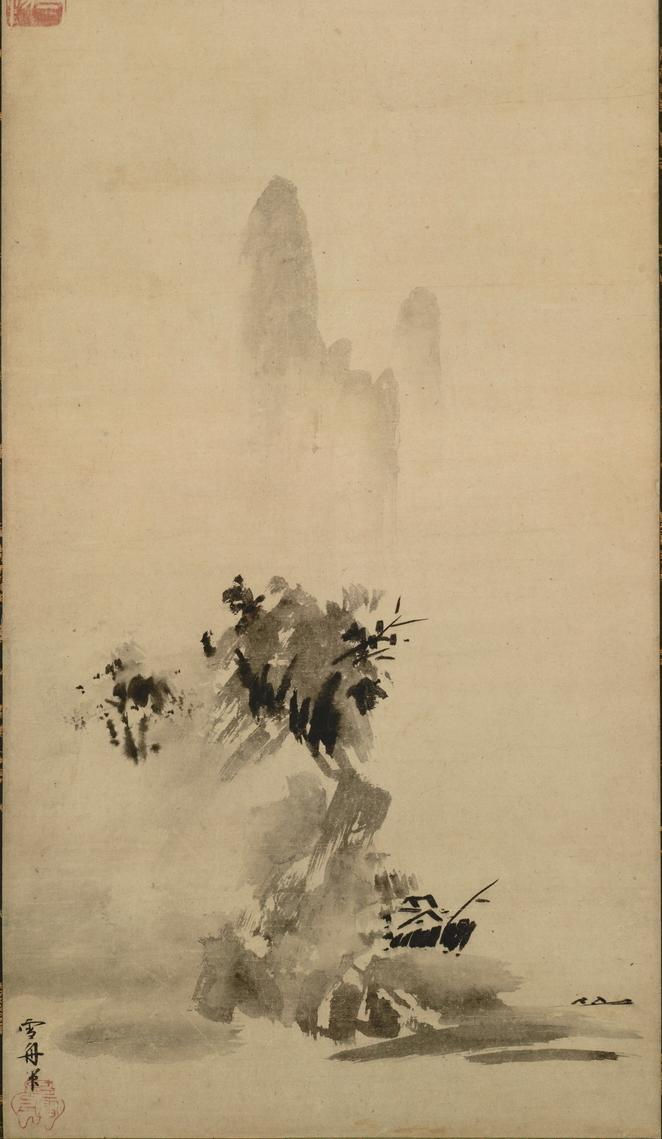
Painted section of the National Treasure, Tokyo National Museum A-282. Cropped from the ColBase object image.
 by Tom Gurney
Tom Gurney BSc (Hons) is an art history expert with over 20 years experience. Updated September 24, 2026.
Introduction
Contents
- Introduction
- A gift at the end of study
- How the scroll accumulated voices
- Sesshū's self-account: China, Japan and authority
- Looking closely at the small landscape
- Haboku and hatsuboku : broken and splashed ink
- What the six poems can and cannot tell us
- Four questions to take to the image
- Related works without merged identities
- Why this work matters
- Reader insights and discussion
- Books on Sesshū and ink painting
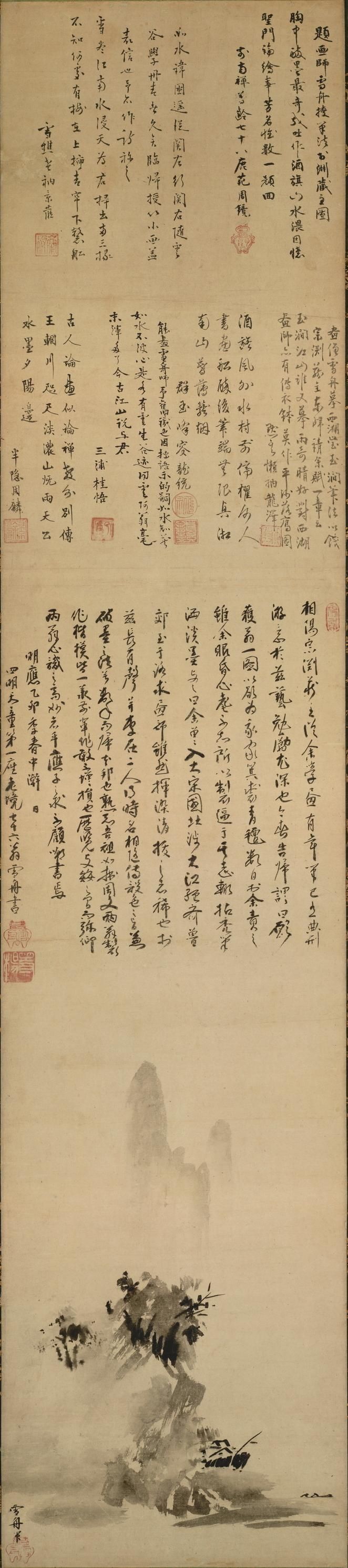
At the foot of this tall hanging scroll, a small inhabited landscape appears from pale washes and decisive dark marks. Above it, writing occupies much more space than the picture. The unusual arrangement is the key to Sesshū Tōyō's Splashed-Ink Landscape, made in 1495 for his pupil Josui Sōen. It was a painted gift at the end of training, a statement by the older artist about his own lineage, and later a surface for poems by six Kyoto monks. A reproduction that shows only the landscape gives us the brushwork but hides the social reason the object exists. The complete Tokyo National Museum scroll, accession A-282, must be the starting point. [1] [2]
It is designated a National Treasure and catalogued by the museum as painted by Sesshū, with his own inscription and poems by six other monks. TNM's detailed object record gives its material as ink on paper, its form as one hanging scroll, and its height and width as 148.9 × 32.7 cm. The same record says the artist was seventy-six when he made it. The first-person dedication is a remarkable near-contemporary source for the teacher-student relation, though it is still an authored account rather than an external diary. The poems represent other makers. This page asks what each layer contributes, how the spare picture builds a place, and why the mode called haboku cannot be reduced to a claim of careless spontaneity. [2]
The object at a glance
- IdentityExact evidence: Tokyo National Museum A-282, National Treasure
Reading limit: Do not substitute another haboku painting or a different impression. [1] [2] - DateExact evidence: Meiō 4, 1495, in Sesshū's inscription
Reading limit: A dated gift; not a date for every related painting. [2] - Material and formatExact evidence: Ink on paper, one hanging scroll, 148.9 × 32.7 cm
Reading limit: The small painted field sits beneath a large textual field. [2] - RecipientExact evidence: Josui Sōen, a pupil leaving the master
Reading limit: The work is evidence of a teaching relationship, not a transcript of lessons. [2] [3] - WritingExact evidence: Sesshū's self-inscription and poems by six Gozan monks
Reading limit: Different hands and occasions; not one uninterrupted text by Sesshū. [2] [3] - Technique wordsExact evidence: Haboku / 破墨 and hatsuboku / 溌墨 both appear in discussions
Reading limit: Their translation as “broken” or “splashed” should not be mistaken for a recipe of random throwing. [4] [5] - Web imageExact evidence: The ColBase file is 662 pixels wide
Reading limit: Suitable for a whole-object view; not a high-resolution transcription or 300-dpi annotation source. [1]
A gift at the end of study
TNM explains that Sōen requested the painting when he had completed his study with Sesshū. An institutional account preserved on e-Museum's text page says he had studied in Suō, the area of present-day Yamaguchi Prefecture, and was returning toward his home in Sagami, present-day Kanagawa. That text is useful research evidence, although e-Museum's image is not used for reproduction here. The National Museum of Asian Art's curator Frank Feltens describes Sōen as originally connected with Kamakura's Engaku-ji and interprets the scroll as a certificate of successful study. That is a curatorial interpretation of the gift's role, not a physical diploma printed on the paper. [2] [6] [7]
The gift has two directions. Sesshū sends a painter who has learned from him back toward eastern Japan; Sōen carries a portable example and a written account of who his master believed his own predecessors to be. The small size of the painted landscape matters in this context. It is something a student can keep, show and study, rather than a monumental wall painting that remains in the master's studio. Sōen's request makes him an active participant. If the page were only about a master demonstrating effortless genius, it would miss the recipient who prompted the work and helped give it a public future. [2] [3]
Art historian Masahiko Aizawa's article, “Haboku Landscape and Sōen” (2007), makes that shift explicit. Its published abstract says earlier studies tended to focus on Sesshū, and asks how much Sōen's own intentions shaped the finished scroll. Aizawa examines the later six inscriptions and the social circle able to provide them. The English abstract, rather than an unexamined full article, is the basis for the summary here. The point changes how we read the page: Sōen was not simply a name in Sesshū's dedication. He may have helped assemble the completed poem-and-painting object as he travelled. [3]
How the scroll accumulated voices
Explore the scroll’s three layers
The source is only 662 pixels wide. These crops are an orientation aid, not high-resolution transcriptions or annotated details.
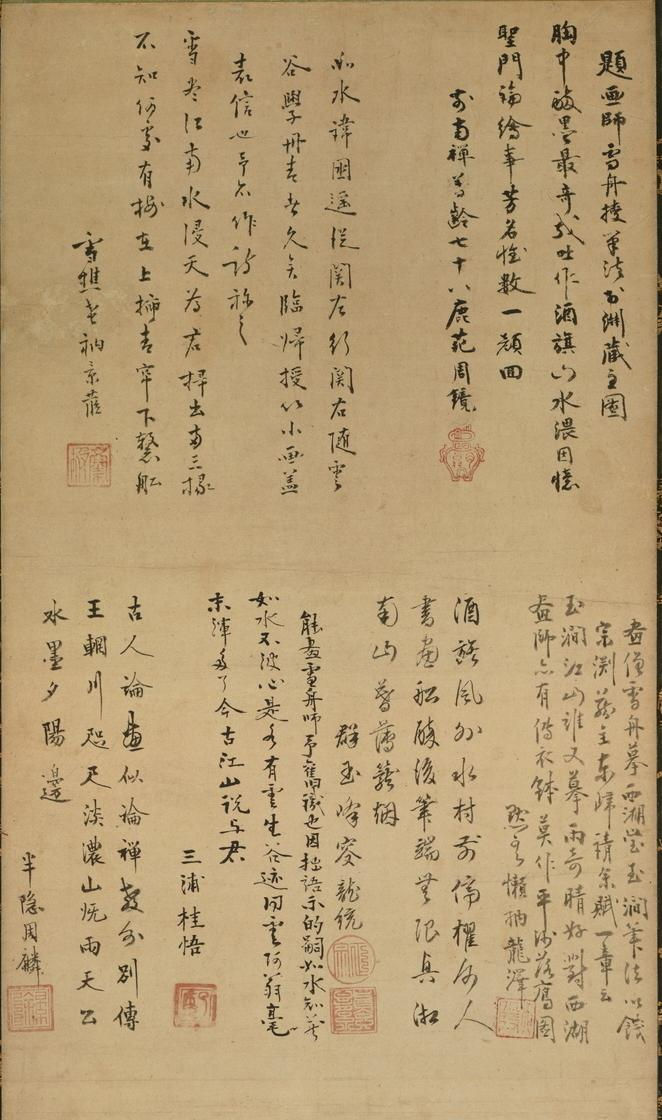
Six monks’ poems. Later poems by Kyoto monks; these are not Sesshū’s self-inscription. ColBase source; cropped for this guide.
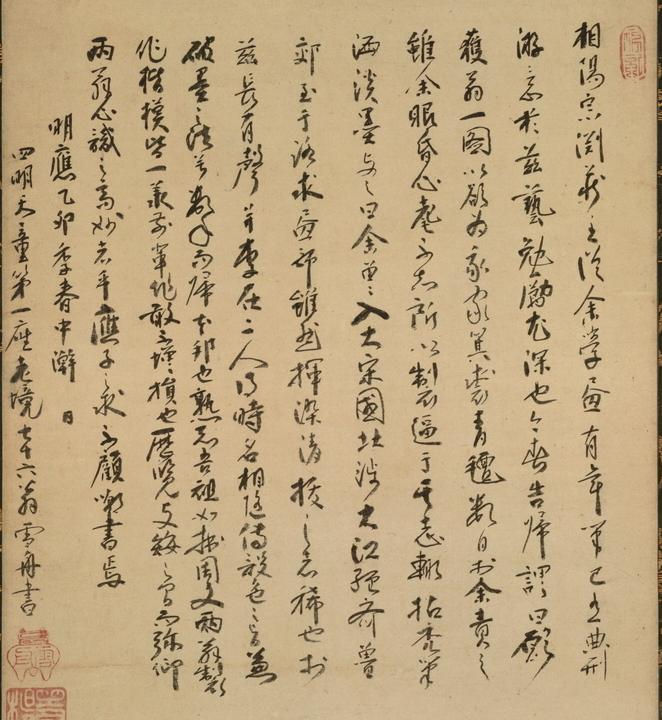
Sesshū’s inscription. The dedication to Sōen and the artist’s account of lineage. Use museum scholarship for a transcription. ColBase source; cropped for this guide.
The landscape. From pale distance to a dark foreground: look for the building, flag and boat. ColBase source; cropped for this guide.
Look at the full object from top to bottom. The six monks' poems occupy the upper registers. Sesshū's text is below them and above his landscape. At the bottom, the painter's brush turns ink into a place. The physical order is not the order in which all the contributions were made. Sesshū first gave the work to Sōen; the poems were added later by Kyoto's Gozan monks, according to the museum account. Sōen's journey offered an occasion for other highly educated writers to respond. A web image that crops away the upper half would erase their participation. [1] [2] [6]
TNM identifies Gettō Shūkyō among the six monks. Aizawa's abstract names all six: Gettō Shūkyō, Ranpa Keishi, Ten'in Ryūtaku, Ryōan Keigo, Shōjū Ryūtō and Keijo Shūrin. It observes that another work inscribed in 1495, now at the Nezu Museum, used the same six men in the same order, with a seventh participant. A 1498 poetry anthology preserved that ordering. The pattern was not a simple sequence by age or institutional rank. Aizawa therefore proposes a connected circle of poet-monks and asks whether the painter-monk Kenkō Shōkei may have helped introduce Sōen. That suggested intermediary is a hypothesis, not an established appointment in Sōen's itinerary. [2] [3]
The inscription sequence has a practical consequence for interpretation. Some of the poems understand the gift as the transfer of a painting method and praise the recipient. The work became a conversation about succession, not merely a critical review of an attractive landscape. The exact classical-language nuances require a specialist transcription and translation. This page therefore describes the poems' roles through the published scholarship rather than printing an unverified line-by-line English translation. Their named authorship and ordering are secure enough to show why the textual area matters. [3] [8]
Sesshū's self-account: China, Japan and authority
In his own text, Sesshū describes learning from Li Zai and Zhang Yousheng in China, then honours the Japanese monk-painters Josetsu and Shūbun. TNM's Japanese object record gives the Chinese names and characterizes the inscription as autobiographical. Another TNM account relates his training at Shōkoku-ji, move to Yamaguchi under Ōuchi protection and voyage with a Ming embassy in 1467. The scroll's value is that the painter named both foreign and domestic sources of authority while handing his method to a younger painter. It is a constructed genealogy as well as information about travel. [2] [9]
The phrase “constructed” need not imply that the voyage was invented. It means that an artist chooses what to say in a text made for a particular audience and purpose. Sesshū did not provide a complete list of every painting he saw, every person he met or the duration of each lesson. He named people whose status would make his brush method meaningful to Sōen and to the later readers of the object. A first-person statement is especially strong evidence that Sesshū wanted these names associated with his own work. It is less strong evidence for the exact logistics of each encounter. This distinction is the difference between reading the inscription as an invaluable historical source and treating it as an unquestionable modern curriculum vitae. [2] [9]
The words also matter because they sit on the same paper as the image. The claim of a lineage is not supplied by a twenty-first-century wall label after the fact. It is an authored component of the object, later surrounded by others' poems. The viewer can move between a distant mountain, a boat, Sesshū's account and the six responses. The format makes authority something to be seen and read, and it allows the recipient's network to add to the teacher's voice. [1] [3]
Looking closely at the small landscape
ColBase's English guide identifies several distances. Light ink suggests far cliffs. Darker wash and strokes make a middle hill. Nearer to us are trees, a building by water, a flag associated with food and drink, and a boat. These cues are easy to miss in a small web reproduction, but they change the picture from an abstract stain into a place where people could arrive, pause and travel onward. The unmarked paper works as atmosphere and water. Forms do not need continuous outlines to occupy different depths. [1]
It is worth looking twice: first from bottom to top to find the dark near bank, buildings, hills and pale peaks; then from top to bottom to feel the transition from the dense social writing into the open paper around the mountains. A few black strokes carry enormous weight because surrounding washes are light. The fragile-looking distance makes the dark foreground feel close. The image is open enough for a viewer to assemble a landscape mentally, but not empty of compositional decisions. The boat and flag are small signs of habitation, not incidental marks that can be reassigned at will. [1]
The image supplied through ColBase is 662 × 2,979 pixels. It lets a visitor appreciate the whole-object proportions and locate painted zones, but the width is insufficient for a claimed high-resolution analysis of individual written characters or tiny boat details. This page can provide a text-led guide, a full original-proportion image, and a link to the museum record. If a genuinely reusable higher-resolution scan becomes available, it may support the standard annotated-detail treatment. Enlarging the current file or taking an e-Museum-sourced high-resolution file from another host would not meet the rights and evidence standard. [1] [10]
Haboku and hatsuboku: broken and splashed ink
The English title “Splashed-Ink Landscape” translates one common description of the mode. Japanese accounts also use 破墨, read haboku and often explained as broken ink, and 溌墨, hatsuboku, often translated splashed ink. The e-Museum textual explanation notes that Sesshū used the word haboku in his dedication even though the visible approach can also be described as splashed ink. A British Museum description of a separate painting associated with the painter likewise discusses both words. These terms overlap in accounts of diluted wash, darker strokes and forms made without continuous outlines; they are not proof that the artist literally poured ink randomly onto the paper. [5] [6] [11]
The Met's explanation of a separate Splashed-Ink Landscape by Bokushō Shūshō describes dark ink applied over wet, lighter washes. The work is an early-sixteenth-century variation on Sesshū's celebrated design. This comparison helps a reader understand a transferable technique: a later painter can work in a related way yet make a different object. The Met also connects the mode to Zen contemplative traditions. Those connections are part of its interpretation, not a licence to say that the Tokyo scroll appeared in a single unplanned trance. Its inscription and training purpose point toward a skilled method that could be demonstrated and transmitted. [4]
In the National Museum of Asian Art's presentation of a separate Sōen landscape, curator Frank Feltens describes a combination of accident and intention, explaining how a painter might build a legible scene around an initially open ink mark. That demonstration concerns Sōen's painting in the Smithsonian collection, not a film of Sesshū making A-282 in 1495. Used with that limit, it offers an effective way to think about the viewer's role: broad ink marks invite the eye to complete mountains, shore and village, while planted details guide the imagination. [7]
What the six poems can and cannot tell us
The poems do more than lend prestigious names to a painting. In Aizawa's account, their common concern with the work as a transfer of painting knowledge makes Sōen's position visible. The student is a person leaving one teaching relationship and entering a new place with an object through which that relationship can be recognized. Gettō's role, the shared ordering of writers and the links with other poetry-painting gatherings suggest that the addition was organised within a cultivated circle. The precise mechanics of its organisation remain debated. Aizawa's suggested intermediary, Kenkō Shōkei, is plausible within the article's reconstruction, but the published abstract does not establish that an introduction definitely happened on a known day. [3]
This distinction matters because a beautifully legible story is easy to invent. We can say that Sōen received a scroll, that six identified monks inscribed poems, and that scholarship has found a telling pattern in their order. We cannot say from those points alone that Sōen visited the writers in the order of the columns or that each was sitting in the same room. The painting's surface preserves a network, but not the complete social itinerary. Looking at the scroll as a layered object helps us keep factual sequence and interpretive hypothesis side by side. [2] [3]
There is a second question: why should poet-monks describe a painting technique at all? In the Gozan milieu, images, Chinese literary knowledge and written responses belonged to connected forms of display. A poem could praise a brush method, compare the recipient with exemplary pupils, or make the scene's flag and boat the material for language. These are not neutral labels identifying every rock. They are responses by historically situated viewers who wanted to make something of the gift. The poems therefore deepen the artwork's history, even when a visitor cannot personally read every character in the web image. A faithful page links to scholarship and labels the inscriptions rather than pretending its reduced photograph is an adequate textual edition. [3] [8]
The order in which the parts now appear also creates a visual hierarchy. A reader of the hanging scroll meets poet-monks first, then Sesshū's voice, then the landscape. The maker's own brush is physically last in the downward passage. That arrangement lets the upper writers frame the small image without replacing it. Reading upward instead, the eye leaves dark ink and arrives at words that explain why a painted method mattered to its recipient. This two-way movement is part of the full object; it disappears in a cropped picture labelled simply “Sesshū landscape.” [1] [2]
Four questions to take to the image
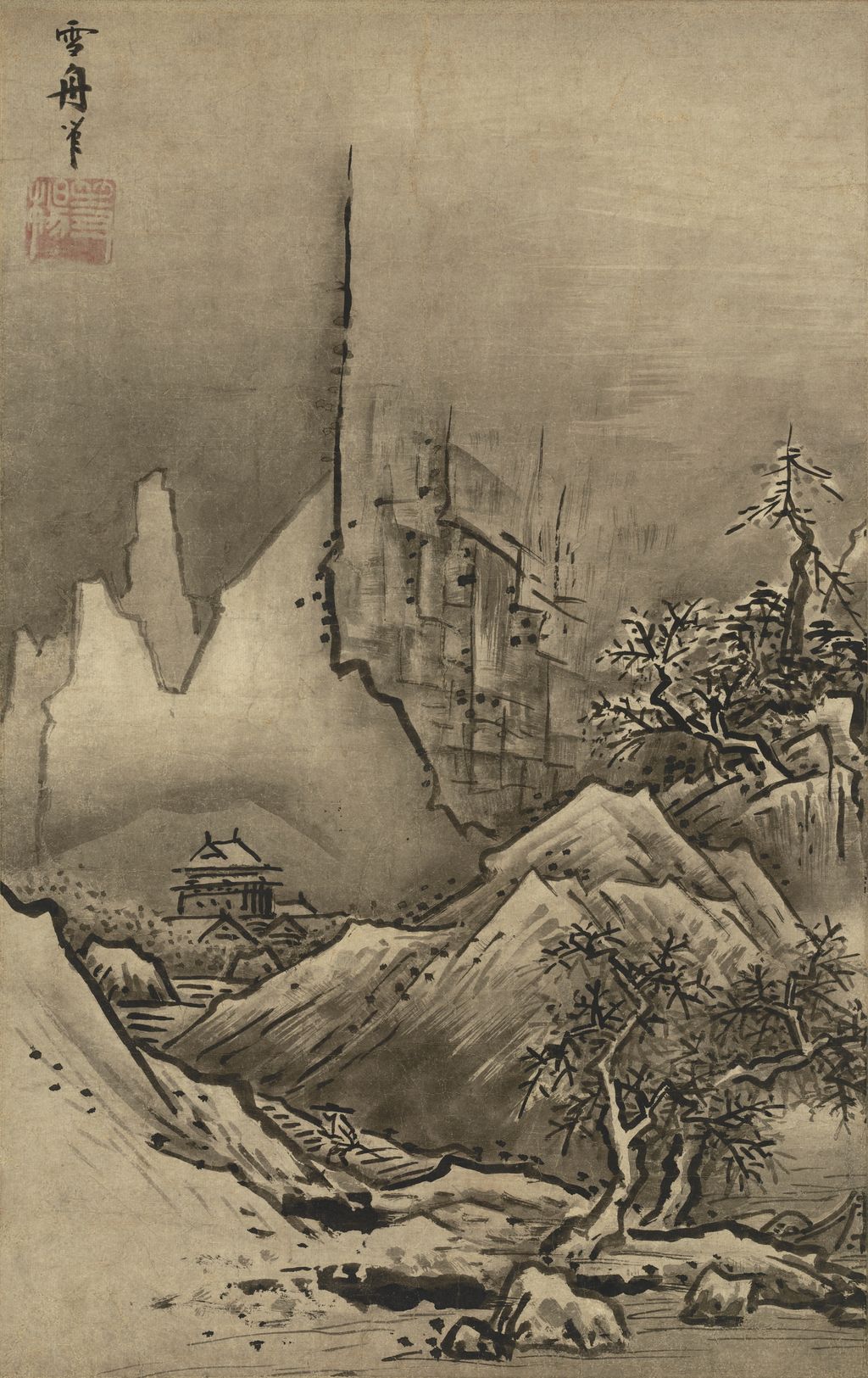
First, where does the lightest ink stop being a shape and become atmospheric distance? Begin with the upper painted peaks, then look for the stronger middle hill. The transition is gradual, and the paper is doing visual work. Second, how many elements make the foreground a lived place? Find the building, its food-and-drink flag and the boat before calling the lower passage an abstract splash. Third, compare the width of the painted field with the width of the written field. They share the same narrow sheet, so the difference is vertical allocation, not a second panel attached for modern display. Fourth, whose voices can actually be identified? The artist and six monks are named in the museum record, while the tiny human presence implied by the boat is part of the represented landscape, not a seventh writer. [1] [2]
These questions distinguish observation from interpretation. The museum's guide supports identifying the building, flag and boat; a viewer can then interpret why these human signs matter amid loosened washes. The historical sources support the authorship and broad sequence of the inscriptions; a viewer can then ask what it means to carry a teacher's picture to other poets. An annotation would normally help mark the elements, but the currently approved ColBase file is too narrow for credible high-resolution detail popups. The reading guide therefore states what to look for in the whole image and leaves open a later rights-cleared image upgrade. [1] [10]
Finally, try comparing this work with a secure haboku variation rather than with a random monochrome landscape. Bokushō's Met painting is explicitly related by the holding museum, yet the objects are not identical. Ask which marks remain open to the viewer's imagination and which details stabilise the space. In the Tokyo scroll, then return to the writing. The same method that can be varied in another painter's hands was made, here, into something teachable and publicly attributable. That is a stronger conclusion than either “Sesshū invented splashed ink” or “anyone could splash ink and make the same picture.” [4] [1]
Related works without merged identities
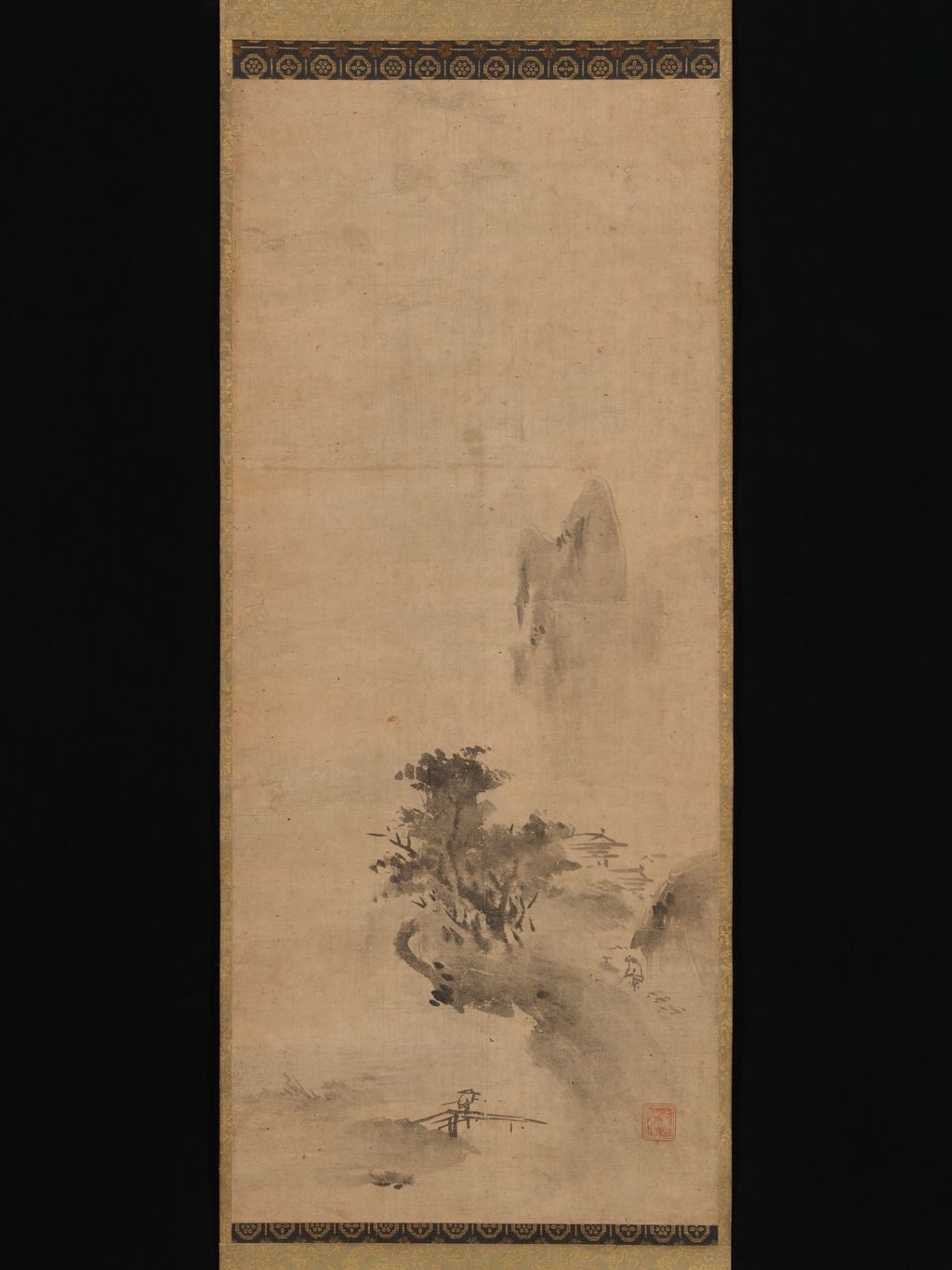
Three comparison objects clarify what makes A-282 specific. The first is Bokushō's Met scroll: a related haboku response by another monk-painter. The second is Sōen's Smithsonian painting, which gives the pupil an artistic identity beyond his role as recipient. The third is the Tokyo National Museum's A-1398 pair of Autumn and Winter Landscapes by Sesshū. Their contrasting path, open sky and winter cliff demonstrate how deliberately different his landscapes can be. No similarity in ink alone gives Bokushō or Sōen the authorship of A-282, and A-1398's broader late-fifteenth to early-sixteenth-century date should not be silently converted into 1495. [4] [7] [12]
The contrast in viewing format is equally important. A-282 has a small landscape under a large textual field and a named student. A-1398 consists of two separate hanging scrolls with different seasonal views. The Mōri Museum's 1486 Landscape of the Four Seasons is a handscroll about sixteen metres long, opened in sequence. A person cannot compare all these as if they were variants of one fixed rectangular picture. They serve different rhythms of looking and different kinds of social use. A close art history begins by keeping accession, format and date beside the title. [1] [12] [13]
Copies can also alter the later sense of Sesshū's style. Kyoto National Museum's 2024 exhibition investigated how pupils, later claimants and works once accepted under his name shaped the artist's reputation. A-282 stands out because the dated self-inscription and museum catalogue offer unusually strong grounds for authorship. That confidence must not be extended automatically to every sheet with washes, a mountain and a seal. The article's comparisons make the autograph more precise, not more generic. [14]
Why this work matters
The National Treasure is a rare picture in which the act of teaching can be studied as part of the artwork's physical history. Sesshū provides the image and a personal account. Sōen receives it at a moment of departure and may help bring it into contact with Kyoto's poet-monks. Their poems elaborate the idea of transmission. Later museums and scholars examine those layers, sometimes recovering the pupil's agency after centuries of emphasis on the celebrated master. The scroll has continued to make relationships visible, even when the precise wording of every conversation is lost. [1] [2] [3]
Its visual force is real: from pale peaks to a dark shore and a few signs of human passage, it creates much with little. Yet its force becomes more interesting when the text remains in view. The landscape is a demonstration within a gift, and the gift is a claim about how painting knowledge moves among people. To continue into Sesshū's other compositional choices, see the separate Autumn and Winter Landscapes page; for the larger life and uncertain later legends, see his biography. [1] [12]
Reader insights and discussion
Name the exact object and say whether it is by, attributed to, copied after, or made in response to Sesshū.
Reader Insights
How does the text above the image alter your reading of the landscape?
What do the path and cliff do to the sense of distance?
What can a later copy tell us about how Sesshū was known?
Join the Conversation
Include the museum accession that prompted your observation.
References
- ColBase, Tokyo National Museum A-282, Splashed-Ink Landscape.
- Tokyo National Museum, A-282 object record in Japanese.
- Masahiko Aizawa, “Haboku Landscape and Sōen,” The Bijutsu Kenkyū 391 (2007), published abstract.
- Metropolitan Museum, Bokushō Shūshō, Splashed-Ink Landscape, 53228.
- British Museum, Sessō Tōyō Haboku-style landscape and terminology.
- e-Museum, A-282 textual object explanation; no image reused.
- National Museum of Asian Art, Frank Feltens on Sōen's ink landscape.
- Yukio Lippit, “Of Modes and Manners in Japanese Ink Painting,” The Art Bulletin 94.1 (2012), publisher abstract.
- Tokyo National Museum, 2007 account of Sesshū's travel and teachers.
- ColBase reuse guidance, National Institutes for Cultural Heritage.
- British Museum, Haboku-style landscape record.
- ColBase, Tokyo National Museum A-1398, Autumn and Winter Landscapes.
- Mōri Museum, 1486 Landscape of the Four Seasons.
- Kyoto National Museum, The Legend of Sesshū, 2024.
