


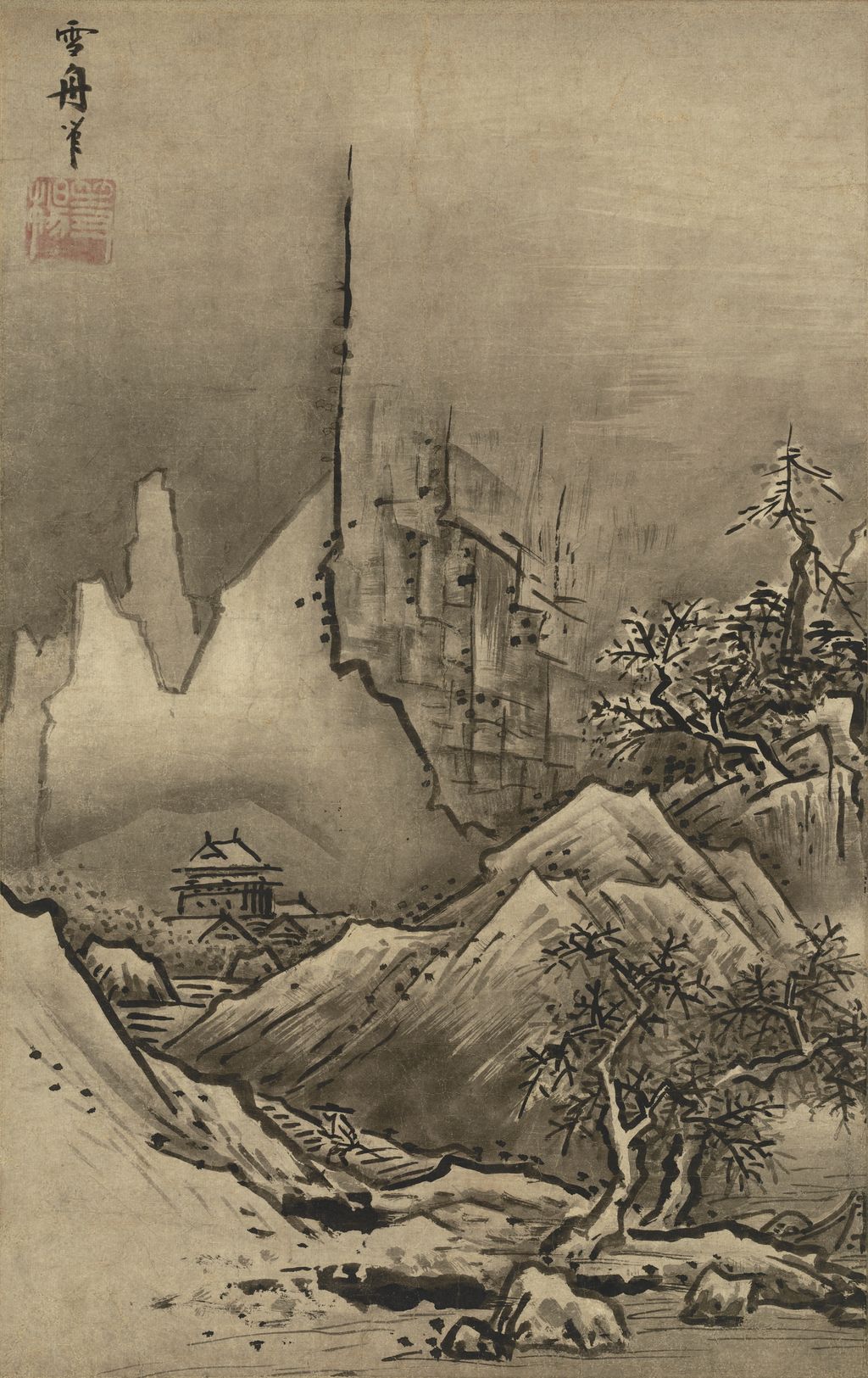
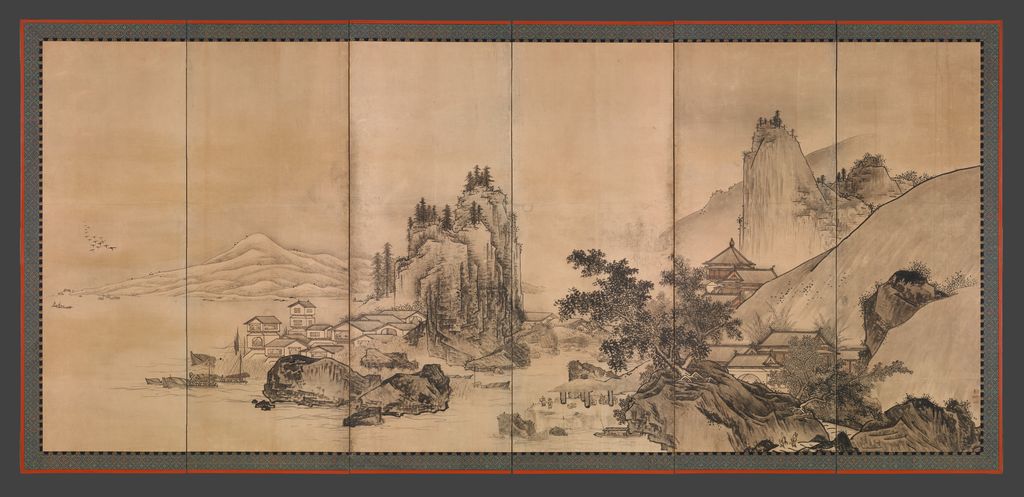
Winter Landscape, one of the National Treasure pair, Tokyo National Museum A-1398. Image from ColBase, resized for web display.
 by Tom Gurney
Tom Gurney BSc (Hons) is an art history expert with over 20 years experience. Updated September 24, 2026.
Introduction
Contents
- Introduction
- Origins, names and the limits of childhood evidence
- Kyoto: Shōkoku-ji and the monk-painter's education
- Yamaguchi and Ōuchi support
- Crossing to Ming China in 1467
- The 1486 long handscroll: age, scale and a dated claim
- 1495: a gift, a statement of lineage and a landscape
- The 1496 figure painting and the breadth of the oeuvre
- Pupils, later successors and the “saint of painting”
- Reading the life through the surviving objects
- Reader insights and discussion
- Books on Sesshū and ink painting
Sesshū Tōyō's life is often told as a journey from a boy punished for drawing to a universally admired master. The first episode belongs to legend; the admiration came through centuries of collecting, copying and argument. Between them stands a working painter and Zen monk whose dated paintings, inscriptions and associations with named people can be examined. The strongest biography begins with those surviving things. A colophon on a long landscape scroll supplies a date and the artist's stated age in 1486; his text above a splashed-ink landscape names teachers, predecessors and a pupil in 1495. Museum records place him in the networks of Kyoto, the Ōuchi domain around Yamaguchi and Ming China. They do not amount to a complete diary. [1] [2] [3]
The conventional dates are about 1420 to 1506, with a question mark still attached to the death year in Kyoto National Museum's 2024 exhibition description. It is safer to say that he worked across much of the fifteenth century and into the first years of the sixteenth than to assign a firm birth or death day. His reputation rests on works of different sorts: compact, heavily inscribed hanging scrolls; pairs of landscapes; a long sequential handscroll; figure paintings; and objects associated with him with varying degrees of certainty. This page traces the life those objects can support, and distinguishes Sesshū's own claims from what later writers made of him. [3] [4]
Chronology and source confidence
| Date or period | Evidence | What it permits us to say |
|---|---|---|
| c. 1420 | Conventional birth date; Kyoto National Museum gives c. 1420–1506? | Approximate, not a documented birthday. [3] |
| Youth | Later mouse-and-tears story, first recorded in early Edo writing | A history of his fame, not eyewitness evidence of childhood. [5] |
| Early career | Shōkoku-ji training described by Tokyo National Museum | A Kyoto Zen-painting environment, without a complete lesson-by-lesson record. [2] |
| Mid-thirties | Move to Yamaguchi under Ōuchi patronage in TNM's account | A change of institutional and patronage setting, not proof of every attributed local work. [2] |
| 1467 | Ming embassy voyage in TNM's account | Contact with Chinese painting and people; precise details of each encounter require separate evidence. [2] |
| 1486 | Dated colophon on the Mōri Museum's long Four Seasons landscape | A firm work-year and the artist's stated age of sixty-seven. [6] |
| 1495 | Self-inscription on Tokyo National Museum A-282 | A dated gift for pupil Sōen and the artist's own account of his artistic lineage. [1] [2] |
| 1496 | Date of the Huike and Bodhidharma painting held by Sainen-ji | A nearby figure-painting anchor, distinct from the 1495 landscape. [7] |
| c. 1506? | Conventional death date used cautiously by Kyoto National Museum | A boundary for his lifetime, not a basis for invented late commissions. [3] |
Origins, names and the limits of childhood evidence
Sesshū is associated with the region of present-day Okayama and, in later accounts, with Hōfuku-ji in modern Sōja. That is also the setting of the famous story in which a young novice, bound by a displeased abbot, draws a mouse with his tears and is recognized as an artist. Kyoto National Museum calls the incident fiction and traces the tale to early Edo Kano Einō's Honchō gashi. The British Museum likewise marks it as legend. The story tells us that later people wanted a vivid explanation for extraordinary talent. It does not tell us what happened in the temple schoolroom of the fifteenth century. A modern photograph of Hōfuku-ji, if used, could identify the later location but would not make the tale historical. [5] [8]
Names create another difficulty. A British Museum object record discusses Sesso Tōyō as an earlier name associated with the first half of his career. A painting carrying an early name is important evidence, yet names and seals cannot be detached from their exact object and used as automatic proof for every similar sheet. The museum itself makes the specific identification; it is an attributed scholarly reading. In a biography, the later name Sesshū is convenient for continuity, while the earlier form reminds us that identity was constructed through monastic and artistic naming practices rather than fixed as a modern signature on every surviving work. [9]
Even the familiar phrase “painter-priest” needs care. It identifies a person who belonged to Zen institutions and made paintings, but it does not explain a particular composition or guarantee that each attributed work served meditation. An inscription, a donor, a student, a temple and a patron can each change a painting's function. The 1495 dedication is especially revealing because the pupil and monastic poets are visible in the physical object. Biography must follow such relationships, not replace them with an undifferentiated story of spiritual spontaneity. [1] [10]
Kyoto: Shōkoku-ji and the monk-painter's education
Tokyo National Museum describes Sesshū's training at Shōkoku-ji, an important Kyoto Zen temple. This setting linked painting with an educated monastic world of Chinese books and images, calligraphy, poetry and exchange among temples. The 2007 TNM exhibition on Kyoto's Gozan temples placed his 1495 painting among works with prefaces and poetic inscriptions. That curatorial arrangement is a useful reminder that an ink painting could be encountered as an image bearing other people's writing. Its surfaces could record social ties as well as landscape ideas. [2] [11]
The artist's 1495 inscription later honours Japanese monk-painters Josetsu and Shūbun. Tokyo National Museum's Japanese explanation identifies these names in his retrospective statement. It would be too simple to turn the statement into proof that each man personally instructed Sesshū at a particular date. Josetsu, associated with an earlier generation, was a model of artistic authority; Shūbun became a crucial reference point for Kyoto ink painting. Sesshū was selecting predecessors while presenting his own achievement to a younger painter. The documentary value lies partly in the selection itself. [2] [12]
Kyoto's connected environment also explains why image and text should be studied together. A poem can identify a viewer, a dedication can name an intended recipient, and a seal may situate a painter within a network. These records are not transparent windows onto every moment of daily life. In the 1495 scroll, the artist's text and the six monks' poems represent different hands and, according to the museum account, different moments. They make the picture a small archive. The biography follows the evidence in that archive without pretending the archive is complete. [1] [11]
Yamaguchi and Ōuchi support
According to TNM's account, Sesshū moved to Yamaguchi in his mid-thirties and worked under Ōuchi protection. The move matters because the Ōuchi domain was a patronage and diplomatic setting, not merely a scenic western province. Support could supply a working base, access to images and a route into overseas travel. A painter's choices of form and audience may shift when his institutional world shifts. The surviving museum summary does not itemize the payment for every commission, so it should not be expanded into a fictional list of orders. [2]
The 2024 Kyoto exhibition describes the importance of Sesshū's pupils and of later artists who asserted a connection to him. Those relationships begin in a career sustained by places and people. He was not only an isolated creator of exemplary brushstrokes. The later pupil Sōen received an explicitly dated work; that fact tells us that training others formed part of the career. It does not prove the exact duration of Sōen's study or allow every later pupil to be placed in one workshop at the same time. Kyoto names Shūgetsu, Sōen and Tōshun as direct disciples, while treating Unkoku Tōgan and Hasegawa Tōhaku as later claimants to succession. A chronology should keep these categories apart. [3]
Yamaguchi is also a geographical hinge in the story. Kyoto, Yamaguchi and the Chinese coast can be connected on a map, but a map line should not imply every stage of a documented itinerary. The source securely supports a move into the Ōuchi sphere and a subsequent voyage; details such as a precise route through every port need separate records. The object led story gains more from explaining what patronage did than from drawing a visually confident route through uncertain stops. [2]
Crossing to Ming China in 1467
Tokyo National Museum states that Sesshū accompanied a Japanese embassy to Ming China in 1467. His later inscription says that he learned from Chinese painters Zhang Yousheng and Li Zai; those names appear in TNM's Japanese account of the text. This is a powerful link between the voyage and the artist's chosen genealogy. It is also important to distinguish the sources: the museum presents the voyage in its historical narrative, while the painting preserves Sesshū's own later account of encounters and study. Neither gives us a day-by-day travel journal in the material consulted for this page. [2]
The voyage should be understood as an encounter with living Ming painting as well as older Chinese images admired in Japan. Sesshū had already worked in a Japanese Zen environment attentive to Chinese models. Seeing artists and works in China could alter what he considered possible, but the word “influence” is meaningful only when attached to named people, objects or forms. The 1495 inscription names the two painters and the Japanese predecessors; it does not claim that a single Chinese teacher supplied all the modes in his later work. A painter who could make a sixteen-metre seasonal handscroll, a compressed splashed-ink landscape and an austere winter hanging scroll had more than one visual problem to solve. [2] [6] [13]
This complicates a familiar opposition between a Chinese source and a Japanese result. Networks of religious exchange, diplomatic travel, collecting and local patronage had already moved painting practices across the sea. Sesshū's own account highlights both Chinese and Japanese predecessors, and he gave that account to a Japanese pupil. His career therefore shows how an artist could build authority by crossing places and then teaching in another setting. The painting and its writing demonstrate that history more precisely than a claim that all his vigorous marks simply “look Chinese.” [1] [2]
The 1486 long handscroll: age, scale and a dated claim
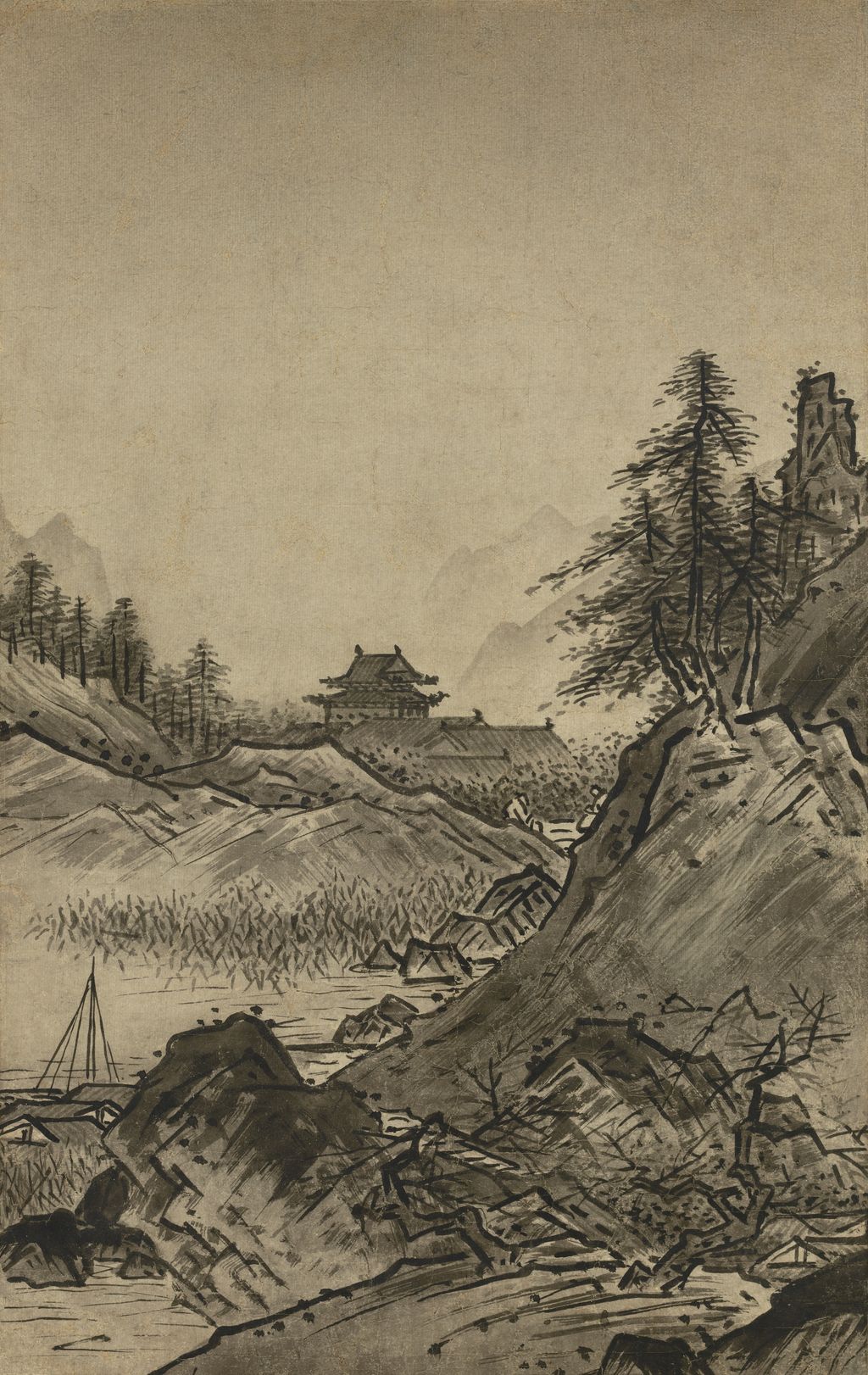
The Mōri Museum's Landscape of the Four Seasons is a separate object from Tokyo's autumn and winter hanging-scroll pair. The museum describes a handscroll about sixteen metres long, with a colophon dated 1486 and an age of sixty-seven supplied by Sesshū. This is among the best chronological anchors for the mature painter. It gives a year and the artist's stated age, though counting conventions and the uncertain birth record mean that a simple modern calculation should not be used to declare an exact birthday. The painting's length also changes viewing: stretches are unrolled and concealed in sequence, rather than all sixteen metres being available to a spectator at once. [6]
Kyoto National Museum holds a different four-season handscroll of about 11.5 metres, the so-called short scroll. Its collection essay presents it as Sesshū's work, whereas its database uses attributed to Sesshū. That discrepancy is part of the evidence, not a nuisance to hide. Later copies and variants multiply the titles further. The Mōri long scroll's dated colophon belongs to that specific object and cannot be transferred to another Four Seasons image merely because the subject sounds alike. A biography can draw on the 1486 anchor while keeping the accession and format visible. [14] [15]
The long handscroll demonstrates a capacity for sustained sequence. As one part closes, another opens, and the seasons can be experienced as a journey. That is a different commission and rhythm from a small hanging scroll given to a student nine years later. The difference does not show a linear “early detailed, late free” evolution. Without a close, securely dated series of comparable objects, style cannot serve as a substitute clock. Scale, format and audience offer alternative reasons for variation. [6] [1]
1495: a gift, a statement of lineage and a landscape
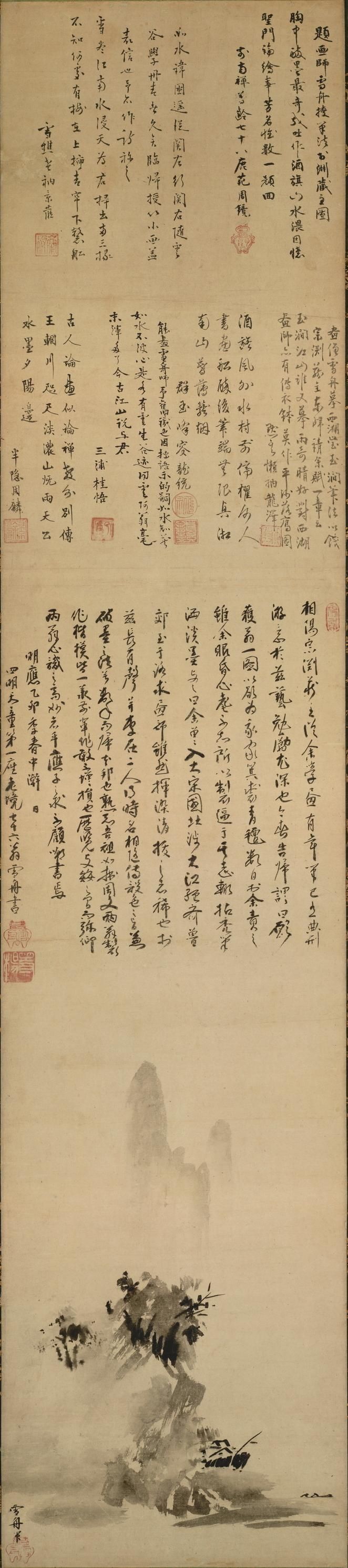
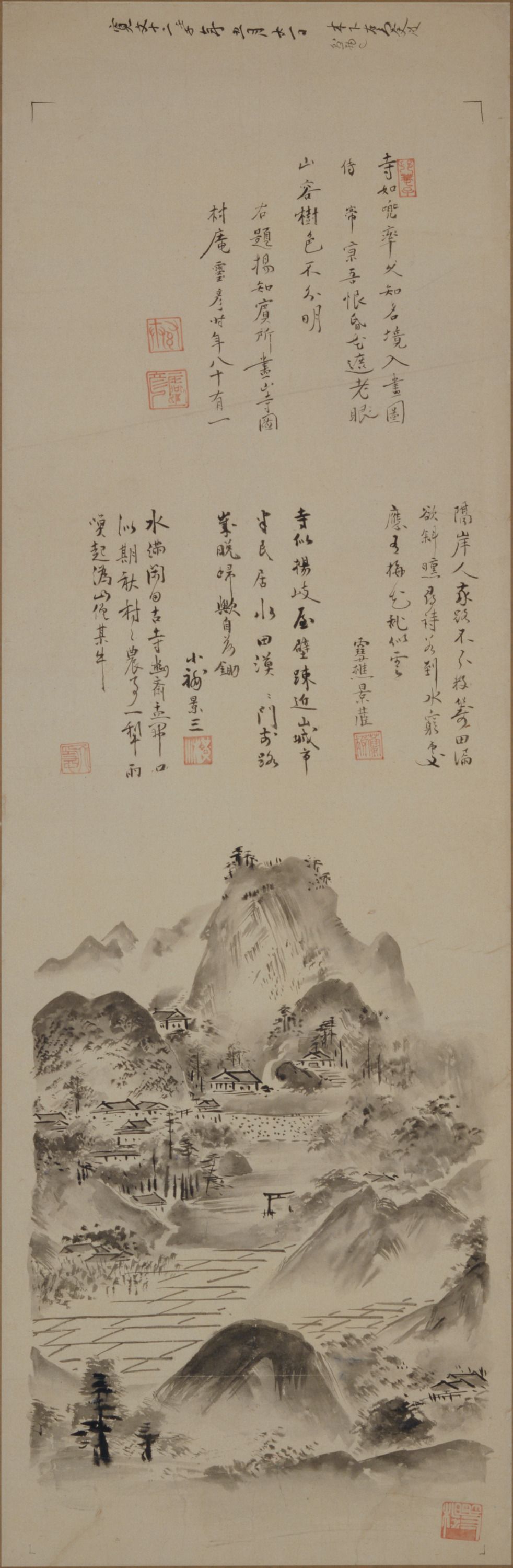
The Tokyo National Museum's National Treasure A-282 is the most intimate dated statement available here. Sesshū wrote an inscription for the young monk Sōen at the conclusion of training and painted a landscape beneath it. Six other monks added poems above the artist's text. The inscription recounts study, offers names of predecessors and turns the work into a lesson about artistic transmission. It is not only a specimen of a technique called haboku. Its different textual hands reveal an educational and monastic occasion. [1] [2]
The image below the writing is small within the full mounted scroll. Misty distance, a darker middle ground, buildings, a flag for food and drink and a boat are described in ColBase's object guide. This inhabited world emerges from dilute ink and more forceful marks, leaving unpainted paper to work as mist, sky or water. The landscape's economy can tempt a viewer to call it improvised. Yet the relationship among inscription, recipient, poems and carefully placed clues suggests an object designed for sustained reading. The material does not prove a precise sequence of brush applications, but it resists the notion that looseness means absence of thought. [1]
Yukio Lippit's published abstract for a 2012 Art Bulletin study argues that this mode and the inscriptions helped construct a lineage of artistic transmission. The full article was inaccessible during this research pass, so this page cites the abstract for that specific argument only. Another museum object offers a useful boundary: the Metropolitan Museum's Splashed-Ink Landscape by Bokushō Shūshō is an early-sixteenth-century variation by a different painter. A shared haboku method does not erase makers or turn a later response into a Sesshū autograph. [16] [17]
The 1495 work gives the biography a student with a name, a year, the painter's retrospective voice and a social afterlife in poetry. Each layer is valuable for a different question. Sōen's role establishes teaching; the named predecessors establish self-presentation; the poems show other monks engaging with the image. None tells us precisely what a private studio conversation sounded like. The work page will let the reader study the full scroll and the text-image structure without enlarging the current ColBase file beyond its actual detail. [1]
The 1496 figure painting and the breadth of the oeuvre
The following year provides a different anchor: Kyoto National Museum describes Huike Offering His Arm to Bodhidharma, held by Sainen-ji, as dated 1496. Its Buddhist figures and demanding narrative are far from the small riverside landscape of 1495. The subject, scale and dramatic human relation matter. A career reconstructed only from hills and mist would omit this major work. The Kyoto record is used as research evidence; its website image has not been assumed available for production reuse. [7]
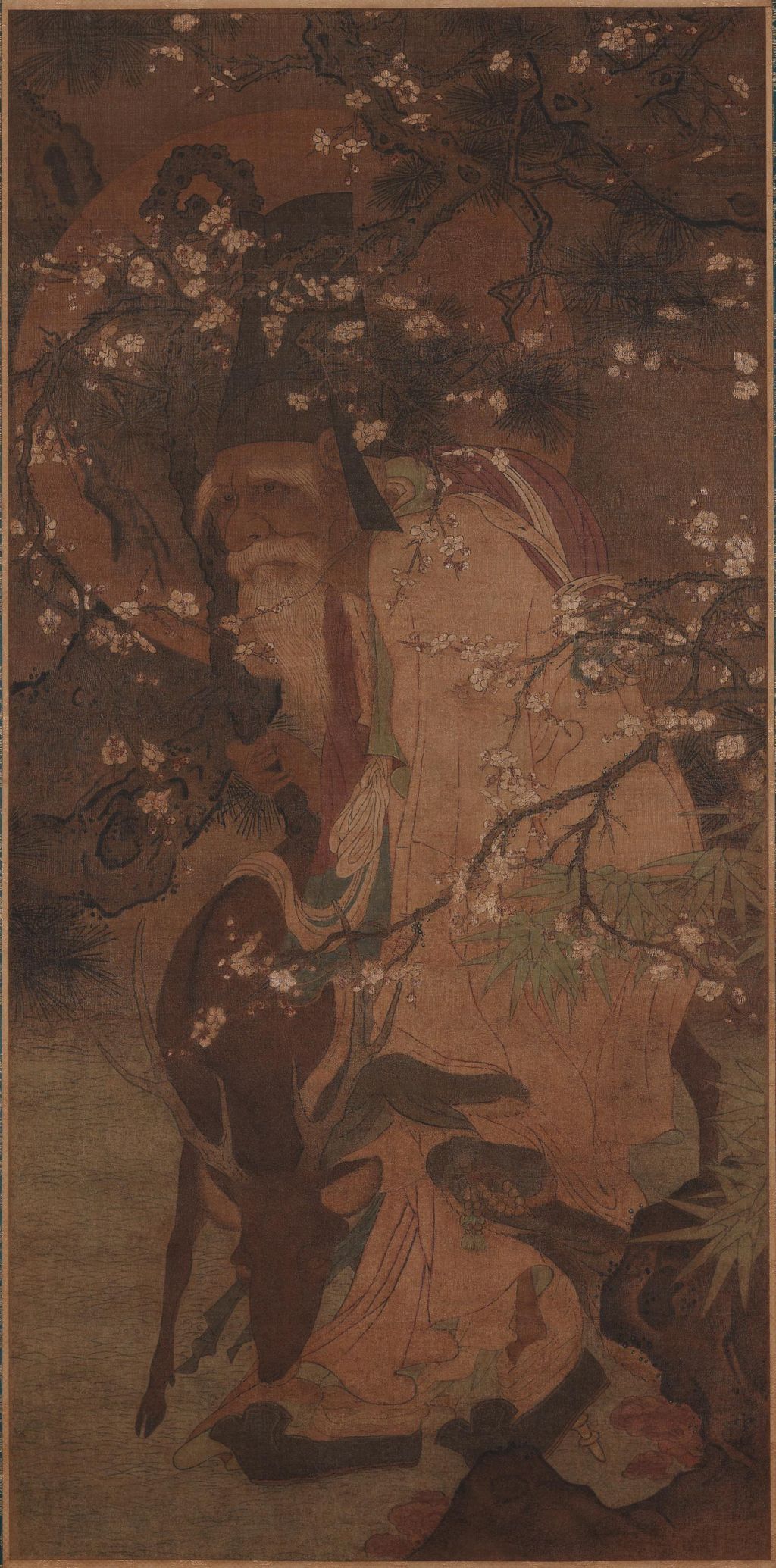
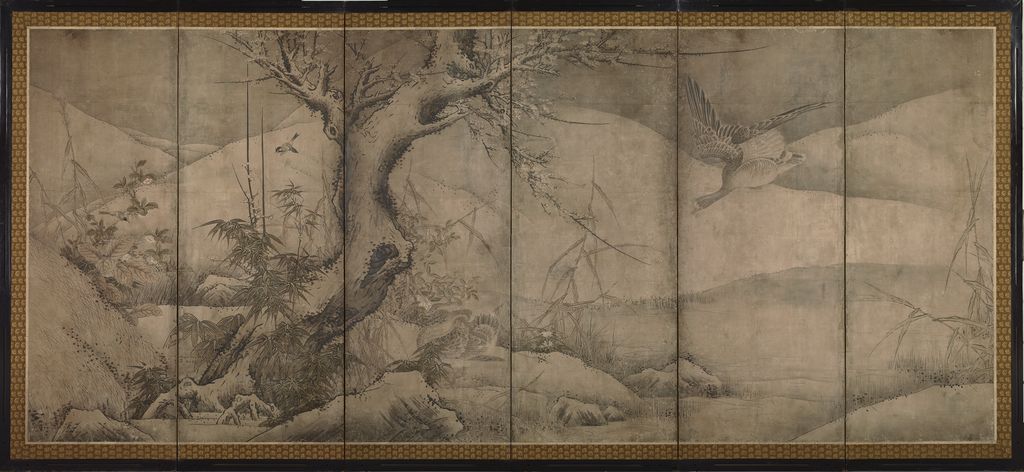
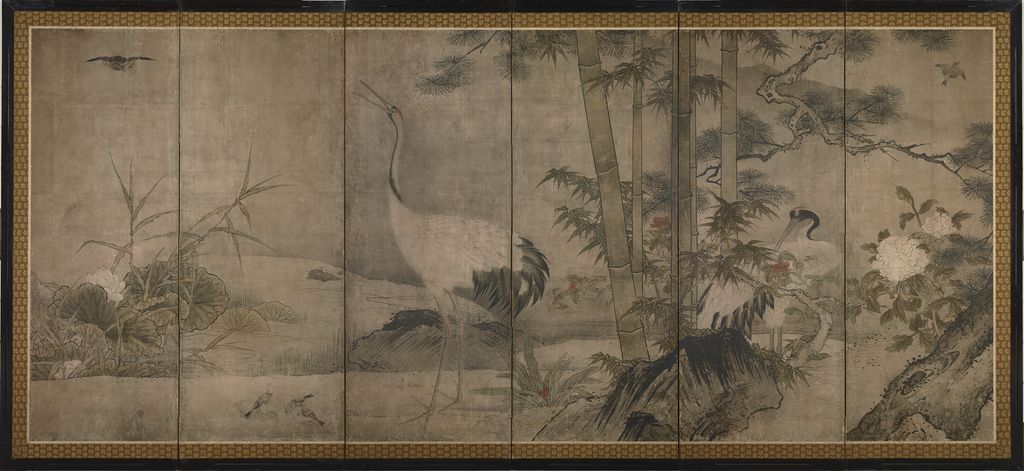
The Tokyo National Museum catalogues Shoulao under a Plum Tree, A-11962, as a fifteenth-century work by Sesshū, with colour in the figure and surrounding setting. It gives another way into genre and material. Conversely, its Birds and Flowers of the Four Seasons screens, A-12335, are presently labelled attributed to Sesshū. They can illustrate the scope of works associated with him only when the uncertain status remains in the caption. The great range attributed to a celebrated painter is itself one reason to compare records carefully. [18] [19]
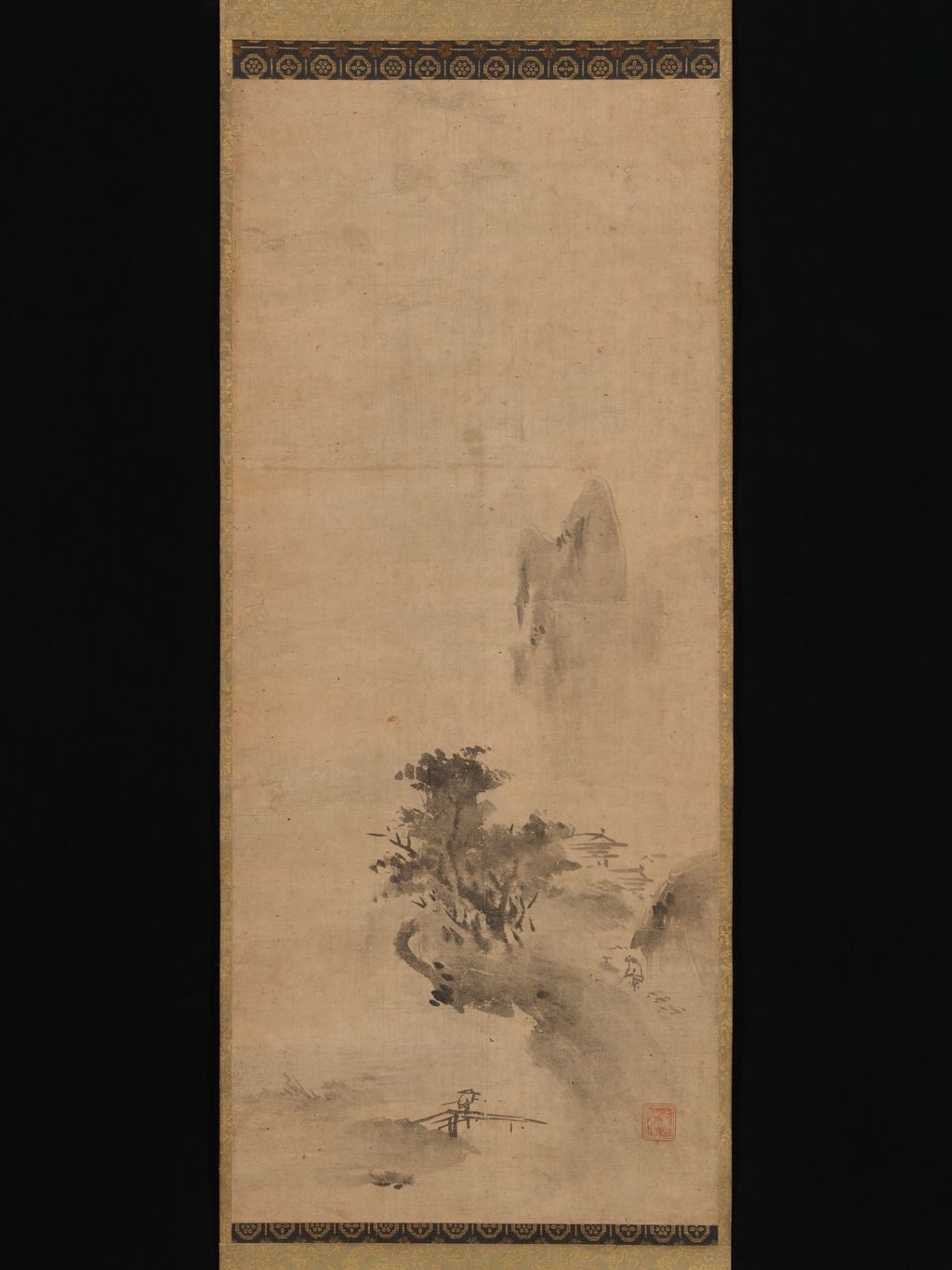
The exact date of every winter landscape, bird-and-flower screen and figure painting cannot be slotted between 1486 and 1496. Tokyo's Autumn and Winter Landscapes, A-1398, are dated to the late fifteenth or early sixteenth century, a broad range. Their contrasting open autumn space and dominating winter cliff show choices in composition, but the pair is not a dated entry in a daily log. Biography uses the images to describe the visual range of the mature artist, not to claim that a winter mood followed a particular winter in his life. [13]
Pupils, later successors and the “saint of painting”
Kyoto National Museum's 2024 exhibition makes the later construction of Sesshū's reputation its central question. It names Sōen, Shūgetsu and Tōshun as direct disciples. It also names Unkoku Tōgan and Hasegawa Tōhaku as later painters who claimed the inheritance, not as men who personally studied with Sesshū. Kano Tan'yū helped shape an early modern canon. These are different historical relationships: instruction, asserted descent, copying and retrospective judgment. Treating all as a single uninterrupted studio lineage would flatten the evidence. [3]
Objects make that history visible. Tokyo National Museum's A-2291 is a seventeenth-century copy made by Kano Tsunenobu after a Sesshū original. It testifies to looking back at Sesshū, but the copy's marks and date belong to Tsunenobu. The Met's four-season screen pair by Unkoku Tōgan similarly belongs to a later painter working with Sesshū's legacy. Kyoto's exhibition points out that some copies once accepted as Sesshū paintings contributed to how his canon was understood. The borders of the oeuvre are therefore historical, not merely a modern cataloguer's technical problem. [20] [21] [3]
The mouse legend is part of that afterlife. Its first recorded early Edo form came long after the child it describes would have lived. It offered an origin story attractive to writers and audiences; it is evidence for a later desire to imagine genius as irresistible even under punishment. The phrase “painting saint” similarly records the scale of later admiration. We can value that history without making it a source for unsupported childhood scenes. The greater achievement of a source-led biography is to show how a life of training, travel, patrons, pupils and varied works became an image of singular mastery. [5] [3]
Reading the life through the surviving objects
Two dated works should remain in the reader's mind. The 1486 Mōri long handscroll locates an older painter engaged in a vast sequential project; the 1495 Tokyo gift locates a teacher explaining his lineage above a much smaller landscape. The 1496 Huike painting then shows that his work did not become exclusively free ink scenery. Alongside them, the autumn/winter pair, figure painting, attributed screens and later copies show the limits of a tidy chronology. Their holdings, image sources and authorship labels should accompany them whenever they are reproduced. [6] [1] [7] [13]
Sesshū's movements from Kyoto to Yamaguchi and across the sea are well supported in museum narratives, while details of private motives and many exact dates are not. The 1495 inscription speaks with his own voice, but its purpose was to instruct and to present a lineage. Later museum records collate and test the objects; later writers constructed legends. An honest biography can make these layers explicit and still offer a rich account of a painter whose work changed the course of Japanese ink painting. The two exact-object essays below follow that principle at a closer scale: Splashed-Ink Landscape and Autumn and Winter Landscapes. [1] [3]
Reader insights and discussion
Name the exact object and say whether it is by, attributed to, copied after, or made in response to Sesshū.
Reader Insights
How does the text above the image alter your reading of the landscape?
What do the path and cliff do to the sense of distance?
What can a later copy tell us about how Sesshū was known?
Join the Conversation
Include the museum accession that prompted your observation.
References
- ColBase, Tokyo National Museum A-282, Splashed-Ink Landscape.
- Tokyo National Museum, 2007 explanation of the 1495 Sesshū landscape.
- Kyoto National Museum, The Legend of Sesshū, 2024.
- British Museum, Sesshū biographical authority.
- Kyoto National Museum, “Sesshu Paints a Mouse with His Tears”.
- Mōri Museum, Landscape of the Four Seasons.
- Kyoto National Museum, Huike Offering His Arm to Bodhidharma.
- British Museum, note on Sesshū and the mouse legend.
- British Museum, object 1913,0501,0.97 and the earlier name Sesso Tōyō.
- Yukio Lippit, “Of Modes and Manners in Japanese Ink Painting,” The Art Bulletin 94.1 (2012), abstract.
- Tokyo National Museum, Zen Treasures from the Kyoto Gozan Temples, 2007.
- Kyoto National Museum, 2024 exhibition checklist.
- ColBase, Tokyo National Museum A-1398, Autumn and Winter Landscapes.
- Kyoto National Museum, shorter Four Seasons landscape scroll.
- Kyoto National Museum collection database, attributed shorter scroll.
- Yukio Lippit, The Art Bulletin 94.1 (2012), publisher abstract.
- Metropolitan Museum, Bokushō Shūshō, Splashed-Ink Landscape, 53228.
- ColBase, Tokyo National Museum A-11962, Shoulao under a Plum Tree.
- ColBase, Tokyo National Museum A-12335, Birds and Flowers of the Four Seasons.
- ColBase, Tokyo National Museum A-2291, Kano Tsunenobu copy after Sesshū.
- Metropolitan Museum, Unkoku Tōgan, Landscape of the Four Seasons, 53240.
