


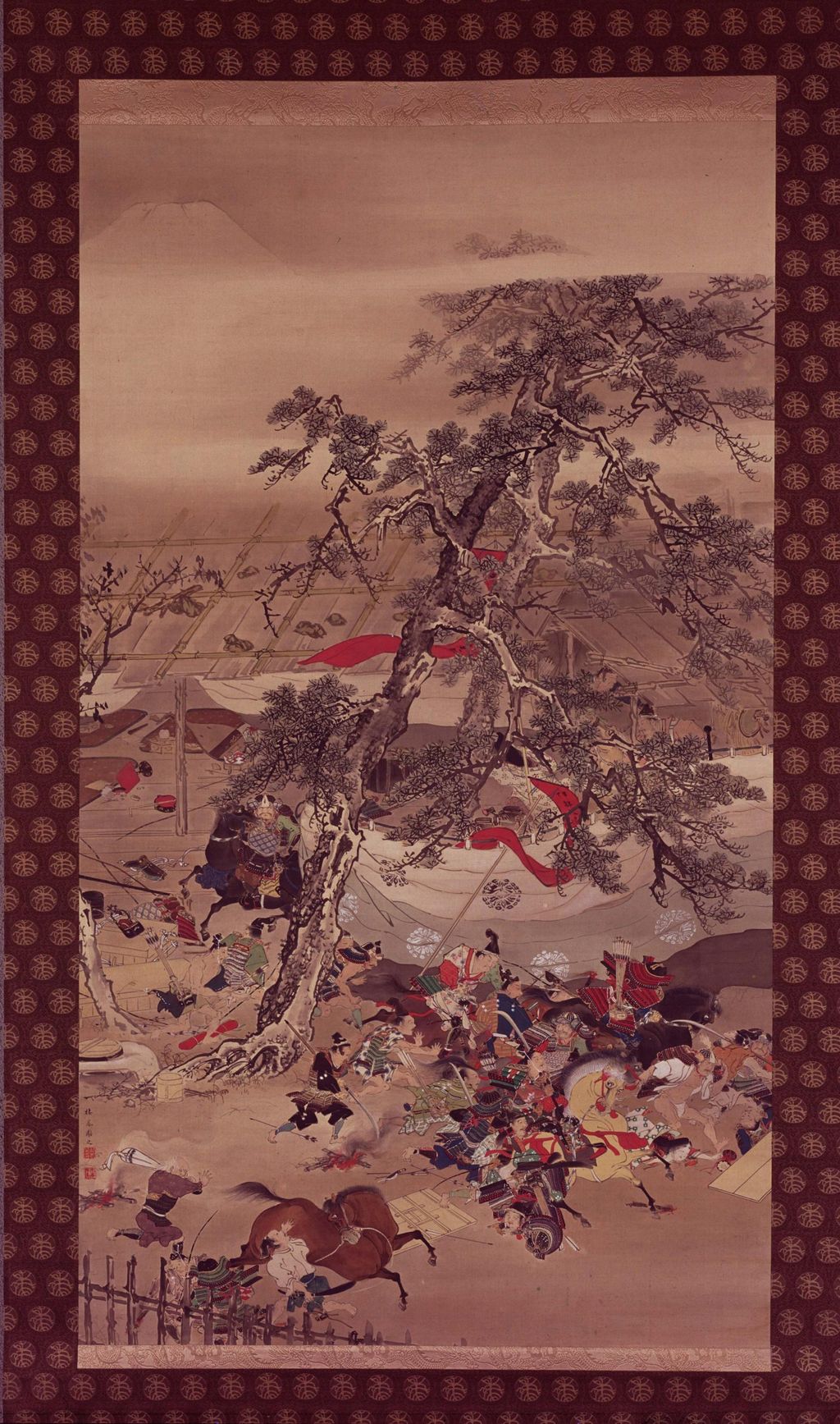
Victory at the Fuji River (《富士川大勝》), 1894, A-10566. Tokyo National Museum via ColBase. Resized for web display. Object or image record.
 by Tom Gurney
Tom Gurney BSc (Hons) is an art history expert with over 20 years experience
Published on September 25, 2026 / Updated on September 25, 2026
Email: tomgurney1@gmail.com / Phone: +44 7429 011000
Takeuchi Seihō: seeing, testing and composing
Takeuchi Seihō (竹内栖鳳, 1864–1942) is often introduced through his animals: a cat whose posture seems to have been caught between movements, a flock of birds, ducks stepping into an open space. That is one way into his painting, but the surviving works present a larger question. How could a painter trained in Kyoto's inherited brush traditions make a bird, an old battle, a newly built shrine and a winter river credible to people living in a rapidly changing city? He answered it through looking, drawing, trying out compositions and choosing what the finished picture should leave unstated. The resulting fluency can conceal the amount of study behind it. [1] [2]
The National Diet Library describes a foundation in the Maruyama–Shijō lineage and an interest in Western ways of observing. Kyoto City Kyocera Museum's 2013 exhibition went further into the working evidence: more than a hundred surviving sketchbooks, repeated observations and multiple preparatory designs. Some plans never became finished works. A spontaneous-looking stroke should therefore be seen as a decision reached after practice, not proof that the painter dispensed with planning. This page follows several exact objects from 1889 to 1937 to see what changed and what remained useful to him. [1] [3]
Contents
- Takeuchi Seihō: seeing, testing and composing
- Before the famous animal paintings: pictures made for rooms
- A new shrine, an old capital and a pair of screens
- Compare the shrine screen and its study
- Europe did not erase the Kyoto brush
- Animals as more than demonstrations of skill
- A Kyoto school with many answers
- What to look for next
- Books on Japanese Art
Seihō's reputation as a painter of living creatures should not make those creatures an isolated genre. In the 1894 scroll Victory at the Fuji River, birds take part in a historical event. The Agency for Cultural Affairs identifies the episode as the rout of Taira Koremori's force in 1180 after the sound of waterbirds rising at the Fuji River. The birds' flight makes the story visible and audible by suggestion; the figures' response carries the imagined sound. The agency also observes that Seihō drew on Kano and Shijō methods and exhibited the painting at a Kyoto craft show. An older subject, several inherited kinds of brushwork and a modern exhibition audience meet in one scroll. [5]
At a glance
- Life1864–1942
- BaseKyoto
- PracticeJapanese painting and observation
- Key worksFuji River, Heian Shrine screens, Spotted Cat
Its format matters. A hanging scroll asks the viewer to encounter a vertical scene rather than scan the extended space of a screen pair. There is a strong temptation to treat every creature in Seihō's oeuvre as an exercise in zoological accuracy. Here the waterbirds must perform narrative work. Whether their shapes arose from one particular field observation is not established by the object record. What we can say is that their movement solves a pictorial problem: it connects a natural occurrence to a human mistake without putting an explanatory sentence inside the picture. [5] [4]
Before the famous animal paintings: pictures made for rooms
An 1889 work in the National Museum of Modern Art, Kyoto helps reset expectations. Landscape of Mountains and Sea (《漁樵山水図》) consists of eight sliding-door panels, not a small independent view to be read on a screen. The museum's record identifies ink and colour on paper and gives panel measurements. Doors make painting part of an interior's changing sightlines: a person may see a section from an entrance, another while passing through, and the whole only from a suitable position. The landscape has to function in architecture before it can function as a flat image on a webpage. [6]

The doors and the later screen paintings show Seihō thinking in lengths and intervals. Western observers sometimes approach nihonga as if the term named one technique or an unbroken ancient style. In Seihō's case, it is more useful to identify the support, the room, the exhibition and the specific problem of each work. The 1889 doors use a domestic architectural format; the 1894 battle scroll turns action into a concentrated vertical episode; a pair of screens made seven years after the doors will make Kyoto landmarks spread across twelve panels. These are materially different jobs. The museum catalogue's distinct descriptions protect us from treating them as interchangeable examples of a single look. [6] [4] [8]
His teacher Kōno Bairei was a major figure in Kyoto painting, and the National Diet Library places Seihō first with Tsuchida Eirin and then with Bairei. The training gave him a repertory of ways to organize a picture and handle ink; it did not hand him a fixed answer for a newly built shrine or for a later encounter with European art. Kyoto City Kyocera Museum describes his subsequent practice as an effort to make new expressions while working across inherited factions. That institutional account is an interpretation of a long career, but these early objects already show the practical point: he selected a format and visual method to suit a subject rather than simply repeating one master's signature. [1] [2]
A new shrine, an old capital and a pair of screens
Seihō's Maruyama Park and Heian Shrine (《円山公園・平安神宮》) was made in 1896, immediately after Heian Shrine was founded to mark the 1,100th anniversary of the capital's establishment in Kyoto. The Agency for Cultural Affairs says the left screen shows the new shrine in a bird's-eye composition and the right screen shows the blossom-viewing park. It also records that the pair was given to a person involved in the commemorative events. This is more than a pleasant topographic scene. The painter had to make a new civic site and a familiar seasonal place belong to the same folding object, while giving a contemporary celebration a visual past. [8]
The record describes a pair of six-panel screens, each 151 × 351 cm. Across twelve panels, a tree, roof or path can establish a rhythm very unlike a single framed view. A bird's-eye perspective permits the shrine buildings to be gathered into a legible complex, while the screens' physical folds would change the apparent spacing as a viewer moved. Museum photographs show portions of the finished screens rather than a newly divided set of works. A detail should be read as part of a screen, never as the entire composition. [8] [9]
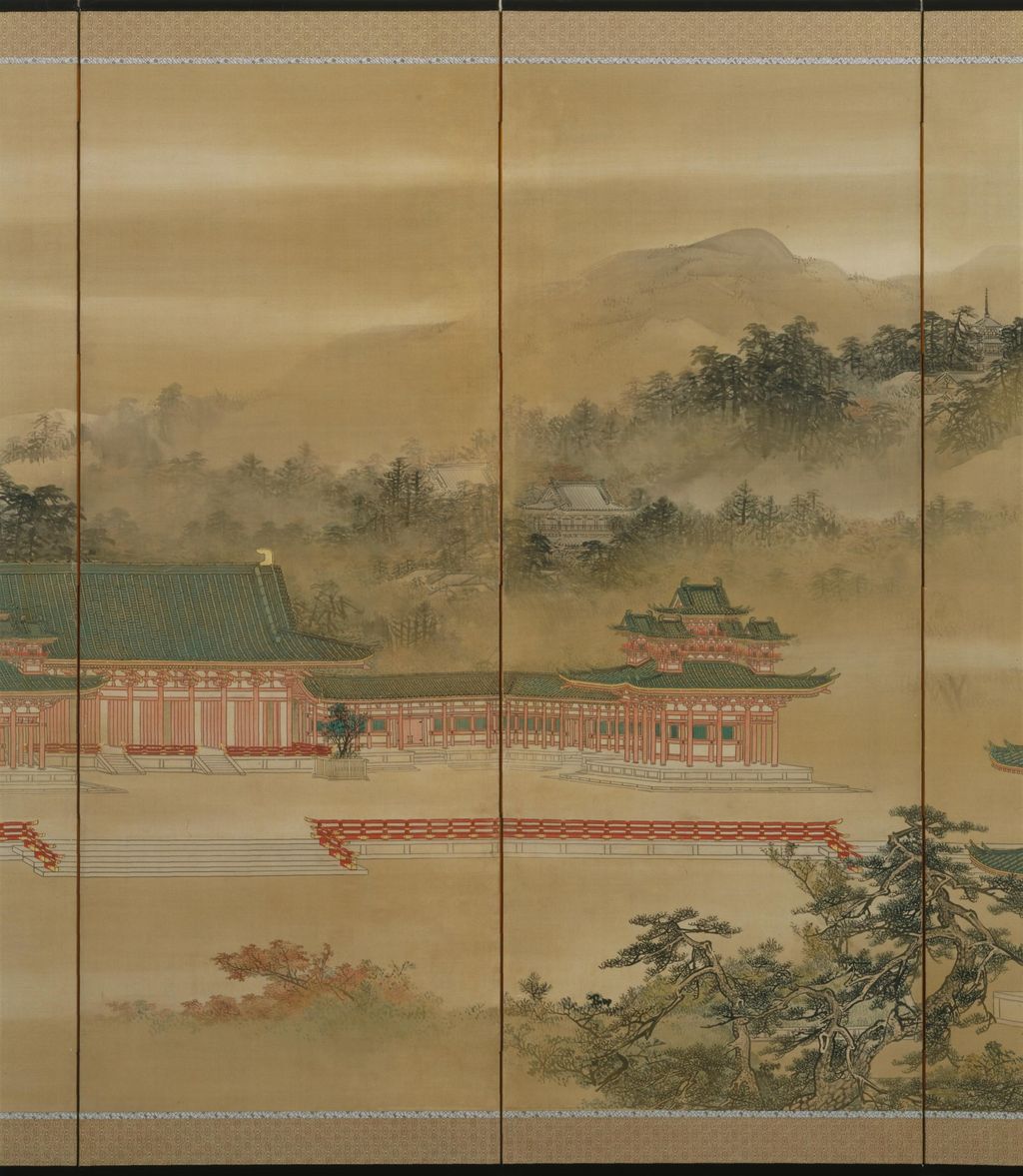
The value of the work increases when it is set beside a drawing. Tokyo National Museum holds Preparatory Drawing for Heian Shrine (《平安神宮下絵》), dated 1896 and catalogued as one large sheet measuring 184.6 × 378.2 cm. A National Institutes for Cultural Heritage acquisition report calls it probably the full-scale preparatory drawing for the left screen, arguing from its panel divisions and design. That qualification matters. It is a strong, institutionally grounded relationship, not permission to describe the two objects as identical or to claim every visible line was transferred directly to the final silk. [10] [11]
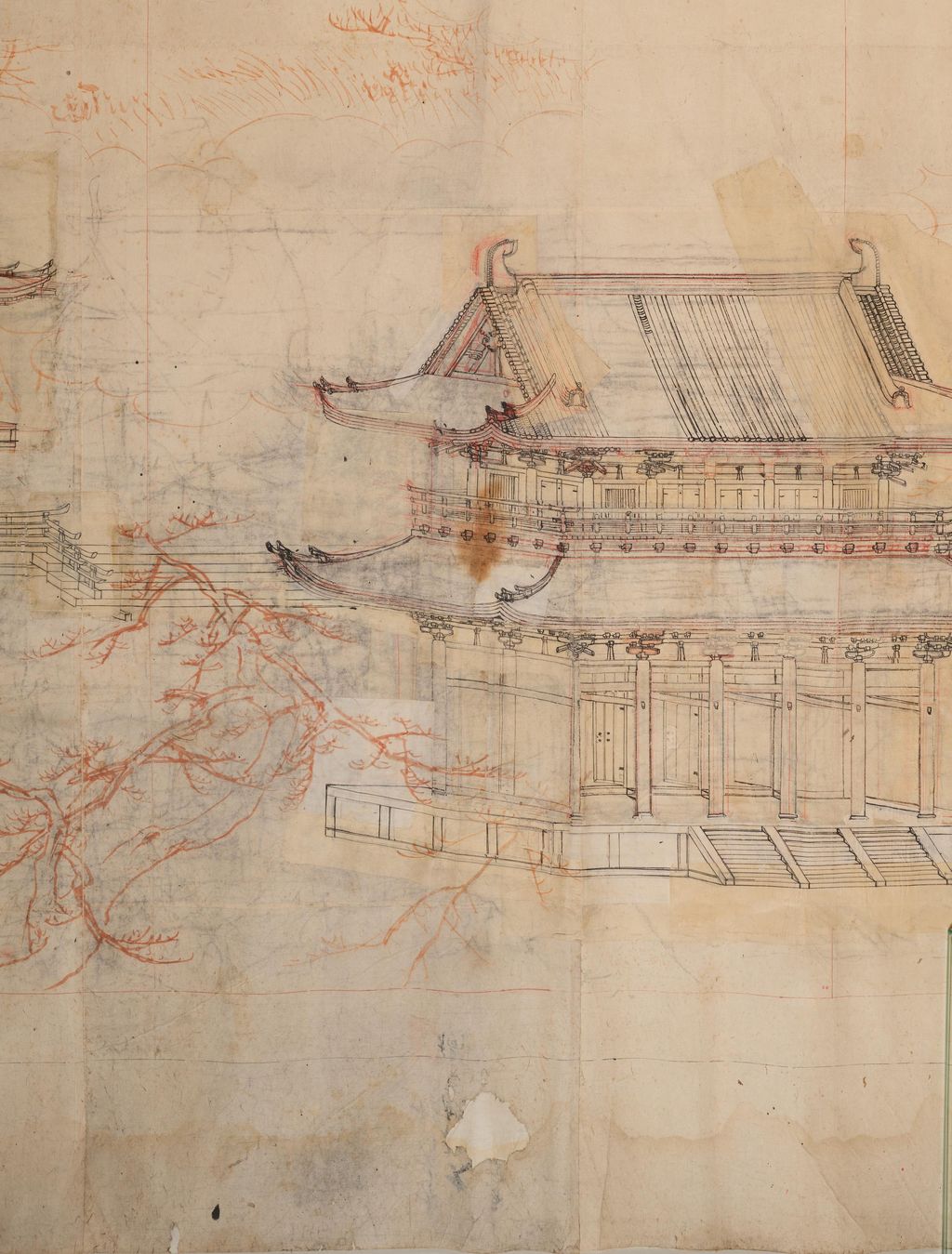
Placed side by side, drawing and screen can teach a viewer to ask better questions. Where did Seihō retain a roof line or a stand of trees? Where did he alter the density of building, path and open ground? Which decisions belong to the shape and folds of the finished screen? The two exact object records and the acquisition report allow that comparison, but the answers must come from matched portions of the retained source files. A generic “before and after” slider would imply one image simply became the other. The more accurate module is a paired study, with object identities visible and two or three individually explained areas. Kyoto's 2013 exhibition, which examined the painter's many sketches and revisions, supplies the broader context for why such a comparison is central rather than incidental. [3] [8] [10]
Compare the shrine screen and its study
Open the numbered details to compare the completed screen with a probable full-scale study. These are two accessioned objects.
Explained details
Detail of figure 3: Heian Shrine roof group, 1896
Central roof area in the completed screen, A-11781. Read the buildings in relation to path and planting. This photo is only a part of the left screen.
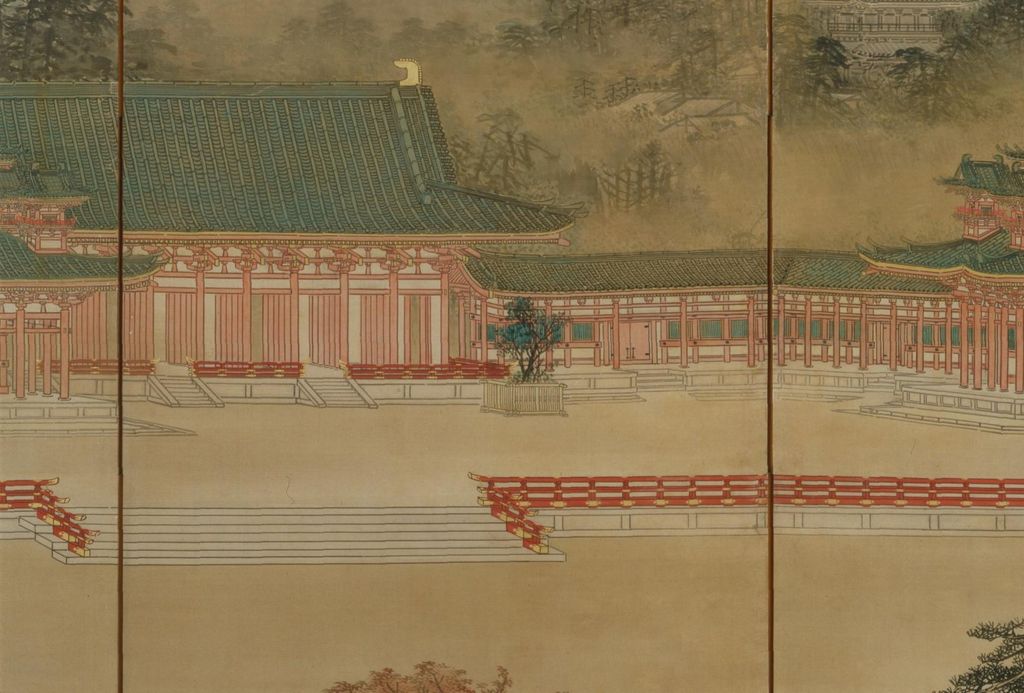
Tokyo National Museum via ColBase. Object record. Roof cropped from the ColBase original and resized.
Part of the probable full-scale Heian Shrine study, 1896, A-12480
Roof area in drawing A-12480. The acquisition report calls it probably a full-scale study for the left screen; no single line is claimed to have transferred unchanged.
Tokyo National Museum via ColBase. Object record. Part photo resized for display.
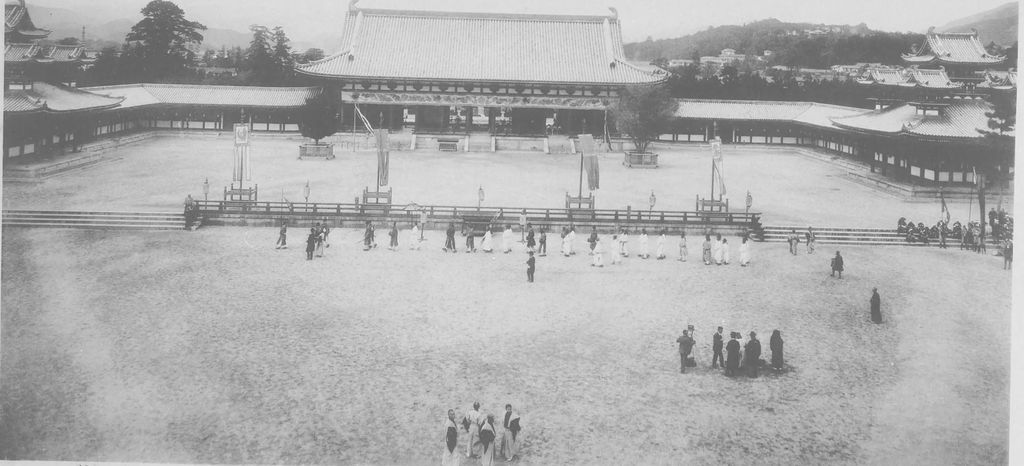
The historic place also has a photographic afterlife. The National Diet Library reproduces a photograph of Heian Shrine from Kyoto Famous Places Album (《京都名所帖》), a volume published in June 1907. The source page is held in its Digital Collections with public-domain access, and the NDL landmarks exhibition explicitly permits reuse with credit. The exposure date is not supplied; it can safely be described as no later than the June 1907 publication. It shows the same shrine more than a decade after Seihō painted it, not the artist's exact view in 1896. That gap is informative: a painting made for commemoration and a later photograph made for a place album ask viewers to see the building differently. [12] [13]
Europe did not erase the Kyoto brush
The National Diet Library dates Seihō's European journey to 1900–01 and records his change from the earlier art-name spelling 棲鳳 to 栖鳳 after his return. Kyoto City Kyocera Museum identifies the 1900 Paris exposition as part of that journey and presents European encounters as one stimulus in a larger search for new expression. These facts support neither a simple conversion to Western painting nor a single moment when all older methods were abandoned. The 1896 screens already demanded close study; the journey enlarged what he could inspect and compare. Later works must still be read individually rather than labelled “Western influence” on sight. [1] [2]
The Kyoto museum's 2023 retrospective lists Remains of Rome (1903), Moon Over Venice (1904) and Tiger and Lion (1901) among the works shown. Their titles alone reveal how widely his subjects could range after travel: European architecture, a Venetian night and animals observed through new encounters. They do not prove that any exact European artist supplied the design of one of these pictures. The museum records linked below provide a starting point for studying those individual works. [2] [14]
One catalogued work from the years after his return is Willow Trees on the Frosty Riverside (《蕭条》), dated about 1904 by the National Museum of Modern Art, Kyoto. It is another pair of six-panel screens, each 167.5 × 372 cm, but it is not another civic map. The English catalogue title brings chill and quiet into the scene; the long, low reproduction lets a viewer sense the spread of trees and riverbank across the pair even while its modest pixel height limits close study. The museum records it in an exhibition commemorating Bairei in 1904, making it part of both Seihō's continuing dialogue with his teacher's circle and his experimentation with landscape. [15]
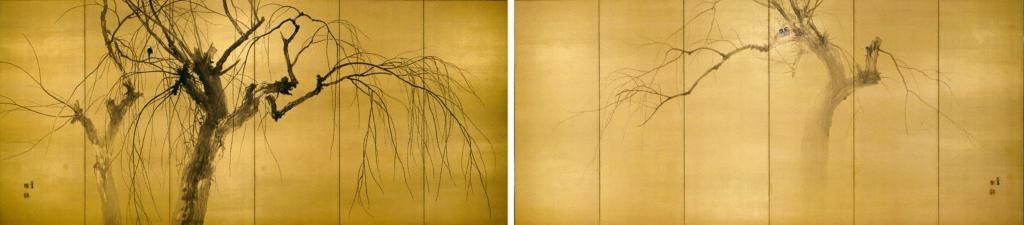
The contrast with the 1896 shrine screens gives a concrete way to discuss change. The earlier pair presents named, constructed sites whose identification and commemorative purpose are documented. Willow Trees is catalogued by atmosphere and landscape rather than an anniversary. Both depend on the mechanics of paired screens; neither can be understood well as a small portrait-oriented illustration. Seihō's modernity lies partly in being able to make different visual promises within the same established format. That conclusion is a comparison of catalogued objects, not a museum's claim that one painting replaced another style. [8] [15]
A third format from this longer career resists the idea that Seihō's gift was limited to landscape and animal life. Kyoto City Kyocera Museum holds Posing for the First Time (《絵になる最初》), a 1913 colour-on-silk hanging scroll, 183.1 × 87.4 cm. The museum reads a woman standing before a paper door as covering her face and holding a removed kimono around herself; her untied sash lies at her feet. Its description treats the blue, grey and ochre patterns as suggestive of embarrassment and uncertainty. That is a curatorial interpretation grounded in a specific image, not a reason to invent the sitter's identity or her words. The scroll demonstrates that Seihō could make a human figure and an awkward social moment carry an entire composition. The holding museum’s record gives the work’s exact title and details. [22]
The 1913 figure also sharpens the page's question about observation. A pose can be studied, yet a painting must decide where the viewer stands in relation to the sitter and how cloth, doorway and empty space distribute attention. A painting of a person is not just animal realism applied to another body. Compared with the 1894 battle scroll, it shows Seihō using the vertical format for a quieter and more uncertain drama. Compared with the wide 1896 screens, it reduces an encounter to one person within a narrow field. These comparisons follow documented dates and formats; they do not claim a direct preparatory relationship between unrelated pictures. [22] [5] [8]
Animals as more than demonstrations of skill
Kyoto's 2013 preparatory-drawing exhibition says Seihō sometimes kept birds and animals at home for observation. Its larger claim is that repeated looking at shape and behaviour helped him pursue both visible form and what Japanese criticism calls shai: an expressive grasp of the subject. That is the museum's account of a working habit, not evidence that a particular duck, cat or tiger lived in one identifiable room. The distinction matters because the best animal paintings seem so alive that a plausible anecdote can easily harden into a false provenance. The surviving sketches and catalogued works permit a firmer conversation about the choices made on paper or silk. [3]
An illustrated publication, Seihō Album of the Twelve Signs of the Zodiac (《栖鳳画伯筆十二支帖》), offers one route into how animal forms reached an audience beyond a finished screen. The National Diet Library's Image Bank presents twelve leaves from one album. One can compare the compression needed for a small leaf with the space given to animals on a pair of screens; the comparison is of format and circulation. An album leaf is not a newly discovered stand-alone painting, and the publication does not on its own date the painter's first observation of that animal. The leaf reproduced here is identified by its own page and publication title. [16] [17]
The British Museum’s catalogue lists the 1901 illustrated book Seihō shūga-chō (《栖鳳習画帖》) under Seihō as print artist, registration 1981,0805,0.1.2. It is a separately catalogued publication from the NDL zodiac album. Its existence shows another channel by which his drawings entered print, while the museum entry alone does not establish the date of each study inside it. The museum record helps place his printed work in a wider history of collecting. [24] [16]
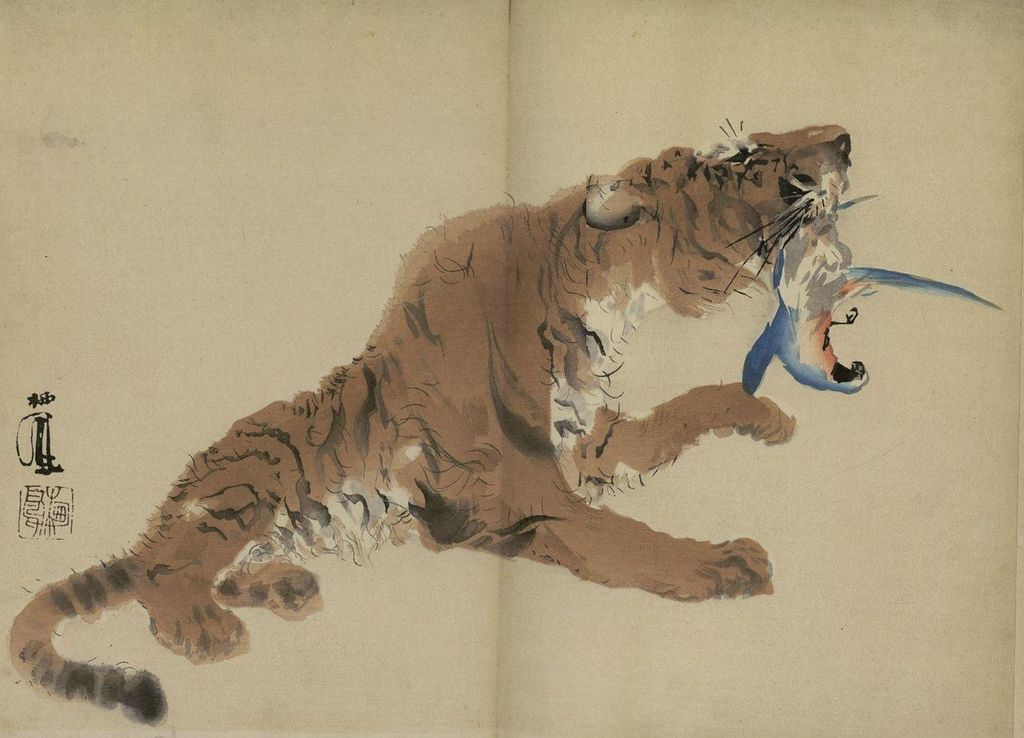
The best-known single animal painting is the 1924 Spotted Cat, held by Yamatane Museum of Art. The museum titles it 《班猫》; the Agency for Cultural Affairs' important-cultural-property record uses 《斑猫》. These are variant spellings attached to the same object, not two cats or two proposed artwork pages. Yamatane's account connects the encounter with a cat at Numazu to subsequent close study. The holding museum’s account and the designated-property record provide two complementary ways to study it. [18] [19]
The cat also shows why “realism” is too blunt a label. A pose, a coat pattern and a glance may be rendered convincingly, but a painting still chooses distance, background, scale and the moment at which observation stops. The museum's account of sketching is evidence of attention; the finished work is an arrangement made from that attention. The question is not whether the painter could copy a cat. It is how the painted animal seems to possess its own balance while the surrounding field lets that balance register. The exact Yamatane object record, rather than a web thumbnail detached from its museum, is the place to test such an interpretation. [18]
The Metropolitan Museum of Art catalogues a different animal problem in Parrot on an Ancient Pine (《老松鸚鵡図》), a 1916 hanging scroll whose painted image measures 141.6 × 51.1 cm. The museum describes a pink-and-white bird on a twisted pine above dense needles. A bright body and an old tree require unlike textures to coexist in a narrow vertical field. The Met’s wider discussion of European realism does not identify a particular Western picture behind this parrot. The linked museum record gives its exact identity and dimensions. [23]
The 1937 Young Ducks (《若き家鴨》) is a useful later counterpoint with a catalogue image. The National Museum of Modern Art, Kyoto records it as a pair of two-panel colour-on-paper screens, each 171 × 184 cm, and notes its appearance in the first Shin-Bunten in 1937. The pair has a different spatial task from both an album leaf and a six-panel landscape. In the retained whole-pair reproduction, several young ducks occupy a field that gives their bodies room to answer each other across the two screens. A viewer can follow the spacing, direction and repeated small forms before attending to brush detail. The image is sufficient for that broad reading, not for a claim about one hairline or the technical sequence of individual strokes. [20]
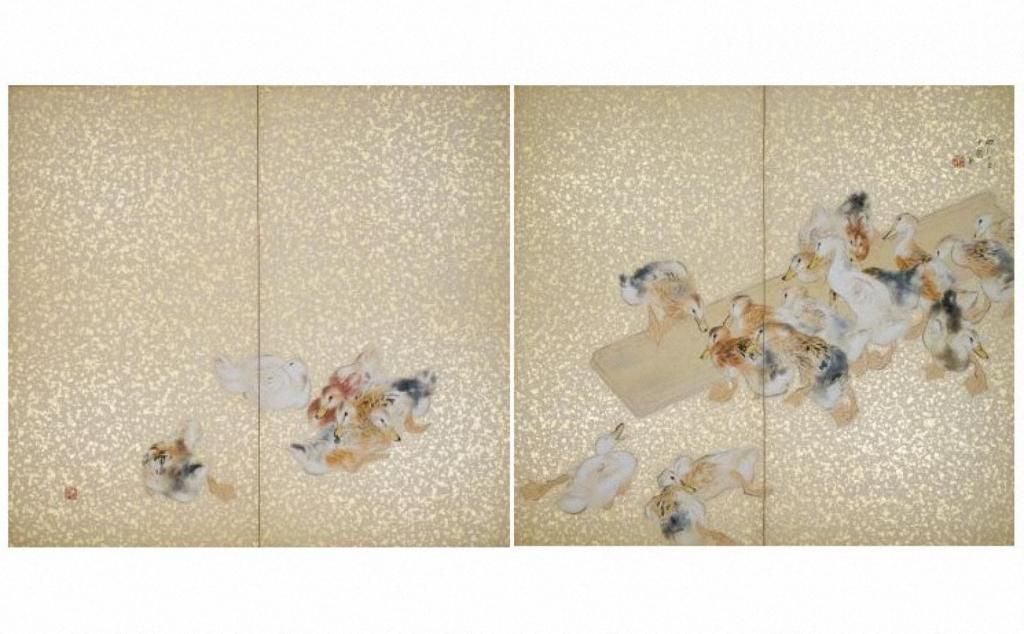
Both cat and ducks were made decades after Seihō's European trip, and both sit in an established Japanese painting career rather than an isolated animal hobby. The late screen was exhibited in a new official venue; the earlier cat entered the history of designated cultural property. These later histories shape which objects a present-day visitor is likely to encounter, but they should not flatten the painter's output into a list of trophies. The 1894 battle scroll, the 1896 shrine screens and the 1904 winter landscape show how many different questions his eye and brush had to answer. [20] [19] [5]
A Kyoto school with many answers
Seihō also taught. The Kyoto City museum names the municipal painting school and his own Chikujōkai studio as places in which he trained younger artists. The National Diet Library names Uemura Shōen among those who emerged from his circle, and Hiroshima Museum of Art names Tsuchida Bakusen as well. These links help map Kyoto painting across generations, but teacher–pupil labels do not mean that Shōen's psychologically alert figures or Bakusen's later work were versions of Seihō's art. Each artist made a separate response to exhibitions, models and materials. A reader can follow the site's distinct Uemura Shōen home and biography rather than have her career compressed into one paragraph here. [1] [2] [21]
His public authority grew alongside that teaching. NDL records him as a judge from the founding of the Bunten in 1907, an Imperial Court Artist in 1913 and a member of the first Order of Culture cohort in 1937. These dates belong in the biography, where the institutions and decisions can be explained. On the artist page, they illuminate why the 1937 ducks mattered beyond a late-career animal image: the official exhibition system in which he had long worked had changed, while he remained an active participant. The museum's exact record gives the first Shin-Bunten showing; the chronology shows the breadth of his public role. [1] [20]
Kyoto City Kyocera Museum's 2023 retrospective assembled roughly 130 works and described his career through both disruption and creation. That exhibition included sketches, preparatory drawings and copies of old paintings as well as celebrated completed works. The curatorial choice is instructive. A painter's most economical line can be a late stage in a process of collecting possibilities and discarding them. The 1896 shrine drawing makes this visible at the scale of an entire screen, and the album leaf shows another scale at which a form could circulate. The reader should finish this survey able to distinguish a study from a finished picture, an album from a painting, and a later photograph of a place from the artist's own view. [2] [3] [10]
What to look for next
Begin with the formats. The 1889 doors extend through an interior; the 1894 scroll concentrates an audible battle episode; the 1896 paired screens join civic memory and observed Kyoto; the c.1904 screens convert a riverbank into a long interval of season and weather; the 1937 duck screens distribute small lives across two broad surfaces. Then look at the works behind works. The Heian Shrine drawing, probably a full-scale study for the left screen, makes revision visible without reducing the finished painting to a mechanical copy. That is a stronger answer to “what is Seihō's style?” than a single adjective such as naturalistic. [6] [5] [8] [10] [15] [20]
His work also asks how a viewer should use historical evidence. The museum record dates and describes an object; the high-resolution photograph lets us inspect a particular surface; a drawing proposes a process; a 1907 printed photograph establishes what a shrine looked like later; an exhibition statement offers a curator's reading. None supplies all the answers alone. Held together, they show a painter whose fluid results were built from distinct encounters with places, animals, predecessors and viewers. [3] [8] [11] [12]
Frequently Asked Questions
He is a major Kyoto nihonga painter known for close observation, especially of animals, and for bringing those studies into an unusually broad range of screens, scrolls and designs. The 1924 Spotted Cat is famous, but the 1896 Kyoto screens and their likely full-scale drawing show the same searching intelligence applied to a civic landscape. [2] [3] [18]
He visited Europe in 1900–01 and studied what he saw there, while continuing to paint within Japanese media and formats. The more useful question is which observation or compositional decision a particular object supports. A Western-looking effect in one painting should not be attributed to an exact European model without specific evidence. [1] [2]
No. Tokyo National Museum catalogues the screens as A-11781 and the large paper drawing as A-12480. The National Institutes for Cultural Heritage describe the drawing as probably a full-scale preparatory study for the left screen. Their relationship is strong but qualified. [8] [10] [11]
Yamatane Museum titles its painting 《班猫》, while the Agency for Cultural Affairs' designation uses 《斑猫》. Both identify the 1924 work held by Yamatane. The spelling difference does not create a second painting. [18] [19]
Discussion
Compare object records, preparatory drawings and later photographs.
Reader Insights
What can the matched roof areas reveal without claiming every line was transferred?
How do the 1896 screens and later shrine photograph differ?
How does a zodiac album leaf differ from the Young Ducks screens?
Join the Conversation
Share a documented example or reliable source below, keeping observation separate from inference.
References
- National Diet Library, “Takeuchi Seihō,” Portraits of Modern Japanese Historical Figures (biography and chronology).
- Kyoto City Kyocera Museum of Art, “Takeuchi Seiho: A Destructive and Creative Force” (2023 retrospective overview and exact exhibited-work list).
- Kyoto Municipal Museum of Art / National Art Center, Tokyo, “Deciphering Preparatory Drawings for Nihonga” (2013 exhibition synopsis).
- Tokyo National Museum via ColBase, 《富士川大勝》, accession A-10566.
- Agency for Cultural Affairs, 《富士川大勝》 (1894, subject, format and exhibition history).
- National Museum of Modern Art, Kyoto / National Art Museums Japan, 《漁樵山水図》, J00892 (1889, exact doors record).
- National Art Museums Japan, catalogue image reuse terms (NoC-CR files: provider credit, URL and edit disclosure).
- Agency for Cultural Affairs, 《円山公園・平安神宮》 (1896, shrine/park screen identities and commemorative context).
- Tokyo National Museum via ColBase, 《円山公園・平安神宮》, accession A-11781.
- Tokyo National Museum via ColBase, 《平安神宮下絵》, accession A-12480.
- National Institutes for Cultural Heritage, 2020 acquisitions report (qualified identification of the full-scale preparatory drawing).
- National Diet Library, “Heian Shrine,” Japanese Landmarks and exhibition image-use guidance.
- National Diet Library Digital Collections, 《京都名所帖》, PID 765647, June 1907; exact IIIF page `R0000017`, public-domain manifest.
- Umi-Mori Art Museum, Takeuchi Seihō collection (separate Rome work and sketches; research source only).
- National Museum of Modern Art, Kyoto / National Art Museums Japan, 《蕭条》, J00140 (c.1904, title, format and Bairei memorial exhibition).
- National Diet Library Image Bank, 《栖鳳画伯筆十二支帖》 (twelve album leaves, PID 1210109).
- National Diet Library Image Bank, about and image-reuse terms.
- Yamatane Museum of Art, “Takeuchi Seihō's 《班猫》 and Animal Paradise” (1924 work, observed-cat account).
- Agency for Cultural Affairs, 《斑猫》 important-cultural-property record (title variant of the Yamatane work).
- National Museum of Modern Art, Kyoto / National Art Museums Japan, 《若き家鴨》, J00041 (1937, paired screens and first Shin-Bunten).
- Hiroshima Museum of Art, Takeuchi Seihō collection and pupils.
- Kyoto City Kyocera Museum of Art, *Posing for the First Time* (《絵になる最初》), 1913 (exact collection record).
- The Metropolitan Museum of Art, *Parrot on an Ancient Pine*, 1916, accession 2021.322.
- British Museum, collection result for *Seihō shūga-chō*, 1901, registration 1981,0805,0.1.2 (research record).