


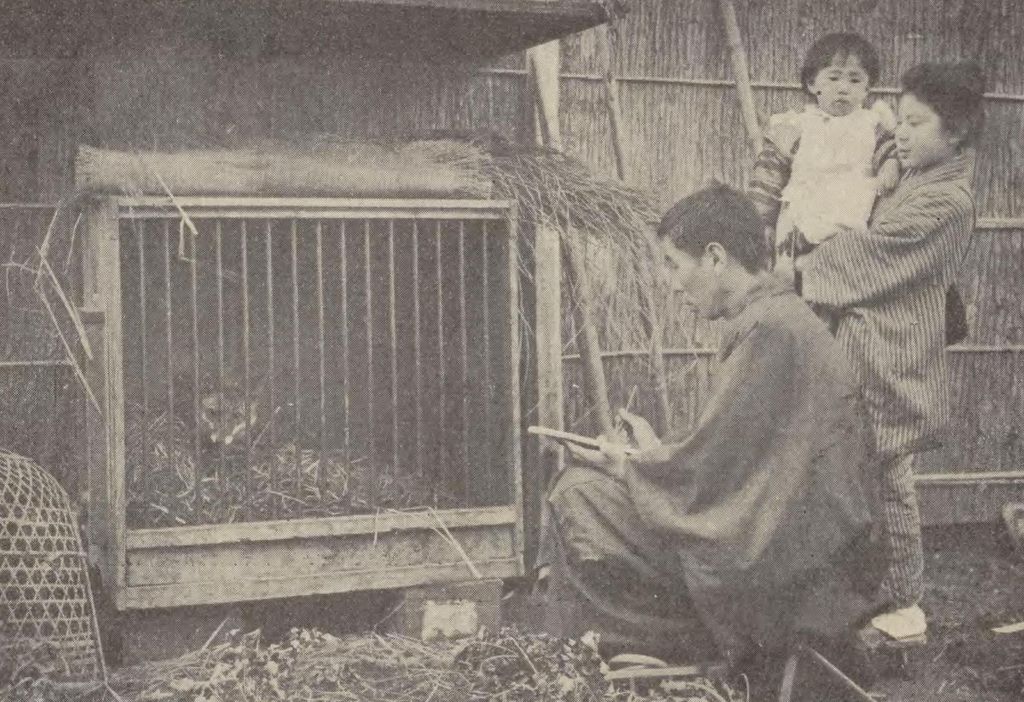
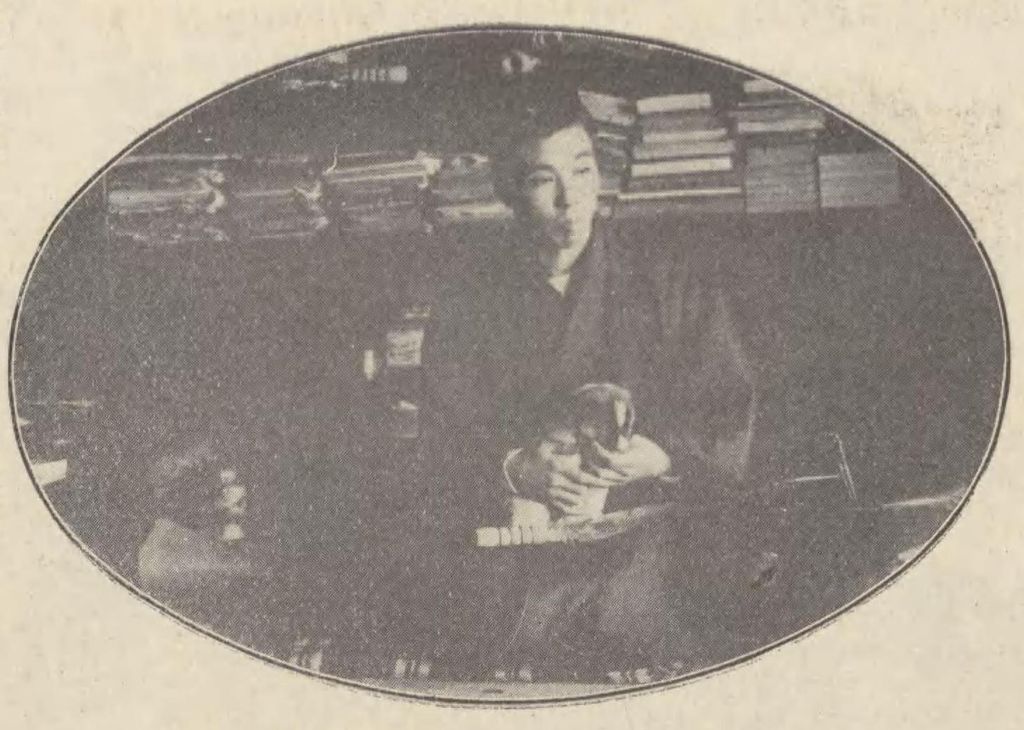
Takeuchi Seihō; published March 1910, photograph date unknown. National Diet Library. Resized for web display. Object or image record.
 by Tom Gurney
Tom Gurney BSc (Hons) is an art history expert with over 20 years experience
Published on September 25, 2026 / Updated on September 25, 2026
Email: tomgurney1@gmail.com / Phone: +44 7429 011000
Takeuchi Seihō: a Kyoto life in a changing art world
Takeuchi Seihō was born Takeuchi Tsunekichi (竹内恒吉) in Kyoto on 20 December 1864 and died on 23 August 1942. Between those dates Japan remade the institutions in which a painter learned, exhibited and earned public authority. Seihō lived that change as a working artist rather than merely witnessing it. He moved from study with local masters to national competitions, from Kyoto subjects to European and Chinese journeys, and from a young exhibitor to a teacher and official judge. The paintings never ceased to matter inside those roles. A chronology that lists appointments without following the changing work would miss why his leadership was persuasive. [1] [2]
The National Diet Library gives his original name as Tsunekichi and records an earlier art-name spelling, 棲鳳. Following the 1900–01 European trip, he wrote it 栖鳳. Romanized “Seihō” conceals that visible change. It is a useful marker in a biography, but not evidence of an instant break with all he learned before. Nor should the two characters be used carelessly to split one artist's records into different people. Searches of Japanese catalogues need both spellings, exact titles and dates. [1]
Contents
Learning to paint in Kyoto
NDL names Tsuchida Eirin and Kōno Bairei as his teachers. Shizuoka Prefectural Museum of Art's artist biography adds that he entered the Kyoto Prefectural School of Painting's northern-school course in 1884. It recalls his attendance at a Fenollosa art lecture in Kyoto two years later. That museum chronology gives useful detail but should be read as an institutional retrospective, not a transcript of every lesson the young painter received. What can be established is a Kyoto network of teachers, school and exhibitions, and a training in observation associated with the Maruyama–Shijō tradition. Tsuchida Eirin was an early teacher; Tsuchida Bakusen was a later artist in Seihō's circle. Sharing a family name must not collapse their separate roles. [1] [4] [5]
Life at a glance
- Life20 December 1864–23 August 1942
- BirthplaceKyoto
- TeachersTsuchida Eirin and Kōno Bairei
- TravelEurope and China
The NDL places a successful entry in the first Domestic Painting Competition in 1882. It is a reminder that Seihō's competitive career began very early, even before the 1884 school date supplied by Shizuoka. Rather than force these records into a neat story in which formal training must precede any recognition, retain both dates as stated. Artists could learn in workshops, show pictures and enter institutions in overlapping ways. The important point for the reader is the early encounter with public judgment. A painting that travelled to an exhibition could be compared with the work of artists who had learned different methods. [1] [4]
This overlap shaped the young artist's options. A school course could put different inherited approaches in the same building; a named teacher could supply sustained criticism and access to a network; an exhibition could test whether a work communicated beyond that network. Those are distinct kinds of education. Later summaries often compress them into the assertion that Seihō was “of the Shijō school.” That phrase is useful for locating a tradition of observed nature and brushwork, but it cannot tell us how he made an eight-panel door painting or why he entered a competitive show. The dated records help keep the school label from becoming a complete explanation. [1] [4] [6]
In 1889 Seihō made Landscape of Mountains and Sea (《漁樵山水図》), now in the National Museum of Modern Art, Kyoto. The work is eight sliding-door panels. It shows a young painter working at architectural scale, not merely drawing small animals while awaiting his mature style. An interior-format commission required continuity across separate panels and a relation to the room in which they would be seen. The exact museum record dates the work; it does not document who ordered it or the room's original configuration, so those details should remain open. [6]

Shizuoka's biography dates Seihō's appointment as a teacher at the Kyoto City Arts and Crafts School to 1895. Kyoto City Kyocera Museum confirms the broad teaching role at the city's painting school and at his own Chikujōkai studio. The institutional titles in English changed over time; it is safer to name the school as the museum does, then give the dated appointment with Shizuoka's source, than to imply that one modern English name applied continuously. Teaching did not mean he stopped competing or painting. At about the same moment he was making ambitious works for public display and new civic purposes. [4] [2]
The appointment also changed his relationship to the next generation. He had learned in a field where a pupil might move between a private master and a formal school; he now helped teach within that mixed system. Later artist lists can create the impression of a single Seihō style passed from hand to hand. The documentary story is subtler. A young painter could receive a teacher's advice, participate in a studio group, enter an official exhibition and then select a different aesthetic problem. Uemura Shōen's history as a painter of women and Tsuchida Bakusen's later trajectory show why an account of “influence” needs their own objects and dates. In this biography, teaching is an institution and a relationship, not ownership of pupils' mature work. [1] [2] [5]
A historical scroll and a new Kyoto shrine
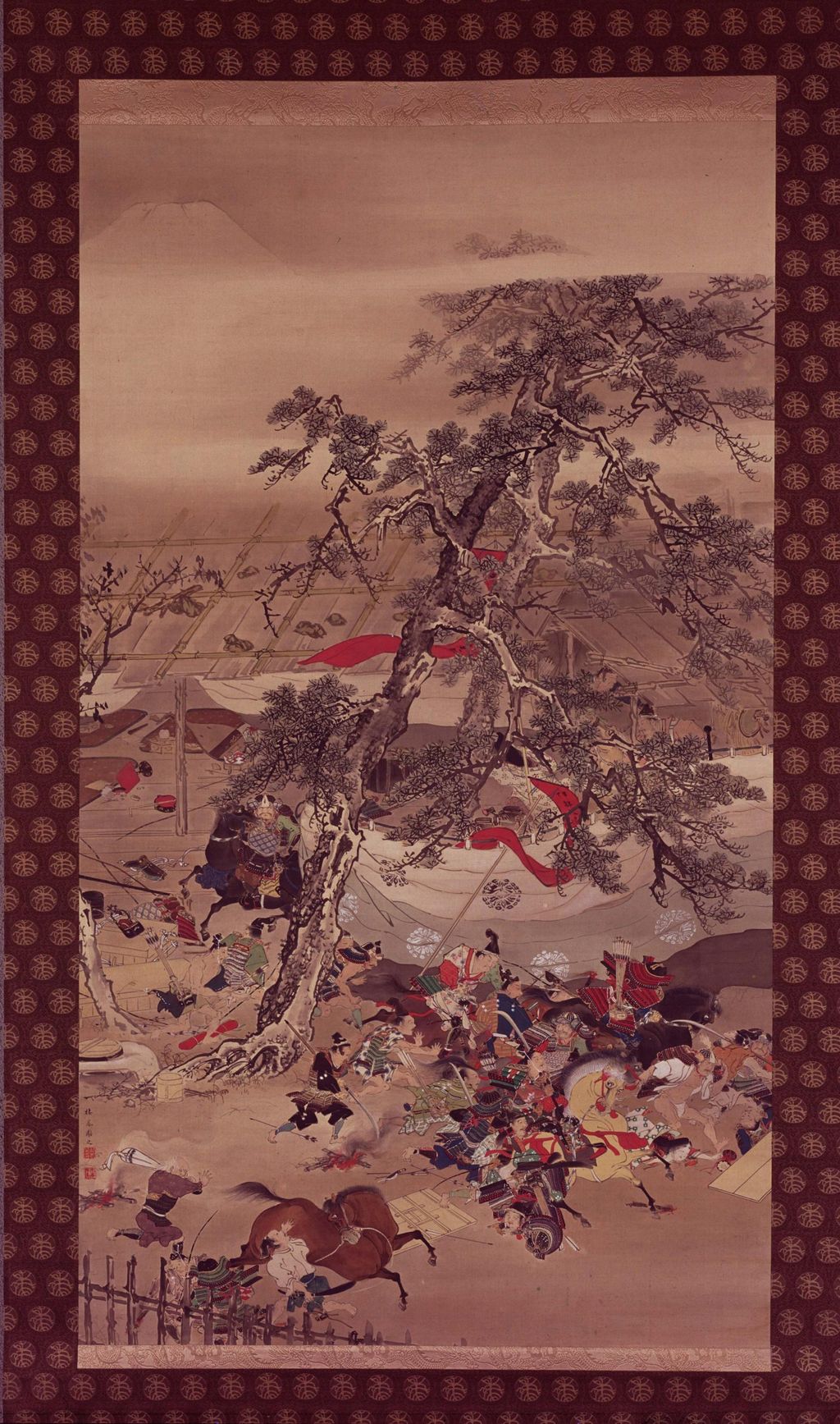
The 1894 Victory at the Fuji River makes a particularly useful biographical marker. The Agency for Cultural Affairs dates the scroll and identifies its subject: the Taira army's panic when waterbirds rose at the 1180 Battle of Fujigawa. The record says it appeared in a Kyoto craft exhibition and drew on Kano and Shijō pictorial methods. Thus the work places the painter within Kyoto exhibition culture before Europe, already willing to combine inherited resources to solve a dramatic scene. Its birds are the trigger of a historical narrative, not a detached nature study. [8]
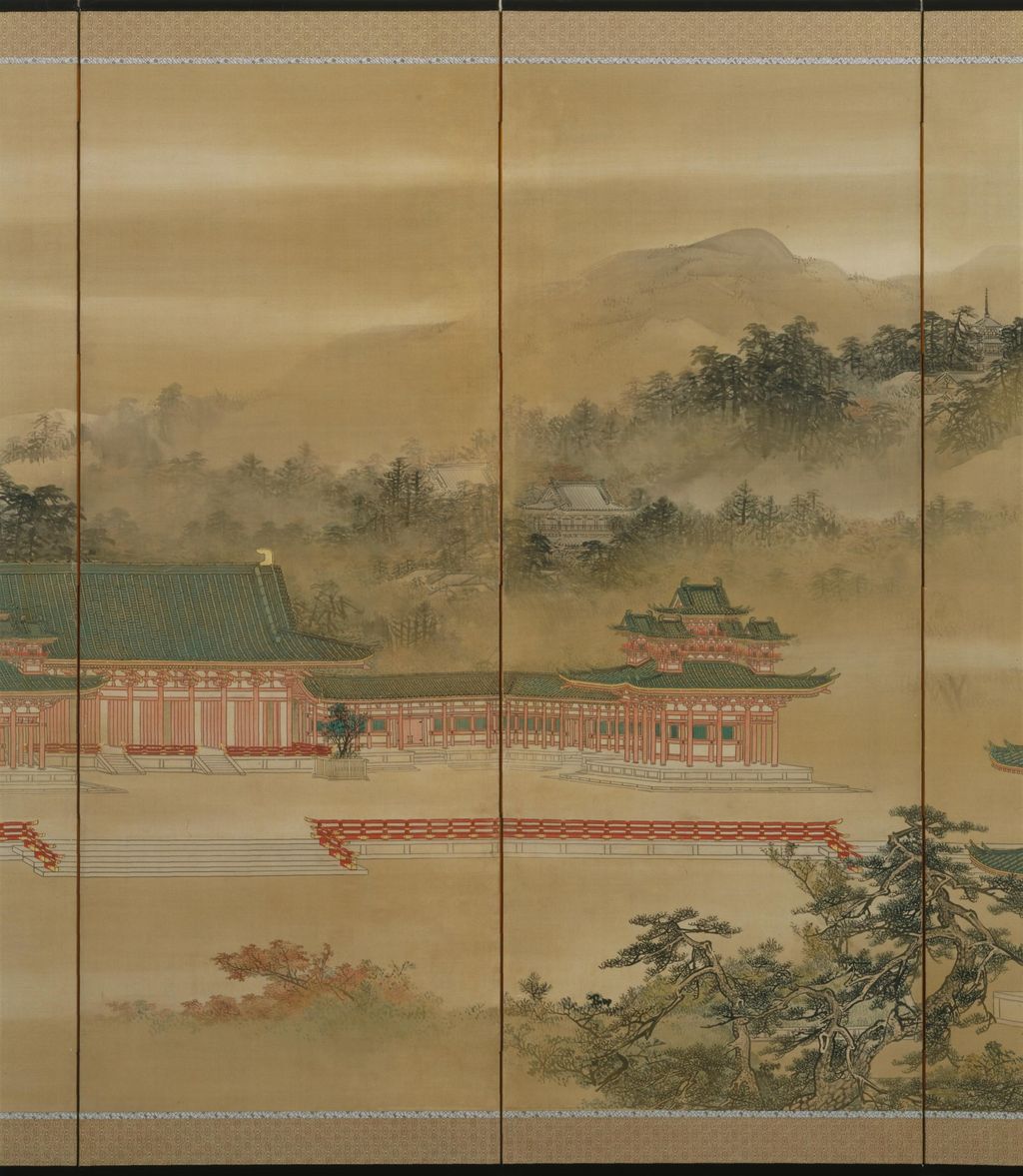
Another turning point in the city itself came in 1895, when Heian Shrine was built for the 1,100th anniversary of Kyoto's establishment as the capital. The following year Seihō painted Maruyama Park and Heian Shrine. The Agency says the work was presented to an official connected with the commemoration: its left screen gathers the new shrine in an elevated view, and its right shows the famous park. The pair was a living commission bound to a public event, not an imagined antique landscape. Seihō had to make the new shrine visually legible while using a six-panel screen pair, a form with a long history. [10]
Tokyo National Museum also holds a large 1896 drawing, Preparatory Drawing for Heian Shrine. A National Institutes for Cultural Heritage report describes it as probably the full-scale design for the left screen, on the evidence of panel divisions and composition. The qualification is as much a part of the record as the relationship. Seihō's career cannot be understood through final objects alone; surviving working material shows the scale of a planned screen and invites a comparison of selected and discarded arrangements. Kyoto's 2013 exhibition later made this broader point with more than a hundred sketchbooks and multiple preparatory drawings. [11] [12]
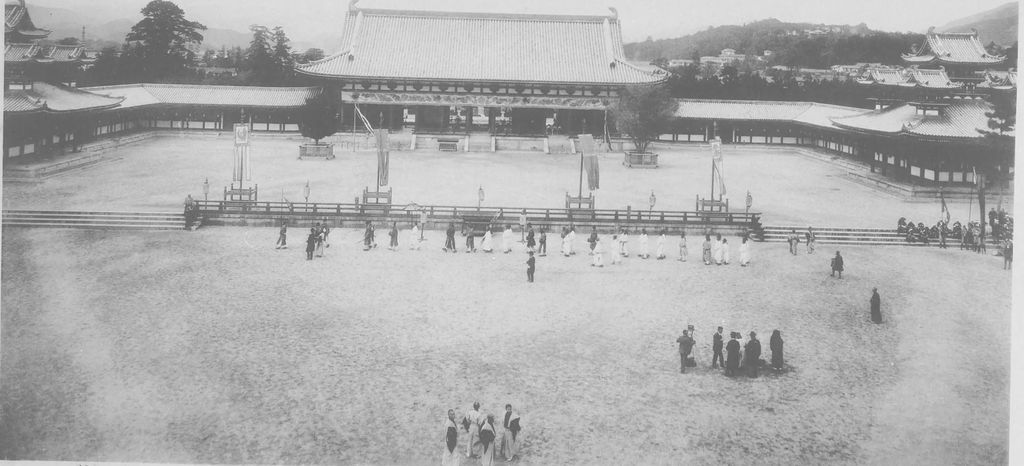
The shrine acquired a photographic presence after Seihō's painting. NDL's Kyoto Famous Places Album, published in June 1907, includes a photograph of Heian Shrine. This cropped public-domain page can help a reader imagine the later built site, provided the date is handled properly. Its exposure is undated and no later than publication; it was not Seihō's reference photograph in 1896. The eleven-year gap is a reason to set the two images beside one another with clear labels, not to describe their views as equivalent. [14] [15]
The painting and photograph also come from different systems of circulation. An official connected with a city commemoration received the screens; a printed volume could take a shrine photograph into readers' hands. The former combines two named places in a folding object, while the latter fixes one camera view on a page. Neither medium is a neutral window. That distinction gives the historical photograph a real purpose in this biography: it shows how a place that mattered to Seihō's career continued to be pictured for another audience. The records establish the dates, provenance and formats. The comparison of their viewing habits is an editorial reading, open to revision when the exact screen segment and the full album page are inspected together. [10] [15]
The 1900–01 journey and the return
NDL dates his European trip from 1900 into 1901. Kyoto City Kyocera Museum links it to the Paris International Exposition of 1900, and Shizuoka Prefectural Museum describes its effect on his understanding of observation and light. The last is the museum's interpretation of the journey's consequences, not a diary quotation from Seihō. An English Mie museum page gives an anomalous “1895 Paris world's fair” line. That date conflicts with the NDL/Kyoto account and with the exposition itself; it has not been carried into this biography. Mie's c.1901 Tiger and Lion is still an exact work lead, but its questionable biographical sentence is not evidence for travel chronology. [1] [2] [4] [16]
The familiar account of Seihō as a painter who “fused East and West” can hide several distinct activities. He looked at European works; he changed an art-name character; he returned to schools, exhibitions and picture formats in Kyoto. He painted subjects connected with his travels, including Rome and Venice, but the museum's public list does not demonstrate that one named European painter supplied the design of a particular Seihō work. Comparative scholarship may establish such a connection for an individual object; a biography should not substitute a general slogan for the evidence. The changes after travel belong to a career already full of cross-school experimentation before 1900. [2] [8] [10]
The trip also has to be located in a Japan where large international exhibitions and domestic juried shows increasingly shaped how art was seen. A painter visiting the Paris exposition was not simply collecting a private gallery of impressions; he encountered a setting designed to present national industries and visual cultures to one another. Kyoto's museum explicitly links the journey to that 1900 event. It is reasonable to say that the trip widened the set of pictures and modes of display Seihō could compare. It is not reasonable to infer a private reaction to a named canvas from the fact of attendance alone. For a biography, the difference between a documented itinerary and a proposed artistic cause should stay visible. [2] [4]
The c.1904 Willow Trees on the Frosty Riverside supplies a dated post-journey work. Kyoto's museum holds it as a pair of six-panel screens and records it at a 1904 memorial exhibition for Bairei. The long wintry riverbank is distant in subject and atmosphere from the civic Heian Shrine screens, yet both rely on a broad paired format. The teacher's memorial context is particularly apt in a life story: Seihō's new European experiences did not sever him from the Kyoto circle in which his practice had formed. That is an inference from the exhibition record, not a claim about his private feelings for Bairei. [17]
The first Bunten exhibition began in 1907. NDL records Seihō as a judge from the founding of the government show. Another exact Agency record places his After a Shower (《雨霽》), a pair of six-panel ink-on-silk screens, in that first exhibition. The agency describes herons after prolonged rain, including one taking flight, with willow branches moving in a light breeze. Its account makes a revealing contrast with the 1894 waterbirds. Both works need a bird's motion, but the earlier one uses it to unleash a historical panic; the later work watches a change in weather and the interval after it. The 1907 object is in the National Museum of Modern Art, Tokyo. The available catalogue download is far below the site's preferred image size, so the painting is discussed here without an enlarged illustration. [1] [18]
The English title After a Shower presents a real catalogue trap. Adachi Museum of Art holds a Seihō work with that English title dated 1928, while the first-Bunten screens at the National Museum of Modern Art, Tokyo are 1907. Both are connected with weather and birds, but the dates, holders and objects are different. A biography might mention them in the same career without turning one into a later state of the other. The Japanese title 《雨霽》 and each museum’s object record help keep the two works distinct. [18] [24]
A teacher in an expanding public world
Seihō's position as a Bunten judge was one part of his public life. A judging role meant evaluating others' work as well as submitting his own, and the new exhibition made decisions about Japanese painting visible nationally. Kyoto City Kyocera Museum names his teaching at the municipal painting school and Chikujōkai. NDL names Uemura Shōen among his pupils; Hiroshima Museum of Art also names Tsuchida Bakusen. They were not copies of their teacher. Shōen's life as a professional woman artist and Bakusen's later decisions each merit independent study. The point here is that Seihō's workshop and classroom helped younger painters enter changing institutions, while those painters carried the field in different directions. [1] [2] [5]
NDL records his appointment as Imperial Court Artist in 1913. The title signifies official recognition, but it should not be made to explain every subsequent canvas. He continued to investigate subjects and travel. Shizuoka's institutional biography dates two journeys to China to 1920 and 1921 and interprets their effect on his treatment of atmosphere and colour. Kyoto City Kyocera Museum independently says that he visited China twice, though its overview does not give the dates. In a biography these records can be presented together: the travel is a dated life event, and the claimed stylistic consequence belongs explicitly to Shizuoka's curatorial account. The artist home can then test any visual claim against an exact dated work. [1] [4] [2]
The year of the court appointment also belongs to a less predictable painting. Kyoto City Kyocera Museum holds Posing for the First Time (《絵になる最初》), dated 1913 and painted on a tall silk hanging scroll. A woman stands before a paper door, averts her eyes and holds her removed kimono around her; her sash lies on the floor. The museum reads the garment's blue, grey and ochre patterns as part of the picture's suggestion of embarrassment. This is an exact object in the city that had shaped the painter's training, and a reminder that his subjects included difficult human attention as well as birds and landscape. Its date connects it to a public honour without claiming that the honour caused him to paint it. [25] [1]
One can trace the research route without inventing a travel sketch. Shizuoka's digital archive identifies its Outside Yangzhou (《揚州城外》) as a 1922 work by Seihō. The title invites a connection with a place in China, but the object entry alone does not prove the precise day he made an initial study or whether a drawing was made on either 1920 or 1921 journey. A dated museum object supports a more precise account than an undocumented “painted on his travels” claim. [4]
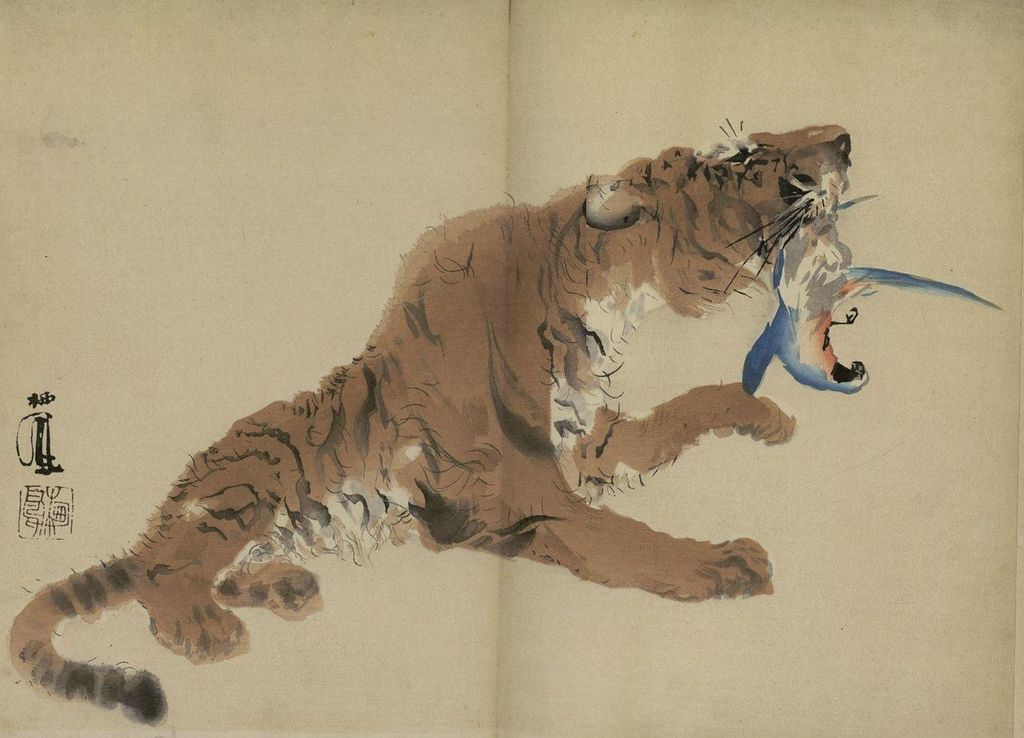
His drawings and books form another thread through these years. NDL Image Bank displays leaves from Seihō Album of the Twelve Signs of the Zodiac. The publication demonstrates that images of animals could circulate outside the physical presence of a painted screen. It does not tell us precisely when Seihō first saw any depicted animal, or turn twelve pages into twelve autonomous paintings. For an artist who taught and whose work reached broader audiences, the distinction between a painting, an album and a reproduction is central. A biography that only enumerates museum masterpieces would leave out this different channel through which his brushwork became known. [19]
A British holding offers a second printed-work marker in the chronology. The British Museum lists a 1901 Seihō shūga-chō (《栖鳳習画帖》), registration 1981,0805,0.1.2, under Seihō as print artist. It is a different book from the NDL zodiac album. The 1901 catalogue date falls around the European journey, but it does not date the making of any individual animal study or make the book a travel diary. The record establishes circulation and later collecting, while the artist’s personal circumstances must be supported elsewhere. The holding record preserves that distinction. [27]
The Metropolitan Museum of Art holds a precisely dated American point of comparison: Parrot on an Ancient Pine (《老松鸚鵡図》), a 1916 silk hanging scroll whose painted image measures 141.6 × 51.1 cm. The museum describes the pink-and-white parrot and the old pine that surrounds it. This object shows that a decade after the first Bunten he was still exploring how an animal could animate a vertical field. It is now held in New York, but the museum’s 2021 gift date is not an event in Seihō’s lifetime. The museum’s object record provides the precise identity and dimensions for comparison. [26]
The 1924 cat and the late public honours
The 1924 Spotted Cat is an important point in his later career, but the two Japanese spellings need care. Yamatane Museum, the holder, uses 《班猫》. The Agency for Cultural Affairs designation uses 《斑猫》. They refer to one painting, not two versions. Yamatane's account says a chance encounter with a cat in Numazu led to close study. This is a museum narrative about how the subject came to him; it does not supply a diary of every drawing. Yamatane’s account and the designated-property record can be read together to test that narrative. [21] [22]
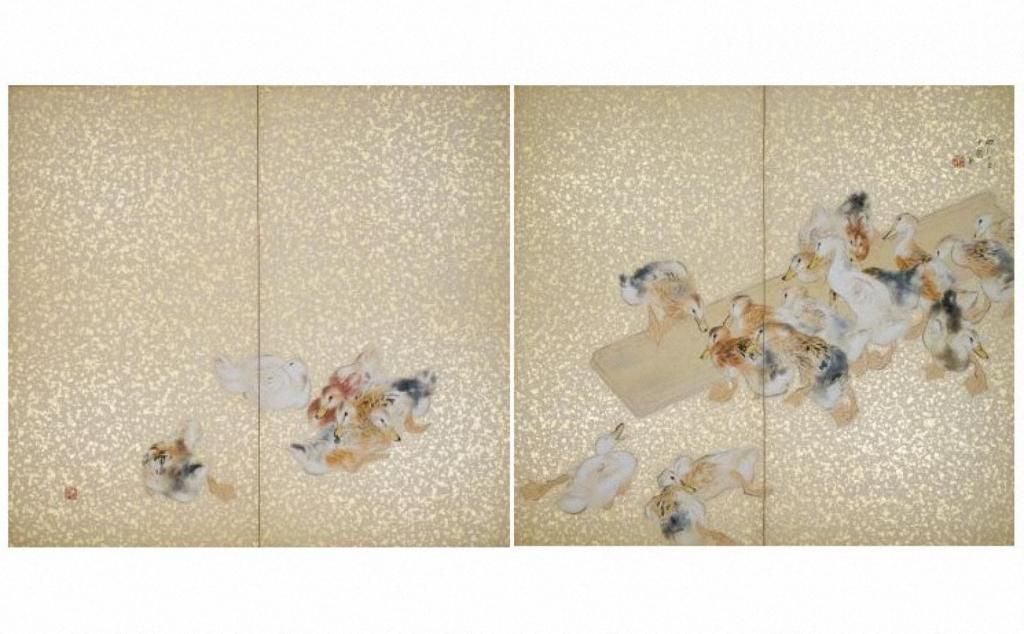
In 1937 Seihō received an Order of Culture in its first cohort, according to NDL. Kyoto City Kyocera Museum describes him as a first recipient; that means he was among the inaugural honourees, not that no one else received the award. In the same year, the National Museum of Modern Art, Kyoto records his Young Ducks (《若き家鴨》) at the first Shin-Bunten. The pair of two-panel screens, each 171 × 184 cm, gives the late date a work to look at rather than leaving it as an honours line. He remained active in a new iteration of the exhibition world that had shaped his career since youth. [1] [2] [23]
The ducks also return the story to the questions with which it began. In his eight-panel doors of 1889, an image had to occupy a long architectural surface; in 1937, the birds occupy two broad screens and their surrounding space is part of the subject. More than forty years separate these objects. Calling the late painting effortless would miss the role of lifelong practice; calling it merely an official exhibition entry would miss the birds' spatial life. The NDL's honours record and Kyoto's object record are most illuminating together, because they locate an active painter inside a public institution without letting the institution replace the picture. [6] [1] [23]
Later honour can encourage an overly smooth life story: promising pupil, European revelation, mature master, public decoration. The records are more interesting. The young painter had already exhibited in 1882; the teacher's memorial exhibition remained relevant after Europe; the 1896 shrine screens required laborious planning; journeys to China came after court appointment; a modern national exhibition still had space for Young Ducks in his seventies. His career moved through overlapping responsibilities and fresh subjects. The portrait from Graphic and the surviving drawings are reminders that public labels rest on a working person who continued to look. [1] [4] [12] [23]
Seihō died in August 1942. The Kyoto museum's retrospective of roughly 130 works, held in 2023, belongs to the history of how later institutions have interpreted his life; it is not itself evidence that he anticipated every modern category of nihonga. The most durable approach is to read each dated document for what it can establish. NDL provides the life dates, names and appointments; Shizuoka supplies a fuller school and travel chronology; Kyoto opens the studio's sketches and teaching; accessioned museum objects mark what was actually made. Together they yield a biography of continuous work, public authority and unfinished questions, rather than a legend of effortless skill. [1] [4] [2] [12]
Frequently Asked Questions
The National Diet Library gives 20 December 1864 and 23 August 1942. His birth name was Takeuchi Tsunekichi. [1]
NDL names Tsuchida Eirin and Kōno Bairei. Later, Seihō taught younger artists including Uemura Shōen and Tsuchida Bakusen; Bakusen must not be confused with the earlier teacher Eirin. [1] [5]
He travelled in 1900–01, including the 1900 Paris exposition. The change in his art-name spelling from 棲鳳 to 栖鳳 followed his return. [1] [2]
Yes. Shizuoka Prefectural Museum of Art dates two journeys to 1920 and 1921; Kyoto City Kyocera Museum also records two China visits. [4] [2]
Discussion
Use dated records to explore how training, travel and public roles overlapped with painting.
Reader Insights
How can an 1882 exhibition success and 1884 school entry coexist?
What do the European and Chinese journey records establish?
How do the 1937 honour and Young Ducks together illuminate his working life?
Join the Conversation
Share a documented example or reliable source below, keeping observation separate from inference.
References
- National Diet Library, “Takeuchi Seihō,” Portraits of Modern Japanese Historical Figures.
- Kyoto City Kyocera Museum of Art, “Takeuchi Seiho: A Destructive and Creative Force” (2023 retrospective).
- National Diet Library, Takeuchi Seihō portrait records; images `6463_2` and `6463_3` reproduced from *Graphic* 2(6), March 1910.
- Shizuoka Prefectural Museum of Art, Takeuchi Seihō artist biography (school, teaching and China travel chronology).
- Hiroshima Museum of Art, Takeuchi Seihō: collection and pupils.
- National Museum of Modern Art, Kyoto / National Art Museums Japan, 《漁樵山水図》, J00892.
- National Art Museums Japan, NoC-CR catalogue image terms.
- Agency for Cultural Affairs, 《富士川大勝》, 1894.
- Tokyo National Museum via ColBase, 《富士川大勝》, A-10566.
- Agency for Cultural Affairs, 《円山公園・平安神宮》, 1896.
- Tokyo National Museum via ColBase, 《平安神宮下絵》, A-12480.
- National Institutes for Cultural Heritage, 2020 acquisitions report; Kyoto Municipal Museum / NACT, 2013 preparatory-drawing exhibition synopsis.
- Tokyo National Museum via ColBase, 《円山公園・平安神宮》, A-11781.
- National Diet Library, Heian Shrine historical image and reproduction terms.
- National Diet Library Digital Collections, 《京都名所帖》, PID 765647, page `R0000017`, June 1907.
- Mie Prefectural Art Museum, *Tiger and Lion* object record; the page's 1895 Paris-fair biography date is not adopted.
- National Museum of Modern Art, Kyoto / National Art Museums Japan, 《蕭条》, J00140.
- Agency for Cultural Affairs, 《雨霽》, 1907 (first Bunten and scene).
- National Diet Library Image Bank, 《栖鳳画伯筆十二支帖》.
- National Diet Library Image Bank, image reuse terms.
- Yamatane Museum of Art, 《班猫》 and animal-painting exhibition.
- Agency for Cultural Affairs, 《斑猫》 designation record.
- National Museum of Modern Art, Kyoto / National Art Museums Japan, 《若き家鴨》, J00041 (first Shin-Bunten).
- Adachi Museum of Art, Takeuchi Seihō collection (distinct 1928 *After a Shower* and image restrictions).
- Kyoto City Kyocera Museum of Art, *Posing for the First Time*, 1913 (exact collection record).
- The Metropolitan Museum of Art, *Parrot on an Ancient Pine*, 1916, accession 2021.322.
- British Museum, *Seihō shūga-chō*, 1901, registration 1981,0805,0.1.2 (research record).