



 by Tom Gurney
Tom Gurney BSc (Hons) is an art history expert with over 20 years experience
Email: tomgurney1@gmail.com / Phone: +44 7429 011000
Portrait of a Woman Traditionally Called the Monomaniac of Envy: Introduction
The white cap catches the eye before the face does. Its crumpled crown and pleated border stand out against a dark, roughly worked background; below it, an older woman looks past us towards the left. Her mouth is closed, her brows uneven, her eyes bright beneath the furrowed forehead. Géricault gives her a powerful physical presence, yet almost everything that would turn this encounter into a biography is missing. We do not know her name, and the title by which the painting became famous was supplied after the artist’s death. The Musée des Beaux-Arts de Lyon dates the canvas to about 1819–22 and identifies it as La Monomane de l’envie, inventory B 825. [1]
Often encountered in English as Insane Woman or The Monomaniac of Envy, this is a portrait whose inherited names can direct our response before we have looked closely. The Lyon museum explicitly warns that the labels attached to these portraits were retrospective. They cannot tell us what this particular woman was thinking, or establish a diagnosis from her appearance. [2] Looking at the picture means holding two things together: the historical circumstances through which it became known, and the individual face that exceeds those circumstances.
At a Glance
- DateAbout 1819–22 [1]
- MediumOil on canvas [1]
- Dimensions72.1 × 58.5 cm [1]
- CollectionMusée des Beaux-Arts de Lyon, B 825 [1]
This work across Théodore Géricault’s career
The Severed Heads
1810s [3]Charging Chasseur
1812 [4]Horse Frightened by Lightning
c.1813–14 [5]The Raft of the Medusa
1818–19 [7]Portrait of a Kleptomaniac
c.1820–24 [9]The Epsom Derby
1821 [10]Contents
- The woman in the Lyon canvas
- A cap, a red scarf and a dark shawl
- What the historical title tells us
- An uncertain origin, followed by a late rediscovery
- Comparison without classification
- A painting that changed its context
- Annotated details
The woman in the Lyon canvas
The painting is an oil on canvas measuring 72.1 × 58.5 cm. Its upright format contains the sitter’s head and upper body, with very little space to either side. Lyon acquired it at public auction in 1908. These are secure points in an otherwise incomplete history, and they anchor the work in a particular object rather than an interchangeable illustration of a psychiatric category. [1]
The head sits slightly off centre within a broad mass of dark clothing. Although the face is turned only a little, the eyes pull more decisively sideways. We cannot see what holds their attention. There is no second figure to complete an exchange, no object that explains an activity, and no visible setting that identifies a hospital. The dark field brings the woman close while leaving her circumstances out of reach.
The face is strongly lit, but light does not simplify it. Across the forehead, short pale marks meet softer grey passages at the temples and hairline. Beneath the eyes, the cheekbones lead towards deep folds around the nose and mouth. One cheek receives more light than the other. These differences keep the head from becoming a symmetrical diagram: each part has its own weight, colour and degree of definition.
Nor is the expression reducible to one clear emotion. The lips form a narrow, gently curving line. Their shape might suggest the beginning of a smile to one viewer and a tightly held reserve to another. The sideways glance can seem watchful or absorbed. Those possibilities arise from the arrangement of paint, but none gives access to the sitter’s private thoughts. The portrait holds attention partly because it makes an expression vivid without making its meaning certain.
A cap, a red scarf and a dark shawl
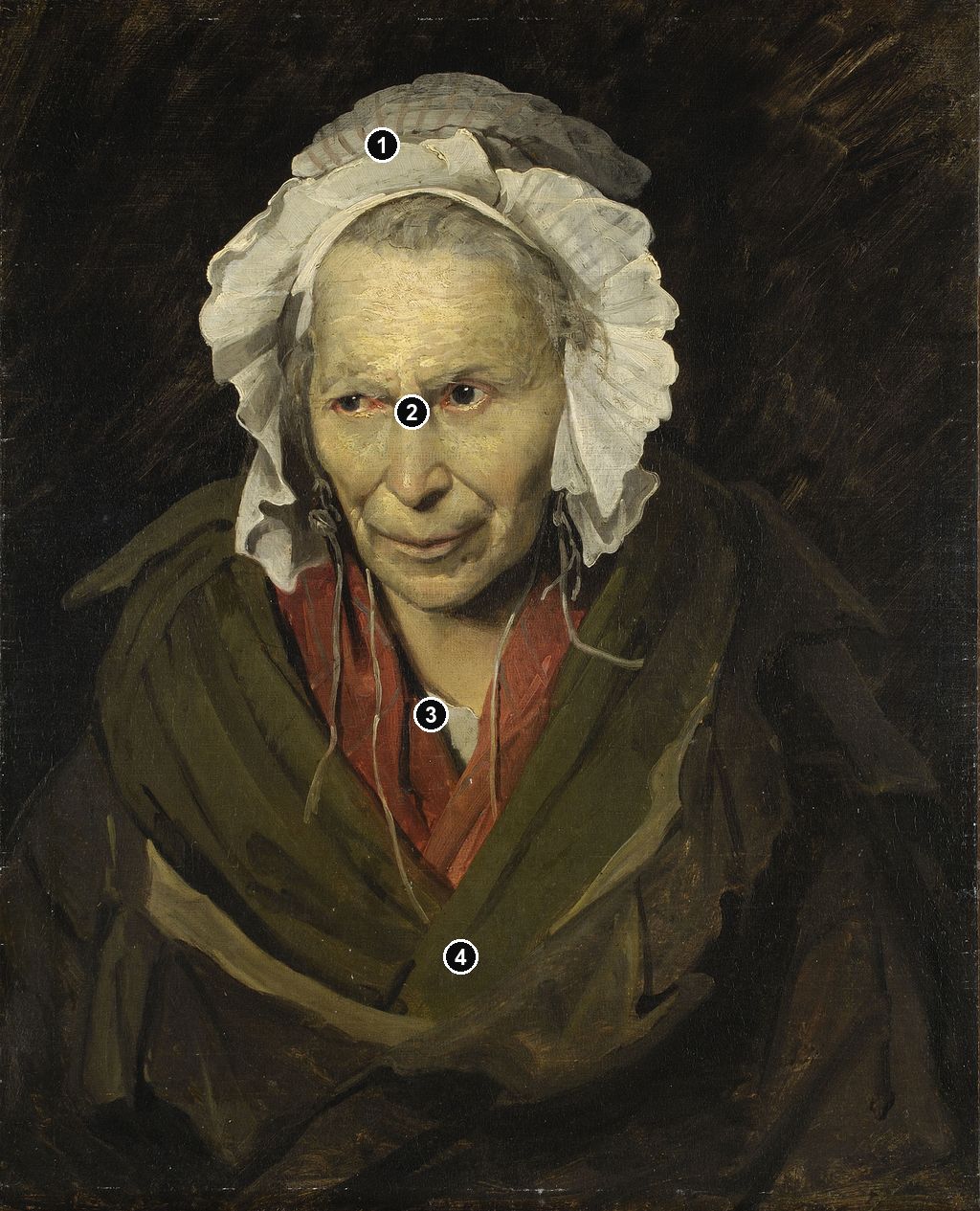
The cap is as carefully differentiated as the face. Around the woman’s temples it forms a pale, irregular frame, with folds that alternately catch light and turn into grey shadow. Above her forehead, its projecting edge overlaps the darker crown. The ruffles do not make a smooth halo: their changing angles create a broken rhythm, and a few fine, light lines sharpen particular edges. The cap enlarges the head’s silhouette and gives the surrounding darkness a jagged boundary.
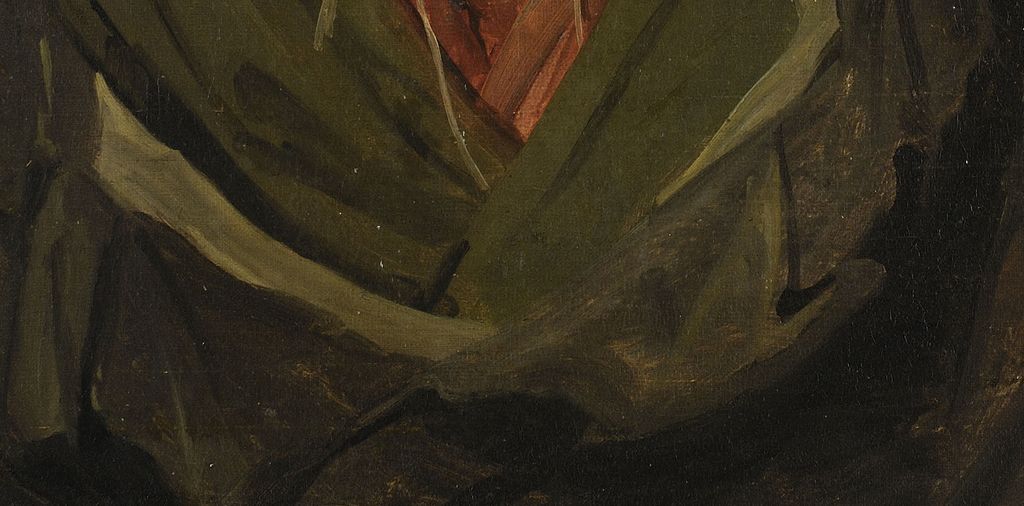
Below the chin, a red scarf interrupts the sombre greens and browns of the outer garment. It forms a deep V, narrowing towards the chest, while a small triangle of white fabric shows inside it. The scarf’s warmer colour draws the eye down from the cheeks before the dark folds carry it outward again. Thin pale ties hang beside the face and across the clothing. They are easy to overlook, but their wiry lines contrast with the much broader strokes around them.
The shawl or outer wrap spreads across the shoulders in heavy, sweeping folds. Long strokes describe its lower curves; nearer the neck, darker wedges make the fabric seem tucked and layered. Géricault changes the scale of his marks as he moves between skin, linen and outer clothing. The face is built through many small transitions, while a single broad stroke can establish a substantial fold. The picture’s force depends on this variety rather than on uniformly fine finish.
These are observations about visible handling, rather than a reconstruction of the painting’s materials or sequence of execution. The reproduction shows exposed-looking strokes in the background and fabric, but it cannot by itself establish how quickly Géricault worked or whether a passage was intended as final. What it does reveal is a hierarchy of attention: the woman’s features remain distinct within a less tightly resolved surrounding field. Lyon’s focus dossier likewise directs attention to the vigorously brushed brown background and the close framing of the face. [2]
Clothing matters here because it supplies more than a frame for presumed symptoms. The white, red and olive-brown areas organise almost the whole composition. They make the sitter a clothed person occupying space, with fabric resting on her shoulders and close to her skin. No elaborate accessory explains her social importance. The portrait’s sustained attention is sufficient to make her consequential to the viewer.
Annotated Details from Portrait of a Woman Traditionally Called the Monomaniac of Envy
The numbered points identify visible features discussed in this article. Return from each detail to the whole composition. Portrait of a Woman Traditionally Called the Monomaniac of Envy Image source. Public domain.
Details from PORTRAIT OF A WOMAN TRADITIONALLY CALLED THE MONOMANIAC OF ENVY
Compare the cropped details with the complete images above. Notice how their colours, shapes and positions contribute to the larger compositions.
The pleated cap
Pale folds create an irregular frame around the forehead, with darker pleats separating its projecting edges.
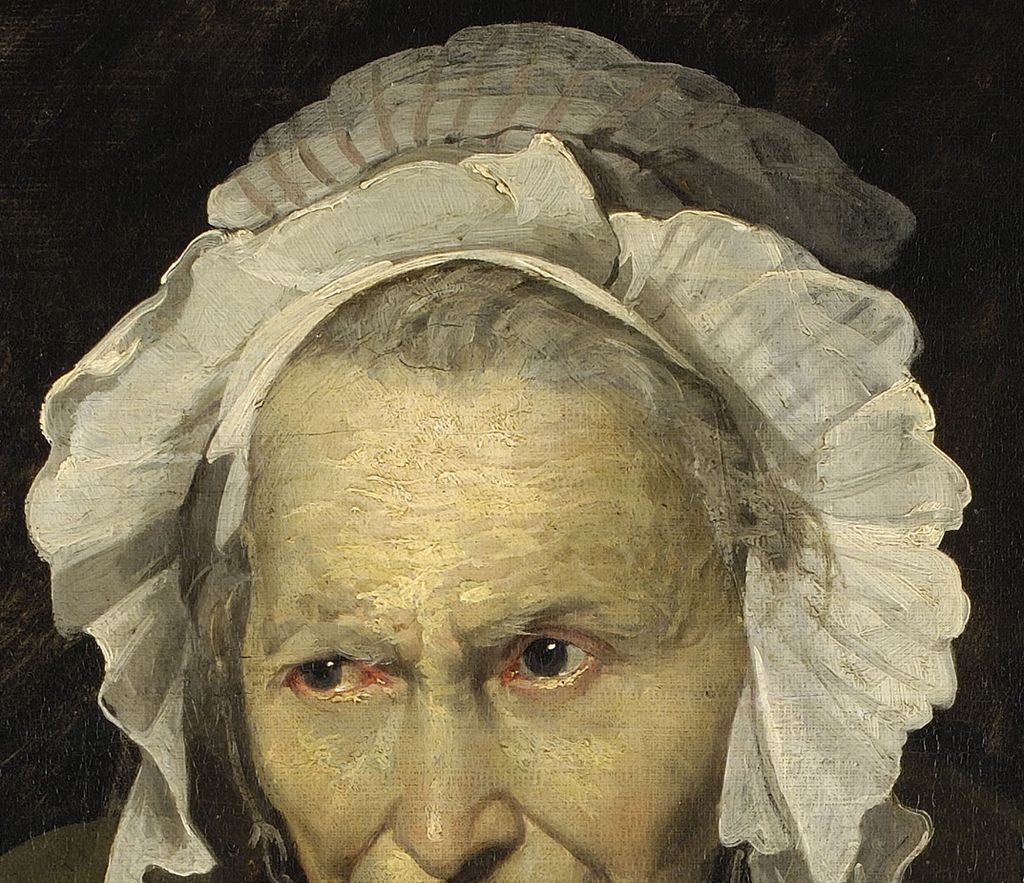
Eyes directed beyond the frame
The eyes turn towards the left of the image, while small changes of light make the two sides of the face distinct.
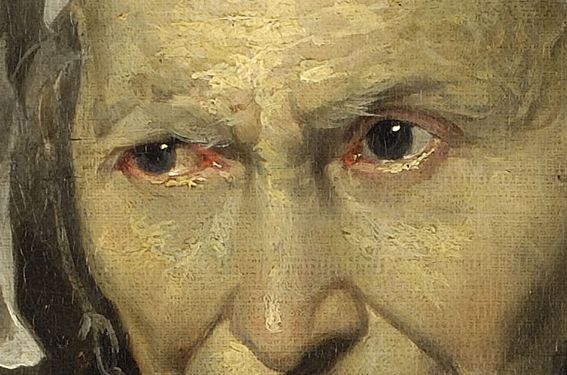
Red scarf and hanging ties
The red scarf makes a deep V below the chin; fine pale ties cross the heavier planes of clothing.
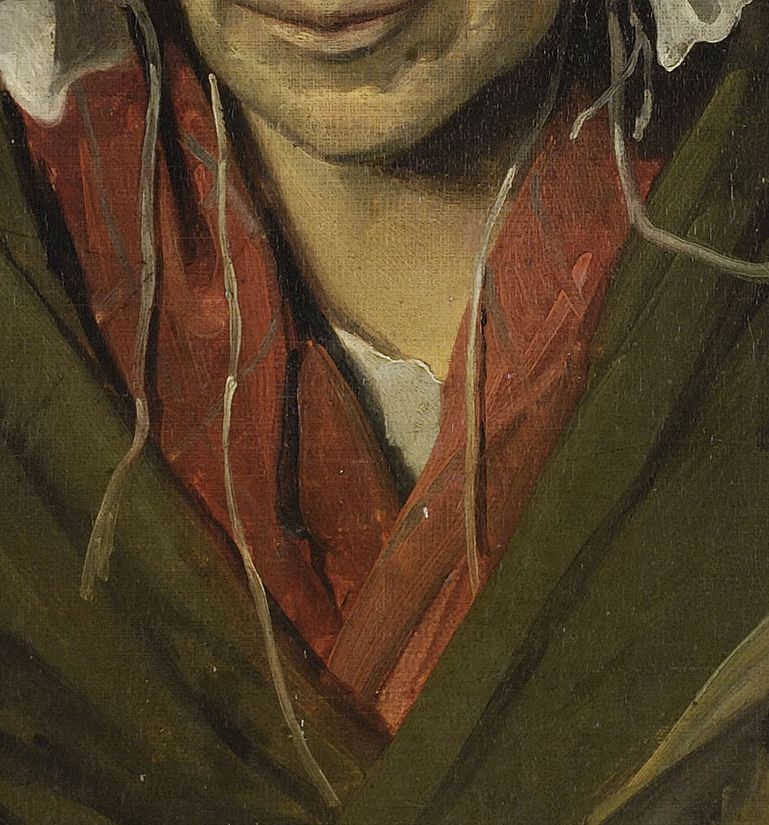
Broadly brushed outer folds
Long, broad strokes describe the wrap’s sweeping folds, contrasting with the smaller changes of colour in the face.
What the historical title tells us
The French word envie means envy. In the title, it belongs to the historical idea of monomania: a disturbance understood as concentrated on a particular obsession or delusion. Lyon’s focus dossier places that terminology within the development of nineteenth-century psychiatry and notes its later disappearance as a diagnostic category. [2] It is therefore a term with a history, rather than a timeless description of the woman before us.
The distinction becomes particularly important with envy. Unlike a depicted action, an envious thought cannot be identified simply by pointing to a visible feature. There is no rival in the picture, no coveted possession and no narrated encounter. If we have already read the title, a tight mouth or sidelong look may appear to confirm it. Without the title, the same features admit other readings. The painting lets us examine that process of interpretation, including our readiness to turn a facial expression into evidence of character.
According to Lyon, the critic Louis Viardot attached the monomania labels to the portraits when he described their rediscovery in 1863. They were not titles supplied by Géricault. [1] The name Monomaniac of Envy is consequently valuable evidence about the work’s reception and transmission. It is much less secure as information about the person who sat for it.
This does not require pretending that the painting has no connection with the history of mental illness. That connection is central to how it has been preserved, named and discussed. It does require separating the history of a label from the history of a life. The woman’s anonymity leaves a serious gap: she has become widely recognisable through an attributed condition, while the ordinary facts that might identify her remain unavailable.
Watch: Géricault and The Raft of the Medusa
Three perspectives on Géricault’s best-known painting, its making and its historical setting.
Gericault, Raft of the Medusa
Smarthistory examines the composition and historical setting of The Raft of the Medusa.
Watch on YouTubeAn uncertain origin, followed by a late rediscovery
The museum’s date of about 1819–22 should be read as a range. It does not fix a sitting in a particular year or identify a single moment in Géricault’s career as the explanation for the picture. Lyon also questions the later date range proposed in Viardot’s account. [1] The uncertainty is part of the painting’s history, not a detail that can be settled by its familiar position among the artist’s late works.
A frequently repeated account says that Géricault painted the portraits for the physician Étienne Georget, either as a commission connected with medical study or through a personal relationship. Lyon’s current record states that no document establishes a connection between the two men or demonstrates Georget’s interest in commissioning such representations. Its focus dossier similarly treats stories about friendship, treatment and a medical publication as unsupported hypotheses. [1] [2] They should not be turned into a definite account of why the woman was painted.
The distinction between a possible context and a documented commission matters. Lyon contrasts the lack of evidence for Georget with the known interest of Jean Étienne Esquirol in having portraits of patients drawn for his observations. Such activity helps explain why images and medical classification might be brought together in this period. It does not identify the patron, location or purpose of Géricault’s canvas. [1]
The later history becomes clearer through Viardot’s account. Lyon’s focus dossier recounts his discovery of five canvases at Baden-Baden in 1863, rolled in a chest and belonging to a physician who had lived in the East. It also emphasises the absence of testimony tracing their earlier journey. The portraits were subsequently dispersed, and the Lyon painting entered the museum through the 1908 sale of Auguste Chéramy’s collection. [2]
This sequence explains why discovery and naming cannot be treated as transparent windows onto the original sittings. The portraits became publicly legible through a story told decades after their creation. Viardot’s report is an important historical witness to their reappearance, but it is not a surviving conversation with this woman or a statement by Géricault. The interval leaves room for questions that later familiarity with the paintings can easily conceal.
Comparison without classification
The other portraits help us recognise Géricault’s choices, provided we do not use them as a chart of different disorders. In the Ghent portrait traditionally called the Kleptomaniac, a man with dark hair and a beard appears against a similarly subdued background. A pale neckcloth separates his face from his dark clothing. The Vlaamse Kunstcollectie record dates that canvas to about 1820–24 and emphasises the suggestive handling that complicates the distinction between a study and a finished painting. [9]
Placed beside the Lyon woman, the Ghent man makes the white cap’s structural importance especially clear. His dark hair blends towards the background; her pale headdress insists on a visible outer contour. His neckcloth gathers light below the beard, whereas her red scarf introduces a stronger colour change. The portraits share concentrated attention to the head, yet their rhythms and contrasts are individual. Neither needs to be read as the generic illustration of its inherited label.
The woman traditionally associated with gambling in the Louvre provides a closer comparison in dress. She too wears a pale cap and a dark outer garment, but a broad white fabric crosses beneath her chin. Her head turns towards the right of the image, and the upward direction of her eyes changes the encounter. The Louvre dates its canvas to 1819–22 and gives dimensions of 77 × 65 cm, making it a distinct, somewhat larger object than the Lyon painting. [11] Comparing the two encourages attention to the placement of the eyes and the geometry of clothing before their titles begin to explain them.
In the Winterthur portrait traditionally called the Man with Delusions of Military Command, the sitter’s dark cap has red edging and a hanging tassel. Light sleeves create a more open pattern around the darker torso, while the head turns firmly to the side. The Oskar Reinhart collection dates that work to about 1819–22 and records an 81 × 65 cm canvas. [12] Its different scale and distribution of light show how much variety exists within the related group. The shared format does not erase the differences among the people represented.
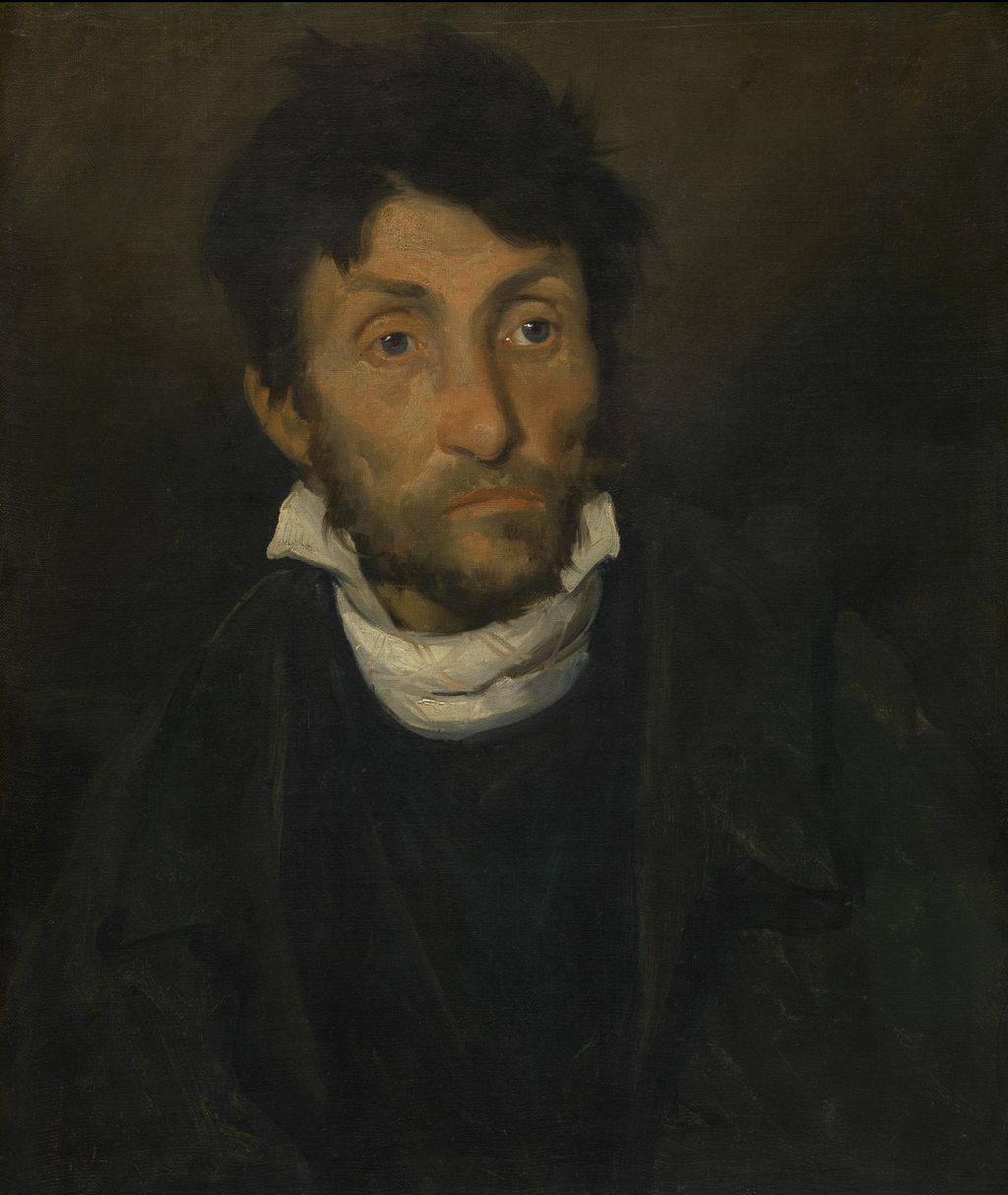
Portrait of a Kleptomaniac Image source. CC0 / Public domain.
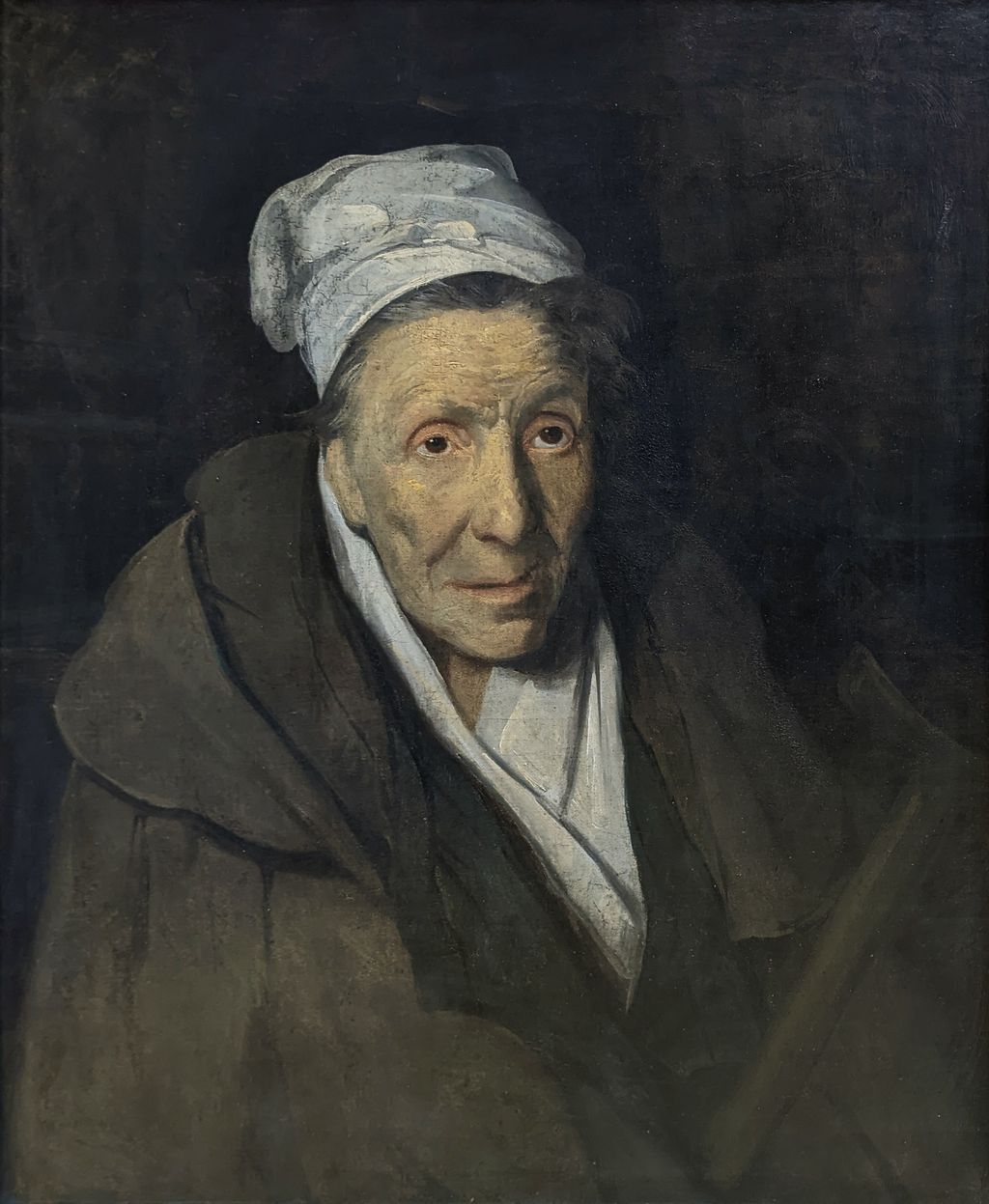
Portrait of a Woman Traditionally Called the Monomaniac of Gambling Image source. Public domain.
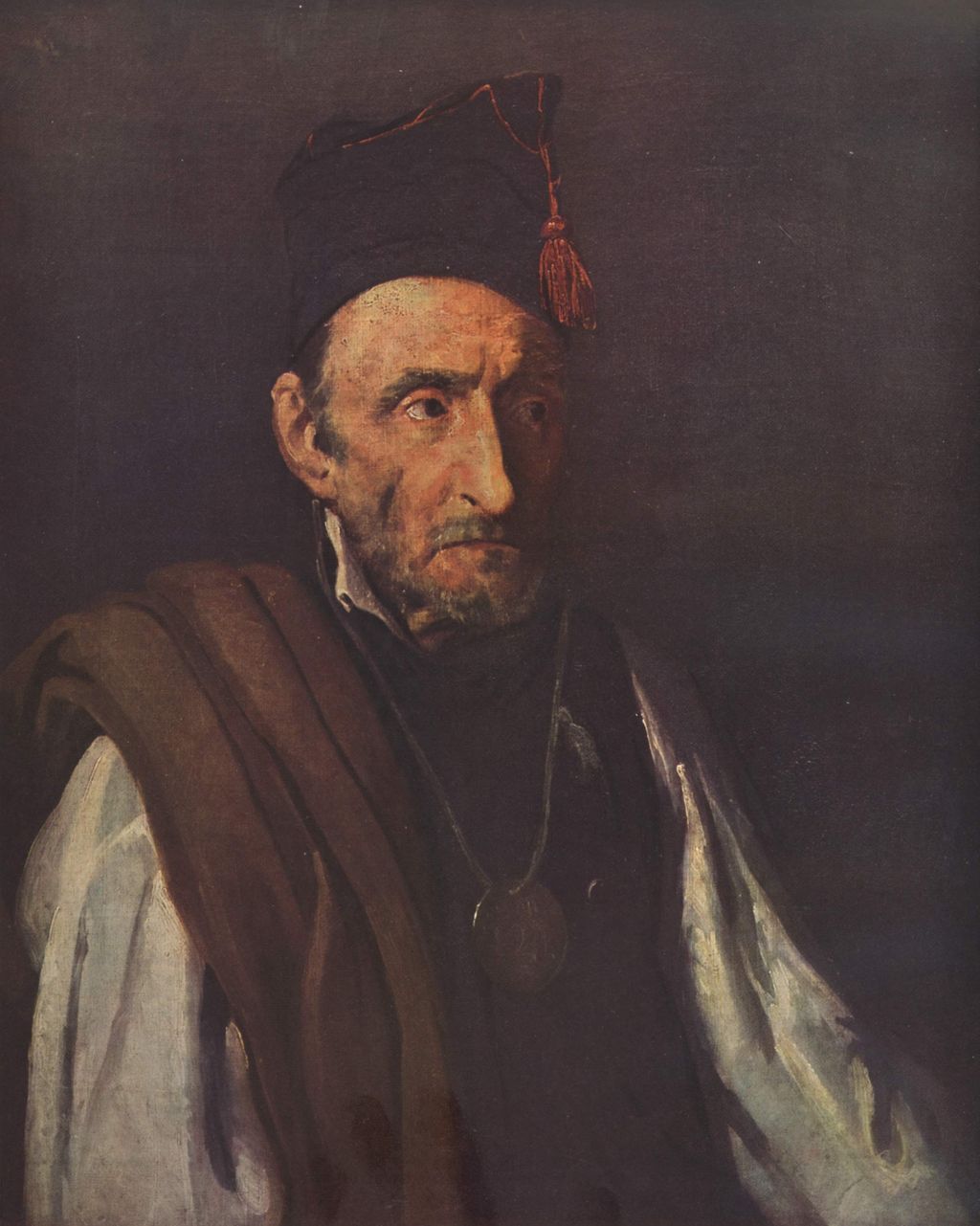
Man with Delusions of Military Command Image source. Public domain.
A painting that changed its context
Lyon’s ownership has shaped the portrait’s more recent interpretation. In 2006, the museum placed its canvas at the centre of Géricault, la folie d’un monde, bringing it together with the Ghent and Louvre portraits. The exhibition’s introductory dossier expressly sought to move the group beyond an isolated account of psychiatric history and towards a broader reading of Géricault’s attention to social exclusion, war, suffering and political life. [13]
That curatorial argument changes the questions we ask. Instead of treating the woman solely as the subject of observation, it asks what it means for an anonymous person to receive the sustained attention of portrait painting. The dossier’s section on portraits of ordinary people presents Géricault’s individual faces as a means of painting history without the usual heroic event. This is an interpretation advanced by the exhibition, rather than documentary proof that this particular canvas was conceived as a political allegory. [13]
Lyon’s current object entry also stresses the significance of representing an anonymous sitter with the gravity traditionally associated with more socially prominent subjects. [1] That observation finds support in the encounter itself. Nothing in the composition invites laughter or offers an entertaining episode. The large, brightly framed head demands time. Even the partly unresolved clothing contributes to the concentration with which the features have been brought before us.
The portrait’s later history thus includes changing attempts to give it a setting: medical, Romantic, social and political. Each can illuminate something, but the face remains more particular than the category around it. Returning to the cap’s uneven folds, the thin ties and the differently lit cheeks makes that particularity tangible. We see what Géricault painted with remarkable force; the woman’s name and thoughts remain her own, beyond the evidence the picture has preserved.
Géricault collection records
Seventy collection records include paintings, drawings and individual print impressions. Different impressions remain separate records; this selection is not a complete catalogue raisonné.
Frequently Asked Questions
Discussion
Look again at the images and ideas explored in Portrait of a Woman Traditionally Called the Monomaniac of Envy. These editorial prompts invite your observations.
Reader Insights
Before reading the title, what words would you use for the woman’s expression? How does the title alter that first impression?
Follow the pale cap, thin ties and red scarf. How do these details guide your attention between the face and the body?
Compare the Lyon and Louvre women. How do the different eye directions and shapes of pale fabric change your sense of an encounter?
Join the Conversation
Share a detail, comparison or question about Portrait of a Woman Traditionally Called the Monomaniac of Envy below.
References
- Musée des Beaux-Arts de Lyon, La Monomane de l’envie, current collection record for B 825, about 1819–22; object metadata, Viardot account and commission cautions (French; consulted 27 October 2026). View source. (in French).
- Musée des Beaux-Arts de Lyon, Théodore Géricault : La Monomane de l’envie, two-page focus dossier, pp. 1–2; historical terminology, retrospective titles, uncertain origins and acquisition (French; undated; consulted 27 October 2026). View source. (in French).
- Nationalmuseum, The Severed Heads, NM 2113; collection metadata and museum interpretation (Swedish). View source.
- Louvre, Charging Chasseur, INV 4885; collection metadata and museum interpretation (French/English interface). View source.
- National Gallery, Horse frightened by Lightning; collection metadata and museum interpretation (English). View source.
- Louvre, Wounded Cuirassier, INV 4886; collection metadata and museum interpretation (French). View source.
- Louvre, The Raft of the Medusa, INV 4884; collection metadata and museum interpretation (French). View source.
- Gary Tinterow / The Metropolitan Museum of Art, Géricault’s Heroic Landscapes: The Times of Day, Met Bulletin 48/3, Winter 1990–91; consulted main essay and relevant object entries (English). View source.
- Vlaamse Kunstcollectie / Museum voor Schone Kunsten Gent, Portret van een kleptomaan, collection record, object 1908-F, about 1820–24; metadata and interpretation of handling (Dutch; consulted 27 October 2026). View source. (in Dutch).
- Louvre, Epsom, MI 708; collection metadata and museum interpretation (French/English interface). View source.
- Musée du Louvre, La folle monomane du jeu, collection record, RF 1938 51, 1819–22; object metadata (French; record updated 18 February 2025; consulted 27 October 2026). View source. (in French).
- Sammlung Oskar Reinhart «Am Römerholz», Théodore Géricault, Geisteskranker mit militärischem Grössenwahn, um 1819–22, collection entry; title, date, medium and dimensions (German; consulted 27 October 2026). View source. (in German).
- Musée des Beaux-Arts de Lyon, Géricault, la folie d’un monde, exhibition press dossier, 2006, pp. 3, 7–8 and 13; exhibition presentation, “Portraits du peuple,” “Peuple fou” and object list (French). View source. (in French).


