



 by Tom Gurney
Tom Gurney BSc (Hons) is an art history expert with over 20 years experience
Email: tomgurney1@gmail.com / Phone: +44 7429 011000
Portrait of a Kleptomaniac by Théodore Géricault: Introduction
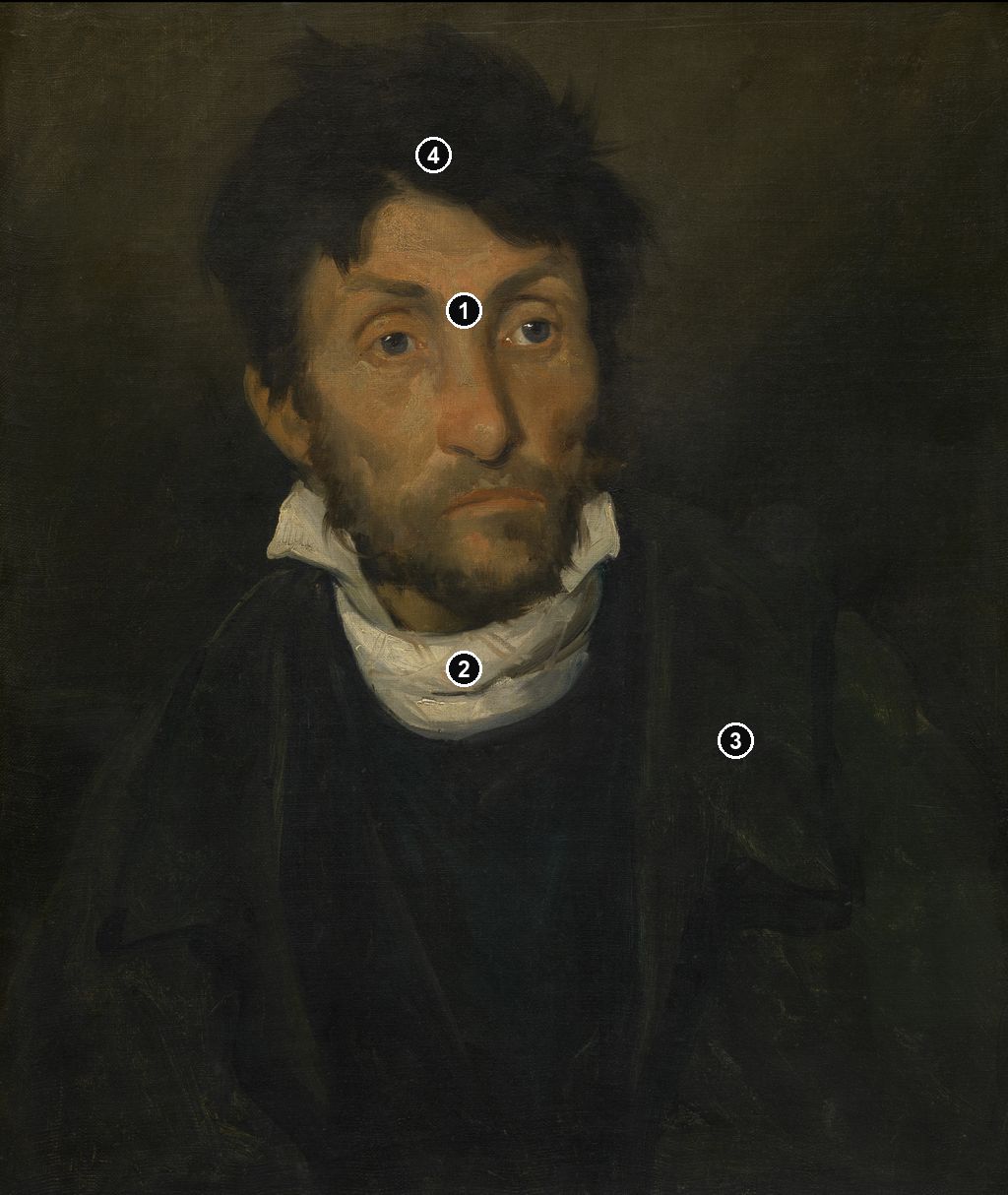
A man in a dark coat looks just past us. His white neckcloth catches the light, his hair rises in uneven masses, and small reflections in his eyes give the face an alert presence. There are no hands, possessions or actions to explain the title Portrait of a Kleptomaniac. The gap between that title and the person we see is central to the painting. A historical label seems to tell us who he is, while the image offers something more particular and less easily resolved.
Théodore Géricault’s portrait belongs to the Museum voor Schone Kunsten in Ghent, where it is catalogued as inventory 1908-F. Painted in oil on canvas, it measures 61.2 × 50.1 cm; the collection dates it approximately 1820–24. Its handling moves from carefully placed lights in the face to broad, dark passages in the clothing. The Vlaamse Kunstcollectie’s account stresses the independent value of such a suggestively painted study, questioning how neatly it can be separated from a finished picture. [1]
The man’s name is unknown. Even the familiar claim that these portraits were commissioned by the doctor Étienne Georget needs qualification: the Musée des Beaux-Arts de Lyon states that no document establishes a connection between doctor and painter. Looking closely therefore matters as much as explaining the painting’s medical reputation. The face is available to us; the circumstances that brought it before Géricault are much less secure. [2]
At a Glance
- DateCirca 1820–24 [1]
- MediumOil on canvas [1]
- Dimensions61.2 × 50.1 cm [1]
- CollectionMuseum voor Schone Kunsten, Ghent [1]
This work across Théodore Géricault’s career
The Severed Heads
1810s [3]Charging Chasseur
1812 [4]Horse Frightened by Lightning
c.1813–14 [5]The Raft of the Medusa
1818–19 [7]The Epsom Derby
1821 [9]Contents
- A face turned beyond the frame
- The white cloth and the dark coat
- How the title shapes what we see
- Was it painted for Étienne Georget?
- One individual within a group
- A place in Ghent’s collection
- Fiona Tan’s continuing encounter
- Annotated details
A face turned beyond the frame
The head is nearly frontal, but its slight turn and the direction of the eyes lead towards the right side of the image. That small displacement prevents the portrait from settling into a straightforward exchange between sitter and spectator. He appears close enough for conversation without actually addressing us. The dark background supplies no destination for his attention. We cannot tell whether he is watching another person, listening, waiting or simply looking away.
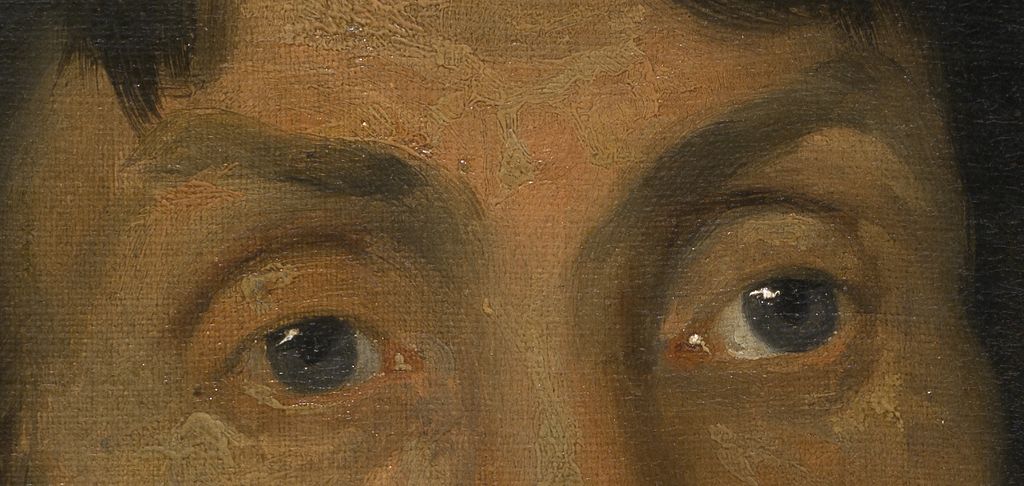
Géricault gives considerable weight to this uncertain encounter. The eyes sit beneath distinct, uneven eyebrows, and the bright touches on their surfaces stand out against the surrounding brown. A warm passage runs down the nose; cooler, greyer paint appears across the cheeks and around the mouth. His lips meet without a smile. The face is constructed through these differences of tone and emphasis rather than a continuous outline enclosing every feature.
It is tempting to translate the sideways gaze into a psychological statement. It might look distracted, wary or withdrawn, depending on what the viewer brings to it. Those responses are possible experiences of the picture, not evidence that the sitter possessed a particular condition. A direction of looking cannot establish why he looked that way. The painting becomes more absorbing when we attend to the exact distribution of light and shadow before deciding what emotional vocabulary to apply.
The hair contributes to the portrait’s physical immediacy. It is almost black at its thickest, with irregular locks breaking the silhouette above the forehead. Around the lower face, the beard and sideburns alternate between dark masses and more lightly indicated areas. Hair, flesh and background sometimes meet through softened transitions. Elsewhere, especially near the lit forehead, their boundaries become more definite. These changes keep the head from resembling a uniformly described specimen.
The crop is equally consequential. We see the head, shoulders and upper torso, with the coat continuing down to the lower edge. The absence of hands removes one of portraiture’s most expressive resources. There is no gesture to balance the face and no activity to turn the sitter into a participant in a story. That restraint concentrates attention, but it also withholds information. In particular, nothing depicted supplies an illustration of stealing.
The white cloth and the dark coat
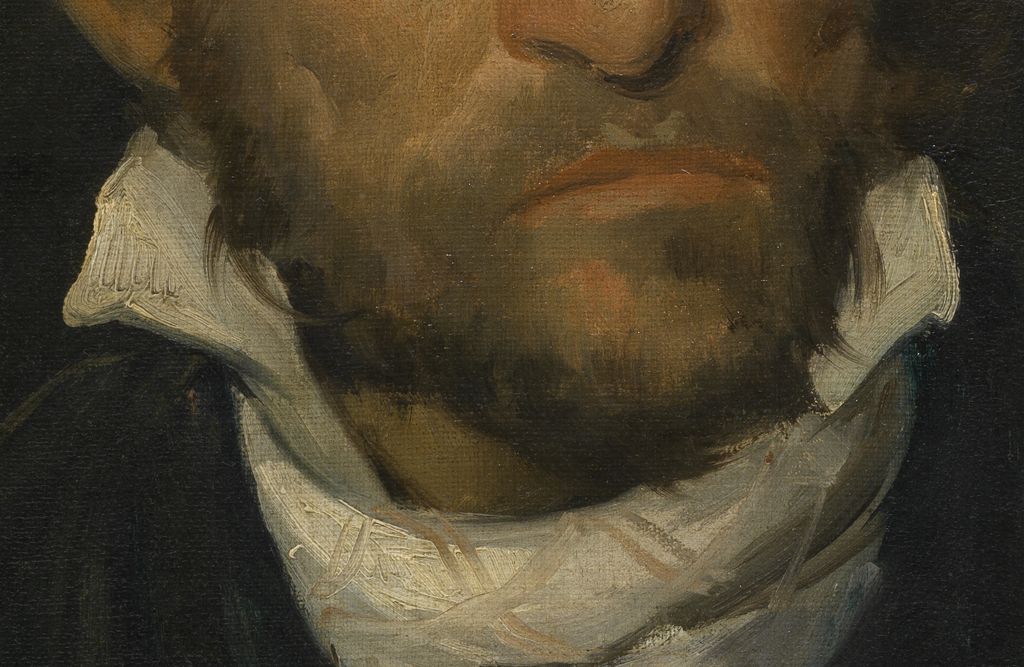
The neckcloth is the picture’s most forceful interruption of darkness. Its ends rise on either side of the neck, while its lower folds form a pale curve beneath the beard. Géricault does not paint it as a flat white patch. Grey and cream passages distinguish overlapping fabric, and visible strokes carry the eye across folds that remain loosely stated. The cloth creates a clear separation between the face and the almost continuous dark field of the coat.
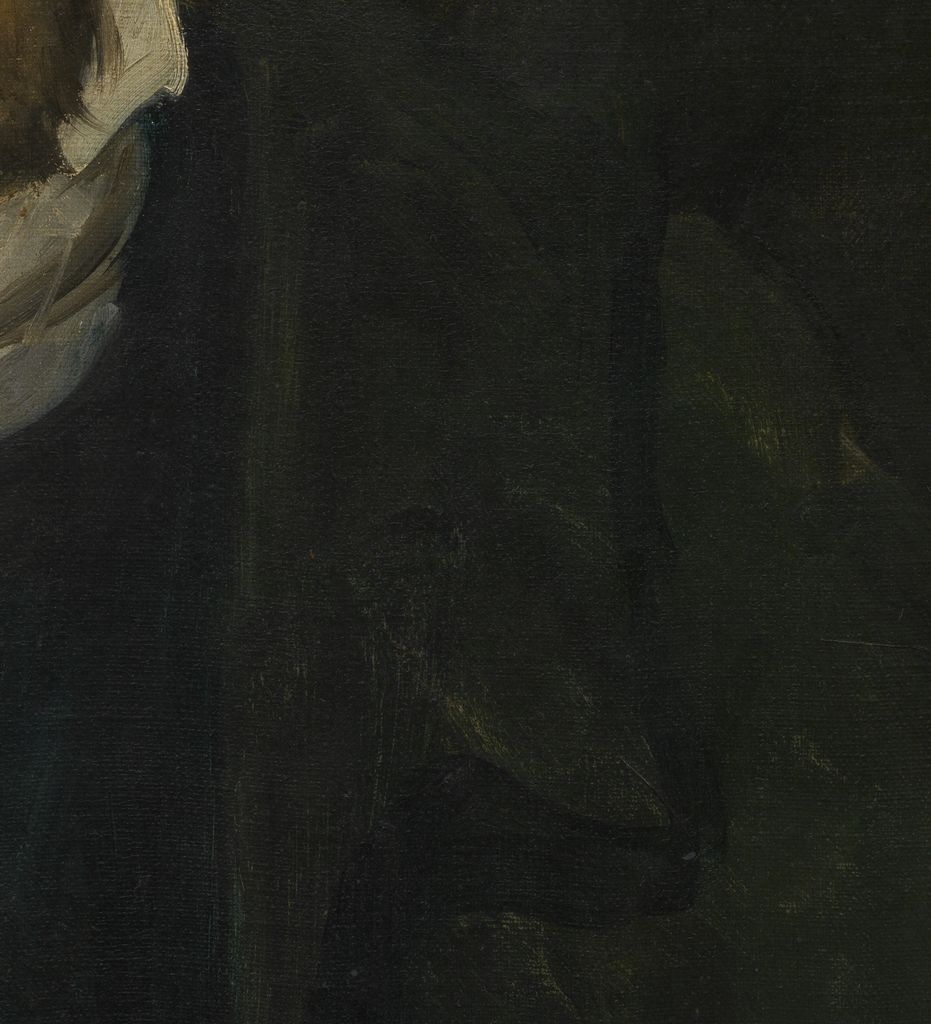
The coat initially reads as a broad enclosing shape. With longer looking, its lapels and changes of plane become easier to distinguish. Muted green-brown strokes indicate edges that a brighter, more polished portrait might have made immediately legible. The shoulder at the right of the image is particularly expansive. The man’s body has weight and occupies space, even though the description of its clothing is selective.
This difference in emphasis establishes an order of attention. We register the face and white fabric first, then discover how much information the darker passages contain. The portrait does not become more intimate by revealing everything equally. Instead, it directs us towards some details while leaving others on the threshold of visibility. The apparent simplicity of a head against darkness depends on a carefully varied field of dark tones.
Calling the painting a study helps describe its economy, provided that the word does not reduce it to an incomplete preliminary for some missing, superior version. The collection account specifically associates its supple, suggestive handling with a reassessment of what makes a painting complete. That observation fits the visible contrast between the concentrated facial lights and the more broadly treated torso. It does not establish that Géricault abandoned the canvas, nor does it prove that another version was intended. [1]
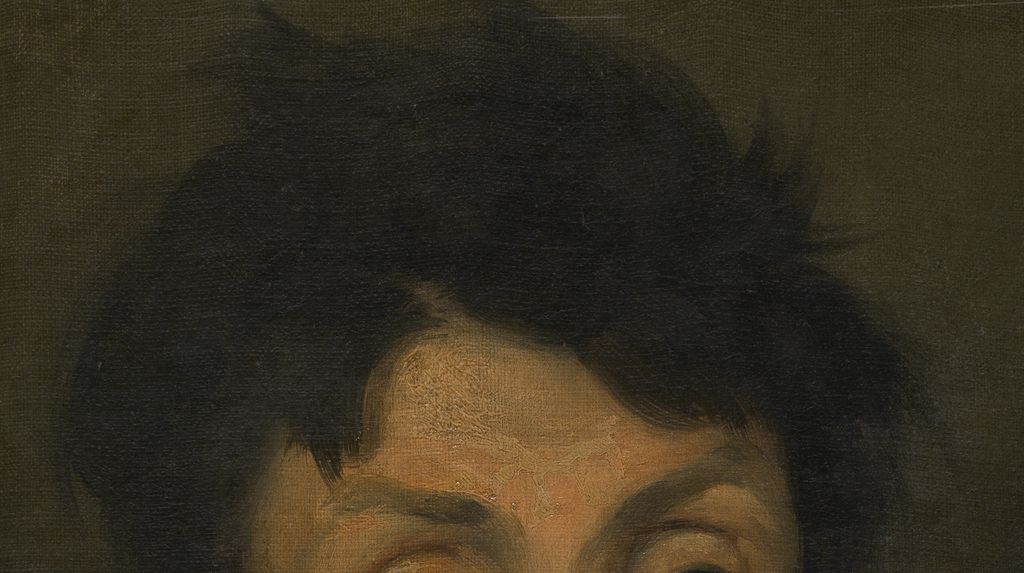
Annotated Details from Portrait of a Kleptomaniac
The numbered points identify visible features discussed in this article. Return from each detail to the whole composition. Portrait of a Kleptomaniac Image source. CC0 / Public domain.
Details from PORTRAIT OF A KLEPTOMANIAC
Compare the cropped details with the complete images above. Notice how their colours, shapes and positions contribute to the larger compositions.
Eyes looking beyond us
Small highlights make the eyes vivid, while the sideways gaze leaves their object of attention outside the frame.
Folded white neckcloth
Cream and grey strokes distinguish folds in the pale cloth, separating the face from the dark coat.
The coat emerges from darkness
Muted strokes establish the lapel and shoulder without making every edge equally distinct.
Hair and silhouette
Irregular dark locks rise above the forehead and break the head’s outline against the background.
How the title shapes what we see
The historical word monomania described a disturbance understood to centre on one overriding idea or obsession, while other faculties might remain comparatively unaffected. In the early nineteenth-century medical setting outlined by the collection account, physicians sought relationships between facial appearance and mental states, using drawings, prints, casts and busts as well as written observation. These practices help explain why portraits such as this have been discussed alongside psychiatry. They do not make a face a reliable record of a diagnosis. [1]
The surviving paintings were given their familiar classifications after Géricault’s lifetime. Lyon’s collection account identifies a letter of 1863 in which the critic Louis Viardot described the group’s discovery in Germany and assigned different obsessions to its sitters. The Ghent man was associated with theft. The other portraits were associated with envy, gambling, military command and child abduction. The account is evidence for the history of the pictures’ interpretation, rather than a surviving statement by Géricault about each model. [2]
Lyon’s two-page dossier makes this retrospective naming particularly clear: the current titles did not come from the artist. It also places Viardot’s account long after the paintings were made and notes the absence of testimony establishing their earlier course. That distance matters. A later classification may have become inseparable from a famous picture without giving us direct access to the sitter’s life. [10]
The effect on viewing can be immediate. A reader who encounters the title first may search the face for secrecy or guilt. Without it, the same expression might suggest concentration or fatigue. The picture has not changed; the proposed explanation has. Retaining the established title makes the work identifiable, but treating that title historically allows us to notice the pressure it exerts on our response.
We should therefore distinguish three things: the anonymous person represented, the later name under which the canvas became known, and our own interpretation of its appearance. Collapsing them turns the portrait into a visual confirmation of an allegation. Keeping them distinct restores some of the openness that the image itself possesses. The painting records a face with great specificity while leaving its owner’s biography beyond our reach.
Watch: Géricault and The Raft of the Medusa
Three perspectives on Géricault’s best-known painting, its making and its historical setting.
Gericault, Raft of the Medusa
Smarthistory examines the composition and historical setting of The Raft of the Medusa.
Watch on YouTubeWas it painted for Étienne Georget?
The traditional explanation gives the group a clear purpose. Géricault is said to have painted patients for Étienne Georget, a physician associated with the developing treatment of mental illness. In the Vlaamse Kunstcollectie’s narrative, the painter and doctor are described as friends, and the portraits are placed within the interests of physicians who regarded mental disturbance as an illness rather than a divine punishment. This remains an influential institutional account. [1]
Lyon offers a substantial caution. Its collection text states that no document attests the relationship between Géricault and Georget, or even Georget’s interest in this particular kind of visual representation. Its focus dossier also questions the proposed commission to illustrate a medical book and the story that the doctor had treated the painter. Those ideas should be presented as traditions or hypotheses, rather than as established events in the portrait’s making. [2] [10]
The distinction is narrower than denying any relationship between painting and contemporary medicine. Lyon contrasts the unsupported Georget connection with the documented interest of Jean Étienne Esquirol in commissioning drawn portraits for his observations. There was a medical culture in which images of patients could have a practical role. What remains uncertain is whether that particular purpose explains these particular canvases. General historical context cannot fill the missing commission document. [2]
Nor can the painting settle the issue through its appearance alone. Its concentrated attention to the face is compatible with close observation, but close observation also belongs to portraiture. The quiet background could concentrate a physician’s attention or a painter’s. Nothing in the represented setting identifies a hospital. The secure account must leave room for the possibility of a medical connection while resisting a fully reconstructed sitting for which the evidence is lacking.
One individual within a group
The portrait is normally considered with the five surviving works known as Géricault’s Monomanes. The familiar account describes an original group of ten, although uncertainty surrounds the circumstances of its creation and survival. Lyon’s dossier sets out that ten-picture tradition while discussing the five identifiable survivors; its current collection page begins from the surviving five. The difference encourages care with what is preserved and what is reconstructed. [10] [2]
The relationship between the works does not make their sitters interchangeable. Lyon’s portrait traditionally associated with envy offers another anonymous person subjected to a retrospective title. Reading it alongside the Ghent canvas shifts attention from a single supposed condition towards the larger problem of how these individuals have been named. The series has a history; each face also has its own pictorial presence. [2]
Scale reinforces the need to distinguish the objects. The Winterthur portrait associated with military command measures 81 × 65 cm according to the Oskar Reinhart collection, larger than the Ghent canvas. Their place in one group should not encourage the assumption that all were identical in size or conceived as a mechanically repeated format. Even basic museum measurements preserve differences that the collective name can obscure. [11]
For the Ghent painting, the most useful comparison is ultimately a return to its own decisions: the elevated hair, the pale wrap around the neck, the slight turn and the dark breadth of the coat. These visible particulars survive the uncertainty of the explanatory scheme. They also explain why the painting can sustain attention outside a complete assembly of the group. It does not require a diagnostic key to become a compelling portrait.
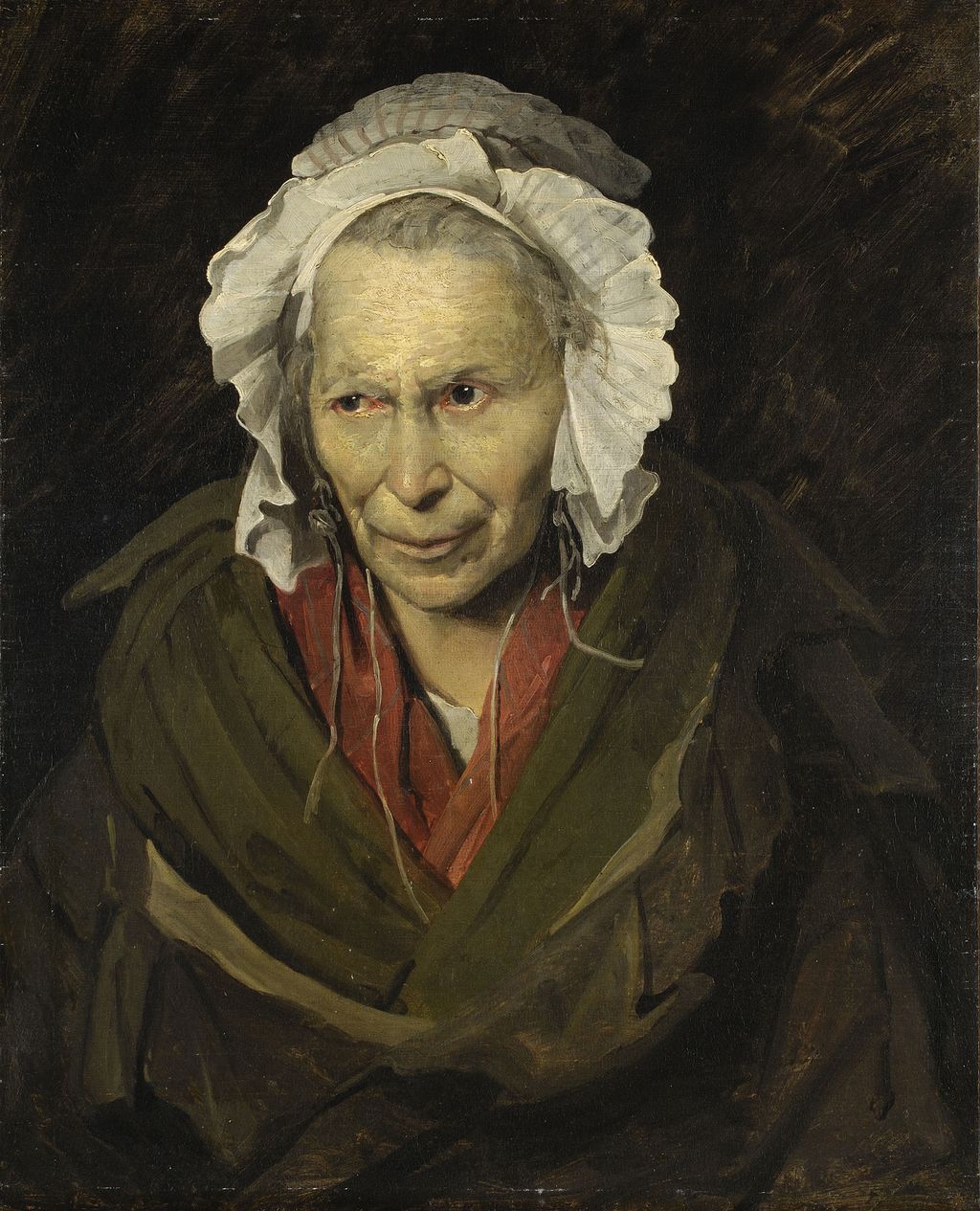
Portrait of a Woman Traditionally Called the Monomaniac of Envy Image source. Public domain.
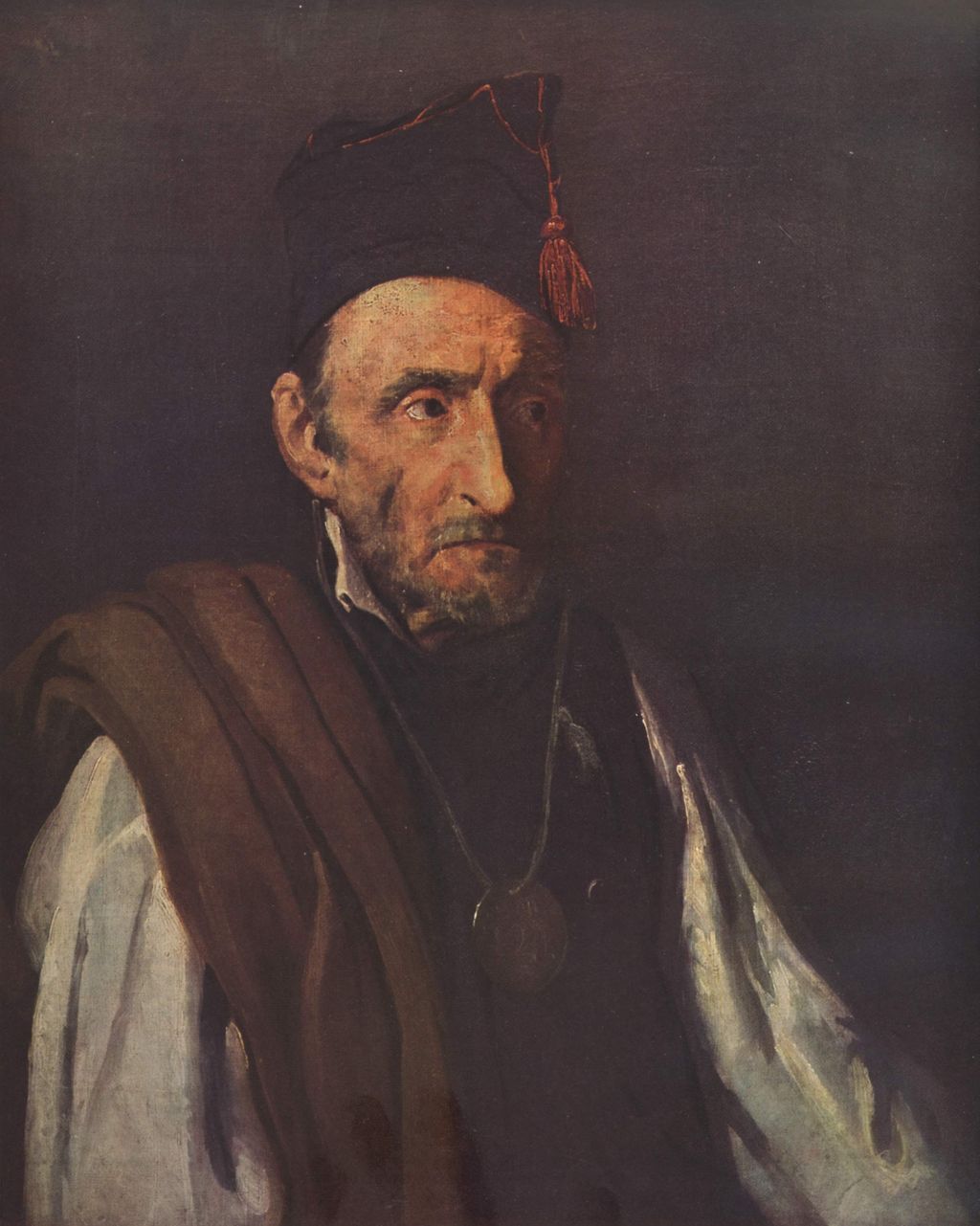
Man with Delusions of Military Command Image source. Public domain.
A place in Ghent’s collection
The portrait entered the Ghent museum in 1908 as a gift from the Friends of the Museum. The museum’s object record identifies that acquisition explicitly, giving a firm point in an otherwise incomplete history. It is a different kind of evidence from the claims about the original commission: a documented institutional arrival, rather than an inferred purpose at the moment of painting. [12]
That arrival also changed the conditions under which the portrait could be encountered. In a public collection, a work once bound to uncertain private histories became available for repeated study and reinterpretation. Its inventory number fixes the identity of the physical object even while its sitter remains anonymous. The record can tell us which canvas we mean, how large it is and where it belongs without being able to answer who the man was.
Fiona Tan’s continuing encounter
The artist and filmmaker Fiona Tan has made that unresolved encounter part of her own work. In a conversation with Griet Bonne, held on 21 May 2025 and published by MSK Gent on 7 July, Tan discussed the Ghent portrait as the model for the protagonist of her film History’s Future (2015). The film follows a man known as MP, or Missing Person, whose memory and sense of identity have been damaged after an assault. Tan’s response develops the painting into a new fiction; it does not identify Géricault’s sitter. [13]
The connection is revealing because it begins with a question rather than a recovered answer. Tan is drawn to the mismatch between the apparent immediacy of the painted man and the difficulty of knowing him. Her research into the portraits and nineteenth-century psychiatry resulted in the essay 10 Madnesses (2018). Bonne’s interview describes that project and Tan’s concern about classifications attached decades after the portraits were painted. The interview provides access to her later artistic inquiry, rather than independent verification of the paintings’ original medical circumstances. [13]
The Ghent portrait was subsequently a starting point for Tan’s exhibition Monomania at the Rijksmuseum in Amsterdam, held from 4 July to 14 September 2025. Her presentation brought museum objects into conversation with her own moving-image works, including Pickpockets (2020) and Janine’s Room (2025). The portrait’s influence thus extended beyond another painted likeness into questions about memory, vulnerability and the ways images frame people. [13]
Tan’s engagement helps explain the work’s continuing force without supplying a retrospective diagnosis. We can recognise the sideways gaze and the unsettled relationship with a viewer while admitting that the man’s experience is inaccessible. Géricault has made him unusually present through differences of paint, light and attention. The most responsible encounter allows that presence to remain particular: a person seen closely, whose life exceeds the title history has attached to him.
Géricault collection records
Seventy collection records include paintings, drawings and individual print impressions. Different impressions remain separate records; this selection is not a complete catalogue raisonné.
Frequently Asked Questions
Géricault gives the face and white neckcloth more concentrated attention than some passages of the dark coat. The collection account values this suggestive study-like handling; it does not prove that the painting was abandoned. [1]
Discussion
Look again at the images and ideas explored in Portrait of a Kleptomaniac by Théodore Géricault. These editorial prompts invite your observations.
Reader Insights
Look at the portrait before rereading its title. Which parts of your response change after you encounter the word kleptomaniac?
Follow the white neckcloth into the dark coat. How does the difference in emphasis determine the order in which you notice the sitter?
Compare the direction of the man’s gaze with your own position as viewer. What can the painting show about that encounter, and what remains unknowable?
Join the Conversation
Share a detail, comparison or question about Portrait of a Kleptomaniac by Théodore Géricault below.
References
- Vlaamse Kunstcollectie, Portret van een kleptomaan, collection record for MSK Gent, inventory 1908-F; Dutch, accessed 27 October 2026. View source. (in Dutch).
- Musée des Beaux-Arts de Lyon, La Monomane de l’envie, collection record, circa 1819–22, inventory B 825; French, accessed 27 October 2026. View source. (in French).
- Nationalmuseum, The Severed Heads, NM 2113; collection metadata and museum interpretation (Swedish). View source.
- Louvre, Charging Chasseur, INV 4885; collection metadata and museum interpretation (French/English interface). View source.
- National Gallery, Horse frightened by Lightning; collection metadata and museum interpretation (English). View source.
- Louvre, Wounded Cuirassier, INV 4886; collection metadata and museum interpretation (French). View source.
- Louvre, The Raft of the Medusa, INV 4884; collection metadata and museum interpretation (French). View source.
- Gary Tinterow / The Metropolitan Museum of Art, Géricault’s Heroic Landscapes: The Times of Day, Met Bulletin 48/3, Winter 1990–91; consulted main essay and relevant object entries (English). View source.
- Louvre, Epsom, MI 708; collection metadata and museum interpretation (French/English interface). View source.
- Musée des Beaux-Arts de Lyon, Théodore Géricault: La Monomane de l’envie, Focus Œuvre dossier, pp. 1–2; French, undated. View source. (in French).
- Sammlung Oskar Reinhart “Am Römerholz”, Théodore Géricault, Geisteskranker mit militärischem Grössenwahn, um 1819–22, object metadata; German, accessed 27 October 2026. View source. (in German).
- Museum voor Schone Kunsten Gent, Portret van een kleptomaan, object record, inventory 1908-F, acquisition field recording the Friends of the Museum’s gift in 1908; Dutch, accessed 27 October 2026. View source. (in Dutch).
- Griet Bonne / Museum voor Schone Kunsten Gent, Géricaults ‘Portret van een kleptomaan’ tijdelijk te zien in het Rijksmuseum, interview with Fiona Tan, conversation 21 May 2025, published 7 July 2025; Dutch. View source. (in Dutch).


