



 by Tom Gurney
Tom Gurney BSc (Hons) is an art history expert with over 20 years experience
Email: tomgurney1@gmail.com / Phone: +44 7429 011000
Géricault’s Writings and Verified Quotations: Introduction
Théodore Géricault’s words become more interesting when read as parts of working notes, arguments and letters. A study programme sets out tasks to be attempted; a criticism of art schools asks how individual vision can survive collective instruction; correspondence moves between affection, irritation and professional ambition. Charles Clément’s Géricault, published in 1867, preserves printed versions of these texts within his account of the artist’s life. The passages below are verified against that printed witness. They are not transcriptions made from inspected autograph manuscripts, and the English quotations are fresh translations from the French printed by Clément. [1]
The accompanying studio portrait needs a separate qualification. The Louvre identifies it as Portrait of an Artist in His Studio, about 1820, by Géricault’s circle. Its sitter is not securely identified as Géricault. The visible palette, skull and small figure make it an evocative image of artistic work, but neither those objects nor the man’s thoughtful pose establishes whose thoughts we are reading. The painting cannot serve as a documented self-portrait illustrating the letters. [2]
At a Glance
- Printed witnessCharles Clément’s Géricault, 1867 narrative offprint [1]
- Study programmePrinted p. 11; Clément credits Batissier; no year supplied in displayed note [1]
- Teaching critiqueOriginality argument on printed p. 97 within fragments of a projected art book [1]
- Musigny letterPrinted pp. 66–67; discusses friendship and criticism of the Raft [1]
Contents
- A programme of study: learning through different kinds of work
- Against uniform teaching: how does originality survive?
- The Musigny letter: friendship amid public criticism
- The Dorcy letter of 12 February 1821: solitude, labour and prospects
A programme of study: learning through different kinds of work
On printed page 11, Clément introduces a note which he describes as written in Géricault’s own hand, while his footnote credits Batissier as the source in which it was cited. That distinction matters: Clément reports the existence of a handwritten note, but the witness available here is his later printed text. He places it within an account of Géricault studying more freely without abandoning study itself. The programme combines drawing, painting, reading, composition, anatomy, antiquities, music and Italian. It even specifies antiquities classes on Tuesdays and Saturdays at two o’clock. [1]
Its practical detail gives the list its character. Painting a figure at Dorcy’s in December stands alongside evening drawing after the antique and the composition of subjects. January brings painting from life at Guérin’s. The final entry changes the conditions of work: “February: devote myself solely to the style of the masters and compose without going out and always alone.” This is a fresh translation of the February entry on printed page 11. The months are named, but the note as printed does not supply a year. [1]
Solitude here belongs to an organised alternation. The artist envisages attending classes, working in another artist’s space, returning to his teacher and then concentrating alone. The note does not make seclusion a universal rule for creativity. Nor does its list of subjects describe a narrow training in manual skill. Anatomy sits beside language and music; looking at inherited models accompanies making new compositions. Read as a programme, it shows how different exercises could be made to support one another. It tells us what he proposed to do, rather than proving that every appointment and monthly objective was fulfilled. [1]
Clément’s surrounding narrative is a different kind of evidence. His remarks about Géricault’s respect for Guérin and experiments in the studio belong to the biographer’s account. The change into the first-person list is therefore worth noticing. The schedule gives a brief, unusually concrete account of intended work within a much fuller retrospective story. Keeping those voices distinct lets the modest document retain its value without turning it into a complete explanation of the painter’s development. [1]
Against uniform teaching: how does originality survive?
Clément introduces fragments of a projected book on art on printed pages 92–93. The discussion of schools and the Prix de Rome follows within these fragments. On page 97, the text asks: “Is it not dangerous to see them study together for years under the same influence, copying the same models and following, so to speak, the same path? How can one hope after that that they can still preserve originality?” This is a fresh translation of an excerpt from the passage printed by Clément. [1]
The force of the argument lies in the sequence: shared influence, repeated models, a common route, then the possible loss of difference. The writer imagines pupils exchanging their particular qualities until their distinct ways of apprehending nature merge into one feeling. The criticism continues on page 98 with compositions whose drawing, colour, arrangements, gestures and facial expressions seem to come from a single source. Polished execution is therefore insufficient. A picture can demonstrate extensive training while giving little sense of an individual’s perception. [1]
This is a criticism of the direction of teaching, rather than a simple rejection of education. Immediately before the originality passage, the argument calls good education an indispensable foundation and considers the age at which a pupil might choose a profession. It also questions whether institutional incentives attract people who lack a strong commitment to painting. These claims are selective and demanding: the text wants public encouragement directed towards exceptional ability. Reducing it to an agreeable modern slogan about everyone being creative would erase that part of the argument. [1]
The study programme offers a useful comparison. There, Géricault’s reported plan includes masters, antique models and a teacher. Here, the objection concerns the flattening of differences when shared instruction becomes the only route. The two texts can be read together without forcing either into a contradiction. Learning from established art and preserving a personal response are presented as problems to negotiate. The fragments also show a painter claiming the right to argue publicly about institutions, rather than leaving the assessment of art entirely to other writers. [1]
Watch: Géricault and The Raft of the Medusa
Three perspectives on Géricault’s best-known painting, its making and its historical setting.
Gericault, Raft of the Medusa
Smarthistory examines the composition and historical setting of The Raft of the Medusa.
Watch on YouTubeThe Musigny letter: friendship amid public criticism
On pages 66–67, Clément prints a letter to M. de Musigny amid his discussion of criticism of The Raft of the Medusa. The letter’s opening places a friend’s message above the competing judgments of newspapers. “I am more flattered by your four lines and by the gracious prediction you had made of my success than by all those articles in which insults and praises are dispensed with such discernment.” This fresh translation preserves the sarcastic turn at the end: the writer plainly doubts that discernment. Clément’s footnote points to Batissier, pages 13–14. [1]
The letter distinguishes the pursuit of lasting artistic distinction from the pursuit of publicity. It recommends indifference to journalists, yet its detailed complaints show how difficult that indifference is to maintain. Géricault describes a situation in which the same painting can be praised as patriotic by a liberal writer and condemned as revolutionary by an ultra-royalist. Brushwork and colour become vehicles for political accusation. His complaint concerns the way partisanship appropriates the picture before considering what it depicts. [1]
The most pointed example is his report that the Drapeau blanc accused him of using a head of expression to slander the entire naval ministry. His answer turns from journalism to bodily suffering: critics who had endured fourteen days without food, he argues, would understand how difficult it was for either poetry or painting to convey the castaways’ anguish. This is Géricault’s defence as printed in the letter. It does not, by itself, settle every question about the painting’s politics or establish that every contemporary response followed the pattern he describes. [1]
Friendship gives the letter an alternative scale of judgment. Musigny’s confidence matters because it comes from a personal relationship rather than the machinery of public approval. Even so, Géricault does not renounce ambition. The closing returns to a kind of glory he would still welcome. The movement from gratitude through mockery to qualified aspiration is more revealing than a detached sentence about ignoring criticism: it allows irritation and artistic purpose to remain visible together. [1]
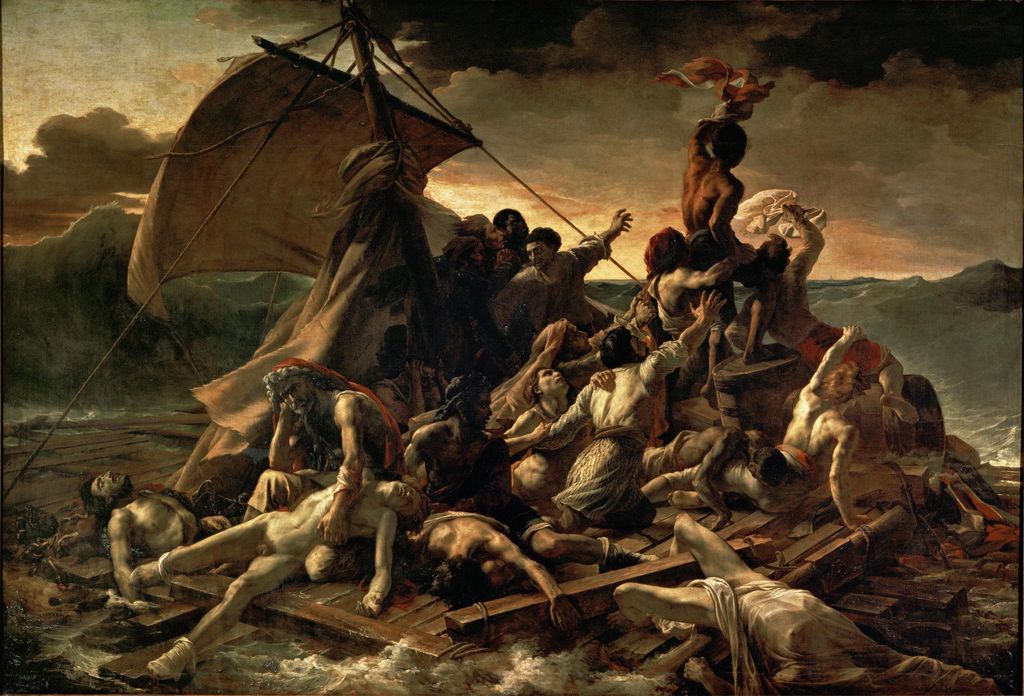
The Raft of the Medusa Image source. Public domain.
The Dorcy letter of 12 February 1821: solitude, labour and prospects
Clément dates the letter to Dedreux-Dorcy on pages 75–76 to 12 February 1821. Its account of life in England moves from an apology for silence into a description of work: “I do not amuse myself at all, and my life is exactly the one I lead in Paris, working a great deal in my room and then roaming the streets to relax.” This is a fresh translation from the letter as printed. The contrast between room and street gives solitude a daily rhythm, rather than presenting the artist as entirely withdrawn. [1]
The apology itself is affectionate and teasing. Géricault blames his failure to write on laziness and trusts his friend’s indulgence, then soon insists that he is working hard. That apparent reversal belongs to the tone of a familiar letter. The room is a place of production; London’s movement and variety offer relief. He also describes an appetite which work cannot fully satisfy: whatever he does, he wishes to be doing something else. This is a particular self-description addressed to Dorcy, not sufficient evidence for a diagnosis or a permanent account of his character. [1]
Lithography gives that restless activity an immediate professional focus. He says he is lithographing intensely and imagines that the medium might bring him to the attention of collectors who could offer other work. His joke about withdrawing into the stable and emerging covered in gold connects horses, earnings and ambition. These are hopes expressed in correspondence. The letter cannot be used as proof that the projected fortune was earned, or that lithography was merely an incidental activity without artistic interest. [1]
The final portion also makes the limits of Clément’s witness unusually plain. Géricault reports serious illness, asks Dorcy to spare his father worry, and acknowledges friends who cared for him. The printed letter then reaches a reference to a romantic conquest, after which Clément announces that he is passing over that subject. His subsequent judgment of the artist’s spirits is the biographer’s interpretation. The omission means this is an edited presentation, not an assuredly complete letter. Reading its work, humour and affection together is possible; filling the gap or making its liveliness settle questions about health is not. [1]
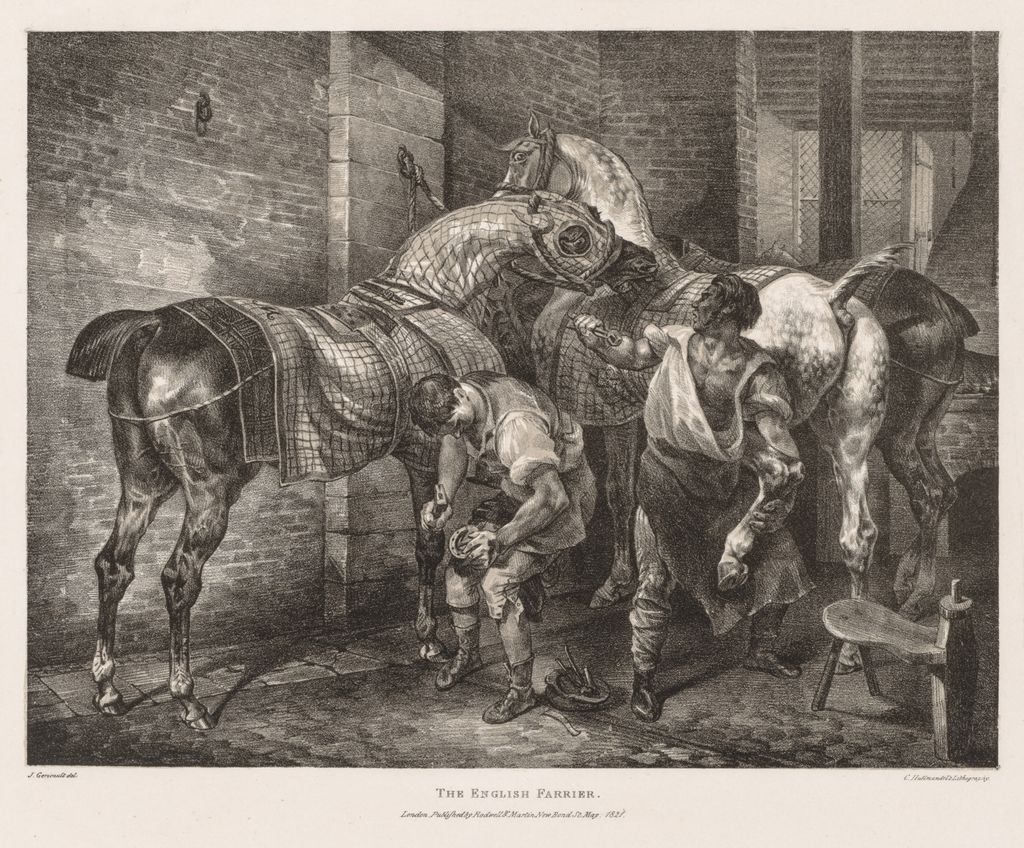
An English Farrier, 1821 — Cleveland Museum of Art Image source. CC0 / Public domain.
Géricault collection records
Seventy collection records include paintings, drawings and individual print impressions. Different impressions remain separate records; this selection is not a complete catalogue raisonné.
Frequently Asked Questions
They are fresh English translations of French passages printed by Charles Clément in 1867. No autograph manuscript has been inspected for this page. Clément credits Batissier for the study note and Musigny letter. [1]
The printed fragments criticise the uniformity produced by shared teaching and models, while also calling good education indispensable. His study programme includes masters, classes and work at Guérin’s. [1]
It describes working in his room, walking London’s streets and making lithographs intensely. His commercial hopes are ambitions rather than evidence of achieved earnings; Clément also explicitly omits part of the letter. [1]
Discussion
Look again at the images and ideas explored in Géricault’s Writings and Verified Quotations. These editorial prompts invite your observations.
Reader Insights
How does the study programme change your impression of the relationship between instruction and solitude?
Where does the Musigny letter’s recommendation to ignore criticism run up against the writer’s irritation?
How does Clément’s explicit omission affect the conclusions you would draw from the Dorcy letter?
Join the Conversation
Share a detail, comparison or question about Géricault’s Writings and Verified Quotations below.
References
- Charles Clément, Géricault, 1867 narrative offprint, French; study programme p. 11; Musigny letter pp. 66–67; Dedreux-Dorcy letter pp. 75–76; introduction to art-writing fragments pp. 92–93 and education argument pp. 95–98. PDF pages 25, 82–83, 91–92 and 108–114. View source.
- Musée du Louvre, Portrait d’un artiste dans son atelier, RF 1225, about 1820, circle of Théodore Géricault; collection record, French. View source.


