


 by Tom Gurney
Tom Gurney BSc (Hons) is an art history expert with over 20 years experience
Email: tomgurney1@gmail.com / Phone: +44 7429 011000
Théodore Géricault’s Drawings: Introduction
A dark outline can make a shoulder look as solid as sculpture; a few quick marks can test whether a group of people will hold together. Géricault used drawing for both kinds of work. His sheets range from concentrated studies of a single body to pages crowded with competing ideas. Reading them alongside the paintings reveals a sustained practice of observation, copying, selection and revision. The apparent urgency of his art depended on considerable preparation.
Drawing also complicates the familiar image of Géricault as an instinctive painter of horses and catastrophe. His studies engage closely with earlier art and the academic nude. In his catalogue discussion of Nude Warrior with a Spear, Lorenz Eitner places the strongly contoured figures of about 1815–16 within a deliberate period of classical self-training before Géricault’s unsuccessful attempt at the Prix de Rome in 1816. These exercises were a way of developing an expressive language, rather than merely passing through a school requirement. [1]
At a Glance
- MediaGraphite, chalk, pen and ink, wash, watercolour and white gouache [2] [1]
- Race studyLouvre INV 26736, pen and brown ink; purchased 1851 [3]
- Working sheetCleveland’s 1819 sketches revisit Roman figure ideas at Fontainebleau [4]
- Two sidesSome sheets contain different subjects on front and back [4] [5]
Contents
- Learning by copying
- The body as a constructed form
- A page full of alternatives
- From landscape design to working figures
- Horses, restraint and a returning idea
- A head study and the limits of identification
- Turning the sheet over
- Drawing for an impression
Learning by copying
One of the clearest demonstrations is the Cleveland Museum of Art’s Man Clutching a Horse in Water, after Poussin’s Deluge, dated about 1816. The subject is borrowed, but the sheet makes visible what Géricault found worth extracting: a man and an animal forced together in distress. Pen and brown ink establish the shapes over graphite, while brush and brown wash give the forms their weight. The museum connects this combination of strong contours and broad washes with his renewed study of earlier masters, including Poussin, Raphael and Michelangelo. [6]
Look at how much the drawing achieves with very little setting. Water reaches across the lower part of the sheet, cutting off the bodies and forcing attention onto two heads. The man’s bent arm reaches over the horse; his face comes close to the animal’s mane. A firmly drawn nostril and the angular opening of the horse’s mouth make its head immediately legible. Around the human figure, folds in the headcloth and cloak are translated into pointed shapes. Broad areas of pale paper interrupt the wash, so that the scene retains a striking clarity even where man, clothing and animal overlap.
The sheet is useful precisely because it is a copy of a detail. Géricault did not need to reproduce an entire painting to learn from it. Isolating a compact group allowed him to examine how an older artist connected bodies, made contact convincing and concentrated an episode of danger. For the viewer, the process is equally revealing: classical study and an interest in physical extremity belong together here. The drawing offers a concrete example of learning from tradition without treating tradition as a fixed set of subjects.
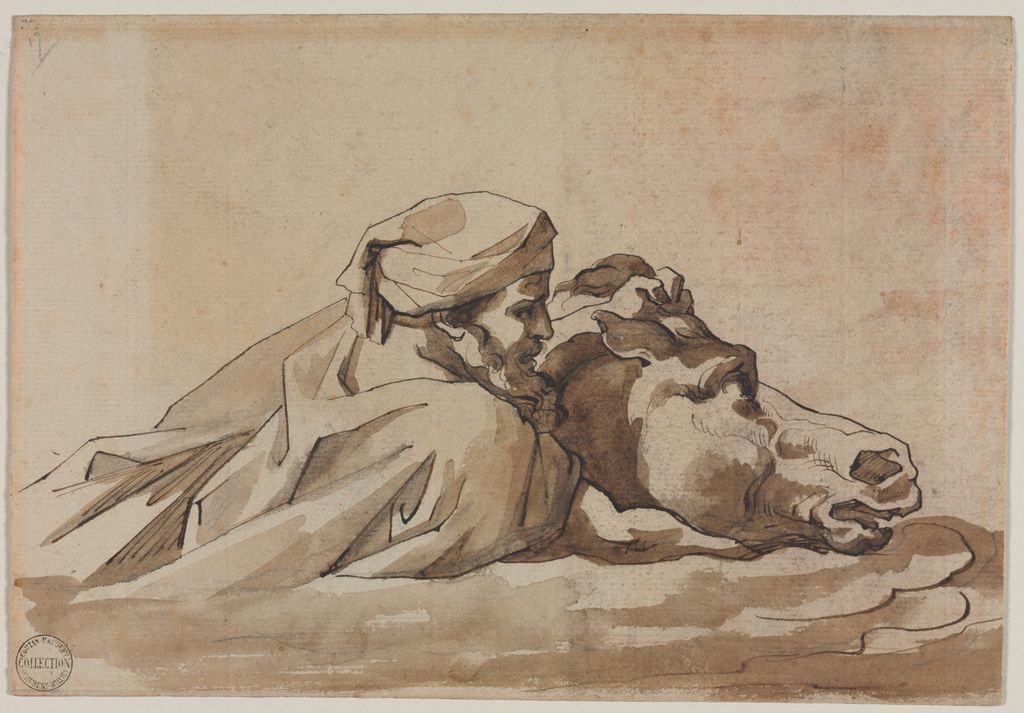
Man Clutching a Horse in Water, after Poussin’s Deluge (recto), c.1816 — Cleveland Museum of Art Image source. CC0 / Public domain.
The body as a constructed form
An académie is a study of the nude model. In Géricault’s practice, studying a model could involve a conspicuous transformation of the observed body. Eitner describes the muscular tension and emphatic outlines of the early nudes as exercises in heroic stylisation. A pose could be anatomically plausible while becoming more forceful through the arrangement of the limbs, the separation of light and shadow, or the firmness of its silhouette. That distinction helps explain why a drawing may feel both carefully studied and deliberately heightened. [1]
The British Museum’s seated male nude, 1920,0216.2, provides an important example. Eitner reproduces it as a study in black chalk, wash and white gouache, related in pose and style to the painted académies. The mixture matters: line, dark tone and added light allow a body to be developed through several different kinds of mark. Its degree of finish also warns against assuming that every drawing is a rapid preliminary notation. A graphic study can be as sustained an investigation of volume as a painted one. [1]
Connections between such studies and paintings nevertheless require care. Eitner regards Nude Warrior with a Spear as an independent académie, without evidence that it prepared a larger composition. Gary Tinterow, discussing the landscape drawings, connects the seated nude’s outstretched-arm pose with figures in the decorative studies and with Evening: Landscape with an Aqueduct. The two discussions show different ways a pose can matter: as a self-contained exercise and as a form available for further use. A related attitude does not automatically establish a direct sequence from one particular sheet to one canvas. [1] [2]
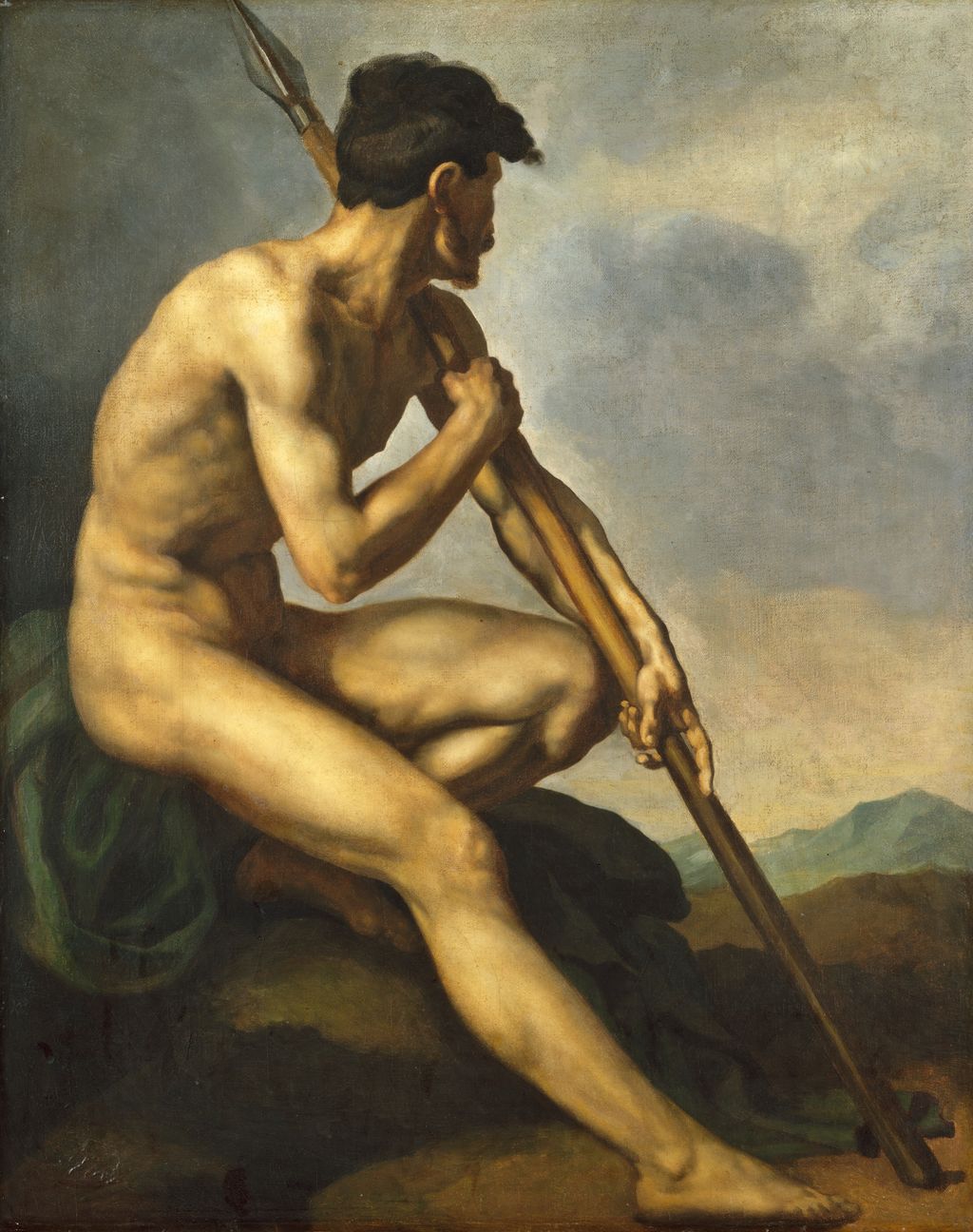
Nude Warrior with a Spear Image source. Public domain.
A page full of alternatives
Some sheets record decisions at a much smaller scale. In the landscape studies discussed by Tinterow, Géricault drew little rectangular frames and tried different arrangements inside them. A Bayonne sheet contains fourteen panel sketches, but Tinterow cautions against reading these as a proposed fourteen-part decoration. They explore a smaller number of compositional possibilities. The frames make alternatives comparable: a tree can become a stronger foreground barrier, a landscape can open out, or the proportions of a panel can change. [2]
This is an essential distinction when looking at a busy page. The number of separate images does not necessarily count intended finished works. Several can belong to one problem, and one page can accommodate unrelated projects. In the Chicago album’s folio 48, for example, military and mythological subjects occupy one side, while boating-party studies appear on the other. Tinterow traces the boating composition to a Louvre painting attributed in Géricault’s time to Annibale Carracci. He also notes Géricault’s repeated experiments with the pose of the boatman. Borrowing an overall idea and inventing a convincing action within it were connected activities. [2]
The dating of these sheets is less straightforward than their immediate appearance might suggest. The Chicago album was assembled after Géricault’s death from more than one sketchbook. Scholars have proposed different dates for portions of it. Tinterow uses subjects, overlapping marks and relationships to other works to reconsider the chronology, while keeping questions open. A sketchbook page is therefore not always a secure entry in a daily diary. Its present neighbours may reflect later collecting and assembly as well as the artist’s original working sequence. [2]
From landscape design to working figures
The studies for Morning: Landscape with Fishermen show drawing operating at several levels. The Harvard watercolour discussed in Tinterow’s catalogue combines watercolour, brown ink, graphite and black chalk. It lays out an invented landscape with a boat being pulled towards the right. The large painting retains much of this arrangement but changes the foreground, enlarges certain features and modifies the distant rock. The watercolour is a developed proposition, already capable of conveying a complete space, rather than a simple record of a place encountered outdoors. [2]
Separate figure sheets tackle the effort of launching the boat. Tinterow argues that these fishermen were drawn from Géricault’s imagination, informed by his existing knowledge of bodies under strain, rather than directly from posed models. He follows changes in the direction of the pull and the relationships between heads and bodies. The problem is collective: each man must exert himself, but the group must appear to perform one task. Drawing allows the artist to solve coordination as well as anatomy. [2]
A small Dijon sheet, DG 242, brings together studies for Morning and an early idea for Evening: Landscape with an Aqueduct. Tinterow uses this shared surface as evidence that at least those two compositions were being conceived together. Its importance lies in a specific relationship between surviving designs. It does not settle the identity of a patron or reconstruct a lost decorative room. The drawings tell us a great deal about developing compositions while leaving parts of the paintings’ intended circumstances unknown. [2]
Watch: Géricault and The Raft of the Medusa
Three perspectives on Géricault’s best-known painting, its making and its historical setting.
Gericault, Raft of the Medusa
Smarthistory examines the composition and historical setting of The Raft of the Medusa.
Watch on YouTubeHorses, restraint and a returning idea
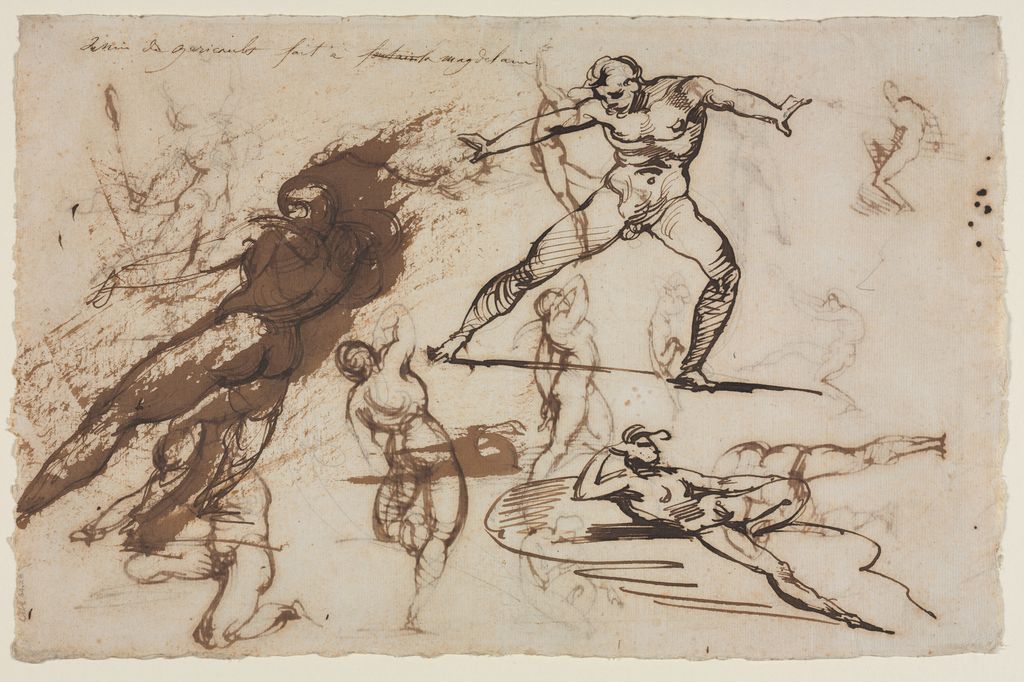
Cleveland’s Sheet of Sketches, dated 1819, presents a different kind of crowded surface. The largest upright male figure spreads his legs and extends both arms, one hand reaching far beyond his torso. Short curved strokes model the abdomen and chest; denser marks along a lower leg intensify the sense of a planted stance. Beneath him, a reclining figure lies across a broadly indicated support. Around these darker forms, paler fragments remain visible. The page offers several degrees of resolution at once, from a lightly indicated limb to a body forcefully enclosed by ink.
The museum relates the male figures to Géricault’s earlier Roman carnival studies of men restraining horses. Yet the inscription places these particular sketches near the Magdelaine spring in the Fontainebleau area, visited in 1819. The distinction matters: an idea associated with Italy could be revisited elsewhere. The drawing’s energetic bodies do not make it an on-the-spot record of a Roman race. [4]
For an expressly preparatory horse-race drawing, the Louvre preserves La course des chevaux libres, INV 26736, Recto. It is pen and brown ink on buff paper, measuring 29.5 × 46 cm. The Louvre identifies it as preparation for one of the painted sketches of the riderless races and records related works in several collections. The sheet entered the museum through purchase from His de La Salle in 1851. This is a distinct drawing, with its own material history, rather than another title for one of the oil studies. [3]
That distinction is particularly helpful beside the riderless-horse race paintings. Paper alone does not define a drawing: a work painted in oils on paper remains a painted study. Conversely, a pen drawing may prepare a painting without having the same composition as every surviving painted version. Identifying the medium and the individual object makes it possible to compare the artist’s decisions without collapsing several works into one.
A head study and the limits of identification
Drawing for The Raft of the Medusa could isolate a face as well as organise a crowd. The Morgan Library & Museum’s Head of a Black Man, dated 1818–19, is a black-chalk study that the museum connects with a figure near the mast. Its account emphasises hatching and stumping: drawn strokes and rubbed chalk combine to model the head. The pose was altered in the painting. This makes the sheet evidence of transformation, rather than a fragment transferred unchanged into the final scene. [7]
The Morgan also records an attribution disagreement: Germain Bazin rejected the sheet, while Bruno Chenique included it in his 2012 exhibition on the making of the Raft. The museum currently catalogues it under Géricault. Its title does not securely identify the sitter as Joseph. Keeping the unnamed drawing separate from the painted study of Joseph respects both the objects and the limits of the surviving evidence. [7]
Turning the sheet over
The other side of a drawing can change how we understand it. Cleveland’s 1819 sheet includes female figures on the reverse, which the museum relates to Pompeian paintings of bacchanals. Some marks from the reverse show through the paper. Thus not every faint form visible among the male studies is necessarily an abandoned stage of the same drawing. A reproduction of one face can contain traces of another surface and another subject. [4]
A sheet in the Museum of Fine Arts, Houston offers a further example. Its recto is a female nude study for the Erotic Trio, the painting also known as Three Lovers. Its verso contains The Combat of Hercules and Hippolyta and underlying female studies in the opposite orientation. The museum dates the black-chalk drawing to 1816–17. Several subjects occupy the same small support, and turning it over also requires changing the direction in which it is read. [5]
These objects suggest a practical way to look at Géricault’s working sheets. First distinguish front from back, then consider differences in orientation, medium and finish. A large dark figure need not be the first thing drawn; a faint one need not be an earlier version of it. Connections become more persuasive when the material evidence and the subject support each other. The sheet is an object used over time, not simply a transparent window onto a single creative instant.
Drawing for an impression
The boundary between drawing and lithography raises another question: what was the marked surface intended to do? In the introduction to his 1866 lithograph catalogue, Charles Clément valued the process because it could circulate the artist’s own drawn design in multiple impressions. His argument helps explain why lithographs belong in any discussion of Géricault as a draughtsman, even though a printed sheet is a different object from a unique drawing. [8]
Clément also describes a group made on prepared lithographic carton, a more portable support than stone. His entries include the sleeping fish seller and children playing with a donkey. Here a drawing could serve the production of impressions rather than the preparation of a painting. The original marked support and the resulting print must be distinguished, just as a conventional preparatory sketch must be distinguished from the design ultimately printed. Clément’s account is historical evidence for the process; his ownership statements and rarity assessments belong to his own period. [8]
Modern museum classifications keep that distinction visible. The National Museum of Western Art’s 2024 exhibition checklist identifies Roman Butchers of 1817 and A French Farrier of 1821 as lithographs. Their graphic language may invite comparison with pen or chalk, but their listed medium tells us that the objects exhibited were prints. Looking across these forms reveals drawing’s reach through Géricault’s art: it could study an inherited motif, test a whole composition, sustain a finished figure or carry a design to a printed audience. [9]
Géricault collection records
Seventy collection records include paintings, drawings and individual print impressions. Different impressions remain separate records; this selection is not a complete catalogue raisonné.
Frequently Asked Questions
A sheet may contain several studies at different levels of finish. Marks from its reverse can also show through. Cleveland’s1819 sheet includes male studies on one side and female figures on the other. [4]
Discussion
Look again at the images and ideas explored in Théodore Géricault’s Drawings. These editorial prompts invite your observations.
Reader Insights
In the Poussin copy, which matters more to the impression of weight: the dark outlines or the broad washes?
How does viewing the 1819 sketches as one working sheet change your response to the largest male figure?
What evidence would persuade you that a study prepared a particular painting rather than simply sharing a pose?
Join the Conversation
Share a detail, comparison or question about Théodore Géricault’s Drawings below.
References
- Lorenz Eitner / National Gallery of Art, French Paintings of the Nineteenth Century, “Nude Warrior with a Spear,” 2000, pp. 254–259 (English). View source.
- Gary Tinterow / The Metropolitan Museum of Art, Géricault’s Heroic Landscapes: The Times of Day, The Metropolitan Museum of Art Bulletin, vol. 48, no. 3, Winter 1990–91, especially pp. 34–38, 44–47 (English). View source.
- Musée du Louvre, La course des chevaux libres, INV 26736, Recto, collection record, updated 24 September 2024 (French). View source. (in French).
- Cleveland Museum of Art, Sheet of Sketches (recto), 1819, 1964.28.a, collection record and description of both sides (English). View source.
- Museum of Fine Arts, Houston, Étude de femme nue pour le Trio érotique (Study of a Female Nude for the Erotic Trio) [recto]; The Combat of Hercules and Hippolyta, Queen of the Amazons and [reversed underlying sketch] Woman on the Ground and Woman in Half Length [verso], 1816–17, 2016.212.A,.B, collection record (English/French titles). View source.
- Cleveland Museum of Art, Man Clutching a Horse in Water, after Poussin’s “Deluge” (recto); Compositional Study? (possibly for “Poussin’s Deluge”) (verso), about 1816, 2008.378, collection record and description (English). View source.
- The Morgan Library & Museum, Head of a Black Man, 1818–19, 2017.92, collection record and notes (English). View source.
- Charles Clément, Catalogue de l’œuvre de Géricault: Lithographies, 1866, introduction pp. 3–4 and prepared-carton entries pp. 16–17, digitised historical scan (French). View source. (in French).
- The National Museum of Western Art, Tokyo, lithography exhibition checklist, 11 June–1 September 2024, p. 1, nos. 3–4 (Japanese/English). View source.
- Splash image, Sheet of Sketches (recto), 1819, drawn near Fontainebleau — Cleveland Museum of Art Image source. CC0 / Public domain.


