



 by Tom Gurney
Tom Gurney BSc (Hons) is an art history expert with over 20 years experience
Email: tomgurney1@gmail.com / Phone: +44 7429 011000
Study of a Dapple Grey by Théodore Géricault: Introduction
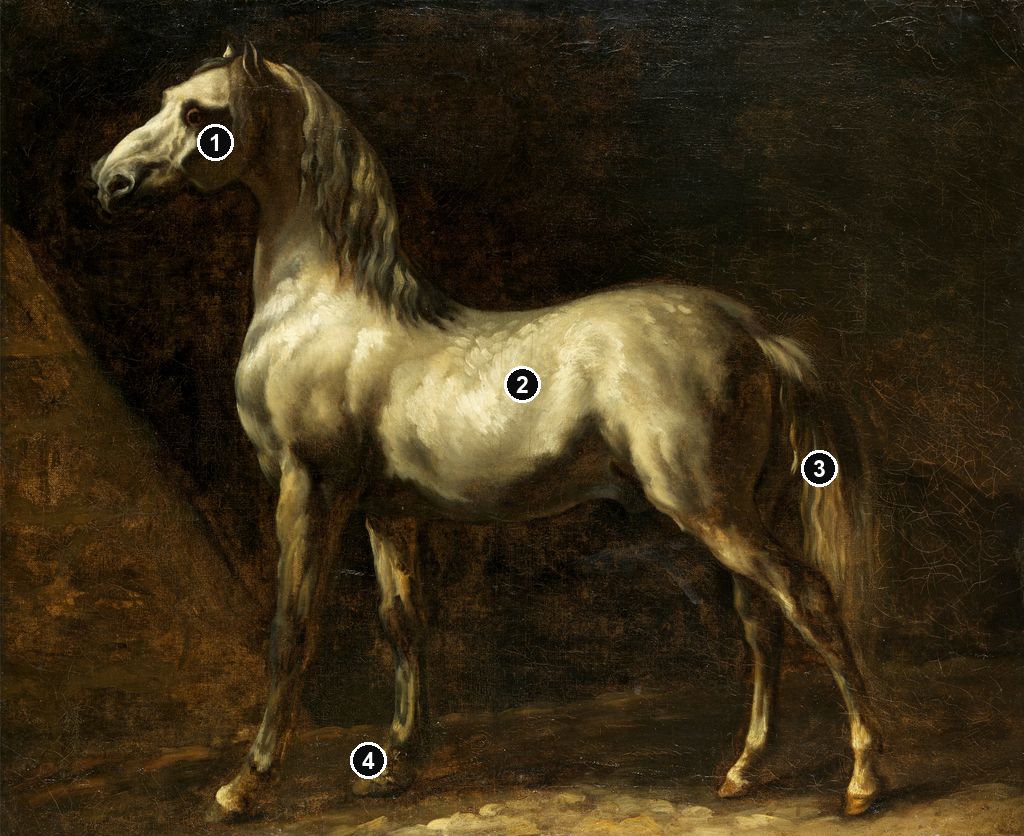
A grey horse stands across a dark interior, its head raised towards the left and its pale body filling most of the picture. Light breaks across its shoulder, flank and hindquarters, while the lower legs descend into brown shadow. In Study of a Dapple Grey, the horse has no rider to explain its importance. Its physical presence supplies the subject. The Musée des Beaux-Arts de Rouen dates this oil painting on canvas to around 1812 and identifies it by inventory number 850.3.1. [1]
The first impression is of a beautifully illuminated animal. A longer look reveals a less settled picture: the head is sharply constructed, the stance combines mass with delicacy, and the tail carries signs of alteration. Those differences make the word “study” useful. Géricault is attending to a living body while also discovering how to give that body force on canvas. Observation and pictorial invention are active together.
At a Glance
- DateCirca 1812 [1]
- MediumOil on canvas [1]
- CollectionMusée des Beaux-Arts de Rouen [1]
- Inventory850.3.1 [1]
This work across Théodore Géricault’s career
The Severed Heads
1810s [2]Charging Chasseur
1812 [3]Horse Frightened by Lightning
c.1813–14 [4]The Raft of the Medusa
1818–19 [6]Portrait of a Kleptomaniac
c.1820–24 [8]The Epsom Derby
1821 [9]Contents
- A standing horse in a dark stall
- How the dapples describe the body
- The head and the study of anatomy
- The altered tail and Rouen’s claim to the original
- Bazin’s argument for realism
- From stillness to lightning and speed
- Annotated details
A standing horse in a dark stall
The interior is established sparingly. A warm brown form rises at the left, darker verticals retreat behind the animal, and a rough floor catches scattered light below. These features give the horse an enclosed setting without competing with its outline. Rouen’s account places the subject in the context of Géricault’s study of horses in their stalls. The painting does not require a precisely identifiable stable to make that encounter convincing. [1]
The body reads broadly from the side, but its arrangement is more complicated than a flat silhouette. The forelegs separate towards the left; at the right, the hind legs make a narrower, angled group. The pale shoulder advances towards us, while the belly recedes into a broad band of shadow. The placement of the legs allows us to feel the body’s volume and the changing intervals beneath it. Empty spaces between the limbs matter almost as much as the illuminated muscles.
Follow the back from the base of the mane to the rounded rump. It makes a low, extended curve, balancing the much steeper ascent of the neck. Below, the belly hangs heavily, then rises towards the hindquarters. These opposing lines give the horse substantial mass. Yet the lower legs become slender, and only small areas of the hooves meet the uneven ground. The contrast makes the animal appear both solid and lightly supported.
Rouen’s commentary describes a comparable effect of apparent weightlessness, despite the vigorous construction of the body. This is a perceptive way of directing attention to the picture’s balance: its lightness comes from the relation between a large, bright torso and narrow contacts with the ground. It is not evidence that the horse is actually leaping or hovering. [1]
The raised head and pointed ears also make standing still an active condition. There is no need to decide that the animal is frightened, proud or defiant. Its alertness is visible; the particular cause of that attention is not. Keeping that distinction open lets the posture retain its specificity without turning the horse into a human character.
How the dapples describe the body
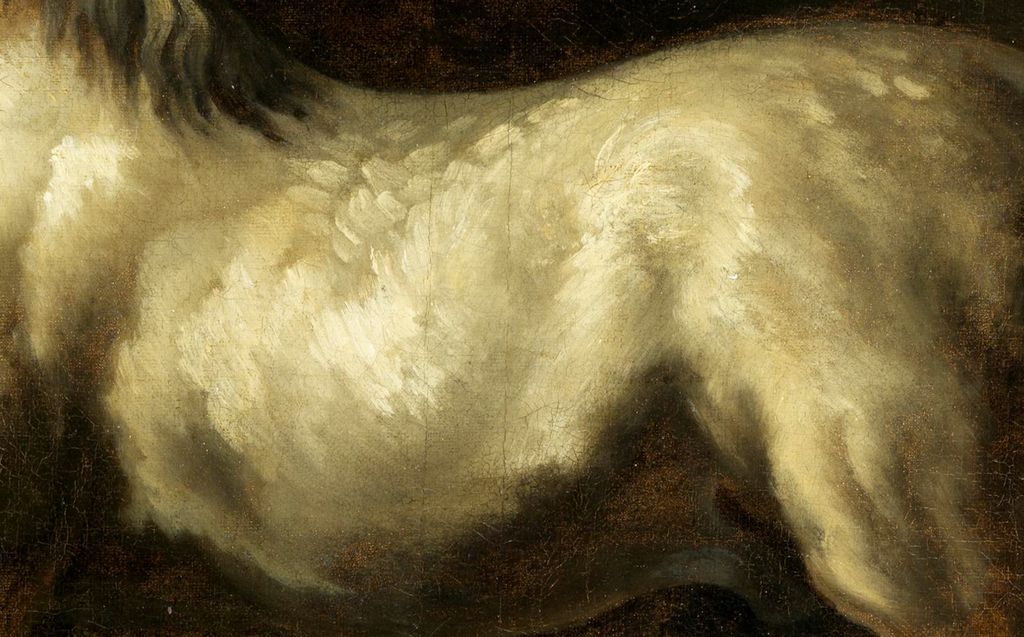
The grey coat is built from a surprisingly warm range of colours. Cream and pale yellow mingle with grey, brown and muted greenish shadows. Bright marks cluster across the shoulder and upper flank, while the underside of the body darkens. The horse consequently emerges from its surroundings by degrees. Some contours are strongly illuminated; others are allowed to merge into the stall.
The dapples do more than identify the coat. Across the middle of the body, irregular pale patches interrupt darker areas and lead the eye towards the light on the rump. Their changing shapes help turn the flank away from us. On the shoulder, larger passages of light gather around the projecting forms rather than forming an even pattern. Géricault makes a marked surface describe a rounded body.
This is easiest to see by comparing the shoulder with the neck. The shoulder is broad, pale and strongly lit. Above it, the neck alternates between illumination and a long dark passage beside the mane. Loose strands of hair descend in broken curves, partly obscuring the transition between neck and back. A continuous, evenly drawn outline would flatten these relationships. Here, light and dark repeatedly establish the form from within.
The stall intensifies the effect. Its darkness supplies a large, relatively quiet field around the brighter animal, particularly above the back. The horse seems unusually radiant because the surrounding space gives the light so little competition. Rouen’s interpretation emphasises this conjunction of the luminous coat and deep background, describing an appearance that exceeds straightforward naturalistic transcription. [1]
There is no contradiction in finding both careful observation and something extraordinary here. A believable coat, convincing muscles and a tangible muzzle provide the basis for an image whose lighting makes the animal seem almost self-contained. The painter’s choice of what to illuminate is as consequential as his attention to the details illuminated.
Annotated Details from Study of a Dapple Grey
The numbered points identify visible features discussed in this article. Return from each detail to the whole composition. Study of a Dapple Grey Image source. Public domain.
Details from STUDY OF A DAPPLE GREY
Compare the cropped details with the complete images above. Notice how their colours, shapes and positions contribute to the larger compositions.
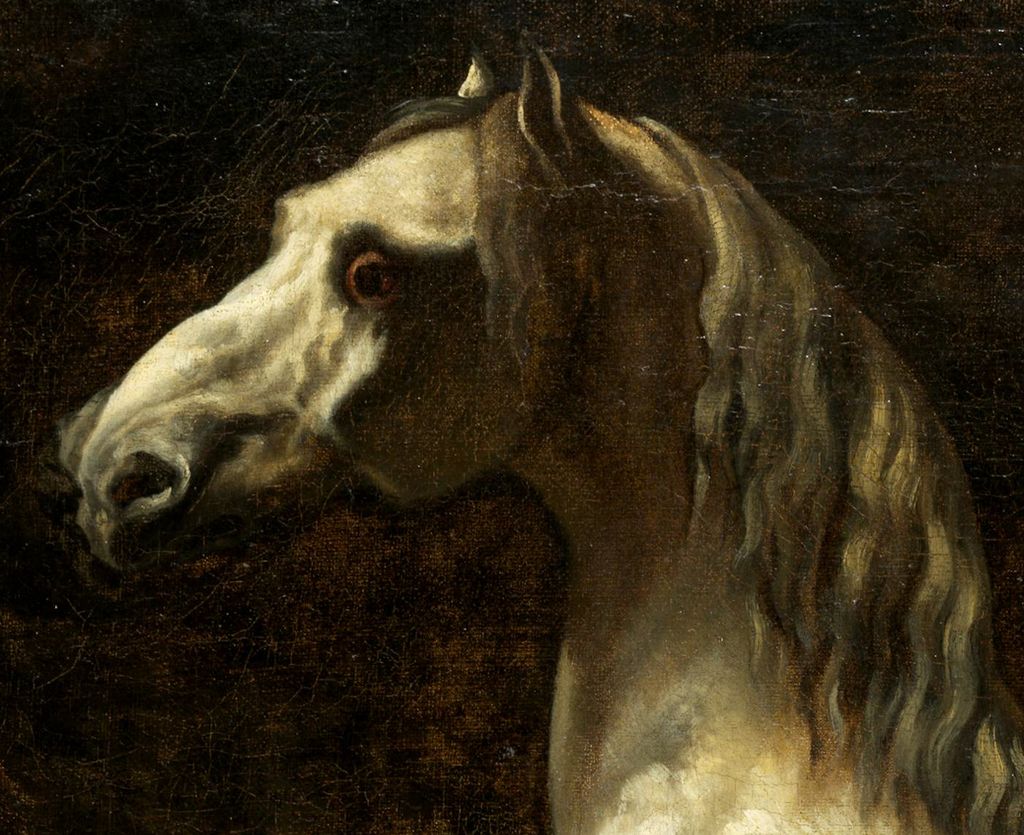
The constructed head
Abrupt light and shadow articulate the muzzle, cheek and eye. Rouen compares this anatomical emphasis to an écorché.
Dapples that turn the flank
Irregular pale patches change across the curved body, making the coat pattern part of the modelling.
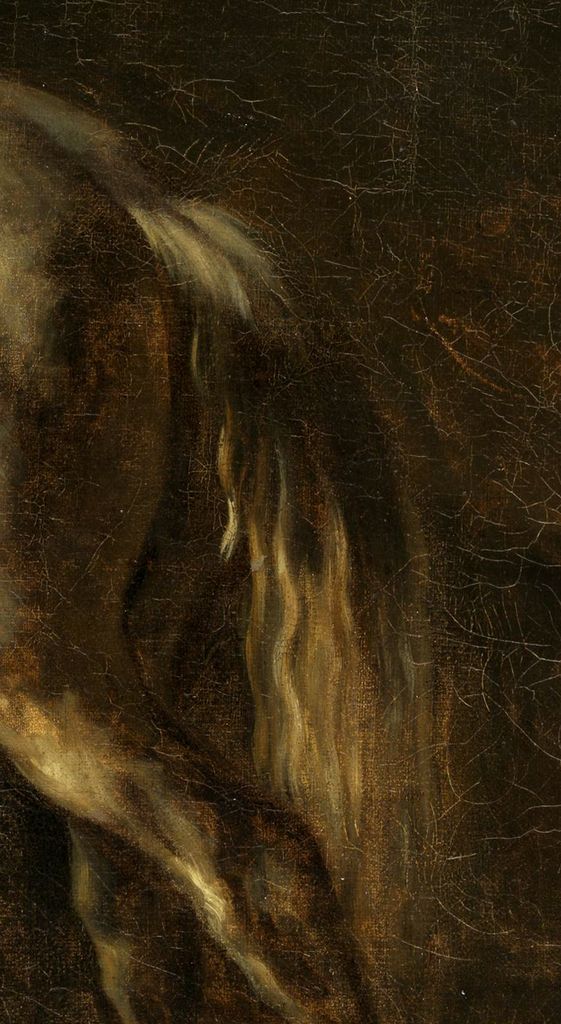
The tail and its revision
Curved traces beside the rump and falling strands draw attention to the tail area. Rouen identifies a change in the tail’s position as a pentimento.
Small contacts with the ground
The separated forelegs narrow towards small hoof contacts, contrasting with the broad illuminated torso above.
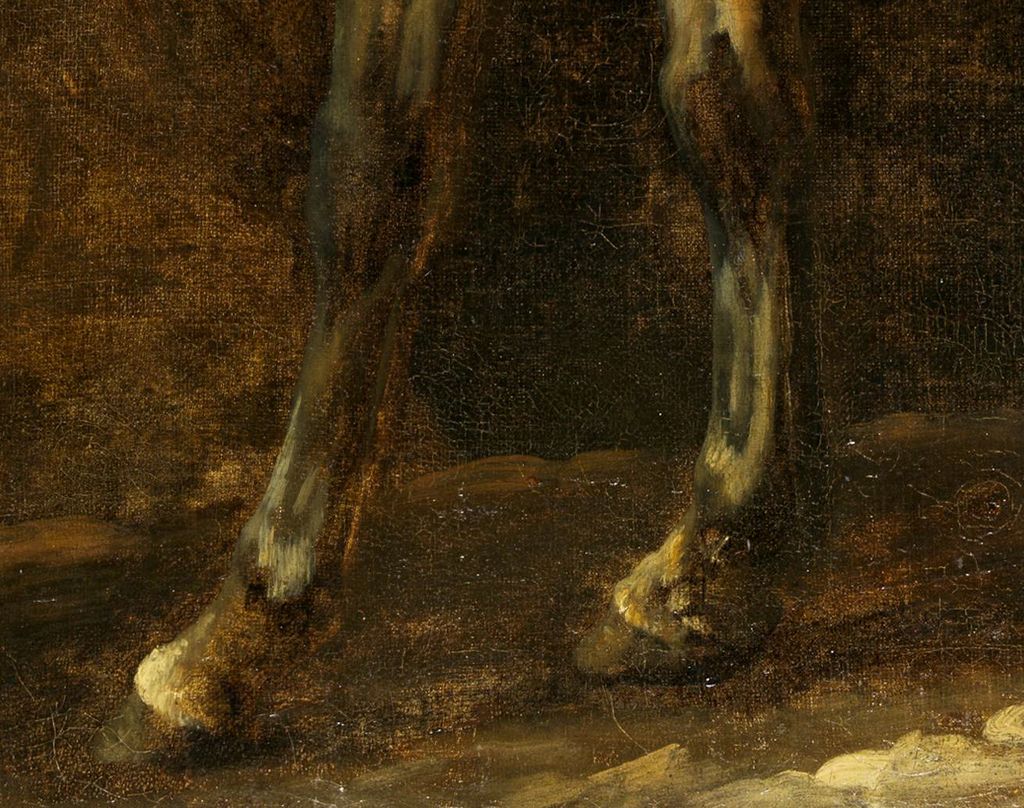
The head and the study of anatomy
The head is one of the most searching passages in the painting. A pale ridge runs down the face towards the muzzle, while the cheek and jaw are divided by abrupt changes of tone. The nostril opens as a dark shape within the lighter end of the face. Around the eye, a small warm accent stands out against the surrounding shadow. These are concentrated, structural marks, different in character from the more expansive treatment of the flank.
Rouen compares the handling of the head to an écorché: an anatomical representation of a body with the skin removed to expose its underlying structure. The comparison concerns the way the head is painted. This is a living, coated horse, and the museum’s term should not be mistaken for a literal account of the subject. It draws attention to the insistence with which Géricault articulates the forms beneath the surface. [1]
That emphasis helps explain why the picture is called a study. The head does not simply complete an elegant profile. Its bony projections, hollows and muscular transitions are given unusual prominence. The eye is compelling partly because it is held within that construction, rather than being isolated as an expressive symbol. The animal’s face remains a physical form to be understood.
Elsewhere, the long mane supplies a different kind of description. Its irregular, hanging strands contrast with the hard divisions of the face and the swelling light across the chest. The picture therefore contains several ways of looking at once: attention to anatomical structure, attention to the fall of hair, and attention to illumination over a large curved surface. Its unity comes from the animal that those different passages bring into view.
Watch: Géricault and The Raft of the Medusa
Three perspectives on Géricault’s best-known painting, its making and its historical setting.
Gericault, Raft of the Medusa
Smarthistory examines the composition and historical setting of The Raft of the Medusa.
Watch on YouTubeThe altered tail and Rouen’s claim to the original
The area around the rump and tail deserves a slower look. Beside the rounded hindquarters, lighter curved traces extend into the dark background; below, the tail descends in a more concentrated gathering of strands. The contours do not read with the same simple clarity as the line of the back. These visible differences are a useful starting point, though a reproduction alone cannot establish the complete order in which Géricault applied or changed the paint.
Rouen identifies a change in the position of the tail as a pentimento, a surviving trace of an artist’s revision. The museum also states that other versions of the composition exist and argues that its painting is the original, citing these revisions and the quality of the composition. This is the holding museum’s attribution argument; it is more specific than a general impression that the painting looks spontaneous. [1]
A revision is significant because it records a decision being made. A painter copying a settled image has a different task from a painter still determining where an element belongs. In this instance, the museum treats the altered tail as evidence of that process of invention. The argument joins a material observation to a judgement about the whole picture rather than relying on either alone.
The tail also has a compositional role that is visible without reconstructing the painting’s history. Its descending strands continue the movement from the back towards the ground and occupy the dark interval beside the rear legs. A shift in its position would change the balance between the illuminated rump and the shadow surrounding it. Even a seemingly secondary feature helps determine how firmly the horse inhabits the canvas.
Bazin’s argument for realism
Rouen introduces the painting through a passage by the Géricault scholar Germain Bazin. As quoted by the museum, Bazin sees Géricault’s close attention to a horse in its stall as a turn towards realism. He contrasts that encounter with the aristocratic animals of George Stubbs and Carle Vernet and the epic horses of Antoine-Jean Gros. His argument places weight on the ordinary, direct encounter between painter and animal. [1]
This is a useful historical interpretation, rather than a neutral division between truthful and untruthful horse painting. Bazin’s contrast is deliberately strong. It helps us notice that this horse needs neither an owner’s status nor a military action to organise our attention. The dark enclosure, exposed body and searching treatment of the head give the individual animal unusual importance.
The painting itself also complicates any simple opposition between realism and invention. Its calculated lighting, sweeping bodily rhythms and lightly grounded stance are means of transforming what has been observed. The horse is convincing through a sequence of pictorial decisions. Bazin’s reading is most productive when it sends us back to those decisions, rather than encouraging us to treat the canvas as an unmediated record of a stable visit.
From stillness to lightning and speed
Géricault’s A Horse Frightened by Lightning offers a close but distinct comparison. The National Gallery dates that canvas to about 1813–14. Its horse turns towards the right beneath a stormy sky, with lightning at the edge of the scene. The Gallery interprets its arrested stance, visible eye and mouth as the reaction to the storm, and describes the short strokes that follow the contours of its coat. [4]
Both paintings make a dappled surface conspicuous against darkness, but the darkness performs a different job in each. In Rouen it encloses the animal in a stall; in London it belongs to the weather and helps establish an event. The storm supplies a reason to read the London horse’s stillness as fear. That explanation cannot simply be carried across to the Rouen study. Similar subjects and lighting effects do not make the horses’ situations interchangeable.
The later Epsom Derby changes the problem again. The Louvre dates its race painting to 1821 and preserves Epsom as a traditional identification in the title. Here, elongated bodies and outstretched legs organise the scene around forward movement, with jockeys directing the horses across open ground. [9] The Musée des Beaux-Arts de Caen’s related preparatory study, dated around 1821, is especially useful for this comparison: the museum emphasises the extreme extension of the legs as a means of producing the impression of speed. [10]
Returning from the racers to Study of a Dapple Grey makes the stable horse’s achievement clearer. Géricault does not need stretched limbs or a passing landscape to animate a body. The distribution of the legs, the changing contour of the neck and the progression of light across the torso are enough to sustain attention. The painting gives a stationary animal the visual complexity usually associated with action.
Its lasting interest lies in that combination of patience and decision. The horse is studied closely, but the canvas is also adjusted, constructed and illuminated. The anatomical head, luminous flank and revised tail each disclose a different part of that work. Together they make the standing horse a subject large enough to occupy the entire picture.
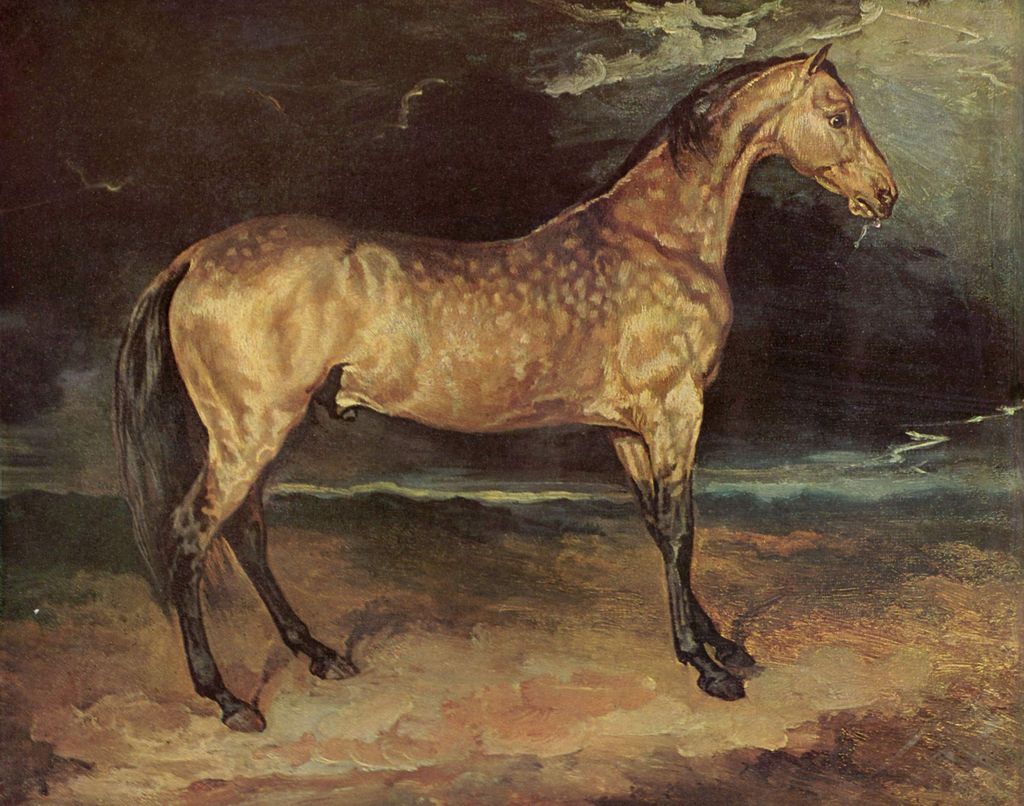
A Horse Frightened by Lightning Image source. Public domain.
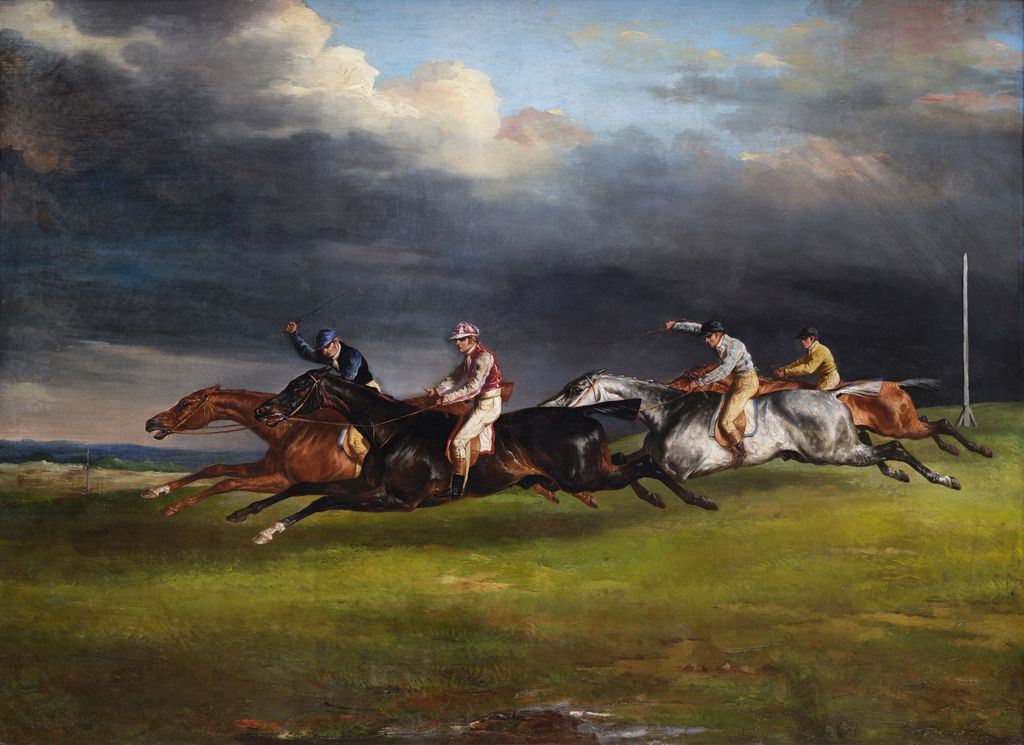
The Epsom Derby Image source. Public domain.
Géricault collection records
Seventy collection records include paintings, drawings and individual print impressions. Different impressions remain separate records; this selection is not a complete catalogue raisonné.
Frequently Asked Questions
Rouen draws attention to the anatomical treatment of the head. The painting investigates structure, light and the animal’s stance, while the revised tail also records a compositional decision. [1]
The museum argues that it holds the original, pointing to revisions, including a change in the tail’s position, and to the quality of the composition. [1]
Discussion
Look again at the images and ideas explored in Study of a Dapple Grey by Théodore Géricault. These editorial prompts invite your observations.
Reader Insights
Follow the pale patches from shoulder to rump. Where do they describe the coat, and where do they make the body turn?
Compare the large torso with the small areas where the hooves touch the ground. How does the horse appear both heavy and light?
Look from the sharply modelled head to the loose mane. What different kinds of attention do these passages invite?
Join the Conversation
Share a detail, comparison or question about Study of a Dapple Grey by Théodore Géricault below.
References
- Musée des Beaux-Arts de Rouen, Study of a Dapple Grey, Théodore Géricault, circa 1812, inventory 850.3.1; collection record and interpretive text, including Germain Bazin’s argument as quoted by the museum (English). View source.
- Nationalmuseum, The Severed Heads, NM 2113; collection metadata and museum interpretation (Swedish). View source.
- Louvre, Charging Chasseur, INV 4885; collection metadata and museum interpretation (French/English interface). View source.
- The National Gallery, London, A Horse frightened by Lightning, about 1813–14, NG 4927; “Overview,” “In-depth” and object details (English). View source.
- Louvre, Wounded Cuirassier, INV 4886; collection metadata and museum interpretation (French). View source.
- Louvre, The Raft of the Medusa, INV 4884; collection metadata and museum interpretation (French). View source.
- Gary Tinterow / The Metropolitan Museum of Art, Géricault’s Heroic Landscapes: The Times of Day, Met Bulletin 48/3, Winter 1990–91; consulted main essay and relevant object entries (English). View source.
- Vlaamse Kunstcollectie, Portrait of a Kleptomaniac; collection metadata and museum interpretation (Dutch). View source.
- Musée du Louvre, Course de Chevaux, dit traditionnellement Le derby de 1821 à Epsom, 1821, MI 708; title, description and date fields (French). View source.
- Musée des Beaux-Arts de Caen, Étude préparatoire pour Le Derby d’Epsom, circa 1821, D.75.1.8; object details and interpretive paragraph on speed and elongated legs (French). View source. (in French).


