



 by Tom Gurney
Tom Gurney BSc (Hons) is an art history expert with over 20 years experience
Email: tomgurney1@gmail.com / Phone: +44 7429 011000
Portrait of a Woman Traditionally Called the Monomaniac of Gambling: Introduction
The woman leans into the picture with her shoulders wrapped in a heavy brown garment. Above it, a white cap and a narrow opening of white cloth frame her face. Her eyes look slightly upwards and towards the right of the canvas; her lips are almost closed. Nothing around her identifies a game, a wager or a gambling house. The connection with gambling comes from the painting’s historical title, rather than from an action Géricault has shown.
The Louvre catalogues this oil on canvas as La folle monomane du jeu, dates it to 1819–22 and records its dimensions as 77 × 65 cm. Its inventory number is RF 1938 51. The more qualified English description, Portrait of a Woman Traditionally Called the Monomaniac of Gambling, acknowledges both that established identification and its limits. We have a compellingly particular face, but no securely identified sitter and no warrant to diagnose her from her appearance. [1] The titles attached to Géricault’s five surviving portraits of so-called monomanes were recorded decades after he painted them. Their familiar medical origin story is also disputed. [2]
At a Glance
This work across Théodore Géricault’s career
The Severed Heads
1810s [3]Charging Chasseur
1812 [4]Horse Frightened by Lightning
c.1813–14 [5]The Raft of the Medusa
1818–19 [7]Portrait of a Kleptomaniac
c.1820–24 [9]The Epsom Derby
1821 [10]Contents
- A face emerging from dark clothing
- What the gambling title tells us
- The uncertain connection with a doctor
- One woman among distinct portraits
- How the portrait entered the Louvre
- Looking beyond an inherited label
- Annotated details
A face emerging from dark clothing
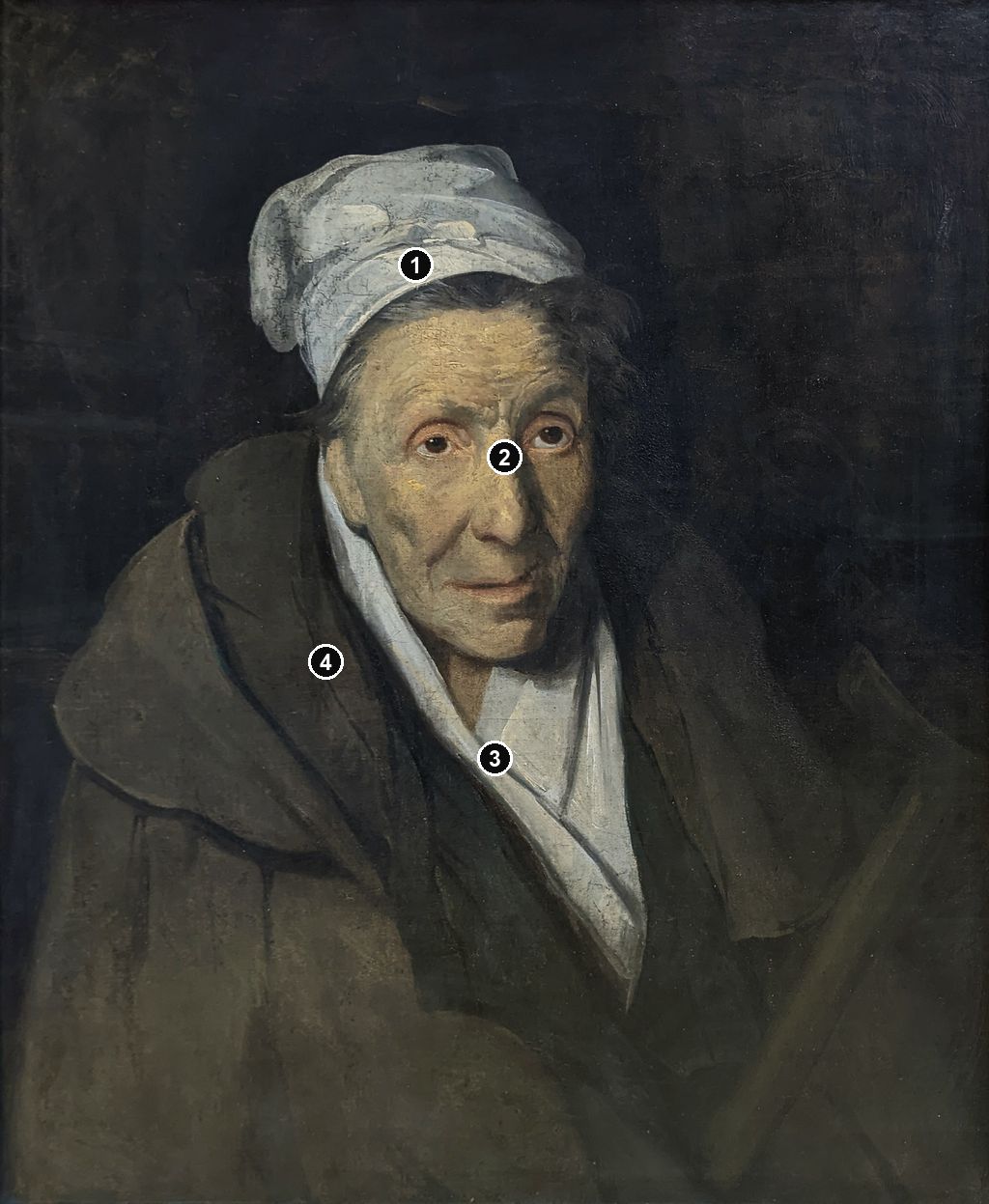
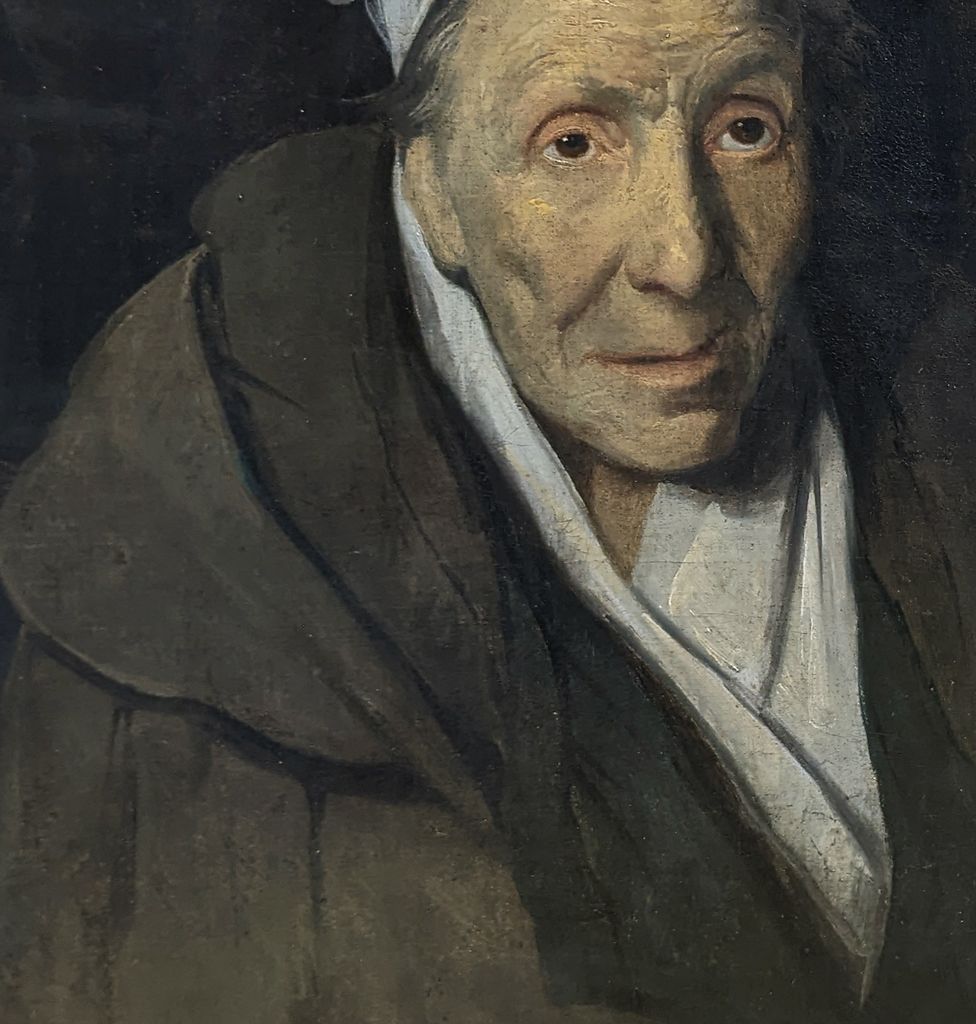
The cap is the first strong interruption of the dark background. Its shape matters as much as its brightness. It rises in a loose, uneven mass above the skull, then folds forward into a firmer band over the forehead. Small changes between grey, cream and white distinguish overlapping pieces of cloth. The curved edge leads down towards the visible hair, making the forehead seem to emerge from beneath a sheltering canopy. This is ordinary headwear given sustained pictorial attention, without becoming a decorative accessory.
Below it, the face is built from warmer tones. The forehead catches broad light, while hollows beside the nose and beneath the cheekbones deepen into brown. Fine horizontal lines cross the brow; stronger creases descend beside the mouth. The eyes remain distinct within this weathered surface because their dark centres and small lights interrupt the surrounding flesh. The asymmetry is crucial. One side of the face is more exposed to the light, and the nose interrupts our access to the other. The head therefore has volume and direction, rather than the flat clarity of a specimen laid out for inspection.
Her body occupies much of the lower canvas, yet it gives relatively little information about what she is doing. Broad folds in the outer garment make a substantial, enclosing shape. The shoulder on the left of the image advances towards us; the opposite side falls back into darkness. Her face turns within that larger mass, producing a slight difference between the movement of head and body. The result is attentive without being theatrical. We may feel that someone has attracted her notice, but the painting supplies neither that person nor the occasion.
The white cloth at her neck carries the light downwards from her face. Its crossing folds form a narrow, angular opening inside the broader brown covering. This small passage gives the body an internal structure: pale diagonals sit within the garment’s heavier, curving folds. The cap and neck cloth also establish two different kinds of white. Above, the fabric expands loosely against the background; below, it is compressed and directed towards the chest. Between them, the warmer face becomes the painting’s centre of attention.
These details complicate the expectation created by the gambling title. Her mouth might seem hesitant, responsive or faintly amused, depending on where we begin looking. None of those impressions establishes a settled emotion, much less a personal history. Even the apparent immediacy of the pose cannot tell us how long a sitting lasted or what passed between painter and sitter. What it does show is Géricault’s capacity to give small differences of angle and light the force of an encounter.
What the gambling title tells us
Calling the woman a gambler can change the way we read every feature. A lifted gaze may begin to look calculating; a crease around the mouth may become evidence of desire or disappointment. Yet those associations arrive with the words. No cards, coins, gaming table or narrative setting confirms them. The image’s refusal to supply such props is one reason the title needs to be handled as historical information, rather than as a transparent account of the sitter.
The Musée des Beaux-Arts de Lyon traces the group’s familiar names to a letter written by the critic Louis Viardot in 1863. He described the portraits after their discovery in Germany and assigned different forms of monomania to them: gambling, envy, theft, military command and child stealing. Lyon’s accompanying dossier stresses that these titles were not supplied by Géricault himself. The identification of the Louvre woman belongs within that later history of explanation. [2] [11]
“Monomania” was a historical psychiatric category concerned with a disturbance understood to be concentrated on one idea or obsession, while other faculties might appear unaffected. That framework helps explain why an apparently composed portrait could be grouped under a term associated with mental illness. It does not establish that this particular woman had the condition assigned to her, nor does it translate neatly into a present-day diagnosis. The Lyon dossier places the category within the development of nineteenth-century psychiatry and notes its later disappearance from diagnostic use. [11]
There are consequently two different uncertainties here. One concerns her identity: we do not know her name or enough of her life to replace the inherited description with a biography. The other concerns the authority of the description itself. Repeating the gambling title without qualification can make a later classification seem like something the painter observed and certified. Keeping “traditionally called” in view allows the work to remain recognisable without allowing its title to settle what the face means.
Annotated Details from Portrait of a Woman Traditionally Called the Monomaniac of Gambling
The numbered points identify visible features discussed in this article. Return from each detail to the whole composition. Portrait of a Woman Traditionally Called the Monomaniac of Gambling Image source. Public domain.
Details from PORTRAIT OF A WOMAN TRADITIONALLY CALLED THE MONOMANIAC OF GAMBLING
Compare the cropped details with the complete images above. Notice how their colours, shapes and positions contribute to the larger compositions.
Folded white cap
Overlapping grey and white folds give the cap a loose upper shape and a firmer band above the forehead.
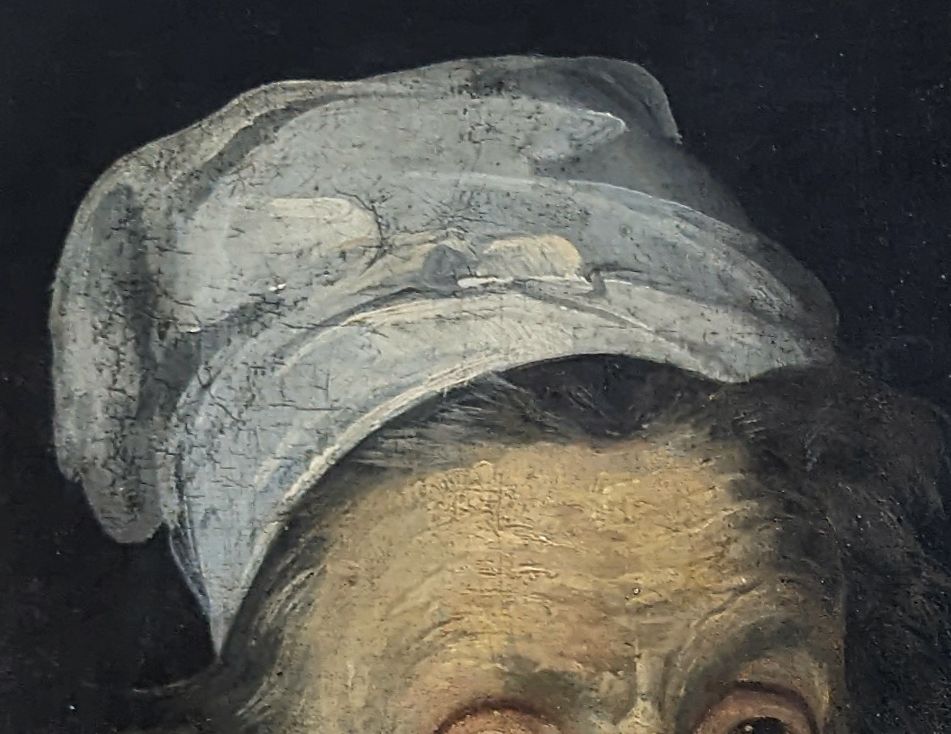
Direction of the eyes
The slightly lifted eyes direct attention towards something beyond the picture, which the painting leaves unidentified.
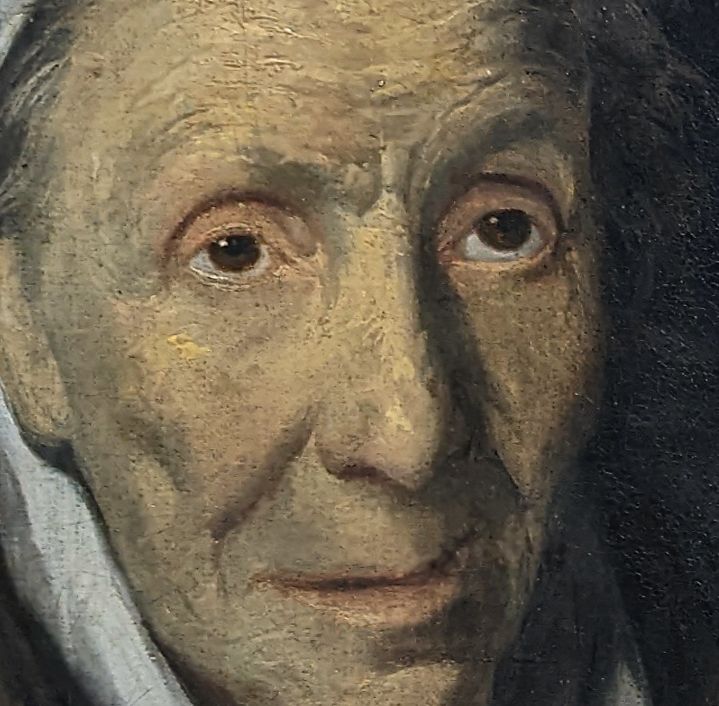
White cloth within brown folds
Crossing pale folds form an angular opening inside the broader, darker garment.
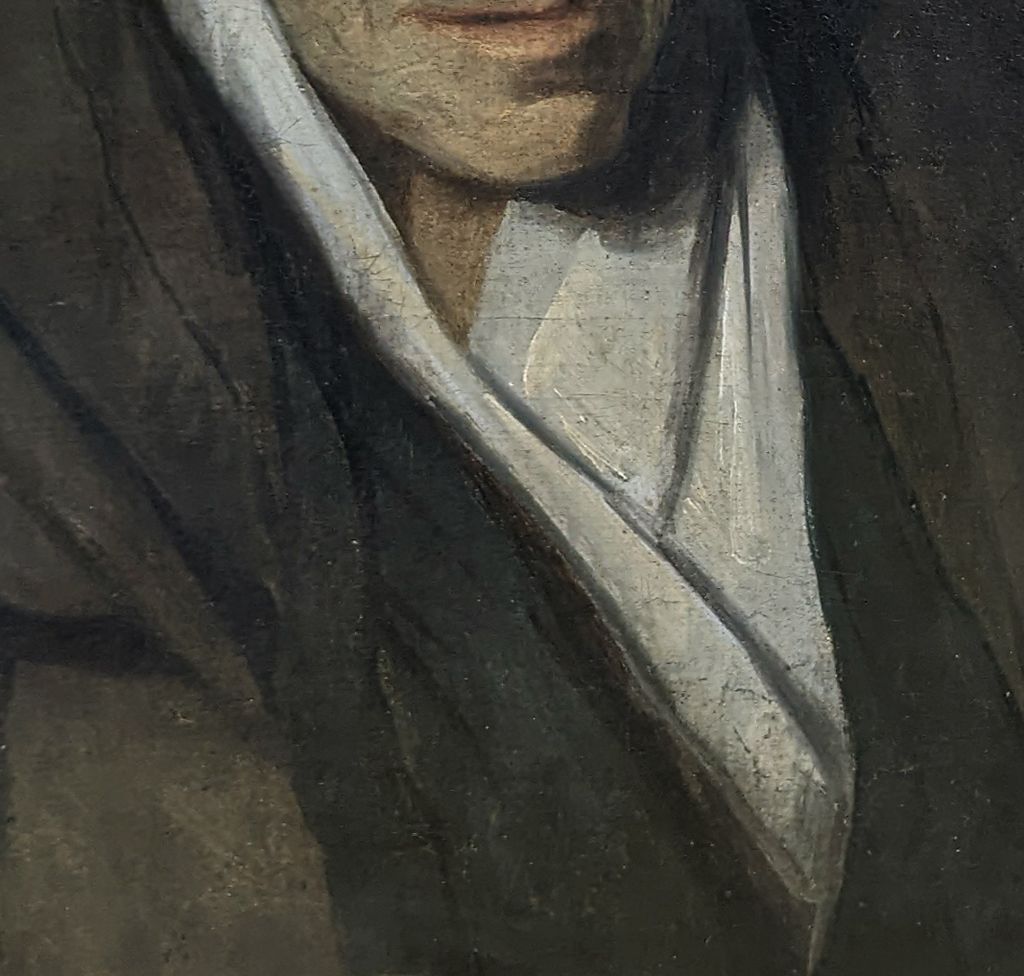
Shoulder and head
The advancing shoulder and the face's slight turn give the otherwise compact pose a sense of movement.
The uncertain connection with a doctor
The best-known account of the series says that Géricault painted it for the physician Étienne-Jean Georget. In different versions, the pictures were intended as medical illustrations or resulted from a personal relationship between doctor and artist. Such a story appears to give these otherwise unexplained portraits a clear place, patron and function. Its coherence has helped it endure.
The evidence is less accommodating. Lyon explicitly states that no document establishes a connection between Géricault and Georget, or even Georget’s interest in commissioning this kind of representation. It distinguishes him from Jean-Étienne Esquirol, whose use of drawn portraits in psychiatric research is documented. The dossier likewise treats the circumstances of the paintings’ creation as unresolved, rather than accepting the commission theory as fact. [2] [11]
The Louvre’s ownership history nevertheless begins with Georget’s collection, followed by that of Dr Adolphe Lachèze in Baden-Baden. This is the provenance tradition recorded by the holding museum; it should not be silently converted into proof that Georget commissioned the canvas, prescribed its subject or selected the woman for a medical demonstration. Ownership and original purpose are different questions. The record can preserve an early chain of possession while the circumstances of production remain open. [1]
The Louvre’s 1819–22 date range should be retained with similar care. It locates the work approximately, without fixing an exact sitting or sequence within the group. Nor does uncertainty justify supplying an imagined hospital scene. The dark background provides no identifiable ward, consulting room or studio. It isolates the figure pictorially, but does not name the place in which she sat.
Watch: Géricault and The Raft of the Medusa
Three perspectives on Géricault’s best-known painting, its making and its historical setting.
Gericault, Raft of the Medusa
Smarthistory examines the composition and historical setting of The Raft of the Medusa.
Watch on YouTubeOne woman among distinct portraits
The related portraits make the Louvre canvas easier to see, provided their titles do not become a checklist of symptoms. In the Lyon woman traditionally associated with envy, a spreading, ruffled white cap surrounds the face and a red scarf produces a strong warm accent below it. Her eyes turn towards the left of the image. The Louvre woman’s cap is more compact, the white at her neck is quieter, and her gaze moves in the opposite direction. These are different arrangements of colour and attention, not interchangeable examples of a single facial type.
The Lyon work is also smaller, at 72.1 × 58.5 cm. Its museum describes the anonymous sitter’s elevation to the status of a serious portrait subject as significant within the art of the post-revolutionary period. That is a useful institutional interpretation of the group’s importance, though it should not be mistaken for a surviving declaration of Géricault’s intentions. [2] In the Louvre canvas, the same seriousness is visible in the space and attention given to unglamorous clothing, ageing skin and a moment of directed looking.
The portrait traditionally called a kleptomaniac in Ghent offers another comparison. Its dark-haired, bearded sitter wears a pale collar and neck cloth above a predominantly dark body. The white cloth makes a compact support beneath the head. In the Louvre painting, the light fabrics extend the visual path above and below the face, so the cap has as much compositional weight as the neck cloth. Neither picture includes an object that demonstrates the behaviour named by its title.
The man traditionally associated with military command in Winterthur is more explicitly differentiated through dress: a dark cap with a red tassel, pale sleeves and a hanging medal interrupt the brown and black clothing. The Oskar Reinhart collection dates its 81 × 65 cm canvas to about 1819–22. [12] Such accessories give the viewer more to interpret, yet they still cannot establish the man’s medical history. Beside him, the Louvre woman’s broad garment and plain fabrics feel especially withholding of an external role.
Comparison therefore sharpens individuality. Each portrait directs the eye differently, and each gives the sitter a different balance of reserve and apparent responsiveness. The shared dark backgrounds and concentrated framing create a family resemblance, while clothing, headwear and the direction of each face keep the people distinct. A history of the group must account for both qualities.
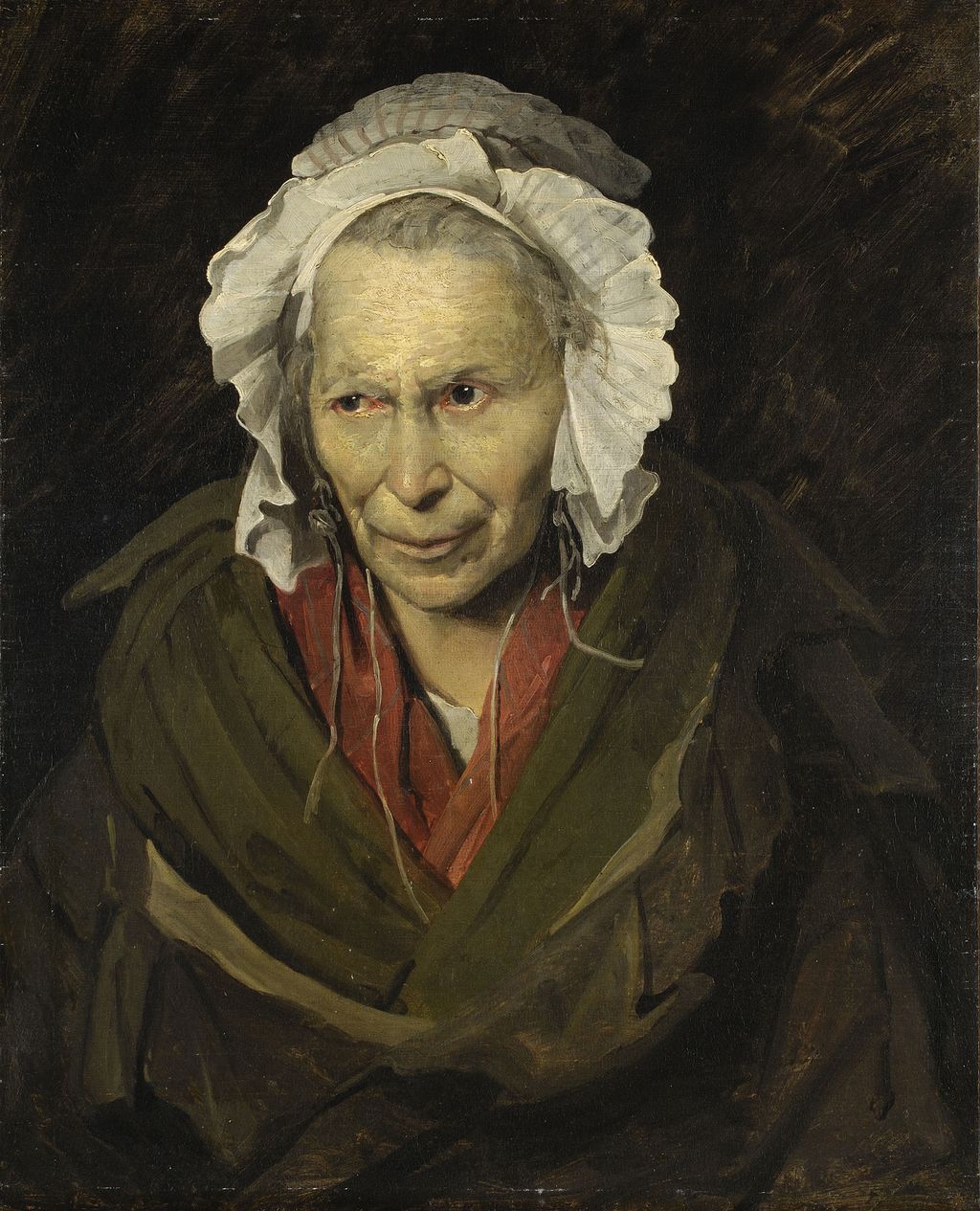
Portrait of a Woman Traditionally Called the Monomaniac of Envy Image source. Public domain.
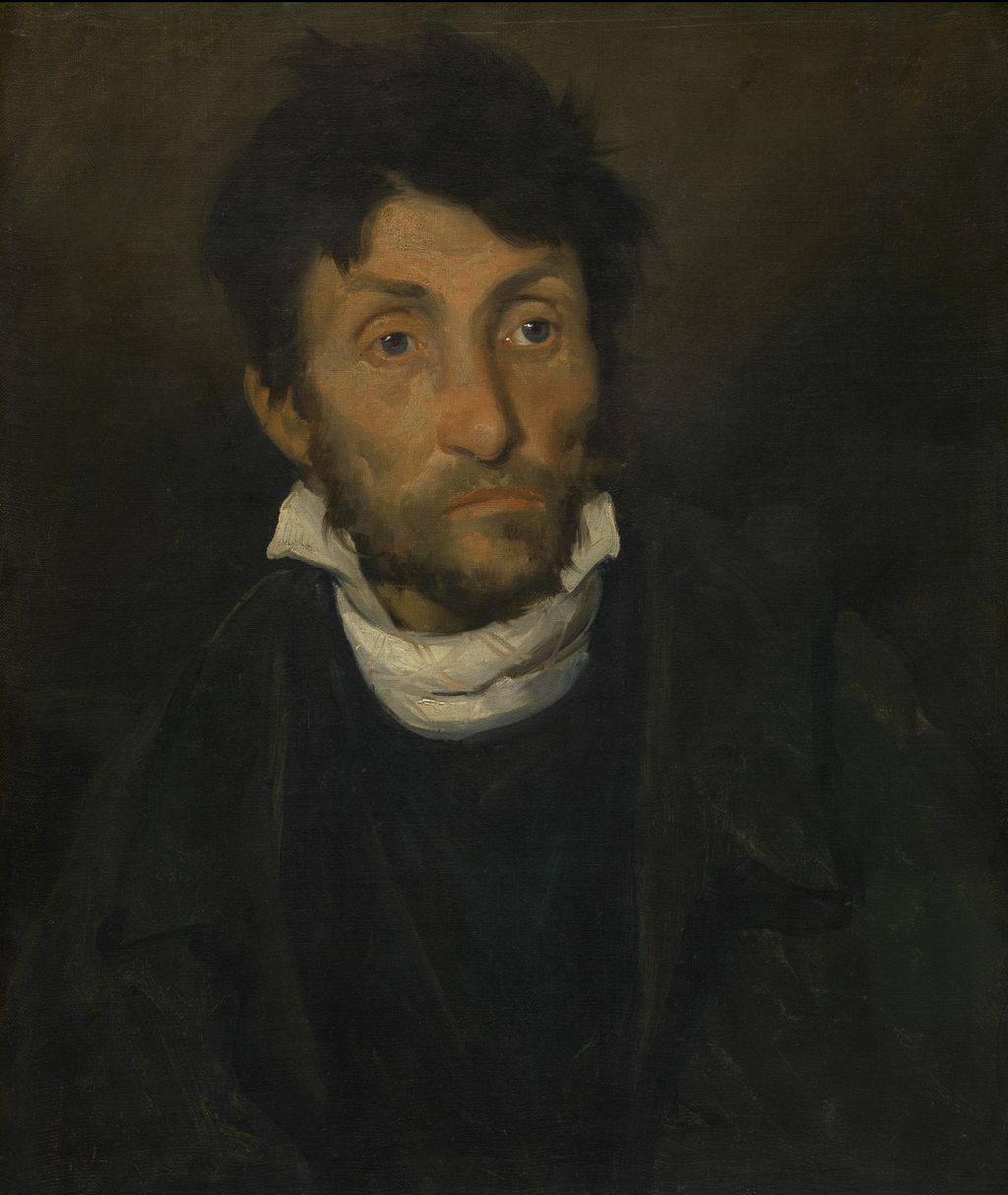
Portrait of a Kleptomaniac Image source. CC0 / Public domain.
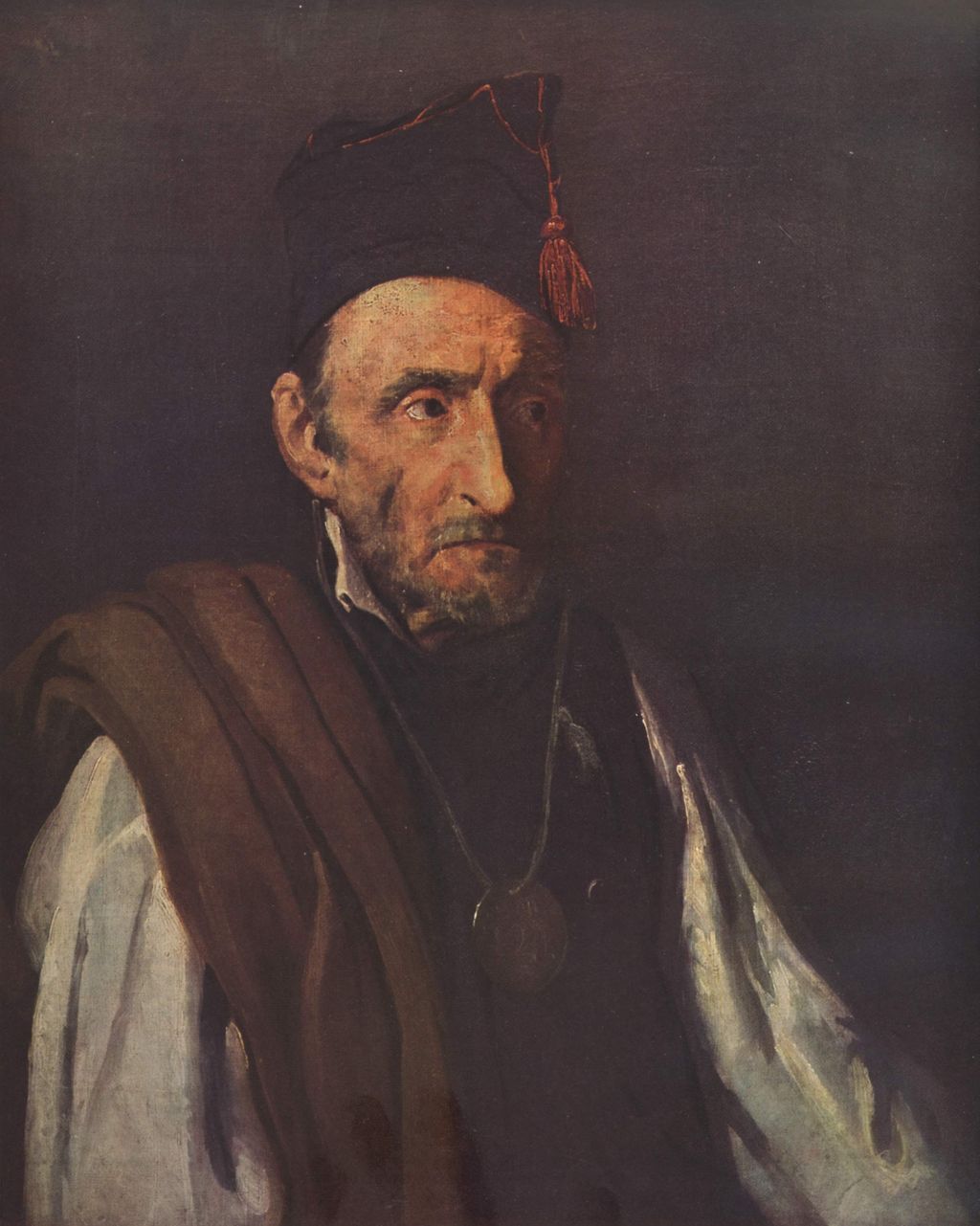
Man with Delusions of Military Command Image source. Public domain.
How the portrait entered the Louvre
The later history of this particular canvas is more definite than its original purpose. According to the Louvre, the painter Henri Harpignies offered it to the museum on Lachèze’s behalf on 19 January 1866. The offer was unsuccessful. Lachèze then sold the portrait to the painter Charles Jacque in February 1868. The Louvre records that it remained in Jacque’s family until 1920, citing the information supplied in the 1938 sale catalogue. [1]
From 1920 it belonged to Édouard Napoléon Mortier de Trévise, fifth duc de Trévise. It appeared as lot 34 at his sale at the Galerie Charpentier in Paris on 18 May 1938. The Société des Amis du Louvre bought it for 300,000 francs with the participation of David-Weill and gave it to the museum that year. Its present inventory number records that acquisition. [1]
The unsuccessful approach in 1866 and the eventual gift in 1938 are useful markers of the painting’s movement into public ownership. They do not, by themselves, explain the museum’s earlier refusal or prove a steady rise in critical esteem. What they establish is a route through medical and artists’ collections, a later aristocratic collection and an organised act of museum patronage. This portrait’s Louvre identity was made through that history of transactions and choices, long after the encounter preserved on its surface.
Looking beyond an inherited label
The tension between these portraits and their titles remains productive in later art. In an interview with Griet Bonne, published by MSK Ghent in July 2025, the artist and filmmaker Fiona Tan discussed the fascination that led to her exhibition Monomania at the Rijksmuseum, held from 4 July to 14 September 2025. Her starting point was the Ghent portrait, rather than the Louvre woman, but her reflections addressed all five surviving paintings. She emphasised the friction between their individual presence and the classifications attached to them later. [13]
Tan’s response is evidence of the series’ continuing reception. It cannot establish what Géricault meant or what his sitters experienced. Its value here is to bring attention back to the difference between an image and an explanation imposed upon it. The portraits can prompt empathy and curiosity while frustrating the wish to know another person completely. That frustration is especially acute in the Louvre canvas, where a lifted face seems close to responding, but no speech or surrounding event completes the exchange.
We should not assume that the woman freely chose her pose, clothing or participation: those circumstances are unknown. Equally, an unknown biography does not make her merely an illustration of someone else’s category. Her specific presence survives in the uneven cap, the turn of her head and the relation between her eyes and almost closed mouth. Looking carefully means recognising those particulars without turning them into proof of gambling. The portrait offers sustained attention to a person; its historical title records one of the ways later viewers tried to explain her.
Géricault collection records
Seventy collection records include paintings, drawings and individual print impressions. Different impressions remain separate records; this selection is not a complete catalogue raisonné.
Frequently Asked Questions
The Société des Amis du Louvre purchased it at the Trévise sale in May 1938, with David-Weill's participation, and gave it to the museum that year. An earlier offer in 1866 had been unsuccessful. [1]
Discussion
Look again at the images and ideas explored in Portrait of a Woman Traditionally Called the Monomaniac of Gambling. These editorial prompts invite your observations.
Reader Insights
How does the white cap change the balance of the portrait when you cover the white cloth at the neck?
Which details seem to suggest gambling only after you have read the historical title?
Compare the Louvre and Lyon women's gaze directions: how does each guide your attention beyond the frame?
Join the Conversation
Share a detail, comparison or question about Portrait of a Woman Traditionally Called the Monomaniac of Gambling below.
References
- Musée du Louvre, La folle monomane du jeu, RF 1938 51, collection record updated 18 February 2025; object fields and ownership history (French). View source. (in French).
- Musée des Beaux-Arts de Lyon, La Monomane de l’envie, B 825, collection record; historical titles, origins and interpretation (French). View source. (in French).
- Nationalmuseum, The Severed Heads, NM 2113; collection metadata and museum interpretation (Swedish). View source.
- Louvre, Charging Chasseur, INV 4885; collection metadata and museum interpretation (French/English interface). View source.
- National Gallery, Horse frightened by Lightning; collection metadata and museum interpretation (English). View source.
- Louvre, Wounded Cuirassier, INV 4886; collection metadata and museum interpretation (French). View source.
- Louvre, The Raft of the Medusa, INV 4884; collection metadata and museum interpretation (French). View source.
- Gary Tinterow / The Metropolitan Museum of Art, Géricault’s Heroic Landscapes: The Times of Day, Met Bulletin 48/3, Winter 1990–91; consulted main essay and relevant object entries (English). View source.
- Vlaamse Kunstcollectie, Portrait of a Kleptomaniac; collection metadata and museum interpretation (Dutch). View source.
- Louvre, Epsom, MI 708; collection metadata and museum interpretation (French/English interface). View source.
- Musée des Beaux-Arts de Lyon, Théodore Géricault: La Monomane de l’envie, two-page Focus Œuvre dossier, pp. 1–2; uncertain commission, retrospective titles, historical terminology and rediscovery (French). View source. (in French).
- Sammlung Oskar Reinhart «Am Römerholz», Théodore Géricault, Geisteskranker mit militärischem Grössenwahn, um 1819–22, object-entry metadata; medium, date and dimensions (German). View source. (in German).
- Griet Bonne / Museum voor Schone Kunsten Gent, Géricaults ‘Portret van een kleptomaan’ tijdelijk te zien in het Rijksmuseum, 7 July 2025, account of an interview with Fiona Tan held 21 May 2025; sections “De ‘Gentse’ Géricault” and “Monomanieën” (Dutch). View source. (in Dutch).


