



 by Tom Gurney
Tom Gurney BSc (Hons) is an art history expert with over 20 years experience
Email: tomgurney1@gmail.com / Phone: +44 7429 011000
Portrait of Laure Bro, née de Comères: Introduction
Théodore Géricault's Portrait of Laure Bro places a seated woman between a dark interior and a pale opening onto landscape. Her white gown travels diagonally across almost the whole picture, from the short sleeves at her shoulders to the blue shoes at the lower left. A red shawl descends beside her chair; a bonnet rests on a small table. Yale University Press's A&AePortal identifies the painting as an oil on canvas of about 1818. The sitter's name is Laure, rather than Laura. [1]
The portrait gives its subject considerable presence without a grand gesture. Laure looks towards the viewer, her head slightly inclined, her hands brought together near her waist. The long sweep of the skirt makes her body occupy the room, while the compact arrangement of head, shoulders and arms concentrates attention on her face. Looking from one to the other reveals a composition built from contrasting scales: an expansive dress, small pieces of personal attire and a direct encounter with an individual.
At a Glance
- SitterLaure Bro, née de Comères [1] [2]
- DateAbout 1818 [1]
- MediumOil on canvas [1]
- Recorded saleSotheby’s Monaco, 3 December 1989, lot 510 [1] [2]
This work across Théodore Géricault’s career
The Severed Heads
1810s [3]Charging Chasseur
1812 [4]Horse Frightened by Lightning
c.1813–14 [5]The Raft of the Medusa
1818–19 [7]Portrait of a Kleptomaniac
c.1820–24 [9]The Epsom Derby
1821 [10]Contents
- A seated figure across the canvas
- Light at the face and window
- Gown, glove, bonnet and shawl
- Laure Bro and Géricault's circle
- A documented sale and an unknown present location
A seated figure across the canvas
The chair is turned sufficiently for Laure's legs and skirt to extend towards the left, while her upper body returns towards us. This creates a gentle change of direction rather than a rigid frontal pose. The sloping skirt carries the eye down and out; her face and the bend of her arms bring it back. The seat itself remains partly concealed. What matters visually is the support it gives the figure and the low horizontal edge visible beneath the white fabric.
Notice how little empty space there is below her shoulders. The dress fills the lower centre, the shawl occupies the right side, and the table holds the left. Yet the arrangement is legible because each area has a different colour and shape. Broad white folds meet a narrow, irregular red border; the table's curved rim interrupts the dark vertical shapes behind it. These differences allow the objects to remain distinct even where their outlines approach one another.
The feet are especially useful for understanding the pose. Their blue shoes reach almost to the lower left corner, establishing how far the seated body projects into the room. They also supply a small, sharp accent against the much larger white skirt. Here their narrowness, colour and crossing ribbons matter as elements of the painted arrangement.
Light at the face and window
The lightest part of the upper setting lies behind Laure's head and shoulders. A pale curtain partly veils the landscape, contrasting with the dark hanging fabric farther left. This division makes the head unusually clear: the dark hair stands against a lighter field, while the illuminated face is set beside the deeper interior tones. The background thus gives different parts of the head different kinds of emphasis.
Her face is more varied in tone than a first glance at the white dress might suggest. A shadow gathers along one side; the cheeks and brow catch warmer light. The eyes meet the viewer without the head becoming perfectly upright. Together, the tilt and gaze produce an attentive, slightly asymmetrical encounter. They do not establish a particular emotion or reveal what Laure thought about being painted. The interest lies in the way the pose keeps direct address from becoming stiffness.
The landscape is comparatively indistinct. It opens a view beyond the room without competing with the sitter for detail. Seen against this subdued distance, the face seems close. The pale curtain supplies an intermediate layer between interior and exterior, so that the setting has depth even though much of it is hidden by the figure and furnishings.
Watch: Géricault and The Raft of the Medusa
Three perspectives on Géricault’s best-known painting, its making and its historical setting.
Gericault, Raft of the Medusa
Smarthistory examines the composition and historical setting of The Raft of the Medusa.
Watch on YouTubeGown, glove, bonnet and shawl
The dress is articulated through changes in light rather than through a continuous pattern. Around the upper body, gathers and short sleeves produce compact folds. Below the waist, longer lines follow the skirt towards the feet. A narrow blue band divides these two areas. Its colour also recalls the shoes, making a connection between the tightly gathered upper costume and the far end of the diagonal below.
White is far from uniform here. There are warm, creamy passages across the skirt, cooler shadows in the folds and brighter edges where the fabric changes direction. These variations describe volume while preventing the broad garment from becoming a flat triangle. The more intricate white material at the wrists adds another texture. Its small interruptions of light differ from the longer, smoother stretches below.
The hands create a second centre of attention beneath the face. A glove and the pale wrist details sit against warmer flesh, with a small dark interval where the hands meet. This makes their arrangement readable despite its compactness. The glove can be discussed as an article of dress and as a contrast of surface and colour. No documented symbolic explanation accompanies it in the sources consulted here, and there is no need to give it a hidden message to explain its contribution to the portrait.
At the left, the bonnet is set apart from Laure's head. Its light fabric and trailing transparent material spread over the table and descend into darkness. The object offers a different kind of white from the gown: smaller, less solid and more irregular at its edges. Across the picture, the red shawl provides the strongest colour contrast. Its decorated border bends around the chair and falls nearly to the floor. Where the gown forms a broad continuous slope, the shawl produces a narrow, broken cascade.
Yale's record places the portrait within Aileen Ribeiro's The Art of Dress: Fashion in England and France, 1750 to 1820, in the chapter on fashion from 1789 to 1820. That publication context makes clothing a useful avenue into the picture. It does not by itself identify the gown's fabric, establish that every accessory carries a coded meaning or supply a biography of its wearer. [1]
Laure Bro and Géricault's circle
Laure belonged to the Bro family, with whom Géricault had personal connections. A Sotheby's catalogue note identifies her as Laure Bro, née de Comères, and names portraits of other family members, including Olivier Bro. It describes Géricault's friendship with Colonel Louis Bro, owner of the building at 23 rue des Martyrs where the artist had a studio. The account also places Bro within Horace Vernet's circle. [2]
That context gives the portrait a setting among people known to the painter. It should not displace Laure herself. The composition does not show a military narrative, nor does knowledge of her husband's career explain every decision about her pose. Her individuality emerges through the relation of face to costume, the inclination of the head and the placement of the hands. The family connection helps explain why this sitter enters Géricault's work; close looking explains what makes this particular portrait engaging.
The Study of the Model Joseph offers a useful visual comparison. Its close crop concentrates the encounter around a turned head and open white collar. Laure’s portrait gives clothing and furnishings much more space: the eye travels across the skirt and room before returning to her face. In each image, pale fabric helps organise the head’s relationship to its darker surroundings, although the scale and direction of that attention differ.
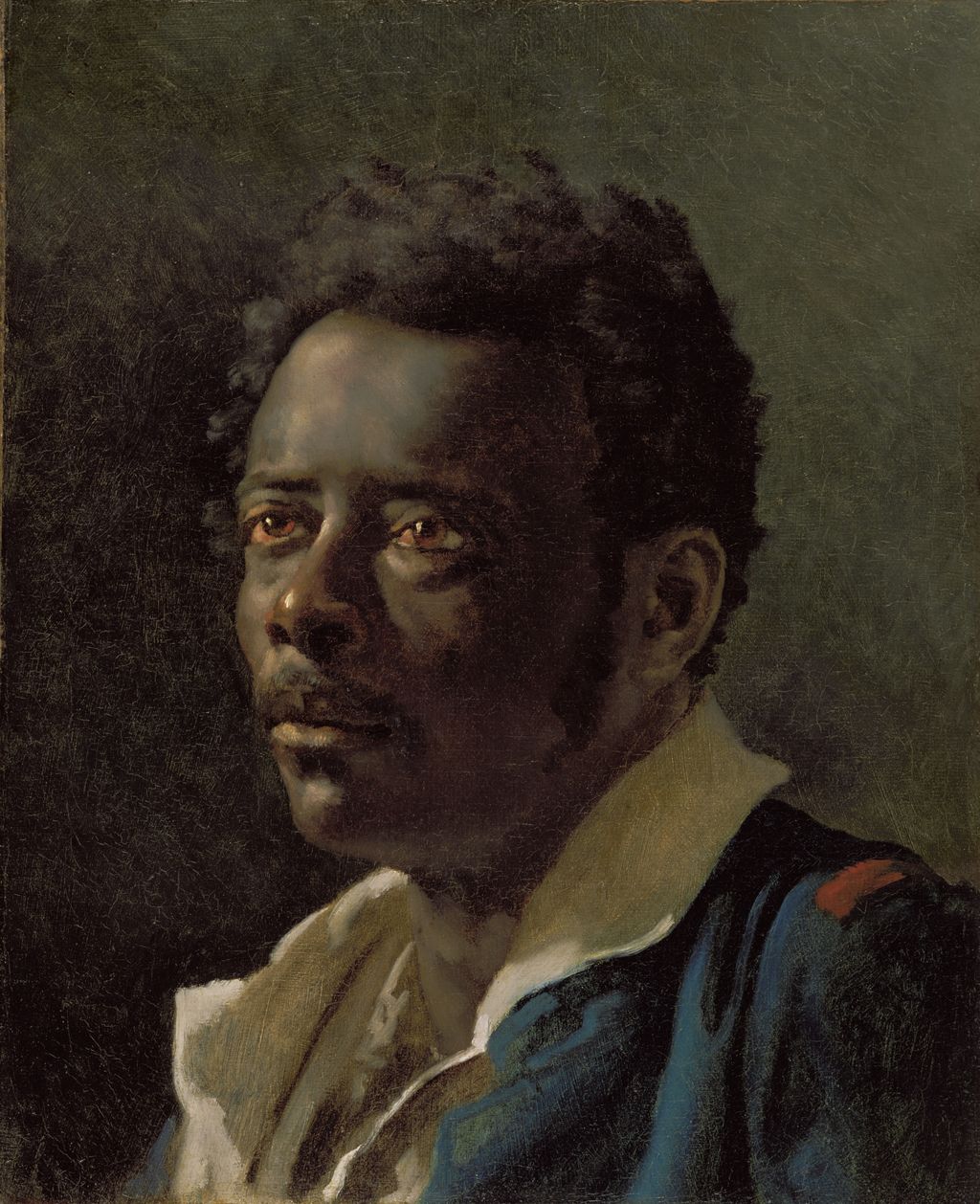
Study of the Model Joseph, c.1818–19 — a contrasting male figure study by Géricault Image source. CC0 / Public domain.
A documented sale and an unknown present location
The painting has a recorded auction appearance at Sotheby's Monaco on 3 December 1989, lot 510. Yale's image record gives that sale and lists the location as unknown. Sotheby's later catalogue independently mentions the portrait and the 1989 sale, describing it in a private collection. These records do not identify a present owner or a museum where visitors can currently see it. [1] [2]
The approximate date deserves the same care: about 1818 is the published dating, rather than a documented day or year of completion. Within those limits, the image offers ample detail for attention. Follow the skirt from waist to shoes, return along the red shawl, then look again at the hands and face. What first appears a quiet seated likeness becomes an arrangement of intersecting directions, contrasting textures and carefully distributed light, all gathered around Laure's steady presence.
Géricault collection records
Seventy collection records include paintings, drawings and individual print impressions. Different impressions remain separate records; this selection is not a complete catalogue raisonné.
Frequently Asked Questions
Yale’s A&AePortal dates the oil-on-canvas portrait to about 1818. This is an approximate date. [1]
Discussion
Look again at the images and ideas explored in Portrait of Laure Bro, née de Comères. These editorial prompts invite your observations.
Reader Insights
How does the diagonal of the skirt change the effect of Laure’s more upright upper body?
What changes when you compare the white gown with the pale bonnet and trailing fabric on the table?
Where does your eye travel after meeting Laure’s gaze, and which colours guide it?
Join the Conversation
Share a detail, comparison or question about Portrait of Laure Bro, née de Comères below.
References
- Yale University Press / Aileen Ribeiro, “Laure Bro,” A&AePortal image record, associated with The Art of Dress: Fashion in England and France, 1750 to 1820 (1995), chapter 2, “Painters of Modern Life: Fashion from 1789 to 1820”; object fields and publication context. View source.
- Sotheby's, “Jean-Louis-André-Théodore Géricault, Grand garde du premier de Hussards,” Old Master and 19th Century Drawings and Paintings, Paris, 2009, lot 79, catalogue note in French; Bro family connections and reference to Laure Bro's portrait sale in Monaco, 3 December 1989. View source.
- Nationalmuseum, The Severed Heads, NM 2113; collection metadata and museum interpretation (Swedish). View source.
- Louvre, Charging Chasseur, INV 4885; collection metadata and museum interpretation (French/English interface). View source.
- National Gallery, Horse frightened by Lightning; collection metadata and museum interpretation (English). View source.
- Louvre, Wounded Cuirassier, INV 4886; collection metadata and museum interpretation (French). View source.
- Louvre, The Raft of the Medusa, INV 4884; collection metadata and museum interpretation (French). View source.
- Gary Tinterow / The Metropolitan Museum of Art, Géricault’s Heroic Landscapes: The Times of Day, Met Bulletin 48/3, Winter 1990–91; consulted main essay and relevant object entries (English). View source.
- Vlaamse Kunstcollectie, Portrait of a Kleptomaniac; collection metadata and museum interpretation (Dutch). View source.
- Louvre, Epsom, MI 708; collection metadata and museum interpretation (French/English interface). View source.


