



 by Tom Gurney
Tom Gurney BSc (Hons) is an art history expert with over 20 years experience
Email: tomgurney1@gmail.com / Phone: +44 7429 011000
Boxers: Introduction
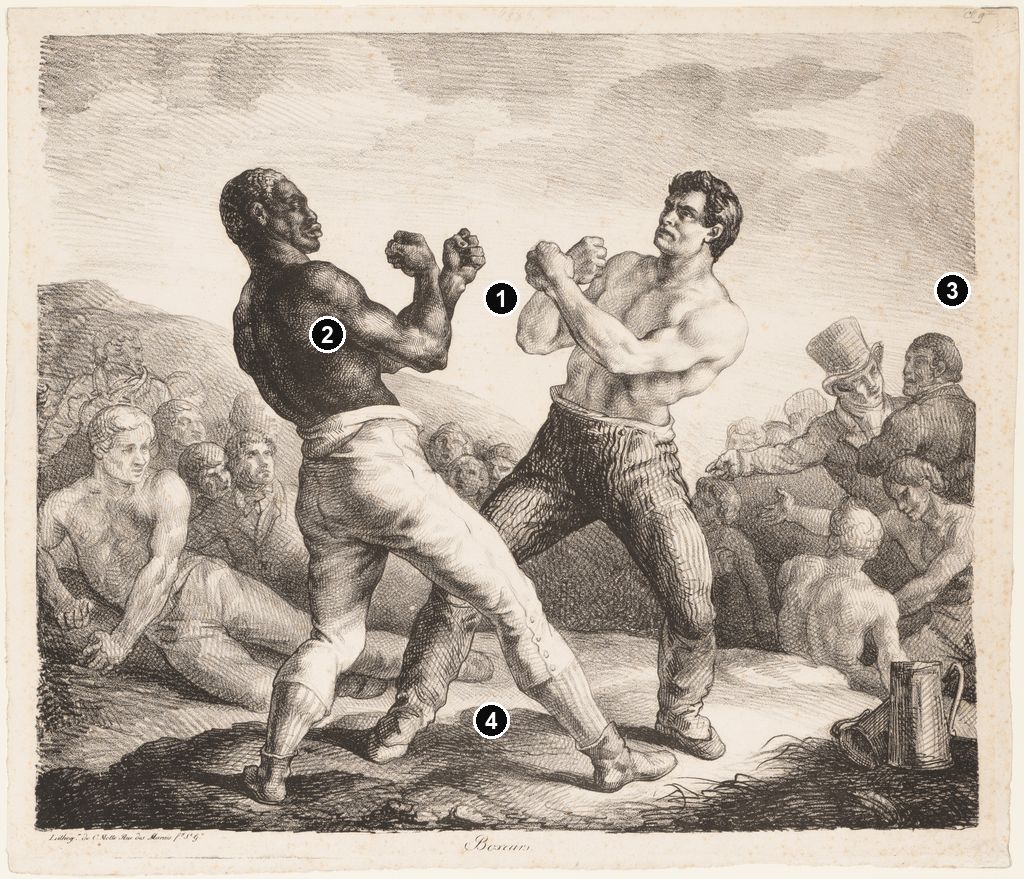
Two men face each other with fists raised, their bodies leaning away even as their legs carry them into the same narrow patch of ground. Neither has landed a blow. In Théodore Géricault’s Boxers, the encounter holds at the point when strength has become visible but its outcome remains undecided. The Black fighter’s broad back and pale trousers answer the white fighter’s light chest and dark, striped trousers. Behind them, a crowd watches, waits and talks. The Metropolitan Museum of Art dates the lithograph to 1818; its impression is accession 22.63.28. [1]
The paired bodies dominate the sheet, but the spectators prevent the scene from becoming an isolated exercise in anatomy. This is physical effort performed before other people. The audience surrounds the fighters without enclosing them in a neatly drawn ring, and the low viewpoint gives the men a scale that the seated onlookers cannot share. Géricault makes the contest both monumental and socially exposed: the bodies have the force of heroic figures, yet they stand among boots, hats, clothing and a drinking vessel.
At a Glance
- Date1818 [1]
- MediumLithograph [1]
- CollectionThe Metropolitan Museum of Art, New York [1]
- Object number22.63.28 [1]
This work across Théodore Géricault’s career
The Severed Heads
1810s [2]Charging Chasseur
1812 [3]Horse Frightened by Lightning
c.1813–14 [4]The Raft of the Medusa
1818–19 [6]Portrait of a Kleptomaniac
c.1820–24 [8]The Epsom Derby
1821 [9]Contents
- An English sport before the English journey
- A balance made from differences
- The people watching
- Drawing with line and grain
- Race, equality and the limits of interpretation
- An encounter that could be printed again
- Annotated details
An English sport before the English journey
The date matters because Boxers precedes Géricault’s travels to England. The Lyon museum’s account places his departure for London with Nicolas-Toussaint Charlet in April 1820, followed by a further English stay in 1821. The 1818 lithograph therefore cannot be treated as an eyewitness report of a London bout seen during those visits. Its subject anticipates his later engagement with English life, but anticipation is different from direct documentation. [10]
Chantilly’s museum exhibition identifies boxing as an English sport that was only tolerated in France when Géricault made the print. That context gives the setting a particular interest: a contemporary physical contest could carry associations beyond the familiar subjects of official history painting. The print does not, however, supply the names of these opponents or identify a match, a venue or a winner. Its short title, Boxeurs, visible beneath the image, directs attention towards the activity rather than commemorating a named sporting achievement. [11]
The absence of a decisive punch helps sustain that emphasis. We see readiness, balance and mutual attention rather than a completed victory. Both men are bare-chested and fight without visible gloves. Their clothes and the informal arrangement of the crowd give the action an everyday setting, while their enlarged muscles lift it beyond casual reportage. The image invites us to study the human body under pressure without requiring a famous battle or an ancient hero to justify that study.
A balance made from differences
At first the fighters look almost like counterparts. Each raises a bent arm towards the centre, each tilts his head back, and each spreads his feet to hold his ground. Yet the resemblance depends on a series of differences. The man on the left turns a large expanse of back towards us; the man on the right opens his chest. One figure is built through a dense field of dark marks above a light garment, the other through a pale torso above a much darker garment. Their contrast travels across the waistlines as well as across their skin.
Follow the feet and the confrontation becomes more complicated. The left fighter plants one foot near the lower left edge of the action and extends the other towards the right. His opponent’s stance reaches towards him from behind. The legs overlap, while the upper bodies pull apart. This combination keeps the pair attached at ground level and separated above: the picture seems to stretch between the planted shoes and the guarded faces. The men occupy one structure, although each tries to preserve his own space within it.
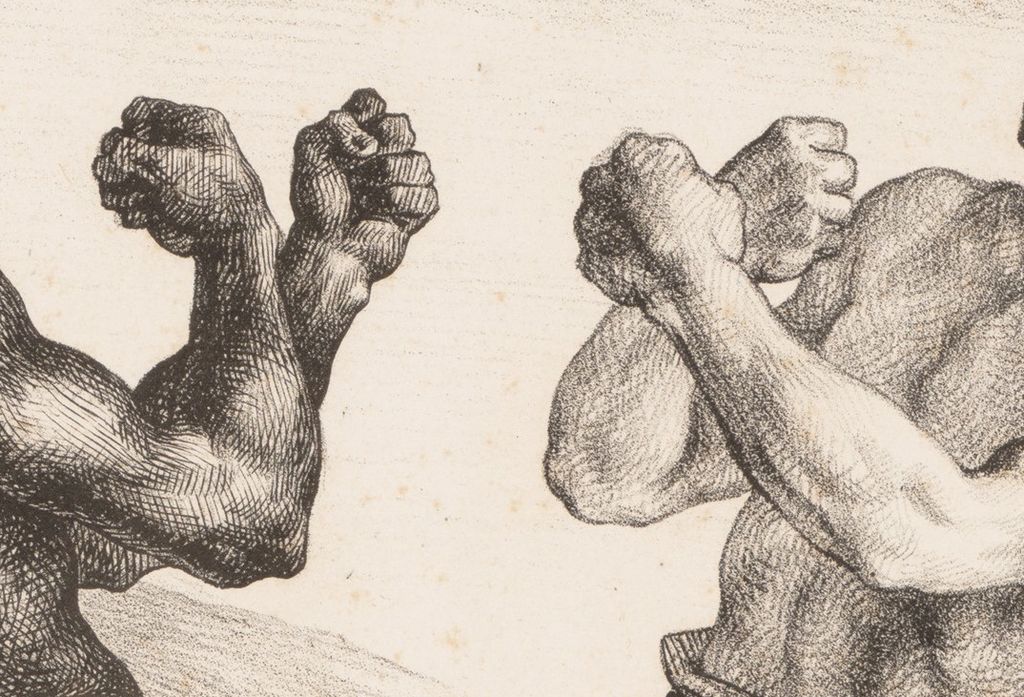
The raised hands are crucial. Their compact, irregular shapes interrupt the pale opening between the heads and shoulders. There is still air around the fists; the central interval has not closed into a tangle of limbs. Looking at the print means waiting for a movement that the sheet will never complete. Géricault gives considerable weight to the muscles, but the suspense belongs equally to the blank paper that separates them.
These bare torsos can bring classical athletic bodies to mind. The association arises from their muscular clarity, broad gestures and commanding scale, rather than from a specific antique statue that can securely be named as their source. Trousers, shoes and spectators anchor those bodies in modern activity. The result lets an ordinary sporting subject assume some of the visual authority of an elevated figure composition, while retaining the awkwardness of a struggle whose next movement remains unknown.
Annotated Details from Boxers
The numbered points identify visible features discussed in this article. Return from each detail to the whole composition. Boxers Image source. Public domain.
Details from BOXERS
Compare the cropped details with the complete images above. Notice how their colours, shapes and positions contribute to the larger compositions.
Guarded fists
Four raised fists interrupt the pale space between the fighters before either man lands a blow.
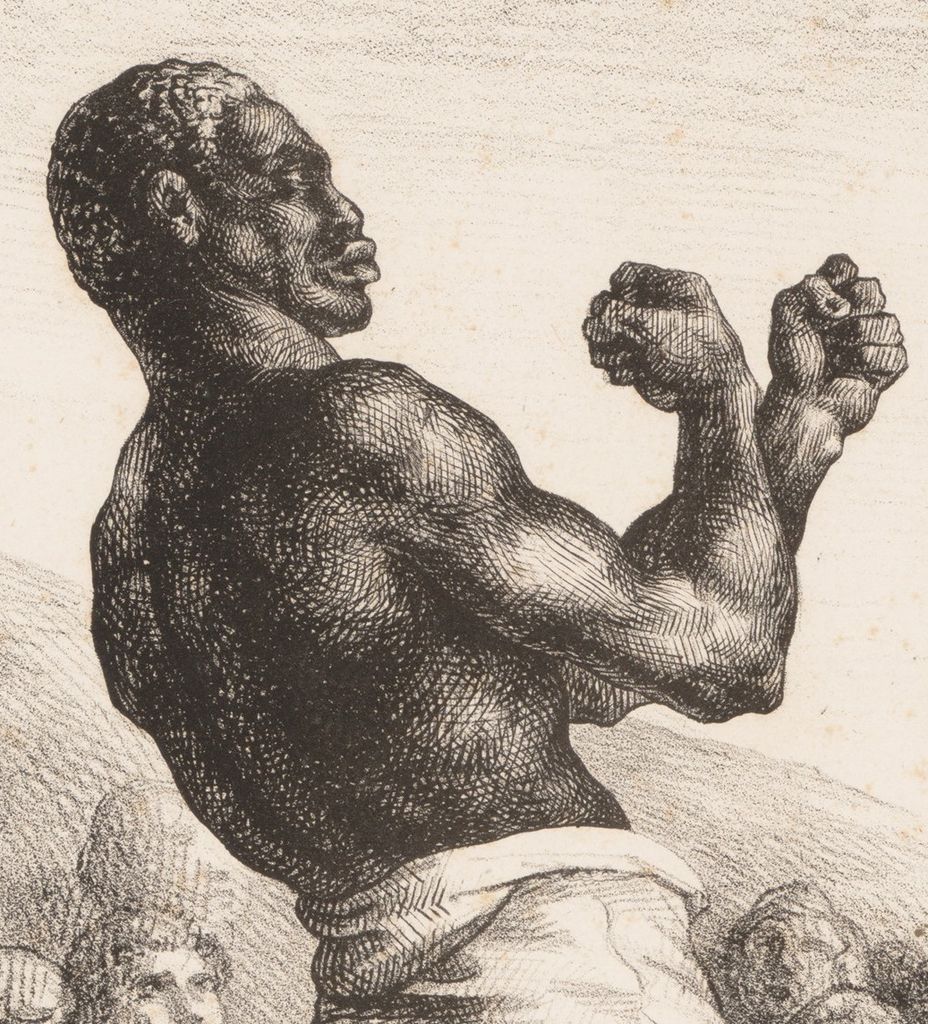
Line across the back
Closely interlacing marks follow the turn of the left fighter’s shoulder and back.
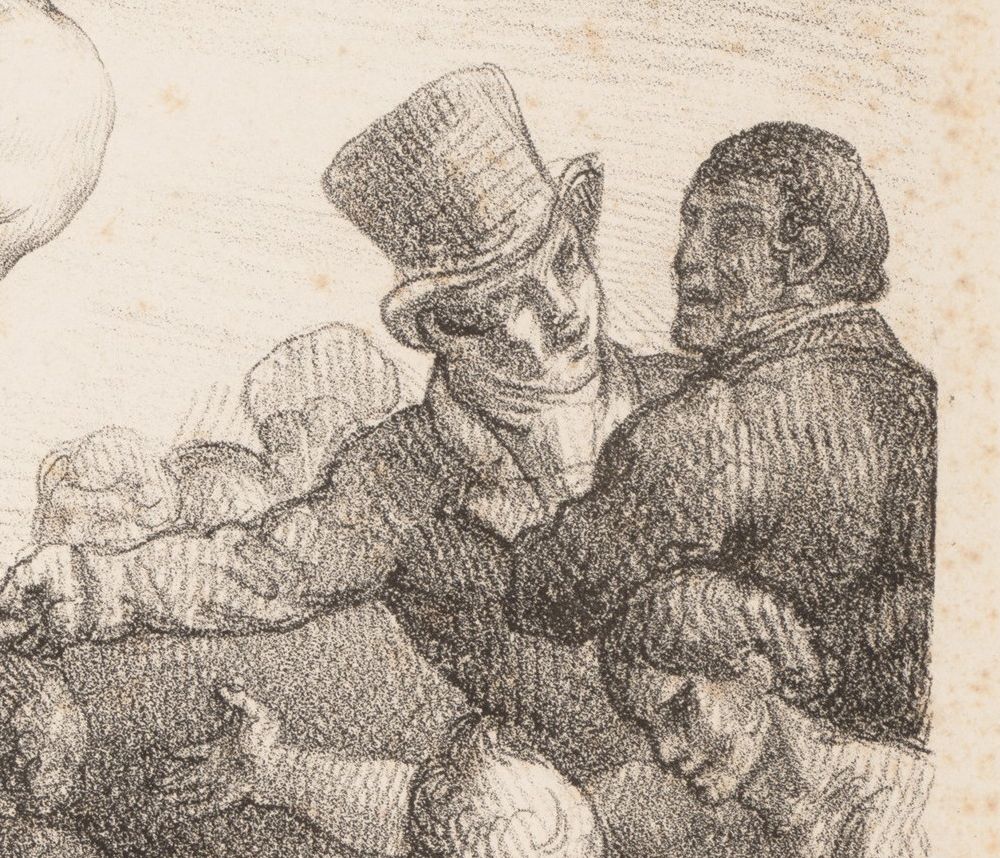
Watching and talking
A spectator in a tall hat turns towards his neighbour, adding another exchange of gestures behind the combat.
Feet holding the balance
The spread feet anchor the pair while their upper bodies lean apart.
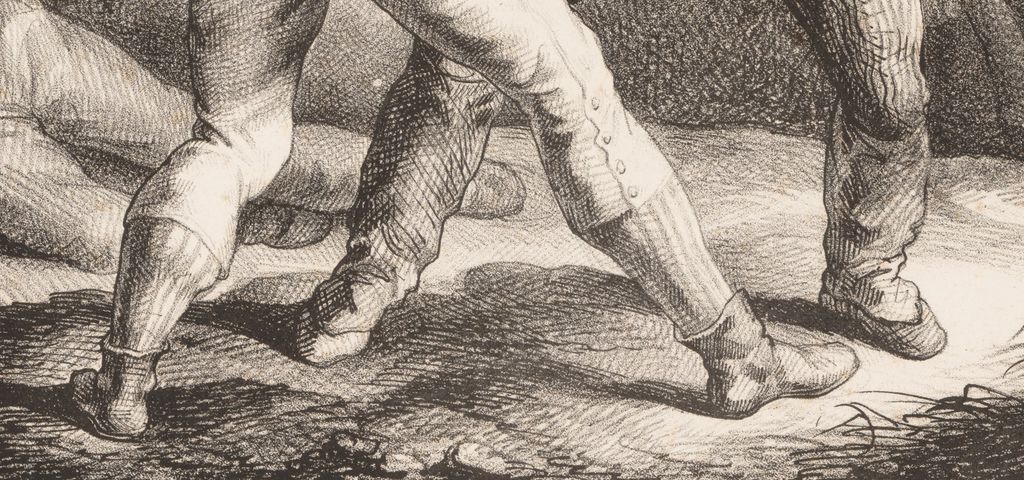
The people watching
The audience forms a low, uneven band behind the fighters. At the left, a seated bare-chested man bends forward, his arms descending towards the ground. His compact posture contrasts with the expansive bodies above him. Further faces appear behind and between shoulders, some little more than quick indications. On the right, a man in a tall hat turns towards another spectator with one arm extended. Below them, a seated figure folds towards his raised knee. These different actions keep the crowd from becoming a uniform chorus of excitement.
In his 1866 catalogue, Charles Clément described resting boxers among the people watching and other figures discussing the blows. His account is useful as an early reading of the print, though it cannot identify every person or settle exactly what each gesture means. The man in the tall hat may be talking about the match, but the picture gives us gesture rather than audible words. We should not turn that gesture into a documented wager, an argument with a known cause or a judgement about which fighter will win. [12]
The crowd also sets up different forms of attention. Some faces turn directly towards the contest; others seem absorbed in nearby people or in their own bodies. This makes spectatorship part of the subject. The two men must maintain their concentration within a gathering that is itself restless and divided. For the viewer, the large figures initially command everything, but the margins offer another picture of bodily activity: crouching, resting, turning, leaning and talking.
At the lower right, the tall handled vessel brings that activity back to ground level. Beside the fighters’ carefully modelled legs, its plain, upright form is almost comically practical. Along with the scattered clothing and loosely indicated vegetation, it denies the encounter a polished ceremonial setting. The force of the central bodies belongs to an untidy world in which other people sit close enough to watch every adjustment.
Watch: Géricault and The Raft of the Medusa
Three perspectives on Géricault’s best-known painting, its making and its historical setting.
Gericault, Raft of the Medusa
Smarthistory examines the composition and historical setting of The Raft of the Medusa.
Watch on YouTubeDrawing with line and grain
Clément drew attention to a technical exchange between the two opponents. He described the Black fighter’s torso as executed in pen, with the rest of the figure in crayon, and the reverse arrangement for the other man. His observation helps explain why the surface changes so markedly as the eye moves around the pair. The dark torso is constructed from interlacing lines that turn around the shoulder and back; softer, grainier passages elsewhere allow light to spread across a chest or trouser leg. [12]
Here, pen and crayon describe ways of making a lithographic image, rather than proving that each finished impression was drawn on by hand. Chantilly explains the process as a drawing made with greasy materials on prepared limestone. During printing, water and ink behave differently on the marked and unmarked areas, allowing the design to transfer to paper under pressure. The method preserves a conspicuously drawn character while making repeated impressions possible. [11]
In Boxers, that drawn character has expressive consequences. The close lines on the left fighter’s back make the body seem tightly held together. The paler torso opposite it emerges through a more open range of tone. Below, the vertical stripes of the trousers break across the bent legs and change direction with the folds. Géricault does more than distinguish surfaces: he makes the marks contribute to the sensation of muscles tightening, cloth pulling and weight being redistributed.
The ground and sky receive a broader, less insistent treatment. The cloudlike sweeps above the heads leave room around the figures, while the darkest ground marks consolidate their foothold. Because the background is comparatively spare, the print does not need a detailed location to make the action convincing. Its strongest description is reserved for the bodies and the small differences in how they meet resistance.
Race, equality and the limits of interpretation
The racial contrast is an explicit part of the composition. The Met interprets the print’s monochrome design as intensifying racial difference through the closely paired poses. Chantilly offers a more directly political reading, seeing the Black boxer’s equal standing with his white opponent as a republican declaration against slavery. These are museum interpretations that help explain the image’s stakes; they are not a surviving statement by Géricault specifying exactly what the sheet was meant to say. [1] [11]
The visual evidence supports a discussion of parity. Neither man is reduced to a minor figure, and neither has been made the defeated object of the other’s strength. Their bodies receive comparable scale, attention and complexity. Yet pictorial balance cannot establish the fighters’ legal status, their personal histories or the responses of everyone who saw the print. Nor does the absence of a winner prove that Géricault intended a single, unambiguous moral conclusion. The composition makes equality of physical presence available to the viewer without providing a complete political explanation.
A useful comparison is Géricault’s Study of the Model Joseph. Getty identifies Joseph as a Haitian immigrant and the model for the raised signalling figure in The Raft of the Medusa, while stressing how few written records of his life survive. That documented relationship does not identify Joseph as the boxer. It does show why named portraiture and anonymous sporting imagery should be considered separately, even when both concern the representation of a Black man. [13]
In Joseph’s portrait, the face and its quiet attention provide the focus. In Boxers, the figure is understood through a whole body in relation to an opponent and a crowd. Comparing the works sharpens the difference between looking at an individual and looking at a participant in a public contest. It also guards against allowing a broad theme of racial representation to erase what is known, or unknown, about each subject.
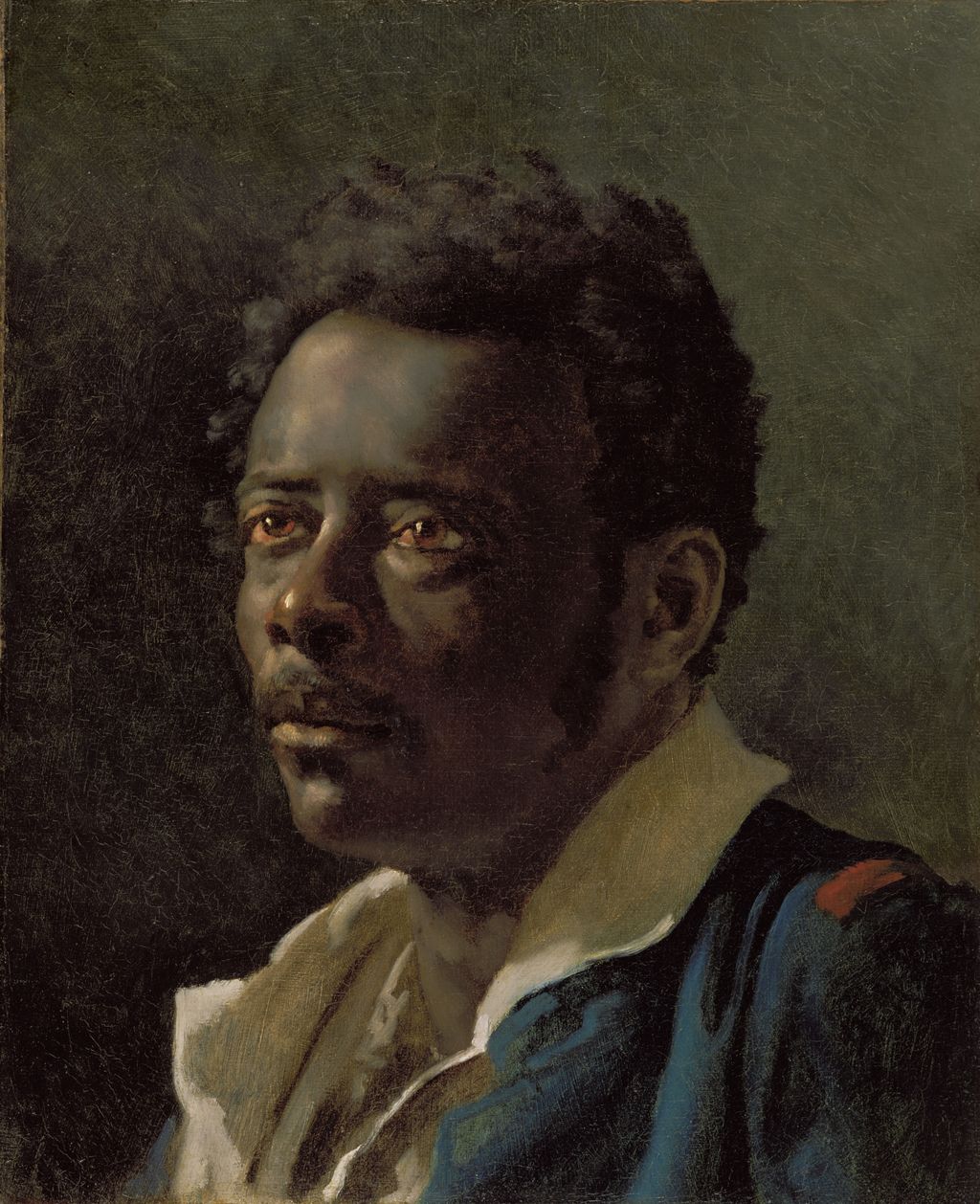
Study of the Model Joseph Image source. CC0 / Public domain.
An encounter that could be printed again
The printer’s inscription beneath the image names C. Motte. Clément recorded a state before lettering and a subsequent state bearing Motte’s address, evidence that the printed composition existed in distinguishable forms. His catalogue remains a historical witness rather than a present-day census of surviving sheets. The small differences between impressions need to be read as features of particular objects, not treated as changes in the identity of the two fighters. [12]
The Met’s sheet measures 38.5 × 45 cm, with an image area of 35.4 × 41.9 cm, and entered the collection through the Rogers Fund in 1922. Those dimensions distinguish the paper from the design printed on it. They also remind us that the apparent monumentality of the figures is achieved within a sheet that can be studied at close quarters. The crowd watches two men at bodily scale within the image; the print’s owner encounters that entire gathering on paper. [1]
Conflict takes a different shape in Géricault’s Fighting Horses, a watercolour over graphite dated about 1820 in Cleveland. There a groom tries to separate the animals, and Cleveland relates the composition to careful studies in a Chicago sketchbook. The comparison need not imply that one work prepared the other. It reveals how differently an encounter can be organised: in the watercolour, force breaks through the group in kicks and twisting bodies; in Boxers, it is concentrated in the guarded interval between two men. [14]
That interval remains the lithograph’s most compelling feature. Every conspicuous muscle seems prepared for action, yet the image gives us no release in a decisive blow. We return instead to the shifting balance of the figures, the varied attention of the crowd and the lines that make bodies tangible on paper. The print’s power lies in keeping those elements active together: a modern sport becomes a study of physical opposition, public looking and the difficult question of what equality can look like.
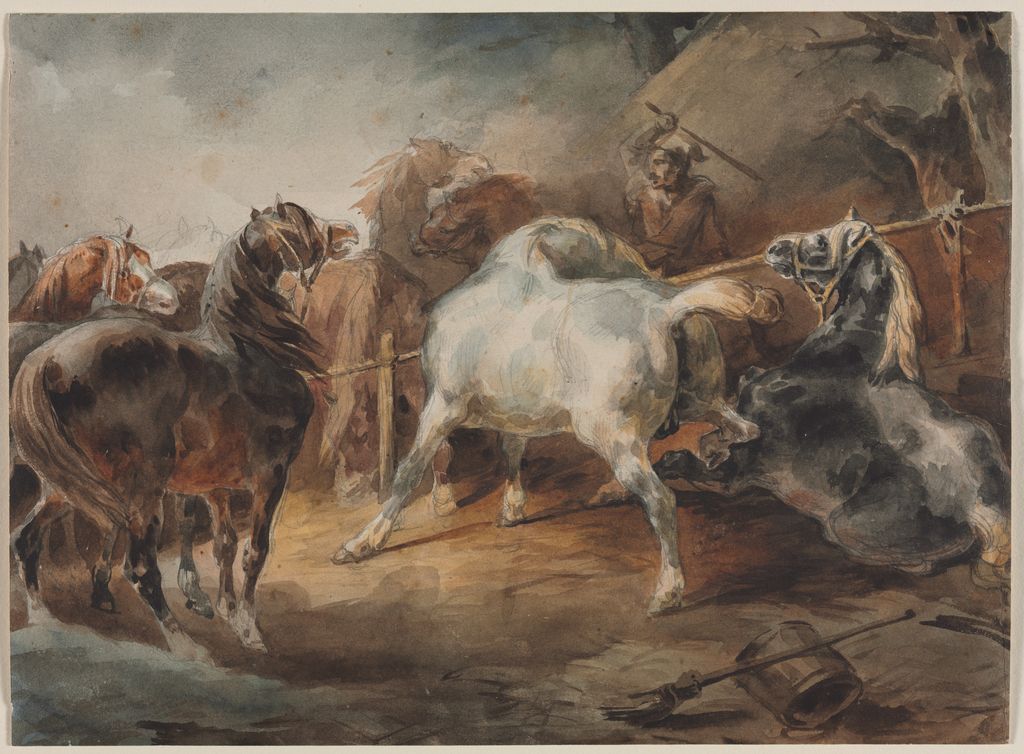
Fighting Horses, c.1820, watercolour — Cleveland Museum of Art Image source. CC0 / Public domain.
Géricault collection records
Seventy collection records include paintings, drawings and individual print impressions. Different impressions remain separate records; this selection is not a complete catalogue raisonné.
Frequently Asked Questions
The fighters receive comparable scale and bodily presence. The Met emphasises racial contrast within the paired poses; Chantilly interprets their equal standing as a republican statement against slavery. Those readings should remain attributed rather than presented as a documented statement by the artist. [1] [11]
Discussion
Look again at the images and ideas explored in Boxers. These editorial prompts invite your observations.
Reader Insights
Which details make the opponents seem evenly matched, and which make them seem different?
How does your reading change when you follow the spectators rather than the fighters?
What does the unfinished moment before a blow allow the image to express?
Join the Conversation
Share a detail, comparison or question about Boxers below.
References
- The Metropolitan Museum of Art, Boxers, Théodore Géricault, 1818, lithograph, accession 22.63.28; collection record and curatorial description (English). View source.
- Nationalmuseum, The Severed Heads, NM 2113; collection metadata and museum interpretation (Swedish). View source.
- Louvre, Charging Chasseur, INV 4885; collection metadata and museum interpretation (French/English interface). View source.
- National Gallery, Horse frightened by Lightning; collection metadata and museum interpretation (English). View source.
- Louvre, Wounded Cuirassier, INV 4886; collection metadata and museum interpretation (French). View source.
- Louvre, The Raft of the Medusa, INV 4884; collection metadata and museum interpretation (French). View source.
- Gary Tinterow / The Metropolitan Museum of Art, Géricault’s Heroic Landscapes: The Times of Day, Met Bulletin 48/3, Winter 1990–91; consulted main essay and relevant object entries (English). View source.
- Vlaamse Kunstcollectie, Portrait of a Kleptomaniac; collection metadata and museum interpretation (Dutch). View source.
- Louvre, Epsom, MI 708; collection metadata and museum interpretation (French/English interface). View source.
- Musée des Beaux-Arts de Lyon, Géricault: La folie d’un monde, exhibition press dossier, 2006, section VI, “Les deux séjours en Angleterre (1820 et 1821)” (French). View source. (in French).
- Château de Chantilly, Géricault et la lithographie: Le romantisme à la française, virtual exhibition based on the 2018 exhibition curated by Nicole Garnier-Pelle; sections “La lithographie,” “Les débuts” and Boxeurs (French). View source. (in French).
- Charles Clément, Catalogue de l’œuvre de Géricault: Lithographies, 1866, p. 8, no. 9, “Boxeurs,” in the digitised historical catalogue, PDF p. 16 (French). View source. (in French).
- Unita Ahdifard, Getty, “Learn about Joseph, a Celebrated Haitian Model in 19th-Century Paris,” 9 February 2023 (English). View source.
- Cleveland Museum of Art, Fighting Horses, about 1820, watercolour over graphite, accession 1929.13; collection metadata and descriptive text (English). View source.


