



 by Tom Gurney
Tom Gurney BSc (Hons) is an art history expert with over 20 years experience
Email: tomgurney1@gmail.com / Phone: +44 7429 011000
The Monomanes Portraits: Introduction
Théodore Géricault’s Monomanes bring five unnamed people unusually close to the viewer. Faces emerge from dark backgrounds; clothes frame heads and shoulders; eyes look beyond the edge of the picture. Their customary titles promise to explain these people through a single obsession: envy, stealing, gambling, military command or child snatching. Yet those names were attached retrospectively. They are part of the paintings’ history of interpretation, rather than reliable access to the sitters’ identities or mental lives. The Musée des Beaux-Arts de Lyon traces the descriptions to the critic Louis Viardot’s account of 1863, almost forty years after Géricault’s death. [1]
That distance matters. The familiar account of a medical commission from Dr Étienne-Jean Georget supplies an attractive explanation for the series, but Lyon explicitly states that no documentary testimony establishes a relationship between doctor and painter. Even the apparently straightforward description of ten original portraits, of which five survive, belongs to the tradition surrounding an incompletely documented group. Five paintings can be identified; their original extent, purpose and circumstances remain much less secure. [2]
The fascination of the Monomanes lies partly in this mismatch between their physical immediacy and their uncertain history. Géricault makes each face particular. Later titles sort the sitters into categories. Looking across the group reveals both a shared pictorial language and the limits of treating portraiture as a way to read a diagnosis from a face.
At a Glance
- Known groupFive surviving portraits; ten originals are traditionally reported [1] [2] [3]
- DatesLyon, Louvre and Winterthur: about 1819–1822; Ghent: about 1820–1824 [1] [4] [5] [3]
- MediumOil on canvas [1] [3] [4] [5]
- LocationsLyon, Ghent, Paris, Winterthur and Springfield, Massachusetts [1]
Contents
- Five paintings, five separate objects
- When were they painted?
- What “monomania” meant
- The Georget story and its limits
- Looking across the group
- Rediscovery, names and dispersal
- Why later viewers keep returning to them
Five paintings, five separate objects
The surviving group consists of two portraits of women and three of men, now divided among museums in France, Belgium, Switzerland and the United States. The woman traditionally associated with envy belongs to Lyon; the man called a kleptomaniac to the Museum voor Schone Kunsten in Ghent; the woman associated with gambling to the Louvre; the man associated with military command to the Oskar Reinhart collection in Winterthur; and the man traditionally associated with child snatching to the Museum of Fine Arts in Springfield, Massachusetts. Lyon’s collection account lists all five together, making clear that the less frequently reproduced Springfield portrait is an existing member of the group. [1]
The Lyon portrait traditionally called the Monomaniac of Envy is an oil painting on canvas measuring 72.1 × 58.5 cm, inventory B 825. The Ghent portrait commonly called Portrait of a Kleptomaniac is also oil on canvas, inventory 1908-F; its recorded height and width are 61.2 × 50.1 cm. These different sizes already caution against imagining the series as a mechanically uniform set. A common subject and format do not make the canvases interchangeable. [1] [3]
The Louvre woman traditionally associated with gambling, RF 1938 51, measures 77 × 65 cm. The Winterthur man associated with military command measures 81 × 65 cm. The larger Winterthur canvas gives more room to the sitter’s clothing and the objects worn around his neck, while the smaller Ghent painting concentrates attention on the head above the white neckcloth. Their relationship is visible in the repeated attention to a single person against a restricted setting, rather than in identical dimensions or an established original hanging order. [4] [5]
“Five surviving portraits” is therefore a useful description, provided that it does not silently turn every part of the traditional story into fact. The Flemish collection record describes ten originals and five survivors, and Lyon’s focus dossier also gives the ten-picture account. Those sources preserve an important history of the series, but they do not identify five additional paintings that can now be examined. The known group and the proposed original total rest on different kinds of evidence. [3] [2]
Nor can the absent five be reconstructed by completing a list of possible obsessions. The titles of the known works are themselves later classifications. To invent complementary subjects would give a speculative scheme the authority of an original programme. The Springfield work belongs in the count of five known paintings; it should never be confused with one of the five said to have disappeared.
When were they painted?
The date of the Monomanes is usually expressed as a range, and the ranges differ between institutions. Lyon dates its woman to about 1819–1822. The Louvre gives 1819–1822 for the gambling portrait. Winterthur also dates its painting to about 1819–1822. The Flemish record for the Ghent portrait gives approximately 1820–1824. These are the dates attached to particular objects, rather than a single securely documented period of work shared by all five. [1] [4] [5] [3]
The difference changes the place the paintings occupy in Géricault’s career. A date around 1819 associates them with the period of The Raft of the Medusa. A later date places greater emphasis on his final years and the experience of England. Neither association should be converted into a certain sequence. The Lyon exhibition dossier of 2006 tentatively suggested the second half of 1820, when the painter’s activity is poorly documented. Its own conditional wording makes this a hypothesis, rather than an appointment with five sitters that can be entered into a firm chronology. [6]
It is tempting to call these Géricault’s final statements because their intensity appears to suit a story of premature death. The objects do not establish that narrative. Nor does a broad date ending in 1824 prove that a particular portrait was painted in the final weeks of his life. The differing museum dates are best retained: they show where knowledge is approximate and keep a compelling late-career interpretation from becoming a false documentary fact.
Dating also intersects with naming. In the 2025 MSK interview about her exhibition Monomania, Fiona Tan described finding the diagnosis of monomania in the patient registers she examined only from 1825 onwards. That was an observation about her research materials, not proof that the concept had been unknown before Géricault died. It nevertheless helped her question how confidently later labels could be attached to these particular images. Her finding belongs to the modern investigation of the group, alongside the museums’ differing dates, rather than supplying a new exact date for the paintings. [7]
What “monomania” meant
The historical idea of monomania concerned a disturbance thought to be concentrated on a single subject, obsession or delusion. Its appeal depended on a division: a person might be regarded as rational in much of life while considered unwell in one particular area. The Flemish collection account places the term within the work of early nineteenth-century physicians known as alienists, who increasingly approached mental disturbance as something to investigate and treat. Lyon’s focus dossier likewise locates it within the developing classifications of psychiatry. [3] [2]
The concept carried consequences for representation. If a disturbance could be partial, it need not announce itself through spectacular behaviour. A person might look composed, ordinary or absorbed. Physicians sought ways to make mental states visible, using portrait drawings, engravings, sculptural forms and other records of appearance. Lyon distinguishes the conjectural Géricault–Georget connection from the documented interest of Jean-Étienne Esquirol, who commissioned a large body of drawings of patients for his research. That wider medical culture provides a relevant context without proving that Géricault’s canvases fulfilled the same function. [1] [3]
The distinction between context and purpose is essential. Paintings made in a world where doctors studied faces need not be medical illustrations. Conversely, the force of their portraiture does not remove them from that world. The Monomanes can be examined in relation to the history of psychiatry while their actual commission remains unresolved. This allows a richer question than whether they are either clinical documents or autonomous art: how does painting respond to a culture that hopes to make the mind readable through the body?
The historical vocabulary should also be kept at a distance from current diagnostic language. “Envy” sounds like a familiar emotion, while “kleptomania” may sound like a precise explanation of conduct. Neither title establishes what the sitter experienced or did. The child-snatching label is especially consequential because it seems to attribute an act as well as a condition. Repeating such names as catalogue titles is different from presenting the people as documented offenders or assigning them present-day diagnoses.
There is a further asymmetry. We know the painter’s name and can follow the canvases through museums, but the people represented remain unnamed in the consulted records. Their customary labels give them an apparent identity while withholding the ordinary biographical information that makes an individual more than a category. The series asks a viewer to recognise that loss without compensating for it through an invented life story. [1] [7]
The Georget story and its limits
The traditional explanation joins the portraits to Dr Étienne-Jean Georget, sometimes as a commission to illustrate medical work and sometimes through a supposed friendship or treatment of Géricault himself. Lyon’s focus dossier sets out these explanations and then states the central difficulty: no testimony establishes a connection between the two men. Its collection entry is equally explicit that neither their relationship nor Georget’s interest in this kind of representation has been demonstrated. [2] [1]
Other institutional records preserve the older account. The Flemish collection text describes the painter as Georget’s friend and connects the series to the alienists’ interests. The Louvre’s provenance for the gambling portrait begins with Georget’s collection, followed by Dr Adolphe Lachèze in Baden-Baden. These records should be read for the specific evidence they provide. An inherited account of early ownership is relevant to provenance; it does not by itself prove that the first named owner ordered the paintings, selected the sitters or supplied their titles. [3] [4]
Several questions too often collapse into one. Who owned the portraits? Who introduced the sitters? Where did painting take place? Who paid for it? Were the works intended for publication, teaching, private study or another purpose? A positive answer to one would not automatically settle the others. Even a securely established transfer of ownership would leave the terms of production to be investigated separately.
This uncertainty also prevents the paintings from becoming illustrations of Géricault’s own supposed illness. The idea that Georget treated the artist has been used to explain a personal identification with the sitters, but the Lyon dossier does not support it as an established relationship. The painter’s sympathy cannot be measured by supplying an undocumented medical encounter. What can be discussed is the sustained visual attention given to each person, and the ways that attention differs from the title’s promise of classification. [2]
Watch: Géricault and The Raft of the Medusa
Three perspectives on Géricault’s best-known painting, its making and its historical setting.
Gericault, Raft of the Medusa
Smarthistory examines the composition and historical setting of The Raft of the Medusa.
Watch on YouTubeLooking across the group
The portraits share a powerful economy. A dark ground removes much of the social setting in which a conventional portrait might locate its sitter. There is no expansive interior, landscape or busy surrounding scene to organise the encounter. Head, clothing and the direction of the eyes carry much of the picture’s weight. This concentration creates a family resemblance across the works, even while each face resists substitution for another.
The two women make a particularly useful comparison. In Lyon, the white bonnet spreads in irregular folds around the head, with narrow ties falling beside the face. A red scarf introduces a strong wedge of colour within the brown-green wrap. In the Louvre painting, a more compact pale cap sits above the forehead, and white fabric forms a broad diagonal beneath the face. The colour structures differ: Lyon’s red draws the eye down from the face, while the Louvre’s white folds connect the cap to the chest. These are visible differences in how each portrait is built, before the words envy and gambling enter the encounter.
The women’s eyes also establish different relationships with the space outside the frame. In the Lyon portrait, the pupils turn sharply to the viewer’s left beneath a lined forehead. The Louvre woman’s eyes lift towards the viewer’s right. Neither image shows the object of that attention. The lack of an answering figure leaves the viewer unable to reconstruct a conversation or event. This withholding can produce a sense of psychological intensity, but an unseen object of attention is not evidence of a particular obsession.
The men in Ghent and Winterthur vary the same restricted format. In Ghent, a white neckcloth creates a light enclosure beneath the bearded face; the dark coat and background leave the head strongly isolated. The lips are closed and the pupils turn towards the viewer’s right. In Winterthur, a dark cap with red edging and a tassel extends the silhouette upwards, while pale sleeves and brown drapery open the figure across the lower canvas. A pendant hangs against the dark clothing. The objects worn by this man make his presentation more materially specific, but they do not tell us his name or establish a military biography.
Seen together, these differences explain why the paintings continue to unsettle the categories attached to them. They offer no simple visible progression from one named condition to another. A bonnet, a neckcloth, a cap or an averted gaze cannot function as a diagnostic key. The details instead make the encounter with each sitter distinct. The group’s coherence comes from Géricault’s repeated concentration on an individual presence, rather than from an illustrated chart of five transparent mental states.
The handling of paint adds to this effect. Background strokes remain visible; clothing is often established in broad passages, while smaller changes of tone articulate a cheek, eyelid or mouth. The Flemish collection text discusses the Ghent portrait’s suggestive execution in relation to the independent value of the painted study. Tan likewise responded to the assurance and apparent immediacy of the brushwork, interpreting it as evidence of artistic maturity. Neither observation requires a reconstruction of how long a sitting lasted or a claim that the canvases were deliberately left unfinished as a single programme. [3] [7]
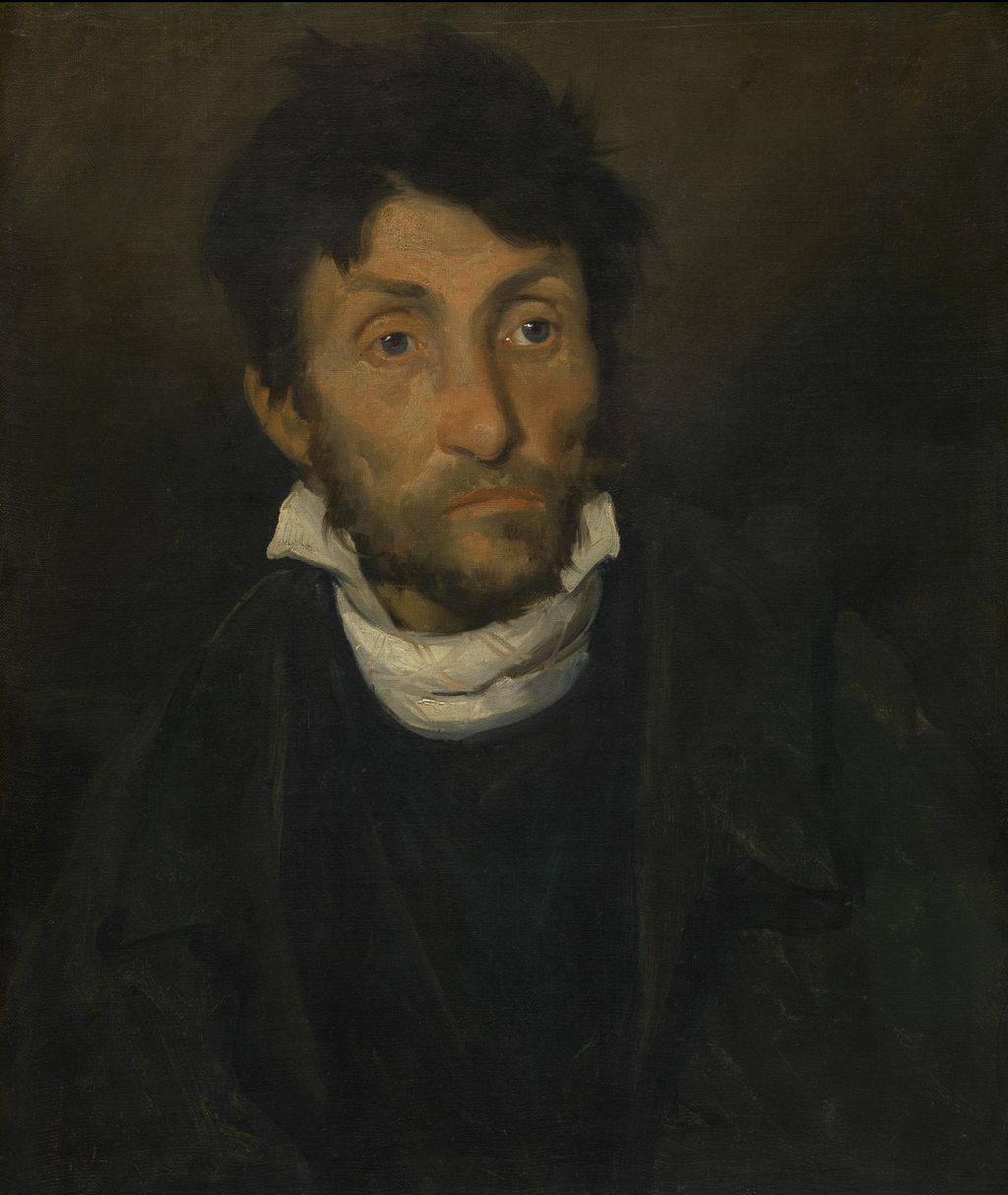
Portrait of a Kleptomaniac Image source. CC0 / Public domain.
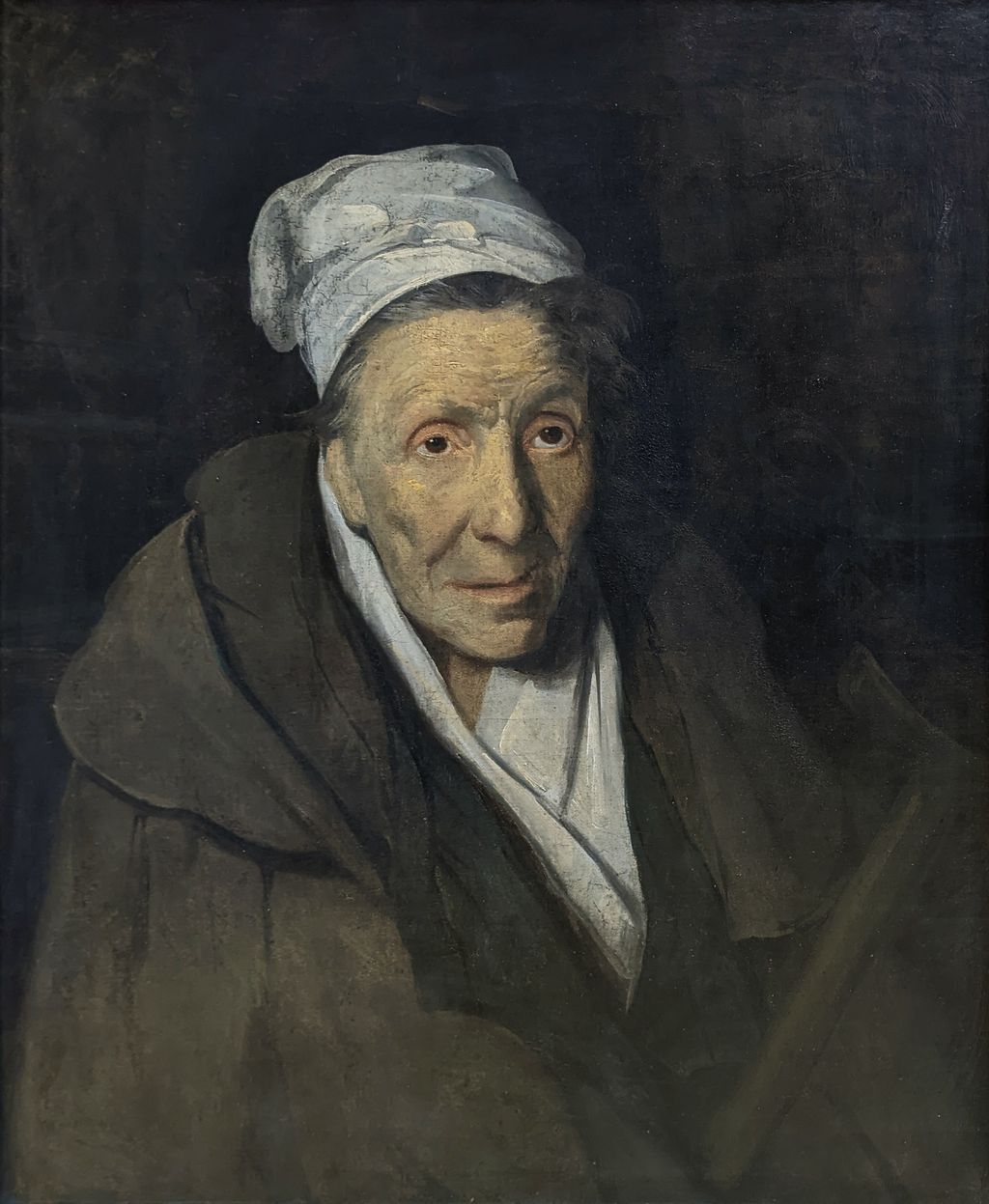
Portrait of a Woman Traditionally Called the Monomaniac of Gambling Image source. Public domain.
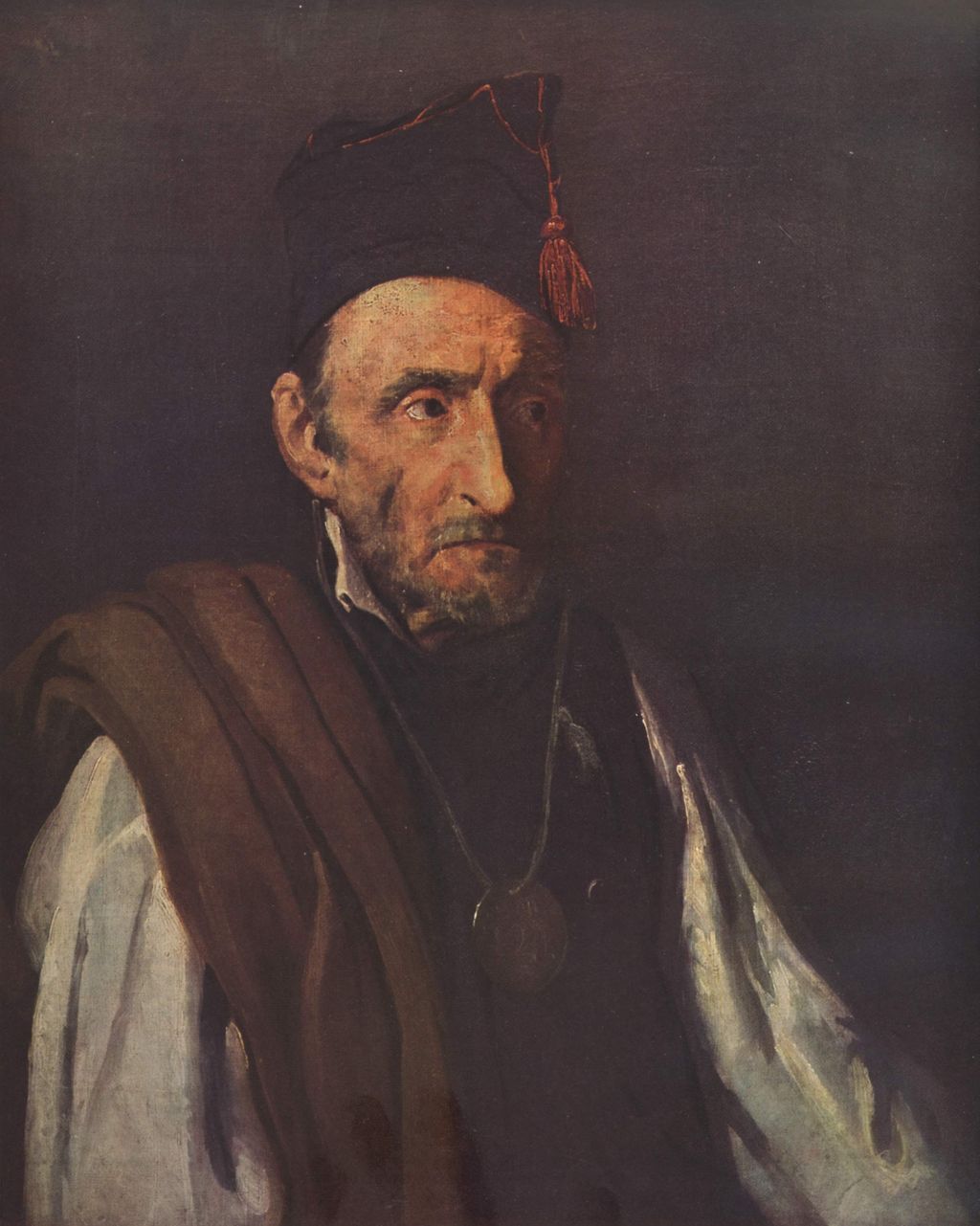
Man with Delusions of Military Command Image source. Public domain.
Rediscovery, names and dispersal
The history of the group becomes more visible in 1863. Lyon recounts Viardot’s discovery of five canvases in Baden-Baden, rolled up in a chest belonging to a doctor who had lived in the East. Viardot commented on the pictures and assigned the monomania titles. This is the account preserved by the museum; the original circumstances of their production do not become secure simply because the later discovery is vivid. The gap between painting and rediscovery remains central to the series. [2]
Naming and dispersal were linked. Once separated, the canvases acquired distinct collection histories, and their common identity increasingly depended on texts, comparisons and occasional exhibitions. The Louvre’s gambling portrait was offered unsuccessfully to the museum on Lachèze’s behalf by Henri Harpignies in January 1866. Charles Jacque bought it in February 1868; it later entered the Trévise collection, and the Société des Amis du Louvre acquired it at the 1938 sale with support from David-Weill and gave it to the Louvre. Lyon acquired its portrait at the Auguste Chéramy sale in 1908. [4] [2]
These histories explain something of the difficulty of seeing the series together. The Lyon exhibition of 2006 brought the Lyon, Ghent and Louvre portraits into the same display. Its dossier explained that the Winterthur painting could not be borrowed because of testamentary conditions, while the Springfield painting could not travel because of its condition at that time. Those were the circumstances of that exhibition, rather than permanent claims about what could ever be shown. Even a major project centred on the series had to work through the presence of three paintings and the absence of two. [6]
The Monomanes thus exist both as individual museum objects and as a group assembled in the reader’s imagination. Comparison can restore relationships that dispersal obscures. It should also preserve the unevenness of the evidence: knowing more about one canvas’s sale history does not fill the gaps in another’s early life, and a shared title format does not establish a lost original arrangement.
Why later viewers keep returning to them
Modern exhibitions have given the portraits different places within Géricault’s art. The 2006 Lyon project, led by Bruno Chenique and Sylvie Ramond, challenged their isolation as an exceptional medical episode. It proposed a political reading across his work, connecting marginality, exclusion and suffering with the upheavals of post-revolutionary society. This is an influential curatorial argument about the painter’s larger concerns, rather than documentary proof that each portrait was conceived as a specific republican allegory. [6]
The Schirn exhibition Images of Life and Death, held in 2013–2014, set psychological suffering beside Géricault’s studies of heads and anatomical fragments. Its framing placed the works between scientific observation and Romantic interest in troubling experience, questioning a rigid opposition between realism and Romanticism. That comparison helps explain why the portraits need not be assigned exclusively to a medical or an emotional category. The exhibition’s interpretation gives them a place in a wider discussion of human vulnerability; it does not recover the missing original commission. [8]
Fiona Tan’s response moved the discussion towards the power of images and labels. The Ghent portrait informed the central character of her film History’s Future (2015), a man whose loss of memory unsettles his identity. Her research into the series also led to 10 Madnesses (2018). In the MSK interview, Tan described the friction between what the painted image offers and what its retrospective title tells a viewer to see. Her response is valuable because it recognises that the gap is active: a label changes an encounter even when the person in the picture remains inaccessible. [7]
Tan’s Rijksmuseum exhibition Monomania, which ran from 4 July to 14 September 2025, brought historical collection objects into dialogue with her own work. An initial interest in making filmed counterparts to the supposedly missing portraits developed into a different exploration of mental suffering. For Janine’s Room (2025), she described assembling images of a constructed setting and objects alongside passages from people’s letters, seeking to address experience without exhibiting patients themselves. This belongs to the portraits’ later artistic reception, rather than evidence about the lives of Géricault’s sitters. [7]
That change of direction sharpens a question already present in the canvases: how can a representation invite attention without reducing a person to an example? The Monomanes offer no simple solution. Their anonymity remains, and the historical classifications cannot be wished away. Yet comparison returns attention to particular faces, fabrics, colours and looks that exceed the narrow descriptions supplied by the titles. Their lasting force comes from this encounter between the urge to explain and the person who cannot be fully explained.
Géricault collection records
Seventy collection records include paintings, drawings and individual print impressions. Different impressions remain separate records; this selection is not a complete catalogue raisonné.
Frequently Asked Questions
Discussion
Look again at the images and ideas explored in The Monomanes Portraits. These editorial prompts invite your observations.
Reader Insights
Compare the two women’s pale headwear and white fabrics. How do these shapes direct attention differently before either title is read?
How does a title such as Portrait of a Kleptomaniac alter what you think you see in a face?
What changes when these canvases are encountered as five related portraits rather than as separate museum objects?
Join the Conversation
Share a detail, comparison or question about The Monomanes Portraits below.
References
- Musée des Beaux-Arts de Lyon, La Monomane de l’envie, collection record, B 825; French, object information and discussion of Viardot and the disputed Georget connection. View source. (in French).
- Musée des Beaux-Arts de Lyon, Théodore Géricault: La Monomane de l’envie, two-page focus dossier, pp. 1–2; French, series, retrospective titles, uncertain origins and rediscovery. View source. (in French).
- Vlaamse Kunstcollectie / Museum voor Schone Kunsten Gent, Portret van een kleptomaan, collection record, 1908-F; Dutch, object fields and interpretive account. View source. (in Dutch).
- Musée du Louvre, La folle monomane du jeu, RF 1938 51, collection record updated 18 February 2025; French, object fields and provenance. View source. (in French).
- Sammlung Oskar Reinhart “Am Römerholz”, Théodore Géricault, Geisteskranker mit militärischem Grössenwahn, um 1819–22, object entry; German, date, medium and dimensions. View source. (in German).
- Musée des Beaux-Arts de Lyon; Bruno Chenique and Sylvie Ramond, Géricault, la folie d’un monde, 2006 exhibition press dossier, especially pp. 3–8, 13 and 20; French, exhibition argument, checklist and chronology. View source. (in French).
- Griet Bonne / Museum voor Schone Kunsten Gent, Géricaults ‘Portret van een kleptomaan’ tijdelijk te zien in het Rijksmuseum, 7 July 2025; Dutch, account of a conversation with Fiona Tan on 21 May 2025, including History’s Future, 10 Madnesses and Monomania. View source. (in Dutch).
- Schirn Kunsthalle Frankfurt, Géricault: Images of Life and Death, exhibition summary and catalogue description, exhibition 18 October 2013–26 January 2014; English. View source.


