



 by Tom Gurney
Tom Gurney BSc (Hons) is an art history expert with over 20 years experience
Email: tomgurney1@gmail.com / Phone: +44 7429 011000
The Sleeping Fish Seller: Introduction
A fish seller sleeps behind his stock while almost everyone around him seems alert. Children gather near his chair, a woman balances a broad basket on her head, and a dog noses the pavement below the stall. The seller's closed eyes and folded body make a still centre within this busy little company. Known as The Sleeping Fish Seller or The Dozing Fishmonger, the composition belongs to Géricault's experiments in lithography around his English visits of 1820–21. The National Gallery of Art catalogues its impression as 1820 and lists both Théodore Géricault and Nicolas-Toussaint Charlet as artists, an attribution that needs to remain visible alongside later arguments for Géricault alone. [1]
The humour is immediately accessible, but the picture rewards more than a glance at its sleeping protagonist. It sets the inactivity of one person against the watchfulness of several others. It also turns the ordinary equipment of selling fish—table, post, chair and basket—into a compact framework for bodies and gestures. Understanding how the image was printed adds another dimension: its surviving impressions are distinct from the prepared carton on which the printable design was drawn.
At a Glance
- MediumLithograph, made using a prepared-carton matrix [1] [2]
- DateAround 1820–21; NGA catalogue date 1820 [1] [3]
- AttributionNGA names Théodore Géricault and Nicolas-Toussaint Charlet; attribution has been debated [1] [3]
- CatalogueDelteil 24, only state [1]
This work across Théodore Géricault’s career
The Severed Heads
1810s [4]Charging Chasseur
1812 [5]Horse Frightened by Lightning
c.1813–14 [6]The Raft of the Medusa
1818–19 [8]Portrait of a Kleptomaniac
c.1820–24 [10]The Epsom Derby
1821 [11]Contents
- A small crowd around a sleeping man
- Humour carried by line
- Drawing, printing surface and impression
- Dates and the question of Charlet
- Street life beside the English labour prints
- What survives on the sheet
- Annotated details
A small crowd around a sleeping man
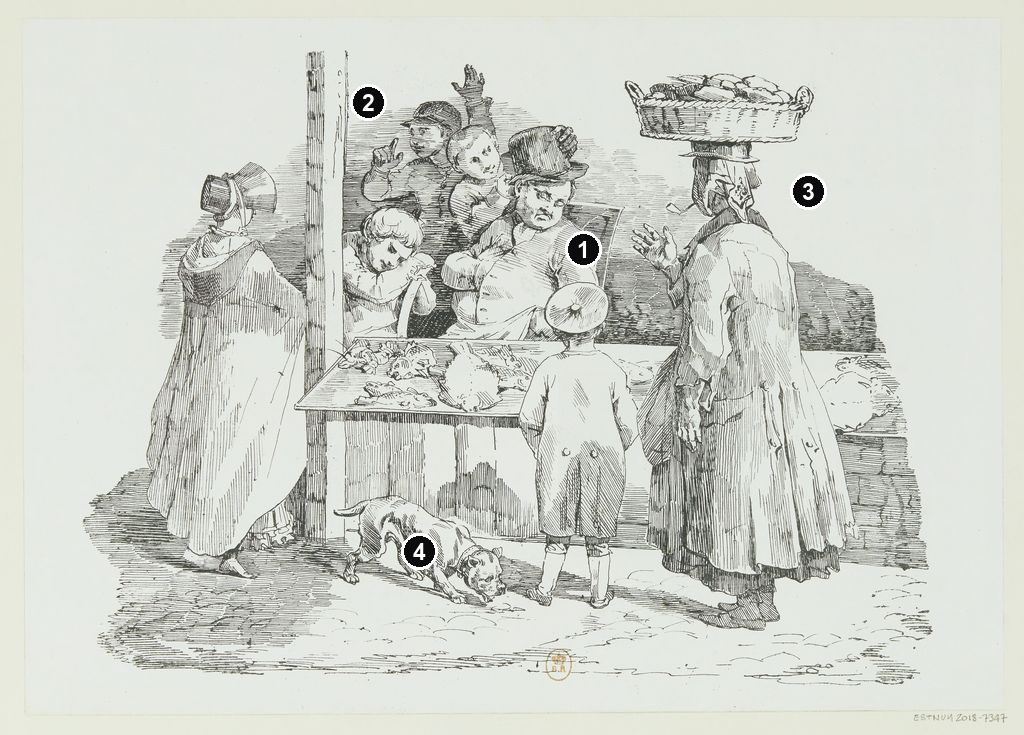
In the Bibliothèque nationale de France impression, the seller sits just beyond the middle of the stall, his top hat slightly tilted and his head bent towards his shoulder. His arms gather across his body. The chair back remains visible behind him, an angled support that reinforces the impression of a body settling into rest. His face is sharply defined, but his eyes offer none of the answering attention that might turn the surrounding figures into customers engaged in a transaction.
The stall brings that interruption of business into focus. Fish lie across its top, some relatively slender, others broad and flat. Their repeated outlines make a busy horizontal band directly below the seller. The vertical boards of the stall front then carry the eye down towards the dog and the standing child's legs. A mundane piece of street furniture becomes the hinge between the crowded upper scene and the more open pavement below.
The boy in the foreground has his back to us. His hands disappear into his pockets, and his bare lower legs stand apart beneath his coat. He provides a particularly effective point of entry: we look past him towards the seller, sharing his position without being given his expression. At the opposite side, the cloaked figure seen largely from behind also directs attention inward. These backs make the spectator one more observer at the stall rather than an audience facing a neatly arranged row of performers.
Above and behind the seller, the children are more demonstrative. One raises a hand, while another leans into the group with an animated face. The smaller child beside the post brings a hand close to the seller's arm. The details suggest teasing, although they do not establish a precise sequence of tricks. Charles Clément's nineteenth-century catalogue likewise describes children mocking the sleeping fishmonger; it also identifies the basket-bearing woman with her pipe, the child viewed from behind and the dog in the foreground. His entry is a useful early account of the composition, rather than evidence for the names or biographies of its participants. [2]
The woman on the right makes a different kind of activity visible. Her basket extends far beyond the width of her head, yet the figure stands upright beneath it. One hand lifts towards the seller while the pipe projects from her mouth. The poised load and extended gesture give her an energy quite unlike his slump. The scene leaves open whether her address would wake him, whether she shares the children's amusement, or whether business simply continues around the interruption. Its interest lies partly in that unresolved exchange.
Humour carried by line
There is little scenery to explain where this gathering takes place. A tall post divides the left side of the group, but no elaborate shop interior or distant street competes with the figures. Instead, stretches of horizontal hatching darken the space behind their heads and shoulders. Against these bands, the seller's face and the children's expressions emerge clearly. Towards the upper and outer edges the drawing gives way to unprinted paper, keeping the incident compact.
The variety of line is more important than any single dramatic contour. On the cloaked figure at the left, long strokes describe falling cloth. Across the woman's skirt, the line extends into a denser vertical texture. On the basket, short crossing marks suggest the weave; on the fish, smaller interruptions pick out fins and irregular edges. The pen language remains visible throughout. It does not conceal the act of drawing beneath a smooth tonal surface.
Several shapes repeat without becoming a mechanical pattern. The seller's tall hat answers the foreground boy's rounded cap, while the wide basket produces a third, exaggerated form above the woman's head. The stall's long top runs beneath these head coverings and faces, binding the group together. Meanwhile, the low dog draws the eye outside the human exchange. Its bent body and lowered nose add a separate pursuit at the feet of people concerned with something else.
This is humour based on relationships: sleep and alertness, a sloping head and an upright burden, a silent centre and busy edges. Nothing requires us to supply a moral about laziness or to assume that the seller's sleep reveals his character. The print shows a moment of vulnerability within a public working space. Its spectators may be amused, but the man remains physically substantial, with the same attention to weight and posture that gives the surrounding figures their presence.
Watch: Géricault and The Raft of the Medusa
Three perspectives on Géricault’s best-known painting, its making and its historical setting.
Gericault, Raft of the Medusa
Smarthistory examines the composition and historical setting of The Raft of the Medusa.
Watch on YouTubeAnnotated Details from The Sleeping Fish Seller
The numbered points identify visible features discussed in this article. Return from each detail to the whole composition. The Sleeping Fish Seller Image source. Public domain.
Details from THE SLEEPING FISH SELLER
Compare the cropped details with the complete images above. Notice how their colours, shapes and positions contribute to the larger compositions.
The sleeping centre
The tilted hat, lowered face and gathered arms turn the seller into a still centre.
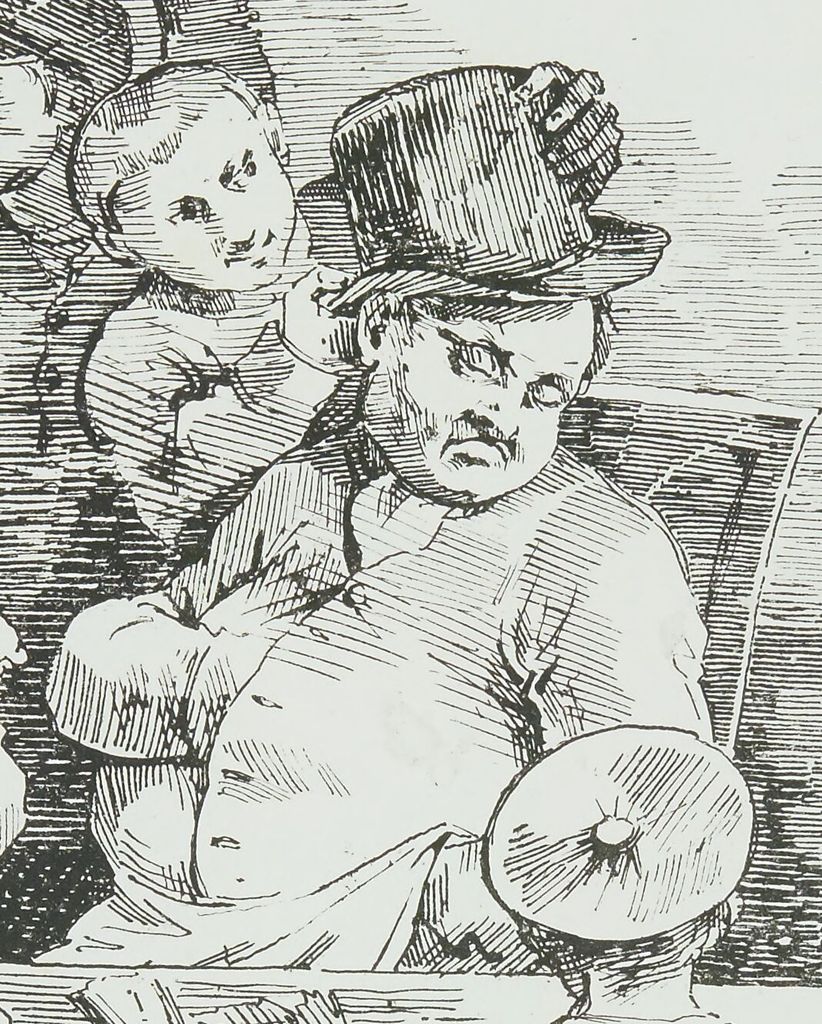
Children behind the stall
Raised hands and animated faces suggest teasing without explaining an exact trick.
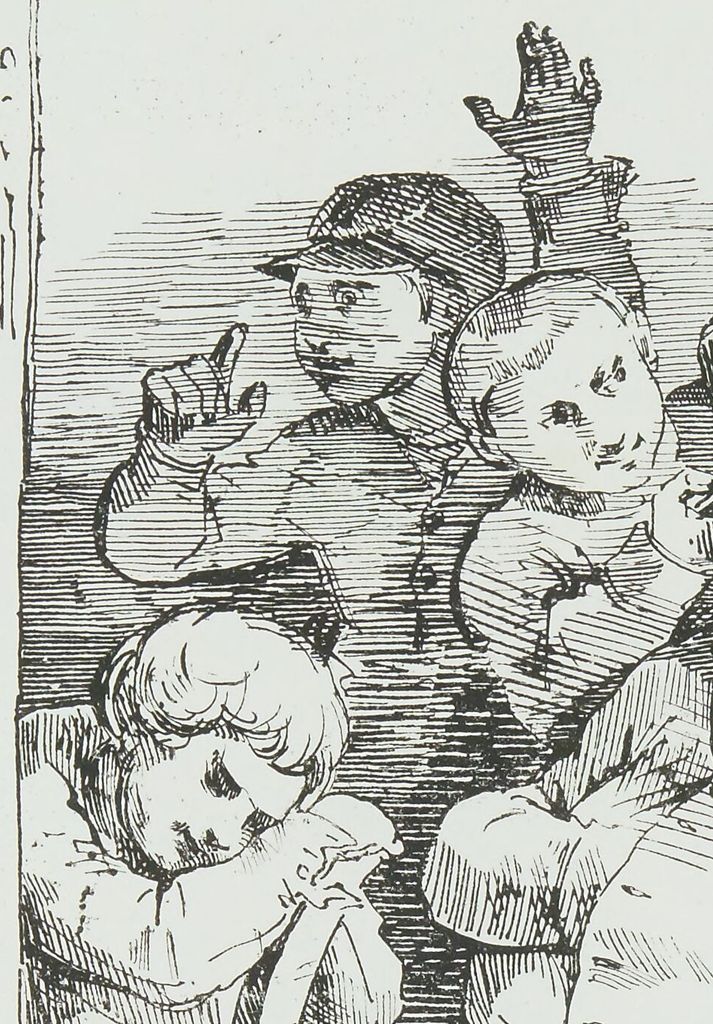
Basket, pipe and gesture
The broad basket and upright figure counter the seller’s sloping posture.
A separate pursuit below
The dog lowers its nose beneath the stall, adding an action outside the human exchange.
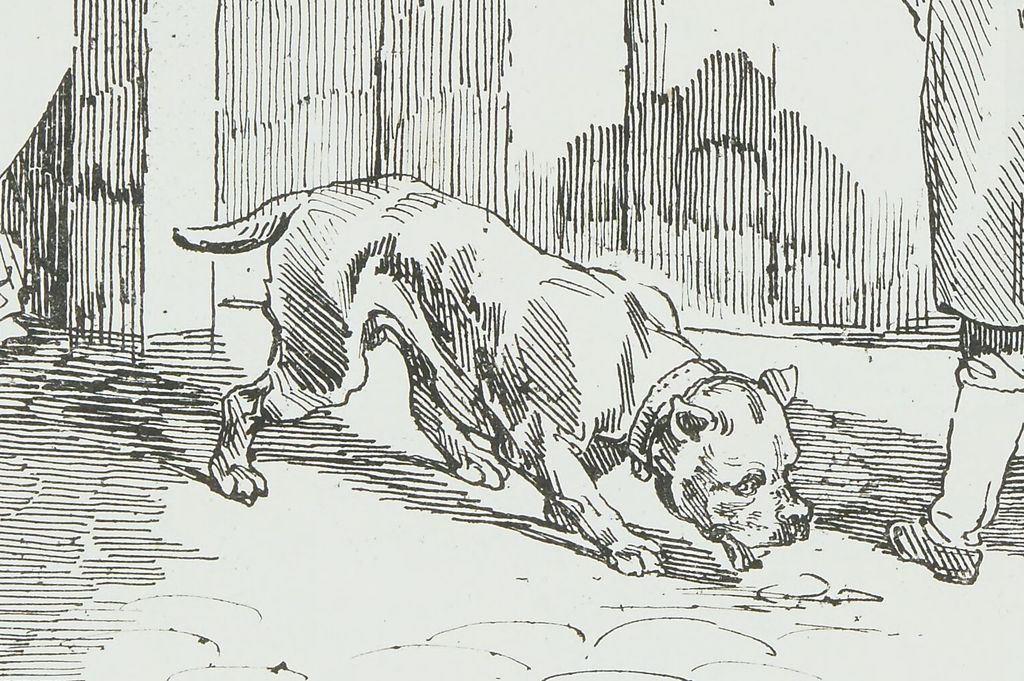
Drawing, printing surface and impression
The word “drawing” can conceal an important distinction here. A preparatory study explores a composition; a drawing made on a printing surface can produce impressions; the impression itself is the inked image received by a separate sheet of paper. These objects may show closely related figures while serving different purposes. The print reproduced here is an impression, not the original surface that carried the design.
Christie's documented that separate surface in its 1997 catalogue: pen and black lithographic ink on prepared “stone paper,” or lithographic carton, measuring 25.6 × 34.8 cm. The essay identifies it as the matrix for The Sleeping Fish Seller and mentions related drawings. Its measurements belong to that carton, not to every printed sheet bearing the composition. [3]
Clément places the fishmonger among works drawn on prepared carton. In introducing the group, he explains that Géricault took this lighter, more easily transported material with him from Paris instead of carrying lithographic stones. He also records the process's serious disadvantages and abandonment. His catalogue therefore links the appearance of these small prints to a practical experiment in making the drawing surface portable. It does not make the surviving printed sheet itself a carton. [2]
Ordinary lithography depends on the different behaviour of greasy drawing material and water on a prepared limestone surface. As the Chantilly museum's explanation describes it, dampening and inking allow ink to collect on the drawn areas before paper receives the image under pressure. That process made it possible to reproduce a drawn language without cutting the image into an engraved plate. The prepared-carton experiment belonged to this search for ways of drawing for the press, though its support should not be confused with the usual stone. [12]
Portability and durability pull in different directions. A surface convenient for travel need not withstand repeated printing well. The fragile carton limited the impressions it could yield, according to the Christie's account. [3] That constraint helps explain why a deceptively informal street scene also matters as evidence of technical experiment. The lively marks and the material history belong to the same object, even though neither supplies a complete account of how every surviving sheet was printed.
Dates and the question of Charlet
The National Gallery of Art's record offers a useful reminder that a print's date, its paper and its attribution answer different questions. Its catalogue date is 1820; the recorded watermark on its sheet includes J Whatman, Turkey Mill and 1821. The watermark concerns the paper of that particular impression. These entries should be kept distinct rather than converted into a precise, undocumented printing date. The museum identifies the print as Delteil 24, in its only state. [1]
The same record names both Géricault and Charlet as artists. Christie's reported Lorenz Eitner's contrary argument in 1997, based on the drawing's handling and his reconstruction of its production during Géricault's second London visit, without Charlet. That position reaches us through the auction essay, not a directly consulted Eitner letter. It remains an argument, while the museum retains the joint credit. Neither record justifies assigning individual figures or technical tasks to one artist. [3]
The distinction matters for a viewer as well as a cataloguer. A confident story in which one artist supplied the children and another the seller would change how we read the scene, yet the available evidence does not establish such a division. We can examine the coherence of the arrangement and the expressive differences between its figures without turning those differences into signatures of separate hands.
Street life beside the English labour prints
Chantilly places Géricault's London lithographs of 1820–21 within his attention to the social realities of early industrial Britain. Its account brings together begging, illness and working horses, while recognising more picturesque episodes as well. That range is useful context for the fish seller: ordinary street activity could sustain a print without becoming either a grand historical event or a straightforward social accusation. [12]
The comparison with Entrance to the Adelphi Wharf makes the variety of this attention clearer. The Metropolitan Museum of Art dates that lithograph to 1821 and identifies Charles Joseph Hullmandel and Rodwell & Martin among its makers and publishers. [13] Clément lists it within the English suite, separately from the subsequent prepared-carton group containing the fishmonger. The shared English context does not make the two prints plates from the same series. [2]
At Adelphi, the wharf entrance organises the movement of labour through an architectural passage. Here, a modest stall gathers people around one temporarily inactive worker. The fish, basket and working clothes keep commerce physically present, even while the children redirect our attention towards play. The comparison broadens the idea of a labour subject: it can include the interruption of work and the social encounters that form around it.
The nearby catalogue entry for Three Children Playing with a Donkey offers another connection. Clément places it immediately after the fishmonger and identifies the same carton process. [2] In both subjects, children help animate an encounter rather than appear as isolated portrait sitters. Their activity brings movement into a tightly contained group. It would be a mistake, however, to identify them as the artist's children or to infer relationships among the fish seller's companions from their proximity alone.
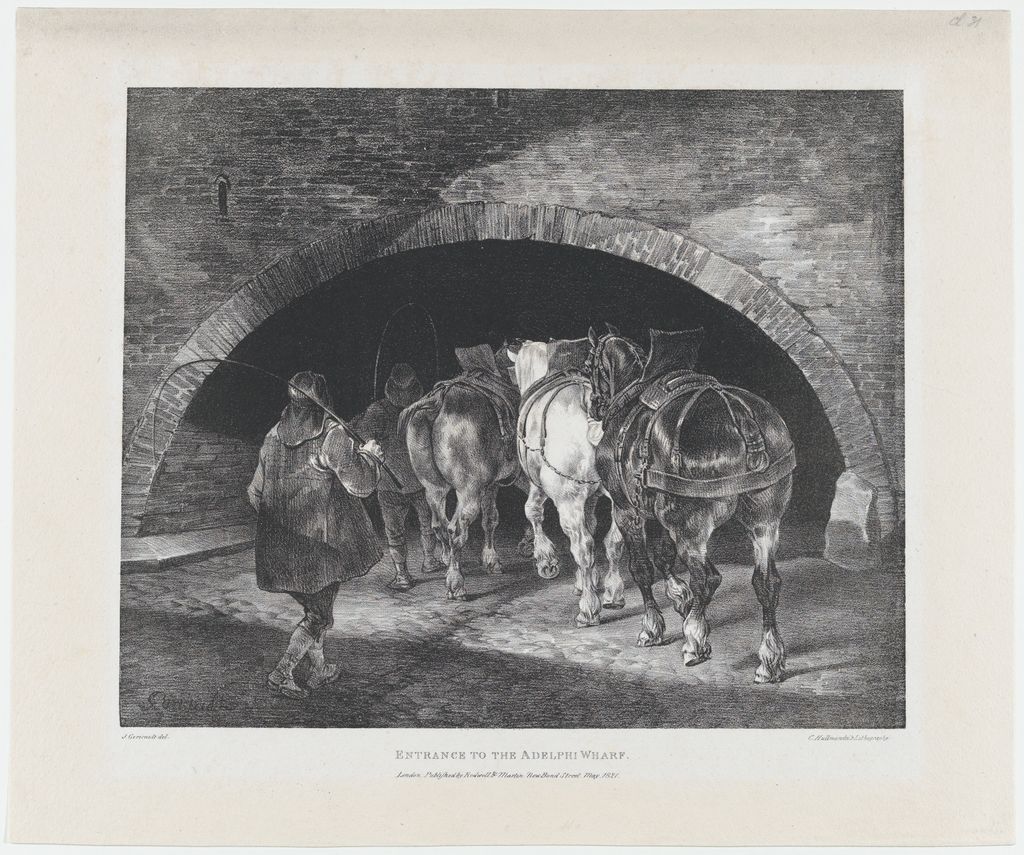
Entrance to the Adelphi Wharf Image source. Public domain.
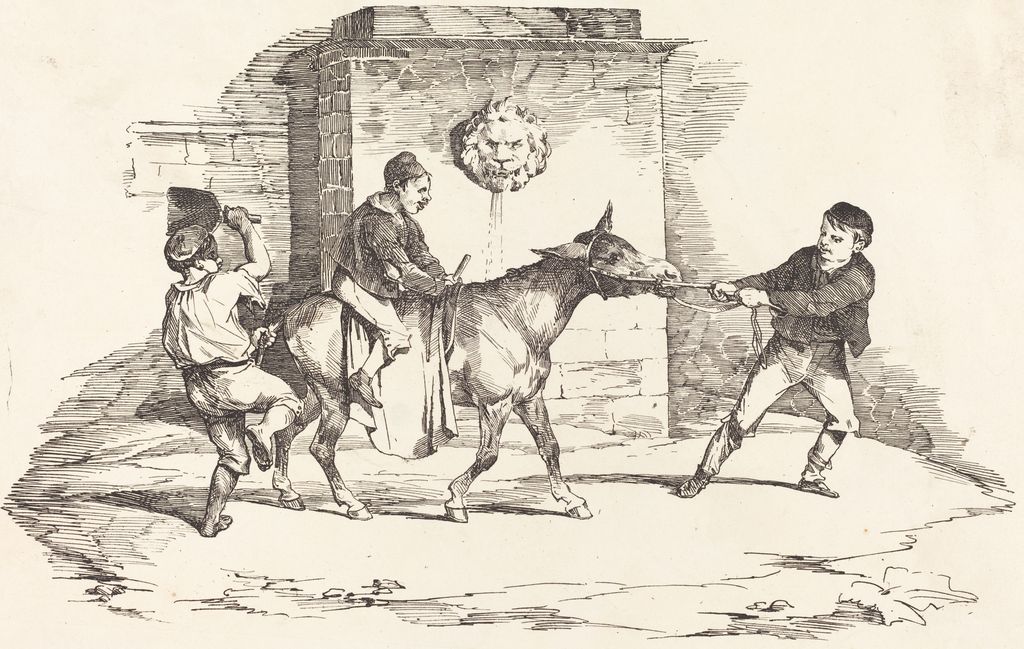
Three Children Playing with a Donkey Image source. CC0 / Public domain.
What survives on the sheet
Clément's catalogue preserves the uneven survival of these experiments. Within the carton group, he reports knowing no impression of the wood-sawyers subject and only two of the shoemaker's family. Those are dated observations about other designs, not a present census of The Sleeping Fish Seller. They show how early collectors and cataloguers had to distinguish a surviving matrix from evidence of prints actually taken from it. [2]
For the fishmonger, the most rewarding starting point remains the visible sheet. The composition has no explanatory caption within its image to settle the exchange. We discover its action by looking from the sleeping face to the raised hand, from the upright basket carrier to the child with his back turned. A portable printing experiment has preserved a surprisingly intricate arrangement of attention. The man has stopped attending to his surroundings; the image makes us attend to everything around him.
Géricault collection records
Seventy collection records include paintings, drawings and individual print impressions. Different impressions remain separate records; this selection is not a complete catalogue raisonné.
Frequently Asked Questions
Their raised hands and lively expressions suggest teasing the sleeping seller, as Clément’s early catalogue also describes. The image does not identify them or establish the exact sequence of their joke. [2]
Discussion
Look again at the images and ideas explored in The Sleeping Fish Seller. These editorial prompts invite your observations.
Reader Insights
Follow the gazes and gestures around the stall. Who seems to watch, who acts, and who remains outside the exchange?
Compare the sloping seller with the upright basket carrier. How does posture make this still image feel active?
Find three different kinds of hatching—in the cloth, basket and background. What does each help you recognise?
Join the Conversation
Share a detail, comparison or question about The Sleeping Fish Seller below.
References
- National Gallery of Art, The Dozing Fishmonger (Le marchand de poissons endormie), catalogue date 1820, accession 1951.10.448, artist, medium, catalogue and paper-watermark metadata (English). View source.
- Charles Clément, Catalogue de l'œuvre de Géricault: Lithographies (1866), English suite and prepared-carton entries, especially nos. 32 and 39–45, printed pp. 15–17 / digitised PDF pp. 23–25 (French); historical catalogue within the composite digitised volume. View source. (in French).
- Christie's, Le Marchand de poissons endormi (The sleeping Fish Seller), lot 226153 (1997), prepared-carton metadata and essay reporting Lorenz Eitner's letter of 8 March 1997 (English). View source.
- Nationalmuseum, The Severed Heads, NM 2113; collection metadata and museum interpretation (Swedish). View source.
- Louvre, Charging Chasseur, INV 4885; collection metadata and museum interpretation (French/English interface). View source.
- National Gallery, Horse frightened by Lightning; collection metadata and museum interpretation (English). View source.
- Louvre, Wounded Cuirassier, INV 4886; collection metadata and museum interpretation (French). View source.
- Louvre, The Raft of the Medusa, INV 4884; collection metadata and museum interpretation (French). View source.
- Gary Tinterow / The Metropolitan Museum of Art, Géricault’s Heroic Landscapes: The Times of Day, Met Bulletin 48/3, Winter 1990–91; consulted main essay and relevant object entries (English). View source.
- Vlaamse Kunstcollectie, Portrait of a Kleptomaniac; collection metadata and museum interpretation (Dutch). View source.
- Louvre, Epsom, MI 708; collection metadata and museum interpretation (French/English interface). View source.
- Château de Chantilly, Géricault et la lithographie, virtual exhibition drawn from the exhibition curated by Nicole Garnier-Pelle, 2018, sections on lithography and England (French). View source. (in French).
- The Metropolitan Museum of Art, Entrance to the Adelphi Wharf, 1821, accession 22.63.25, object record (English). View source.


