



 by Tom Gurney
Tom Gurney BSc (Hons) is an art history expert with over 20 years experience
Email: tomgurney1@gmail.com / Phone: +44 7429 011000
Théodore Géricault’s Style and Technique: Introduction
A horse stands almost motionless, yet the broken lights across its coat make its body seem alert. A seated man leans on a spear, his limbs arranged into a tense structure of opposing diagonals. In a landscape, tiny bathers occupy the foot of a towering assembly of cliffs and ruins. Géricault could make stillness feel charged without relying on a single kind of brushwork or a constantly moving subject. His art brings close observation into contact with deliberate exaggeration: the particular body becomes the material for a more forceful pictorial design.
That relationship helps explain both his Romantic reputation and his continuing attachment to older art. He learned from studio exercises, earlier paintings and the study of living bodies; he also changed his handling according to the task. Technical examinations reveal carefully layered flesh in one painting, thinly worked landscape passages in another, and revisions that complicate the appearance of an apparently decisive image. His technique is best understood through these particular objects, rather than through a formula supposedly applied throughout his career.
At a Glance
- TrainingCarle Vernet, followed by Pierre Guérin around 1810–11 [1]
- Painted figure exampleNude Warrior with a Spear, circa 1816; layered brown modelling, opaque paint and glazes [2]
- Landscape exampleEvening: thin paint with selected impasto highlights [1]
- Print exampleReturn from Russia, circa 1818; black and ochre printed from two stones, with white watercolour added to Cleveland impression 1931.48 [3]
Contents
- Training, copying and the uses of tradition
- The body as an arrangement of forces
- Painting the individuality of a horse
- Scale and the construction of landscape
- Drawing as a place to test alternatives
- Drawing for the printed page
- Reading a surface that has changed
Training, copying and the uses of tradition
Géricault’s first teacher was Carle Vernet, known for horses and military subjects. He subsequently entered Pierre Guérin’s studio around 1810–11. These were different forms of preparation: Vernet offered a connection with contemporary equestrian imagery, while Guérin’s teaching belonged to the classical training of the figure. Gary Tinterow’s study of Géricault’s landscapes describes the young painter’s first major Salon picture, the Charging Chasseur of 1812, as combining the energy of Rubens with the military art of Gros and Vernet. Its vigorous colour and unstable action already differed from Guérin’s more restrained example. [1]
Independence did not mean that the lessons of training disappeared. The practice of posing, drawing and painting the nude remained available when Géricault wanted to reconsider the figure. Lorenz Eitner places the Nude Warrior with a Spear within a renewed period of classical study around 1815–16, before the artist’s unsuccessful attempt at the Prix de Rome. In this account, the academic body became a means of disciplining an already ambitious painter’s imagination. That is a more useful way to understand the painting than to treat it as the product of an inexperienced student learning anatomy for the first time. [2]
Copying also supplied practical knowledge. A particularly revealing example survives beneath Géricault’s Deluge in the Louvre, RF 1950-40. As Tinterow explains, X-radiography disclosed an earlier copy of Napoleon on horseback after Gros’s Battle of the Pyramids. The same canvas subsequently carried a different subject. Here, copying was a physical painting exercise, and a support used for studying another artist later became the ground for an independent composition. The discovery concerns this particular Deluge; it does not establish that every painting concealed an earlier image. [1]
Borrowing could also take the form of selecting and transforming a motif. In the landscapes of 1818, Géricault drew on the composed scenery of Poussin, Dughet, Salvator Rosa and Claude Joseph Vernet. Joseph was Carle Vernet’s father, and his imaginary architecture offered a different inheritance from Carle’s horses. Géricault’s aqueduct in Evening follows a structure Joseph Vernet had invented by combining the medieval bridge at Spoleto with Roman-style tiers of arches. Its authority comes from painted tradition rather than accurate topography. An Italian journey and knowledge of earlier pictures could work together without producing a literal record of a place. [1]
The body as an arrangement of forces
In Nude Warrior with a Spear, the seated figure nearly fills the canvas. The illuminated shoulder, back and thigh carry much of the visual weight. His face turns away, leaving the articulation of the torso and limbs to hold attention. The long leg descends towards the lower edge, while the spear cuts diagonally across the setting. A bent arm pulls the pose inward as the other reaches down along the weapon. The result is a body at rest whose parts seem to exert pressure in different directions.
Eitner analyses this as a calculated composition of contrasting contours, diagonals, highlights and shaded forms. He also warns against allowing the modern title to invent a story: “warrior” has no historical authority as the subject’s original identification. The picture belongs to the tradition of the académie, a study of a posed nude that could acquire a suggestive setting without illustrating a particular event. Eitner found no evidence that this canvas prepared a larger composition. A reader can therefore attend to its heroic appearance without having to supply a battle, a defeated army or a named ancient protagonist. [2]
The painting’s construction is more varied than its sculptural solidity might suggest. The National Gallery of Art’s technical notes describe a thick white preparation, marked by vertical ridges, beneath the paint. Infrared examination reveals drawn outlines of the upper torso and limbs. Thin, partly transparent brown paint helps model the body, remaining apparent in shadows and at contours. Opaque paint worked while wet and translucent glazes together build the flesh and surrounding setting. “Glaze” here means a transparent or translucent paint layer through which an underlying colour remains active. [2]
These findings explain why modelling cannot be reduced to dark outlines around pale forms. The shadow is part of a layered structure; the light-bearing flesh has a different density from the transparent brown beneath it. Looking at the bent elbow and the broad plane of the thigh, one can follow the passage from a lit surface into a deeper recess. Drawing, underpaint and final colour all contribute to that effect. The evidence belongs to this canvas, however. It supplies no basis for prescribing the same white ground or brown underpaint for every work by Géricault. [2]
Nor does technical evidence erase interpretation. The lengths of limbs, the tight turn of the torso and the cropping make this more than an anatomical demonstration. The academic body becomes unusually insistent and near. Eitner’s connection with Michelangelo helps account for its ambition, but the painting’s effect is available before that comparison: the spectator encounters a person whose physical presence is much more definite than his narrative identity. [2]
Painting the individuality of a horse
Géricault’s horses offer another meeting of bodily knowledge and pictorial invention. In Rouen’s Study of a Dapple Grey, dated around 1812, the pale animal stands against a dark, only loosely specified setting. Light breaks across the flank and shoulder, while the head is sharply articulated. The mane falls in long strands; the marks on the coat vary in shape and intensity. These differences give the body substance without turning every patch into an equally prominent detail. [4]
The Rouen museum emphasises the anatomical character of the head and the attention given to the effects of light on the coat. It also identifies a change in the tail’s position, a pentimento: a revision that remains detectable beneath or through a later painted decision. The museum uses this change, together with quality, in arguing that its canvas is the original among several versions. A pentimento is valuable because it records a decision in the making. It is not simply another word for any visible underpainting, and its presence does not establish a rule that every revised picture must be authentic. [4]
The National Gallery’s A Horse Frightened by Lightning, painted around 1813–14, uses a comparable profile for a different effect. The neck rises, the ears point upwards and a small flash of white marks the eye. The animal remains planted rather than rearing. Its body occupies most of the width, and the dark cloud bank presses close behind it. The lightning belongs to the landscape, but the response is concentrated in small bodily signs. Fear becomes legible through the contrast between a largely stable silhouette and an alert head. [5]
The Gallery draws attention to short strokes of fluid paint that follow the forms of the coat. In the reproduction, the patterned flank reads at once as hair, changing light and an accumulation of brush marks. The horse’s surface is not polished into anonymity. Yet the overall form remains clear: broken handling works within a strongly bounded silhouette. The museum compares that side-on presentation with classical friezes and the individuality of the animal with Stubbs’s Whistlejacket. These are curatorial comparisons, rather than evidence that Géricault copied a particular frieze for this painting. [5]
Together, the two horses show why naturalism and expressive design need not be opposing categories. Observed differences of coat, head and stance make an animal particular; the isolation of that animal, the placement of light and the reduction of its surroundings intensify the encounter. Neither painting needs constant motion to feel alive. Nor does visible liveliness tell us how many hours the painter worked. A short brush mark records a movement of the brush, not the duration of the whole painting.
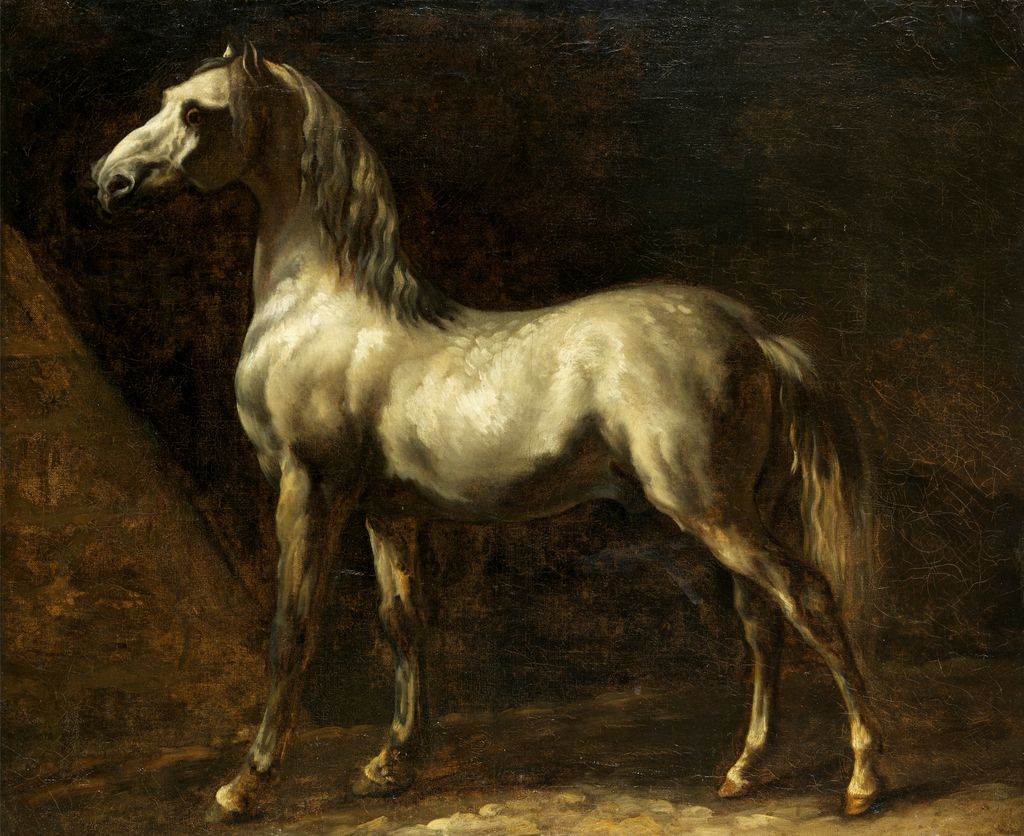
Study of a Dapple Grey Image source. Public domain.
Watch: Géricault and The Raft of the Medusa
Three perspectives on Géricault’s best-known painting, its making and its historical setting.
Gericault, Raft of the Medusa
Smarthistory examines the composition and historical setting of The Raft of the Medusa.
Watch on YouTubeScale and the construction of landscape
Géricault’s three known Times of Day landscapes—Morning, Noon and Evening—date from 1818. Supplier’s invoices, discussed by Tinterow, establish the delivery of three large canvases that summer. Their scale is essential to the interpretation: these landscapes approach the dimensions of ambitious figure paintings, while their human inhabitants remain small. Their original patron, destination and intended room are unknown. Size can be analysed as part of their effect without turning it into proof of a particular decorative commission. [1]
In Evening: Landscape with an Aqueduct, the foreground ruin and tree on the left rise almost the full height of the picture. Beyond them, the eye meets a succession of arched bridge, buildings and cliffs. The composition repeatedly climbs away from the bathers below. A pale sky opens between dark forms, and warm light picks out selected edges and rock faces. The figures supply a bodily measure against which the architecture and terrain become enormous.
Tinterow relates this disproportion to the sublime: landscape can overwhelm the spectator rather than offer an agreeable, easily surveyed prospect. The argument is especially persuasive when one compares the prominence of the massive foreground wall with the size of the seated nude at its base. Géricault retains recognisable things—trees, water, masonry, bodies—but distributes their importance unequally. The composition’s force comes partly from the distance between the human scale and the world surrounding it. [1]
The surface adds another kind of contrast. Tinterow observes that Géricault appears to have established the broad masses while preparing the canvas: a reddish-brown wash under the cliffs and a grey preparation for the water. Much of Evening is thinly painted. Thicker touches, or impasto, occur selectively in the highlights of figures, the tree at the right and parts of the architecture and cliffs. Freer vegetation and reinforced contours allow loose passages to coexist with sharp definition. These are observations about Evening, not a general inventory of Géricault’s materials. [1]
The distinction matters because an image of physical grandeur need not be built from uniformly thick paint. A thin shadow can make a bright raised touch more conspicuous. A restrained expanse of water can hold the foreground while small accents animate the bathers. Géricault varies the pressure of attention across the picture, letting some passages act as broad fields and others as points of concentration.
The three landscapes also resist a single account of preparation. Tinterow notes six surviving related drawings for Morning and relatively few changes in its painted composition. Noon and Evening contain more revisions. This difference suggests different balances between planning and alteration within one closely connected group. It does not establish a reliable timetable for execution, or mean that a less visibly revised canvas required less thought. [1]
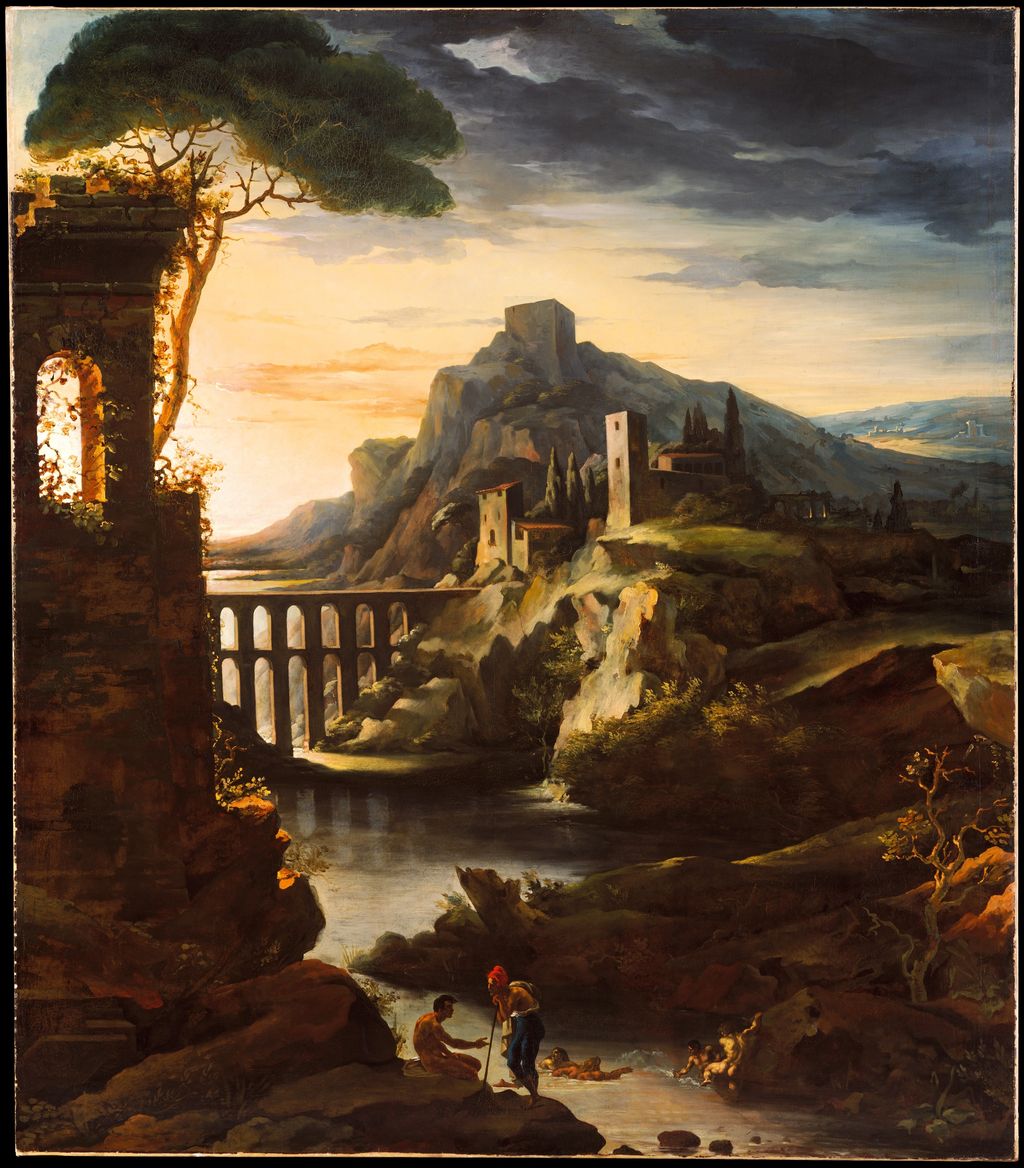
Evening: Landscape with an Aqueduct Image source. Public domain.
Drawing as a place to test alternatives
Géricault’s drawings preserve decisions that a finished painting can conceal. Tinterow’s catalogue includes sheets carrying small, framed alternatives for decorative landscapes, as well as pages on which military figures, classical subjects and landscape ideas occupy the same surface. The little rectangles on the Bayonne landscape sheets test compositions; they do not demonstrate that a cycle of fourteen separate paintings was intended. On a Chicago sheet, drawings of landscapes overlap an earlier study associated with the Prix de Rome subject of the dying Paris. The use of a sheet could extend beyond a single subject or moment. [1]
The materials vary with the kind of investigation. Graphite can establish a contour or map out the main components of a scene. Pen gives a more emphatic linear structure; wash can gather light and shade into larger areas. The seated nude drawing in the British Museum, discussed by both Tinterow and Eitner, combines graphic and tonal means. Eitner treats it as comparable to the painted academic studies. A drawing could investigate volume and bodily tension in its own right, rather than exist solely as an incomplete painting. [1] [2]
Relationships between drawings and paintings require care. Some poses recur without matching exactly; dates proposed for sketchbook pages differ among scholars. Tinterow’s account shows how a boating-party idea could be transformed as it entered a landscape, with changes to both figures and mood. Such connections are useful because they reveal invention through alteration. They do not justify arranging every surviving sheet into a certain sequence from first thought to final canvas. The wider range of Géricault’s drawings includes experiments, copies and independent investigations alongside studies for paintings. [1]
Drawing for the printed page
Lithography offered Géricault a further way to make an image through drawing. Chantilly’s museum account explains the process: the artist marks a prepared limestone surface with greasy chalk or ink. During printing, moisture keeps the unmarked areas from accepting the oily printing ink, while the drawn areas receive it. Paper is then pressed against the stone. The process could retain the appearance of drawn marks while allowing the image to circulate in multiple impressions. [6]
This was a different material operation from building flesh in oil paint, but it could address some of the same problems: weight, contour, atmosphere and the expressive relations between bodies. Chantilly places Géricault’s military subjects beside the horses and street scenes of his English period. The medium’s range allowed the observed body to appear within a more widely distributed image. It did not require him to abandon the careful orchestration of light and dark that mattered in his paintings. [6]
Cleveland’s impression of Return from Russia, made around 1818, provides an unusually clear example of separate operations contributing to one result. Two stones printed the design in black and broad tonal areas in ochre. The museum identifies white watercolour added by hand to indicate snow. These hand additions belong to this physical impression, accession 1931.48; they should not be assumed to occur identically in every print of the composition. [3]
The black marks articulate uniforms, faces and the drooping head of the horse, while the ochre establishes larger atmospheric shapes. The pale ground remains active between them. The figures gather in a close group: the walking soldier, the mounted man and the exhausted animal depend visually on one another, with an arm reaching across to the standing man’s shoulder. The technique gives different kinds of presence to the immediate group and the more lightly indicated travellers behind it. A print can be exact at a face or a hand and much less explicit elsewhere without losing coherence.
The added white also changes the meaning of an apparently empty area. Snow is partly an intervention upon an already printed sheet. Here, colour is not merely decoration applied to a completed black image: tone and hand additions help establish the conditions through which the bodies move. Cleveland emphasises the early integration of a second printed colour into the design. The example shows the value of identifying both the composition and the individual impression before describing a print’s technique. [3]
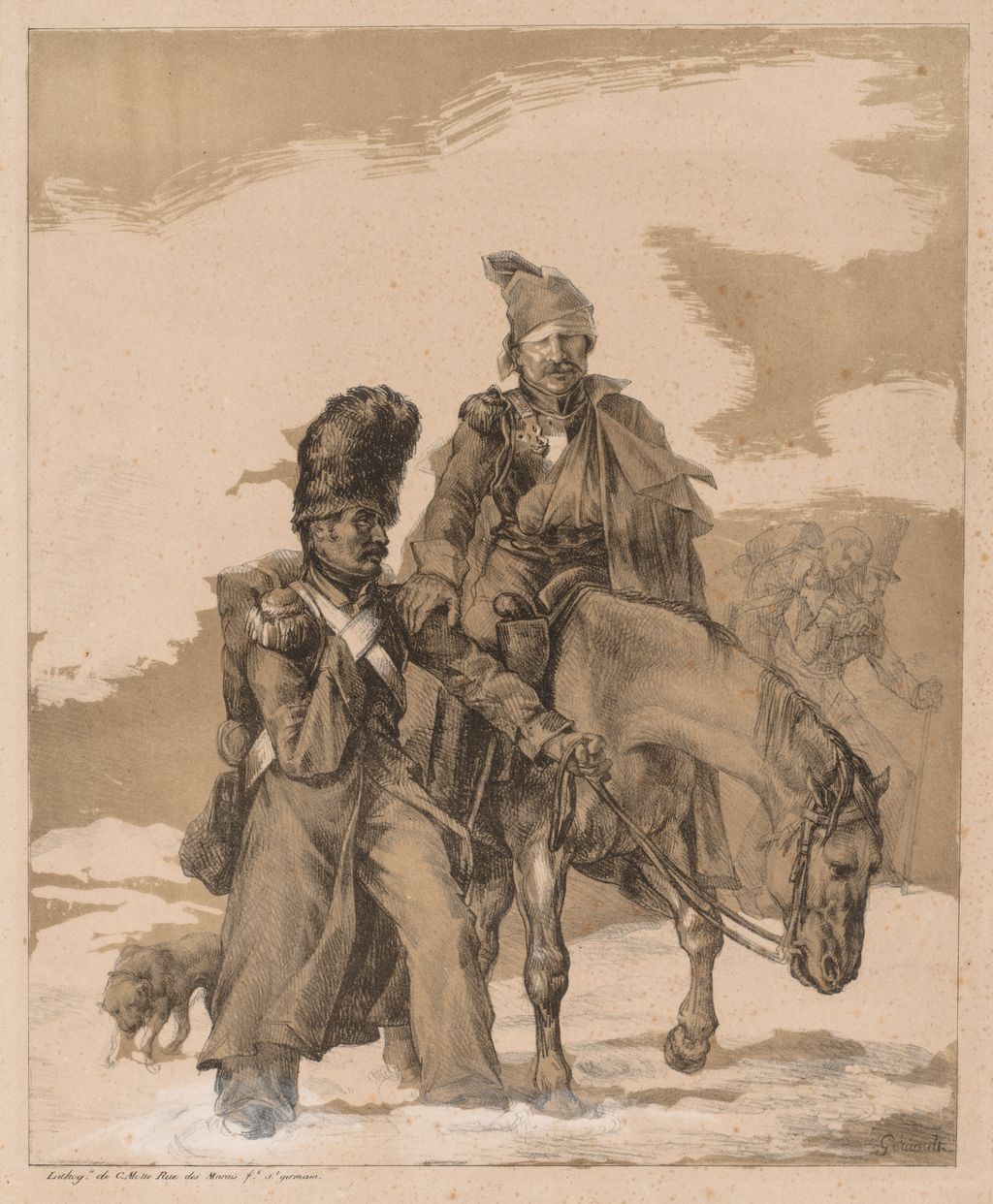
Return from Russia, c.1818 — Cleveland impression 1931.48, with hand-added colour Image source. CC0 / Public domain.
Reading a surface that has changed
Present appearance includes the history of an object after the artist’s work. In the Nude Warrior, the technical catalogue records abrasion, retouching and extensive reglazing in part of the sky. Some changes to the hair are probably Géricault’s own; the cursorily painted extension of a foot may be a later completion. The canvas was also slightly enlarged on its lining, by about a centimetre along each edge. That small alteration is different from evidence that the original figure was drastically cut down. These distinctions prevent a modern viewer from treating every transition in handling as an untouched artistic decision. [2]
The Clark’s Trumpeter of the Hussars offers a more substantial alteration. Its catalogue describes canvas strips added around the central image, together with secondary soldiers and changes in the background. The date and authorship of the enlargement remain uncertain: Géricault or someone close to him may have been responsible. The related smaller Study after Trumpeter of the Hussars is catalogued as “Style of Théodore Géricault”, rather than securely as his preparatory study. Its smooth, uniform handling forms part of the attribution discussion, but resemblance and a familiar subject do not settle authorship. [7]
Technical vocabulary needs equally careful limits. A possible bitumen layer mentioned in the Clark’s report on the smaller picture cannot become a universal recipe for Géricault, especially when that work’s attribution is uncertain. Nor should dark passages everywhere be diagnosed by their colour alone. What the report supplies is a qualified observation about a particular object. Turning that into an explanation of an entire career would discard the very precision that makes technical study useful. [7]
The anatomical paintings supply a related warning about stylistic comparison. Carmen L. McCann’s account of earlier scholarship records disagreements over the Rouen and Lebel variants, alongside much broader acceptance of the Montpellier canvas. That is evidence of a historical attribution debate, not a new verdict on every work of the subject. [8] The Louvre currently catalogues the lamp-lit study of arms and legs, RF 579, deposited in Rouen, under Géricault’s name. Similar titles must not erase the separate identities and histories of these paintings. [9]
Géricault’s style emerges most clearly when these differences remain visible. A horse’s coat, a model’s shoulder, an imagined cliff and a lithographic cloud demand different kinds of marks. Across them, he repeatedly makes the observed body carry more than a descriptive function: it sets the scale, directs attention and gives force to the image. Preparation and revision, learned form and particular observation, all contribute. Looking closely means seeing that variety as part of his achievement.
Géricault collection records
Seventy collection records include paintings, drawings and individual print impressions. Different impressions remain separate records; this selection is not a complete catalogue raisonné.
Frequently Asked Questions
He changes his handling to suit the subject: layered modelling can give a nude solidity, short strokes articulate a horse’s coat, and thin landscape paint can carry selected thick highlights. Strong contours and unequal scales often intensify the result. There is no single recipe demonstrated for all his paintings. [2] [5] [1]
The method depends on the print. Cleveland’s Return from Russia was printed from two stones in black and ochre, and its impression also carries white watercolour applied by hand. Those additions describe this particular sheet, rather than every impression. [3]
Discussion
Look again at the images and ideas explored in Théodore Géricault’s Style and Technique. These editorial prompts invite your observations.
Reader Insights
Compare the shoulder in Nude Warrior with the flank in Dapple Grey. How do continuous modelling and broken marks each suggest a body?
Look first at the bathers in Evening, then at its foreground ruin. How does the change in scale alter your experience of the landscape?
In Return from Russia, follow the black outlines separately from the broad ochre areas. What does each contribute that the other leaves open?
Join the Conversation
Share a detail, comparison or question about Théodore Géricault’s Style and Technique below.
References
- Gary Tinterow / The Metropolitan Museum of Art, Géricault’s Heroic Landscapes: The Times of Day, The Metropolitan Museum of Art Bulletin, vol. 48, no. 3, Winter 1990–91, especially printed pp. 6–16, 34–44, 52–59 (English). View source.
- Lorenz Eitner / National Gallery of Art, French Paintings of the Nineteenth Century, Part I: Before Impressionism, 2000, “Nude Warrior with a Spear”, printed pp. 254–259, including technical notes (English). View source.
- The Cleveland Museum of Art, “Return from Russia”, circa 1818, accession 1931.48, object record and technical description (English). View source.
- Musée des Beaux-Arts de Rouen, “Study of a Dapple Grey”, circa 1812, inventory 850.3.1, collection entry and interpretation (English). View source.
- The National Gallery, London, “A Horse frightened by Lightning”, about 1813–14, NG 4927, overview and in-depth commentary (English). View source.
- Château de Chantilly, “Géricault et la lithographie: Le romantisme à la française”, virtual exhibition based on the 2018 exhibition curated by Nicole Garnier-Pelle (French). View source. (in French).
- Sterling and Francine Clark Art Institute, Nineteenth-Century European Paintings at the Sterling and Francine Clark Art Institute, edited by Sarah Lees, 2012, entries 149–150, “Trumpeter of the Hussars” and “Study after Trumpeter of the Hussars”, with technical reports by Sandra L. Webber, printed pp. 351–355 (English). View source.
- Carmen L. McCann, “Status Viatoris”: A New Construction of Death in Paintings by Théodore Géricault and Eugène Delacroix and Prints of Père Lachaise Cemetery, 1815–1830, PhD dissertation, Pennsylvania State University, 2010, printed pp. 99–100; narrowly consulted official-repository indexed passage on anatomical-painting attributions (English). View source.
- Musée du Louvre, “Étude de bras et de jambes, peinte à la lumière de la lampe, pour le Radeau de la Méduse, au Louvre”, circa 1818–19, RF 579, collection record (French). View source. (in French).


