



 by Tom Gurney
Tom Gurney BSc (Hons) is an art history expert with over 20 years experience
Email: tomgurney1@gmail.com / Phone: +44 7429 011000
Artillery Caisson: Introduction
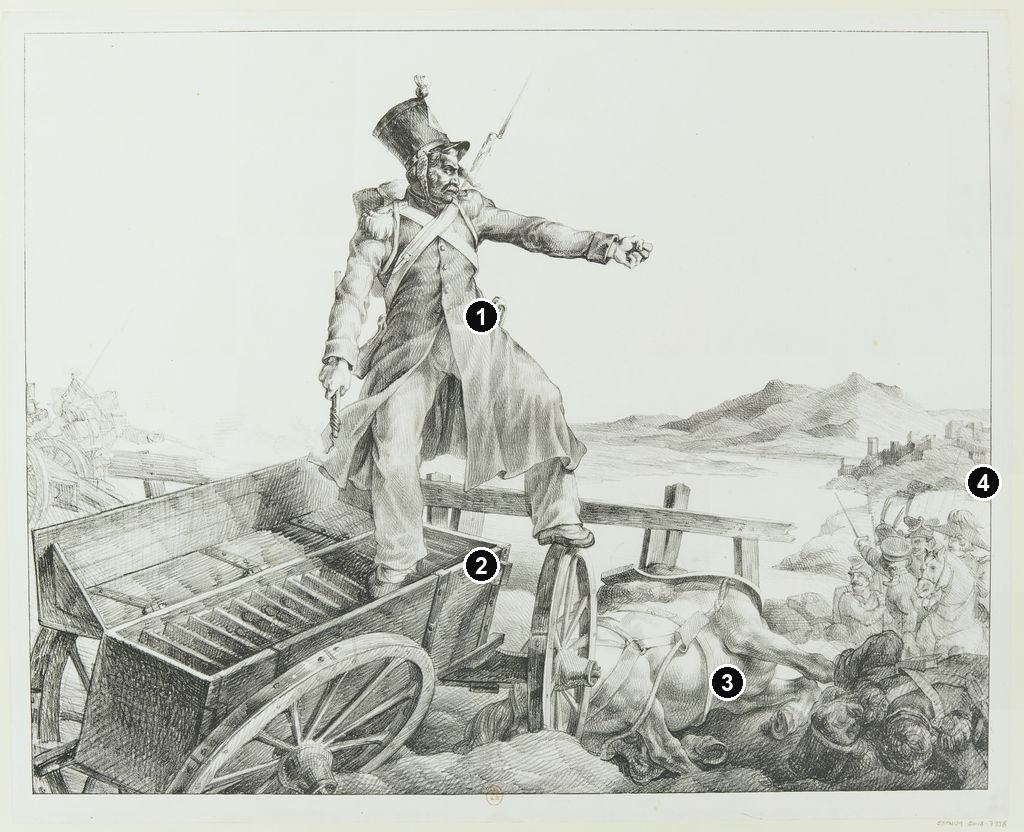
A soldier stands above an open ammunition wagon, one boot planted inside the chest and the other balanced on a wheel. He thrusts a clenched fist towards the men approaching from the right; his lowered hand holds a burning fuse. Beneath him, the wagon’s horse lies dead. Théodore Géricault’s Artillery Caisson brings military courage to the edge of catastrophe: the soldier can still resist, but the means of resistance threatens to destroy the position he occupies. The Rijksmuseum catalogues this lithograph as a work of 1818 and identifies the ammunition wagon, dead horse, fist and fuse in its description. [1]
The scene gives no reassuring outcome. Its most commanding figure has height, resolve and a weapon, yet stands on equipment that has ceased to function. Across the sheet, the space between his fist and the distant soldiers remains open. That interval holds the drama: there is time to recognise a threat, but no visible resolution of what either side will do next.
At a Glance
- Date1818 (catalogue date) [1]
- MediumLithograph on paper [1]
- Documented ImpressionRijksmuseum, RP-P-2008-69 [1]
- Rijksmuseum Sheet438 × 546 mm [1]
This work across Théodore Géricault’s career
The Severed Heads
1810s [2]Charging Chasseur
1812 [3]Horse Frightened by Lightning
c.1813–14 [4]The Raft of the Medusa
1818–19 [6]Portrait of a Kleptomaniac
c.1820–24 [8]The Epsom Derby
1821 [9]Contents
- A last position on the ammunition wagon
- A Napoleonic subject without a named battle
- How black marks hold the action still
- Courage, assistance and the vulnerable horse
- The design and its surviving impressions
- Annotated details
A last position on the ammunition wagon
The French title, Caisson d’artillerie, identifies the vehicle carrying ammunition. Géricault makes its contents accessible by opening the lid and dividing the chest into clearly drawn compartments. The soldier’s lowered hand brings the fuse close to this exposed interior. The implication is a possible explosion, although the image itself stops before ignition of the wagon. The Rijksmuseum’s subject headings include gunpowder and explosives; they support understanding the chest as the source of the danger rather than treating it as an ordinary transport cart. [1]
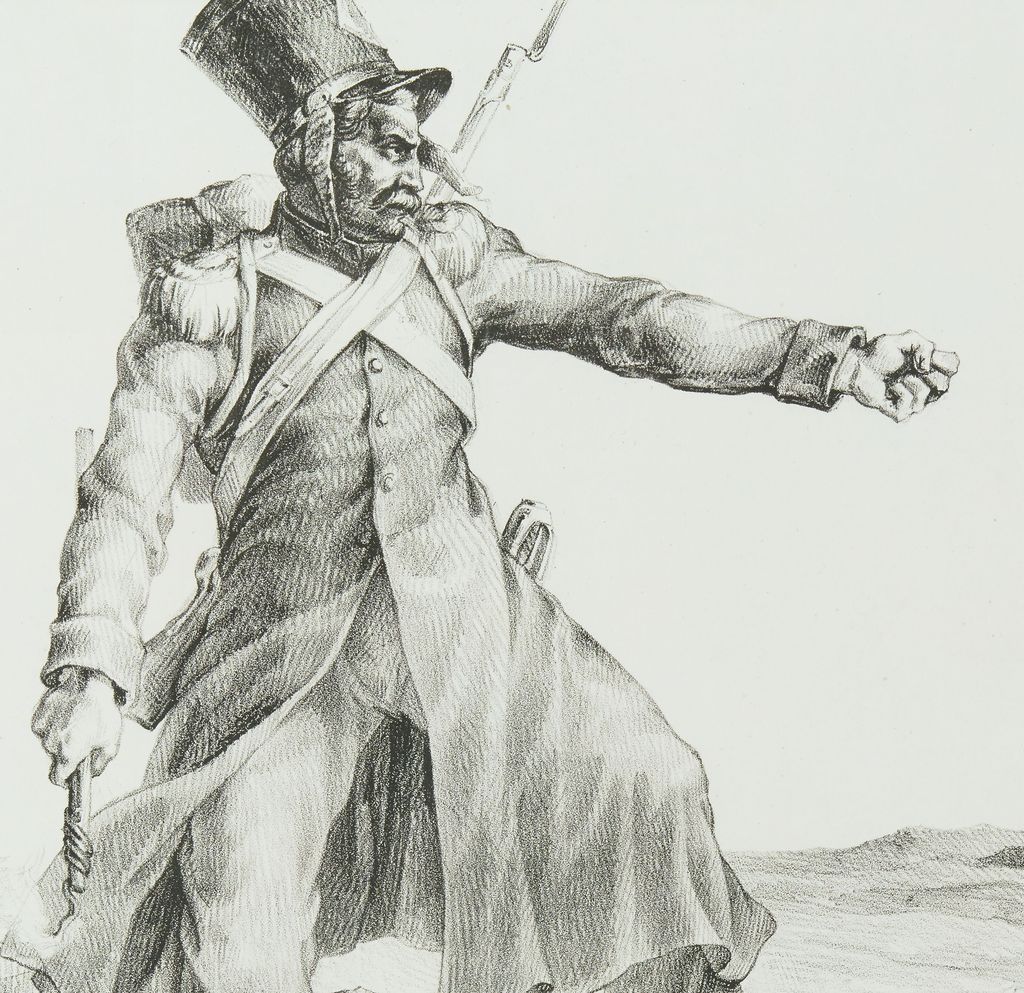
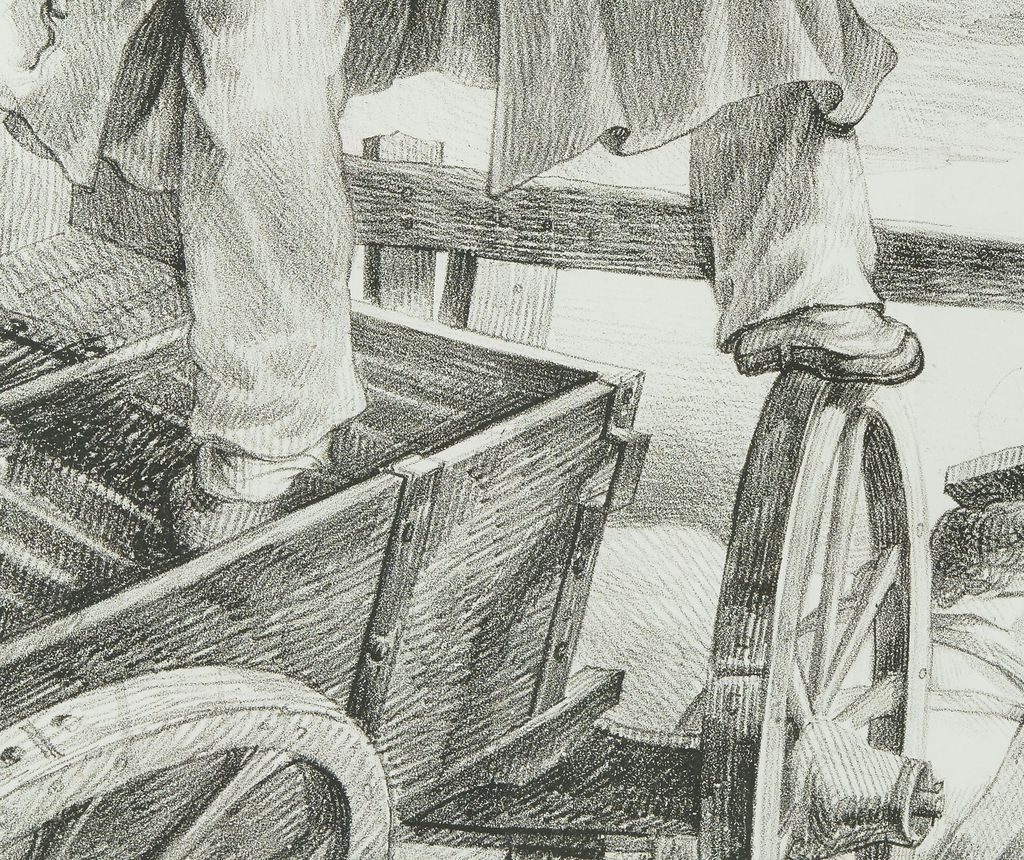
The body is braced rather than comfortably upright. The feet occupy different levels, while the coat opens around the legs and falls across the box. The extended arm draws attention towards the right, but the other hand redirects the eye downwards, into the ammunition. These two gestures make the position legible. One addresses the enemy; the other demonstrates the means by which the soldier might prevent capture. His stance can look triumphant at first glance, yet the detail of his footing makes that triumph precarious.
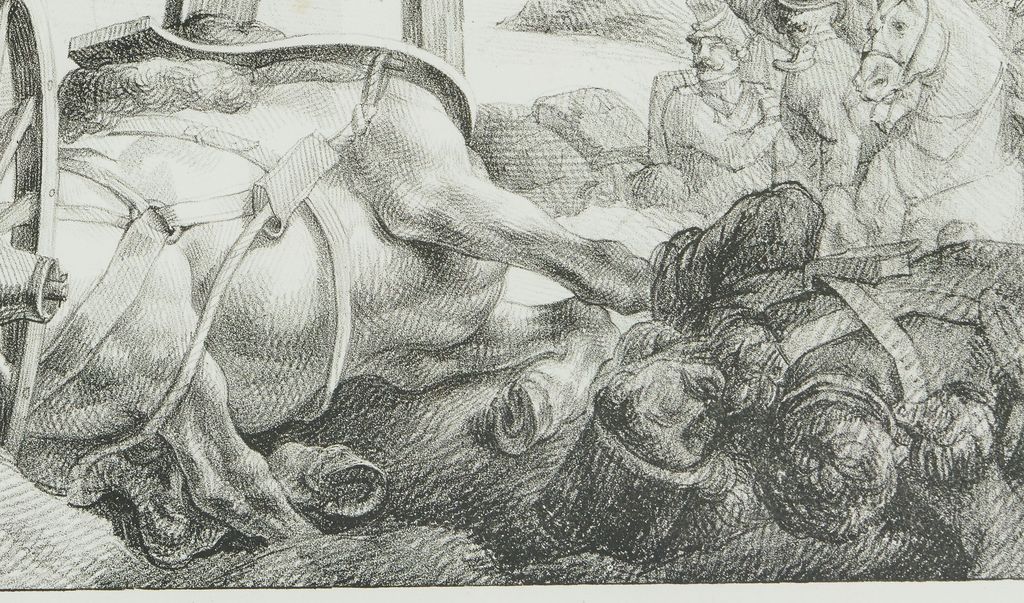
The foreground complicates the heroic outline further. A dead horse fills the space beside the wheel, its harness still crossing its body. Fallen human figures crowd the lower right. The upright soldier therefore rises out of a field of bodies, broken barriers and disabled machinery. His elevation is inseparable from the destruction beneath him. Géricault gives the standing figure room to dominate the sheet without allowing the viewer to forget what that dominance costs.
The approaching men occupy a much smaller area near the right edge. Their horses and weapons are compressed into the distance, beyond the fallen figures. They remain a group rather than a set of individual opponents whose expressions can be studied as closely as the central soldier’s. That difference in scale directs sympathy and attention, while withholding the sort of detailed exchange that would turn the scene into an illustrated military report.
A Napoleonic subject without a named battle
Charles Clément’s nineteenth-century catalogue describes the men confronting the soldier as Russians. His entry places one foot on the wheel, the other in the caisson, and reads the raised fist as a challenge to a group apparently consulting together. This is useful historical testimony about how the composition was understood. The present Rijksmuseum description is more restrained, identifying the soldier’s action without naming a battle or the individual performing it. [10]
The distinction matters. The print belongs to Géricault’s engagement with the military world of Napoleon’s armies, but neither of these records establishes a witnessed episode involving a named soldier. Calling it an image of defiance in a Russian campaign is different from supplying an exact encounter, date or last words. Its persuasive force comes from the action Géricault has constructed: an isolated man makes his own endangered position into a threat against those approaching him.
Nor should the work’s 1818 catalogue date be confused with the date of the military action imagined. It dates the print, after the Napoleonic wars, rather than placing this confrontation in 1818. Chantilly’s museum essay situates Géricault’s military lithographs between the glory of the Napoleonic campaigns and their human misery. That framework helps explain why a heroic stance and a wrecked vehicle can occupy the same image without cancelling each other. [11]
The soldier’s courage remains visible. So does the absence of a route forward. His horse cannot pull the caisson away, and the open chest offers the possibility of destruction rather than escape. The image makes it difficult to separate admiration for resistance from anxiety about what resistance now requires. That tension is more specific than a general celebration of battle, and more troubling than a simple illustration of defeat.
Watch: Géricault and The Raft of the Medusa
Three perspectives on Géricault’s best-known painting, its making and its historical setting.
Gericault, Raft of the Medusa
Smarthistory examines the composition and historical setting of The Raft of the Medusa.
Watch on YouTubeAnnotated Details from Artillery Caisson
The numbered points identify visible features discussed in this article. Return from each detail to the whole composition. Artillery Caisson Image source. Public domain.
Details from ARTILLERY CAISSON
Compare the cropped details with the complete images above. Notice how their colours, shapes and positions contribute to the larger compositions.
Two gestures, one threat
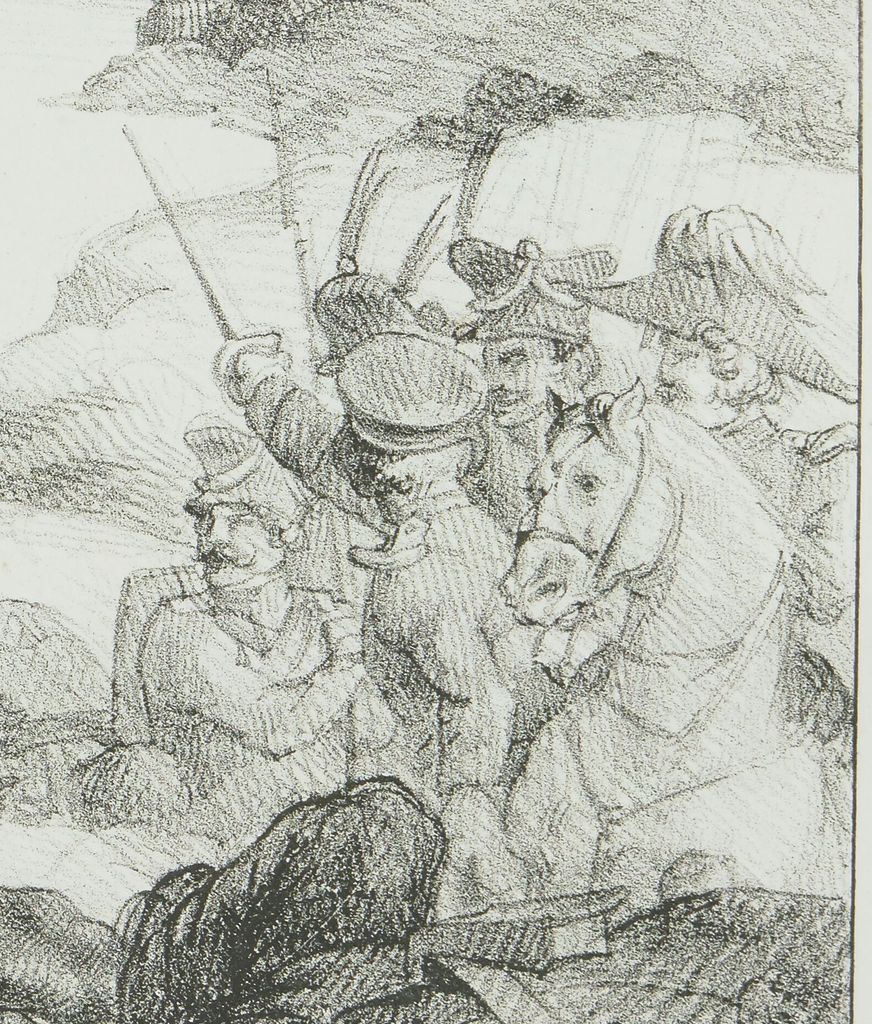
The clenched fist addresses the approaching men, while the lowered hand holds the fuse above the open chest.
A precarious footing
One boot stands in the ammunition chest; the other rests on the wheel, giving the soldier height without secure ground.
Transport brought down
The harness still connects the dead horse to the disabled wagon, making its lost power part of the soldier’s predicament.
The approaching group
Small mounted figures at the right edge occupy the space towards which the soldier directs his fist.
How black marks hold the action still
Much of the upper sheet is almost empty. The soldier’s head, shoulders and fist stand against pale paper, making their contour unusually easy to follow. Below, the wagon and bodies produce a dense accumulation of lines. The large near wheel, slanting lid and upright wheel beneath the boot give the foreground a structure of circles and diagonals. These shapes help support the figure visually even as the depicted vehicle has lost its practical stability.
Look particularly at the difference between the coat and the open sky. Small strokes build the shaded folds, the turn of the torso and the dark recesses inside the clothing. The crossed white straps cut across that modelling and keep the uniform legible. Around the fist, very little background competes with the gesture. A small, tightly drawn hand acquires force because Géricault leaves so much space around it.
The horse receives another kind of attention. Its pale body is modelled with enough care to retain volume and weight, while the harness ties it visibly to the wrecked transport. It is not merely a dark obstacle placed beneath a human hero. Its twisted, grounded form is a second centre of attention, answering the upright soldier with an image of complete physical helplessness. The relation between them supplies an emotional contrast that the relatively empty landscape could not provide alone.
Lithography allowed such drawing to become a printed image. Chantilly explains the process through a drawing made with greasy chalk or ink on prepared limestone: dampened areas without the drawing repel printing ink, while the greasy marks accept it. Paper pressed against the stone receives the image. This gave artists a means of multiplying a drawing while retaining its varied marks. [11]
In Artillery Caisson, that capacity matters because the drama depends on differences of emphasis. Close, dark marks make the chest feel solid; softer passages carry the landscape away; the isolated outline of the arm brings the confrontation back into focus. The print does not require colour to distinguish the soldier from the distant group. Scale, empty paper and the changing density of the drawing perform that work.
Courage, assistance and the vulnerable horse
A comparison with Return from Russia reveals another way Géricault pictured military endurance. The Cleveland Museum of Art describes that print’s wounded soldiers and exhausted animals as an image of the misery following Napoleon’s defeat in Russia. There, survival depends on movement and assistance. In Artillery Caisson, the transport has stopped and the central soldier’s defiance separates him from the group confronting him. [12]
The technical difference is also revealing. Cleveland’s impression of Return from Russia, dated about 1818, was printed from two stones in black and ochre, with watercolour added by hand; its white additions indicate snow. Those features belong to the Cleveland impression and should not be transferred to every example of the composition, still less to Artillery Caisson. Together the works demonstrate that Géricault could make military suffering visible through different printed effects, rather than through one fixed formula. [12]
The Mameluke Defending a Wounded Trumpeter offers a further comparison. Clément’s description emphasises the defender’s support of the wounded man and his readiness to meet the approaching Cossack. In that composition, physical courage protects another person. The caisson soldier’s action has a harsher uncertainty: his threatened explosion would involve the place where he himself stands. The comparison brings out the different relationships between heroism and vulnerability within Géricault’s military subjects. [10]
The horse is essential to that distinction. In the caisson scene, its death has removed the possibility of ordinary transport, leaving the soldier to turn the stationary wagon into a final position. Military equipment and animal strength are shown as dependent on one another. Once the horse has fallen, a vehicle made to carry ammunition becomes an exposed container of danger. The animal’s vulnerability is therefore both a subject of sympathy and a condition of the human predicament.
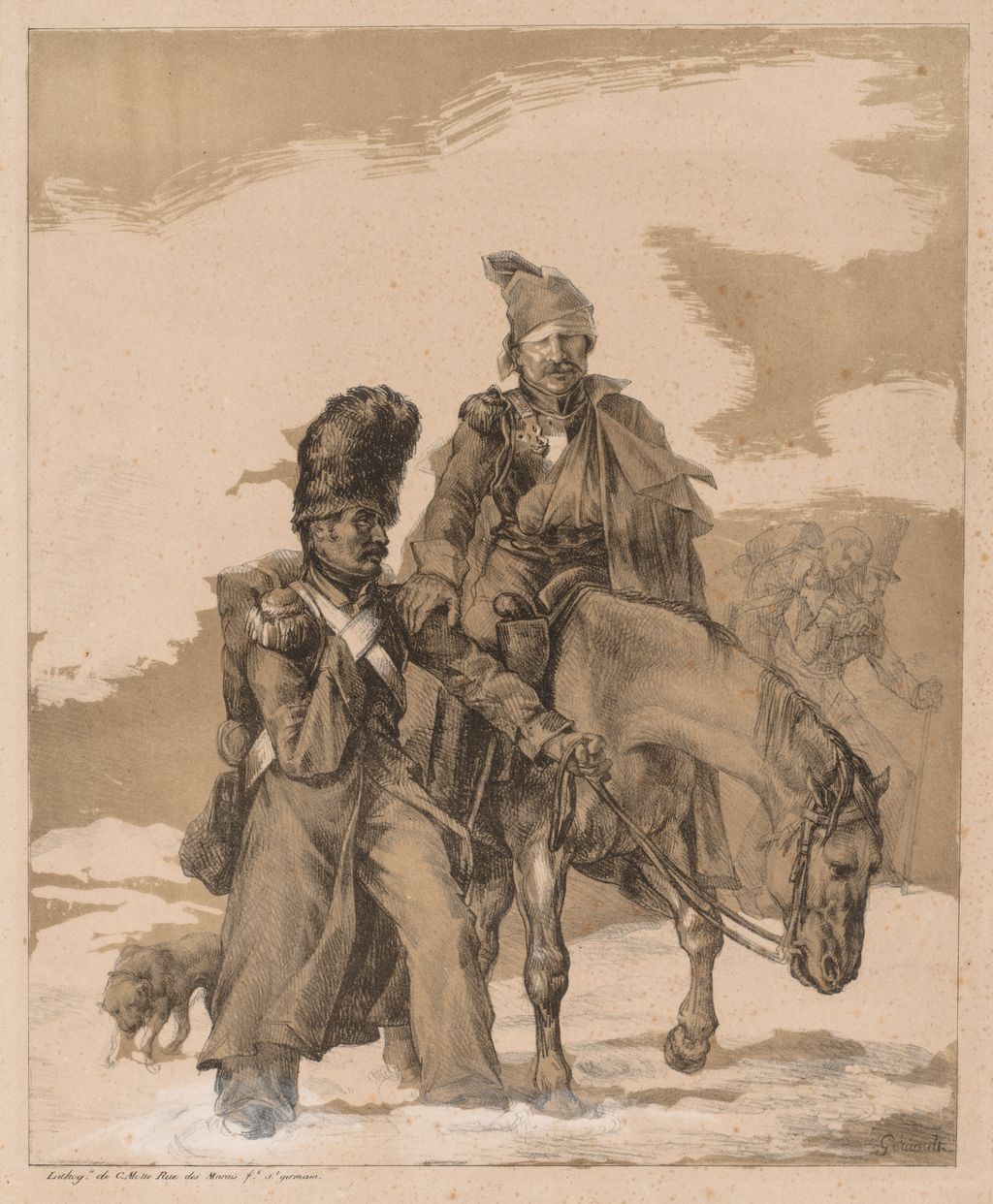
Return from Russia, c.1818 — Cleveland impression 1931.48, with hand-added colour Image source. CC0 / Public domain.
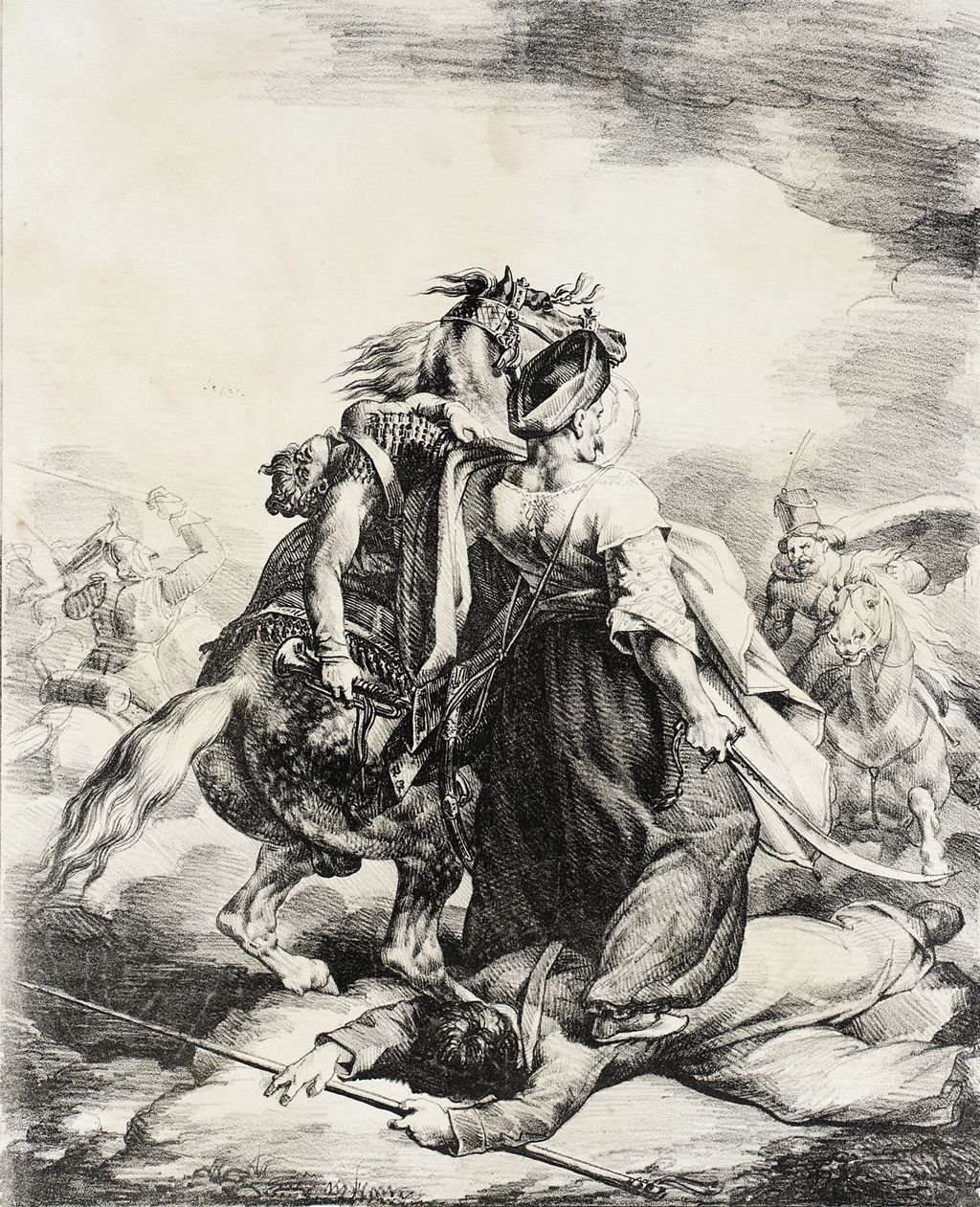
Mameluke Defending an Injured Trumpeter, 1818 — LACMA impression M.91.154 Image source. Public domain.
The design and its surviving impressions
The Rijksmuseum’s example, RP-P-2008-69, is a lithograph on paper measuring 438 × 546 mm. It entered the collection by purchase in 2008 with support from the F. G. Waller-Fonds. These are facts about that particular sheet. [1] The detailed reproduction discussed here is a separate impression held by the Bibliothèque nationale de France, identified as btv1b10029068f. The two preserve the same composition, but the Rijksmuseum’s dimensions and acquisition history belong to its own object.
Clément lists the design as number 13 and gives measurements of 414 × 523 mm, smaller than the Rijksmuseum sheet. Image measurements and full sheet measurements need to be kept separate. He also describes the print as without lettering. That observation records the condition he catalogued; it does not by itself establish a numbered state for every surviving impression. Nor does the absence of a printed title make the museum’s catalogue date an inscription on the image. [10]
Clément’s entry also preserves an anecdote about its early reception. According to the recollection he attributes to Géricault’s pupil Jamar, Madame Delpech disparaged the artist’s pursuit of lithography when Jamar collected impressions for him. This is reported testimony, not an independently documented account of the print’s sales. Its interest lies in the distance between early doubts about the medium and later collecting esteem. Chantilly’s nearly complete group of Géricault lithographs was acquired by the duc d’Aumale in 1866. [10] [11]
The image sustains that attention through a remarkably economical predicament. A fist reaches out into open space, a fuse hangs above exposed ammunition, and a dead horse makes withdrawal impossible by ordinary means. The soldier has seized control of the moment, but the print leaves its consequences unresolved. To look longer is to see both the force of his resistance and the fragile material circumstances on which it rests.
Géricault collection records
Seventy collection records include paintings, drawings and individual print impressions. Different impressions remain separate records; this selection is not a complete catalogue raisonné.
Frequently Asked Questions
His burning fuse and position above the open ammunition chest suggest that he could ignite the wagon. Géricault stops the action before showing an explosion or its consequences. [1]
Discussion
Look again at the images and ideas explored in Artillery Caisson. These editorial prompts invite your observations.
Reader Insights
How does your reading change when you look from the raised fist to the hand holding the fuse?
What happens to the soldier’s heroic stature when you consider the dead horse beneath him?
Compare this isolated resistance with the assistance in Return from Russia: what different forms of courage do they suggest?
Join the Conversation
Share a detail, comparison or question about Artillery Caisson below.
References
- Rijksmuseum, Munitiewagen / Caisson d’Artillerie, Théodore Géricault, 1818, RP-P-2008-69; object description, technique, dimensions, inscriptions and acquisition record (Dutch). View source. (in Dutch).
- Nationalmuseum, The Severed Heads, NM 2113; collection metadata and museum interpretation (Swedish). View source.
- Louvre, Charging Chasseur, INV 4885; collection metadata and museum interpretation (French/English interface). View source.
- National Gallery, Horse frightened by Lightning; collection metadata and museum interpretation (English). View source.
- Louvre, Wounded Cuirassier, INV 4886; collection metadata and museum interpretation (French). View source.
- Louvre, The Raft of the Medusa, INV 4884; collection metadata and museum interpretation (French). View source.
- Gary Tinterow / The Metropolitan Museum of Art, Géricault’s Heroic Landscapes: The Times of Day, Met Bulletin 48/3, Winter 1990–91; consulted main essay and relevant object entries (English). View source.
- Vlaamse Kunstcollectie, Portrait of a Kleptomaniac; collection metadata and museum interpretation (Dutch). View source.
- Louvre, Epsom, MI 708; collection metadata and museum interpretation (French/English interface). View source.
- Charles Clément, Catalogue de l’œuvre de Géricault: Lithographies (1866), introduction, printed pp. 3–4, and catalogue nos. 8 and 13, printed pp. 8 and 10 (scan PDF pp. 11–12, 16 and 18; French). View source. (in French).
- Château de Chantilly, Géricault et la lithographie: Le romantisme à la française, virtual exhibition based on the 2018 exhibition curated by Nicole Garnier-Pelle; sections on lithography, the Napoleonic period and the collection (French). View source. (in French).
- Cleveland Museum of Art, Return from Russia, about 1818, 1931.48; object record and interpretive description, including two-stone printing and hand-added watercolour (English). View source.


