



 by Tom Gurney
Tom Gurney BSc (Hons) is an art history expert with over 20 years experience
Email: tomgurney1@gmail.com / Phone: +44 7429 011000
Entrance to the Adelphi Wharf: Introduction
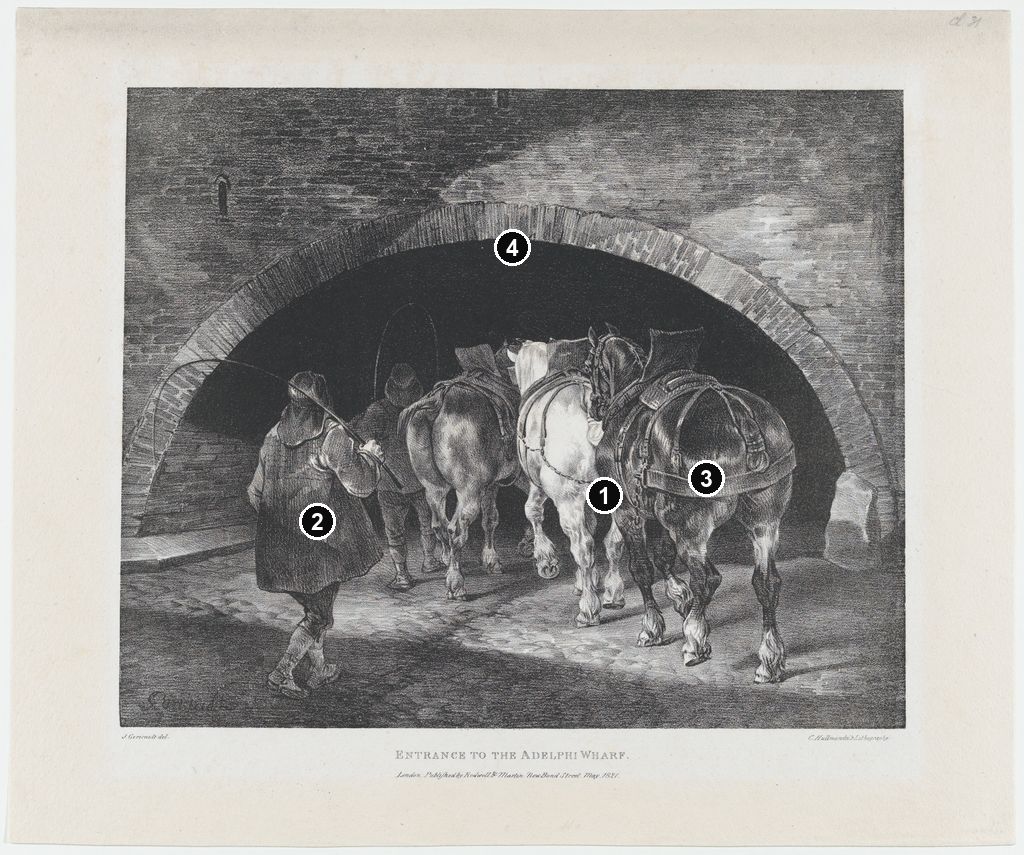
Three harnessed horses face into a low, dark arch. Their hindquarters fill the entrance, while a man at the left turns towards us, a long whip curving above his shoulder. The pale horse in the middle catches enough light to divide the group, but the passage ahead remains almost unreadable. In Entrance to the Adelphi Wharf, Théodore Géricault gives an ordinary movement of working animals the concentration of a major event. Published in London in 1821, the lithograph belongs to his English exploration of horses and the people whose work depended on them. [1]
The force of the image comes partly from its restricted view. We cannot survey the wharf, inspect a cargo or follow a clear road into the distance. We stand close behind the horses, facing the same constricted opening. Brickwork, harness, coats and lowered heads establish a place organised around physical work. The subject is local and specific, yet the arrangement asks us to consider how much of that work is carried by animal bodies.
At a Glance
- Date1821; publication imprint May 1821 [2]
- MediumLithograph [1]
- ProductionCharles Joseph Hullmandel; published by Rodwell & Martin, London [1] [2]
- Met impression22.63.25; image 25.2 × 31 cm; sheet 33 × 39.6 cm [1]
This work across Théodore Géricault’s career
The Severed Heads
1810s [3]Charging Chasseur
1812 [4]Horse Frightened by Lightning
c.1813–14 [5]The Raft of the Medusa
1818–19 [7]Portrait of a Kleptomaniac
c.1820–24 [9]The Epsom Derby
1821 [10]Contents
- A working entrance on the Thames
- How the arch holds the scene together
- Horses and men within the same task
- Drawing weight in lithography
- A London subject within an English suite
- Related drawings and different impressions
- Annotated details
A working entrance on the Thames
The Musée Condé at Chantilly identifies the setting with the Adelphi district beside the Thames, where vessels unloaded coal. Its account places the print within Géricault’s recurring attention to coal transport and to the demanding labour of men and horses. This context matters because the image itself gives us no panoramic explanation of the business carried on beyond the arch. The title names the place; the museum’s documentation supplies the connection to the coal trade. [2]
Géricault has chosen an entrance rather than the unloading of a ship or the delivery of fuel. There is no prominently displayed mound of coal to make the trade immediately legible. Instead, the harnessed animals and their handlers occupy a threshold through which work must pass. A commercial landscape is condensed into a few necessary elements: a route, a confined opening, the bodies using it and the equipment that connects them to their tasks.
This distinction also sets a useful limit on the story. The print does not establish the men’s names, their employer, their working hours or the particular journey they are making. Nor does the absence of a visible wagon tell us the whole sequence of their day. What can be seen is substantial enough: three draught horses, two men and a narrow passage within an urban workplace. The coal-wharf identification gives these details a historical setting without turning them into a documentary account of an individual shift. [2]
The entrance makes that setting felt bodily. Although its arch is broad, the procession nearly fills its lower opening. There is very little empty space around the group. Above them stretches a large expanse of masonry, its horizontal markings interrupted by the radiating bricks of the arch. The building appears durable and immovable; the bodies beneath it must keep moving. That difference between fixed structure and passing effort is one of the image’s most effective observations.
How the arch holds the scene together
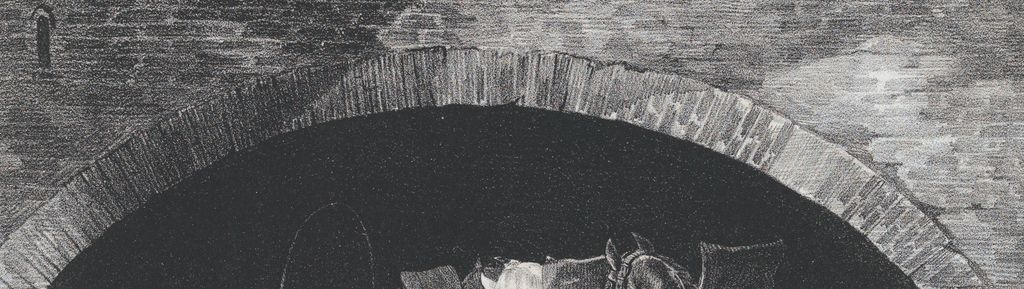
The masonry forms a great curve across the picture. Inside it, the dark passage becomes a second, heavier shape, enclosing the horses’ heads and the more distant handler. The geometry is simple enough to register at once, but the irregular drawing of the wall prevents it from becoming a neat architectural diagram. Patches of light and dark spread across the brickwork, while the upper part of the image offers almost no relief from built surfaces.
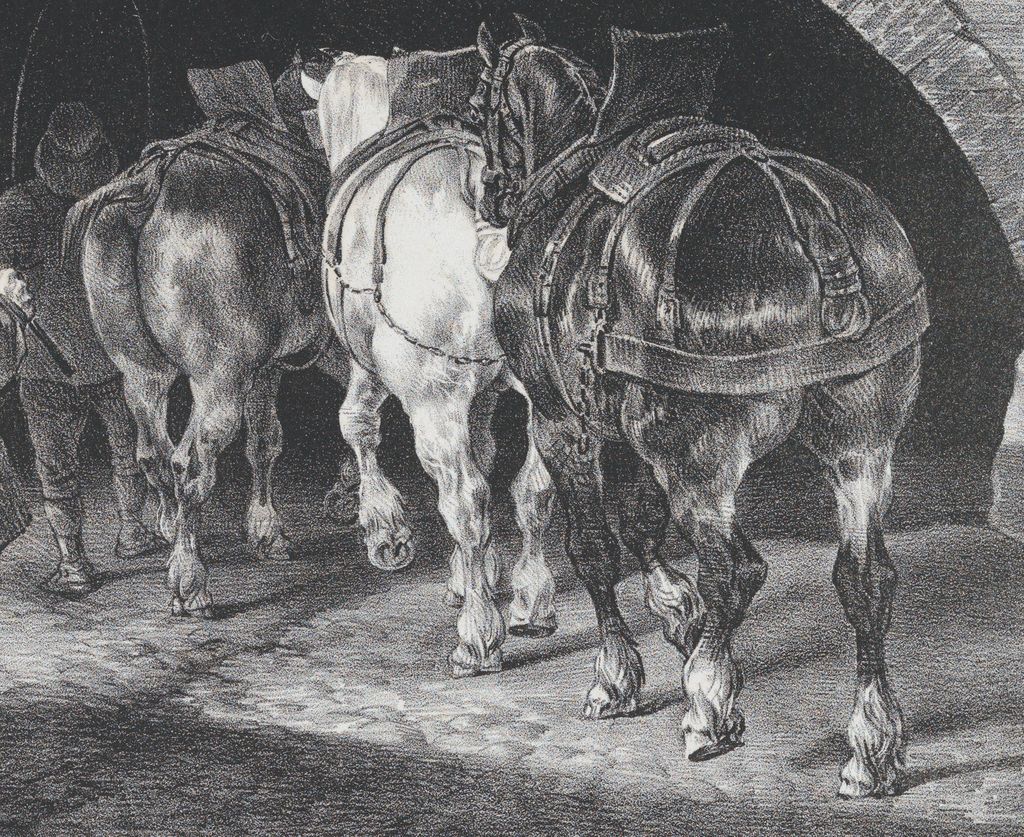
The horses move beneath and into this arch. Their backs are nearest to us; their necks and heads reach away. The horse on the right occupies the largest area and establishes the closest point of the procession. Its rounded quarters, long tail and descending legs lead the eye towards the central pale animal and then the smaller horse at the left. This uneven recession creates a sense of depth without revealing a distant view. We can follow the bodies into the passage, but we cannot see where that passage ends.
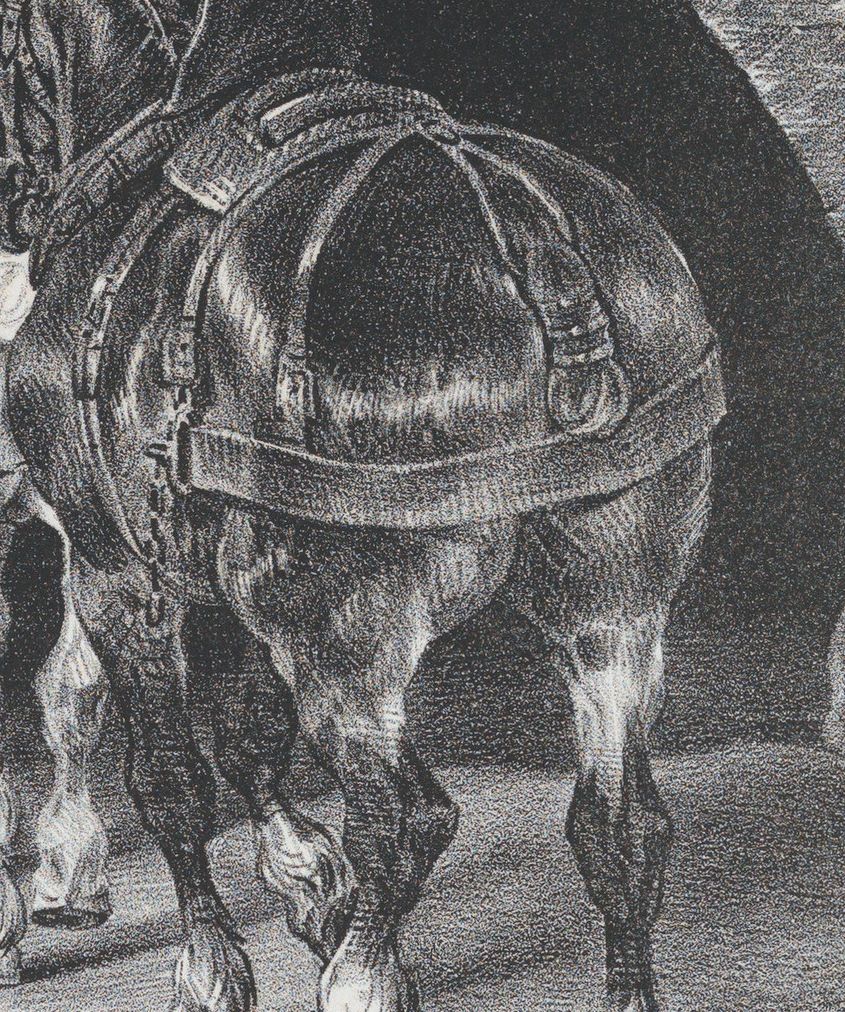
The central horse supplies the strongest break in the darkness. Its pale neck and hindquarters stand out against the tunnel, while darker harness straps cross the coat. Light does more than identify a differently coloured animal: it keeps the middle of the group intelligible where overlapping bodies might otherwise merge. On either side, the darker horses are modelled by narrower highlights. The right-hand animal’s rounded surface is especially clear because the harness crosses and partly frames it.
Lower down, the composition becomes more intricate. Hooves rise or meet the ground at different points; legs overlap; light touches the roadway between them. These details make the advance feel measured and uneven rather than mechanically synchronised. The horses share a direction, but each negotiates the ground separately. Their weight is communicated through the placement of limbs and the changing shapes of the bodies, not through a dramatic gallop.
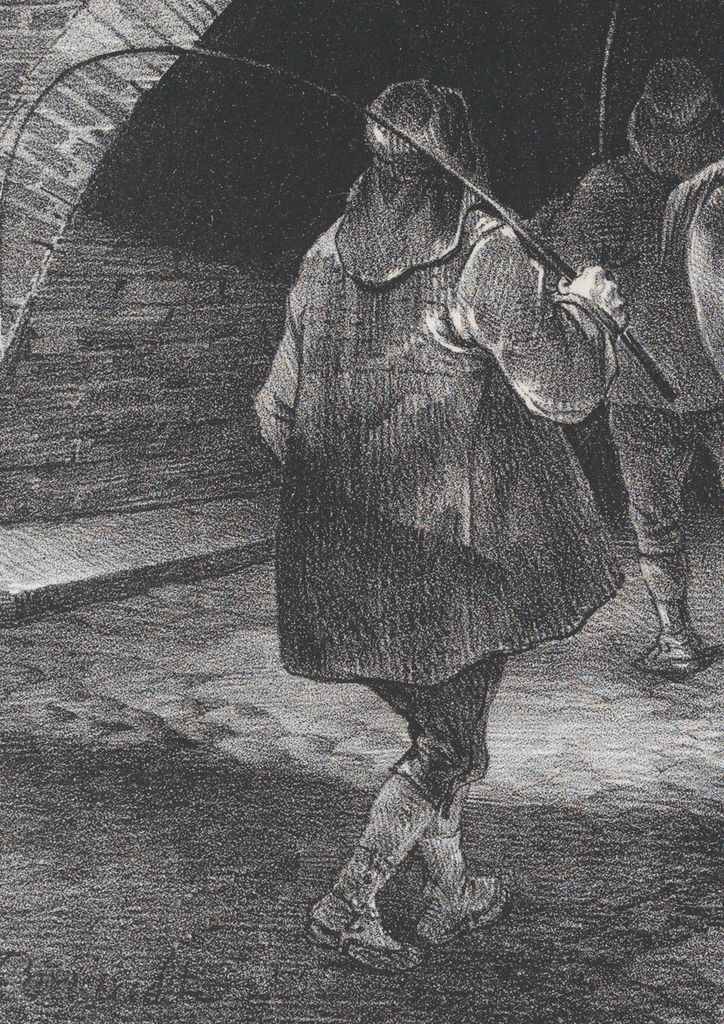
The man at the left complicates this recession. While the animals face away, his face turns outward. His crossed stepping legs and loose outer garment form an oblique shape against the more upright horses. The whip draws a long curve from the left edge towards his hand, introducing a thin, flexible line beneath the great fixed curve of the arch. Together, these two curves frame different kinds of control: the building defines the route, while the handler directs the procession.
Annotated Details from Entrance to the Adelphi Wharf
The numbered points identify visible features discussed in this article. Return from each detail to the whole composition. Entrance to the Adelphi Wharf Image source. Public domain.
Details from ENTRANCE TO THE ADELPHI WHARF
Compare the cropped details with the complete images above. Notice how their colours, shapes and positions contribute to the larger compositions.
Horses entering the arch
Backs and hindquarters face the viewer while the horses’ heads turn into the dark passage.
The foreground handler
The man’s outward-turned face and curved whip interrupt the horses’ recession into the arch.
Harness and reflected light
Broad straps cross the nearest horse’s rounded hindquarters, connecting equipment with the drawing of volume.
A curve of masonry
Radiating bricks form a low curve above the almost unbroken darkness of the passage.
Horses and men within the same task
The rear view is central to Géricault’s treatment of the animals. It makes their breadth and mass more immediately visible than their expressions. The nearest horse is not presented for inspection in a clear side profile. Its head is partly screened by its own body, the harness and the neighbouring horse. We encounter the animal first as a body advancing under equipment, with the vulnerable detail of its legs below a powerful torso.
Harness is prominent throughout the group. Straps cross coats, follow curves and divide areas of reflected light. Rather than treating the equipment as incidental decoration, Géricault makes it part of the drawing’s structure. The large horse on the right carries an especially conspicuous band across its hindquarters. The band clarifies the animal’s volume while also reminding us that this strength belongs to a system of work organised by people.
The humans do not stand outside that system. The foreground handler occupies the same roadway and moves beside the horses. Farther in, a second man is much less distinct, his hat and upper body discernible within the shadow. He helps extend the scene beyond the bright foreground without opening up its destination. Human presence continues into the darkness even where individual features cease to be readable.
The whip makes authority visible, but the print does not show a blow being struck. Equally, the horses’ deliberate movement does not by itself establish a precise condition of exhaustion or injury. Géricault’s image can make the burden of work compelling without supplying those events. The Chantilly account’s emphasis on arduous human and animal labour helps explain its social force; the visible evidence lies in mass, harness, proximity and the enclosed route. [2]
There is no single heroic protagonist. The nearest horse dominates by size, the central horse by brightness and the left-hand man by the direction of his face. Attention moves between them. Their shared task holds the group together more strongly than any one figure’s action. This balance is particularly striking in a picture where the animals occupy so much more space than their handlers.
Watch: Géricault and The Raft of the Medusa
Three perspectives on Géricault’s best-known painting, its making and its historical setting.
Gericault, Raft of the Medusa
Smarthistory examines the composition and historical setting of The Raft of the Medusa.
Watch on YouTubeDrawing weight in lithography
The print’s tonal range makes these relationships possible. The passage is densely dark, the central horse is comparatively light, and the brick wall and roadway occupy many intermediate greys. Yet the surfaces do not have an identical texture. Horizontal strokes help build the wall; shorter, changing marks describe the horses; firm lines give the harness its edges. Looking closely, we see that the apparent solidity of the scene depends on differences within the printed marks.
Chantilly’s account of Géricault’s lithography explains the process as drawing with greasy chalk or ink on prepared limestone, followed by printing in which dampened areas resist the oily ink. The technique allowed drawn marks to be reproduced without translating every passage into the cut lines of an engraving. In this image, that capacity supports both broad darkness and delicate transitions across a horse’s coat. [11]
The soft gradations are particularly useful on the hindquarters, where volume has to remain convincing despite the restricted view. The horses do not read as flat silhouettes against the arch. Light moves around their forms, while darker marks turn the flanks away from us. The masonry has weight too, but its more repetitive texture distinguishes it from living muscle. The whole composition depends on that encounter between two kinds of mass.
The lettering beneath the image records a collaborative production. Géricault supplied the design; Charles Joseph Hullmandel’s lithographic establishment produced the print; Rodwell & Martin published it in London. Chantilly transcribes an imprint dated May 1821, also visible beneath the title on the reproduced sheet. The published object therefore joins close observation to a commercial network of making and distribution. [2]
A London subject within an English suite
Entrance to the Adelphi Wharf was part of the English suite titled Various Subjects Drawn from Life and on Stone. In his 1866 catalogue, Charles Clément described the group as twelve plates with a separate title sheet and listed the Adelphi composition as the sixth subject. That distinction prevents the title page from being mistaken for a thirteenth scene. His entry also describes the three horses from behind entering beneath the vault, confirming the direction that is so important to the composition. [12]
The range of the suite helps explain why a wharf entrance could command such concentrated attention. Clément’s catalogue places it among horses being exercised, farriery, coal transport and scenes of human vulnerability. These subjects allow everyday English experience to carry a considerable emotional range. Chantilly’s exhibition essay similarly reads Géricault’s English lithographs through their attention to social conditions in an industrialising society. That is a museum interpretation of their significance, rather than a surviving declaration by the artist about this particular print. [11]
A revealing comparison is Horses Going to a Fair, another London lithograph of 1821 made with Hullmandel and Rodwell & Martin. [13] There, the horses cross uneven open ground beneath a large sky. A light-and-dark horse turns its head towards us in the foreground, while other animals and a rider follow the rising route. Individual coats, lifted heads and changing orientations make the group varied and expansive.
At Adelphi, the masonry suppresses that expansiveness. The animals’ common direction matters more than their different temperaments, and the viewer meets their backs rather than an inviting turned head. In both compositions Géricault makes movement legible through overlapping horses and stepped levels of ground. But the wharf channels that movement into a dark opening, while the country road distributes it across the landscape. The comparison reveals how strongly an environment can alter the expressive effect of similar animal bodies.
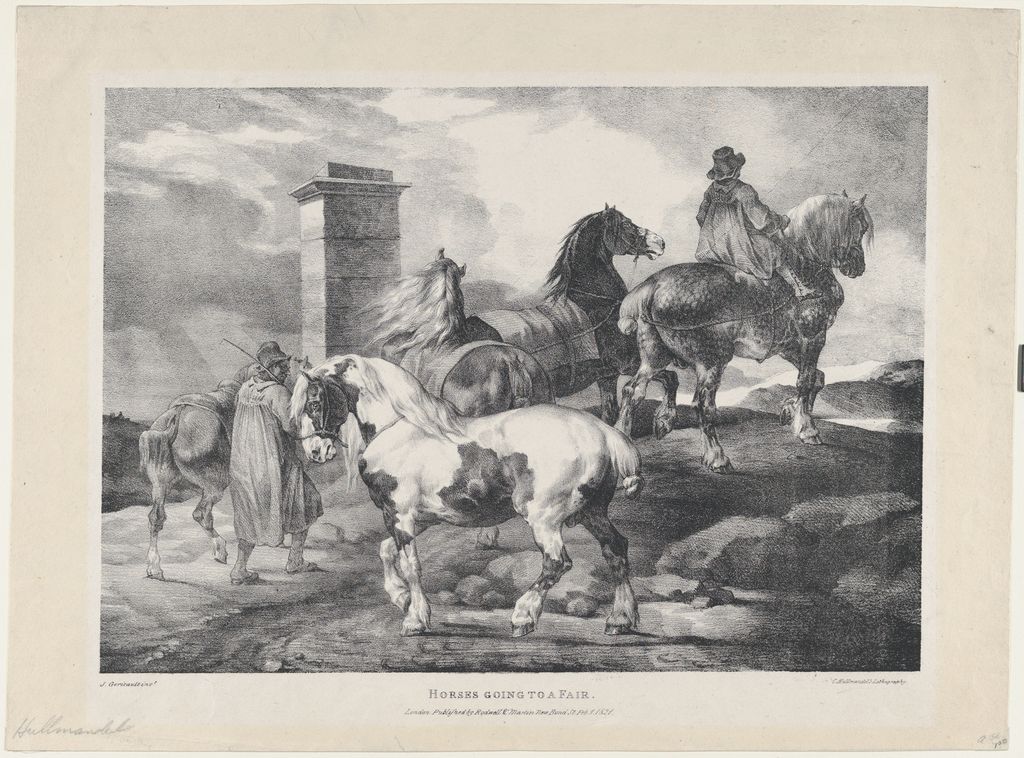
Horses Going to a Fair Image source. Public domain.
Related drawings and different impressions
Chantilly connects the print’s subject with a watercolour of coal transport in the British Museum, registered as 1968,0210.28. It also records a closely related drawing in a private collection in which the horses passing beneath the vault are represented. These connections show that coal transport and the arrangement of working horses occupied Géricault beyond this single printed composition. They do not make every related image a securely identified first stage of this lithograph. [2]
Clément provides more specific historical testimony about the nearest horse: he recorded a pencil study washed in Indian ink, then owned by His de La Salle, with the animal facing in the reverse direction to the print. He also catalogued a sepia drawing of the three horses entering a vault. These are nineteenth-century descriptions and ownership statements, not evidence of the drawings’ present locations. Their value here lies in showing how individual animal studies and a grouped composition were understood in relation to the lithograph. [12]
The lithograph itself survives as multiple impressions. The Metropolitan Museum of Art’s example, accession 22.63.25, has an image measuring 25.2 × 31 cm on a sheet measuring 33 × 39.6 cm. [1] Chantilly’s impression, inventory 2015-0-25, is recorded on a sheet measuring 37.8 × 55.8 cm. Those figures describe different physical sheets, and the Chantilly sheet measurement should not be compared directly with the Met’s image measurement. [2]
The distinction brings us back to how the work is encountered. A reproduction can fill a screen with the dark arch and the heavy horses, but the original design is a concentrated image on paper, surrounded by margins and publication lettering. Its monumental effect comes from organisation rather than physical scale. The horses nearly fill their passage, the wall nearly fills their world, and a familiar movement through a workplace becomes an image worth sustained attention.
Géricault collection records
Seventy collection records include paintings, drawings and individual print impressions. Different impressions remain separate records; this selection is not a complete catalogue raisonné.
Frequently Asked Questions
Three harnessed draught horses and their handlers entering a dark arch at a London wharf. Chantilly connects the setting with coal unloaded from vessels on the Thames. [2]
Their backs are closest to us and their heads face into the arch. The movement leads away from the viewer beneath the vault. [12]
Discussion
Look again at the images and ideas explored in Entrance to the Adelphi Wharf. These editorial prompts invite your observations.
Reader Insights
How would seeing the horses from the front change the way you read their work?
Where does the print make weight most convincing: the brickwork, harness or animals’ bodies?
Compare the arch with the open sky in Horses Going to a Fair. How does the setting change the same basic subject of horses on a route?
Join the Conversation
Share a detail, comparison or question about Entrance to the Adelphi Wharf below.
References
- The Metropolitan Museum of Art, Entrance to the Adelphi Wharf, 1821, accession 22.63.25, collection record, English. View source.
- Musée Condé, Château de Chantilly, Entrance to the Adelphi Wharf, 1821, inventory 2015-0-25, object description, inscriptions and measurements, French. View source. (in French).
- Nationalmuseum, The Severed Heads, NM 2113; collection metadata and museum interpretation (Swedish). View source.
- Louvre, Charging Chasseur, INV 4885; collection metadata and museum interpretation (French/English interface). View source.
- National Gallery, Horse frightened by Lightning; collection metadata and museum interpretation (English). View source.
- Louvre, Wounded Cuirassier, INV 4886; collection metadata and museum interpretation (French). View source.
- Louvre, The Raft of the Medusa, INV 4884; collection metadata and museum interpretation (French). View source.
- Gary Tinterow / The Metropolitan Museum of Art, Géricault’s Heroic Landscapes: The Times of Day, Met Bulletin 48/3, Winter 1990–91; consulted main essay and relevant object entries (English). View source.
- Vlaamse Kunstcollectie, Portrait of a Kleptomaniac; collection metadata and museum interpretation (Dutch). View source.
- Louvre, Epsom, MI 708; collection metadata and museum interpretation (French/English interface). View source.
- Château de Chantilly, Géricault et la lithographie, online exhibition based on the 2018 exhibition and catalogue curated by Nicole Garnier-Pelle; sections “La lithographie” and “L’Angleterre,” French. View source. (in French).
- Charles Clément, Catalogue de l’œuvre de Géricault: Lithographies (1866), English-suite heading and entries 26–38, printed pp. 13–16; related drawing catalogue entry 130 (PDF p. 88), French. View source. (in French).
- The Metropolitan Museum of Art, Horses going to a Fair, 1821, accession 17.41.9, collection record, English. View source.


