



 by Tom Gurney
Tom Gurney BSc (Hons) is an art history expert with over 20 years experience
Email: tomgurney1@gmail.com / Phone: +44 7429 011000
Mameluke Defending a Wounded Trumpeter: Introduction
A cavalryman has collapsed backwards across his horse. His head hangs to one side, an arm drops almost vertically, and his hand still holds a sword. Beside him, a standing soldier turns towards an approaching rider while extending an arm towards the wounded man. Théodore Géricault’s Mameluke Defending a Wounded Trumpeter makes protection the centre of a battle scene: the strongest figure must keep another man from falling while preparing to meet an attack. The lithograph dates from 1818. The impression in the Los Angeles County Museum of Art, titled Mameluke Defending an Injured Trumpeter, records the design on firm velin paper. [1]
The drama is immediate, but its outcome remains unsettled. A dead man lies beneath the defender’s feet, and a mounted opponent presses in from the right. The Mameluke holds his curved sword low rather than flourishing it overhead. His turned head and planted body make him the point around which the surrounding movements gather. Géricault gives him a heroic presence through the difficulty of what he is doing, with the wounded trumpeter’s helpless weight always in view.
At a Glance
- Date1818 [1]
- MediumLithograph on firm velin (LACMA impression) [1]
- Selected impressionLos Angeles County Museum of Art, M.91.154 [1]
- Image dimensions34.29 × 27.94 cm (LACMA) [1]
This work across Théodore Géricault’s career
The Severed Heads
1810s [2]Charging Chasseur
1812 [3]Horse Frightened by Lightning
c.1813–14 [4]The Raft of the Medusa
1818–19 [6]Portrait of a Kleptomaniac
c.1820–24 [9]The Epsom Derby
1821 [10]Contents
- A battle reduced to an act of defence
- The Mameluke and the memory of the Empire
- How the composition holds its tension
- Drawing made printable
- Protection among Géricault’s military subjects
- Annotated details
A battle reduced to an act of defence
The title identifies roles rather than individuals. The central defender is a Mameluke, also spelled Mamluk, of Napoleon’s Imperial Guard; the wounded rider is a trumpeter; the approaching enemy is a Cossack. Charles Clément’s nineteenth-century catalogue describes the same arrangement, including the rearing horse and the Cossack corpse in the foreground. It does not establish a named battle or identify the men. The scene should therefore be approached as a concentrated military encounter, without supplying a date or battlefield beyond the evidence. [11]
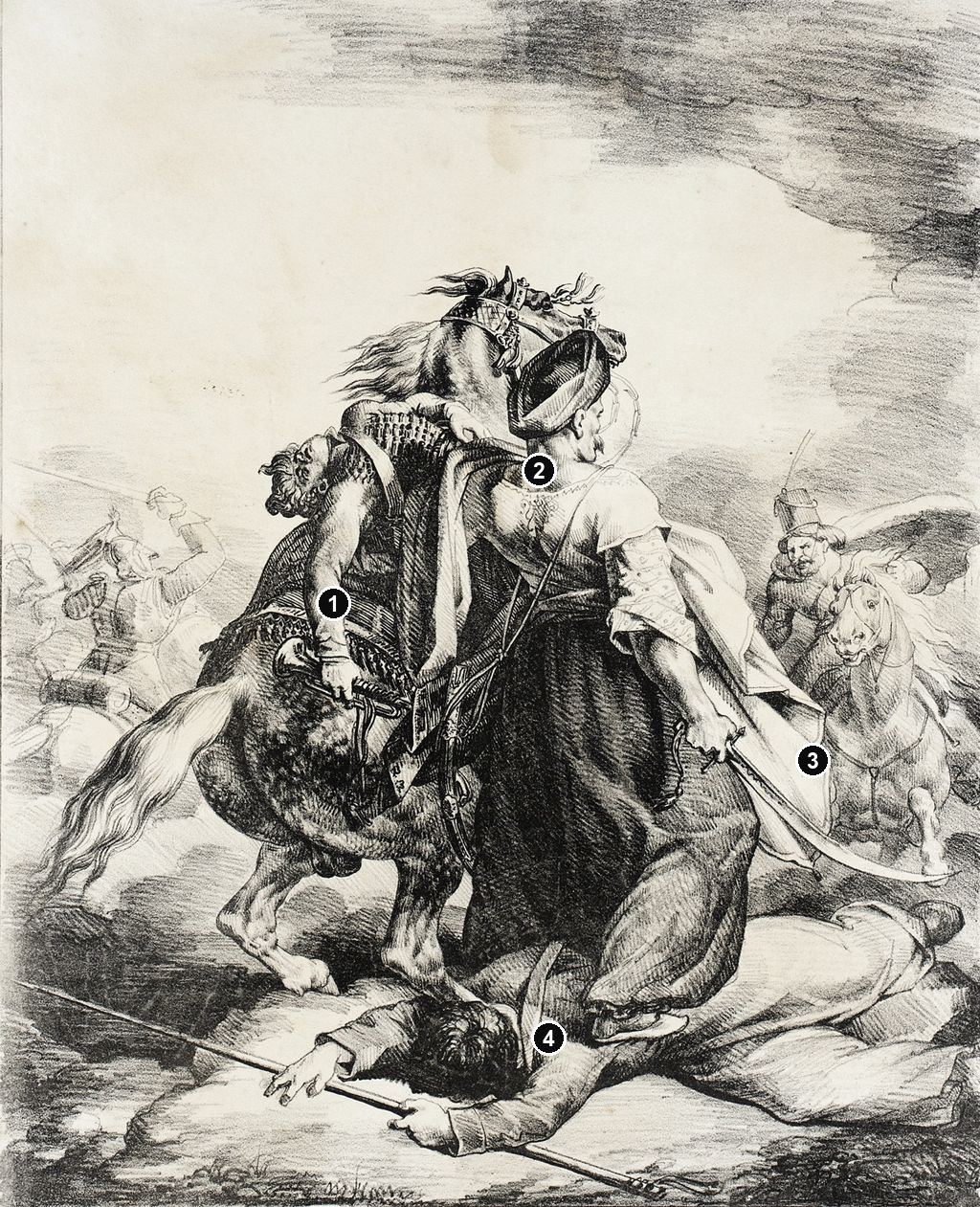
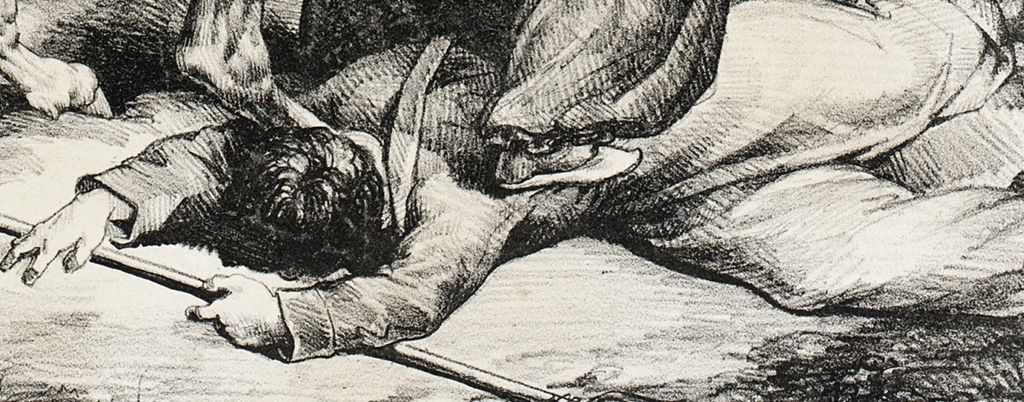
The wounded trumpeter’s position makes his danger unusually clear. His decorated jacket marks the upper part of his torso, but his head and arm sink away from the upright horse’s neck. The sword retained in his hand cannot give him command of the situation. Its hilt is close to the defender, while the hanging arm registers the loss of bodily control. Costume, weapon and horse remain the equipment of a cavalryman; his posture shows how quickly that identity can become dependent on someone else’s strength.
The horse complicates the rescue. Its lifted forelegs and high head carry the wounded man upwards while his body seems to slide down and back. Mane, straps and ornaments create small restless accents around the animal’s head. The defender must operate within this unstable knot of living bodies. His extended arm connects him to the trumpeter, but his face is turned towards the attacker. Attention and physical effort pull in different directions.
At the bottom of the image, the fallen Cossack stretches across the foreground. His head is lowered towards the ground, and a long weapon passes through the space around his outstretched arms. The defender’s foot rests on his back. That contact is disturbing because it gives the standing man a foothold on a dead opponent. The image’s act of care takes place within continued violence; the composition provides no separate, sheltered area in which rescue might become safe.
The Mameluke and the memory of the Empire
The Château de Chantilly’s museum essay places this print within the contested memory of Napoleon’s forces after the Empire’s fall. It identifies the Mamelukes as Egyptian cavalrymen who served in the Imperial Guard and explains that they suffered racism and violence under the Bourbon Restoration. Chantilly interprets Géricault’s defender as a rehabilitation of these soldiers, giving courage and loyalty to a figure who could be subject to hostility in post-Napoleonic France. This is a curatorial interpretation of the image’s political force, rather than a surviving declaration by Géricault about his purpose. [12]
The composition gives that reading something concrete to rest on. The defender is placed nearest the viewer and occupies the most commanding upright position. His face appears in clear profile against a comparatively pale area. The broad folds of his clothing enlarge his figure, while the blade at his side extends the action towards the approaching horseman. The viewer can recognise his resolve before following all the smaller incidents around him. Above all, his courage takes the form of assistance to an incapacitated comrade.
His clothing matters to the figure’s historical identity, but it does not explain his character by itself. The wrapped headgear, loose trousers and curved sword should not become an excuse for general claims about an imagined “Eastern” temperament. Géricault makes the soldier legible through posture, placement and relationships: he supports, turns, braces and waits. The personal identity of any model for the figure is unknown in the evidence considered here. Nothing in the image warrants assigning him an invented biography or treating him as a portrait of all Mameluke soldiers.
The Cossack approaching from the right creates a different kind of presence. His horse faces into the central group, and his own bent body seems to follow its forward pressure. Yet he remains smaller and farther back than the defender. Géricault allows the enemy to be visible enough to explain the immediate threat while giving the rescue the greatest physical weight. The picture’s emotional centre lies with the man who must respond to the charge, and with the vulnerable body he is protecting.
Watch: Géricault and The Raft of the Medusa
Three perspectives on Géricault’s best-known painting, its making and its historical setting.
Gericault, Raft of the Medusa
Smarthistory examines the composition and historical setting of The Raft of the Medusa.
Watch on YouTubeAnnotated Details from Mameluke Defending a Wounded Trumpeter
The numbered points identify visible features discussed in this article. Return from each detail to the whole composition. Mameluke Defending an Injured Trumpeter, 1818 — LACMA impression M.91.154 Image source. Public domain.
Details from MAMELUKE DEFENDING A WOUNDED TRUMPETER
Compare the cropped details with the complete images above. Notice how their colours, shapes and positions contribute to the larger compositions.
An arm losing its strength
The trumpeter’s head and arm hang backwards, although his hand still retains a sword.
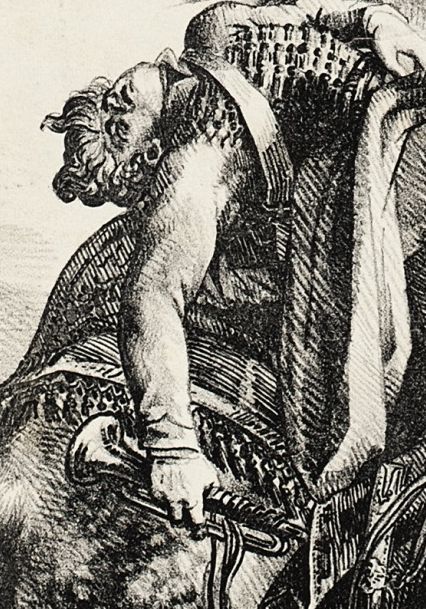
Attention divided
The defender turns towards the approaching attacker while extending his other arm into the group around the wounded rider.
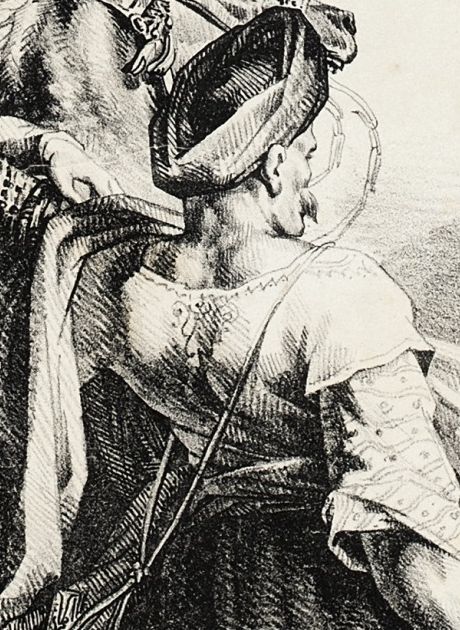
A low, curving blade
The Mameluke’s curved sword opens the central group towards the Cossack and his horse.
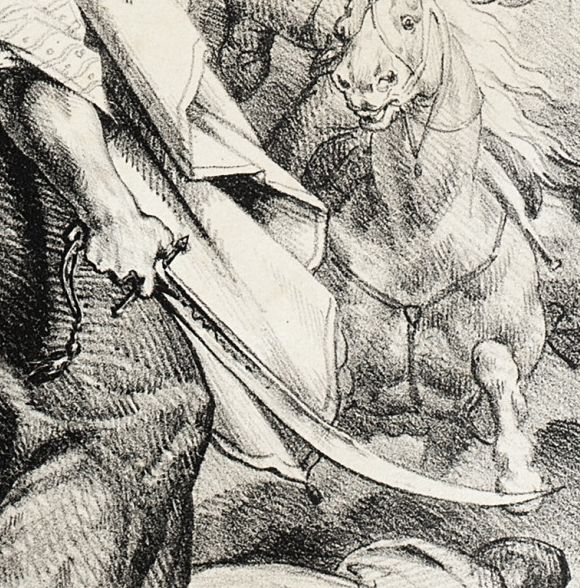
A foothold on the fallen
The defender’s foot rests on the fallen Cossack, placing the rescue directly above a body on the battlefield.
How the composition holds its tension
Much of the upper sheet is open sky. Dark, grainy strokes gather across the top and towards the right, but the largest concentration of bodies sits below. The empty space above the horse makes its head and tossing mane conspicuous. It also prevents the scene from becoming an evenly filled record of combat. Our eye is drawn towards one compact group, with the surrounding battle reduced to fragments.
On the left, riders and raised arms appear in much lighter marks. Their faintness creates distance without requiring an elaborate landscape. On the right, the approaching Cossack is more distinct, but his horse is still less densely worked than the central animal. Across the print, differences in darkness organise attention as strongly as differences in size. The setting is sufficient to suggest a battle continuing beyond the immediate encounter, while leaving its geography unresolved.
The central horse and the Mameluke overlap so closely that it takes a moment to separate their contours. The animal’s dark body rises behind the soldier; its forelegs bend beside his clothing. The defender’s light sleeve and long falling garment break up that mass. These pale passages help us find his arm, torso and sword amid the densely worked shadows. The rescue becomes understandable through a sequence of contrasts, even though the bodies themselves are tightly compressed.
Two curves are especially effective. The horse’s arched neck rises above the trumpeter, while the Mameluke’s sword sweeps towards the lower right. Between them, the defender turns outward. The curves do not complete a restful enclosure: the horse’s movement lifts the group, and the blade opens it towards danger. Meanwhile, the dead man’s horizontal body interrupts the upward energy. Looking from the foreground to the horse’s head, the viewer passes through death, resistance and precarious survival.
Clément praised the standing figure’s composure and courage in his 1866 lithograph catalogue. His response is useful as evidence of how an early cataloguer understood the work, though it cannot tell us how every contemporary viewer reacted. The qualities he admired are still available to close looking: the Mameluke’s head remains steady while the horse rears and the trumpeter hangs back. The contrast between their bodily states gives his controlled posture its expressive power. [11]
Drawing made printable
Lithography allowed a design drawn with greasy material on a prepared limestone surface to be inked and transferred to paper. Chantilly’s account emphasises the medium’s capacity for relatively rapid, inexpensive reproduction. Géricault could bring the immediacy of drawing into an image capable of circulating in multiple impressions. That possibility helps explain why a scene with the concentrated force of a major military composition exists as a sheet intended for close inspection. [12]
Here, the medium’s resources remain visible. The sky is made from broad, broken strokes, while short, closely packed marks model the horse’s body and the folds of the defender’s trousers. Elsewhere, thin lines describe tack, weapons and jacket decoration. These different textures work together within a restricted tonal range. The reader of the image moves from the large opposition of light and dark to the finer information that distinguishes a uniform, a hand or the edge of a blade.
Multiple impressions also mean multiple physical objects. LACMA’s sheet, M.91.154, was a gift of Gerhard and Marianne Pinkus; its image measures 34.29 × 27.94 cm. [1] A separate impression recorded by the Museum of Fine Arts, Houston belongs to the Sarah Campbell Blaffer Foundation and bears the number BF.1999.26. Houston gives a plate measurement of 34.3 × 27.7 cm and a larger sheet measurement of 40.6 × 32.2 cm. Its exhibition history includes The Plains of Mars in Houston, from 1 February to 26 April 2009. Those dimensions and that exhibition history belong to the Houston impression. [8]
This distinction helps preserve what a reproduction can obscure. The composition may be shared, while paper, margins, collecting history and exhibition history belong to an individual impression. Nor does the medium’s capacity for reproduction prove a particular edition size or establish how widely this design was seen in 1818. Its later place in collections is better documented: Chantilly’s nearly complete group of Géricault lithographs was acquired by the duc d’Aumale in 1866. [12]
Protection among Géricault’s military subjects
The scene gains another dimension beside Return from Russia, a lithograph of about 1818. Cleveland’s account describes wounded soldiers and exhausted animals during the retreat from Russia, emphasising the misery of the campaign. Its impression was printed from two stones in black and ochre, with watercolour additions; that technique belongs to the comparison and should not be transferred to Mameluke Defending a Wounded Trumpeter. The connection between the two designs lies in their attention to bodies that can no longer function independently. [13]
In Return from Russia, survival is bound up with movement through exhaustion. Here, assistance must happen at the instant of renewed combat. The defender’s upright strength and the trumpeter’s collapse coexist in one tightly joined group. Care cannot wait until the fighting has ended. That pressure makes the work more complicated than an image of a single victorious warrior: whatever happens to the approaching enemy, the wounded man still needs support.
Géricault had already made the horse and cavalryman a monumental subject in The Charging Chasseur, painted in 1812 and exhibited at that year’s Salon. [3] The later lithograph returns to the physical excitement of mounted warfare while shifting attention towards the effort needed to keep a soldier from falling. Its most memorable figure stands on the ground, facing danger with another man’s life literally within reach. The unresolved encounter holds that responsibility before us.
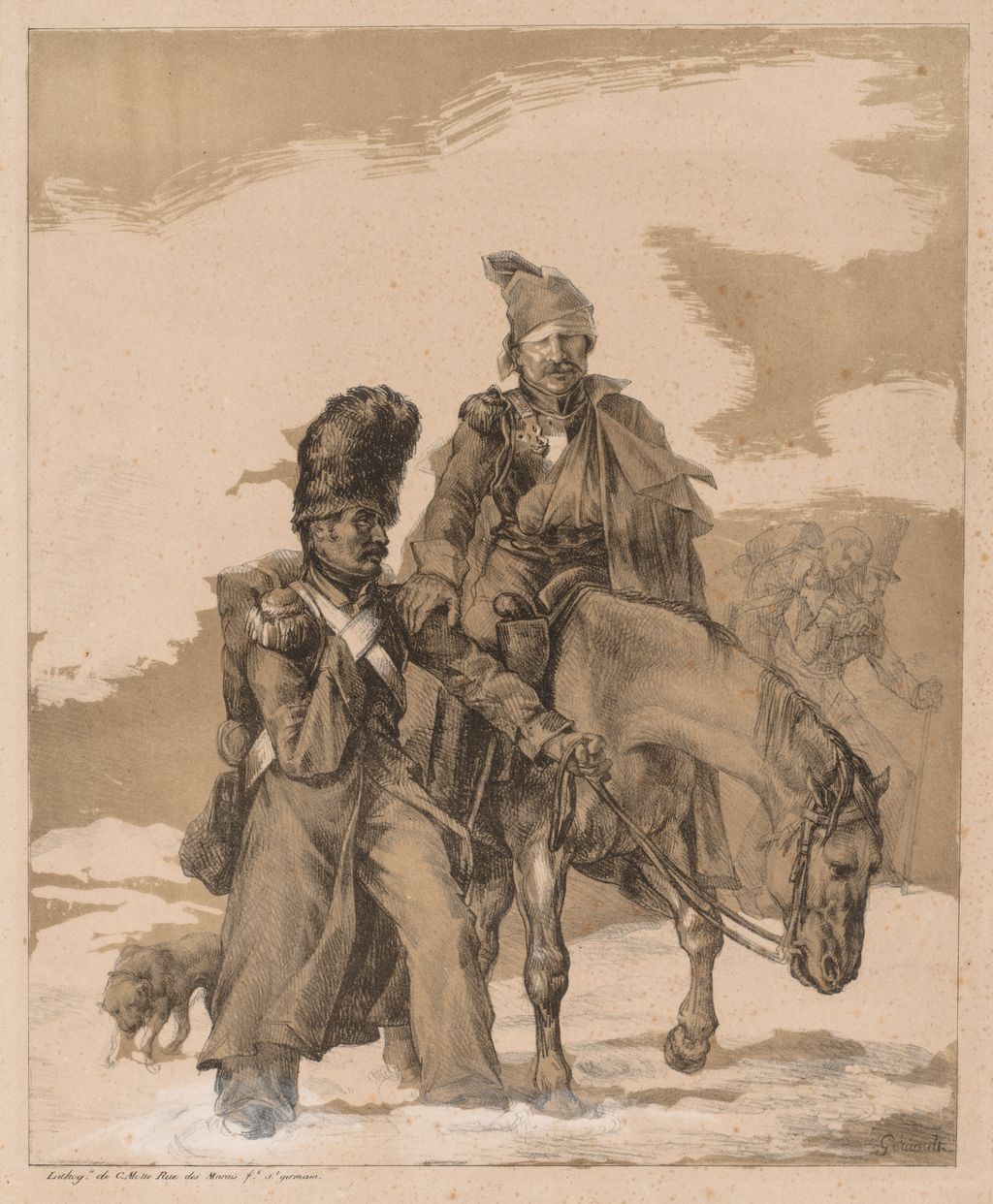
Return from Russia, c.1818 — Cleveland impression 1931.48, with hand-added colour Image source. CC0 / Public domain.
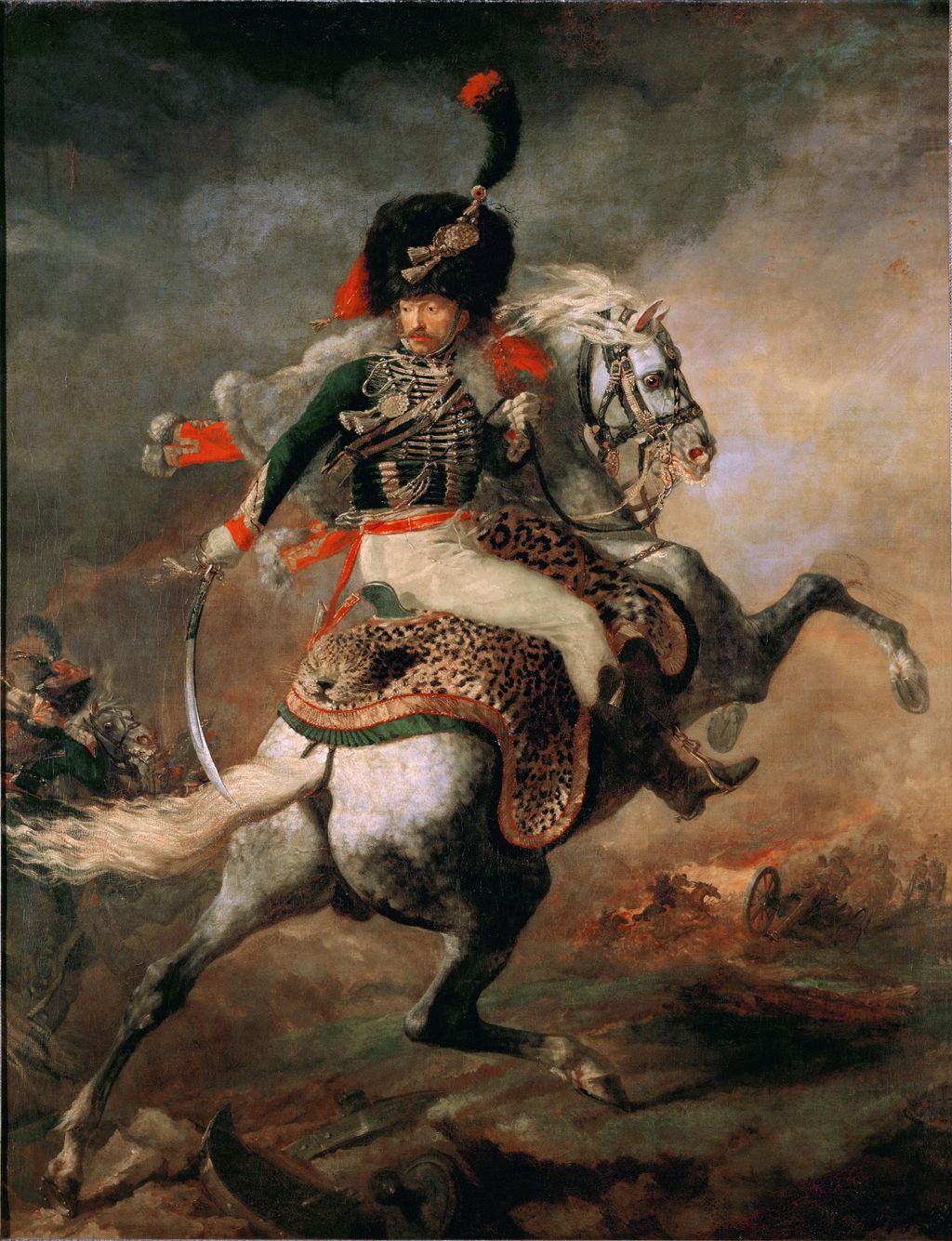
The Charging Chasseur Image source. Public domain.
Géricault collection records
Seventy collection records include paintings, drawings and individual print impressions. Different impressions remain separate records; this selection is not a complete catalogue raisonné.
Frequently Asked Questions
He protects a wounded cavalry trumpeter who has collapsed backwards across a rearing horse, while a Cossack approaches from the right. [11]
The historical account identifies the soldiers’ roles but does not establish a named battle or the identities of the men. [11]
Discussion
Look again at the images and ideas explored in Mameluke Defending a Wounded Trumpeter. These editorial prompts invite your observations.
Reader Insights
How does the trumpeter’s hanging arm change your response to the defender’s sword?
Follow the darkest areas of the print. Where do they draw your attention before you notice the distant riders?
What changes when you compare the immediate rescue here with the slow exhaustion of Return from Russia?
Join the Conversation
Share a detail, comparison or question about Mameluke Defending a Wounded Trumpeter below.
References
- Los Angeles County Museum of Art, Mameluke Defending an Injured Trumpeter, 1818, M.91.154, object metadata and dimensions. View source.
- Nationalmuseum, The Severed Heads, NM 2113; collection metadata and museum interpretation (Swedish). View source.
- Musée du Louvre, Officier de chasseurs à cheval de la Garde impériale, chargeant, 1812, INV 4885; MN 50, object record and Salon history, French. View source.
- National Gallery, Horse frightened by Lightning; collection metadata and museum interpretation (English). View source.
- Louvre, Wounded Cuirassier, INV 4886; collection metadata and museum interpretation (French). View source.
- Louvre, The Raft of the Medusa, INV 4884; collection metadata and museum interpretation (French). View source.
- Gary Tinterow / The Metropolitan Museum of Art, Géricault’s Heroic Landscapes: The Times of Day, Met Bulletin 48/3, Winter 1990–91; consulted main essay and relevant object entries (English). View source.
- Museum of Fine Arts, Houston, Mameluke defending a wounded trumpeter, 1818, Sarah Campbell Blaffer Foundation, BF.1999.26, object metadata and exhibition history. View source.
- Vlaamse Kunstcollectie, Portrait of a Kleptomaniac; collection metadata and museum interpretation (Dutch). View source.
- Louvre, Epsom, MI 708; collection metadata and museum interpretation (French/English interface). View source.
- Charles Clément, Catalogue de l’œuvre de Géricault: Lithographies, 1866, p. 8, no. 8 (digitised scan PDF p. 16), French; historical description and critical response. View source. (in French).
- Château de Chantilly, Géricault et la lithographie, virtual exhibition based on the 2018 exhibition curated by Nicole Garnier-Pelle, particularly “La lithographie” and “L’époque Napoléonienne,” French. View source. (in French).
- Cleveland Museum of Art, Return from Russia, about 1818, 1931.48, object record and technical description. View source.


