



 by Tom Gurney
Tom Gurney BSc (Hons) is an art history expert with over 20 years experience
Email: tomgurney1@gmail.com / Phone: +44 7429 011000
Horses in Géricault’s Art: Introduction
A horse seen from behind, walking into a dark wharf entrance, belongs to a different world from a cavalry mount rising beneath an officer’s sword. Yet both give animal bodies a commanding place in Théodore Géricault’s art. Horses carry men, resist them, serve them and sometimes occupy a picture without any human attendant. Following these changes reveals more than a favourite subject: it shows how Géricault varied the relationship between physical power and the forces directing it.
His horses cannot all be described as symbols of freedom. Some are restrained before a race, others trained for battle or fitted with heavy working harness. Nor does their importance depend entirely on spectacular movement. The alert stillness of a standing animal can be as absorbing as a charge. In the National Gallery’s A Horse frightened by Lightning, for example, the body remains upright on its legs while a visible eye and open mouth register alarm. The museum explicitly distinguishes this arrested response from the familiar drama of rearing. [1]
Across paintings, drawings and lithographs, the same attention to shoulders, heads, weight and coat serves different purposes. A horse may be studied as an individual, made part of a public spectacle, or placed within the ordinary work of a city. Looking across these subjects brings out Géricault’s range without making every animal tell the same story.
At a Glance
- Recurring rolesIndividual study, cavalry mount, racer and working horse [1] [2] [3] [4]
- Early comparisonStudy of a Dapple Grey, circa 1812; A Horse frightened by Lightning, about 1813–14 [5] [1]
- Roman race project1817; preparatory studies survive for an unrealised large painting [3] [6] [7]
- English subjectsRacing, fairs, farriers and London wharf labour, including lithographs of 1821 [8] [9] [4] [10]
Contents
- Looking at an individual horse
- Cavalry: power carried and controlled
- Rome: riderless does not mean uncontrolled
- British racing: the image of speed
- Horses at work: care, commerce and the city
- Vulnerability and the limits of strength
- A legacy of different ways of seeing
Looking at an individual horse
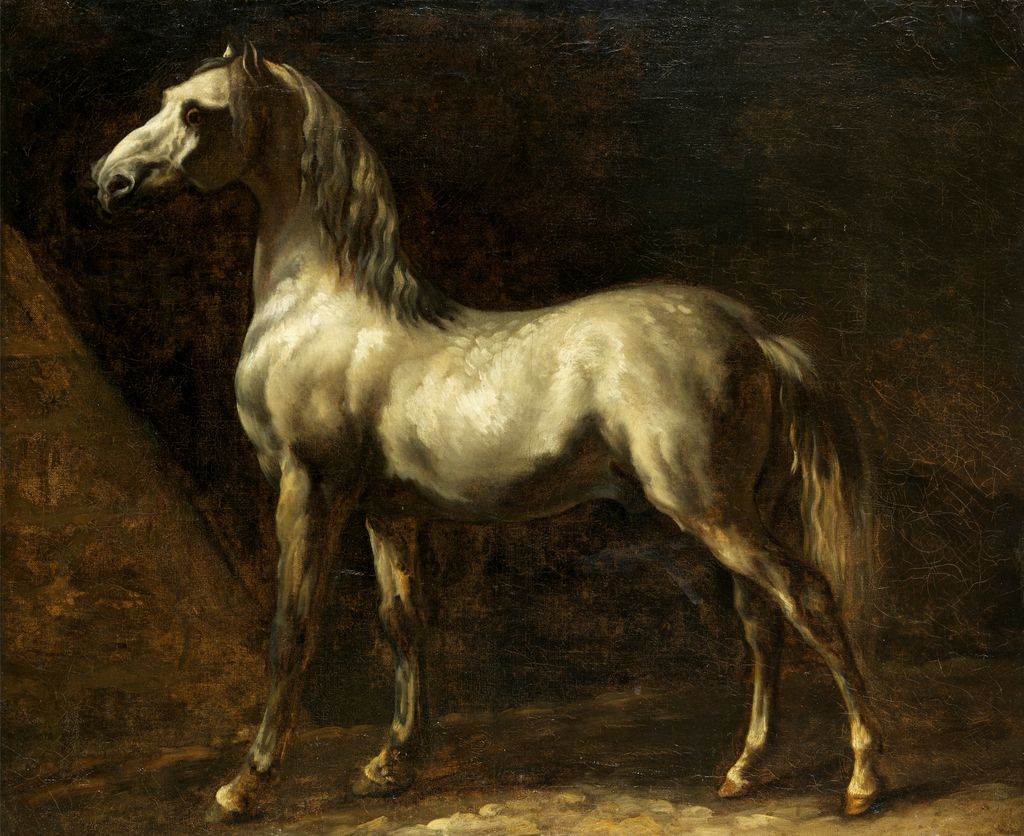
The Study of a Dapple Grey, painted around 1812 and now in Rouen, concentrates attention on the horse’s bodily presence. The pale animal faces left against a dark setting. Its neck rises sharply, the mane falls in distinct strands, and bright patches of paint articulate the shoulder and rounded flank. Its legs establish a standing posture; the drama lies in how light and modelling make the body emerge. Rouen’s museum identifies a revision in the position of the tail and emphasises the anatomical character of the head. [5]
This combination of a strongly constructed head and a luminous coat matters. An anatomical study might seem to promise a body understood through separate parts, while the painting gives us the immediate impression of a living whole. The shoulder, belly and hindquarters belong to one substantial animal. The pattern of the coat does not sit on top of that construction like decoration: the changing lights help the eye read its volumes. Even without a rider or an elaborate setting, there is plenty to examine.
Rouen introduces the picture through Germain Bazin’s interpretation of Géricault’s turn towards direct observation in the stable. Bazin’s comparison with the more aristocratic or heroic horses of other painters is a critical judgement, relayed by the museum, rather than a statement by Géricault. It is useful because it draws attention to the choice of an ordinary place of study: the horse’s own surroundings, where the painter could observe it closely. It need not imply that Géricault had put artistic training or pictorial invention aside. [5]
The National Gallery makes a related distinction in its account of A Horse frightened by Lightning, dated about 1813–14. It treats the work as a portrait of a particular animal rather than a general illustration of a breed. The horse fills the canvas in profile, with no attendant, saddle or identifiable stable to explain its status. Its dappled surface, dark legs, long neck and attentive head give it a specific appearance. The museum suggests a possible association with Géricault’s studies at the Imperial stables at Versailles, while leaving that connection uncertain. [1]
The two paintings also show how much can change while a basic standing format remains. In Rouen, light builds a pale body against shadow. In the National Gallery picture, the dark weather and lightning make illumination part of an event. Short strokes following the body’s contours give the coat an active surface. The horse’s immobility intensifies its alarm: the eye, mouth and set of the head become more significant because the entire body has not erupted into action. Description of fear comes through observed animal features rather than a human gesture imposed on them.
These works offer a useful starting point for the larger subject. Before the horse becomes a vehicle for military glory, racing excitement or economic labour, it can hold the viewer’s attention on its own. Later compositions repeatedly test what happens to that bodily independence when people enter the picture.
Study of a Dapple Grey Image source. Public domain.
Cavalry: power carried and controlled
In the Charging Chasseur, the horse helps create a public image of military distinction. Géricault exhibited this monumental canvas in 1812, initially under the title Portrait équestre de M. D[ieudonné]. The Louvre records its height as 349 cm: the mount participates in an image far larger than an intimate stable study. The same painting returned to the Salon in 1814 as Un Hussard chargeant. Its changing historical titles connect personal portraiture with a more general military identity. [2]
The officer turns in the saddle while the horse rises, so man and animal do not simply point in one direction. The rider looks back across the picture; the horse’s raised forelegs project to the right. Reins, saddle and the rider’s seat bind these different movements together. The richly patterned saddlecloth spreads across the flank, and the animal’s broad body sustains the brilliant uniform above it. Military display depends on the horse’s size and energy as much as on the officer’s clothes or weapon.
Yet the mount is more than a platform. Its eye, lifted head and open mouth remain forceful presences beside the rider’s face. The composition makes controlled riding look like an unstable achievement. We can see the equipment and the rider’s position, but we also see a powerful body capable of movements that must be answered. The tension between training and animal energy helps animate the portrait.
The Wounded Cuirassier, shown in 1814, rearranges that relationship. The Louvre identifies a dismounted soldier with an unmounted horse, and records a canvas 358 cm high. Man and animal still occupy the scale of a major public painting, but the man now negotiates the ground on foot while holding the reins. The title names an injury, although it does not follow that a particular wound can be located visually. [11]
The horse’s bulk looms behind the soldier. Its head lifts above his helmet while its body occupies much of the upper right. Instead of a rider elevated by his mount, there are two bodies whose movements have to be managed together. The soldier’s turned face and extended arm complicate his descent; the horse’s presence makes that descent a shared problem. The pair invites a comparison between martial command and the difficulty of getting safely away.
It is tempting to make the two canvases a perfectly legible story of imperial triumph followed by defeat. The comparison has historical force, but the pictures leave more open than that formula allows. The Clark catalogue’s discussion of Géricault’s military subjects stresses their ambiguity and the frequent absence of direct engagement with an enemy. Precise uniforms and convincing horses do not necessarily supply an identifiable battlefield episode or a single political message. [12]
The horses help sustain that openness. They make military power physically impressive while reminding us that it relies on vulnerable, responsive bodies. A mount can carry a soldier into a charge; it can also become another living being that must be led through danger.
Rome: riderless does not mean uncontrolled
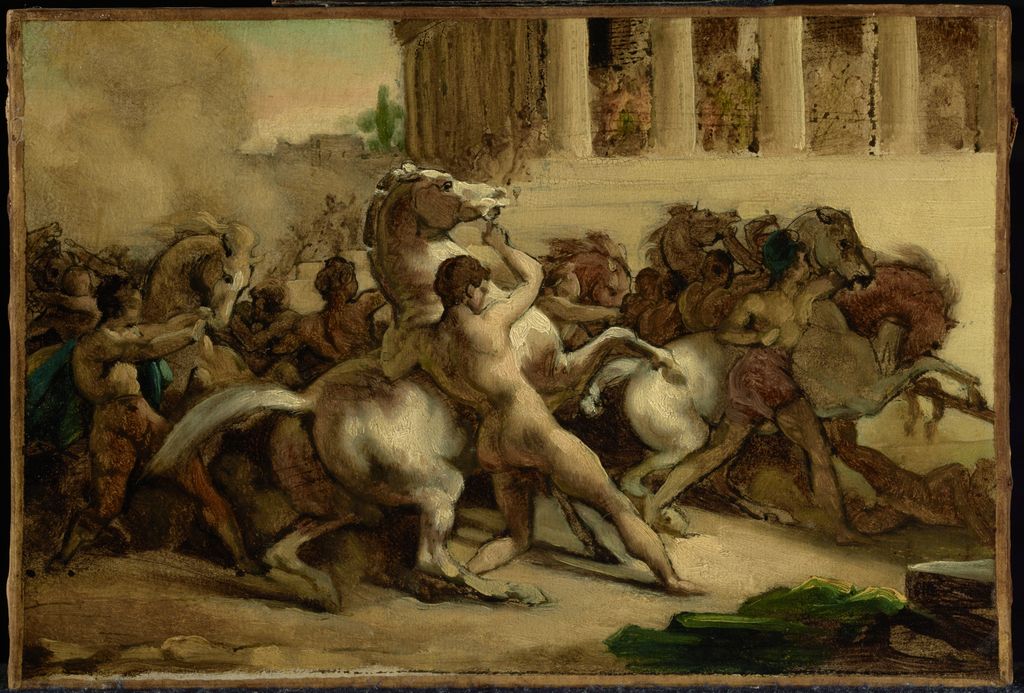
The Roman Carnival races offered Géricault a different arrangement of horses and men. He witnessed the spectacle during his Italian stay and made numerous studies in 1817. The horses raced without mounted jockeys, but the surviving images repeatedly concentrate on their handling. The Getty’s Race of the Riderless Horses represents the struggle immediately before the start. It belongs to an ambitious project for a large painting that Géricault did not complete. [3]
The contrast with the Chasseur is revealing. In the cavalry painting, a single rider maintains his place above a rising horse. In the Getty study, men stand among the animals, reaching, pulling and bracing themselves. The central groom’s body is pressed into the horse’s movement. Other heads and limbs overlap so tightly that control appears to require coordinated exertion from several people. The absence of a rider has increased the visibility of human work around the horse.
This is a small work, only 19.8 × 29.1 cm, made with oil and pen and ink on paper laid on canvas. It nevertheless aims at a large, concentrated effect. Pale bodies stand out from brown shadow, and curves of necks and backs join into a dense band across the foreground. The Getty relates the muscular nude figures to ancient athletes and the horses to the Parthenon frieze. These comparisons explain how Géricault transformed a contemporary entertainment through classical forms. [3]
Antiquity here does not replace observation with serene idealism. The antique references heighten a contest of strength. Human torsos and horse bodies become comparable masses, both capable of force and both caught in exertion. The picture brings the groom unusually close to the status of a heroic figure. Its grandeur comes from his difficult physical relationship with the animal.
The Louvre’s Course de chevaux libres à Rome, RF 2042, presents another concentrated struggle between handlers and unmounted horses. A bare-chested man in green trousers braces himself beside a chestnut horse, while a pale wall separates the foreground action from spectators behind it. Compared with the Getty’s smaller study, this arrangement makes the division between bodily exertion and public watching especially clear. The Louvre dates its oil on paper, mounted on canvas, to around 1817 in the object history. It is a distinct study, neither the Getty’s 85.PC.406 nor the Thyssen’s winning-horse procession, and does not establish an ordered sequence of designs. [6]
The Roman studies must also be distinguished by the moments they show. Mar Borobia identifies the Thyssen-Bornemisza painting as a ceremonial stage after the race: a winning horse, covered with green and gold cloth, is led by a young man carrying a yellow flag. This is a separate painting and a different action from the Getty’s struggle before the start. [7]
The winner’s procession restores a more orderly relationship between person and horse. The animal has become an object of public honour, adorned and led through a ritual. Seen beside the Getty study, it suggests the range of the project: resistance could be followed by celebration, and physical force by ceremonial display. We should not turn those separate studies into a securely reconstructed sequence for a final painting that never existed.
Drawing was another means of working through the subject. The Louvre’s brown-ink sheet La course des chevaux libres, inventory INV 26736, is catalogued as preparatory to one of the painted sketches. The record connects it with a wider group of studies and identifies the race’s course along the Corso in Rome. A drawing can investigate the arrangement of bodies without being another painted version of the same size or finish. Keeping media separate makes the variety of Géricault’s preparation easier to understand. [13]
The Race of the Riderless Horses — Getty study Image source. CC0 / Public domain.
Watch: Géricault and The Raft of the Medusa
Three perspectives on Géricault’s best-known painting, its making and its historical setting.
Gericault, Raft of the Medusa
Smarthistory examines the composition and historical setting of The Raft of the Medusa.
Watch on YouTubeBritish racing: the image of speed
The English racing picture traditionally called the Epsom Derby shifts attention from the struggle surrounding release to the apparent rush of a race already under way. The Louvre dates it to 1821 and gives its current title as a horse race traditionally known as the Derby of 1821 at Epsom. That wording leaves the identification qualified; the canvas should not be treated as a reliable record of a named winner or a precisely established race. [8]
Four horses and riders extend across a low strip of landscape beneath a vast, changeable sky. Heads reach forward, legs stretch outward and the bodies seem suspended above the turf. The dark foreground horse joins separate movements into a long horizontal form. The jockeys’ contrasting clothes help distinguish competitors, but the horses’ overlapping bodies make the group feel like one advancing wave. There is little of the Roman study’s crowded resistance. Space has opened ahead.
The elongated gallop belongs to the painting’s construction of speed. It carries the eye rapidly along the animals, making their progress feel continuous even though a painting holds every part still. The important pictorial question is how stretched bodies, low ground and a broad sky combine to produce a compelling impression of racing.
This is a different answer to the problem posed by the standing studies. There the painter directs attention around an individual body; here he directs it along a course. The pale grey horse catches the light and separates itself from the darker animal in front, but neither is isolated for prolonged inspection. Each belongs to a competitive arrangement in which position matters. The picture makes individuality visible within collective speed.
Roman and British racing thus gave Géricault two sharply different ways to organise equestrian spectacle. One puts grooms and horses into a compressed scene of preparation and restraint. The other distributes riders and mounts across an open horizontal field. Their differences are as instructive as their common subject.
Horses at work: care, commerce and the city
The same English period produced lithographs in which horses belong to everyday labour. The Metropolitan Museum dates both Horses Going to a Fair and Entrance to the Adelphi Wharf to 1821, crediting Charles Joseph Hullmandel as lithographer and Rodwell & Martin as publisher. Their printed form carried these observations into a market beyond the unique painted canvas. [9] [4]
Horses Going to a Fair offers a procession rather than a race. The animals differ in coat, build and pose. A conspicuously light, patch-marked horse occupies the foreground, while others overlap behind and climb towards the right. An adult walks among them while a child rides the leading horse, a distinction also recorded in Charles Clément’s historical catalogue. [14] The route rises, encouraging the eye to compare bodies at different angles instead of reading them as a uniform line of competitors.
The fair named in the title gives this gathering a commercial destination, although it does not identify a particular event. The horses are being moved through the countryside as animals with practical and exchange value. Still, the foreground horse’s turned head and strongly marked coat claim the kind of individual attention found in the early oil studies. Commerce has not made them visually interchangeable. The subject allows variety itself to become the organising principle.
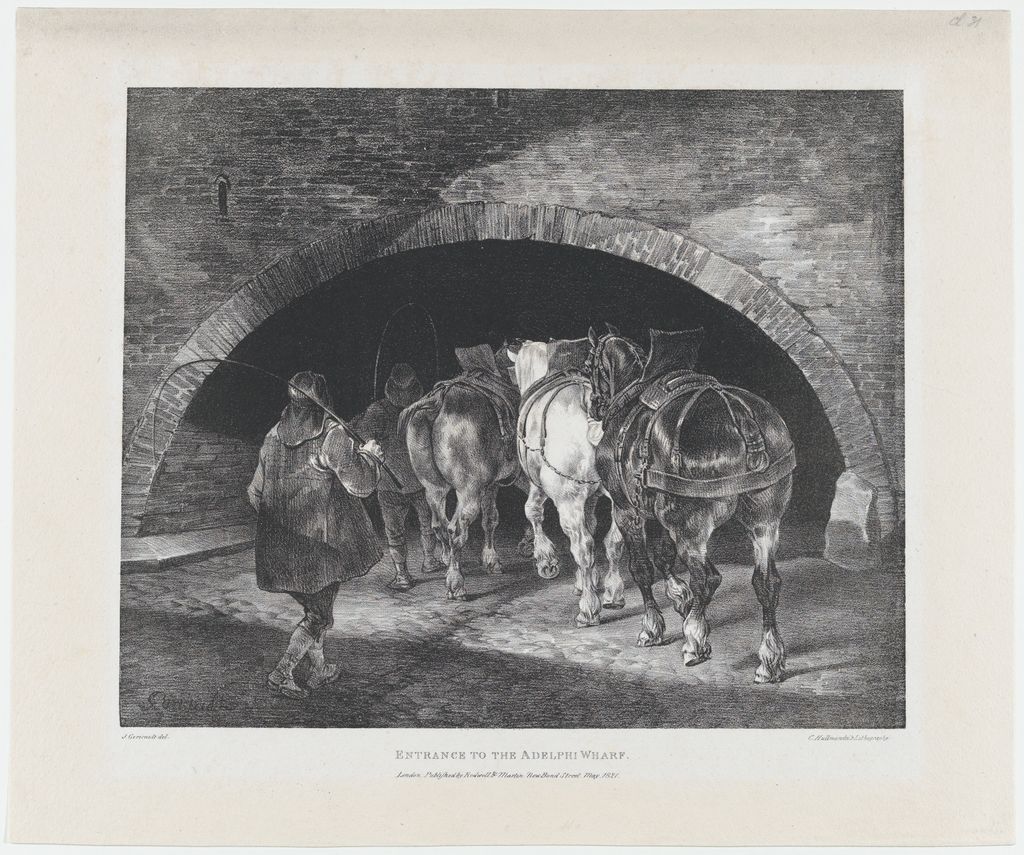
Entrance to the Adelphi Wharf changes the viewer’s position. Three harnessed horses face into a large dark arch; we see their hindquarters and follow their direction of travel. The central pale animal stands between darker companions. Harness crosses their backs, and the man at the left shares the confined approach to the opening. The bodily strength admired in cavalry and race pictures now belongs to the work of a London wharf. [4]
The rear view is crucial. There is no horse’s face to hold the viewer through a startled eye or flared mouth. Instead, rounded haunches, lifted feet and the repeated curves of harness convey weight and motion. The arch presses its broad outline around the group and draws the animals into shadow. The image makes a working route, and the effort of passing along it, worth sustained attention.
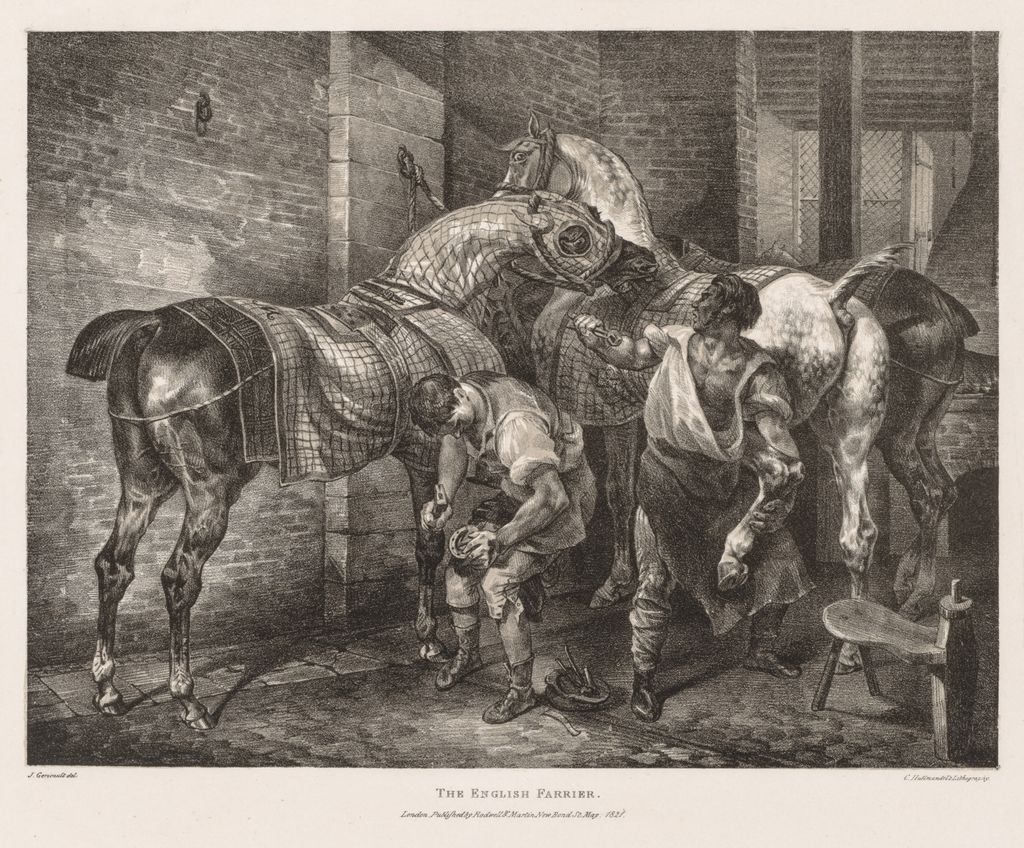
Care and handling also appear in The English Farrier. Chantilly’s museum essay describes two farriers attending three horses, including a blanket-covered animal trying to bite its neighbour. The subject joins necessary maintenance to differences of temperament: human work does not abolish the animals’ responses to one another. The museum reads the scene as evidence of Géricault’s knowledge of and affection for horses. [10]
Labour brings the horse within a network of people, equipment and places. Reins, harness, blankets, tools and doorways are not incidental additions to an otherwise timeless animal body. They show the conditions under which that body is used and cared for. In the wharf image especially, Géricault makes the working horse central to a view of the city rather than treating it as background transport.
Lithography helps give those relationships visual weight. Its tonal range can set pale coats against dense darkness while retaining the drawn character of manes, harness and legs. Chantilly explains the medium as drawing with greasy material on prepared limestone, followed by printing through the differing behaviour of grease and water. It allowed a direct graphic language to be multiplied. These are original print compositions, not simply reproductions of the cavalry canvases. [10]
Entrance to the Adelphi Wharf Image source. Public domain.
An English Farrier, 1821 — Cleveland Museum of Art Image source. CC0 / Public domain.
Vulnerability and the limits of strength
Physical power does not protect Géricault’s horses from suffering. In its account of Return from Russia, dated around 1818, Cleveland describes wounded soldiers accompanied by exhausted, starving animals. The print concerns the aftermath of Napoleon’s Russian campaign rather than a triumphant charge. Its production date must be separated from the campaign of 1812 that it recalls. [15]
Placed beside the cavalry paintings, that subject changes the significance of animal strength. Military movement depends on horses, but war can consume the bodies that make movement possible. The living mount is no inexhaustible source of energy. Cleveland’s interpretation locates the force of the print in the misery shared by people and animals, a useful corrective to seeing every muscular horse as an uncomplicated emblem of power. [15]
Alarm, resistance and exhaustion should nevertheless remain distinct. The National Gallery horse reacts to lightning; the Getty horses struggle amid preparation for a race; the animals in Return from Russia bear the effects of privation. Their situations call for different kinds of looking. Géricault’s achievement is partly his refusal to make a single dramatic pose stand for every condition.
His own experience as a horseman helps explain his sustained interest, but it should not become the explanation of every painting. He trained with Carle Vernet and then Pierre Guérin, and studied art in the Louvre. Bruno Chenique’s biographical essay also records several riding falls during his later illness, followed by periods of recovery and renewed work. That extended history does not support reducing his life to one fatal accident. [16]
A legacy of different ways of seeing
Géricault’s equestrian art left more than an image of Romantic excitement. It offered ways to make a contemporary horse compelling through patient observation, dramatic arrangement or attention to ordinary work. Gary Tinterow places his broader artistic influence in the combination of contemporary subjects, classical grandeur and the energy of earlier painting. That account helps explain why the horse pictures can be both closely observed and highly constructed. [17]
The surviving works also attracted repetition. The Clark catalogue discusses copies and disputed attributions around the Trumpeter of the Hussars, including a smaller version now catalogued as Style of Géricault. Such objects document the appeal of his equestrian imagery while warning against treating every related horse painting as an authentic preparatory study. Resemblance is the beginning of an attribution question, not its answer. [12]
The most rewarding comparison remains between different relationships within the images themselves. A standing horse can command attention without an owner. A cavalry mount shares the unstable balance of a soldier. A riderless racer brings human exertion into view. A wharf horse carries its strength into a city’s daily work. Together these subjects show how carefully Géricault could distinguish animal presence from animal use—and how much meaning he could find where the two meet.
Géricault collection records
Seventy collection records include paintings, drawings and individual print impressions. Different impressions remain separate records; this selection is not a complete catalogue raisonné.
Frequently Asked Questions
Discussion
Look again at the images and ideas explored in Horses in Géricault’s Art. These editorial prompts invite your observations.
Reader Insights
Compare the eye and mouth of the standing Lightning horse with the body of the rearing cavalry mount. Which conveys alarm more strongly to you, and through what visible detail?
Follow the reins, harness and human hands in one military and one working-horse image. How do they change your sense of the animal’s independence?
How does seeing the Adelphi horses from behind change the attention you give their weight, movement and relationship to the city?
Join the Conversation
Share a detail, comparison or question about Horses in Géricault’s Art below.
References
- National Gallery, A Horse frightened by Lightning, about 1813–14, NG 4927, object record and in-depth commentary (English). View source.
- Musée du Louvre, Officier de chasseurs à cheval de la Garde impériale, chargeant, 1812, INV 4885, object record and Salon history (French). View source.
- J. Paul Getty Museum, The Race of the Riderless Horses, 1817, 85.PC.406, structured object metadata and interpretive text (English). View source.
- The Metropolitan Museum of Art, Entrance to the Adelphi Wharf, 1821, 22.63.25, collection metadata (English). View source.
- Musée des Beaux-Arts de Rouen, Study of a Dapple Grey, circa 1812, 850.3.1, object entry, including Germain Bazin’s interpretation (English). View source.
- Musée du Louvre, Course de chevaux libres à Rome, circa 1817, RF 2042, object record and history (French). View source. (in French).
- Mar Borobia, Museo Nacional Thyssen-Bornemisza, Carrera libre de caballos, circa 1817, inv. 157 (1979.40), collection essay (Spanish). View source. (in Spanish).
- Musée du Louvre, Course de Chevaux, dit traditionnellement Le derby de 1821 à Epsom, 1821, MI 708, object record (French). View source.
- The Metropolitan Museum of Art, Horses going to a Fair, 1821, 17.41.9, collection metadata (English). View source.
- Château de Chantilly, Géricault et la lithographie, virtual exhibition based on Nicole Garnier-Pelle’s 2018 exhibition catalogue; sections on lithography, England and The English Farrier (French). View source. (in French).
- Musée du Louvre, Cuirassier blessé, quittant le feu, 1814, INV 4886, object record and Salon history (French). View source. (in French).
- Sarah Lees, ed., with technical reports by Sandra L. Webber, Nineteenth-Century European Paintings at the Sterling and Francine Clark Art Institute, 2012, vol. 1, entries 149–150, pp. 349–354: military ambiguity, versions, technical examination and attribution (English). View source.
- Musée du Louvre, La course des chevaux libres, INV 26736, Recto, drawing record and commentary (French). View source. (in French).
- Charles Clément, Catalogue de l’œuvre de Géricault: Lithographies, 1866, English suite, no. 38, Horses Going to a Fair, printed p. 16 (digitised scan, PDF p. 24; French). View source. (in French).
- The Cleveland Museum of Art, Return from Russia, circa 1818, 1931.48, collection metadata and interpretive description (English). View source.
- Bruno Chenique, Musée des Beaux-Arts de Lyon, Théodore Géricault (1791–1824), l’enfant terrible du romantisme français, in the 2006 exhibition dossier Géricault: La folie d’un monde, sections I and VII (French). View source. (in French).
- Gary Tinterow, The Metropolitan Museum of Art, Géricault’s Heroic Landscapes: The Times of Day, The Metropolitan Museum of Art Bulletin, vol. 48, no. 3, Winter 1990–91, introduction, pp. 8–10 (English). View source.


