 by Tom Gurney
Tom Gurney BSc (Hons) is an art history expert with over 20 years experience
Email: tomgurney1@gmail.com / Phone: +44 7429 011000
Horses Going to a Fair: Introduction
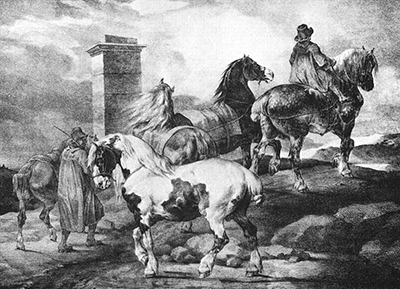
A piebald horse fills the foreground, its broad white flank broken by dark patches. Behind it, other horses climb towards the right, their backs, manes and raised heads overlapping. A child rides the leading animal high against the sky; an adult walks much lower down, almost lost among the bodies. Théodore Géricault makes the journey in Horses Going to a Fair feel substantial and slow. Each animal occupies space, carries its own weight and responds differently to the road.
Made in 1821, this lithograph belongs to Géricault’s English printmaking period. The Metropolitan Museum of Art holds an impression measuring 32.4 × 43.5 cm across the sheet, accession 17.41.9. Its record names Charles Joseph Hullmandel as lithographer and Rodwell & Martin as publisher in London. Those collaborators helped turn a drawing of horses on the move into an image that could circulate beyond a single studio or exhibition. [1]
At a Glance
- Date1821 [1]
- MediumLithograph [1]
- CollectionThe Metropolitan Museum of Art, New York [1]
- Object number17.41.9 [1]
This work across Théodore Géricault’s career
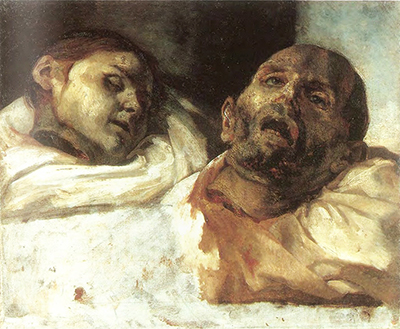
The Severed Heads
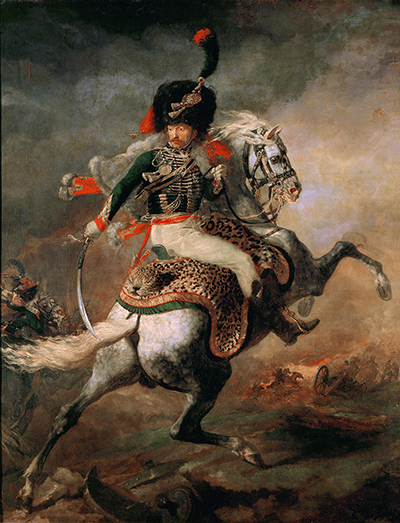
1810s [2]Charging Chasseur
1812 [3]Horse Frightened by Lightning
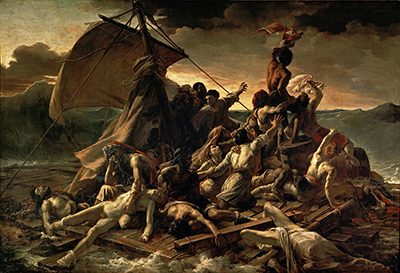
c.1813–14 [4]The Raft of the Medusa
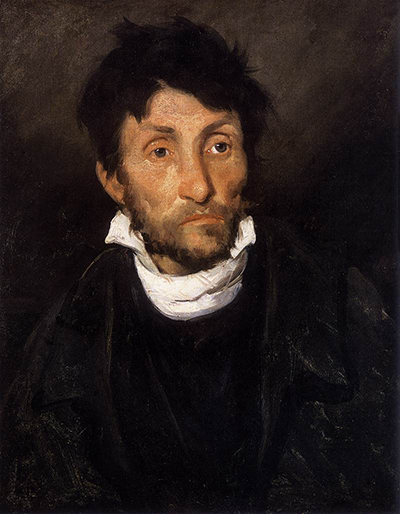
1818–19 [6]Portrait of a Kleptomaniac
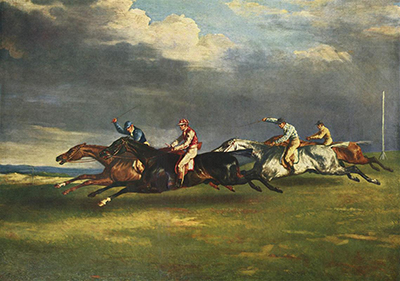
c.1820–24 [8]The Epsom Derby
1821 [9]Contents
- A procession that turns through the picture
- Coats, blankets and the weight of bodies
- Architecture, road and sky
- Horses within an economy of work
- An English print, an individual sheet
- Annotated details
A procession that turns through the picture
The group does not form a neat row. It bends through the landscape, with the leading horse at the upper right and the large piebald close to the viewer below. Between them, a dark horse raises its head above a covered back, while another animal’s pale mane spreads across the centre. At the left, the walking man and his smaller mount make a more modest group. The differences in height draw the eye up the slope in stages.
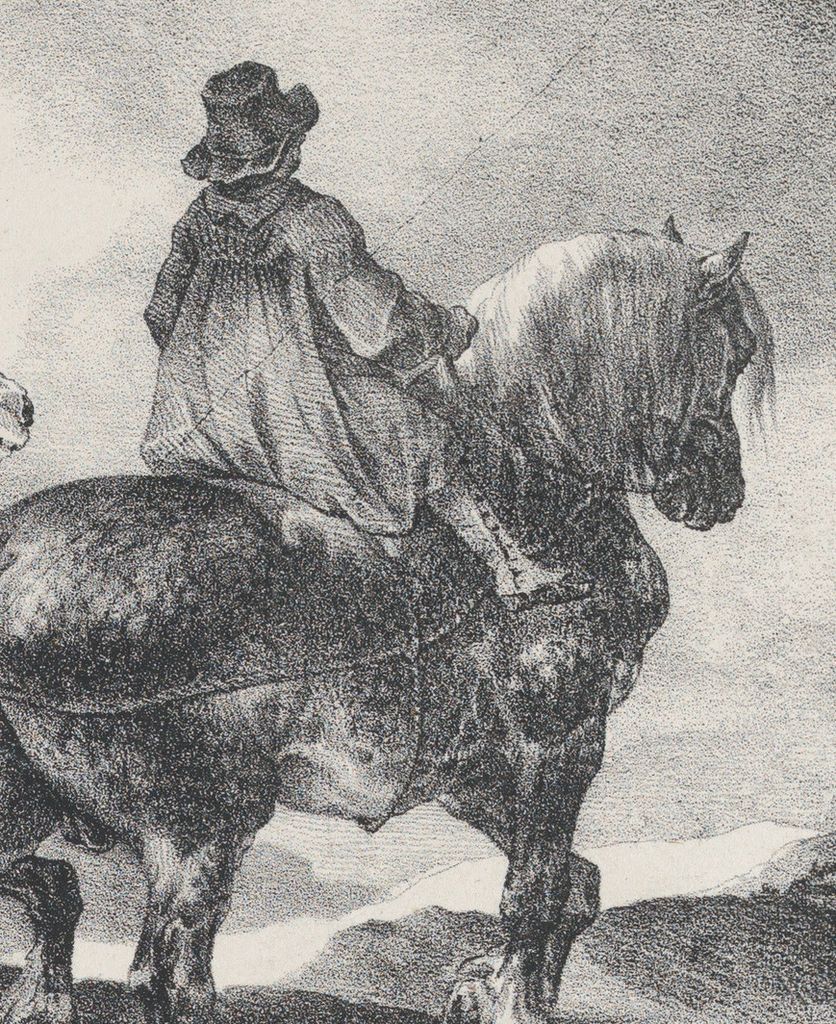
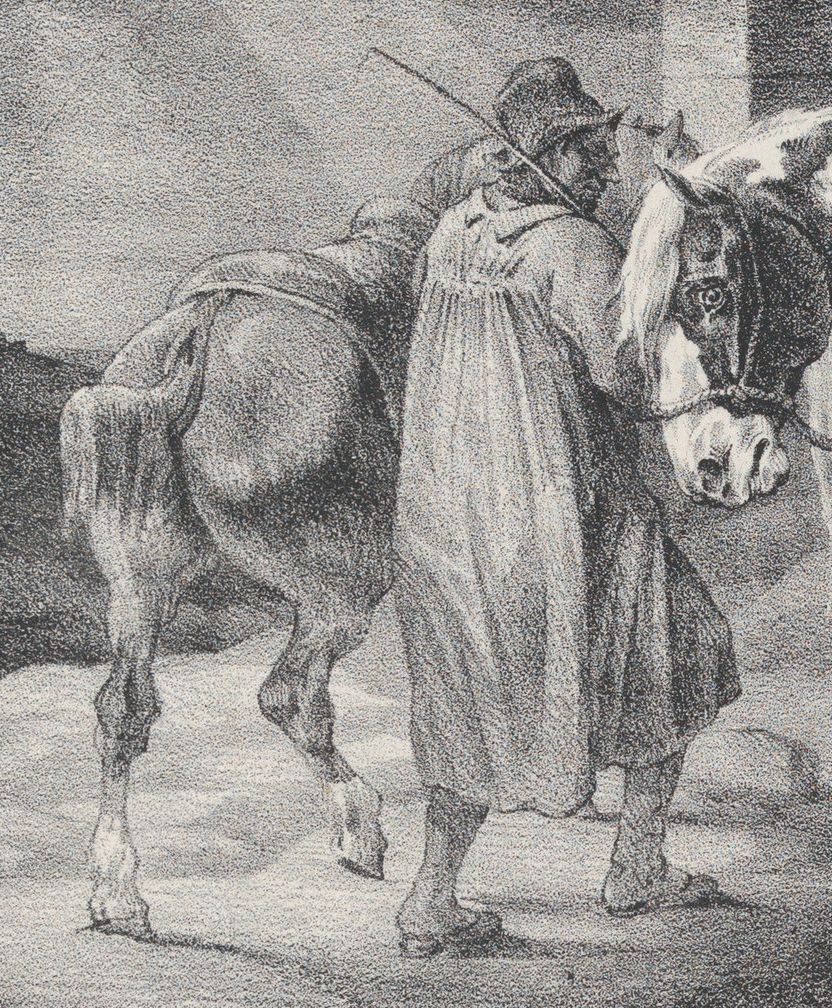
Charles Clément’s historical catalogue of 1866 describes four horses being taken to a fair, with a horse dealer on foot beside his small horse. He identifies the figure riding at the head of the procession as a child in a smock. That description helps disentangle the overlapping animals without supplying a story for the people. Neither figure is named. [10]
The composition makes the horses much easier to distinguish than their human companions. The child’s face is small beneath an oversized-looking hat, and the loose clothing obscures the body. The dealer’s long garment is a pale vertical among legs and tails. Both figures participate in the work of moving the animals, but neither supplies the commanding presence familiar from an equestrian portrait. Their importance lies in their relationship to the horses and the route.
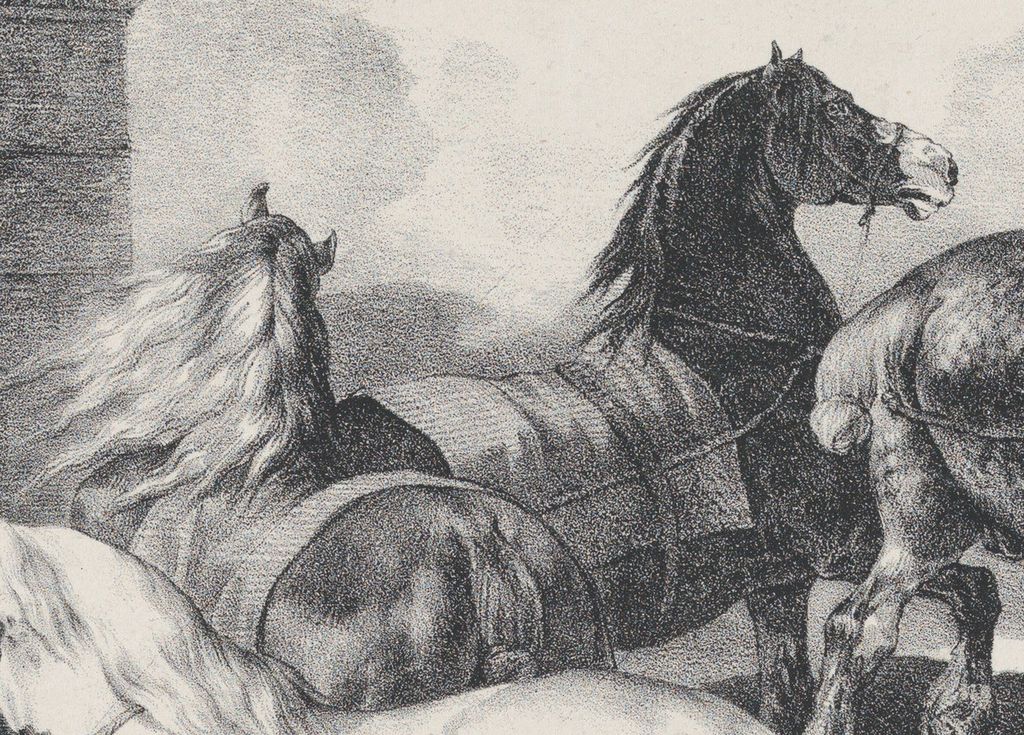
Look particularly at the foreground animal’s head. It turns left, away from the leading horse’s direction, bringing the marked face into view. The body offers a wide lateral surface, while the neck changes the direction of attention. Above it, the dark horse’s raised muzzle interrupts the sequence of lowered or partly hidden heads. These small divergences prevent the procession from becoming a repeated pattern. The animals travel together without appearing mechanically identical.
The legs reinforce this variety. Some carry weight while others lift or bend; a hoof is briefly clear of the ground, and another meets the uneven road. The leading horse’s position higher on the slope brings its hindquarters conspicuously into view. Movement is built from changes of support and balance rather than the stretched-out silhouette of a galloping horse. There is time to notice how the bodies move, even though the group is on a journey.
Coats, blankets and the weight of bodies
Géricault’s black-and-white medium does not flatten the differences between the horses. The piebald’s broad patches create a strong pattern that remains legible at a distance. The leading animal has a more broken, mottled surface, with light catching the rump and long hair hanging down the neck. The dark head near the centre stands out through a concentrated mass of tone, relieved by its pale muzzle. Elsewhere, a light mane runs in long strands against a darker body.
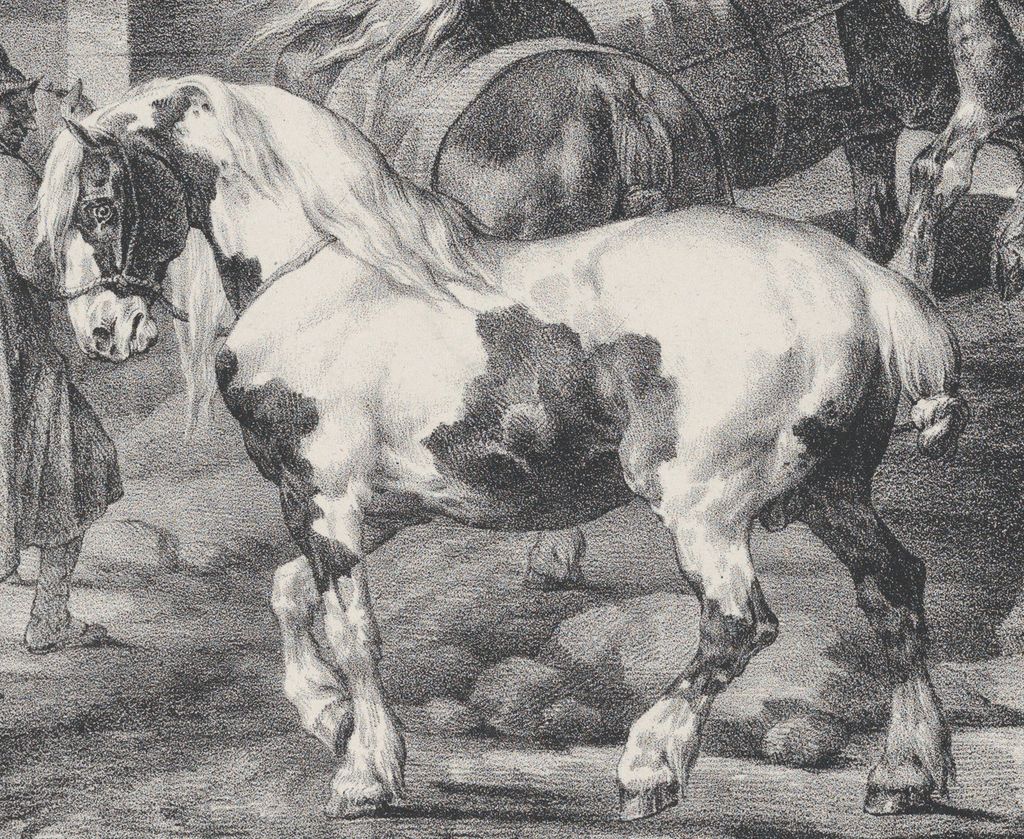
These changes do more than identify separate coats. They give the eye several ways of understanding volume. A bright patch opens out across a flank; closely worked dark marks draw the neck back into shadow; a pale edge separates one animal from the next. On the foreground horse, the rounded belly and hindquarter retain their fullness beneath the irregular markings. Pattern and anatomy work together rather than competing for attention.
The covering on the middle horse is another useful distinction. Its folds and bands make a surface unlike hair or bare skin, and its darker edges help separate the crowded bodies. A viewer can follow the equipment across the back before finding the animal’s neck and head above it. With so much overlap, these differences of texture are essential to reading the group.
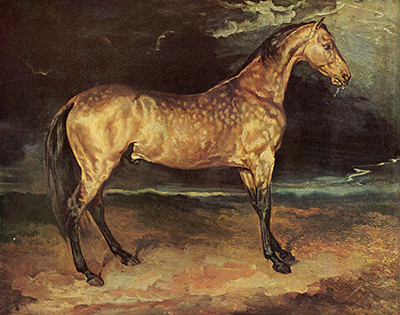
A comparison with Study of a Dapple Grey shows how persistent Géricault’s interest in the horse’s surface could be. The Rouen museum dates that oil painting to about 1812 and draws attention to the light on the dappled coat and the anatomical emphasis of the head. [11] In the painting, a single animal stands against a dark interior. Here, comparable attention to the body has to survive the demands of a crowded outdoor scene. The horse remains an individual even when it becomes part of a moving group.
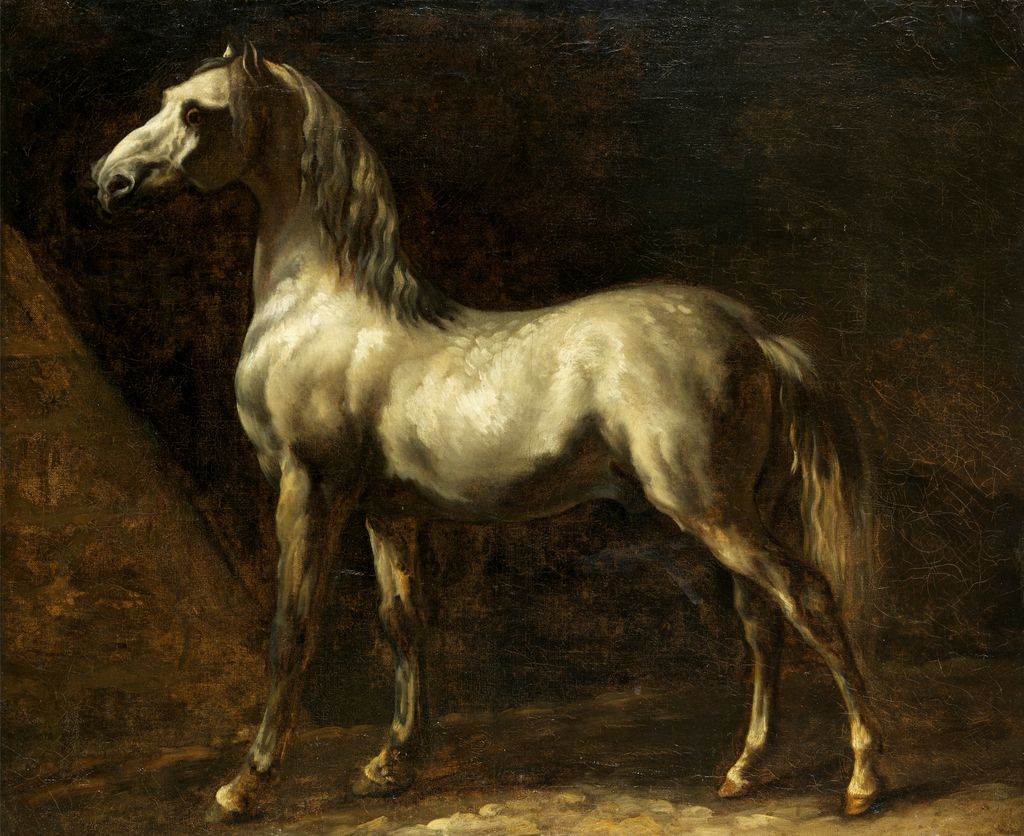
Study of a Dapple Grey Image source. Public domain.
Watch: Géricault and The Raft of the Medusa
Three perspectives on Géricault’s best-known painting, its making and its historical setting.
Gericault, Raft of the Medusa
Smarthistory examines the composition and historical setting of The Raft of the Medusa.
Watch on YouTubeAnnotated Details from Horses Going to a Fair
The numbered points identify visible features discussed in this article. Return from each detail to the whole composition. Horses Going to a Fair Image source. Public domain.
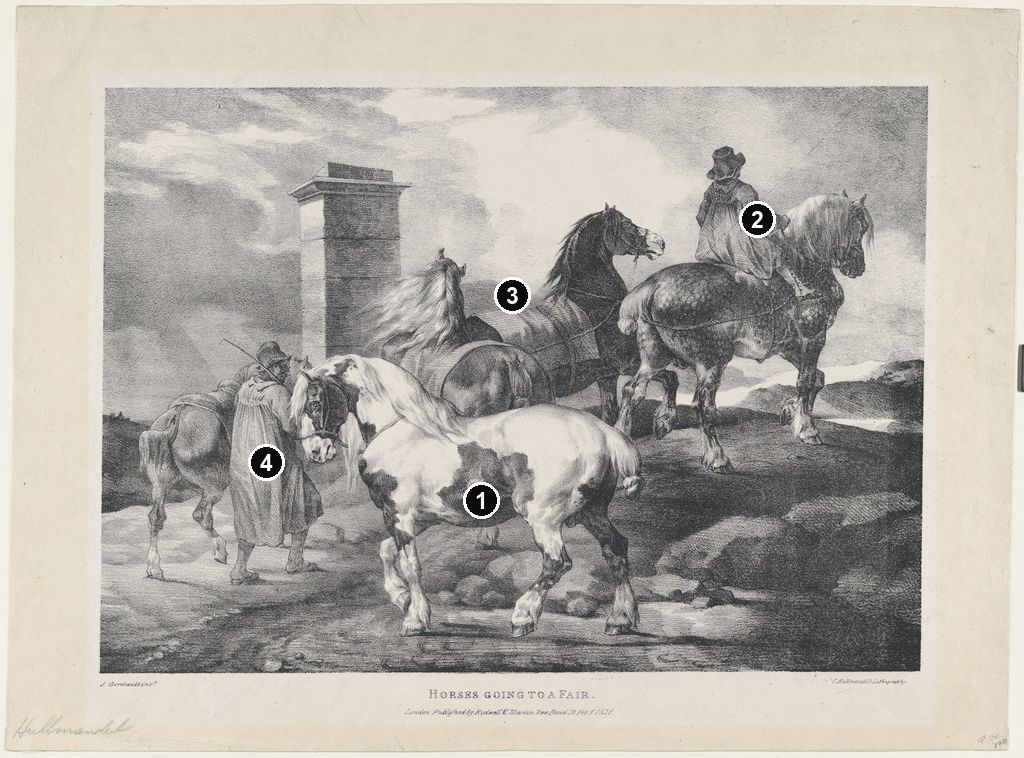
Details from HORSES GOING TO A FAIR
Compare the cropped details with the complete images above. Notice how their colours, shapes and positions contribute to the larger compositions.
The foreground piebald
The horse’s dark patches keep their distinct pattern while shading gives the broad body its rounded weight.
The child above the group
The small rider and the leading horse stand against the light sky, marking the high point of the procession.
Heads and manes overlap
A pale mane and a raised dark head make neighbouring horses legible within the crowded central group.
The walking dealer
The dealer walks beside his smaller horse, lower in the composition than the mounted child.
Architecture, road and sky
The square masonry structure left of centre gives the procession a firm point around which to turn. Its straight sides and projecting cap contrast with curved backs, loose manes and sloping ground. It also marks a passage through the landscape: the horses appear to have come around it before climbing across the picture. Clément specifically noticed the turn beside this structure, as well as the leading horse’s separation against a light sky. [10]
The architecture supplies a vertical measure without dominating the animals. Its top remains below the broad upper expanse of cloud, and the open sky allows the rider and horse on the right to stand clear. Lower down, the sky becomes more difficult to see because bodies crowd across it. This alternation between open space and overlap makes the ascent legible.
The countryside is neither a detailed map nor a blank backdrop. Low distant forms, a rough foreground and changes in the road’s level establish a place through which the group must move. Stones and darker patches of earth bring the viewer close to the surface under the hooves. The broad clouds give the scene atmosphere, but there is no visible incident that requires us to turn them into a threatening storm.
The road matters because the title places the fair ahead. We see no crowd inspecting the animals, no bargaining and no completed sale. The journey occupies the entire image. The horses’ probable commercial destination changes the meaning of their appearance: their bodies are being brought into a setting where people may assess and trade them. Yet the picture stops before that encounter. No particular fair is securely identified by the title or the records cited here.
Horses within an economy of work
These heavy bodies and abundant manes belong to a different visual world from the disciplined display of a mounted military officer. Their human companions wear practical loose clothing, and the animals’ individual turns and pauses remain conspicuous. Géricault gives the gathering an impressive presence without requiring a heroic rider, a battle or a feat of speed.
The trading context also keeps the scene from becoming simply an image of animals roaming freely. The child is mounted, the dealer accompanies the group, and bridles and other equipment connect human activity with equine movement. The horses occupy most of the image, but the destination belongs to a human system of exchange. Their strength is visible before any future use is specified. It would go beyond the evidence to assign each one a breed, purchaser or intended job.
Entrance to the Adelphi Wharf offers a revealing comparison. It too dates from 1821 and was produced in London with Hullmandel and Rodwell & Martin. [12] There the horses are heavily harnessed beneath an enormous arch. Their rear-facing bodies fill the entrance, and the darkness above them presses closely around their movement. The masonry encloses the group instead of standing beside a relatively open route.
Seen together, the prints show how strongly surroundings affect our reading of animal labour. At the wharf, harness, close quarters and the arch organise a concentrated task. On the road to the fair, the broader interval between ground and sky makes the group feel less confined. The commercial title nevertheless prevents the countryside from becoming an escape from economic life. Travel, handling and sale belong to the same larger world as transport and hauling, even though the immediate exertion looks different.
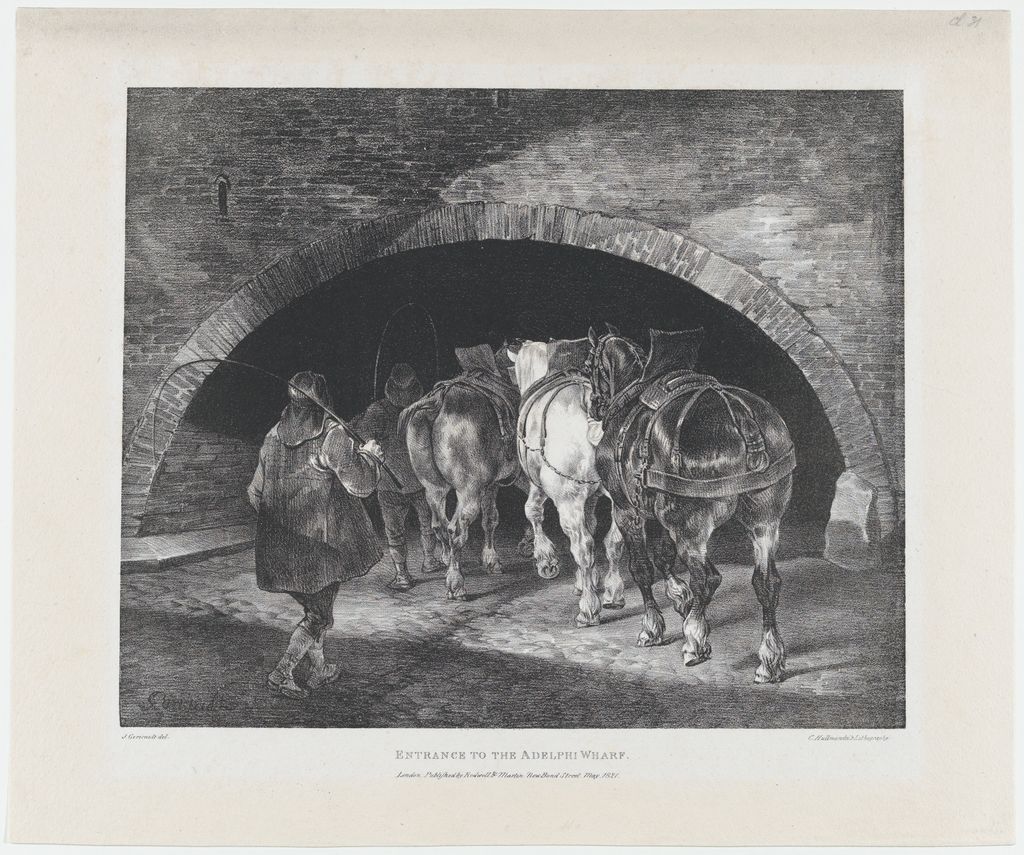
Entrance to the Adelphi Wharf Image source. Public domain.
An English print, an individual sheet
Clément catalogued Horses Going to a Fair as the twelfth subject in a suite of twelve large English lithographs, accompanied by a separate title sheet. His list brings together farriers, horses exercising, a coal wagon and figures encountered in streets. This places the fair scene among images concerned with everyday movement, work and dependence. It is one part of a varied publication rather than an isolated illustration of a market journey. [10]
The inscriptions beneath the image make that publication history visible. Géricault’s name appears at the lower left and Hullmandel’s lithography credit at the right. Below the English title, the publishing line names Rodwell & Martin, New Bond Street, London, and gives 1 February 1821. Clément transcribed the same publishing information. [10] The words sit outside the landscape, connecting the horses’ road with the London trade that brought the print before an audience.
It is useful to distinguish the composition from the particular piece of paper carrying it. The Met’s measurements, 32.4 × 43.5 cm, describe its whole sheet, including the margins around the scene. The museum records its acquisition through the Rogers Fund in 1917. [1] Clément, writing much earlier, gave dimensions of 254 × 356 mm for the print in his catalogue. Those figures should not be substituted for the Met’s sheet measurements or treated as proof that the museum holds a different composition. [10]
Keeping the margins in view preserves the relationship between picture, title and maker credits. Looking into the image then reveals a different kind of organisation: the bend of the route, the varying heads, the coat patterns and the rhythm of the hooves. Horses Going to a Fair holds those two experiences together. A published sheet identifies and distributes the subject, while the drawing gives the travelling animals a physical individuality that the general title can only begin to describe.
Géricault collection records
Seventy collection records include paintings, drawings and individual print impressions. Different impressions remain separate records; this selection is not a complete catalogue raisonné.
Frequently Asked Questions
In his 1866 catalogue, Charles Clément described a child in a smock riding the leading horse and a dealer walking beside his small horse. Their personal identities are not documented here. [10]
It is a lithograph published in London in 1821. The Metropolitan Museum of Art holds an impression whose sheet measures 32.4 × 43.5 cm; the margins carry the title and publishing information. [1]
Discussion
Look again at the images and ideas explored in Horses Going to a Fair. These editorial prompts invite your observations.
Reader Insights
Follow the heads of the horses through the group. Which changes of direction make the procession feel least regular?
Compare the open sky here with the arch in Entrance to the Adelphi Wharf. How does each setting change your sense of the horses’ movement?
Consider what the title adds to the image. How differently might you read this journey if its market destination were not named?
Join the Conversation
Share a detail, comparison or question about Horses Going to a Fair below.
References
- The Metropolitan Museum of Art, Horses going to a Fair, Théodore Géricault, 1821, accession 17.41.9; object information, maker roles, dimensions and acquisition, English. View source.
- Nationalmuseum, The Severed Heads, NM 2113; collection metadata and museum interpretation (Swedish). View source.
- Louvre, Charging Chasseur, INV 4885; collection metadata and museum interpretation (French/English interface). View source.
- National Gallery, Horse frightened by Lightning; collection metadata and museum interpretation (English). View source.
- Louvre, Wounded Cuirassier, INV 4886; collection metadata and museum interpretation (French). View source.
- Louvre, The Raft of the Medusa, INV 4884; collection metadata and museum interpretation (French). View source.
- Gary Tinterow / The Metropolitan Museum of Art, Géricault’s Heroic Landscapes: The Times of Day, Met Bulletin 48/3, Winter 1990–91; consulted main essay and relevant object entries (English). View source.
- Vlaamse Kunstcollectie, Portrait of a Kleptomaniac; collection metadata and museum interpretation (Dutch). View source.
- Louvre, Epsom, MI 708; collection metadata and museum interpretation (French/English interface). View source.
- Charles Clément, Catalogue de l’œuvre de Géricault: Lithographies, 1866, English suite catalogue, printed pp. 13–16, especially no. 38, Horses Going to a Fair, p. 16; French, digitised historical scan, PDF pp. 21–24. View source. (in French).
- Musée des Beaux-Arts de Rouen, Study of a Dapple Grey, Théodore Géricault, about 1812, inventory 850.3.1; collection entry and discussion of anatomical study and coat, English. View source.
- The Metropolitan Museum of Art, Entrance to the Adelphi Wharf, Théodore Géricault, 1821, accession 22.63.25; object information and maker roles, English. View source.