



 by Tom Gurney
Tom Gurney BSc (Hons) is an art history expert with over 20 years experience
Email: tomgurney1@gmail.com / Phone: +44 7429 011000
Return from Russia: Introduction
A soldier on foot leads a horse through snow. Its rider rests a hand on his companion’s shoulder; behind them, another man carries a comrade on his back. In Théodore Géricault’s Return from Russia, survival takes the form of one body supporting another. The lowered heads of the horse and dog extend that condition beyond the soldiers. Everyone in this small procession appears to be approaching the limits of endurance.
Géricault made the lithograph around 1818, looking back to Napoleon’s disastrous retreat from Russia in 1812. The impression in the Cleveland Museum of Art is particularly revealing: printed in black and ochre from two stones, it also has watercolour added by hand, including white in the snow. Its atmosphere depends on both the repeatable printed design and the treatment of this individual sheet. Cleveland catalogues it as Delteil 13, state III of VI, with a border measuring 44.4 × 36.4 cm. [1]
At a Glance
- DateAround 1818 [1]
- SubjectThe retreat from Russia in 1812 [1] [2]
- MediumLithograph printed in black and ochre, with watercolour added by hand to this impression [1]
- Border dimensions44.4 × 36.4 cm [1]
This work across Théodore Géricault’s career
The Severed Heads
1810s [3]Charging Chasseur
1812 [4]Horse Frightened by Lightning
c.1813–14 [5]The Raft of the Medusa
1818–19 [7]Portrait of a Kleptomaniac
c.1820–24 [9]The Epsom Derby
1821 [10]Contents
- A retreat remembered
- How the men support one another
- The horse, the dog and the snow
- Black, ochre and white: how this impression was made
- States, stones and the life of the print
- Other ways of showing wounded soldiers
- Compassion without a promised rescue
- Annotated details
A retreat remembered
The difference between the event and the making of the image matters. This is a print of about 1818 about the retreat of 1812, rather than an image known to have been made on the march. Its concentrated encounter should not be treated as a literal eyewitness record of particular soldiers. The title supplies the historical setting; the figures give that history a human scale. The Château de Chantilly’s account of Géricault’s lithography places Return from Russia among his representations of the suffering of the imperial troops, alongside images that preserve other aspects of the Napoleonic epic. [2]
There is very little here that allows a spectator to reconstruct a military operation. No commander directs the men, no enemy advances into the foreground, and no landmark identifies a precise stage of the retreat. The immediate problem is how to continue across the next stretch of ground. Even the word “return” offers a destination that the picture itself withholds: there is no home, shelter or welcoming figure in view.
The vertical format brings the group close. Their bodies fill the lower and central portions of the image, while the open sky above them gives little sense of protection. A broad, uneven sweep of tone traverses that sky. Against it, the rider’s covered head and the walking soldier’s tall fur cap remain unmistakable, although neither man has the commanding presence those silhouettes might suggest in a parade or battle scene. Military dress survives; the confident action usually associated with it has become a difficult act of walking.
How the men support one another
The foreground figures belong to different branches of the army. In his nineteenth-century catalogue, Charles Clément describes a grenadier who has lost an arm leading the horse of a blind cuirassier whose left arm is in a sling. He also identifies the distant pair as a soldier carrying another on his back. These identifications sharpen the structure already visible in the image, but they should remain distinct from a medical account of actual named men. [11]
The walking soldier holds the bridle with his surviving arm. His empty sleeve is conspicuous on the left side of the group, hanging beside the coat rather than concealing the loss behind a heroic gesture. The fabric has enough presence to make the missing limb register without blood or exposed injury. His face turns slightly towards the rider, but his gaze is lowered. He is both a wounded man and the person responsible for guiding the horse.
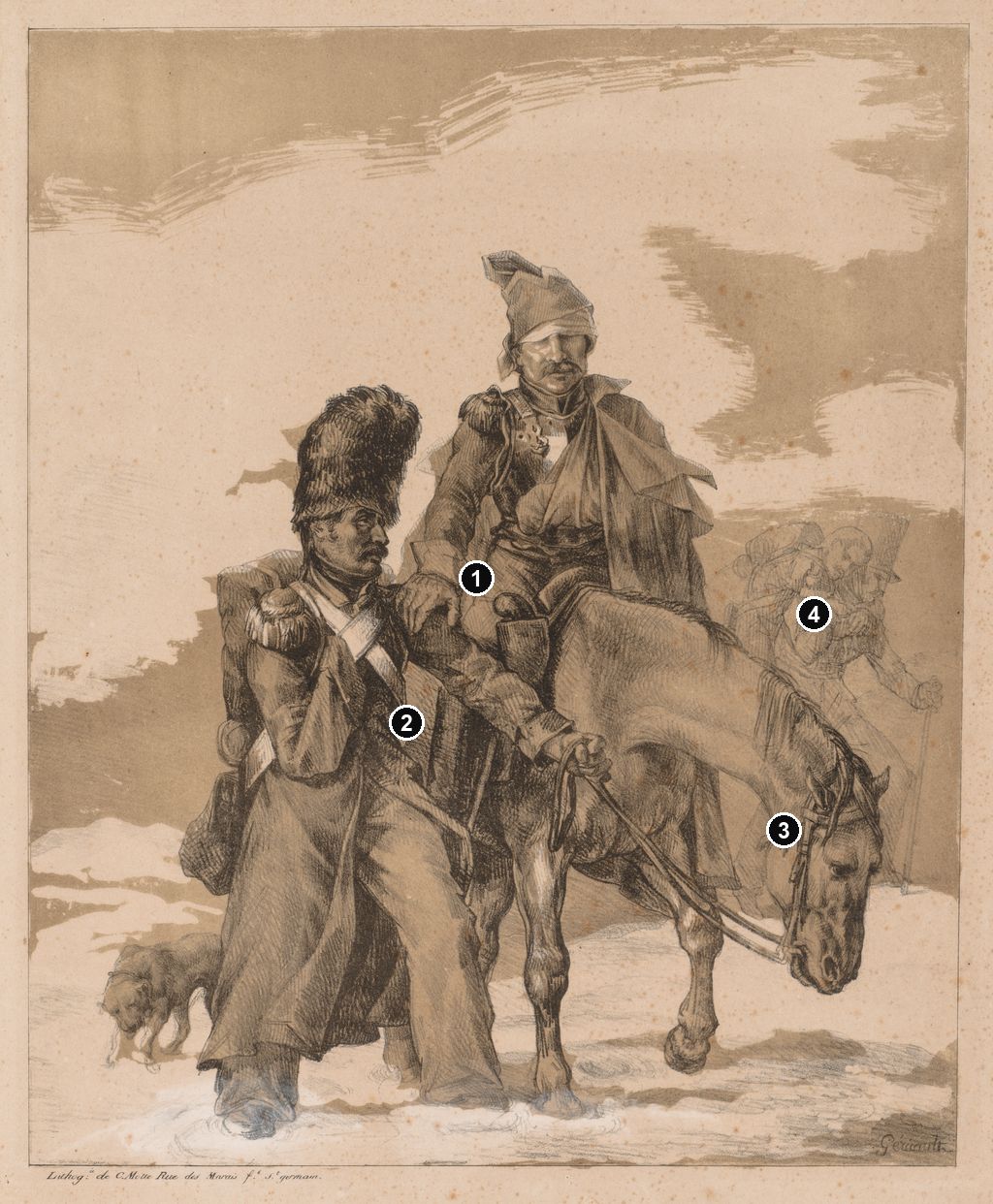
Above him, the rider sits heavily in the saddle. The sling cuts across his chest; the covering over his eyes prevents the usual outward exchange between a mounted soldier and the world around him. His available hand rests on the grenadier’s shoulder. That small contact is the centre of the composition’s human relationship. It joins the seated and standing figures across their difference in height, and it makes the rider’s dependence visible without a theatrical embrace.
The horse’s bridle, the leading hand and the hand on the shoulder form a chain of contact. Each connection is modest, but together they organise the whole group. The walking soldier can direct the animal; the animal can carry the rider; the rider can keep contact with his companion. Injury has not simply removed the men’s ability to act. It has changed action into something shared, with each participant relying on what the others can still provide.
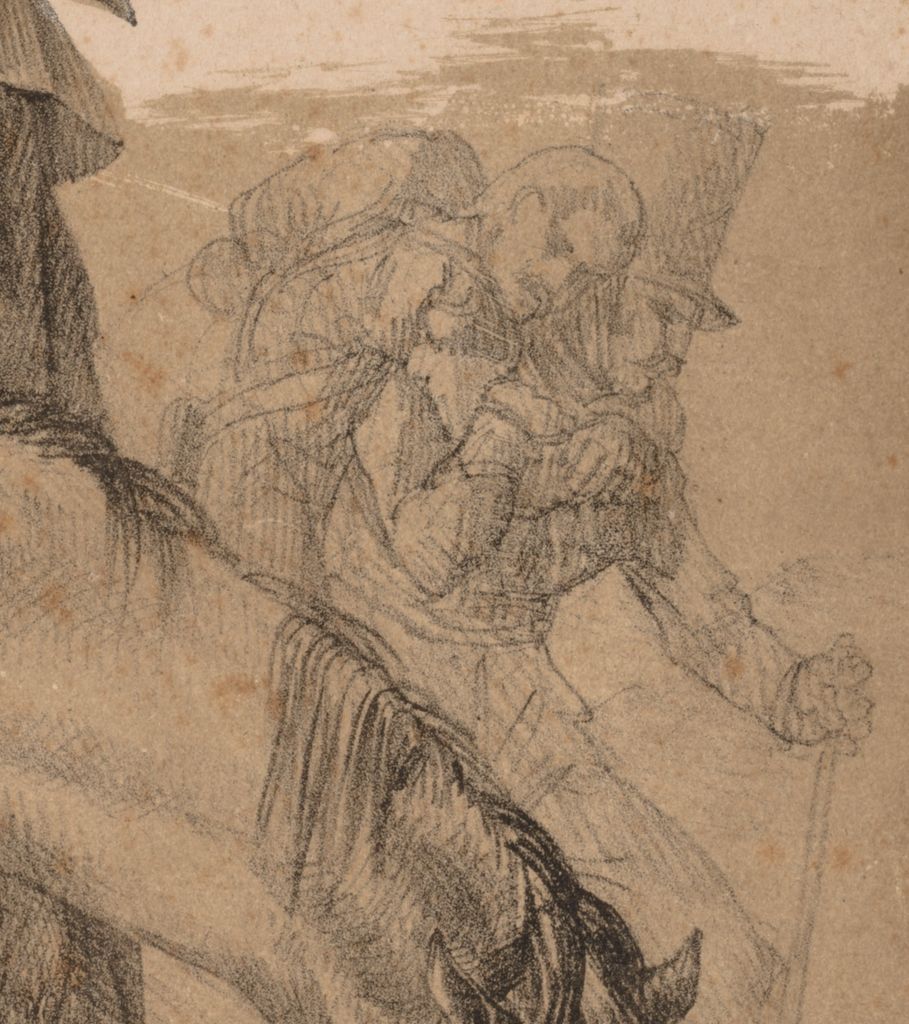
The smaller group at the right repeats this arrangement more starkly. One soldier bends under the weight of another, whose upper body droops across his back. Their lighter drawing pushes them into the distance, yet their action is legible enough to answer the foreground. Here a human body performs the carrying work assigned to the horse below. The repetition broadens the subject from a single affecting encounter to a condition extending along the route.
Géricault does not make these acts look easy. The carrier is bent; the grenadier’s stride is cumbersome; the horse’s head hangs low. Support is taking place within exhaustion. That gives the scene its tension: the bonds are real, but the strength sustaining them is finite. We can recognise practical care between the figures without having to invent their conversation, their previous relationship or what will happen to them next.
Annotated Details from Return from Russia
The numbered points identify visible features discussed in this article. Return from each detail to the whole composition. Return from Russia, c.1818 — Cleveland impression 1931.48, with hand-added colour Image source. CC0 / Public domain.
Details from RETURN FROM RUSSIA
Compare the cropped details with the complete images above. Notice how their colours, shapes and positions contribute to the larger compositions.
A hand on a shoulder
The rider keeps contact with his companion while the sling holds his other arm. The touch joins the figures across their unequal heights.
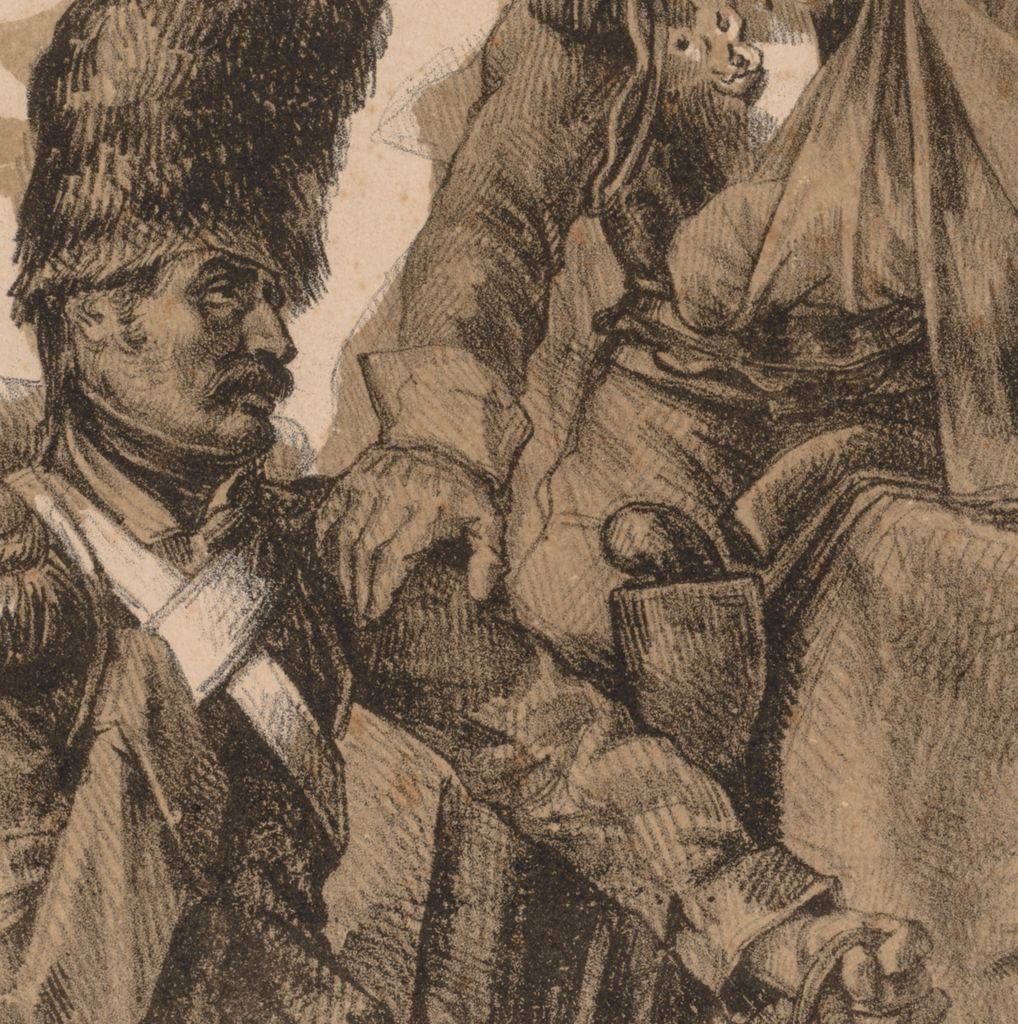
The bridle and the empty sleeve
The walking soldier guides the horse with his surviving hand. His empty sleeve makes the cost of that work visible.
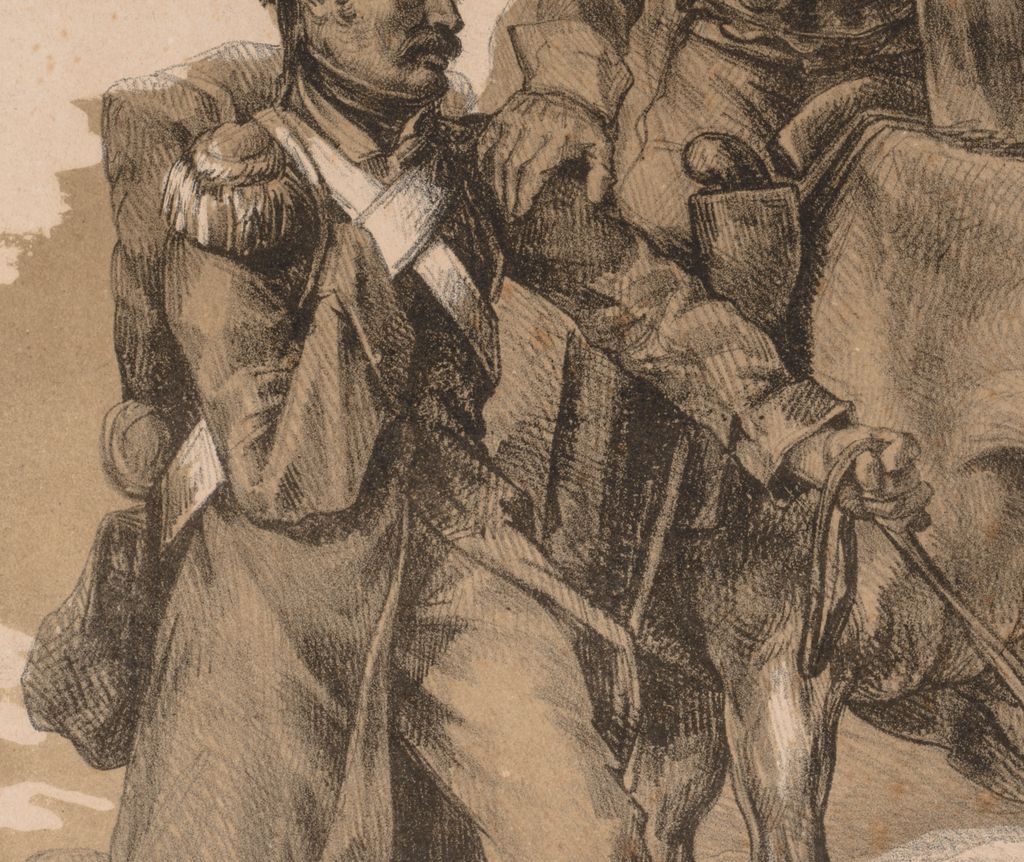
The horse’s lowered head
The neck slopes steeply towards the snow beneath the seated rider. Harness and thin legs emphasise the burden of carrying him.
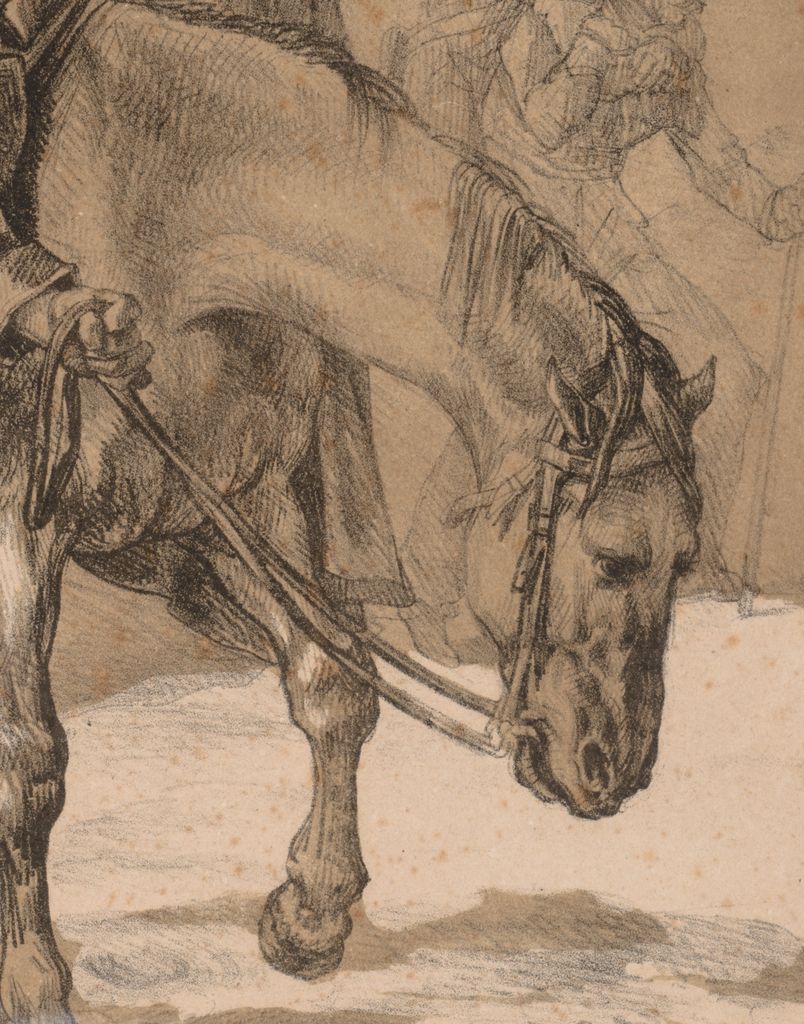
A second act of carrying
Lightly drawn figures repeat the foreground relationship: one soldier carries another on his back.
The horse, the dog and the snow
The horse occupies almost as much of the foreground as the walking soldier. Its neck slopes down and forward, ending in a muzzle close to the snowy ground. The lowered head is especially telling beside the rider’s upright torso: the man’s elevated position depends on an animal that can barely seem to sustain it. The legs look narrow beneath the weight they carry, and the carefully drawn harness remains an apparatus of work rather than an ornament.
At the left, the dog follows with its nose down. Its small scale makes it easy to overlook, but its posture belongs to the same downward movement as the horse’s head and the soldiers’ faces. Cleveland describes the animals as exhausted and starving. That interpretation fits the visual emphasis on depleted bodies, while the dog’s presence also enlarges the procession beyond a purely military unit. [1]
The dog should not be assigned an invented owner or a fixed symbolic meaning. What the picture gives us is its participation: it moves in the same direction and endures the same exposed ground. The group contains different kinds of dependence, without turning the animals into mere illustrations of the men’s feelings.
Snow is the surface on which all this becomes visible. Light patches gather around the boots and hooves, interrupted by darker marks and shallow shadows. The ground offers no firm road receding towards safety. Its irregular contrasts make each step feel local and uncertain. The whiteness also draws attention downwards, from the faces and hands to the contact between bodies and earth. Cold is conveyed through the relation of the figures to this pale terrain, rather than through a panoramic spectacle of winter.
Watch: Géricault and The Raft of the Medusa
Three perspectives on Géricault’s best-known painting, its making and its historical setting.
Gericault, Raft of the Medusa
Smarthistory examines the composition and historical setting of The Raft of the Medusa.
Watch on YouTubeBlack, ochre and white: how this impression was made
The image’s apparent simplicity conceals a purposeful use of colour. According to Cleveland, one lithographic stone carried the black design and another supplied the broad ochre tones. The museum identifies it as an early French example in which a second printed colour participates in the image rather than serving only as an even background tint. The white watercolour used for the snow was added by Géricault to this impression. [1]
Lithography allowed an artist to draw on a prepared limestone surface with greasy material. During printing, water and ink behaved differently on the drawn and undrawn areas, enabling the design to transfer to paper under pressure. Chantilly’s account explains the process as a means of producing multiple images from an artist’s drawing, with relative speed and economy. Here, the additional stone extended that drawing through a second printed tone. [2]
The distinction between stone and sheet is essential. The Cleveland object is a paper impression, not the stone on which the image was drawn. Nor is its hand colouring evidence that every impression received identical additions. The black and ochre belong to the printing process recorded for this image; the watercolour belongs to the treatment of this particular physical example. Its catalogue date, around 1818, should likewise be kept separate from the date of the Russian campaign.
Looking closely, the two printed tones do different work. The black establishes faces, clothing, harness and the fine lines that give the bodies weight. Ochre passes through larger areas of the scene, especially the sky, where its irregular edges remain conspicuous. The image therefore combines closely worked figures with a less enclosed atmosphere. The open spaces do not read simply as empty paper surrounding a finished drawing; they participate in the exposure of the men and animals.
The added white makes a third visual register. Against the warm colour of the sheet and the ochre printing, it gives the snow a distinct, cool brightness. This does not require a colourful depiction of uniforms or a naturalistic blue sky. A restricted palette is enough to separate the figures from the weather and the ground. Much of the print’s force comes from how little is needed to make that environment felt.
States, stones and the life of the print
Cleveland’s designation “III/VI” identifies its impression as the third of six catalogued states. A state records a stage in the alteration of a printing image; it is different from an individual impression pulled from it. Hand-applied colour adds another level of variation. An impression can therefore share a printed state with other sheets while possessing additions particular to itself. [1]
Clément’s earlier catalogue offers a useful view of the print’s material and commercial history, though its classification should not replace Cleveland’s later state designation. His 1866 lithograph catalogue lists Retour de Russie as number 12 and describes two states, distinguishing changes to the title and printer’s or seller’s addresses. Cleveland instead cites Delteil’s number 13. These are different catalogue systems, not competing names for different compositions. Clément also records the use of two tones. [11]
An anecdote in the same entry brings the printing stone into view as something that could be bought and sold. Clément reports that Géricault’s pupil Jamar, charged with selling the stone, obtained 100 francs from Madame Brossier on the quai Voltaire, while the stone alone had cost 60 or 70 francs. This is Jamar’s recollection as transmitted by Clément, not a surviving sale receipt. It concerns the printing matrix, not the sale price of the Cleveland sheet or the value of every impression. [11]
The story is useful because it places an emotionally charged image within the practical business of printmaking. Stones, impressions, printers and sellers were all part of its life. The capacity to produce multiple sheets gave the composition a different possible reach from a single large painting, although these records do not establish its original edition size or the response of its first purchasers. Géricault’s lithographs brought difficult modern subjects into a medium that could circulate from hand to hand; the history of a particular print still needs to be distinguished from that general possibility.
Other ways of showing wounded soldiers
The change from Géricault’s Wounded Cuirassier to Return from Russia is revealing. The Louvre painting, shown at the Salon of 1814, presents a dismounted cavalryman leading his horse. Its scale is monumental: 358 × 294 cm. The precise wound is not visibly explained, while the figure’s turning body and uncertain descent sustain the tension. [6] In Return from Russia, injury becomes more explicit and the solitary relationship between man and horse opens into a network of companions. The print exchanges a commanding individual silhouette for connected, unequal bodies.
The Wagon Filled with Wounded Soldiers provides another comparison. The BnF catalogues that lithograph in 1818 and identifies its second state with the names of Géricault and the printer Motte. [12] A wounded man beside the crowded vehicle seems to seek a place, while the horses’ conflicting movements disturb the means of transport. Clément describes the appeal for space and the interaction of the animals. [11] There, care depends on a vehicle with limited room and animals requiring control. In Return from Russia, a slower, smaller arrangement of assistance holds together for the moment.
In Artillery Caisson, also dated 1818, a soldier stands on an ammunition wagon beside a dead horse, holding a burning fuse and extending a clenched fist. The Rijksmuseum’s record identifies these central elements. [13] Its concentrated gesture faces an immediate threat. Return from Russia finds equal intensity in the absence of such a climax. The horse is still moving, the men are still helping, and the danger is the gradual failure of their remaining strength.
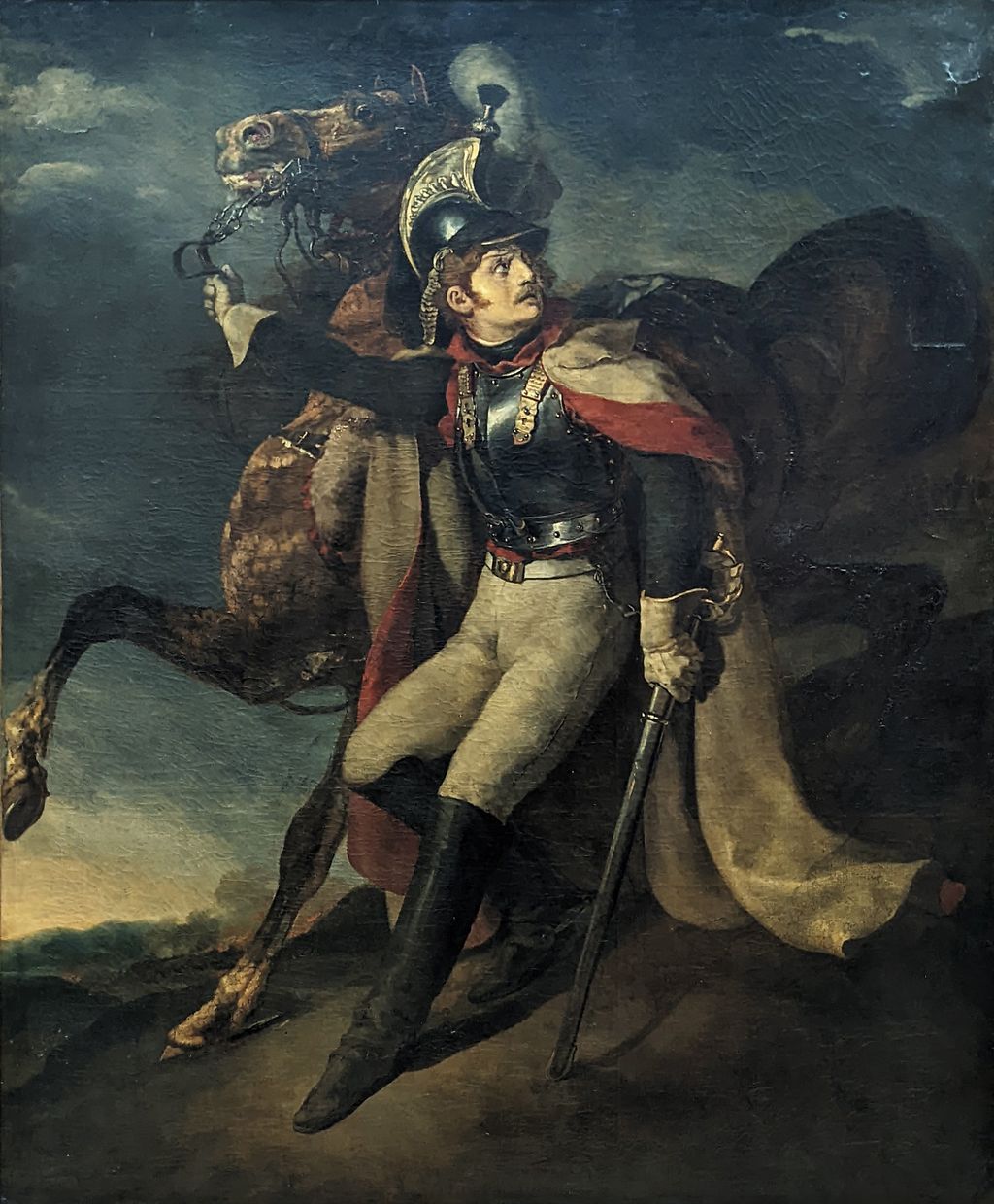
The Wounded Cuirassier Image source. Public domain.
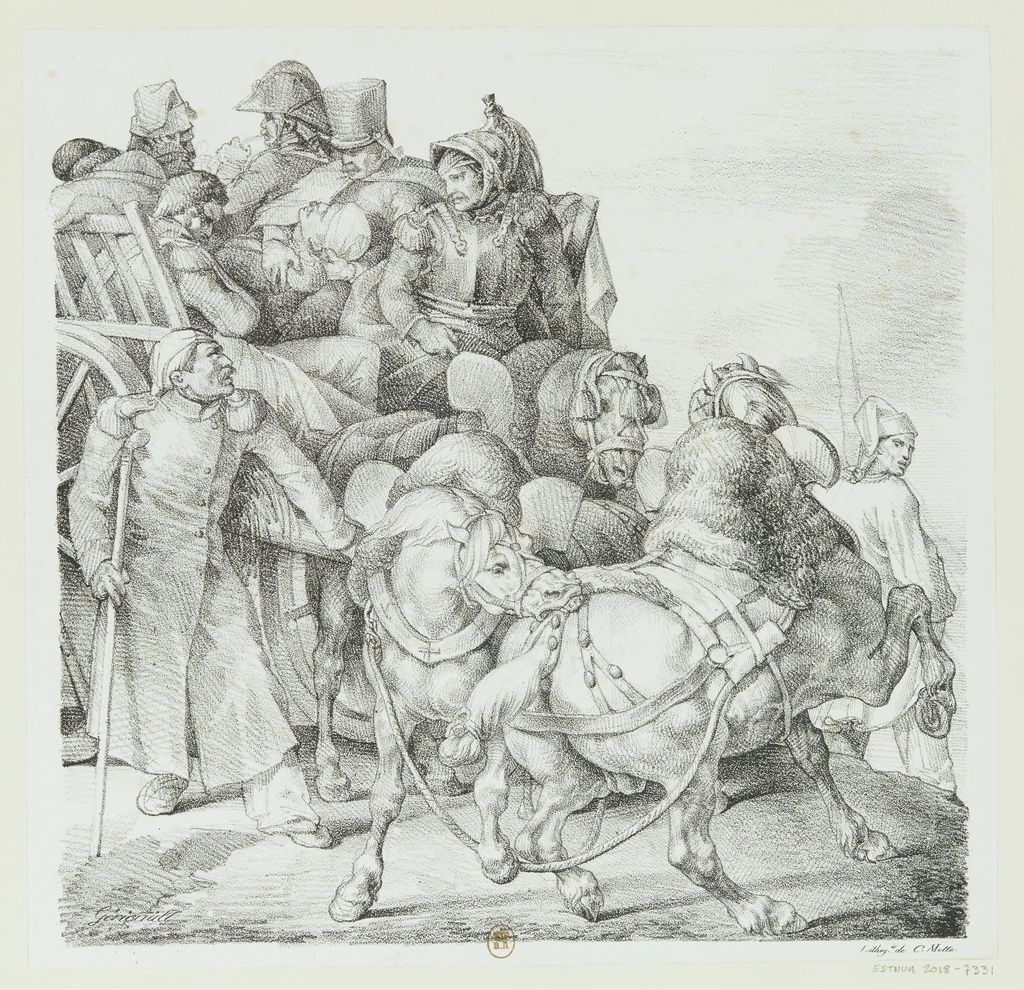
Wagon Filled with Wounded Soldiers Image source. Public domain.
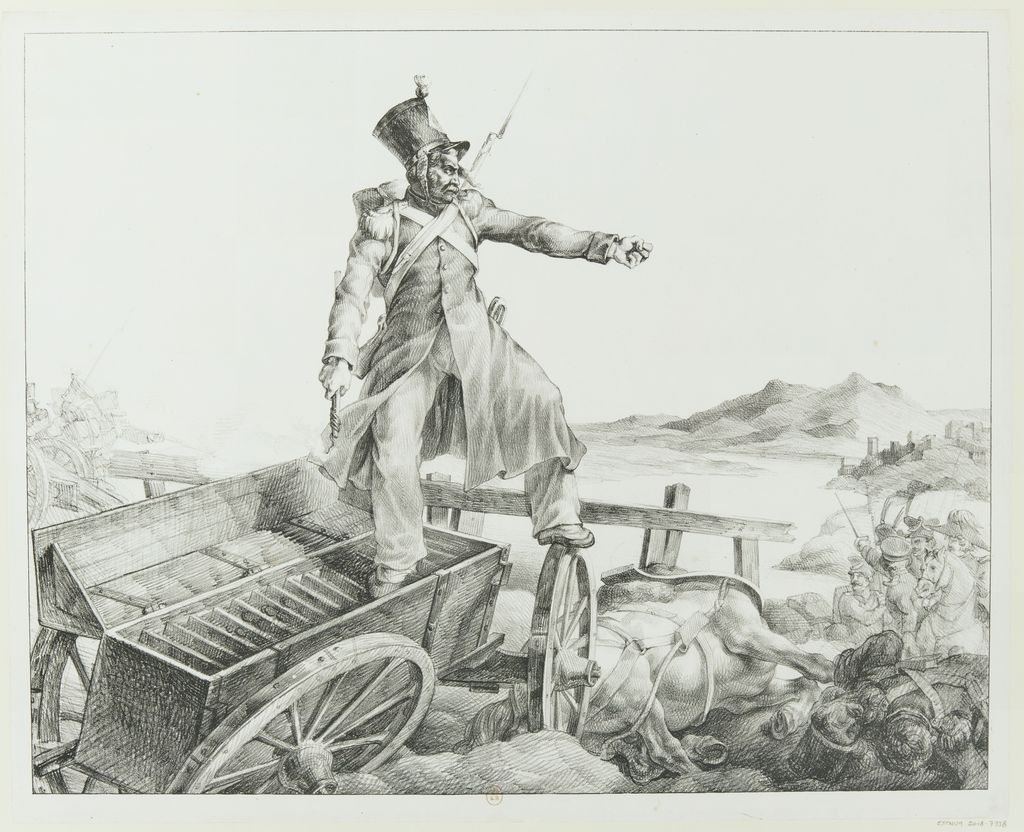
Artillery Caisson, 1818 — Bibliothèque nationale de France impression btv1b10029068f; distinct from the Rijksmuseum sheet cited for catalogue information. Image source. Public domain.
Compassion without a promised rescue
Cleveland interprets Return from Russia through the misery and horror of war, rather than its glorification. Chantilly places it within a body of work that can acknowledge the Napoleonic epic while dwelling on its suffering. [1] [2] These perspectives need not be reduced to a single political slogan. Sympathy for injured soldiers can coexist with a devastating account of what military ambition has left them to endure. The image does not tell us that compassion requires admiration for the campaign that brought them here.
Its most persistent question is practical: what can one exhausted being still do for another? The answer is distributed across a hand on a shoulder, a grip on a bridle, a horse bearing weight and a soldier carrying his companion. None guarantees rescue. Together they give the retreat a form that a viewer can understand without mistaking the picture for a report from a specific day. History remains present in the uniforms and title, but the scene’s emotional authority comes from the precarious work of keeping one another moving.
Géricault collection records
Seventy collection records include paintings, drawings and individual print impressions. Different impressions remain separate records; this selection is not a complete catalogue raisonné.
Frequently Asked Questions
The image was printed from two stones, one for black and one for ochre. Watercolour was also added by hand to this individual impression, including white for the snow. These additions should not be assumed to occur identically on every sheet. [1]
Clément’s historical catalogue identifies the foreground figures as a grenadier who has lost an arm and a blind cuirassier with his left arm in a sling. It does not supply documented personal identities for actual soldiers. Their linked hands and the horse’s bridle show how their progress depends on one another. [11]
Discussion
Look again at the images and ideas explored in Return from Russia. These editorial prompts invite your observations.
Reader Insights
Follow the contacts from the rider’s hand to the soldier’s shoulder and from the soldier’s hand to the bridle. How do they change your sense of who leads the group?
Compare the horse’s lowered head with the dog and the two men in the background. Which posture first makes exhaustion apparent to you?
Imagine the scene without the added white watercolour. How much of its cold and exposure comes from the printed line, and how much from the snow’s brightness?
Join the Conversation
Share a detail, comparison or question about Return from Russia below.
References
- Cleveland Museum of Art, Return from Russia, c. 1818, accession 1931.48; object record, description and official collection metadata, Delteil vol. 18, no. 13, state III/VI. View source.
- Château de Chantilly, Géricault et la lithographie: Le romantisme à la française, virtual exhibition drawn from the 2018 exhibition curated by Nicole Garnier-Pelle; sections on lithography, the Napoleonic period and Retour de Russie (French). View source. (in French).
- Nationalmuseum, The Severed Heads, NM 2113; collection metadata and museum interpretation (Swedish). View source.
- Louvre, Charging Chasseur, INV 4885; collection metadata and museum interpretation (French/English interface). View source.
- National Gallery, Horse frightened by Lightning; collection metadata and museum interpretation (English). View source.
- Musée du Louvre, Cuirassier blessé, quittant le feu, 1814, INV 4886 / MN 51; object description, dimensions and Salon history (French). View source. (in French).
- Louvre, The Raft of the Medusa, INV 4884; collection metadata and museum interpretation (French). View source.
- Gary Tinterow / The Metropolitan Museum of Art, Géricault’s Heroic Landscapes: The Times of Day, Met Bulletin 48/3, Winter 1990–91; consulted main essay and relevant object entries (English). View source.
- Vlaamse Kunstcollectie, Portrait of a Kleptomaniac; collection metadata and museum interpretation (Dutch). View source.
- Louvre, Epsom, MI 708; collection metadata and museum interpretation (French/English interface). View source.
- Charles Clément, Catalogue de l’œuvre de Géricault: Lithographies, 1866, pp. 9–10, entries 10 and 12, in the digitised historical catalogue, PDF pp. 17–18 (French). View source. (in French).
- Bibliothèque nationale de France, Chariot chargé de soldats blessés, 1818, second state, notice FRBNF45606659; catalogue description and printer information (French). View source. (in French).
- Rijksmuseum, Caisson d’Artillerie (Munitiewagen), 1818, RP-P-2008-69; object description and dating (Dutch). View source.


