



 by Tom Gurney
Tom Gurney BSc (Hons) is an art history expert with over 20 years experience
Email: tomgurney1@gmail.com / Phone: +44 7429 011000
The Swiss Guard at the Louvre: Introduction
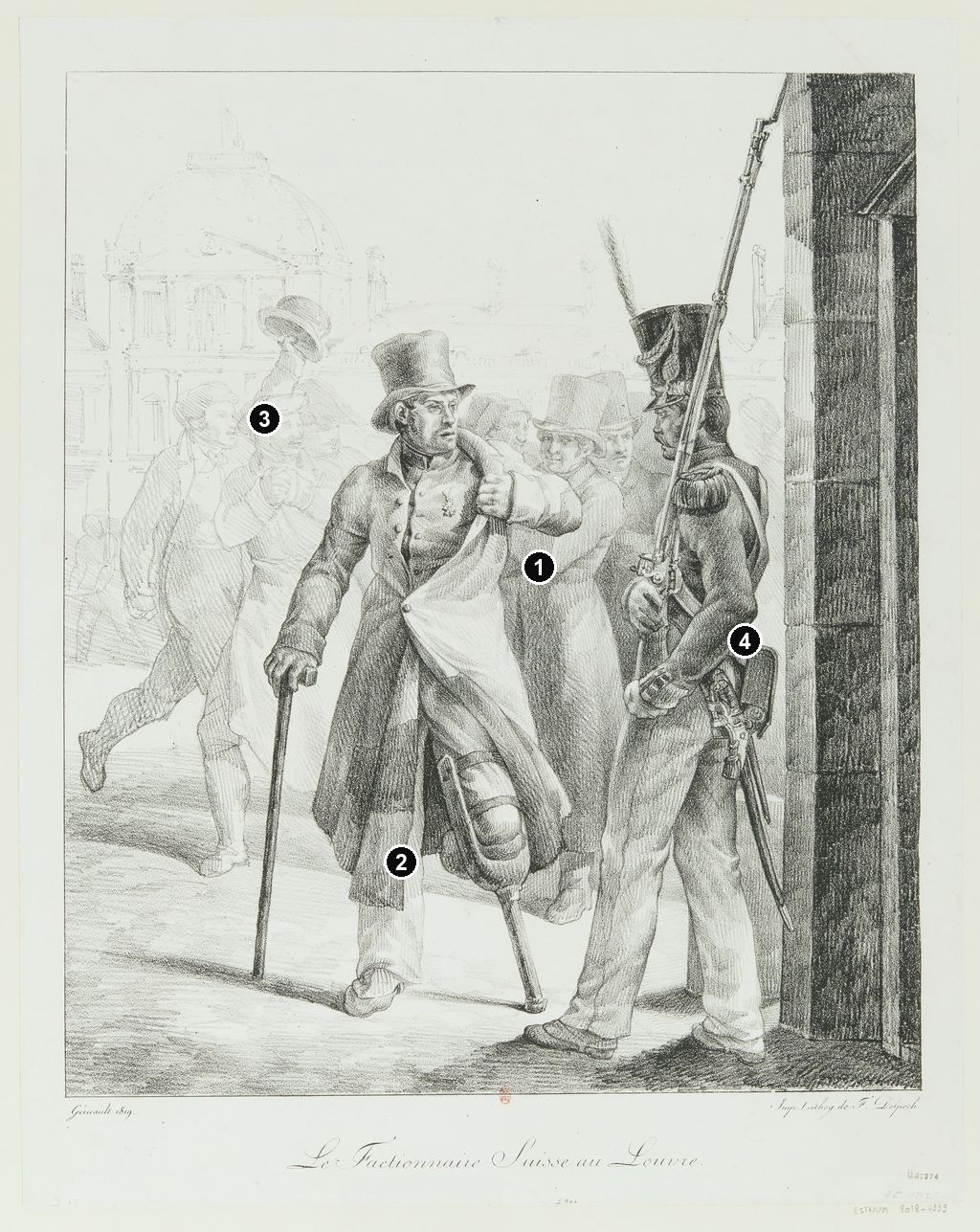
A veteran pulls open his coat in front of an armed sentry. Beneath the lapel is the small cross of the Legion of Honour; below the coat is a wooden prosthetic leg. His body and his decoration offer two forms of evidence for military service. The guard has a uniform, a weapon and a doorway under his control. Géricault’s The Swiss Guard at the Louvre makes their encounter a contest over who deserves recognition, and who has the power to withhold it.
The lithograph dates from 1819. At the Musée Condé in Chantilly, an impression catalogued as the second state bears Géricault’s name and date and the printing inscription of F. Delpech. The museum connects its subject to a newspaper account of a former soldier refused passage into the Louvre by a Swiss sentry. That account supplies the story, but the print gives it a public audience: people gather behind the veteran, turning an obstruction at a door into a spectacle of disputed honour. [1]
At a Glance
- Date1819 [1]
- MediumLithograph on paper [1]
- Collection ExampleMusée Condé, Chantilly, inventory 2015-0-8 [1]
- StateSecond state in Chantilly’s record [1]
This work across Théodore Géricault’s career
The Severed Heads
1810s [2]Charging Chasseur
1812 [3]Horse Frightened by Lightning
c.1813–14 [4]The Raft of the Medusa
1818–19 [6]Portrait of a Kleptomaniac
c.1820–24 [8]The Epsom Derby
1821 [9]Contents
- Two kinds of military authority
- The crowd as an audience
- A newspaper story, with an uncertain date
- The doorway and the distant buildings
- Drawing, printing and the second state
- From wounded soldiers to ordinary people
- Annotated details
Two kinds of military authority
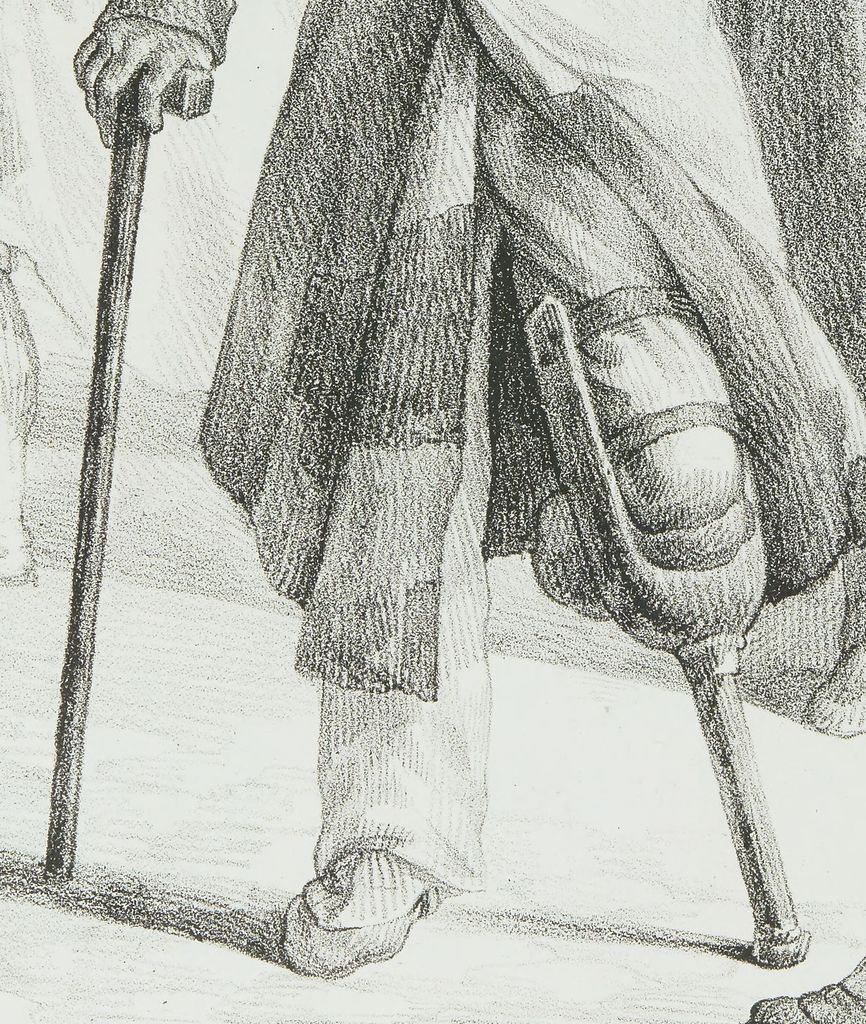
The veteran occupies the centre of the image, but he does not stand with the effortless stability of a conventional military hero. One hand rests on a walking stick. His surviving foot, his wooden leg and the stick make separate points of contact with the ground. The folds of the opened coat frame the padded attachment above the prosthesis. Géricault makes the practical work of standing plainly visible, without allowing it to overwhelm the man’s forceful address.
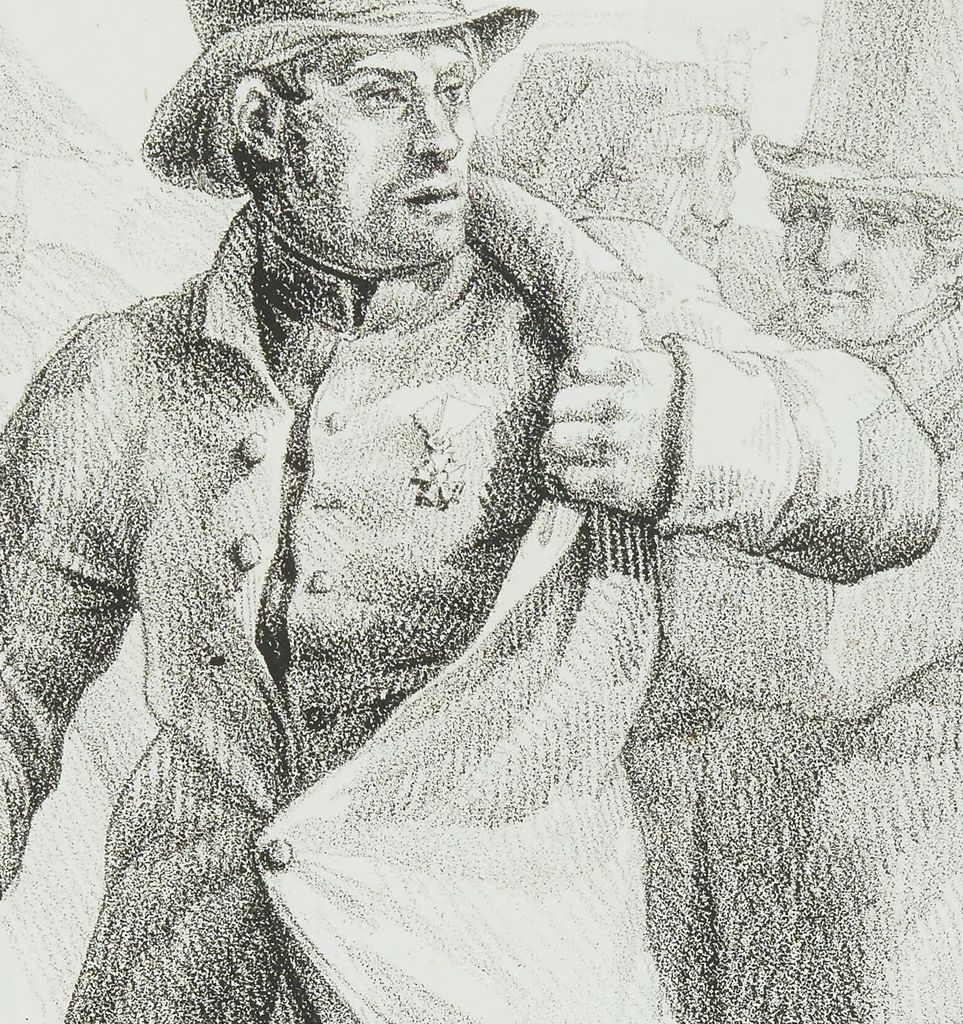
His other hand draws the coat aside. This gesture reveals the decoration and directs the guard’s attention towards it. His mouth is open and his face turned sharply to the right. The raised elbow takes possession of the space between the two men: although he needs support, he is the figure who initiates the exchange. The disability shown here belongs to an active, indignant person rather than a passive emblem of suffering.
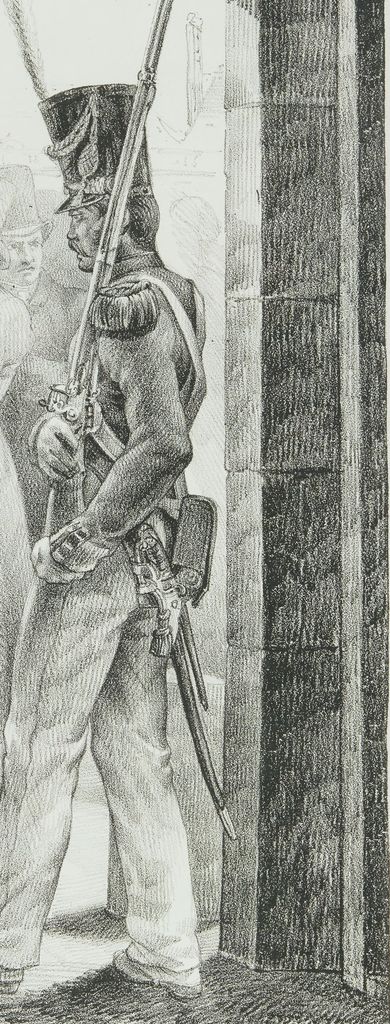
The guard has an altogether different silhouette. His tall military headgear and upright musket extend the vertical lines of the stone doorway. Epaulette, straps, sword and firearm make his official equipment conspicuous. His feet are planted apart, while his body forms a barrier close to the entrance. The two men face each other at short range, so that the viewer can compare their equipment almost item by item: walking stick and gun, exposed decoration and regulated uniform, altered leg and firmly braced stance.
The veteran’s medal is tiny beside the sentry’s weapon. Nevertheless, it supplies the pivot of the narrative. In Charles Clément’s nineteenth-century catalogue, the former soldier shows his cross and orders the sentry to present arms. That reported command reverses their immediate positions: the man being stopped claims the right to receive a military salute. Clément also describes the crowd applauding. These details belong to his account of the subject, rather than a transcript that can be recovered simply by looking at the printed faces. [10]
The crowd as an audience
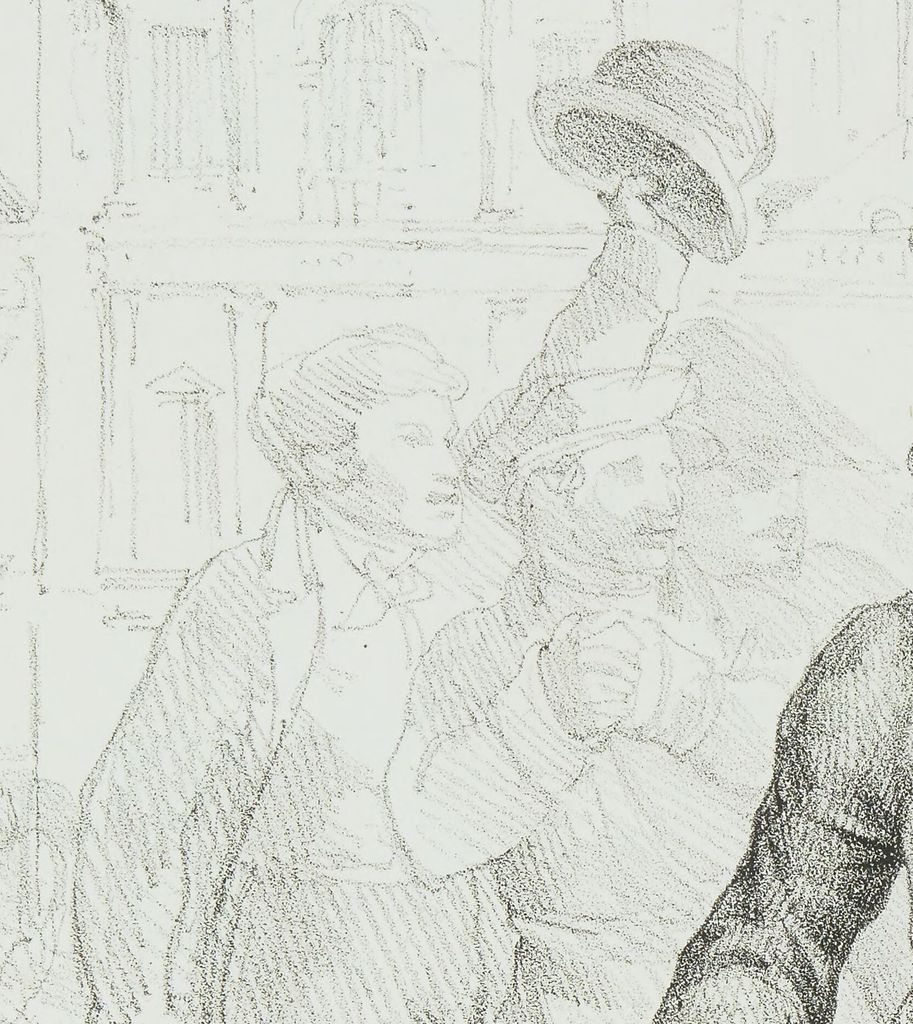
Géricault does not give every spectator the same response. At the left, an arm raises a hat above the cluster of heads. Nearby figures lean or turn towards the encounter. Behind the veteran’s outstretched arm, men in tall hats appear more restrained. Their overlapping faces make a narrow band across the middle of the composition, surrounding the principal action without obscuring it.
The raised hat gives the clearest visible sign of an affirmative response. The quieter expressions elsewhere are less readily fixed. It would be too definite to assign a political allegiance to every hat or a precise social identity to every face. What matters visually is that this is a witnessed confrontation, and that the onlookers do more than fill an empty background. They create the possibility of recognition outside the guard’s control.
The viewer joins that audience from a particularly revealing position. Both the medal and the prosthesis are legible, while the guard is seen largely in profile. We can inspect the veteran’s claim even if the sentry has not yet responded to it. The arrangement makes us weigh the evidence rather than merely observe two strangers arguing. A scene about admission becomes a scene about judgement.
The figure at the far left also helps the image escape the stillness of a formal confrontation. His extended leg and turning body suggest movement through the surrounding space. Against him, the sentry and the dark doorway remain comparatively fixed. The meeting seems to have interrupted the ordinary passage of people, allowing a brief incident to gather a crowd.
Annotated Details from The Swiss Guard at the Louvre
The numbered points identify visible features discussed in this article. Return from each detail to the whole composition. The Swiss Guard at the Louvre Image source. Public domain.
Details from THE SWISS GUARD AT THE LOUVRE
Compare the cropped details with the complete images above. Notice how their colours, shapes and positions contribute to the larger compositions.
The revealed cross
The veteran pulls his coat aside to expose the Legion of Honour, making a small decoration the focus of a forceful gesture.
The work of standing
Walking stick, surviving foot and wooden prosthesis give the veteran three distinct points of support.
A public response
A hat rises above the spectators, while the other faces register a less uniform response.
Guard and threshold
The upright musket and the sentry’s body reinforce the dark vertical mass of the entrance.
A newspaper story, with an uncertain date
Chantilly identifies the source as Le Constitutionnel, which it describes as a Bonapartist newspaper. In the museum’s account, a former soldier of the Grande Armée resents being denied access by a foreign mercenary and opens his worn coat to show his Legion of Honour. The museum reads the episode as evidence of the treatment of former soldiers under the Restoration. This is the holding institution’s historical interpretation of the anecdote; the print itself cannot establish how typical the incident was. [1]
The chronology needs care. Chantilly gives the newspaper report as 6 June 1819, whereas Clément refers to Le Constitutionnel in 1817. Clément nonetheless records the date 1819 on the lithograph. The secure distinction is between the dated print and the less securely established chronology of its reported source. Without an independently verified newspaper issue, an exact day should not be treated as settled. [1] [10]
That uncertainty does not erase the image’s political tension. The anecdote opposes service rendered to France and authority exercised at a public entrance. It also mobilises nationality against the Swiss guard. That opposition belongs to the story’s rhetoric; it need not become the viewer’s own assumption that the guard’s foreignness makes him morally inferior. Géricault gives the veteran the stronger dramatic initiative, but the sentry’s face is not a grotesque caricature.
Nor does sympathy for the former imperial soldier establish a complete political programme for the artist. The work can expose an affront to military honour without functioning as documentary proof of party membership. Its argument becomes more precise when kept close to the action: a decorated man asks an institution’s representative to acknowledge what his uniform no longer displays.
Watch: Géricault and The Raft of the Medusa
Three perspectives on Géricault’s best-known painting, its making and its historical setting.
Gericault, Raft of the Medusa
Smarthistory examines the composition and historical setting of The Raft of the Medusa.
Watch on YouTubeThe doorway and the distant buildings
The architecture makes that question of recognition tangible. The right edge is a heavy, dark mass of masonry. Above the guard is part of a wall fixture, while the door recess descends beside his body. The veteran has reached a threshold whose solidity contrasts with the comparatively open space behind him. Even before the anecdote is explained, the division between movement and obstruction is clear.
Beyond the crowd, buildings are drawn with much lighter marks. The large domed structure on the left is visible but subdued; it does not compete with the black of the sentry’s headgear or the folds around the veteran’s chest. This difference in tone establishes distance and also keeps attention on the encounter. The city provides a recognisable public setting without turning the print into an architectural view.
Clément credited the background, which he identified with the Tuileries, to Horace Vernet. This is a historical attribution and should be retained as such, rather than expanded into an undocumented account of the two artists working together. It is nevertheless a useful reminder that the scene’s setting has its own making history. The name of Géricault on the sheet does not by itself answer every question about participation in its production. [10]
The pale distance and dark threshold contribute differently to the narrative. One places the confrontation in the city; the other turns official authority into something that occupies space. The veteran has to negotiate both a person and a physical barrier. His claim to honour is presented where it can have an immediate practical consequence: whether he will be allowed to pass.
Drawing, printing and the second state
Clément distinguished an initial state without the title from a second state with it. He also described a related graphite sketch and a revised position for the guard’s weapon on its reverse. His entry shows attention to the construction of the scene, particularly the sentry’s military bearing. It does not justify assuming that every surviving impression has an identical history or that a change of state necessarily transformed the whole composition. [10]
A state is a stage in the development of the printable design; an impression is an individual sheet pulled from it. Chantilly’s second-state impression, inventory 2015-0-8, is therefore one physical example of a composition known in more than one stage. The title and the Delpech inscription help identify the published object.
The medium matters to the way the story reaches its audience. Chantilly’s exhibition on Géricault’s lithographs explains that lithography uses a greasy drawing on prepared limestone; water and printing ink then allow that drawing to be transferred to paper. It offered a relatively rapid and economical means of multiplying images. Here the varying density of drawn marks accommodates both the worn surfaces of clothing and the lightly indicated city beyond. [11]
A newspaper anecdote could thus become a separately circulated visual narrative, one whose gestures could be read without a long explanatory caption. The coat-opening action, exposed cross and gathered spectators carry the central exchange. This possibility of circulation does not tell us how many people actually bought or saw the print. No print run or contemporary audience total is established by the records discussed here.
The print also acquired a life as a collected work of art. Chantilly’s exhibition explains that the duc d’Aumale acquired a nearly complete group of Géricault’s lithographs in 1866. That later collecting context helps explain why these comparatively small works can now be studied together, across military scenes and English subjects. It is evidence of their later preservation and esteem, rather than a measure of the public response to this particular image in 1819. [11]
From wounded soldiers to ordinary people
Chantilly’s wider account places Géricault’s military lithographs alongside his later English images of poverty, illness and work. Its discussion of Return from Russia emphasises the miseries of war, while its English examples give attention to people who would not normally occupy the centre of a grand historical composition. The Louvre veteran connects these concerns: military service has become an ordinary civilian struggle over access and respect. [11]
There is no battle in this image. The visible consequences of service have entered a city doorway and brought the past into contact with a present official. The veteran’s distinction depends neither on command of troops nor on a spectacular act performed before us. It rests on a claim that his community should already know how to recognise.
The small decoration and the large prosthesis hold that claim together. One is an official sign of honour; the other shows the material alteration of a body. Géricault makes both visible through a single gesture. Around them, the public watches. The print’s lasting force lies in the way it asks recognition to become an action, at the very point where an injured veteran is being told to stop.
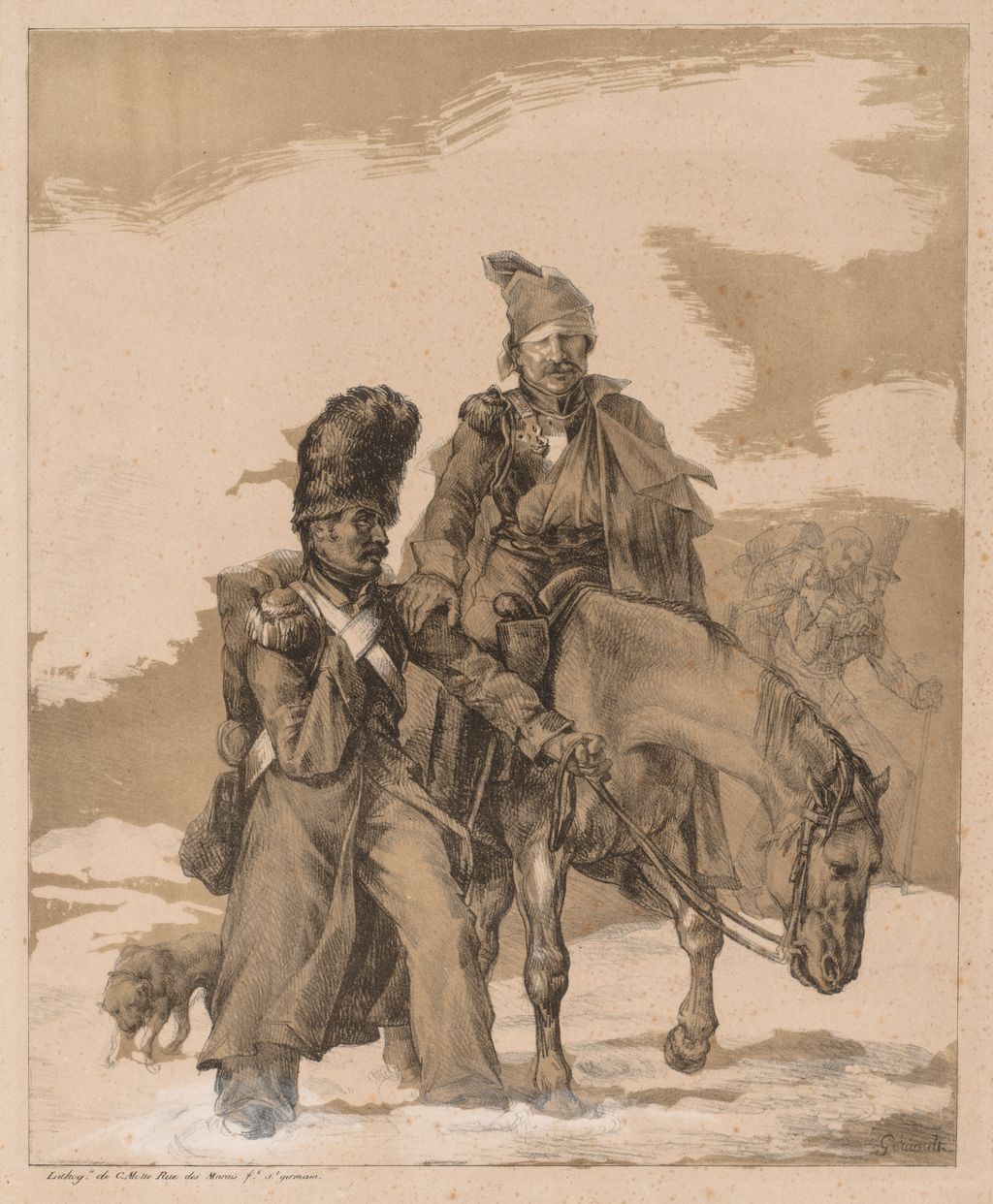
Return from Russia, c.1818 — Cleveland impression 1931.48, with hand-added colour Image source. CC0 / Public domain.
Géricault collection records
Seventy collection records include paintings, drawings and individual print impressions. Different impressions remain separate records; this selection is not a complete catalogue raisonné.
Frequently Asked Questions
Clément’s 1866 catalogue credits Horace Vernet with drawing the background. That historical attribution should remain distinct from a fully documented account of how the artists divided the work. [10]
Discussion
Look again at the images and ideas explored in The Swiss Guard at the Louvre. These editorial prompts invite your observations.
Reader Insights
Which makes the stronger claim on your attention: the small cross of honour or the visibly altered leg?
How do the raised hat and the quieter faces affect your sense of the crowd’s response?
How would the confrontation change if the heavy doorway were replaced by an open street?
Join the Conversation
Share a detail, comparison or question about The Swiss Guard at the Louvre below.
References
- Musée Condé, Château de Chantilly, Le Factionnaire Suisse au Louvre, collection record, inventory 2015-0-8; creation, description, state and inscriptions, French. View source. (in French).
- Nationalmuseum, The Severed Heads, NM 2113; collection metadata and museum interpretation (Swedish). View source.
- Louvre, Charging Chasseur, INV 4885; collection metadata and museum interpretation (French/English interface). View source.
- National Gallery, Horse frightened by Lightning; collection metadata and museum interpretation (English). View source.
- Louvre, Wounded Cuirassier, INV 4886; collection metadata and museum interpretation (French). View source.
- Louvre, The Raft of the Medusa, INV 4884; collection metadata and museum interpretation (French). View source.
- Gary Tinterow / The Metropolitan Museum of Art, Géricault’s Heroic Landscapes: The Times of Day, Met Bulletin 48/3, Winter 1990–91; consulted main essay and relevant object entries (English). View source.
- Vlaamse Kunstcollectie, Portrait of a Kleptomaniac; collection metadata and museum interpretation (Dutch). View source.
- Louvre, Epsom, MI 708; collection metadata and museum interpretation (French/English interface). View source.
- Charles Clément, Catalogue de l’œuvre de Géricault: Lithographies, Paris, extrait de la Gazette des Beaux-Arts, 1866, p. 10, no. 14, “Le Factionnaire suisse au Louvre” (PDF p. 18), French. View source. (in French).
- Château de Chantilly, Géricault et la lithographie: Le romantisme à la française, virtual exhibition derived from the 2018 exhibition; curatorship Nicole Garnier-Pelle, virtual exhibition Clara Voiry; sections on technique, Napoleonic subjects and England, French. View source. (in French).


